 Скачать презентацию Business Ethics BUSI 1314 Lecture 2 Wim Vandekerckhove
Business Ethics 2010 Lecture 02.ppt
- Количество слайдов: 16



Business Ethics BUSI 1314 Lecture 2 Wim Vandekerckhove vw 01@gre. ac. uk
Lecture 2 1. 2. 3. 4. 5. 6. What is an organisation? What is a business organisation? Purpose vs Goal Stakeholders Creating value Coursework 1, task 1 • Further reading: – Handy 2002 – Vandekerckhove 2009 Wim Vandekerckhove - Business Ethics BUSI 1314 - University of Greenwich 2010 -2011
1. What is an organisation? • What would you mean when you say to a group: ‘get organised!’ Wim Vandekerckhove - Business Ethics BUSI 1314 - University of Greenwich 2010 -2011
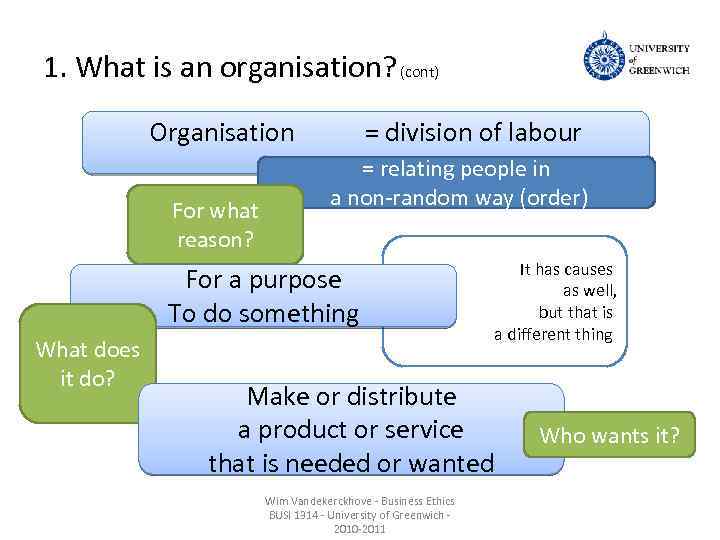
1. What is an organisation? (cont) Organisation For what reason? = division of labour = relating people in a non-random way (order) For a purpose To do something What does it do? Make or distribute a product or service that is needed or wanted Wim Vandekerckhove - Business Ethics BUSI 1314 - University of Greenwich 2010 -2011 It has causes as well, but that is a different thing Who wants it?
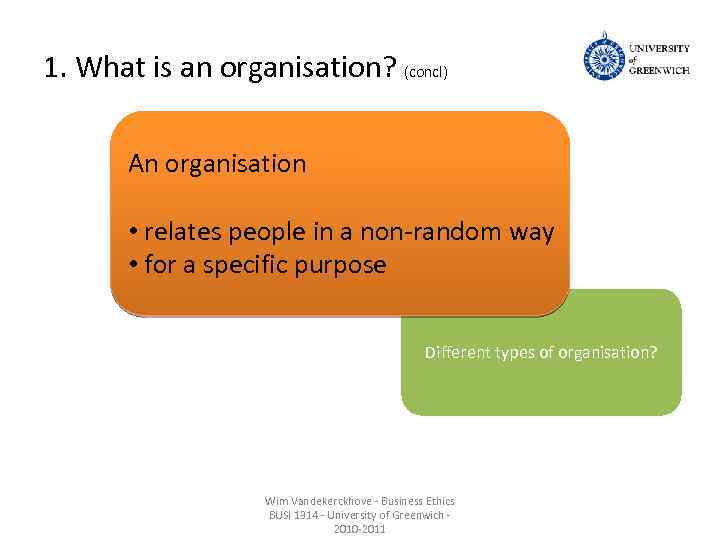
1. What is an organisation? (concl) An organisation • relates people in a non-random way • for a specific purpose Different types of organisation? Wim Vandekerckhove - Business Ethics BUSI 1314 - University of Greenwich 2010 -2011
2. What is a business organisation? • How is a business organisation different from other organisations? Wim Vandekerckhove - Business Ethics BUSI 1314 - University of Greenwich 2010 -2011
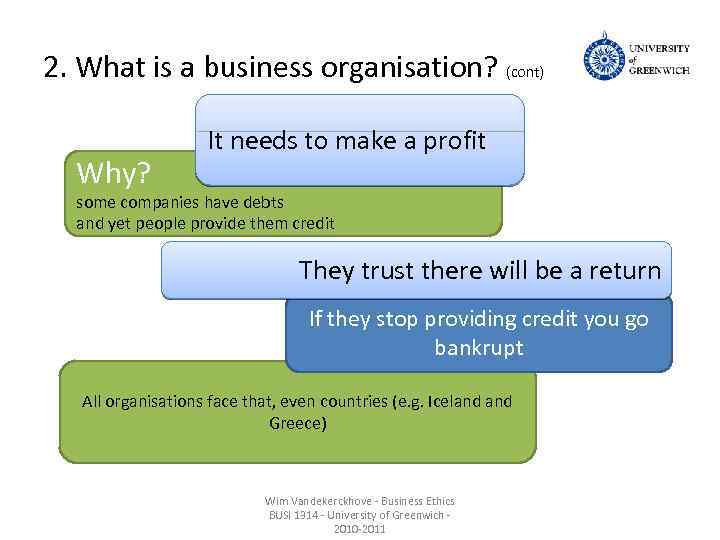
2. What is a business organisation? (cont) Why? It needs to make a profit some companies have debts and yet people provide them credit They trust there will be a return If they stop providing credit you go bankrupt All organisations face that, even countries (e. g. Iceland Greece) Wim Vandekerckhove - Business Ethics BUSI 1314 - University of Greenwich 2010 -2011
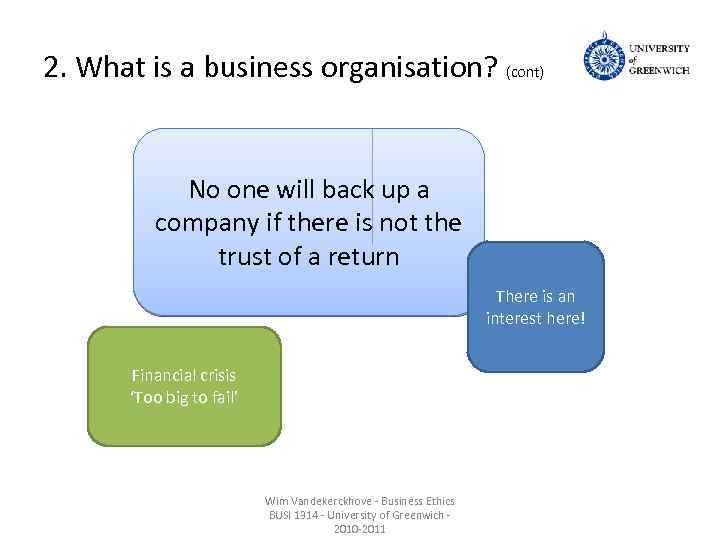
2. What is a business organisation? (cont) No one will back up a company if there is not the trust of a return There is an interest here! Financial crisis ‘Too big to fail’ Wim Vandekerckhove - Business Ethics BUSI 1314 - University of Greenwich 2010 -2011
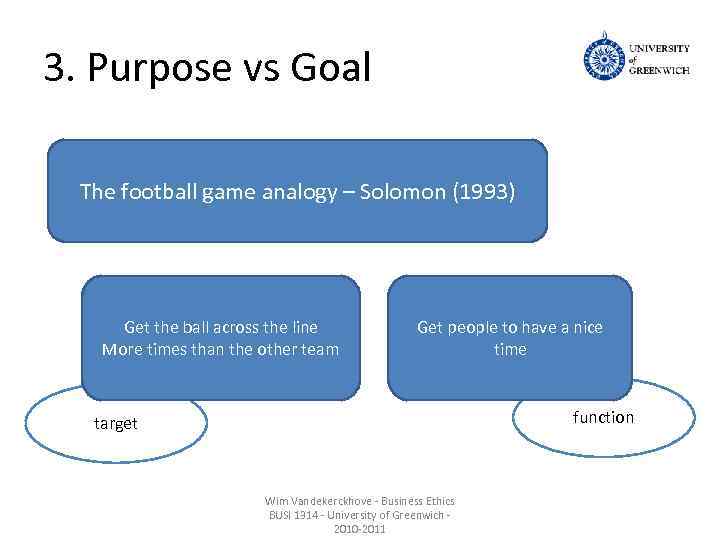
3. Purpose vs Goal The football game analogy – Solomon (1993) Get the ball across the line More times than the other team Get people to have a nice time function target Wim Vandekerckhove - Business Ethics BUSI 1314 - University of Greenwich 2010 -2011
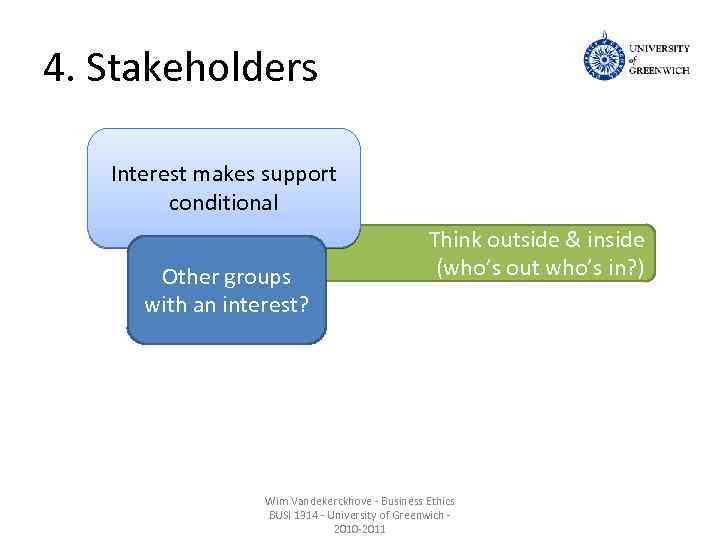
4. Stakeholders Interest makes support conditional Other groups with an interest? Think outside & inside (who’s out who’s in? ) Wim Vandekerckhove - Business Ethics BUSI 1314 - University of Greenwich 2010 -2011
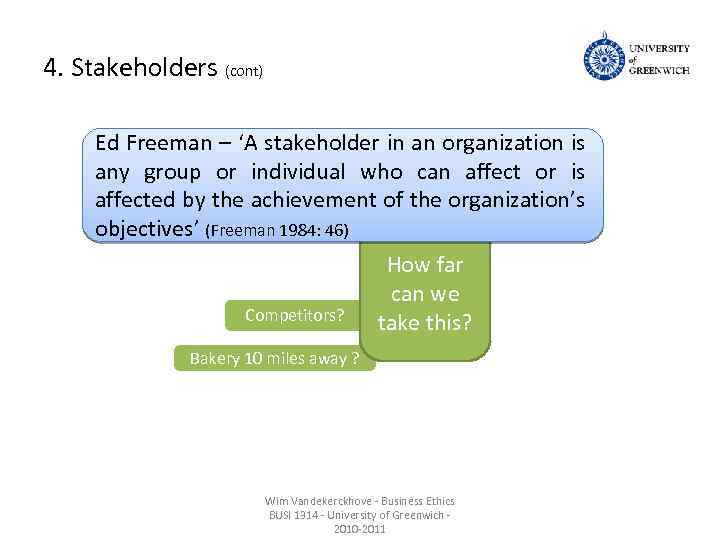
4. Stakeholders (cont) Ed Freeman – ‘A stakeholder in an organization is any group or individual who can affect or is affected by the achievement of the organization’s objectives’ (Freeman 1984: 46) How far can we Competitors? take this? Bakery 10 miles away ? Wim Vandekerckhove - Business Ethics BUSI 1314 - University of Greenwich 2010 -2011
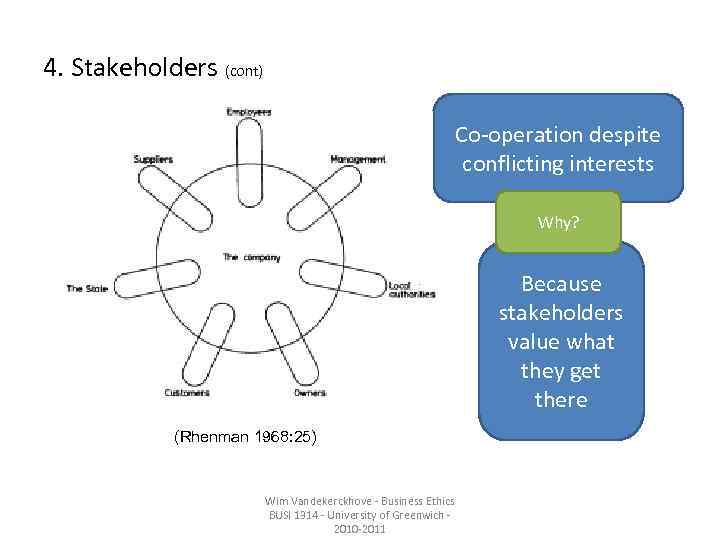
4. Stakeholders (cont) Co-operation despite conflicting interests Why? Because stakeholders value what they get there (Rhenman 1968: 25) Wim Vandekerckhove - Business Ethics BUSI 1314 - University of Greenwich 2010 -2011
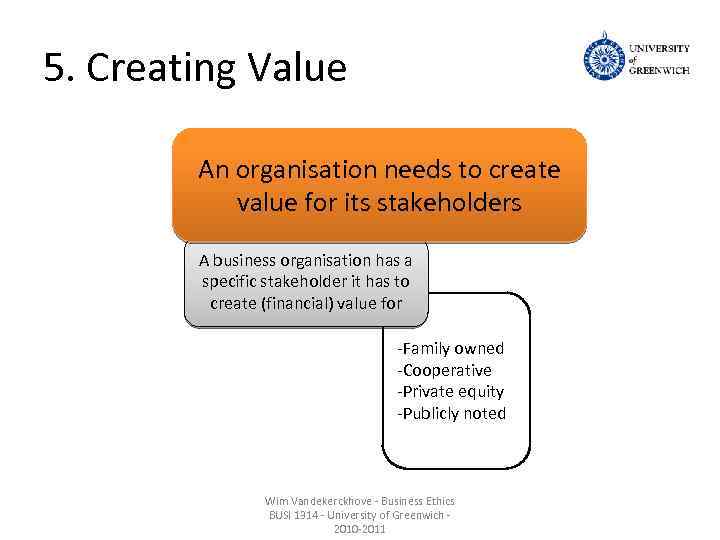
5. Creating Value An organisation needs to create value for its stakeholders A business organisation has a specific stakeholder it has to create (financial) value for -Family owned -Cooperative -Private equity -Publicly noted Wim Vandekerckhove - Business Ethics BUSI 1314 - University of Greenwich 2010 -2011
What is an organisation? • Organisations are co-operations of people, that make or distribute goods or services through a division of labour, to fulfil a purpose. • It can only do that when it creates value for its stakeholders. Wim Vandekerckhove - Business Ethics BUSI 1314 - University of Greenwich 2010 -2011
References • • • Freeman, R. E. (1984), Strategic management. A stakeholder approach. Boston, Pitman. Handy, C. (2002), ‘What’s a business for? ’ Harvard Business Review (december), 49 -55. Rhenman, E. (1968), Industrial democracy and industrial management. A critical essay on the meanings and implementations of industrial democracy. Assen/London, Van Gorcum/Tavistock. Solomon, R. C. (1993), Business and Excellence. Cooperation and integrity in business. New York/Oxford, Oxford University Press. Vandekerckhove, W. (2009), ‘What managers do: comparing Rhenman and Freeman’, Philosophy of Management 8(3), 25 -36. Wim Vandekerckhove - Business Ethics BUSI 1314 - University of Greenwich 2010 -2011
6. Coursework 1, Task 1 Requirements: 1. Do a stakeholder analysis of the organisation you work for. (if not applicable then ‘have worked for’; a relative works for. Either as a paid employee, family business, as a volunteer) Guiding questions: a) who are stakeholders (be specific), b) what are their stakes? Present as a list. 2. Which (potentially) conflicting stakes can you see? 3. What was the ‘added value’ for you (or your relative) as a stakeholder? 4. What is the purpose of the organisation? 500 words, submit as part of coursework 1 (deadline 5 Nov 3 pm) Wim Vandekerckhove - Business Ethics BUSI 1314 - University of Greenwich 2010 -2011
Скачать презентацию Business Ethics BUSI 1314 Lecture 2 Wim Vandekerckhove
Business Ethics 2010 Lecture 02.ppt