 Скачать презентацию Business Ethics BUSI 1314 Lecture 11 Knowledge
Business Ethics 2010 Lecture 11.pptx
- Количество слайдов: 10



Business Ethics BUSI 1314 Lecture 11 – Knowledge This lecture: -Introduces you to philosophy of knowledge - offers an opportunity to reflect on the use of knowledge in management Wim Vandekerckhove vw 01@gre. ac. uk
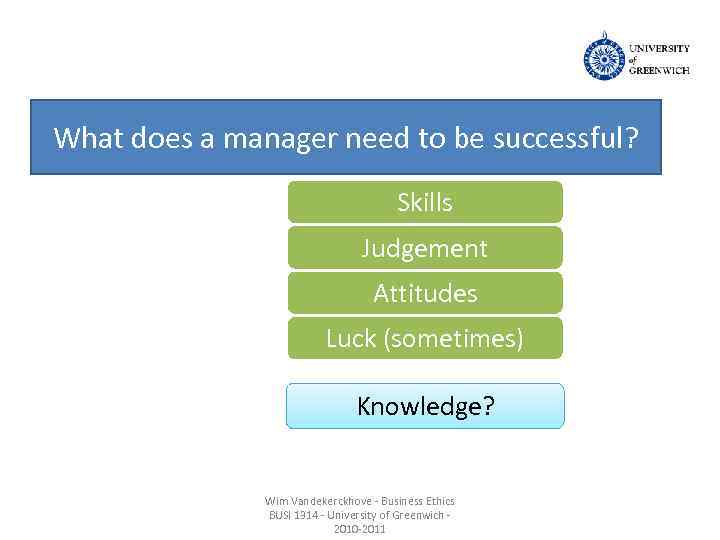
What does a manager need to be successful? Skills Judgement Attitudes Luck (sometimes) Knowledge? Wim Vandekerckhove - Business Ethics BUSI 1314 - University of Greenwich 2010 -2011
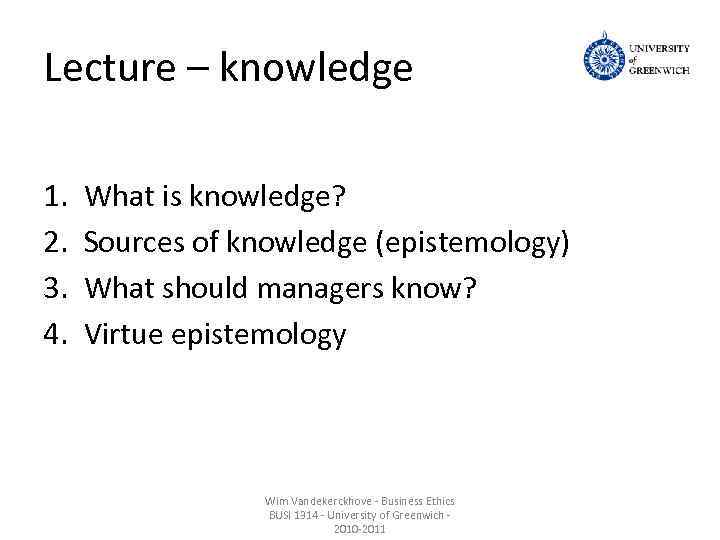
Lecture – knowledge 1. 2. 3. 4. What is knowledge? Sources of knowledge (epistemology) What should managers know? Virtue epistemology Wim Vandekerckhove - Business Ethics BUSI 1314 - University of Greenwich 2010 -2011
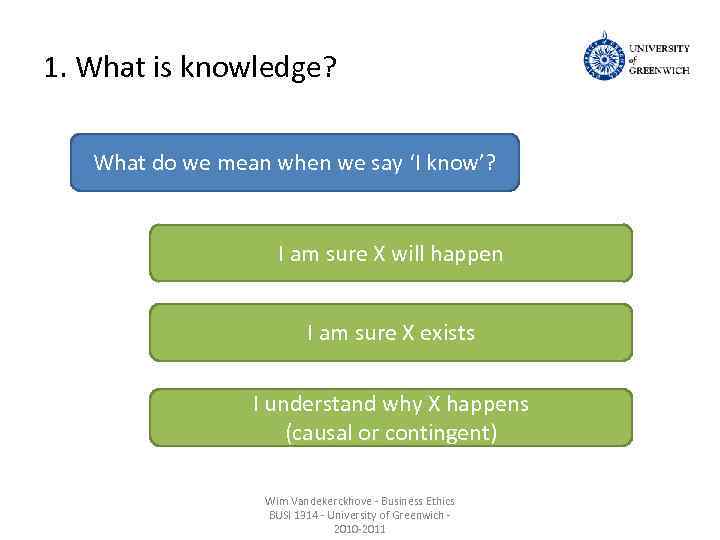
1. What is knowledge? What do we mean when we say ‘I know’? I am sure X will happen I am sure X exists I understand why X happens (causal or contingent) Wim Vandekerckhove - Business Ethics BUSI 1314 - University of Greenwich 2010 -2011
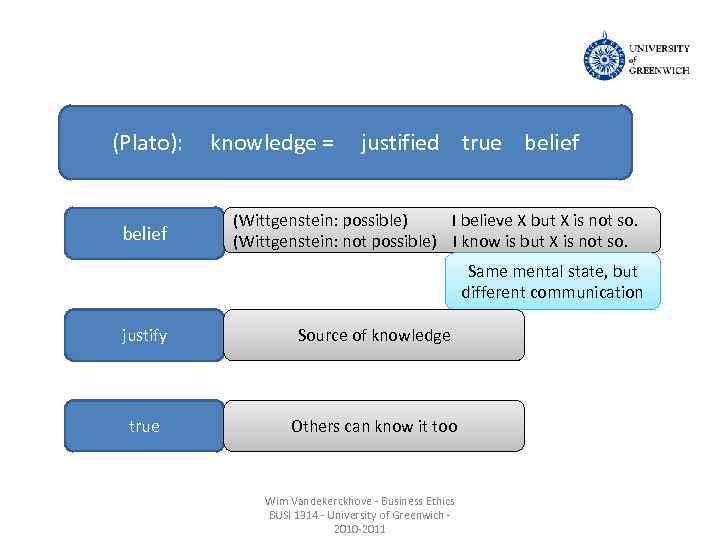
(Plato): belief knowledge = justified true belief (Wittgenstein: possible) I believe X but X is not so. (Wittgenstein: not possible) I know is but X is not so. Same mental state, but different communication justify Source of knowledge true Others can know it too Wim Vandekerckhove - Business Ethics BUSI 1314 - University of Greenwich 2010 -2011
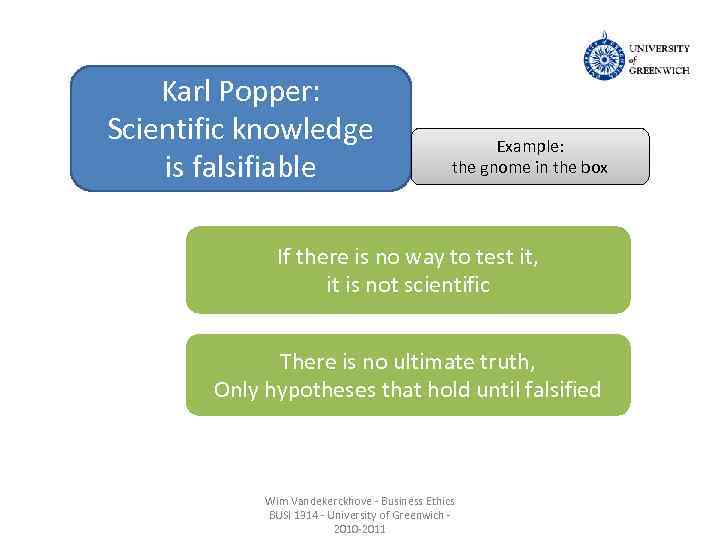
Karl Popper: Scientific knowledge is falsifiable Example: the gnome in the box If there is no way to test it, it is not scientific There is no ultimate truth, Only hypotheses that hold until falsified Wim Vandekerckhove - Business Ethics BUSI 1314 - University of Greenwich 2010 -2011
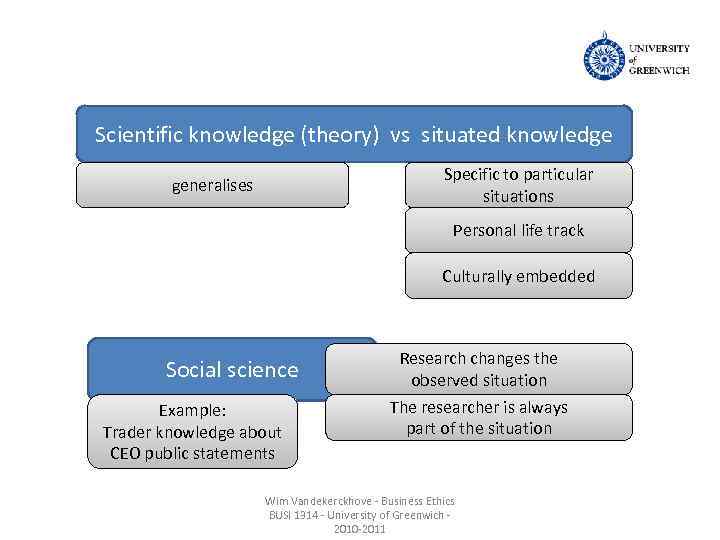
Scientific knowledge (theory) vs situated knowledge Specific to particular situations generalises Personal life track Culturally embedded Social science Example: Trader knowledge about CEO public statements Research changes the observed situation The researcher is always part of the situation Wim Vandekerckhove - Business Ethics BUSI 1314 - University of Greenwich 2010 -2011
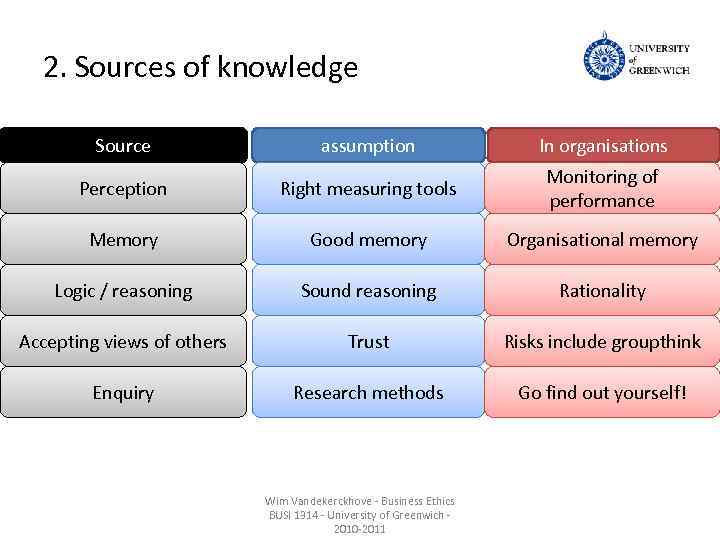
2. Sources of knowledge Source assumption In organisations Perception Right measuring tools Monitoring of performance Memory Good memory Organisational memory Logic / reasoning Sound reasoning Rationality Accepting views of others Trust Risks include groupthink Enquiry Research methods Go find out yourself! Wim Vandekerckhove - Business Ethics BUSI 1314 - University of Greenwich 2010 -2011
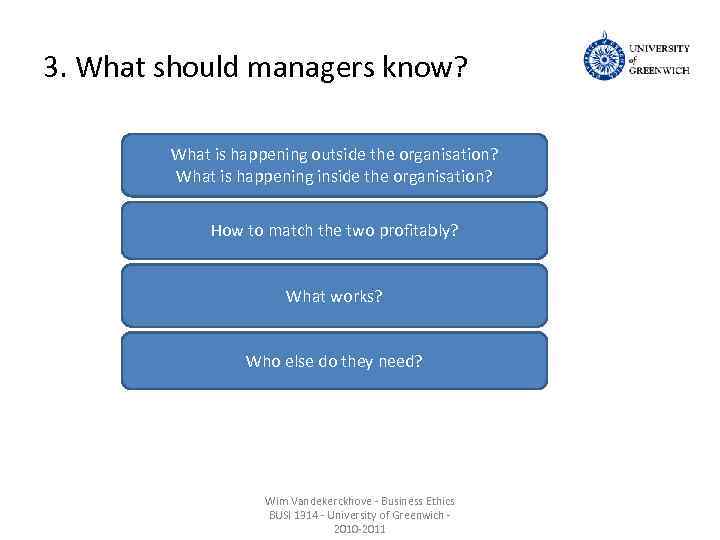
3. What should managers know? What is happening outside the organisation? What is happening inside the organisation? How to match the two profitably? What works? Who else do they need? Wim Vandekerckhove - Business Ethics BUSI 1314 - University of Greenwich 2010 -2011
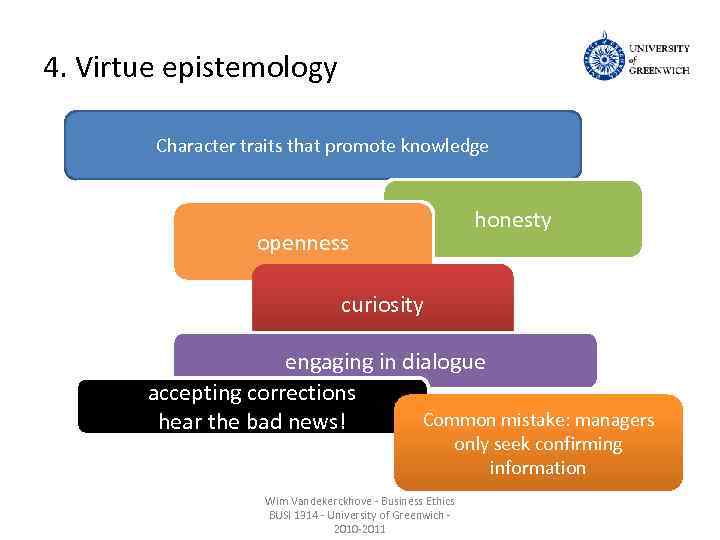
4. Virtue epistemology Character traits that promote knowledge openness honesty curiosity engaging in dialogue accepting corrections Common mistake: managers hear the bad news! only seek confirming information Wim Vandekerckhove - Business Ethics BUSI 1314 - University of Greenwich 2010 -2011
Скачать презентацию Business Ethics BUSI 1314 Lecture 11 Knowledge
Business Ethics 2010 Lecture 11.pptx