 Скачать презентацию Business English Lesson 3 www ipskiev com by
Business English3.ppt
- Количество слайдов: 35



Business English Lesson 3 www. ipskiev. com by Karina Kostogorova Sinaevskaya
Today’s syllabus Программа занятия • • Особенности Past Perfect Инверсия в Past Perfect Употребление Conditional Sentences Presentation (Beginning a Presentation) www. ipskiev. com by Karina Kostogorova Sinaevskaya
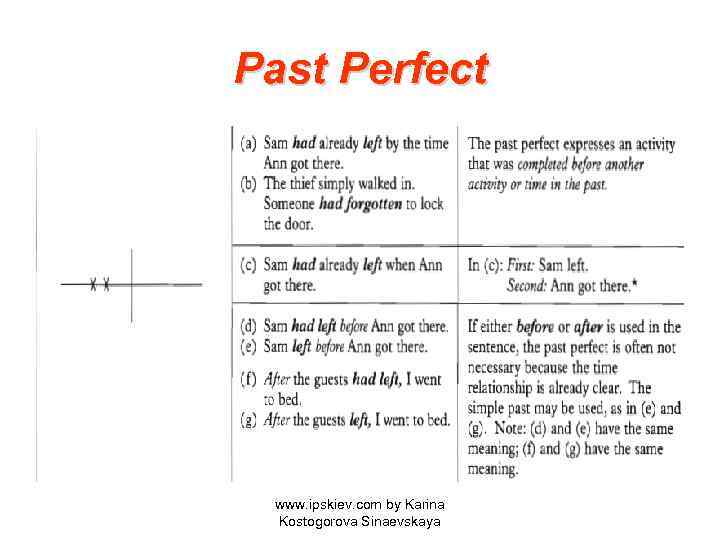
Past Perfect www. ipskiev. com by Karina Kostogorova Sinaevskaya
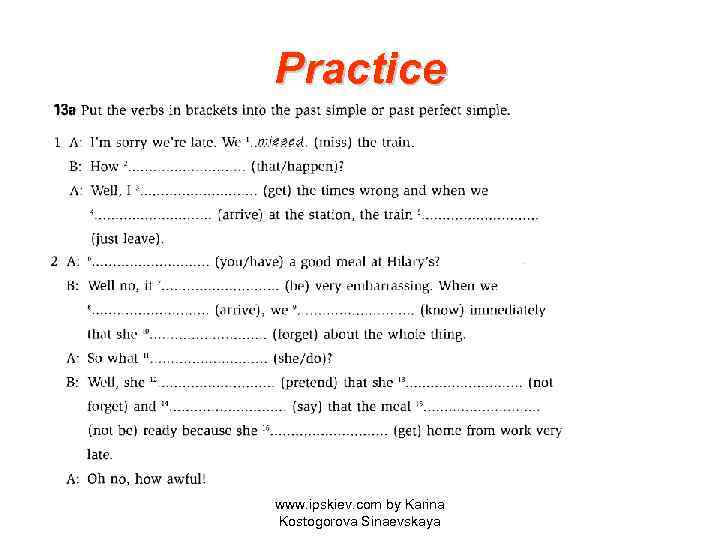
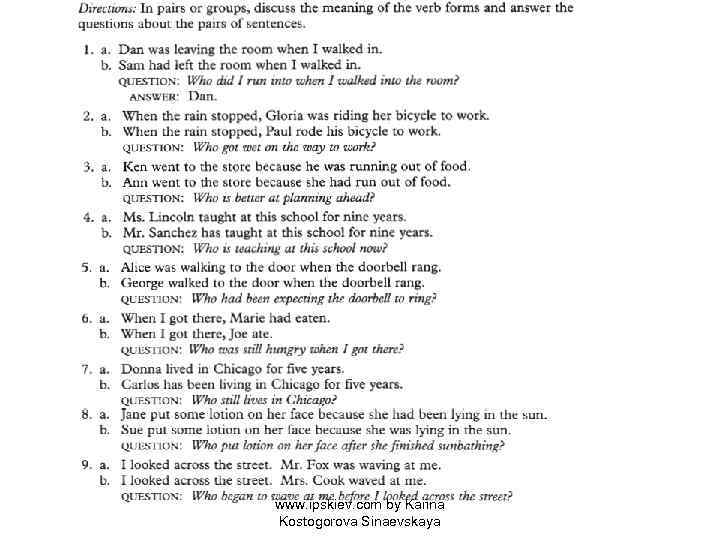
Practice www. ipskiev. com by Karina Kostogorova Sinaevskaya
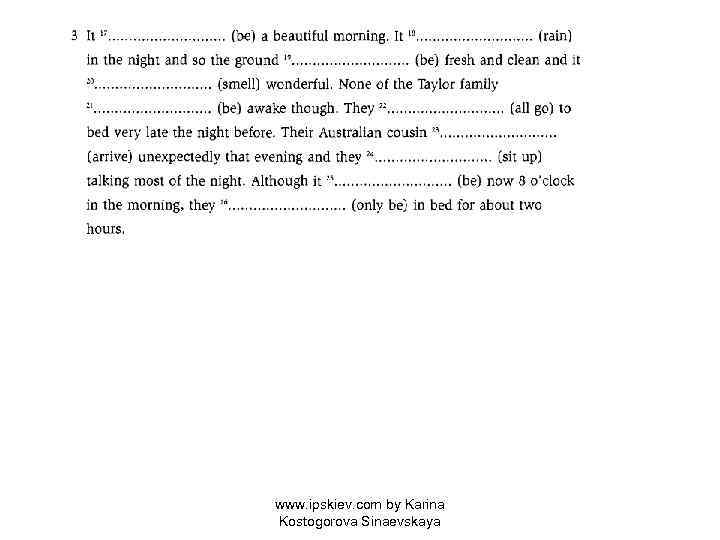
www. ipskiev. com by Karina Kostogorova Sinaevskaya
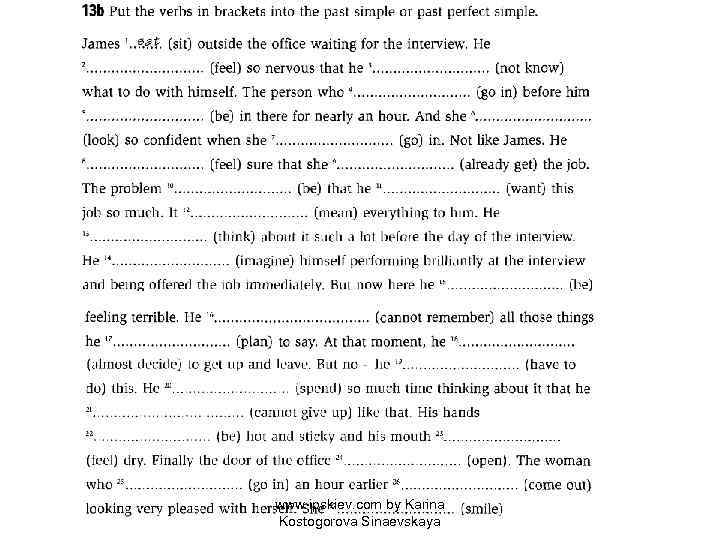
www. ipskiev. com by Karina Kostogorova Sinaevskaya
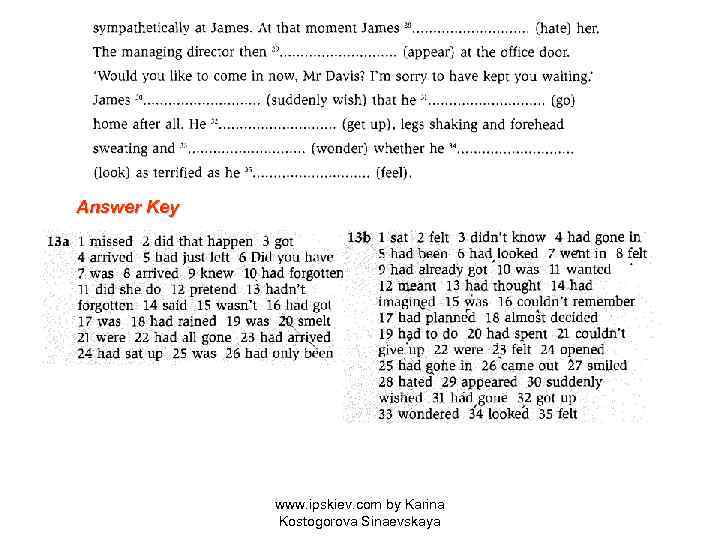
Answer Key www. ipskiev. com by Karina Kostogorova Sinaevskaya
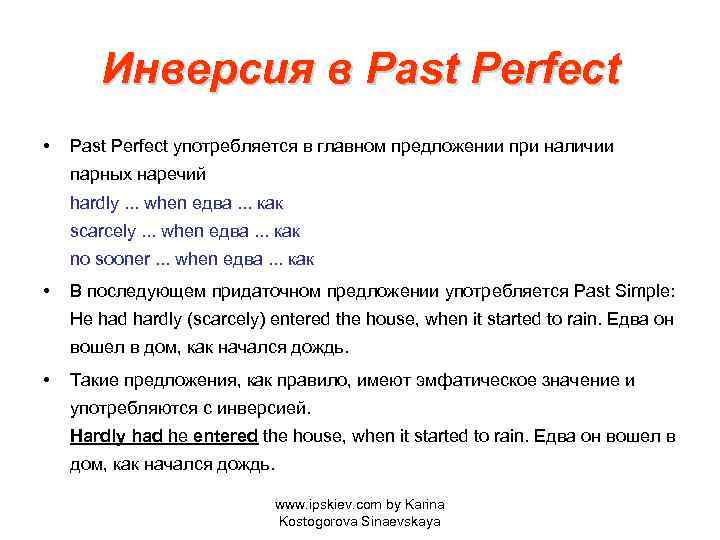
Инверсия в Past Perfect • Past Perfect употребляется в главном предложении при наличии парных наречий hardly. . . when едва. . . как scarcely. . . when едва. . . как no sooner. . . when едва. . . как • В последующем придаточном предложении употребляется Past Simple: Не had hardly (scarcely) entered the house, when it started to rain. Едва он вошел в дом, как начался дождь. • Такие предложения, как правило, имеют эмфатическое значение и употребляются с инверсией. Нardly had hе entered the house, when it started to rain. Едва он вошел в дом, как начался дождь. www. ipskiev. com by Karina Kostogorova Sinaevskaya
www. ipskiev. com by Karina Kostogorova Sinaevskaya
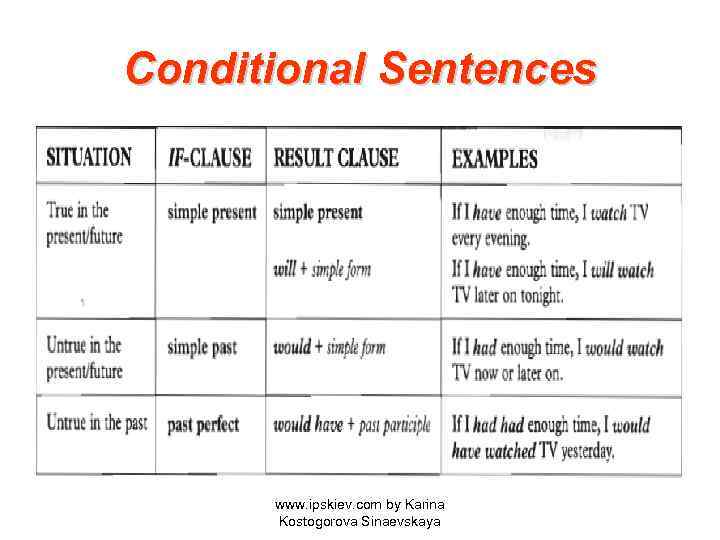
Conditional Sentences www. ipskiev. com by Karina Kostogorova Sinaevskaya
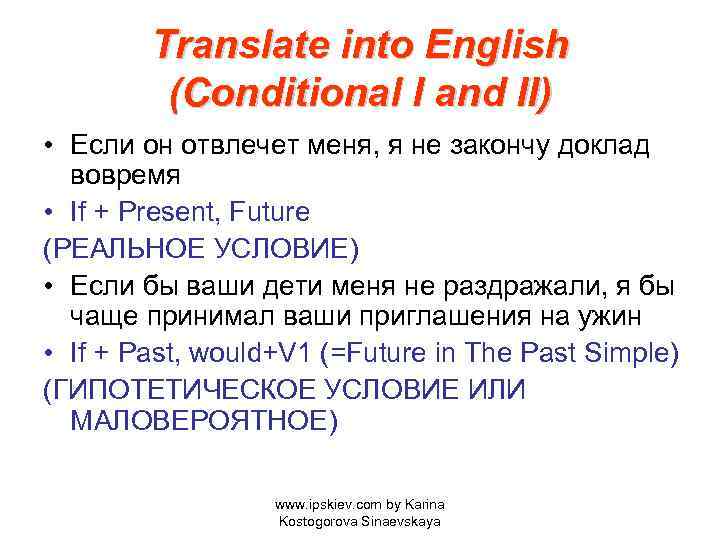
Translate into English (Conditional I and II) • Если он отвлечет меня, я не закончу доклад вовремя • If + Present, Future (РЕАЛЬНОЕ УСЛОВИЕ) • Если бы ваши дети меня не раздражали, я бы чаще принимал ваши приглашения на ужин • If + Past, would+V 1 (=Future in The Past Simple) (ГИПОТЕТИЧЕСКОЕ УСЛОВИЕ ИЛИ МАЛОВЕРОЯТНОЕ) www. ipskiev. com by Karina Kostogorova Sinaevskaya
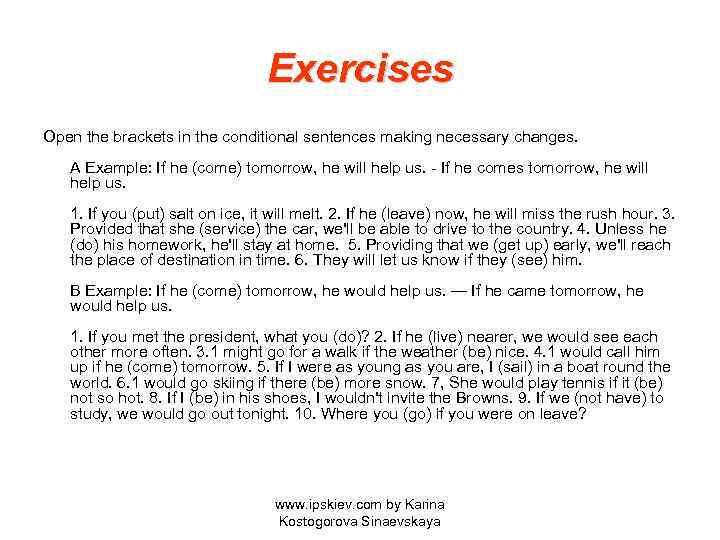
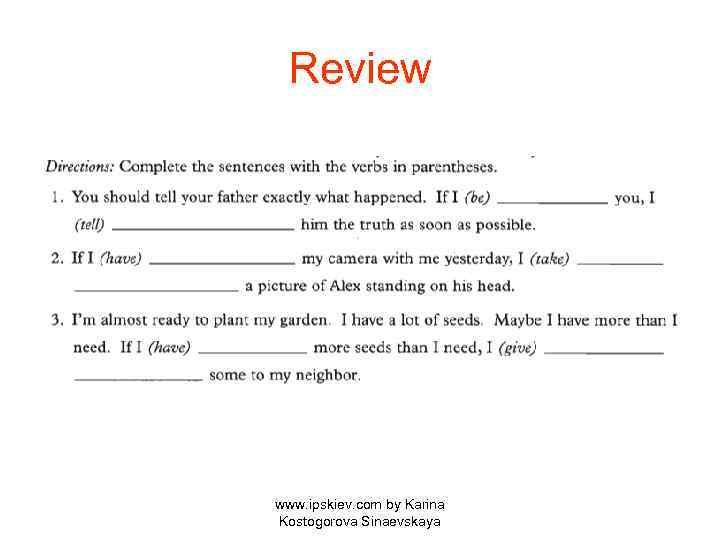
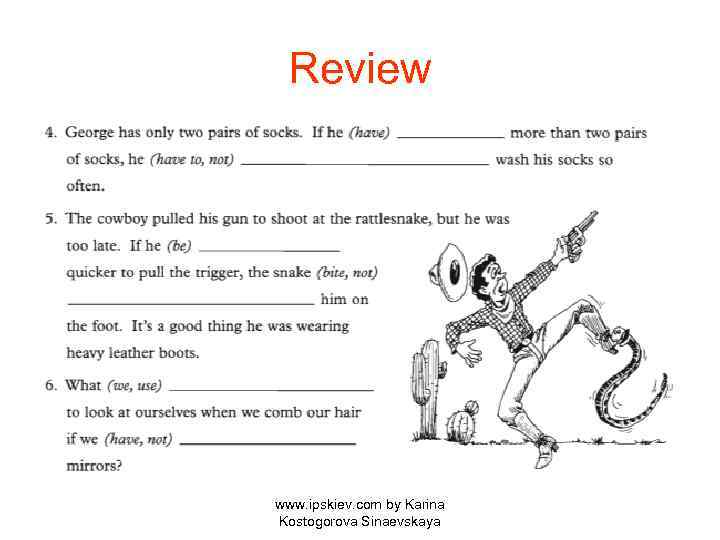
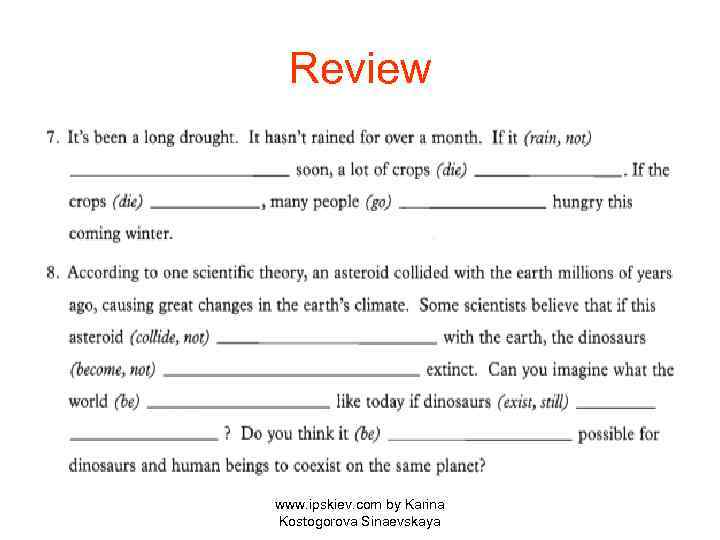
Exercises Open the brackets in the conditional sentences making necessary changes. A Example: If he (come) tomorrow, he will help us. If he comes tomorrow, he will help us. 1. If you (put) salt on ice, it will melt. 2. If he (leave) now, he will miss the rush hour. 3. Provided that she (service) the car, we'll be able to drive to the country. 4. Unless he (do) his homework, he'll stay at home. 5. Providing that we (get up) early, we'll reach the place of destination in time. 6. They will let us know if they (see) him. В Example: If he (come) tomorrow, he would help us. — If he came tomorrow, he would help us. 1. If you met the president, what you (do)? 2. If he (live) nearer, we would see each other more often. 3. 1 might go for a walk if the weather (be) nice. 4. 1 would call him up if he (come) tomorrow. 5. If I were as young as you are, I (sail) in a boat round the world. 6. 1 would go skiing if there (be) more snow. 7, She would play tennis if it (be) not so hot. 8. If I (be) in his shoes, I wouldn't invite the Browns. 9. If we (not have) to study, we would go out tonight. 10. Where you (go) if you were on leave? www. ipskiev. com by Karina Kostogorova Sinaevskaya
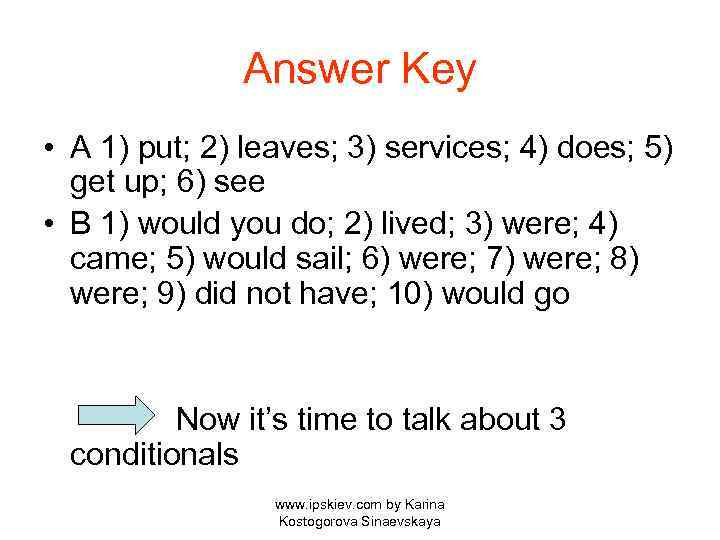
Answer Key • A 1) put; 2) leaves; 3) services; 4) does; 5) get up; 6) see • В 1) would you do; 2) lived; 3) were; 4) came; 5) would sail; 6) were; 7) were; 8) were; 9) did not have; 10) would go Now it’s time to talk about 3 conditionals www. ipskiev. com by Karina Kostogorova Sinaevskaya
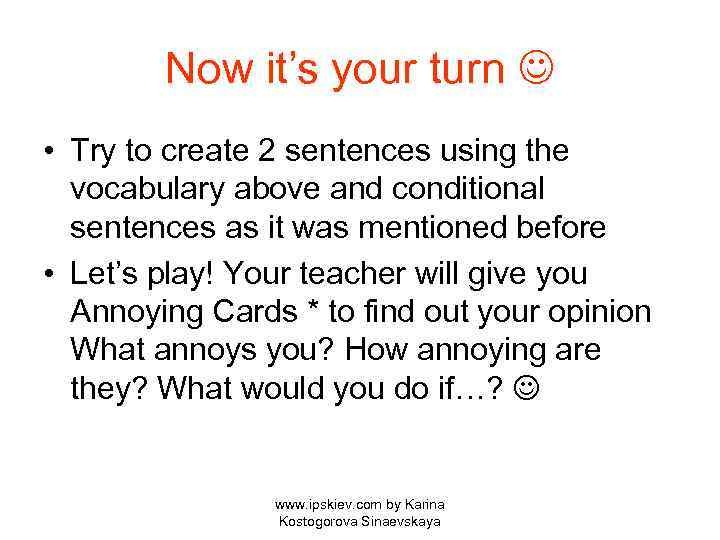
Now it’s your turn • Try to create 2 sentences using the vocabulary above and conditional sentences as it was mentioned before • Let’s play! Your teacher will give you Annoying Cards * to find out your opinion What annoys you? How annoying are they? What would you do if…? www. ipskiev. com by Karina Kostogorova Sinaevskaya
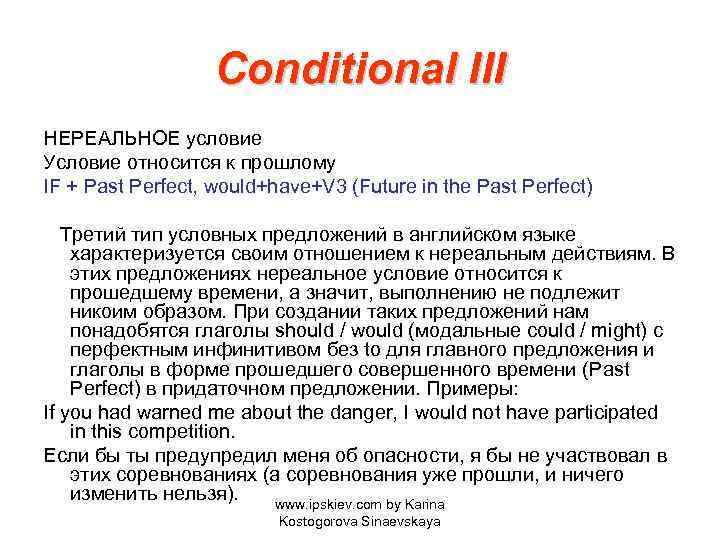
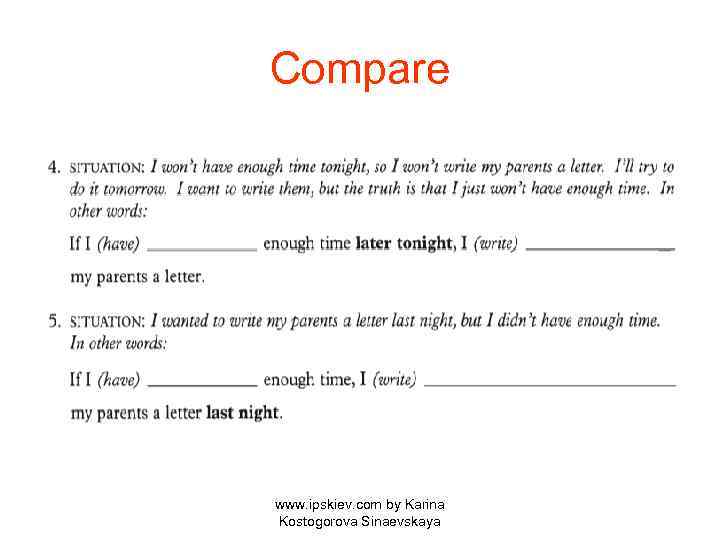
Conditional III НЕРЕАЛЬНОЕ условие Условие относится к прошлому IF + Past Perfect, would+have+V 3 (Future in the Past Perfect) Третий тип условных предложений в английском языке характеризуется своим отношением к нереальным действиям. В этих предложениях нереальное условие относится к прошедшему времени, а значит, выполнению не подлежит никоим образом. При создании таких предложений нам понадобятся глаголы should / would (модальные could / might) с перфектным инфинитивом без to для главного предложения и глаголы в форме прошедшего совершенного времени (Past Perfect) в придаточном предложении. Примеры: If you had warned me about the danger, I would not have participated in this competition. Если бы ты предупредил меня об опасности, я бы не участвовал в этих соревнованиях (а соревнования уже прошли, и ничего изменить нельзя). www. ipskiev. com by Karina Kostogorova Sinaevskaya
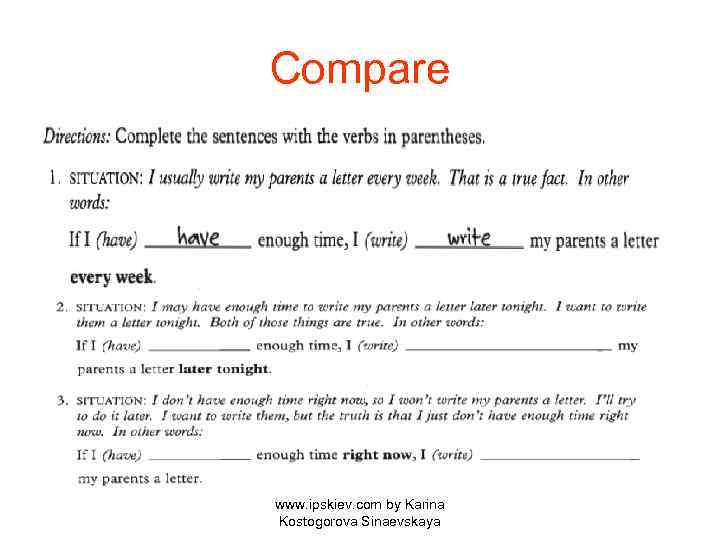
Compare www. ipskiev. com by Karina Kostogorova Sinaevskaya
Compare www. ipskiev. com by Karina Kostogorova Sinaevskaya
Review www. ipskiev. com by Karina Kostogorova Sinaevskaya
Review www. ipskiev. com by Karina Kostogorova Sinaevskaya
Review www. ipskiev. com by Karina Kostogorova Sinaevskaya
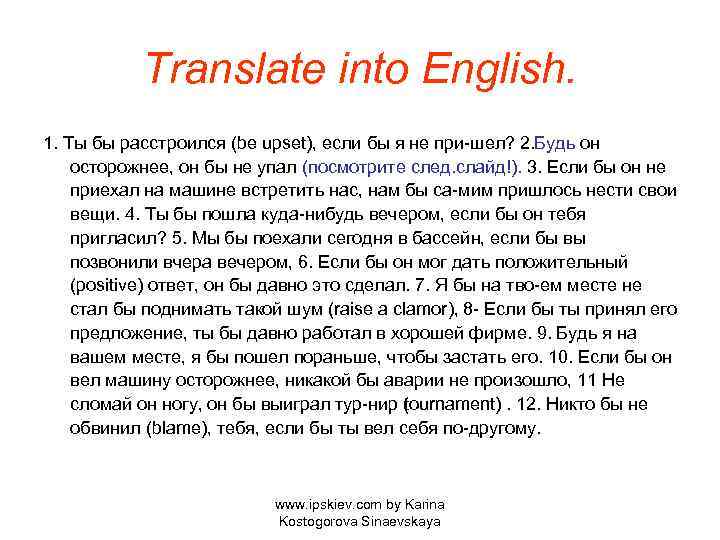
Translate into English. 1. Ты бы расстроился (be upset), если бы я не при шел? 2. удь он Б осторожнее, он бы не упал (посмотрите след. слайд!). 3. Если бы он не приехал на машине встретить нас, нам бы са мим пришлось нести свои вещи. 4. Ты бы пошла куда нибудь вечером, если бы он тебя пригласил? 5. Мы бы поехали сегодня в бассейн, если бы вы позвонили вчера вечером, 6. Если бы он мог дать положительный (positive) ответ, он бы давно это сделал. 7. Я бы на тво ем месте не стал бы поднимать такой шум (raise a clamor), 8 Если бы ты принял его предложение, ты бы давно работал в хорошей фирме. 9. Будь я на вашем месте, я бы пошел пораньше, чтобы застать его. 10. Если бы он вел машину осторожнее, никакой бы аварии не произошло, 11 Не сломай он ногу, он бы выиграл тур нир (ournament). 12. Никто бы не t обвинил (blame), тебя, если бы ты вел себя по другому. www. ipskiev. com by Karina Kostogorova Sinaevskaya
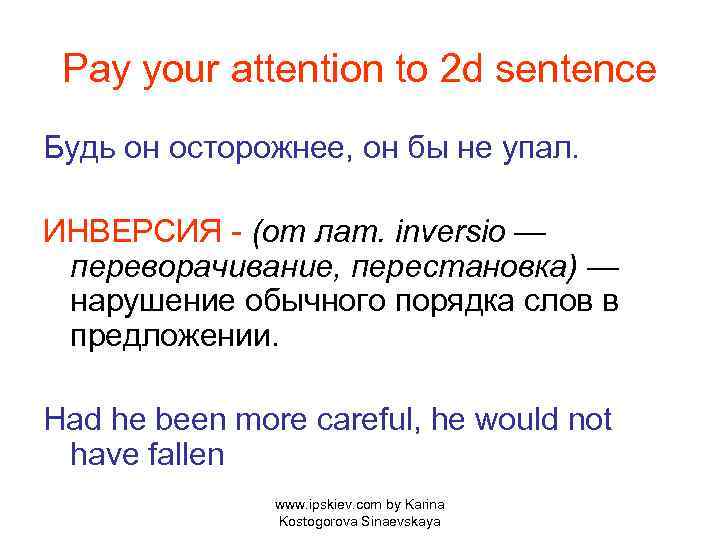
Pay your attention to 2 d sentence Будь он осторожнее, он бы не упал. ИНВЕРСИЯ (от лат. inversio — переворачивание, перестановка) — нарушение обычного порядка слов в предложении. Had he been more careful, he would not have fallen www. ipskiev. com by Karina Kostogorova Sinaevskaya
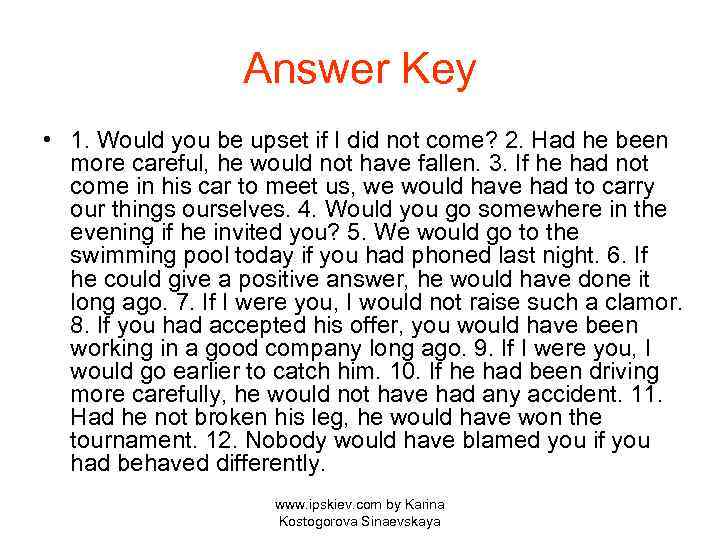
Answer Key • 1. Would you be upset if I did not come? 2. Had he been more careful, he would not have fallen. 3. If he had not come in his car to meet us, we would have had to carry our things ourselves. 4. Would you go somewhere in the evening if he invited you? 5. We would go to the swimming pool today if you had phoned last night. 6. If he could give a positive answer, he would have done it long ago. 7. If I were you, I would not raise such a clamor. 8. If you had accepted his offer, you would have been working in a good company long ago. 9. If I were you, I would go earlier to catch him. 10. If he had been driving more carefully, he would not have had any accident. 11. Had he not broken his leg, he would have won the tournament. 12. Nobody would have blamed you if you had behaved differently. www. ipskiev. com by Karina Kostogorova Sinaevskaya
What else you should know about conditional sentences: www. ipskiev. com by Karina Kostogorova Sinaevskaya
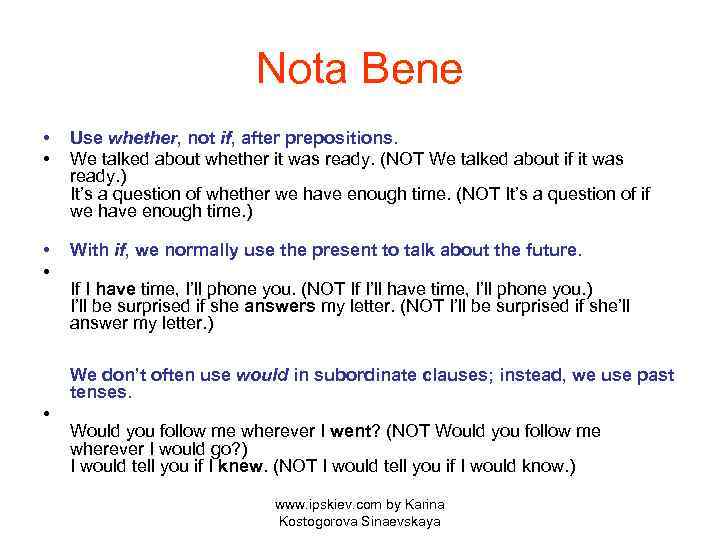
Nota Bene • • Use whether, not if, after prepositions. We talked about whether it was ready. (NOT We talked about if it was ready. ) It’s a question of whether we have enough time. (NOT It’s a question of if we have enough time. ) • • With if, we normally use the present to talk about the future. If I have time, I’ll phone you. (NOT If I’ll have time, I’ll phone you. ) I’ll be surprised if she answers my letter. (NOT I’ll be surprised if she’ll answer my letter. ) We don’t often use would in subordinate clauses; instead, we use past tenses. • Would you follow me wherever I went? (NOT Would you follow me wherever I would go? ) I would tell you if I knew. (NOT I would tell you if I would know. ) www. ipskiev. com by Karina Kostogorova Sinaevskaya
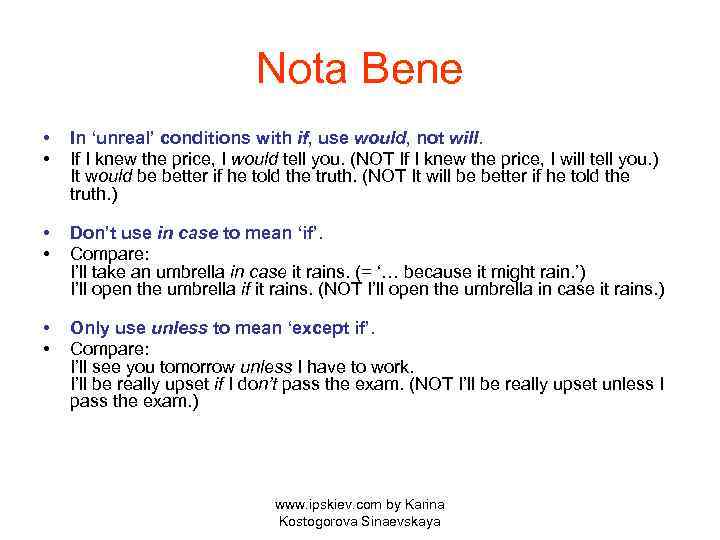
Nota Bene • • In ‘unreal’ conditions with if, use would, not will. If I knew the price, I would tell you. (NOT If I knew the price, I will tell you. ) It would be better if he told the truth. (NOT It will be better if he told the truth. ) • • Don’t use in case to mean ‘if’. Compare: I’ll take an umbrella in case it rains. (= ‘… because it might rain. ’) I’ll open the umbrella if it rains. (NOT I’ll open the umbrella in case it rains. ) • • Only use unless to mean ‘except if’. Compare: I’ll see you tomorrow unless I have to work. I’ll be really upset if I don’t pass the exam. (NOT I’ll be really upset unless I pass the exam. ) www. ipskiev. com by Karina Kostogorova Sinaevskaya
Now it’s your turn • Try to create 5 sentences using the vocabulary above and conditional sentences as it was mentioned before • Use the inversion where it’s possible www. ipskiev. com by Karina Kostogorova Sinaevskaya
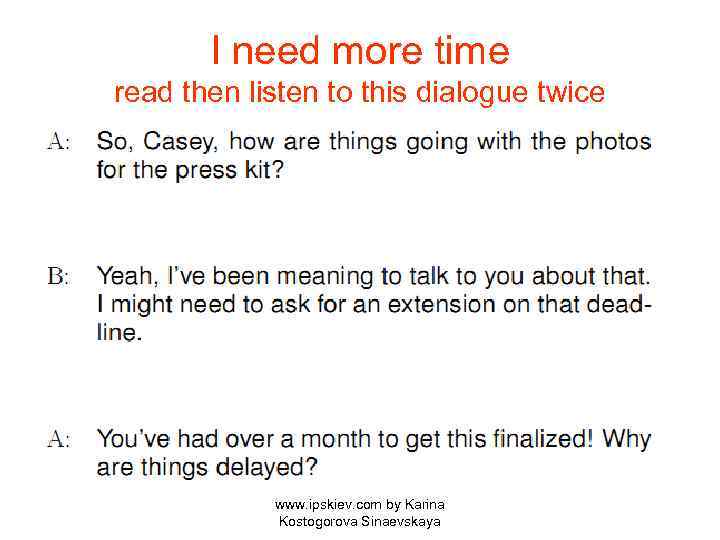
I need more time read then listen to this dialogue twice www. ipskiev. com by Karina Kostogorova Sinaevskaya
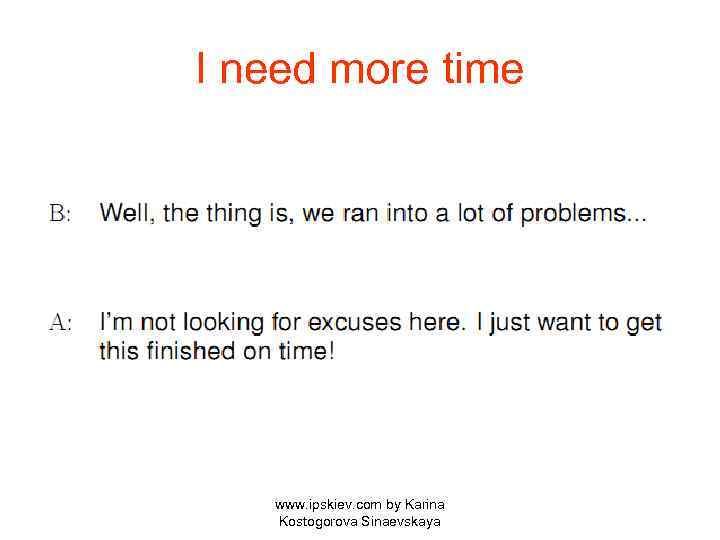
I need more time www. ipskiev. com by Karina Kostogorova Sinaevskaya
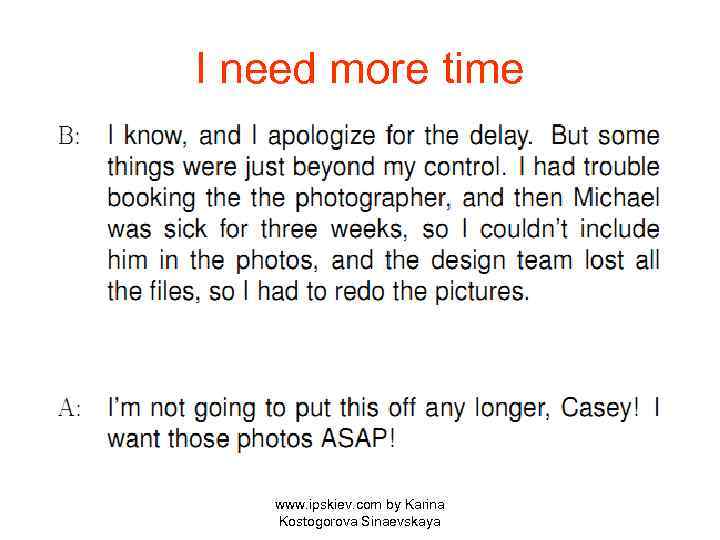
I need more time www. ipskiev. com by Karina Kostogorova Sinaevskaya
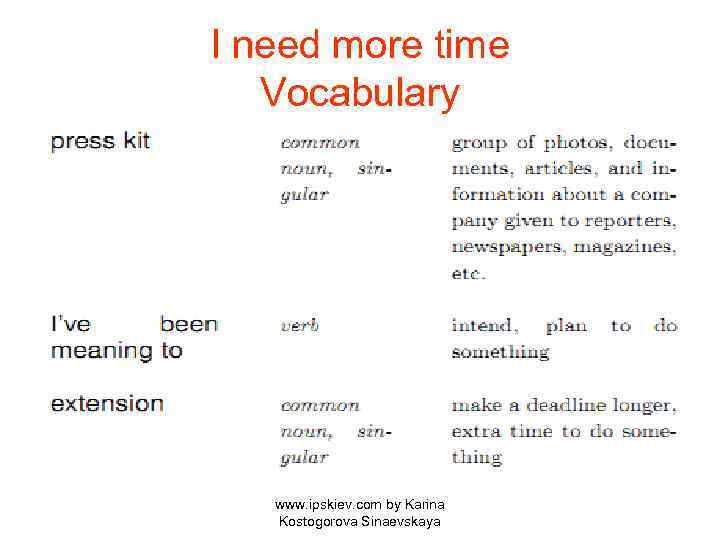
I need more time Vocabulary www. ipskiev. com by Karina Kostogorova Sinaevskaya
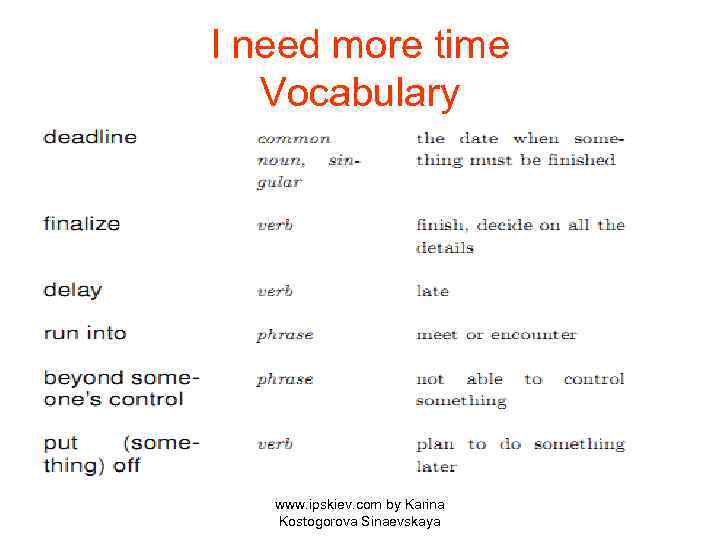
I need more time Vocabulary www. ipskiev. com by Karina Kostogorova Sinaevskaya
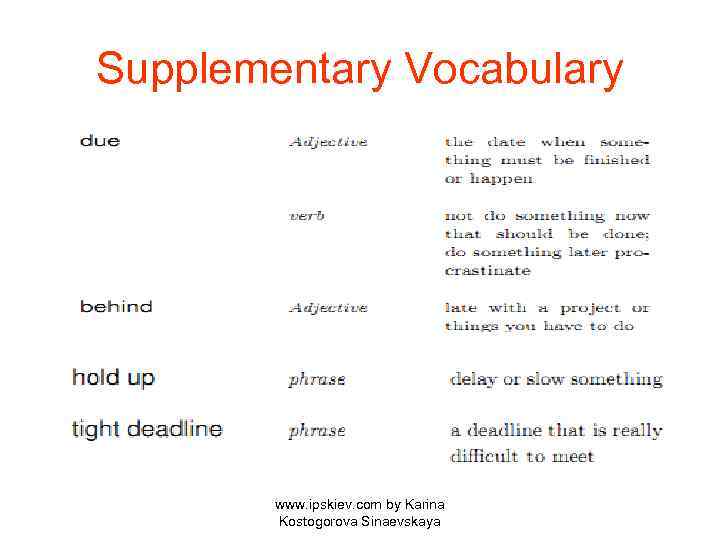
Supplementary Vocabulary www. ipskiev. com by Karina Kostogorova Sinaevskaya
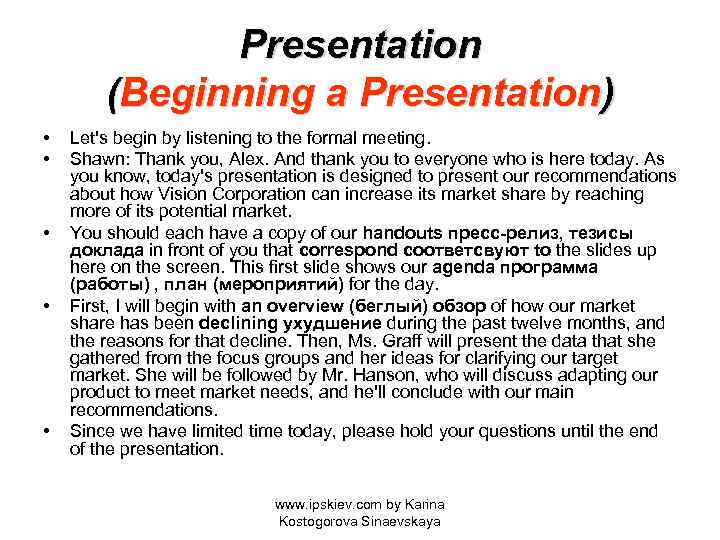
Presentation (Beginning a Presentation) • • • Let's begin by listening to the formal meeting. Shawn: Thank you, Alex. And thank you to everyone who is here today. As you know, today's presentation is designed to present our recommendations about how Vision Corporation can increase its market share by reaching more of its potential market. You should each have a copy of our handouts пресс-релиз, тезисы доклада in front of you that correspond соответсвуют to the slides up here on the screen. This first slide shows our agenda программа (работы) , план (мероприятий) for the day. First, I will begin with an overview (беглый) обзор of how our market share has been declining ухудшение during the past twelve months, and the reasons for that decline. Then, Ms. Graff will present the data that she gathered from the focus groups and her ideas for clarifying our target market. She will be followed by Mr. Hanson, who will discuss adapting our product to meet market needs, and he'll conclude with our main recommendations. Since we have limited time today, please hold your questions until the end of the presentation. www. ipskiev. com by Karina Kostogorova Sinaevskaya
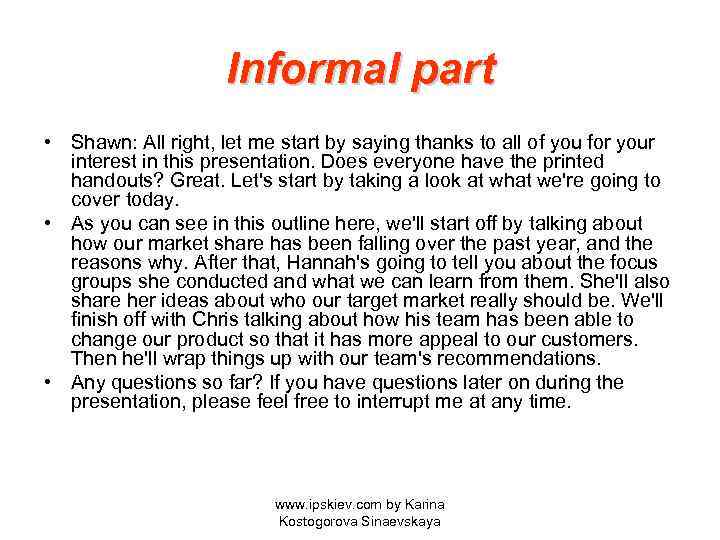
Informal part • Shawn: All right, let me start by saying thanks to all of you for your interest in this presentation. Does everyone have the printed handouts? Great. Let's start by taking a look at what we're going to cover today. • As you can see in this outline here, we'll start off by talking about how our market share has been falling over the past year, and the reasons why. After that, Hannah's going to tell you about the focus groups she conducted and what we can learn from them. She'll also share her ideas about who our target market really should be. We'll finish off with Chris talking about how his team has been able to change our product so that it has more appeal to our customers. Then he'll wrap things up with our team's recommendations. • Any questions so far? If you have questions later on during the presentation, please feel free to interrupt me at any time. www. ipskiev. com by Karina Kostogorova Sinaevskaya
Скачать презентацию Business English Lesson 3 www ipskiev com by
Business English3.ppt