 Скачать презентацию BUSINESS CYCLES AROUND THE GLOBE Péter Benczúr Attila
5cf81e61014a40d52eedde966a913839.ppt
- Количество слайдов: 23



BUSINESS CYCLES AROUND THE GLOBE Péter Benczúr Attila Rátfai Magyar Nemzeti Bank and Central European University IEA WC, Istanbul June 26, 2008
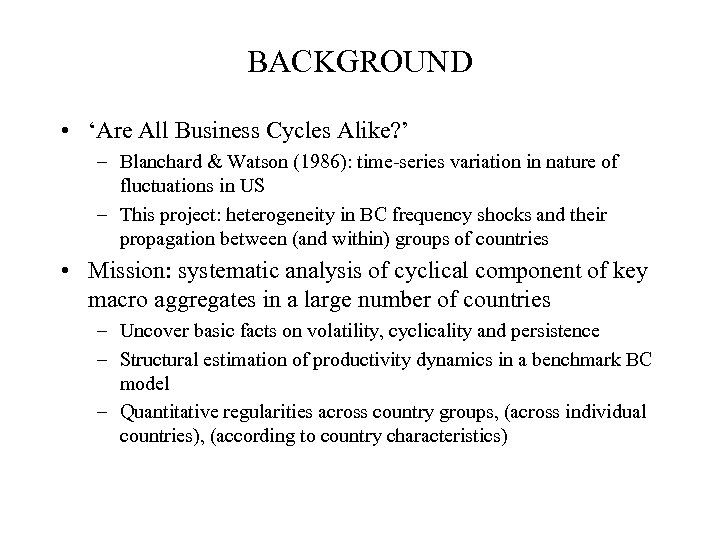
BACKGROUND • ‘Are All Business Cycles Alike? ’ – Blanchard & Watson (1986): time-series variation in nature of fluctuations in US – This project: heterogeneity in BC frequency shocks and their propagation between (and within) groups of countries • Mission: systematic analysis of cyclical component of key macro aggregates in a large number of countries – Uncover basic facts on volatility, cyclicality and persistence – Structural estimation of productivity dynamics in a benchmark BC model – Quantitative regularities across country groups, (across individual countries), (according to country characteristics)
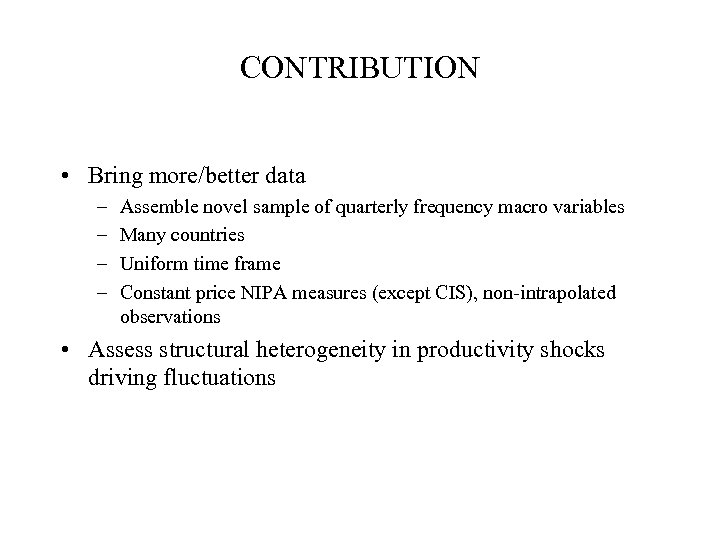
CONTRIBUTION • Bring more/better data – – Assemble novel sample of quarterly frequency macro variables Many countries Uniform time frame Constant price NIPA measures (except CIS), non-intrapolated observations • Assess structural heterogeneity in productivity shocks driving fluctuations
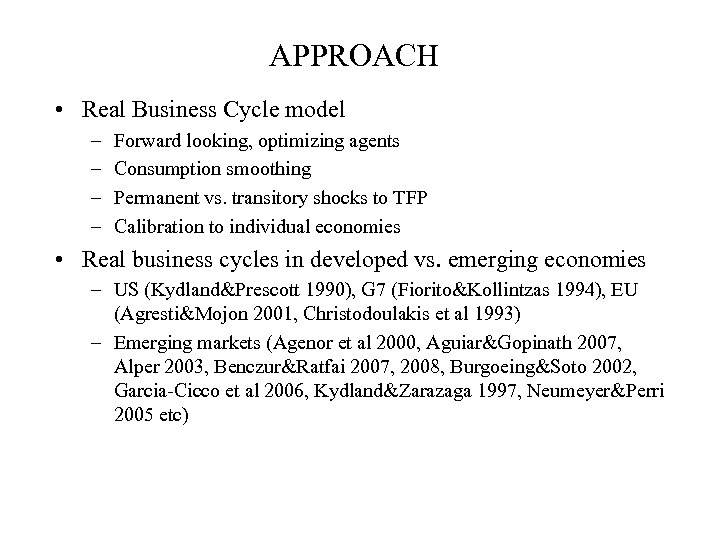
APPROACH • Real Business Cycle model – – Forward looking, optimizing agents Consumption smoothing Permanent vs. transitory shocks to TFP Calibration to individual economies • Real business cycles in developed vs. emerging economies – US (Kydland&Prescott 1990), G 7 (Fiorito&Kollintzas 1994), EU (Agresti&Mojon 2001, Christodoulakis et al 1993) – Emerging markets (Agenor et al 2000, Aguiar&Gopinath 2007, Alper 2003, Benczur&Ratfai 2007, 2008, Burgoeing&Soto 2002, Garcia-Cicco et al 2006, Kydland&Zarazaga 1997, Neumeyer&Perri 2005 etc)
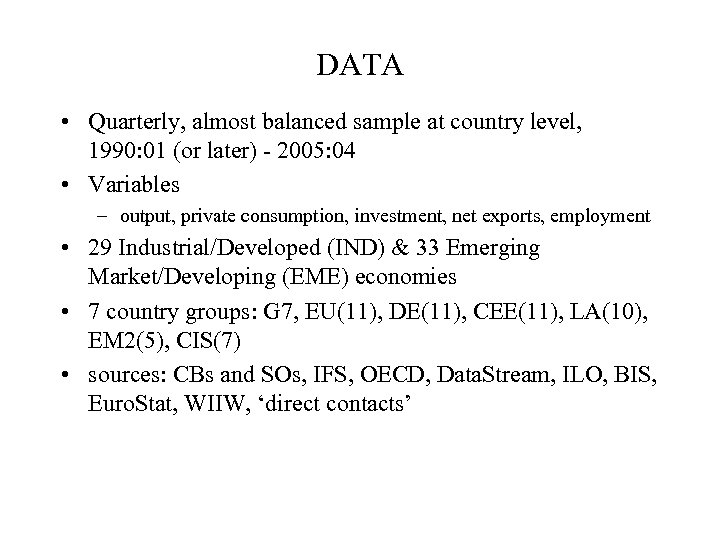
DATA • Quarterly, almost balanced sample at country level, 1990: 01 (or later) - 2005: 04 • Variables – output, private consumption, investment, net exports, employment • 29 Industrial/Developed (IND) & 33 Emerging Market/Developing (EME) economies • 7 country groups: G 7, EU(11), DE(11), CEE(11), LA(10), EM 2(5), CIS(7) • sources: CBs and SOs, IFS, OECD, Data. Stream, ILO, BIS, Euro. Stat, WIIW, ‘direct contacts’
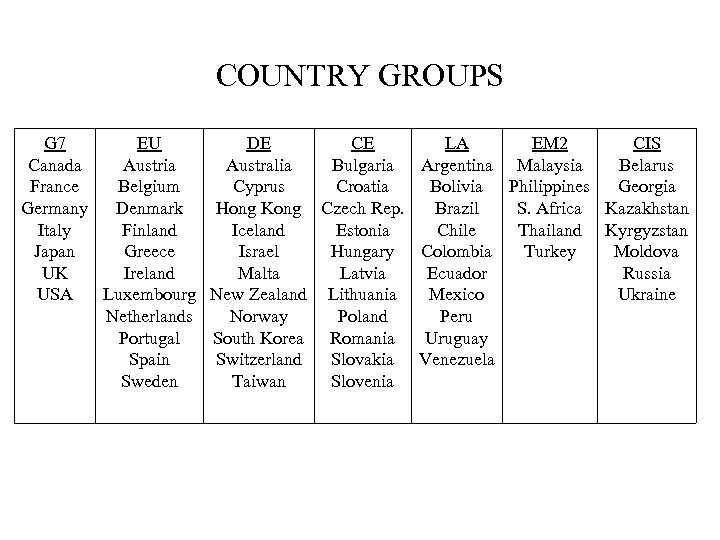
COUNTRY GROUPS G 7 EU DE CE LA EM 2 CIS Canada Austria Australia Bulgaria Argentina Malaysia Belarus France Belgium Cyprus Croatia Bolivia Philippines Georgia Germany Denmark Hong Kong Czech Rep. Brazil S. Africa Kazakhstan Italy Finland Iceland Estonia Chile Thailand Kyrgyzstan Japan Greece Israel Hungary Colombia Turkey Moldova UK Ireland Malta Latvia Ecuador Russia USA Luxembourg New Zealand Lithuania Mexico Ukraine Netherlands Norway Poland Peru Portugal South Korea Romania Uruguay Spain Switzerland Slovakia Venezuela Sweden Taiwan Slovenia
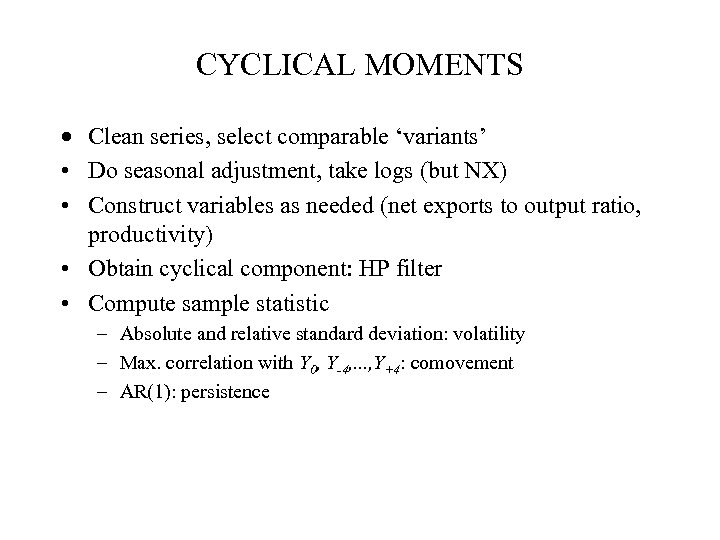
CYCLICAL MOMENTS · Clean series, select comparable ‘variants’ • Do seasonal adjustment, take logs (but NX) • Construct variables as needed (net exports to output ratio, productivity) • Obtain cyclical component: HP filter • Compute sample statistic – Absolute and relative standard deviation: volatility – Max. correlation with Y 0, Y-4, . . . , Y+4: comovement – AR(1): persistence
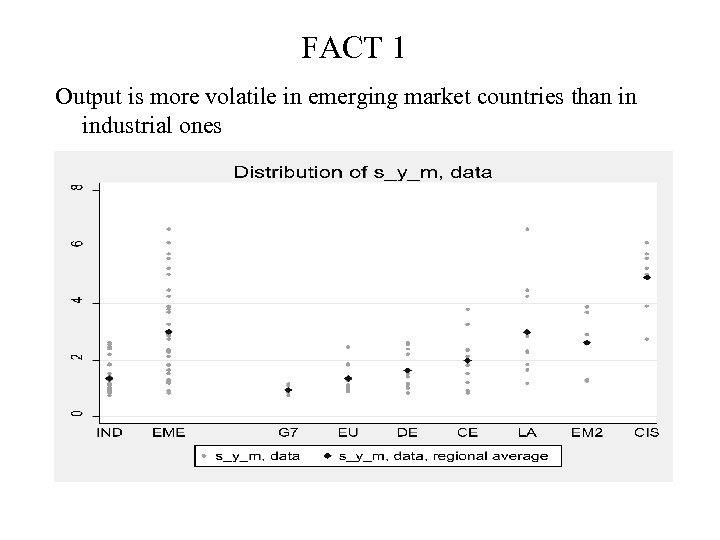
FACT 1 Output is more volatile in emerging market countries than in industrial ones
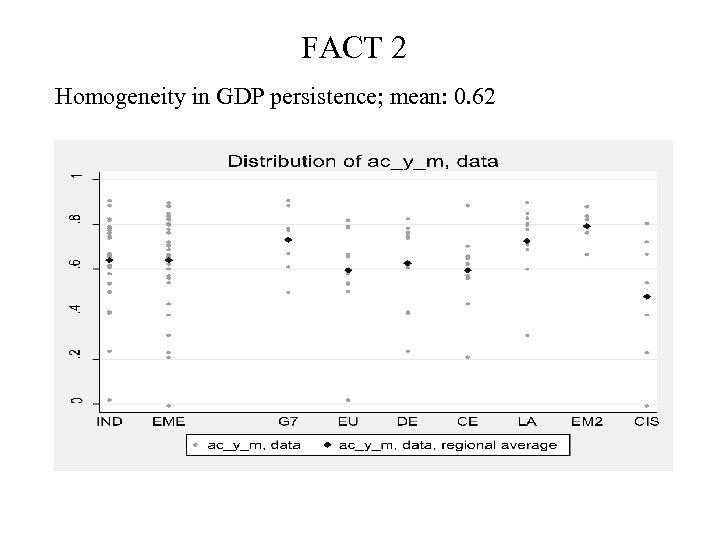
FACT 2 Homogeneity in GDP persistence; mean: 0. 62
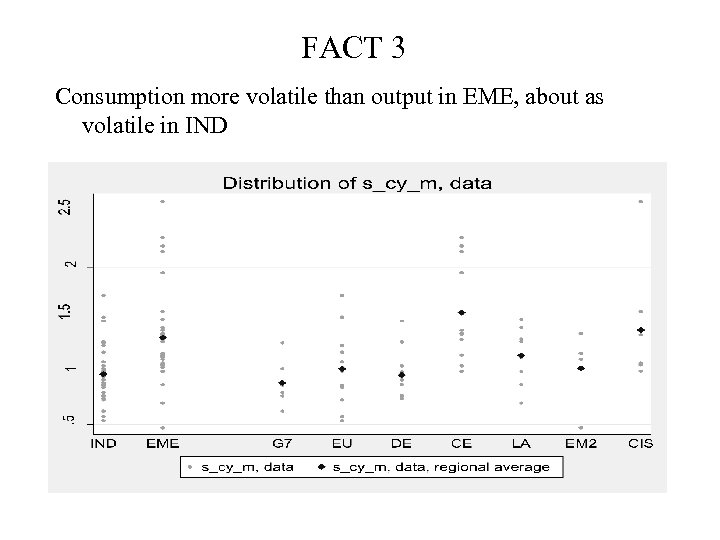
FACT 3 Consumption more volatile than output in EME, about as volatile in IND
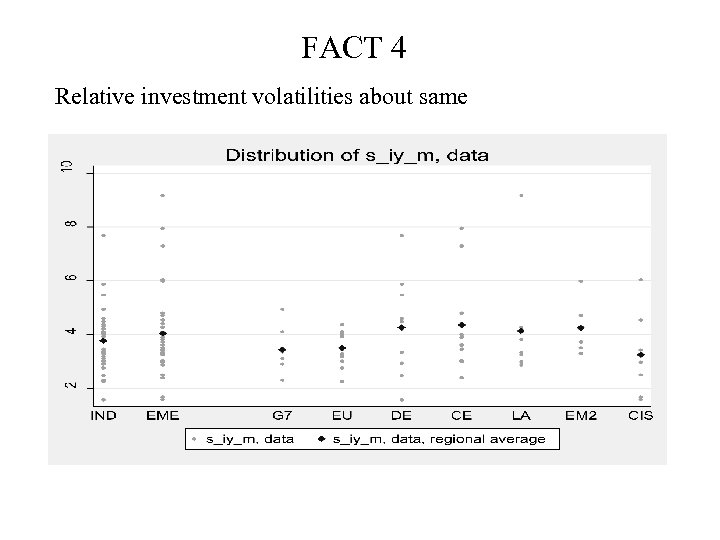
FACT 4 Relative investment volatilities about same
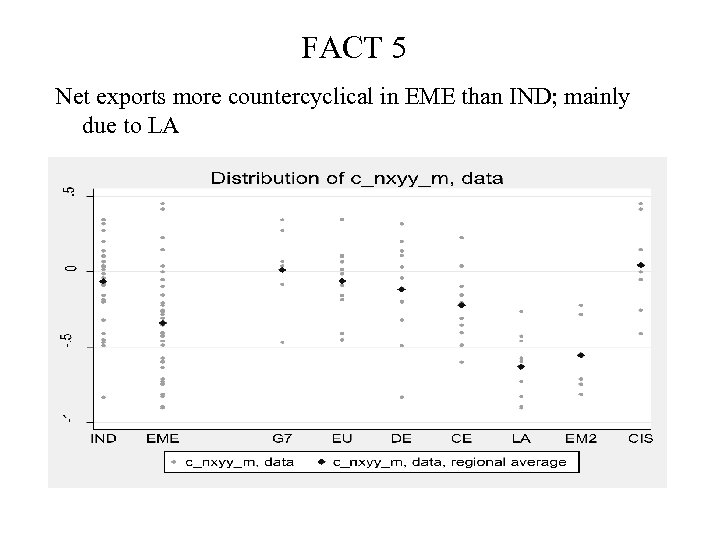
FACT 5 Net exports more countercyclical in EME than IND; mainly due to LA
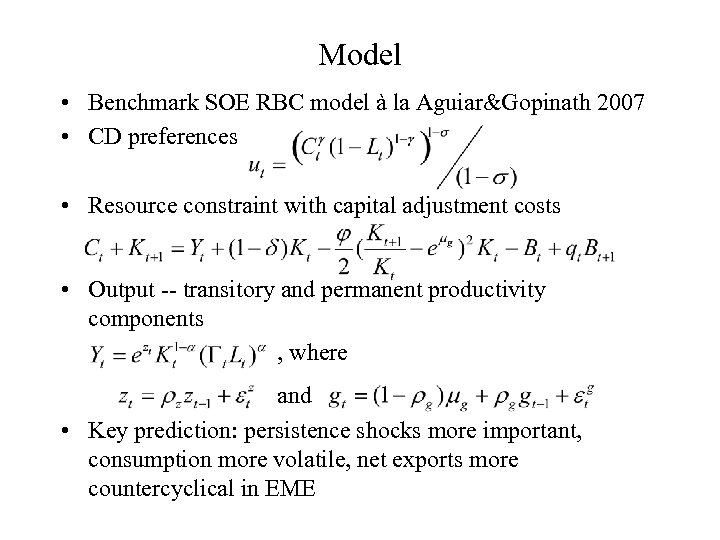
Model • Benchmark SOE RBC model à la Aguiar&Gopinath 2007 • CD preferences • Resource constraint with capital adjustment costs • Output -- transitory and permanent productivity components , where and • Key prediction: persistence shocks more important, consumption more volatile, net exports more countercyclical in EME
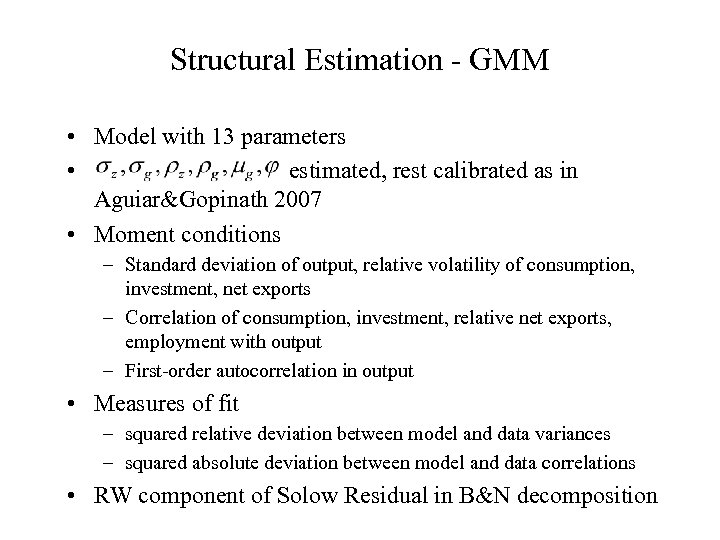
Structural Estimation - GMM • Model with 13 parameters • estimated, rest calibrated as in Aguiar&Gopinath 2007 • Moment conditions – Standard deviation of output, relative volatility of consumption, investment, net exports – Correlation of consumption, investment, relative net exports, employment with output – First-order autocorrelation in output • Measures of fit – squared relative deviation between model and data variances – squared absolute deviation between model and data correlations • RW component of Solow Residual in B&N decomposition
MODEL FIT 1 Output volatility smaller in IND than EME; model gets it right (Percentage difference between data and model moment)
MODEL FIT 2 Output persistence overpredicted in EME (Absolute difference between data and model moment)
MODEL FIT 3 Consumption volatility bit underpredicted, IND-EME differential is OK (Percentage difference between data and model moment)
MODEL FIT 4 Model underpredicts investment volatility, main source of model misfit (Percentage difference between data and model moment)
MODEL FIT 5 Net exports cyclicality slightly overpredicted (Absolute difference between data and model moment)
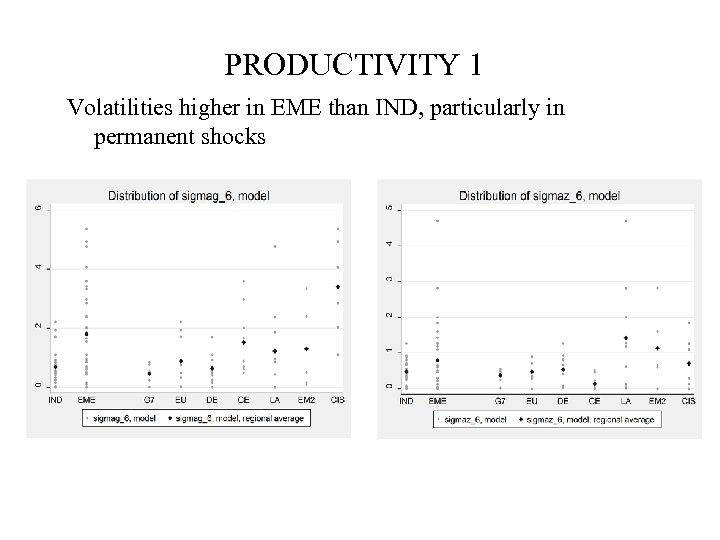
PRODUCTIVITY 1 Volatilities higher in EME than IND, particularly in permanent shocks
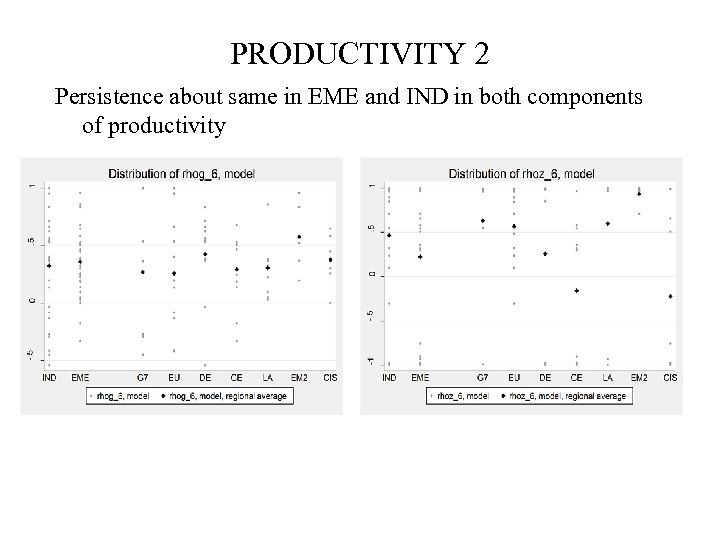
PRODUCTIVITY 2 Persistence about same in EME and IND in both components of productivity
PRODUCTIVITY 3 B&N random walk component slightly higher in EME
CONCLUSION • New data • Overriding message: Business Cycles Are NOT Alike! – Massive heterogeneity in basic facts between (and within) groups of developed and emerging market economies • Structural estimation – – Combine observable moments with model structure Reasonable fit of model Heterogeneity in productivity parameters Mixed support for RBC approach to understand difference between emerging and developed economies
Скачать презентацию BUSINESS CYCLES AROUND THE GLOBE Péter Benczúr Attila
5cf81e61014a40d52eedde966a913839.ppt