 Скачать презентацию BUSINESS CULTURE IN CHINA DONE BY KABYLZHAN AINUR
CHINA.pptx
- Количество слайдов: 9



BUSINESS CULTURE IN CHINA DONE BY KABYLZHAN AINUR
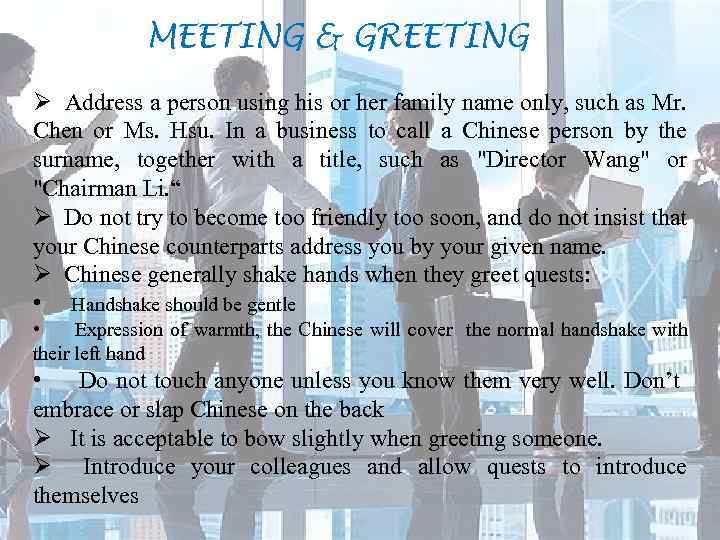
MEETING & GREETING Ø Address a person using his or her family name only, such as Mr. Chen or Ms. Hsu. In a business to call a Chinese person by the surname, together with a title, such as "Director Wang" or "Chairman Li. “ Ø Do not try to become too friendly too soon, and do not insist that your Chinese counterparts address you by your given name. Ø Chinese generally shake hands when they greet quests: • Handshake should be gentle • Expression of warmth, the Chinese will cover the normal handshake with their left hand • Do not touch anyone unless you know them very well. Don’t embrace or slap Chinese on the back Ø It is acceptable to bow slightly when greeting someone. Ø Introduce your colleagues and allow quests to introduce themselves
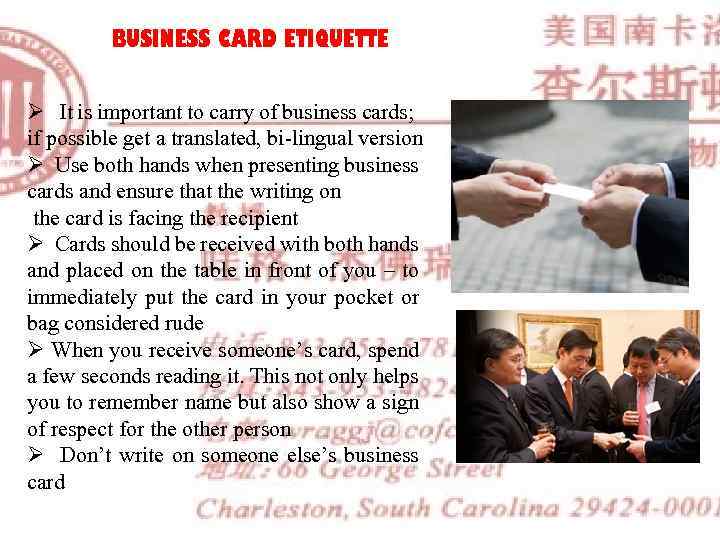
BUSINESS CARD ETIQUETTE Ø It is important to carry of business cards; if possible get a translated, bi-lingual version Ø Use both hands when presenting business cards and ensure that the writing on the card is facing the recipient Ø Cards should be received with both hands and placed on the table in front of you – to immediately put the card in your pocket or bag considered rude Ø When you receive someone’s card, spend a few seconds reading it. This not only helps you to remember name but also show a sign of respect for the other person Ø Don’t write on someone else’s business card
COMMUNICATION v In Chinese culture, saying ‘No’ is normally regarded as impolite v They may respond with indecisive answer like ‘Inconvenient’; ‘Under consideration’; ‘Maybe’ or ‘That might be difficult’. v Another common way of saying ‘no’ in China is to raise objections.
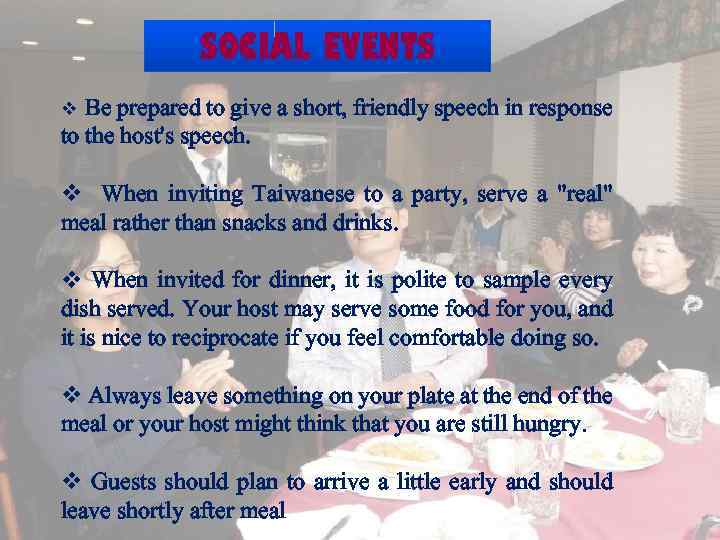
SOCIAL EVENTS Be prepared to give a short, friendly speech in response to the host's speech. v v When inviting Taiwanese to a party, serve a "real" meal rather than snacks and drinks. v When invited for dinner, it is polite to sample every dish served. Your host may serve some food for you, and it is nice to reciprocate if you feel comfortable doing so. v Always leave something on your plate at the end of the meal or your host might think that you are still hungry. v Guests should plan to arrive a little early and should leave shortly after meal
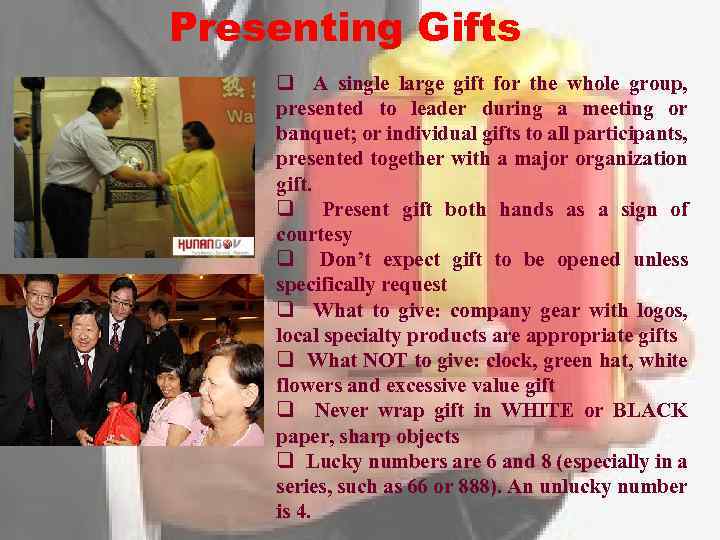
Presenting Gifts q A single large gift for the whole group, presented to leader during a meeting or banquet; or individual gifts to all participants, presented together with a major organization gift. q Present gift both hands as a sign of courtesy q Don’t expect gift to be opened unless specifically request q What to give: company gear with logos, local specialty products are appropriate gifts q What NOT to give: clock, green hat, white flowers and excessive value gift q Never wrap gift in WHITE or BLACK paper, sharp objects q Lucky numbers are 6 and 8 (especially in a series, such as 66 or 888). An unlucky number is 4.
Behavior & Manners in China v Do not use large hand movements. The Chinese do not speak with their hands. Your movements may be distracting to your host. v Do not point when speaking. v It is considered improper to put your hand in your mouth. v Avoid acts that involve the mouth. v Do not discuss business at meals. v Do not start to eat or drink prior to the host. v Sample meals only, there may be several courses. v Never place your chopsticks straight up in your bowl. By placing your sticks upright in your bowl your will remind your host of joss sticks which connotes death. v Do not drop the chopsticks it is considered bad luck. v Women do not usually drink at meals. v Tipping is considered insulting, however the practice is becoming more common. v Bring several copies of all written documents for your meetings. v The decision making process is slow. You should not expect to conclude your business swiftly.

THANK YOU FOR ATTENTION!!!
Скачать презентацию BUSINESS CULTURE IN CHINA DONE BY KABYLZHAN AINUR
CHINA.pptx