 Скачать презентацию BUSINESS CORRESPONDENCE What is it Why do
BUSINESS CORRESPONDENCE.ppt
- Количество слайдов: 28



BUSINESS CORRESPONDENCE What is it?
Why do people write Business Letters? to persuade - убедить to inform - сообщить to request - попросить to express thanks - сказать спасибо to remind - напомнить to recommend - порекомендовать to apologize-извиниться to congratulate - поздравить to reject a proposal or offer- оказаться от предложения to invite or welcome - пригласить или поприветствовать to formalize decisions - сообщить о решении
Who writes Business Letters? Letters are written from a person/group, known as the sender to a person/group, known in business as the recipient. Here are some examples of senders and recipients: n business «» business n business «» consumer n job applicant «» company n citizen «» government official n employer «» employee n staff member «» staff member
Golden rules for written correspondence Before you start n Double check the addressee's address. (Name, title, company, address) n Think about the purpose and the structure of the letter. n Provide a concise reason explaining why you are writing.
Structure n n n n Remember to date the letter. Otherwise it will have no evidential value. Try to fit your letter onto one sheet of paper. If this isn’t possible, do not use the back of the paper; use a second sheet. This to avoid that the second page is overlooked. Mention your name and address at the top of the letter. It will tell people how you want to be addressed. Make an indent or skip a line for every new paragraph. Indents are somewhat outdated, preferably leave an empty line. Choose a logical division of paragraphs. Only deal with one topic per paragraph. Indicate the relationships between paragraphs to clarify the structure of the letter. Avoid long introductions.
Language n n n Use short sentences to improve readability. Make sure to spell the recipient's name correctly. Avoid colloquial language. Colloquial language is accepted when speaking, but can be very unprofessional in a letter. Speak person to person (I, we, . . . ) to involve the reader to the maximum. Use active verbs and avoid passive language. Readers will find your message to be more compelling. Write from the recipient's point of view. Be careful not to overuse any one word or phrase. Only use abbreviations if there is no alternative. Avoid difficult words. If in doubt, always check spelling and word use. Let someone else proofread your work or take a break after writing the letter and re-read it. Your eyes will be fresh and may catch careless errors.
Sending n n n Always save a copy of your letters for you own records. Make sure to put the right postage on it. Pay extra attention to the address on the envelope. Remember to add your own information. This is the first thing the recipient will see.
Types of Business Letters 1. 2. 3. 4. 5. 6. 7. 8. 9. 10. 11. 12. Letter of Application Letter of Inquiry / Direct Mail Letter of Reference Letter of Appreciation / Thank you letter Letter of Inquiry of Application Status Letter of Acknowledgment Letter Giving or Seeking Additional Information Letter Accepting or Declining Offers Alumni / Networking letter Letter of Inquiry and Application for Summer Positions Letter of Congratulations Letter of Condolence
1. Application Letter письмо-заявление is used to market you and your abilities, knowledge, skills and work habits. It states your qualifications for a desired job, position, grant or scholarship. Remember that in business communications, your writing represents you - it is "you" on paper. Make certain it reflects what you consider yourself to be.
2. Letter of Inquiry письмо-запрос is sent to companies that may be hiring, but, haven't advertised job openings. Inquiry letters should contain information on why the company interests you and why your skills and experience would be an asset to the company. Also provide information on how you will make your career and your contact information.
3. Letter of Reference письмо-рекоммендация are recommendation letters in which the writer assesses the qualities, characteristics, and capabilities of the person being recommended in terms of that individual’s ability to perform a particular task or function. Recommendation letters are almost always specifically requested to be written about someone, and are therefore addressed to a particular requestor.
4. Letter of Appreciation/ Thank you letter благодарственное письмо is used for more formal situations such as thanking senior level professionals and/or officials.
5. The Letter of Inquiry of Application Status письмо о статусе заявления о приеме на работу is used before or after your first interview to find out the status of your application. It’s important to be aggressive and show initiative – let the employer know that you want this job. If you don’t hear from the company for a long time, write and ask when a final decision will be made. This letter can be sent three or four weeks after an interview, or just one week after the interviewer said he would be in touch with you.
6. Letter of Acknowledgment письмо-уведомление is used to inform that something has been received e. g. the employer has received your application and now it is in the process of deciding
7. Letter Giving or Seeking Additional Information письмо-запрос о дополнительной информации is used when you have any questions or concerns. You can ask for additional information which helps you to take a decision
8. Letter Accepting or Declining Offers письмо, уведомляющее о согласии или несогласии с предложением is used to let the future employer about your final decision: if you accept this job offer or not
9. Alumni / Networking Letter is used to obtain an invaluable information interview and is a great way to tap into an existing networking resource. Networking letters are a great way to expand your current network or to initiate a new, potentially helpful relationship. An alumnus [ə’lʌmnaɪ] (plural alumni) is a graduate of a school, college, or university. An alumnus can also be a former member, employee, contributor or inmate as well as a former student
10. Letter of Inquiry of Application for Summer Position письмо-заявление об устройстве на работу на лето Is used to apply for a summer job. Summer jobs are mostly adopted by the poor family college students or the school going children. Summer jobs are temporary jobs. The application letter should clearly mention for how many months or days you will be able to work. Application should be drafted in such a way that the receiver should understand the proper reason why you are adopting to work in summer vacation and it should make him realize that you are in need of it. Summer job application letters helps us to prove our self worthy to apply for any particular job.
11. Letter of Congratulation письмо-поздравление is used to say congratulations for a promotion, a new job, and others
12. Letter of Sympathy / Condolence is used to comfort someone who is grieving the death of a loved one. condolence [kən’dəυləns] соболе знование
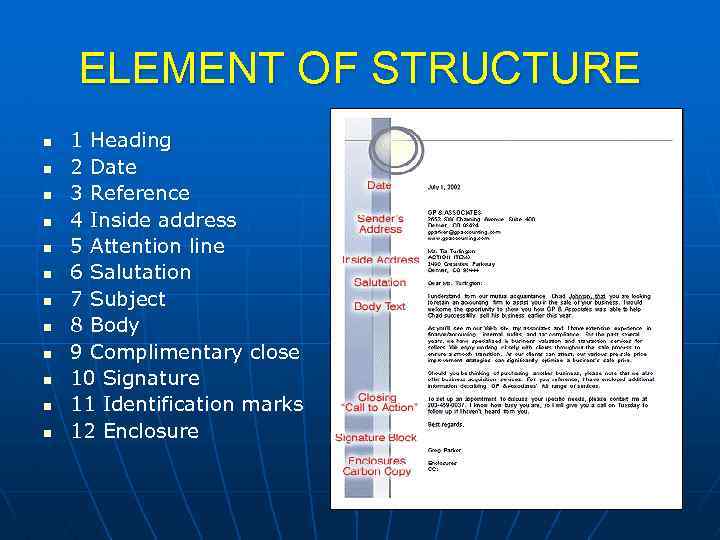
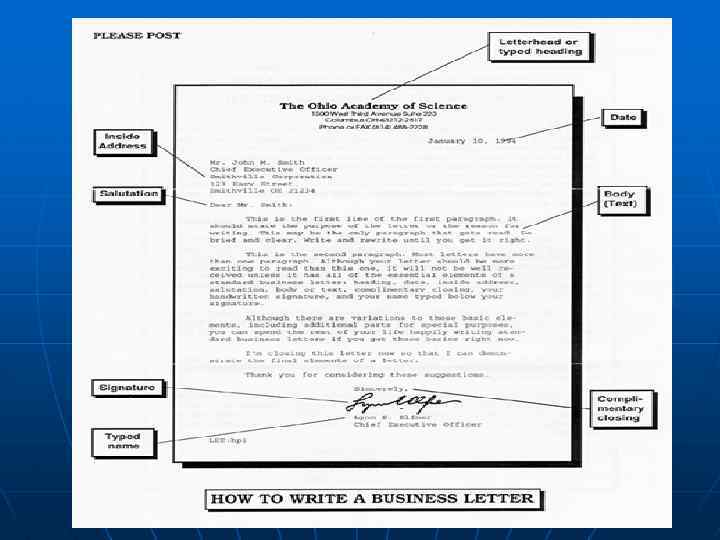
ELEMENT OF STRUCTURE n n n 1 Heading 2 Date 3 Reference 4 Inside address 5 Attention line 6 Salutation 7 Subject 8 Body 9 Complimentary close 10 Signature 11 Identification marks 12 Enclosure
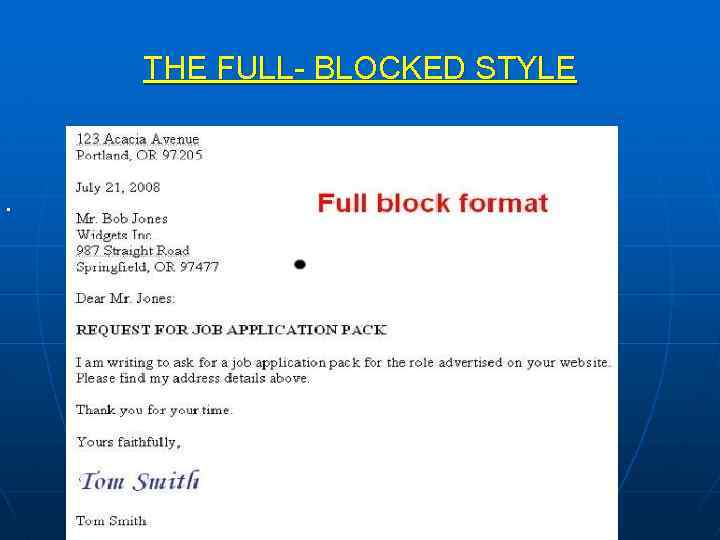
THE FULL- BLOCKED STYLE n
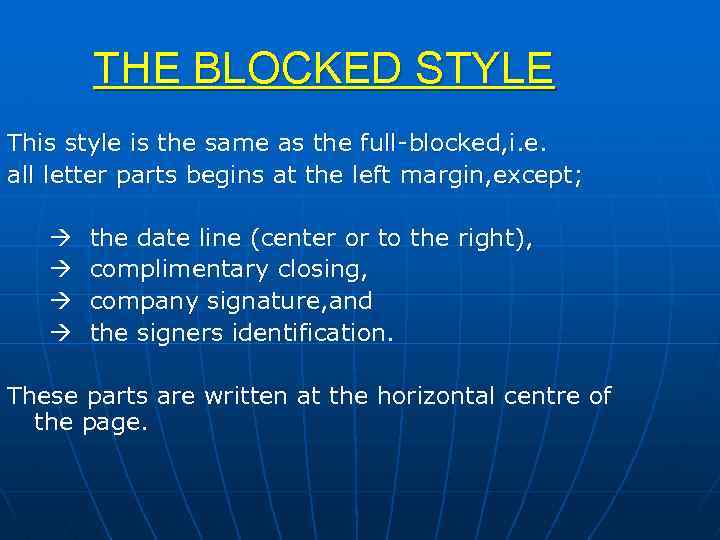
THE BLOCKED STYLE This style is the same as the full-blocked, i. e. all letter parts begins at the left margin, except; the date line (center or to the right), complimentary closing, company signature, and the signers identification. These parts are written at the horizontal centre of the page.
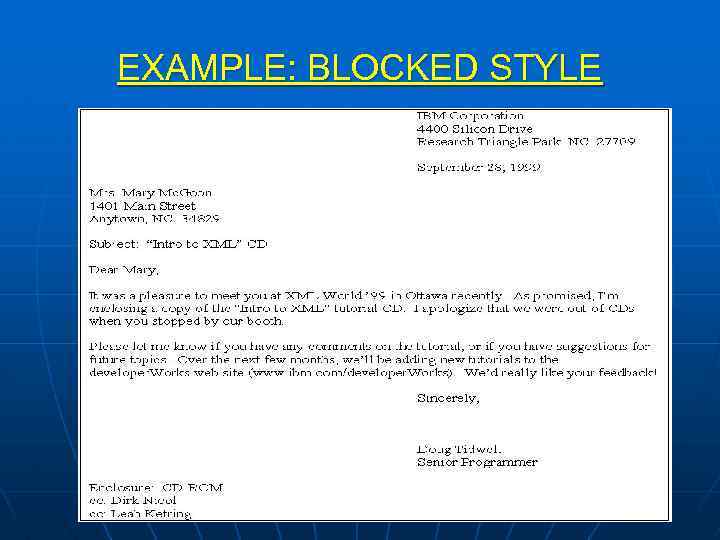
EXAMPLE: BLOCKED STYLE
THE SIMPLIFIED STYLE This style is the same as the full-blocked, except: n There is no salutation or complimentary closing; n A capitalized subject line (without the word “subject”) must be used; n The signers identification is typed in all capitals; n Unnumbered lists are indented five spaces.
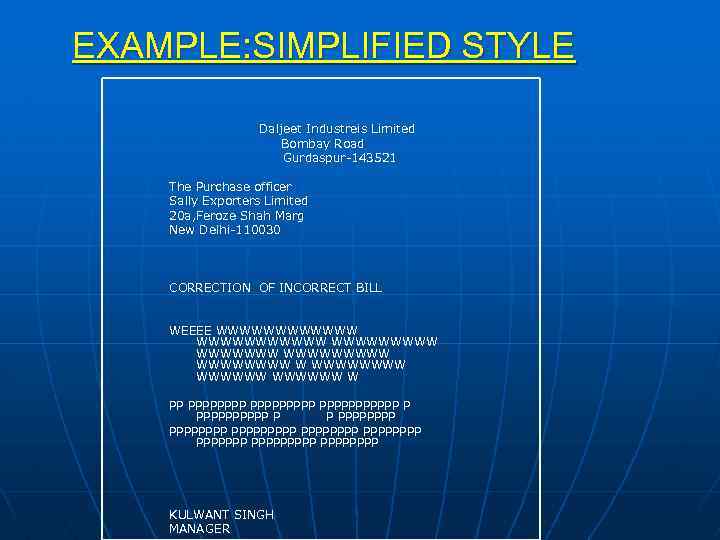
EXAMPLE: SIMPLIFIED STYLE Daljeet Industreis Limited Bombay Road Gurdaspur-143521 The Purchase officer Sally Exporters Limited 20 a, Feroze Shah Marg New Delhi-110030 CORRECTION OF INCORRECT BILL WEEEE WWWWWW WWWWWWWWW W WWWWWW W PP PPPPPPPPP P PPPPP P P PPPPPPPP PPPPPPPPP KULWANT SINGH MANAGER
Thanks for your listening!
Скачать презентацию BUSINESS CORRESPONDENCE What is it Why do
BUSINESS CORRESPONDENCE.ppt