 Скачать презентацию Business Communication and Etiquette in Chinese Fei Gao
1Understanding Business Communication.ppt
- Количество слайдов: 72



Business Communication and Etiquette in Chinese Fei Gao School of Business Administration Northeastern University Copyright © Cengage Learning. All rights reserved. 1 | 1

NAME:Fei Gao AFFILIATION:Department of Industrial Economics, School of Business Administration, Northeastern University ADDRESS: No. 500, Zhihui Street, Hunnan District, Shenyang, Liaoning, 110169, China MOBILE PHONE: 0086 -13614026608 0086 -18640067789 E-MAIL: fgao@mail. neu. edu. cn Copyright © Cengage Learning. All rights reserved. 1 | 2
Chapters 1. Understanding Business Communication 2. Contemporary Issues in Business Communication 3. Interpersonal Communication Skills 4. The Writing Process 5. Routine Messages 6. Persuasive Messages 7. Bad-News Messages 8. Making Oral Presentations 9. Employment Communication Copyright © Cengage Learning. All rights reserved. 1 | 3
Chapter 1 Understanding Business Communication Copyright © Cengage Learning. All rights reserved. 1 | 4
Understanding business communication • • • Communicating in organizations The components of communication Verbal communication Directions of communication Barriers to communication Copyright © Cengage Learning. All rights reserved. 1 | 5
Communicating in Organizations • An organization is a group of people working together to achieve common goals. Communication is vital to that process. Understanding how communication works in business and how to communicate competently within an organization can help you participate more effectively in every aspect of business. Competent writing and speaking skills will help you get hired, perform well, and earn promotions. Copyright © Cengage Learning. All rights reserved. 1 | 6
The Importance of Good Communication Skills • • 1. Writing ability is used to evaluate prospective employees for hiring. 2. Writing ability is used to evaluate employees for promotions. In fact, writing skill becomes more important as a person advances in the field. 3. Careers can be blocked because of poor writing skills. 4. Verbal and listening skills are essential in dealing effectively with people. Copyright © Cengage Learning. All rights reserved. 1 | 7
• • 5. Good communication skills help coordinate activities within an organization. 6. Good communications help increase job satisfaction and productivity. 7. Effective written communications provide official, permanent records for a business and reflect the pride that employees take in themselves and their firm. 8. Good communications help project a positive company image. Copyright © Cengage Learning. All rights reserved. 1 | 8
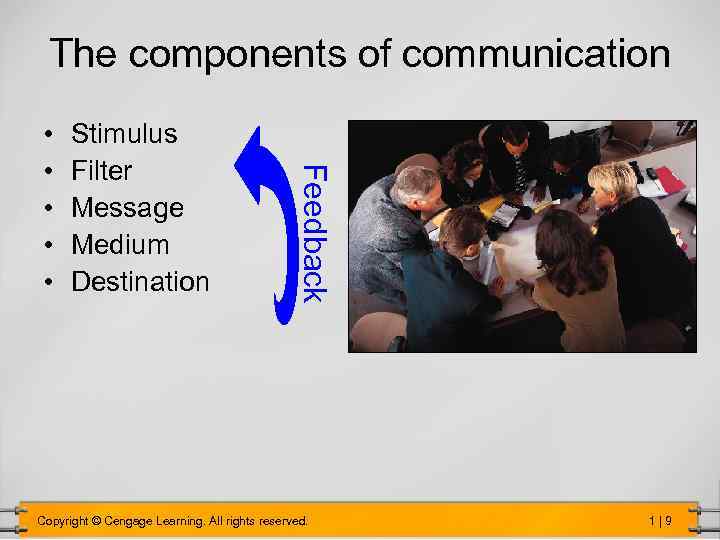
The components of communication Stimulus Filter Message Medium Destination Feedback • • • Copyright © Cengage Learning. All rights reserved. Insert photo of group discussion 1 | 9
• • The Stimulus (刺激) The stimulus--internal or external--is an event that creates within an individual the need to communicate. You respond to the stimulus by formulating a message: a verbal message (written or spoken words), or a nonverbal message (nonwritten and nonspoken signals), or some combination of the two. Copyright © Cengage Learning. All rights reserved. 1 | 10
• • The Filter (过滤) The filter consists of a person’s unique impression of reality based on that person’s experiences, culture, emotions at the moment, personality, knowledge, socioeconomic status, and other variables. The brain receives the stimulus that is the source of the communication, interprets the stimulus, and derives meaning from it in determining what response--if any--is necessary. Copyright © Cengage Learning. All rights reserved. 1 | 11
• • The Message (信息) The message is the information you want to transmit. The extent to which your communication achieves its goal depends directly on how you construct your message to suit your audience. Copyright © Cengage Learning. All rights reserved. 1 | 12
• • The Medium (媒介) The medium is the means of transmitting the message. The medium can be oral (for example, a phone call), written (a letter), or nonverbal (a smile). Copyright © Cengage Learning. All rights reserved. 1 | 13
• • The Destination (目的地) The destination is the point at which the transmitted message enters the sensory environment of the receiver. At this point, control passes from the sender to the receiver, and the transmitted message becomes the source, or stimulus, for the next communication. A response or reaction to a message provides feedback. Copyright © Cengage Learning. All rights reserved. 1 | 14
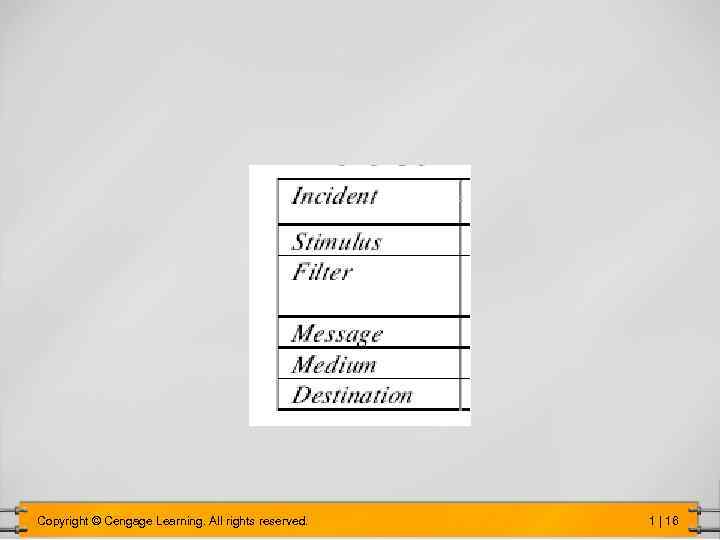
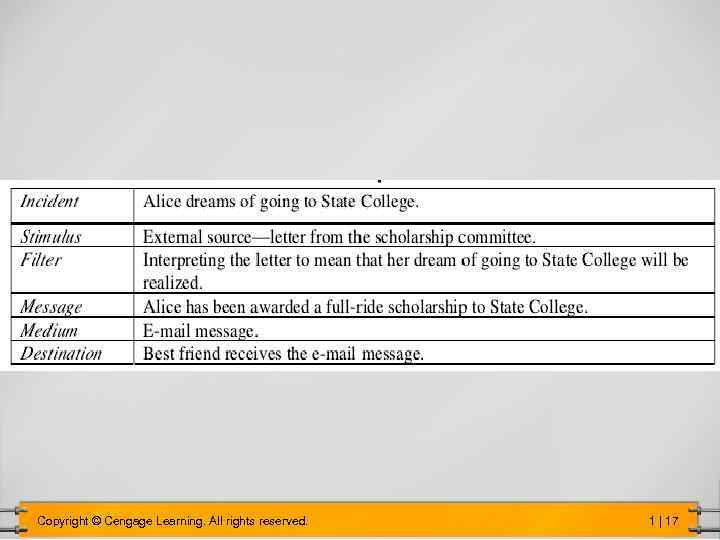
Exercise: Communication Components • • Communication Components Working with a partner, identify the five components of communication in the following situation: Alice Liston has had dream of going to State College. She has worked hard to maintain a 3. 95 GPA and has a very high ACT score. Because her family is not in a position to pay her tuition. Alice applied for an academic scholarship to State College. Two weeks later Alice receives a letter from the scholarship committee. She nervously reads the letter and then runs to her bedroom to email her best friend letting her know that she had received a full-ride scholarship to State College. Her friend reads the email message two hours later. Copyright © Cengage Learning. All rights reserved. 1 | 15
Copyright © Cengage Learning. All rights reserved. 1 | 16
Copyright © Cengage Learning. All rights reserved. 1 | 17

Communication noise Examples of noise or interference that can enter into the communication process: • Misreading body language or tone • Noisy transmission • Power struggles • Managers and subordinates hesitating to be candid • Physical distractions Think of an example of each type of noise. Copyright © Cengage Learning. All rights reserved. 1 | 18
Providing feedback • Providing feedback is accomplished by restating the speaker's feelings or ideas in your own words. Your words should be saying, "This is what I understand your idea to be. Am I correct? " • Providing feedback includes both verbal and nonverbal responses. Cocking your head or dipping your eyebrows shows you don't quite understand the meaning of the last phrase. • One direct way of getting feedback is to ask the listener, “Would you repeat what I just said in your own words? ” Copyright © Cengage Learning. All rights reserved. 1 | 19
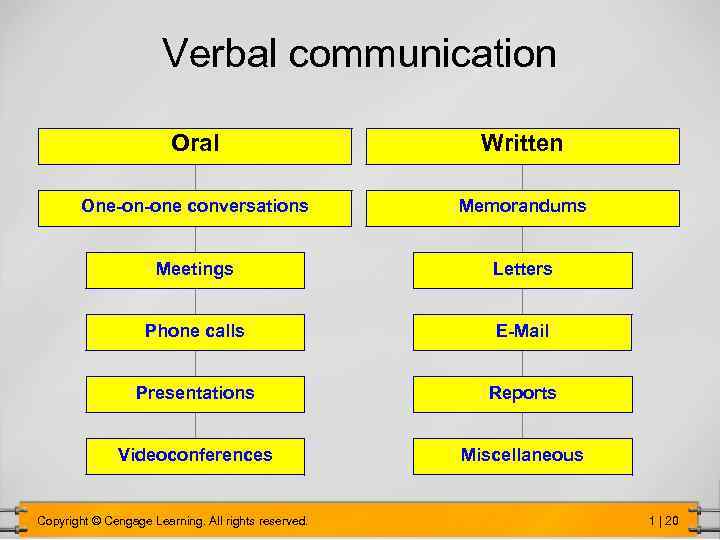
Verbal communication Oral Written One-on-one conversations Memorandums Meetings Letters Phone calls E-Mail Presentations Reports Videoconferences Miscellaneous Copyright © Cengage Learning. All rights reserved. 1 | 20
Oral Communication • • • 1. Oral communication is one of the most common functions in business. 2. Oral communication is different from written communication in that you have more ways to get a message across to others. 3. For oral communication to be effective, a second communication skill-listening-is also required. Nearly 60 percent of all communication problems in business are caused by poor listening. Copyright © Cengage Learning. All rights reserved. 1 | 21
Forms of oral communication in an organization • • • Staff meetings Personal discussions Informal conversation Face-to-face meetings Telephone calls, teleconferences, videoconferences • Speeches, presentations Copyright © Cengage Learning. All rights reserved. 1 | 22
Written Communication • • • 1. Writing is often more difficult than speaking because you have to get your message right the first time; you do not have the advantage of immediate feedback and nonverbal clues. 2. Writing is critically important to the modern organization because it serves as the major source of documentation. 3. Efficient reading skill is necessary when a written communication channel is used. Copyright © Cengage Learning. All rights reserved. 1 | 23
forms of written communication in an organization • e-mail (a message transmitted electronically over a computer network most often connected by cable, telephone lines, or satellites) • website (a source of information accessed via the Internet) • memorandum (a message sent to someone within the same organization) • letter (a message sent to someone outside the organization) • report (an orderly and objective presentation of information that assists in decision making or problem solving) Copyright © Cengage Learning. All rights reserved. 1 | 24
Other forms of written communication in an organization • • • Employee handbook In-house magazines and journals Bulletin boards, posters Museums and exhibitions Notice boards Suggestion system Copyright © Cengage Learning. All rights reserved. 1 | 25
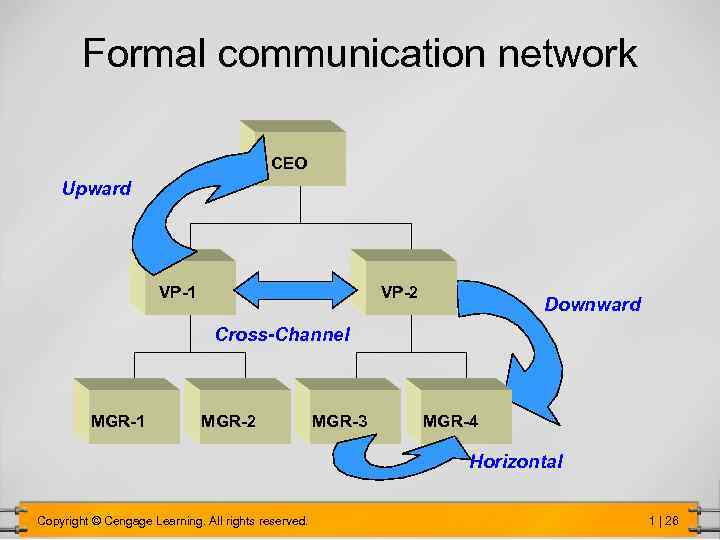
Formal communication network CEO Upward VP-1 VP-2 Downward Cross-Channel MGR-1 MGR-2 MGR-3 MGR-4 Horizontal Copyright © Cengage Learning. All rights reserved. 1 | 26
Downward communication • In most organizations the largest number of vertical communications move downward, from someone of higher authority to someone of lower authority. Information regarding job performance, policies and procedures, day-today operations, and other organizational concerns is communicated. Copyright © Cengage Learning. All rights reserved. 1 | 27
Upward communication • Upward communication provides higher management with the information needed for decision making and with feedback indicating whether downward messages have been received and understood. It cultivates employee loyalty by giving employees a chance to be heard, to air their grievances, and to offer suggestions. Copyright © Cengage Learning. All rights reserved. 1 | 28
Horizontal communication • Horizontal communication is the flow of information among peers within the same work unit. It helps individuals coordinate work assignments, share information on plans and activities, negotiate differences, and develop interpersonal support, thereby creating a more cohesive work unit. Copyright © Cengage Learning. All rights reserved. 1 | 29
Cross-channel communication • Cross-channel communication is the exchange of information among employees in different work units who are neither subordinate nor superior to one another. Copyright © Cengage Learning. All rights reserved. 1 | 30
The communication network at Finagle A Bagel Heather Robertson describes how the "open door" policy at Finagle A Bagel, which allows one-on-one interaction with top management, helps to retain employees. How would you describe the formal communication network at this company? Copyright © Cengage Learning. All rights reserved. 1 | 31
The Informal Communication Network • The grapevine is the informal communication network, the nonofficial channels within the organization through which information is transmitted. Employees often say the grapevine is their most frequent source of information on company plans and performance. Copyright © Cengage Learning. All rights reserved. 1 | 32
The grapevine is. . . • • • Business-related Accurate Pervasive Rapid Most active during change Normal Copyright © Cengage Learning. All rights reserved. 1 | 33
Verbal barriers • • Inadequate knowledge or vocabulary Differences in interpretation Language differences Inappropriate use of expressions: Slang, Jargon, Euphemisms • Over-abstraction and ambiguity • Polarization Copyright © Cengage Learning. All rights reserved. 1 | 34
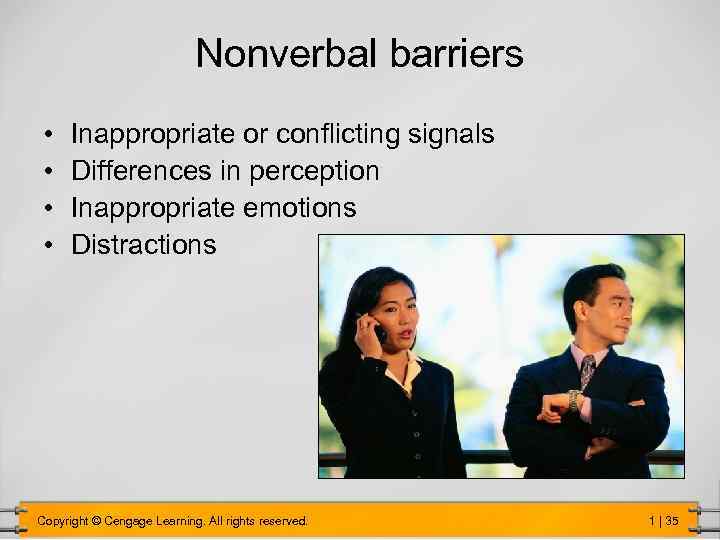
Nonverbal barriers • • Inappropriate or conflicting signals Differences in perception Inappropriate emotions Distractions Copyright © Cengage Learning. All rights reserved. 1 | 35
Apparent nonverbal barriers • Flashing or rolling eyes • Quick or slow movements • Arms crossed, legs crossed • Gestures made with exasperation • Slouching, hunching over • Poor personal care • Doodling • Staring at people or avoiding eye contact • Excessive fidgeting with materials Source: Rod Windle and Suzanne Warren, “Communication Skills, ” http: //www. directionservice. org/cadre/section 4. cfm#Verbal%20 Communication%20 Barriers , accessed 10/1/07. Copyright © Cengage Learning. All rights reserved. 1 | 36
The 3 Ps model • Problem: defines the situation and discusses the need for a particular communication task. • Process is a series of questions that provides step-by-step guidance for accomplishing the specific communication task. • Product is the key——the finished document. . Copyright © Cengage Learning. All rights reserved. 1 | 37
Example • Problem • You are an vice president of sales for Intuit. At the end of the workday, you receive a call from a large software dealer in New York who complains about being repeatedly disconnected during calls to Intuit's customer service centers, which are located in Bangalore, India. Over and over, this dealer screams about the rude treatment she says she has received when trying to talk with lntuit's customer service representatives. You doubt any employees would be rude on purpose, yet it is your job to ensure smooth relations with dealers. Copyright © Cengage Learning. All rights reserved. 1 | 38
• Process A. What is the problem facing you in this situation? I must decide how to respond to an irate dealer’s complaints of rude treatment by Intuit employees in India. Copyright © Cengage Learning. All rights reserved. 1 | 39
b. What verbal and nonverbal barriers to communication seem to be operating here? • • • Verbal barrier: Language differences may be preventing the dealer from understanding what the Indian employees are saying. Nonverbal barrier: The dealer seems to be displaying inappropriate emotions, specifically overly intense anger. Nonverbal barrier: The dealer seems to have a different perception of the situation, believing that being disconnected was a deliberate act of rudeness. Copyright © Cengage Learning. All rights reserved. 1 | 40
c. What options do you see for resolving this problem? • • • Defend the company by saying that no employee would deliberately act that way. Talk back to the dealer, saying that you do not appreciate his tone or accusation. Offer a brief but sincere apology and then ask what you can do to help the dealer. Copyright © Cengage Learning. All rights reserved. 1 | 41
d. What criteria can you use to determine the best option in this situation? • • Will this option help defuse a tense situation? Will this option benefit or harm the dealer? Will this option benefit or harm the company? Would I want to be treated like this? Copyright © Cengage Learning. All rights reserved. 1 | 42
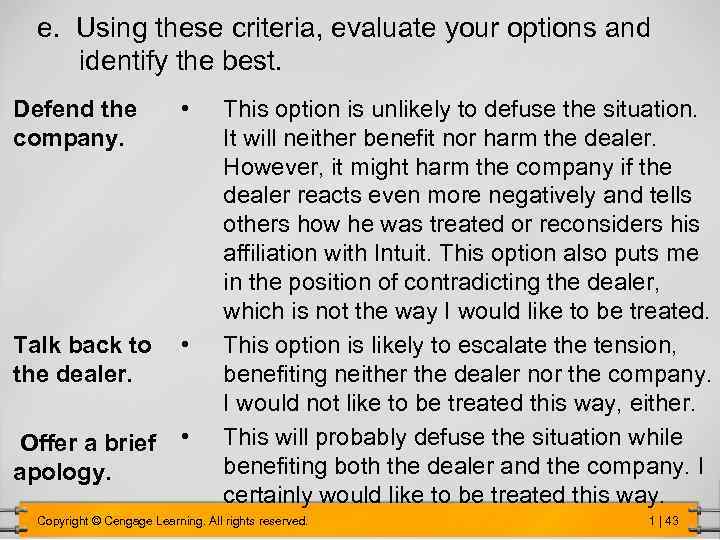
e. Using these criteria, evaluate your options and identify the best. Defend the company. • Talk back to the dealer. • Offer a brief apology. • This option is unlikely to defuse the situation. It will neither benefit nor harm the dealer. However, it might harm the company if the dealer reacts even more negatively and tells others how he was treated or reconsiders his affiliation with Intuit. This option also puts me in the position of contradicting the dealer, which is not the way I would like to be treated. This option is likely to escalate the tension, benefiting neither the dealer nor the company. I would not like to be treated this way, either. This will probably defuse the situation while benefiting both the dealer and the company. I certainly would like to be treated this way. Copyright © Cengage Learning. All rights reserved. 1 | 43
• Product On behalf of Intuit, I want to apologize for this problem and for the inconvenience you have experienced. Please let me help you right now. What questions can I answer for you? Copyright © Cengage Learning. All rights reserved. 1 | 44
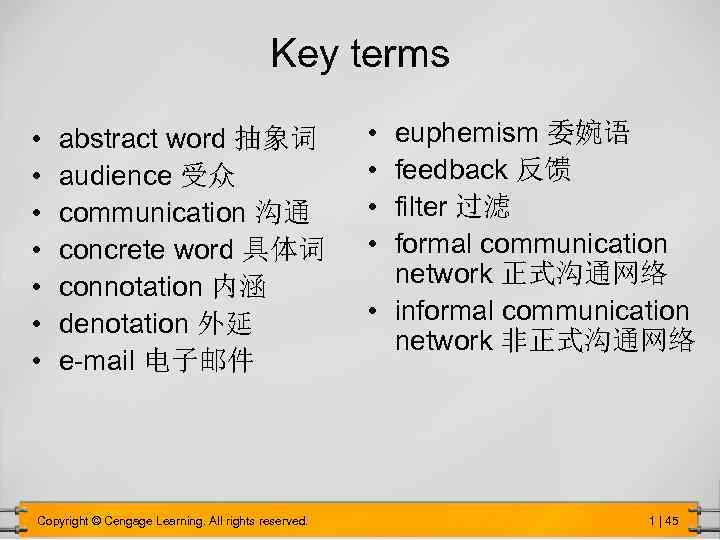
Key terms • • abstract word 抽象词 audience 受众 communication 沟通 concrete word 具体词 connotation 内涵 denotation 外延 e-mail 电子邮件 Copyright © Cengage Learning. All rights reserved. • • euphemism 委婉语 feedback 反馈 filter 过滤 formal communication network 正式沟通网络 • informal communication network 非正式沟通网络 1 | 45
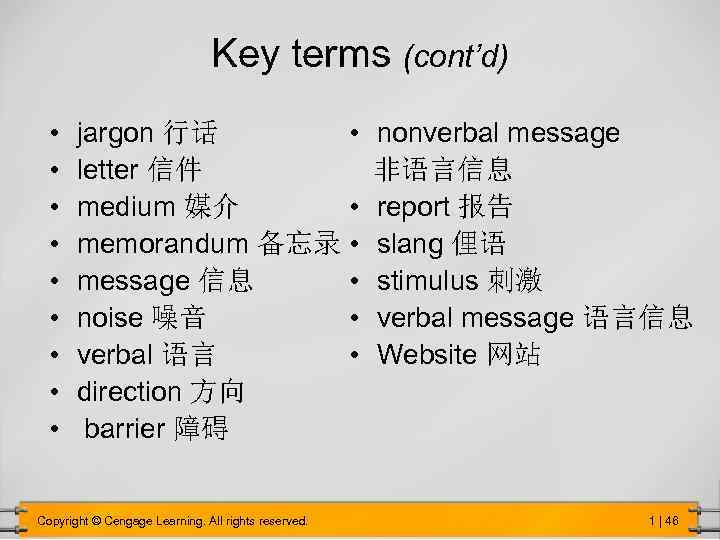
Key terms (cont’d) • • • jargon 行话 • nonverbal message letter 信件 非语言信息 medium 媒介 • report 报告 memorandum 备忘录 • slang 俚语 message 信息 • stimulus 刺激 noise 噪音 • verbal message 语言信息 verbal 语言 • Website 网站 direction 方向 barrier 障碍 Copyright © Cengage Learning. All rights reserved. 1 | 46
Excercise • • • Which component is not required for communication to take place? a) feedback b) medium c) stimulus d) message e) filter Copyright © Cengage Learning. All rights reserved. 1 | 47
Excercise • • • Which of the following creates the need for someone to initiate communication? a) medium b) filter c) message d) stimulus e) denotation Copyright © Cengage Learning. All rights reserved. 1 | 48
Excercise • • • Your unique perception of reality acts as a ______ when you are interpreting a stimulus. a) nonverbal message b) medium c) filter d) feedback mechanism e) communication process Copyright © Cengage Learning. All rights reserved. 1 | 49
Excercise • • • Which of the following is not an example of a filter? a) personality b) culture c) socioeconomic status d) communication medium e) an individual's emotional state Copyright © Cengage Learning. All rights reserved. 1 | 50
Excercise • • • A(n) ______ is an example of an oral medium. a) news conference b) hand gesture c) e-mail d) facial expression e) newsgroup Copyright © Cengage Learning. All rights reserved. 1 | 51
Excercise • • • When a message you transmit reaches its destination, it becomes a) feedback for the receiver. b) a stimulus for the receiver. c) a medium for the receiver. d) a filter for the receiver. e) a communication channel for the receiver. Copyright © Cengage Learning. All rights reserved. 1 | 52
Excercise • • • If you put on a puzzled look as a coworker tries to explain the company's new sick-leave policy, you are a) using a nonverbal medium to filter the message. b) adding noise to the communication environment. c) providing an internal stimulus for your audience. d) simultaneously sending and receiving a message. e) eliminating the feedback portion of the process. Copyright © Cengage Learning. All rights reserved. 1 | 53
Excercise • • • Which of the following statements is not true of verbal communication? a) The ability to communicate by using words separates humans from the rest of the animal kingdom. b) Our verbal ability allows us to learn from the past. c) Verbal communication consists of spoken words only. d) Oral communication allows more ways to get a message across. e) Listening is required for oral communication to be effective. Copyright © Cengage Learning. All rights reserved. 1 | 54
Excercise • • • To avoid annoying your audience, do not ______ when using oral communication. a) whine, nag, or complain b) add nonverbal clues to enhance the meaning of your message c) use your tone of voice to emphasize particular ideas d) request feedback e) answer questions you are asked Copyright © Cengage Learning. All rights reserved. 1 | 55
Excercise • • • The purpose of a report is to a) clarify any questions the receiver may have. b) present information for decision making and problem solving. c) avoid nonverbal clues that contribute to noise. d) offer additional information immediately if needed by the audience. e) share information in an informal medium. Copyright © Cengage Learning. All rights reserved. 1 | 56
Excercise • • • A professor who sends an e-mail to her students to explain the requirements for a class project is engaging in ______ communication. a) upward b) downward c) horizontal d) cross-channel e) nonverbal Copyright © Cengage Learning. All rights reserved. 1 | 57
Excercise • • • _____ communication occurs when peers within a department share ideas, coordinate activities, and negotiate differences. a) Upward b) Downward c) Horizontal d) Vertical e) Cross-channel Copyright © Cengage Learning. All rights reserved. 1 | 58
Excercise • • • Which of the following is an example of cross-channel communication? a) Your supervisor sends you an e-mail that lists your strengths and weaknesses. b) Three state senators discuss the pros and cons of passing new laws against hate crimes. c) The vice president of marketing prepares a report to share with the regional sales representatives. d) You respond to an internal survey conducted by a colleague from another department. e) You prepare a year-end sales report for your supervisor's approval. Copyright © Cengage Learning. All rights reserved. 1 | 59
Excercise • • • You are using the grapevine when you a) ask top management, during a company meeting, about the company's recent merger. b) write a memo to your boss suggesting how to publicize the company's recent merger. c) post a news release on your company's website announcing its recent merger. d) write an article for your company's newsletter, quoting the CEO's comments about the recent merger. e) discuss the company's recent merger while you carpool with a coworker. Copyright © Cengage Learning. All rights reserved. 1 | 60
Excercise • • • Which of the following is another term for the grapevine? a) upward communication network b) cross-channel communication network c) horizontal communication network d) downward communication network e) informal communication network Copyright © Cengage Learning. All rights reserved. 1 | 61
Excercise • • • Which statement about the grapevine is correct? a) It moves information rapidly through the organization. b) It is less active during times of uncertainty, such as layoffs, mergers, and branch closings. c) Most of the information communicated through the grapevine pertains to personal matters. d) Information spread through the grapevine is usually incomplete. e) It is not an important communication network in large organizations. Copyright © Cengage Learning. All rights reserved. 1 | 62
Excercise • • • Which of the following is not a verbal barrier to communication? a) inadequate knowledge b) differences in interpretation c) language differences d) inappropriate use of expressions e) specific, concrete words Copyright © Cengage Learning. All rights reserved. 1 | 63
Excercise • • • Which of the following best describes jargon? a) a fad expression that is short-lived b) a polite expression that is used to soften the impact of an unpleasant situation c) a cultural tradition d) efficient terminology when communicating within specialized groups e) a denotative phrase that characterizes vertical communication Copyright © Cengage Learning. All rights reserved. 1 | 64
Excercise • • • Which of the following is an abstract word? a) letter b) memorandum c) e-mail d) report e) communication Copyright © Cengage Learning. All rights reserved. 1 | 65
Excercise • • • Which statement contains abstract or ambiguous language? a) Tony's e-mail contains five misspelled words. b) More than 76 percent of the employees belong to a union. c) At least eight associates submitted their expense reports after the deadline. d) The office manager purchased 15 cartons of paper for delivery on Tuesday. e) The customer service department received some complaints today. Copyright © Cengage Learning. All rights reserved. 1 | 66
Excercise • Describe the importance of communication in today's business world. Copyright © Cengage Learning. All rights reserved. 1 | 67
Excercise • Describe at least three advantages that oral communication has over written communication. Provide an example of a situation in which oral communication would be more effective than written communication. Copyright © Cengage Learning. All rights reserved. 1 | 68
Excercise • Briefly describe a personal example of upward, downward, and horizontal communication in your life. Copyright © Cengage Learning. All rights reserved. 1 | 69
Excercise • What is the informal communication network? How effective is it? How does an effective manager deal with it? Copyright © Cengage Learning. All rights reserved. 1 | 70
Excercise • Define the terms slang, jargon, and euphemism. When is each type of expression appropriate? When do problems arise? Copyright © Cengage Learning. All rights reserved. 1 | 71
Excercise • Give an original example of a nonverbal message that reinforces a verbal message and of a nonverbal message that contradicts a verbal message. Copyright © Cengage Learning. All rights reserved. 1 | 72
Скачать презентацию Business Communication and Etiquette in Chinese Fei Gao
1Understanding Business Communication.ppt