 Скачать презентацию Business 16 Stanford Department of Continuing Education Class
bc6eaad184ad15a8641f75dc4ea502fe.ppt
- Количество слайдов: 22



Business 16 Stanford Department of Continuing Education Class # 8, 11/16/09 Getting Liquid Guest: David Liu Managing Director Internet/Software Investment Banking, Jeffries & Co.
What the #@%&*! does that mean? o Selling your company o Trading stock for cash o Start with “illiquid securities” o Get “liquid securities” or cash o Overall spending plan o Taking your company “public” o IPO: Initial Public Offering o Selling your shares to the unqualified public
Going public o SEC (Securities & Exchange Commission) (www. sec. gov) o Heavily regulates what you can sell to “widows and orphans” o In the days of Robber Barons, many abuses o Now there a huge number of laws dedicated to ensuring adherence to procedures and accurate disclosure o As a result, going public is a pain in the #@? !%
Sounds ugly. What are the benefits of going public? o You can raise large amounts of money from the o o sale of stock You can do it at prices (in general) cheaper than venture capital You can gain partial liquidity without having to lose control of your company (maybe) and continue to participate in its upside undiluted (relatively) Your employees can achieve the liquidity you promised Your stock has greater value (or at least a value) when considering acquisitions
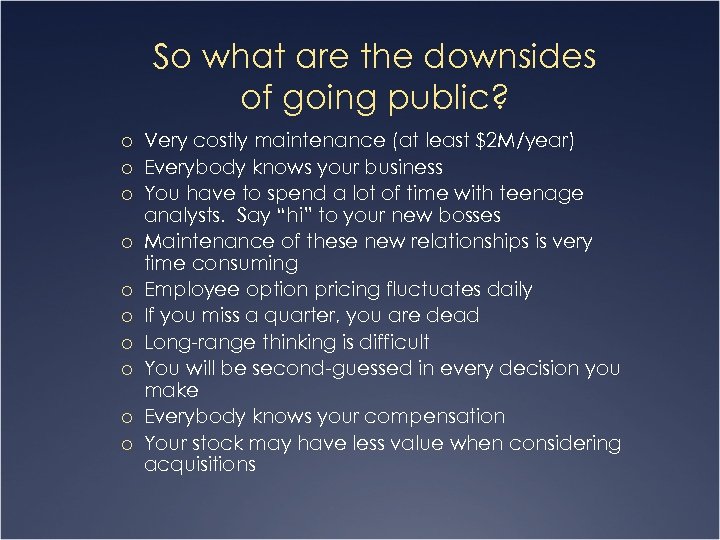
So what are the downsides of going public? o Very costly maintenance (at least $2 M/year) o Everybody knows your business o You have to spend a lot of time with teenage o o o o analysts. Say “hi” to your new bosses Maintenance of these new relationships is very time consuming Employee option pricing fluctuates daily If you miss a quarter, you are dead Long-range thinking is difficult You will be second-guessed in every decision you make Everybody knows your compensation Your stock may have less value when considering acquisitions
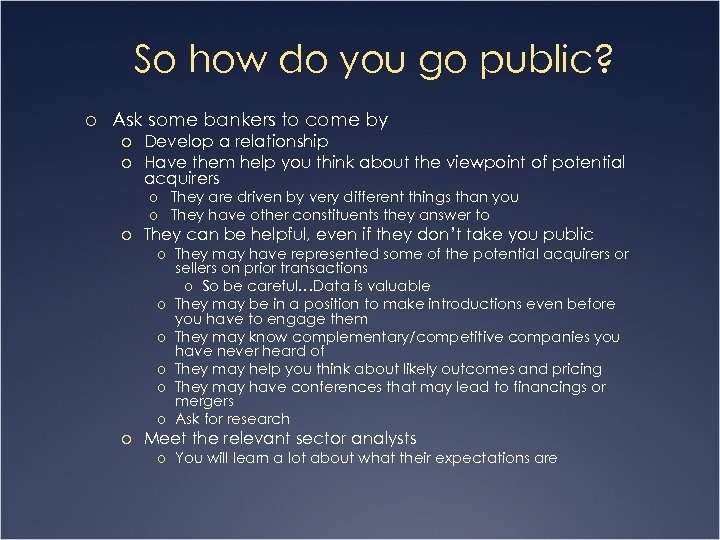
So how do you go public? o Ask some bankers to come by o Develop a relationship o Have them help you think about the viewpoint of potential acquirers o They are driven by very different things than you o They have other constituents they answer to o They can be helpful, even if they don’t take you public o They may have represented some of the potential acquirers or o o o sellers on prior transactions o So be careful…Data is valuable They may be in a position to make introductions even before you have to engage them They may know complementary/competitive companies you have never heard of They may help you think about likely outcomes and pricing They may have conferences that may lead to financings or mergers Ask for research o Meet the relevant sector analysts o You will learn a lot about what their expectations are
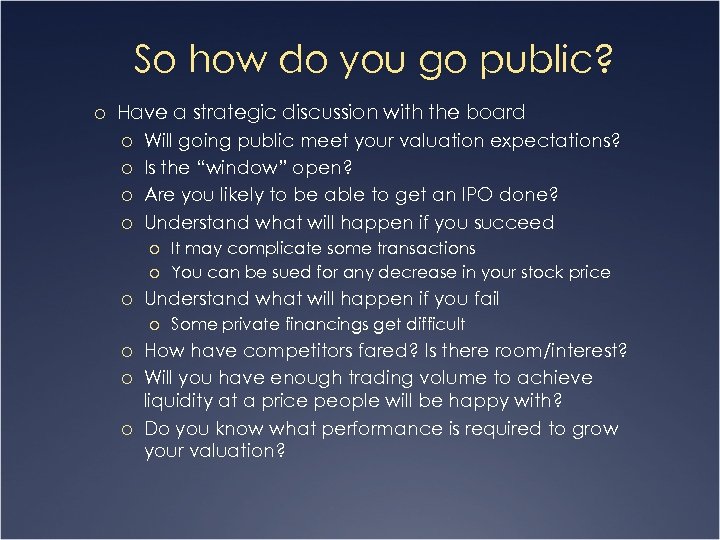
So how do you go public? o Have a strategic discussion with the board o Will going public meet your valuation expectations? o Is the “window” open? o Are you likely to be able to get an IPO done? o Understand what will happen if you succeed o It may complicate some transactions o You can be sued for any decrease in your stock price o Understand what will happen if you fail o Some private financings get difficult o How have competitors fared? Is there room/interest? o Will you have enough trading volume to achieve liquidity at a price people will be happy with? o Do you know what performance is required to grow your valuation?
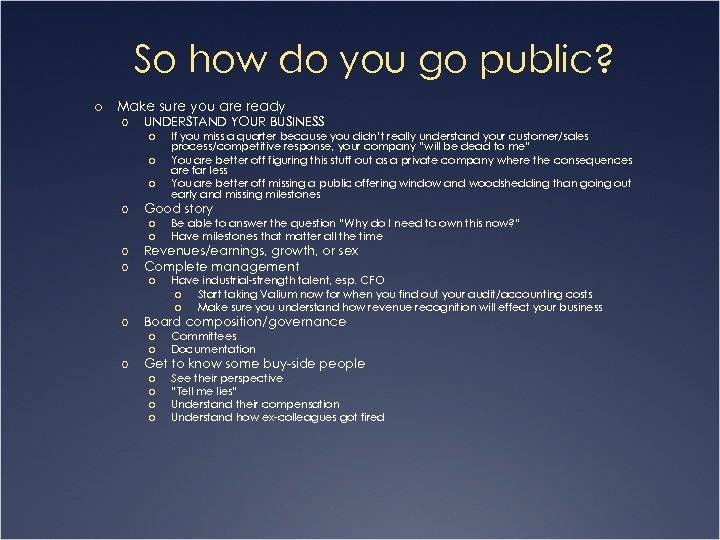
So how do you go public? o Make sure you are ready o UNDERSTAND YOUR BUSINESS o o Good story o o Have industrial-strength talent, esp. CFO o Start taking Valium now for when you find out your audit/accounting costs o Make sure you understand how revenue recognition will effect your business Board composition/governance o o o Be able to answer the question “Why do I need to own this now? ” Have milestones that matter all the time Revenues/earnings, growth, or sex Complete management o o If you miss a quarter because you didn’t really understand your customer/sales process/competitive response, your company “will be dead to me” You are better off figuring this stuff out as a private company where the consequences are far less You are better off missing a public offering window and woodshedding than going out early and missing milestones Committees Documentation Get to know some buy-side people o o See their perspective “Tell me lies” Understand their compensation Understand how ex-colleagues got fired
So how do you go public? o After a while, you or your banker will tired of an unconsummated relationship They worry that after all the favors they did for you, you will go with someone else You are worried they will represent somebody else o o o Invite bankers in for a “beauty contest” o They will try to show you that they know about your industry sector Most really won’t o o They will try to show you that they are really well connected Most aren’t You need to know that they have relationships with all the senior management in referenced companies, not junior bat boys Better yet are people that have actually completed transactions with the reference companies o Everything else is just talk o Don’t let somebody learn on your nickel o o They pitch you about why: o o o They are the greatest They have done a bunch of deals in your area The aftermarket value of all their deals is multiples of the IPO valuation They claim to be able to get an astronomical valuation with their institutional clients They have a proprietary or trust relationship with the buy-side
So how do you go public? o Then VCs/board “add value” o When the bankers leave, they judge the beauty contest o Poise, grace, flattery, analyst coverage and valuations important considerations o It is easy to fake valuations, though, so understand what they are saying o They should give you several tables of valuation comps to help you think of how your industry looks at companies like yours o Sometimes, the truth hurts o Your baby may actually be ugly or just average o Also, what were the last few hot deals the bank had o What other useful industrial relationships they have o Usually, they split the decision and invite more than one o The banks hate this o VCs don’t care; risk reduction o So you sign the deal, and they get 7% of the money they raise, plus expenses o Plus, there is usually a “tail” that requires you to use them in subsequent transactions o Make sure that you are only bound by a tail if the same people are still employed by the bank o If your banker or analyst moves on, you could end up an orphan
So how do you go public? o Now you start the “drafting sessions” o Usually at the lawyers’ offices o The bankers show up o So does senior management o So do the lawyers (bankers’ and company’s) o You draft a “red herring” o Prospectus o Sanitized o Risks such as the Leonid meteor shower are included o No forward looking statement that can’t be justified o It all goes to the SEC for comment & approval
So how do you go public? o By now, the SEC has made their comments, and the company replies to these questions/comments and waits for a response back. And waits and waits and waits and waits and waits and waits and waits o When you have answered all of their questions, the company is legally ready to “go effective”
So how do you go public? o Next, your investment banker and your senior company management travel around the world (NY, Chicago, London, Geneva, Hoboken, etc) to meet potential buyers of your stock o These people are called the “buy side” of the transaction o Your banker is taking their temperature throughput the meetings, usually at hotels local to the buyer for breakfast, lunch and dinner o These buy-side people are from investment firms (like Fidelity, T Rowe Price), insurance companies (like Allstate), and many small and large funds (Deerfield)
So how do you go public? o In the process, your bankers (the “Book Runners”) start filling “the Book” o They ask how much stock buyers want and at what price o They get some idea as to price elasticity o When they are several times oversubscribed, they are ready to price & “go effective”
So how do you go public? o The night before the IPO, there is a “pricing meeting” o The bankers claim that despite their best efforts, last minute changes in the market/government/Israeli Palestinian peace agreement/chicken entrails mean that they could only get you 1/2 the price that you wanted o The VCs start crying “I thought you said you loved me? ” o The bankers start crying “I know what I said. But my buy-side friends…I’m so confused” o A price is agreed on o The VCs think the bankers are lying scum o The bankers think the VCs are lying scum
So how do you go public? o The company goes public o The buyers pay their cash to the bankers, who then give 90% of the money to the company o Shares start trading o The bankers have priced the shares at a discount to get o o somebody to buy them o A lot of these guys are momentum players o They wait for the price to rise high enough to screw other momentum players Everybody wants long-term holders The VCs own a big piece of the company, can’t sell for 6 months They watch the price skyrocket, then miraculously a few days before the VCs can sell, crater Insiders can sell, but only in certain windows, and even then you can get sued
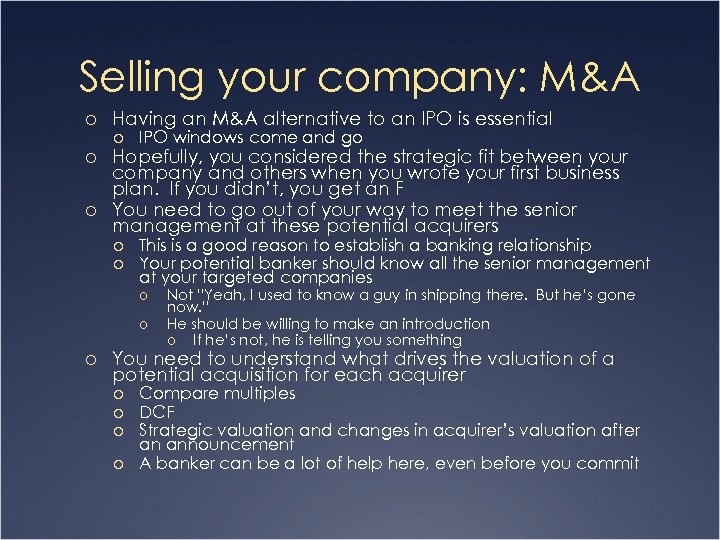
Selling your company: M&A o Having an M&A alternative to an IPO is essential o IPO windows come and go o Hopefully, you considered the strategic fit between your company and others when you wrote your first business plan. If you didn’t, you get an F o You need to go out of your way to meet the senior management at these potential acquirers o o This is a good reason to establish a banking relationship Your potential banker should know all the senior management at your targeted companies o o Not ”Yeah, I used to know a guy in shipping there. But he’s gone now. ” He should be willing to make an introduction o If he’s not, he is telling you something o You need to understand what drives the valuation of a potential acquisition for each acquirer Compare multiples DCF Strategic valuation and changes in acquirer’s valuation after an announcement o A banker can be a lot of help here, even before you commit o o o
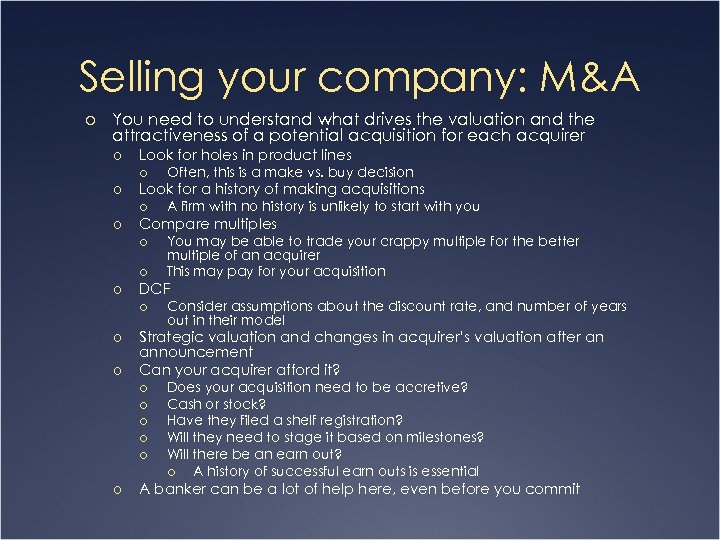
Selling your company: M&A o You need to understand what drives the valuation and the attractiveness of a potential acquisition for each acquirer o Look for holes in product lines o o Look for a history of making acquisitions o o Consider assumptions about the discount rate, and number of years out in their model Strategic valuation and changes in acquirer’s valuation after an announcement Can your acquirer afford it? o o o You may be able to trade your crappy multiple for the better multiple of an acquirer This may pay for your acquisition DCF o o A firm with no history is unlikely to start with you Compare multiples o o Often, this is a make vs. buy decision Does your acquisition need to be accretive? Cash or stock? Have they filed a shelf registration? Will they need to stage it based on milestones? Will there be an earn out? o A history of successful earn outs is essential A banker can be a lot of help here, even before you commit
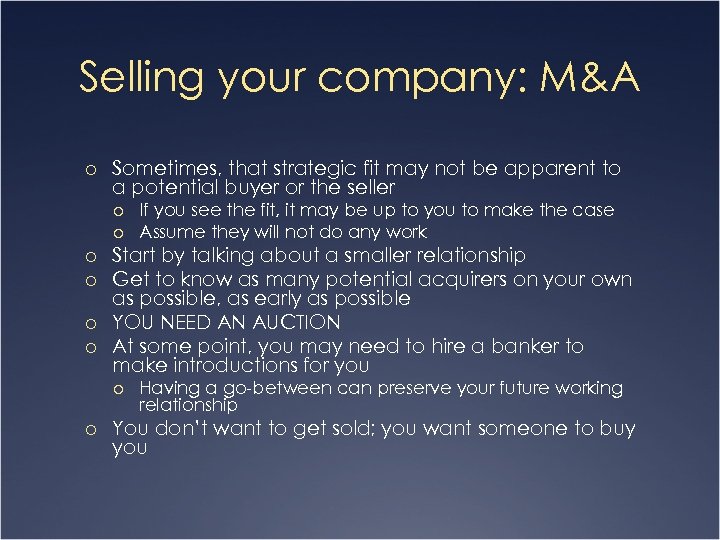
Selling your company: M&A o Sometimes, that strategic fit may not be apparent to a potential buyer or the seller o If you see the fit, it may be up to you to make the case o Assume they will not do any work o Start by talking about a smaller relationship o Get to know as many potential acquirers on your own as possible, as early as possible o YOU NEED AN AUCTION o At some point, you may need to hire a banker to make introductions for you o Having a go-between can preserve your future working relationship o You don’t want to get sold; you want someone to buy you
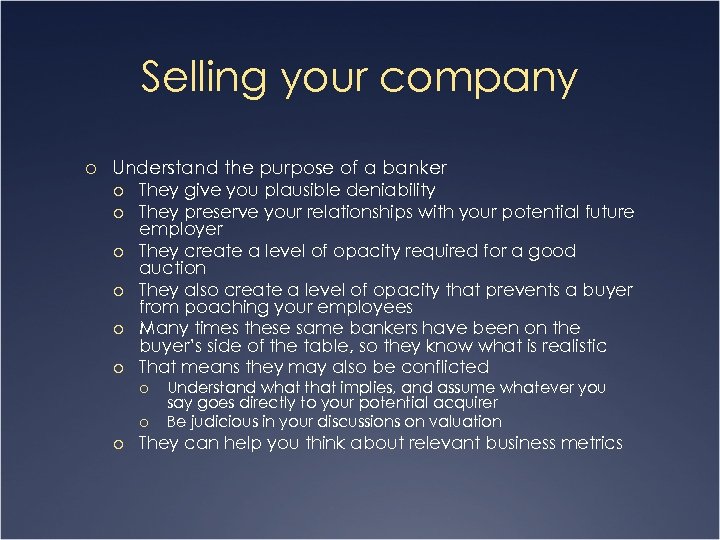
Selling your company o Understand the purpose of a banker o They give you plausible deniability o They preserve your relationships with your potential future employer o They create a level of opacity required for a good auction o They also create a level of opacity that prevents a buyer from poaching your employees o Many times these same bankers have been on the buyer’s side of the table, so they know what is realistic o That means they may also be conflicted o o Understand what that implies, and assume whatever you say goes directly to your potential acquirer Be judicious in your discussions on valuation o They can help you think about relevant business metrics
Selling your company o A banker can rarely do anything for you that you o o have not already thought through yourself They can help you mature a process at a pace that maximizes the chance of multiple bidders They set up a “data room” that allows you to see who is actually looking through your stuff They help you manage all of these relationships and minimizing pissing anybody off They have usually have minimums (usually $1 -2 M)
Dividendizizing/annuitizing (? !? ) your company o In many companies (restaurants, machine shops, o o hair dressers), a natural acquirer is not obvious Liquidity in these kinds of small businesses can occur by distributing the profits in cash at the end of each year There are lots of tax implications in how you do this, so make sure you have competent tax/accounting advice Your lawyer should be able to help you with this A track record of large dividends may actually help you find an acquirer where none was obvious
Скачать презентацию Business 16 Stanford Department of Continuing Education Class
bc6eaad184ad15a8641f75dc4ea502fe.ppt