 Скачать презентацию Burn Barrel Reduction Campaign Why are we
bd39beaff07f226f047d7c6d71ec2108.ppt
- Количество слайдов: 25



Burn Barrel Reduction Campaign
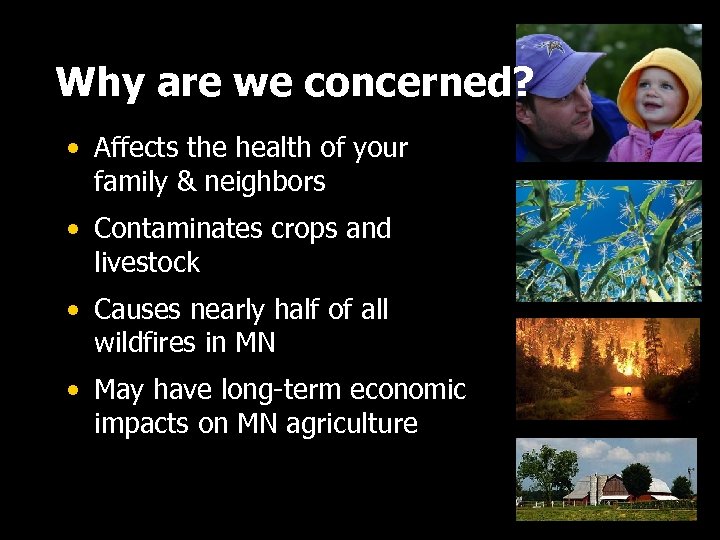
Why are we concerned? • Affects the health of your family & neighbors • Contaminates crops and livestock • Causes nearly half of all wildfires in MN • May have long-term economic impacts on MN agriculture
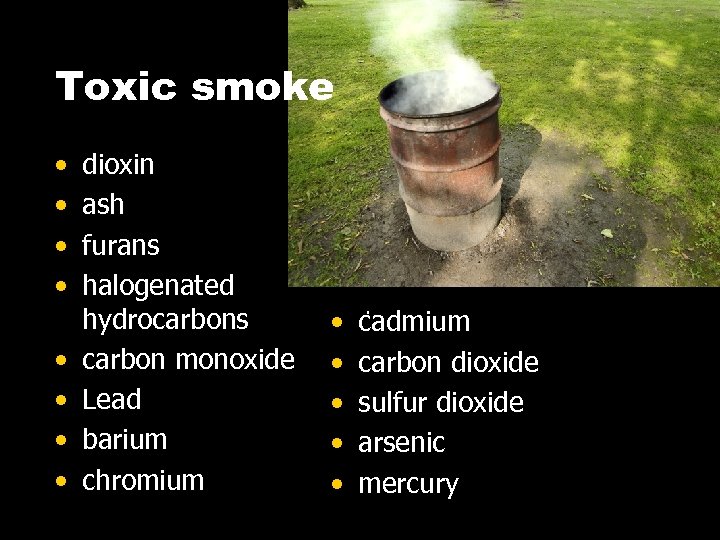
Toxic smoke • • dioxin ash furans halogenated hydrocarbons carbon monoxide Lead barium chromium • • • cadmium carbon dioxide sulfur dioxide arsenic mercury
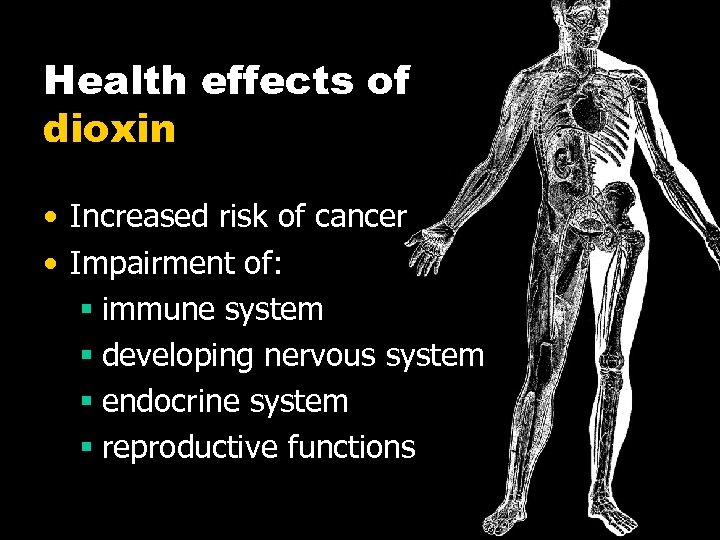
Health effects of dioxin • Increased risk of cancer • Impairment of: § immune system § developing nervous system § endocrine system § reproductive functions
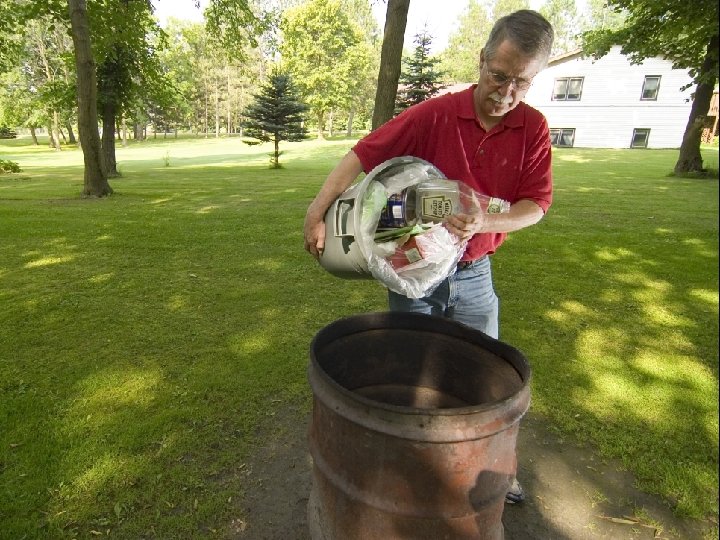
Backyard burning vs. municipal incinerators • Burn barrel temperatures rarely exceed 500 F so combustion is incomplete. • Municipal incinerators operate at 2, 200 F to ensure complete combustion, and use efficient filters to reduce harmful emissions. • Garbage burned in a burn barrel gives off twice as many furans, 40 times as much ash, and as much or more dioxin as a municipal incinerator (and may be much higher depending on what’s burned).
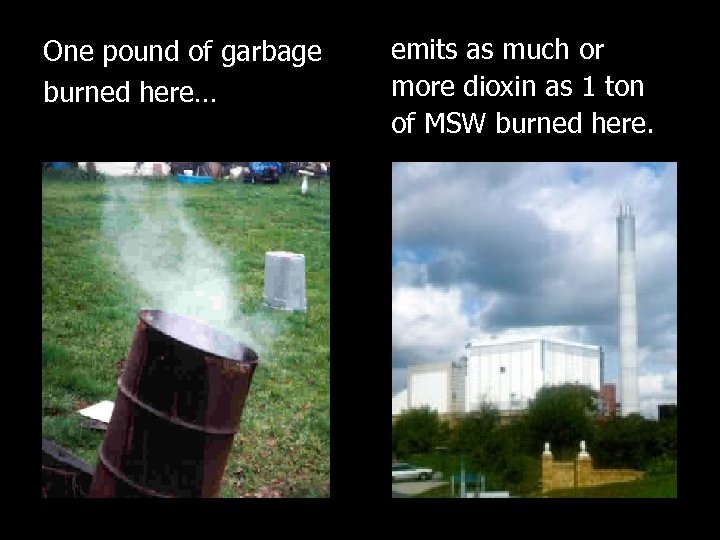
One pound of garbage burned here… emits as much or more dioxin as 1 ton of MSW burned here.
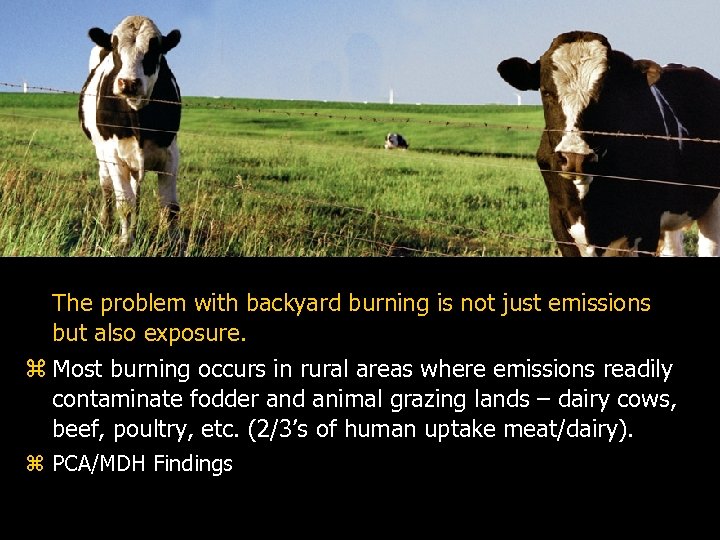
The problem with backyard burning is not just emissions but also exposure. z Most burning occurs in rural areas where emissions readily contaminate fodder and animal grazing lands – dairy cows, beef, poultry, etc. (2/3’s of human uptake meat/dairy). z PCA/MDH Findings
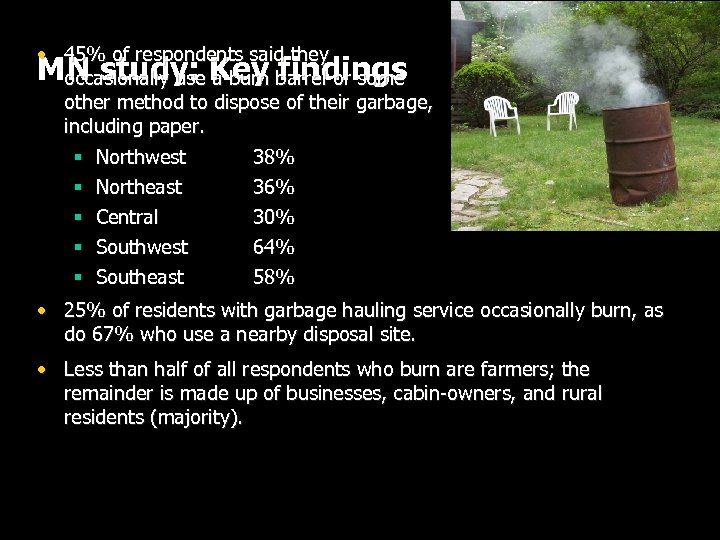
• 45% of respondents said they MN study: Key barrel or some occasionally use a burn findings other method to dispose of their garbage, including paper. § Northwest 38% § Northeast 36% § Central 30% § Southwest 64% § Southeast 58% • 25% of residents with garbage hauling service occasionally burn, as do 67% who use a nearby disposal site. • Less than half of all respondents who burn are farmers; the remainder is made up of businesses, cabin-owners, and rural residents (majority).
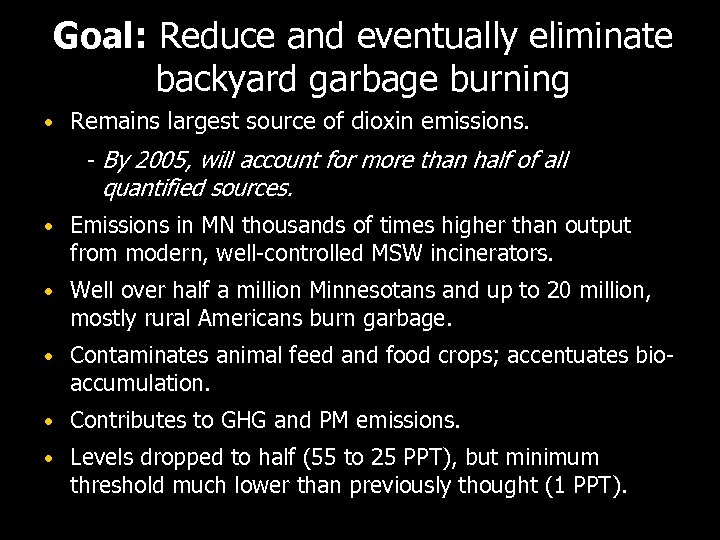
Goal: Reduce and eventually eliminate backyard garbage burning • Remains largest source of dioxin emissions. - By 2005, will account for more than half of all quantified sources. • Emissions in MN thousands of times higher than output from modern, well-controlled MSW incinerators. • Well over half a million Minnesotans and up to 20 million, mostly rural Americans burn garbage. • Contaminates animal feed and food crops; accentuates bioaccumulation. • Contributes to GHG and PM emissions. • Levels dropped to half (55 to 25 PPT), but minimum threshold much lower than previously thought (1 PPT).
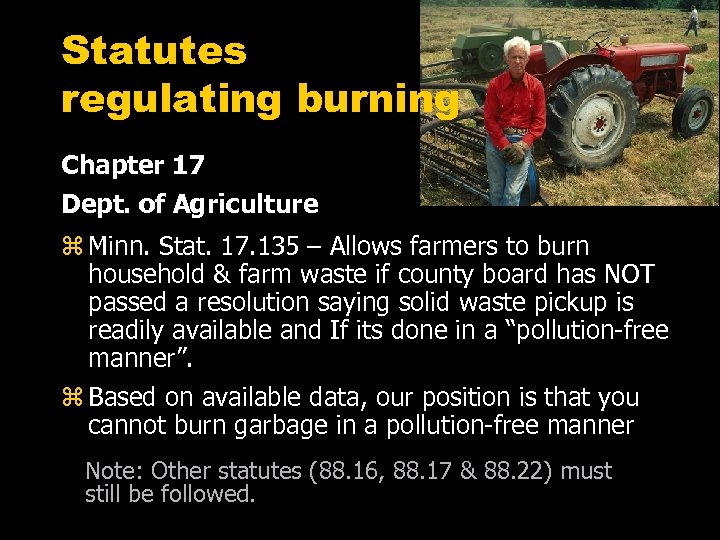
Statutes regulating burning Chapter 17 Dept. of Agriculture z Minn. Stat. 17. 135 – Allows farmers to burn household & farm waste if county board has NOT passed a resolution saying solid waste pickup is readily available and If its done in a “pollution-free manner”. z Based on available data, our position is that you cannot burn garbage in a pollution-free manner Note: Other statutes (88. 16, 88. 17 & 88. 22) must still be followed.
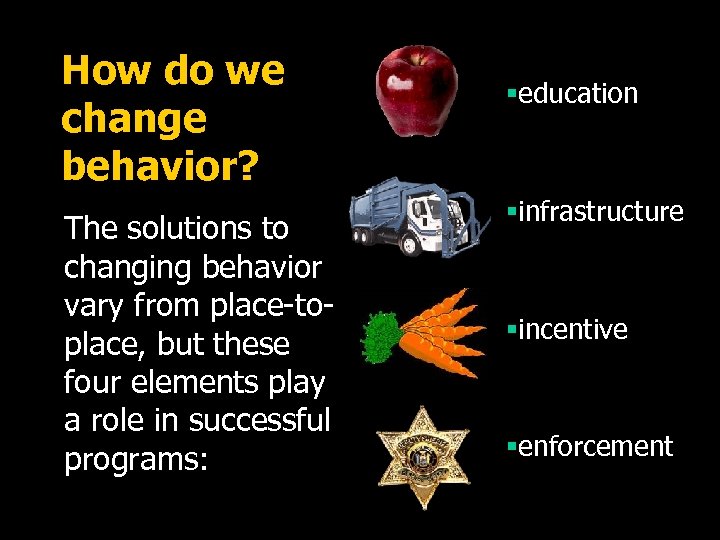
How do we change behavior? The solutions to changing behavior vary from place-toplace, but these four elements play a role in successful programs: §education §infrastructure §incentive §enforcement
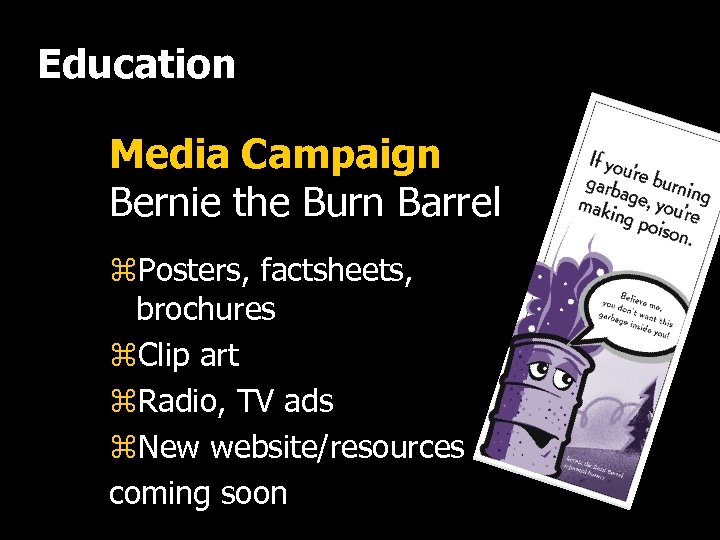
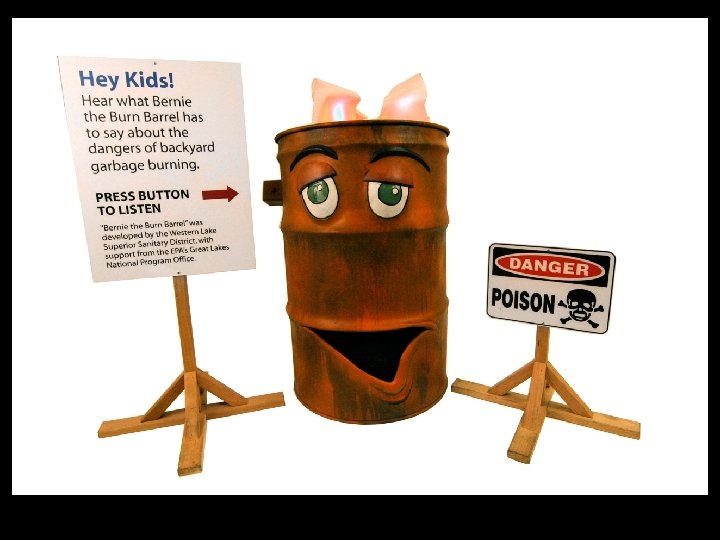
Education Media Campaign Bernie the Burn Barrel z. Posters, factsheets, brochures z. Clip art z. Radio, TV ads z. New website/resources coming soon
Infrastructure z. Hauler coverage z. Staffed and un-staffed drop-off sites z. Houston County rural sheds y. Reduced dumping/burning y. Per-HH fee funds y. Paying for it so residents use y. Become a place to catch up w/ neighbors
Incentives Burn Barrel Buy-Back Program z. Chisago passed County no-burn resolution y. Teamed up w/ haulers and offered ½ price garbage service for 6 months y. Sign no-burn pledge, turn in barrel y. Cut burn barrel use nearly in ½ in 4 years z. Subsidized township/county drop-sites
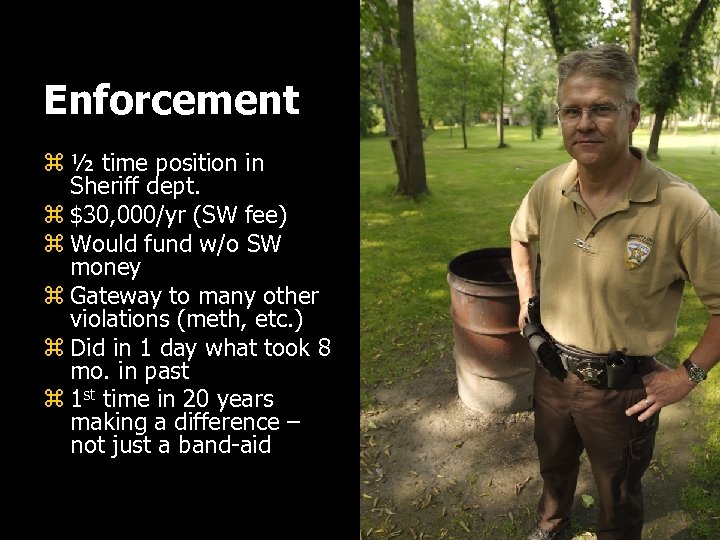
Enforcement z ½ time position in Sheriff dept. z $30, 000/yr (SW fee) z Would fund w/o SW money z Gateway to many other violations (meth, etc. ) z Did in 1 day what took 8 mo. in past z 1 st time in 20 years making a difference – not just a band-aid
Many partners • • counties cities townships farmers haulers DNR Dept. of Ag MDH • • • EPA businesses extension lake associations fire department insurance companies • citizens • elected officials
Updates z Funding 5 burn barrel reduction projects in NE, SW, East Central MN, & statewide (CLIMB) z 2008 grant round (likely January) – Similar to 1 st and 2 nd round with focused priority areas z Met with Ag Commish and staff – supportive of campaign approach; promoted via newsletters and other events to educate z Met with Farmers Union, Farm Bureau, and MN Milk – Interest in partnering on reduction and education initiatives – developing articles z New and revised resources and website
Campaign basics • Strategic plan goal: Reduce emissions by 50% by 2008 • 2005 Solid Waste Policy Report recommends: § Eliminate burn barrels by 2010. § 2006 -2010: Work on reduction initiatives. § Report to 2007 Legislature on effectiveness of reduction initiatives.
Campaign basics Phase One • Do regional and county board presentations – educate on issues, program ideas, grants, noburn resolutions. • Ask the question “What will it take to get your residents to change their behavior? ” • Fund and support local/regional burn barrel buyback campaigns and related reduction/education initiatives.
Campaign basics Phase Two • Continue reduction initiatives and grants • Develop updated education and media pieces for targeted groups that can be customized (e. g. , Bernie the Burn Barrel). • Report progress to Legislature, recommend further steps, & discuss phased statewide ban (2007 SWPR recommendation)
Discussion w/ regional staff z. Next 2 years and beyond: y. Get counties and LUG’s prepared for 2010 x. Promote educational resources x. Implement local reduction efforts (including grants, promoting buy-backs*, etc. ) x. Understand gaps in service/drop-sites and address x. Team up with local enforcement (determine what PCA can do) x. Work to pass local no-burn resolutions leading to 2010 x Ultimately, need to conduct 87 county inventory so we can understand address barriers (tie in w/ proposed legislative temporary exemption) *Need more haulers actively promoting; testimonials
Next Steps z. Convene burn barrel forum and lay out process for more effective enforcement (tie in w/ education and reduction efforts) z. Actively enforce current no-burn laws for cities
Next Steps z Continue campaign y. Work with partners (counties, townships, etc. ) y. Grants, technical assistance, etc. z Hire student worker – start date 1/23 y. Bernie guide, work w/ lake assoc, help with local efforts (resolutions, program help, etc. ), develop web resources z 2008 Legislative Session y. Discuss 2007 SWPR recommendations & 2010 phaseout
Скачать презентацию Burn Barrel Reduction Campaign Why are we
bd39beaff07f226f047d7c6d71ec2108.ppt