 Скачать презентацию Bureau Veritas International General Committee Oil tankers under
942327541776ba9b128bffb282655acc.ppt
- Количество слайдов: 29



Bureau Veritas International General Committee Oil tankers under the spotlight Paris, 26 June 2008 Nicholas Fistes Chairman of INTERTANKO
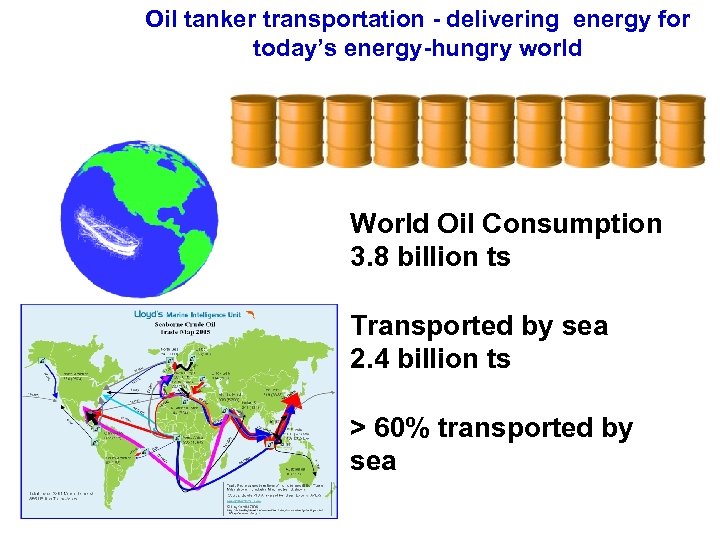
Oil tanker transportation - delivering energy for today’s energy-hungry world World Oil Consumption 3. 8 billion ts Transported by sea 2. 4 billion ts > 60% transported by sea
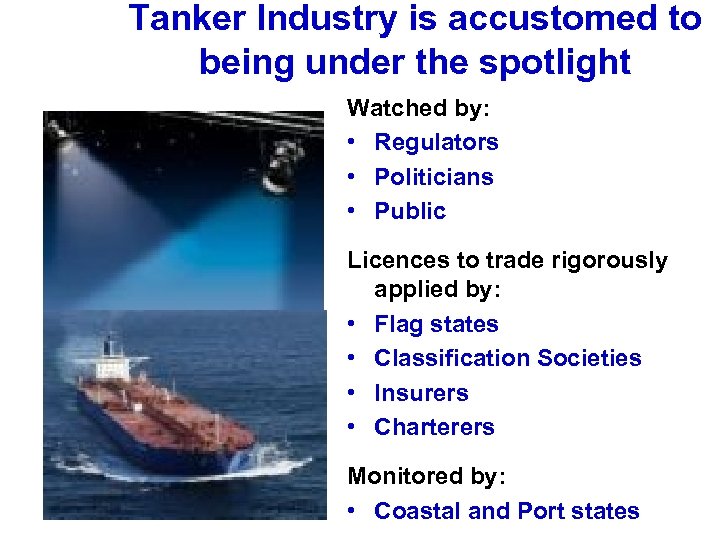
Tanker Industry is accustomed to being under the spotlight Watched by: • Regulators • Politicians • Public Licences to trade rigorously applied by: • Flag states • Classification Societies • Insurers • Charterers Monitored by: • Coastal and Port states
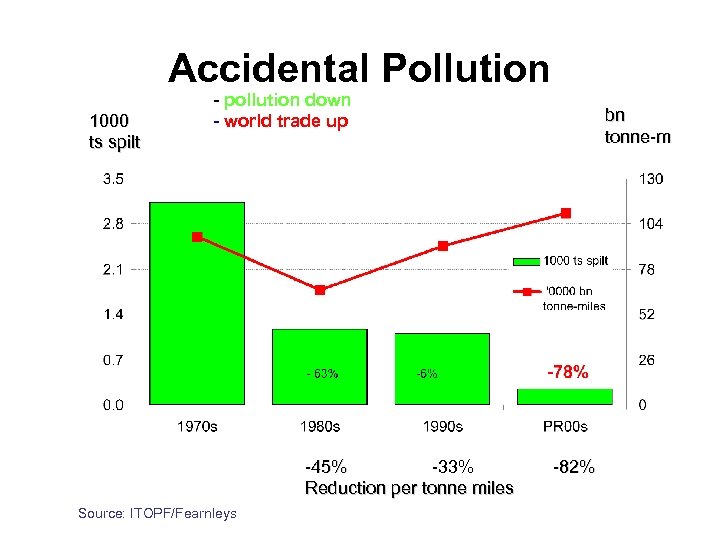
Accidental Pollution 1000 ts spilt - pollution down - world trade up -45% -33% Reduction per tonne miles Source: ITOPF/Fearnleys bn tonne-m -82%
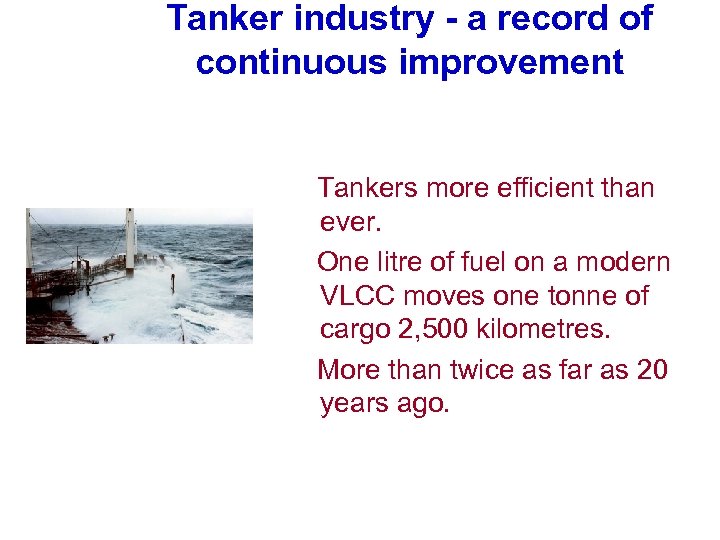
Tanker industry - a record of continuous improvement Tankers more efficient than ever. One litre of fuel on a modern VLCC moves one tonne of cargo 2, 500 kilometres. More than twice as far as 20 years ago.
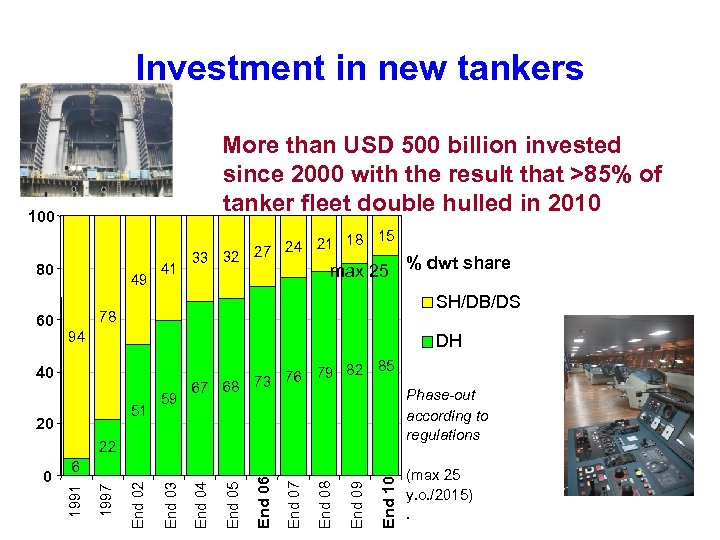
Investment in new tankers More than USD 500 billion invested since 2000 with the result that >85% of tanker fleet double hulled in 2010 100 80 SH/DB/DS 94 DH 40 20 22 85 76 79 82 67 68 73 Phase-out 59 51 according to regulations End 10 End 09 End 08 End 07 End 06 End 05 End 04 End 03 1997 6 1991 0 max 25 % dwt share 78 End 02 60 49 41 15 24 21 18 33 32 27 (max 25 y. o. /2015).
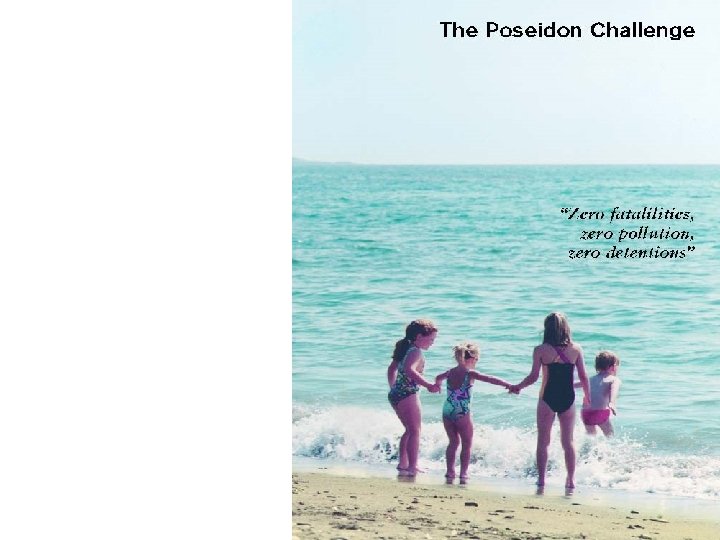
Proud of performance, but not complacent The tanker industry is proud of its performance … but it is not complacent as it faces the challenges… as it strives towards zero fatalities, zero pollution, zero detentions
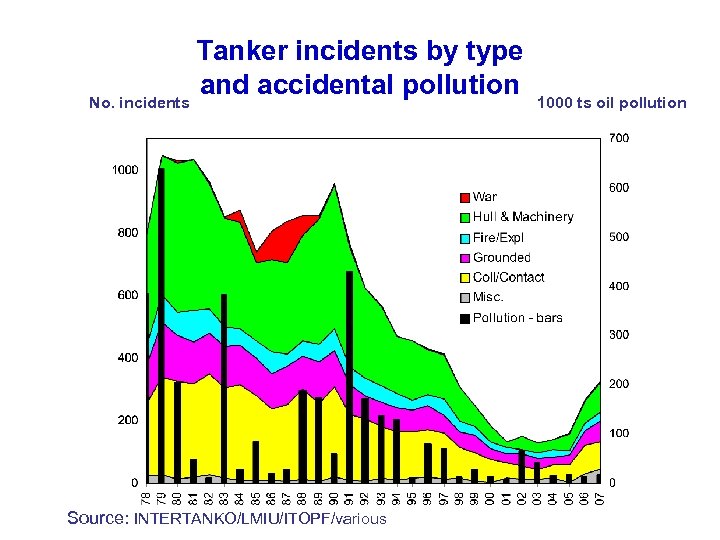
Tanker incidents by type and accidental pollution No. incidents Source: INTERTANKO/LMIU/ITOPF/various 1000 ts oil pollution
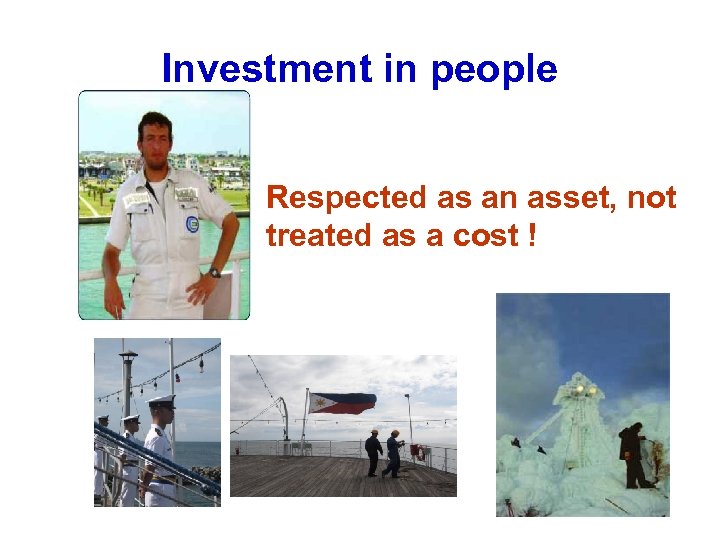
Investment in people Respected as an asset, not treated as a cost !
Investment in people • Cadet berths • Onboard training facilities • INTERTANKO’s Human Element in Shipping Committee • Training standards and criteria
INTERTANKO Tanker Officer Training Standards (TOTS) – providing the tanker industry with a clear standard of tanker officer competence • • • Eases compliance with officer matrix requirements Enhances tanker officers’ understanding Bridges the experience gap Provides core competency training and verification Helps reduce human factor element in accidents
TOTS: The Objective • TOTS establishes a new industry standard of training for Tanker Officers … assesses the competence acquired from onboard and shore training … ensures tanker officers’ competence for rank-specific shipboard operations as well as for specific tanker types (crude, product, chemical) and company-specific operating systems. • TOTS provides a viable alternative to “Time in Rank” and “Time with Company” measures and eases the problems that tanker owners encounter with the different “Officer Matrix” requirements of certain charterers. • TOTS also contributes to industry’s efforts aimed at reducing the human factor element in shipping incidents.
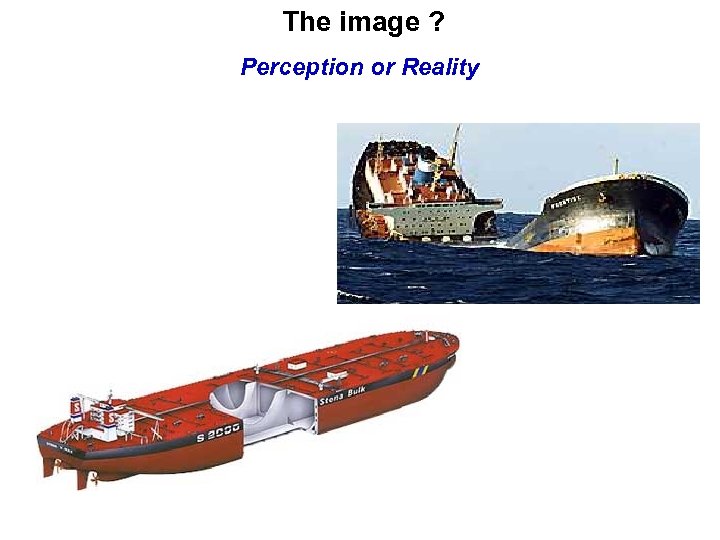
The image ? Perception or Reality

Criminalisation European Court of Justice EU Ship Source Pollution Directive
Fair treatment of seafarers • Shore leave denied • Crew changes prohibited • Access to medical treatment restricted • Excessive charges for terminal transits • Inadequate equipment
Too many inspections ! Adding unnecessarily to fatigue and stress - Failure to share information frequently results in inspections overlapping; and - improper targeting - frequently hitting the soft option both create their own problems
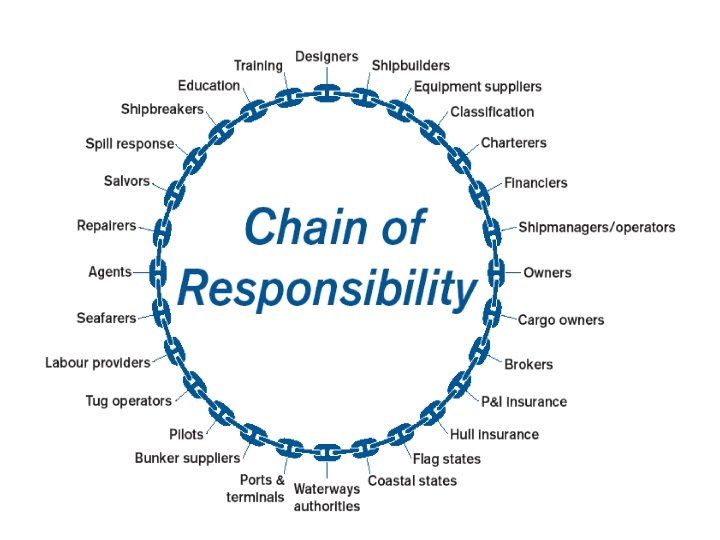

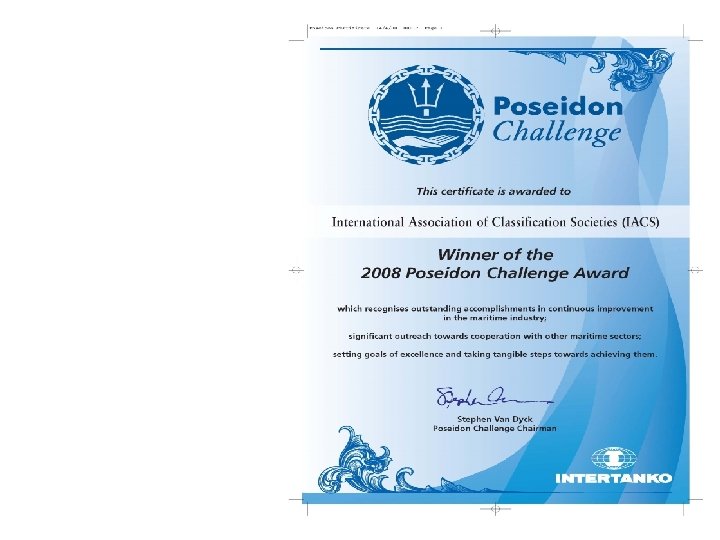
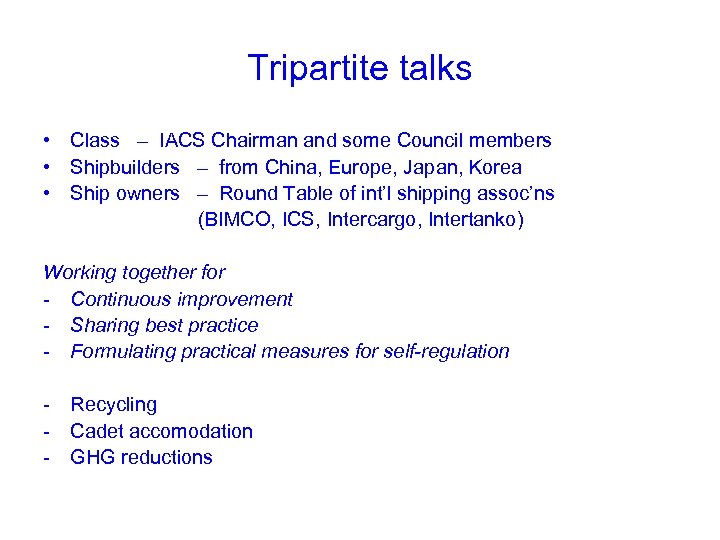
Tripartite talks • Class – IACS Chairman and some Council members • Shipbuilders – from China, Europe, Japan, Korea • Ship owners – Round Table of int’l shipping assoc’ns (BIMCO, ICS, Intercargo, Intertanko) Working together for - Continuous improvement - Sharing best practice - Formulating practical measures for self-regulation - Recycling - Cadet accomodation - GHG reductions
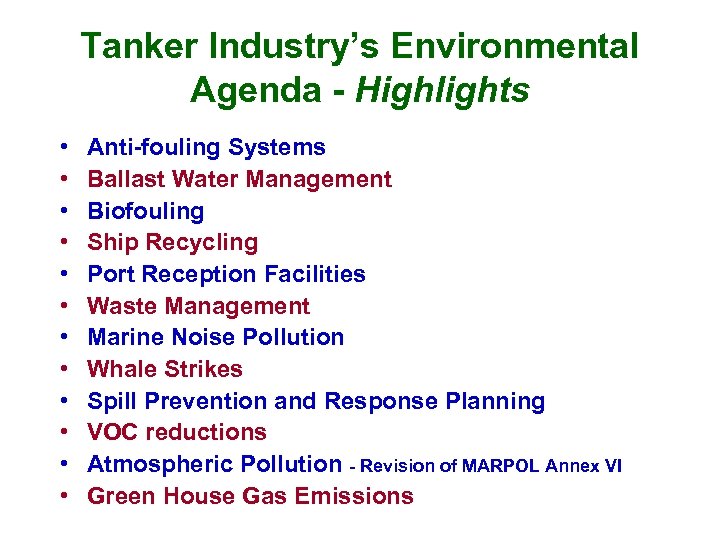
Tanker Industry’s Environmental Agenda - Highlights • • • Anti-fouling Systems Ballast Water Management Biofouling Ship Recycling Port Reception Facilities Waste Management Marine Noise Pollution Whale Strikes Spill Prevention and Response Planning VOC reductions Atmospheric Pollution - Revision of MARPOL Annex VI Green House Gas Emissions
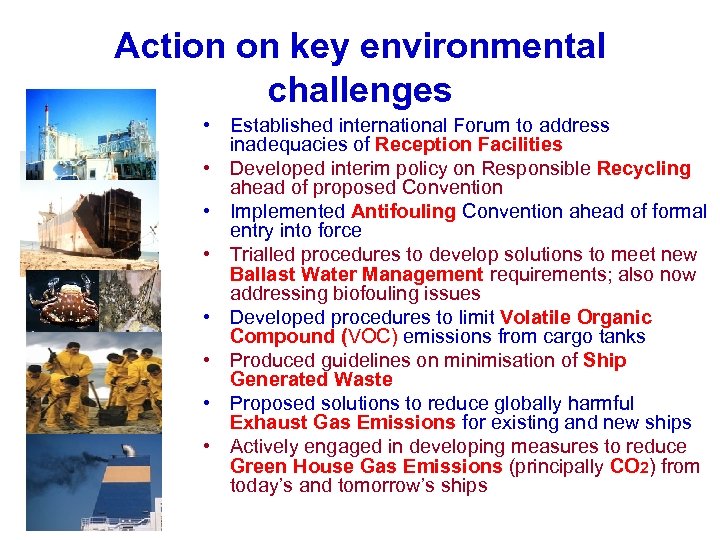
Action on key environmental challenges • Established international Forum to address inadequacies of Reception Facilities • Developed interim policy on Responsible Recycling ahead of proposed Convention • Implemented Antifouling Convention ahead of formal entry into force • Trialled procedures to develop solutions to meet new Ballast Water Management requirements; also now addressing biofouling issues • Developed procedures to limit Volatile Organic Compound (VOC) emissions from cargo tanks • Produced guidelines on minimisation of Ship Generated Waste • Proposed solutions to reduce globally harmful Exhaust Gas Emissions for existing and new ships • Actively engaged in developing measures to reduce Green House Gas Emissions (principally CO 2) from today’s and tomorrow’s ships
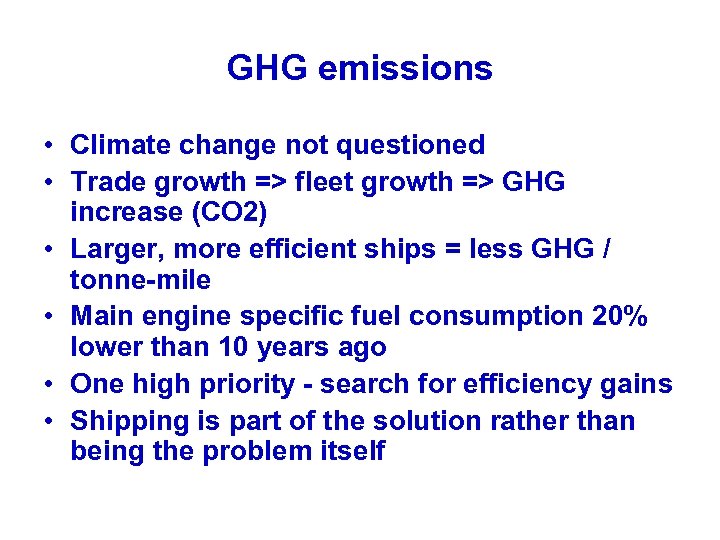
GHG emissions • Climate change not questioned • Trade growth => fleet growth => GHG increase (CO 2) • Larger, more efficient ships = less GHG / tonne-mile • Main engine specific fuel consumption 20% lower than 10 years ago • One high priority - search for efficiency gains • Shipping is part of the solution rather than being the problem itself
Greenhouse gases Short term measures • • Improvement in fuel consumption Energy efficient ship design, hull/prop polishing Onshore power supply Use of wind power Rating performance of ships and operators Limitations on leakage rates of refrigerants Vessel speed reductions Measures to improve traffic control and cargo handling
Greenhouse gases Long Term Measures • • • Technical measures for ship design Use of alternative fuels Mandatory ship design index for new ships Emissions trading scheme Mandatory CO 2 element in port infrastructure charging
Thank you Merci beaucoup For more information, please visit: www. intertanko. com www. poseidonchallenge. com www. shippingfacts. com www. maritimefoundation. com
Скачать презентацию Bureau Veritas International General Committee Oil tankers under
942327541776ba9b128bffb282655acc.ppt