 Скачать презентацию Bunch Instrumentation DAQ Instrumentation Hardware and Measurements
8026863c6eebf217b75262eafe3c3613.ppt
- Количество слайдов: 13



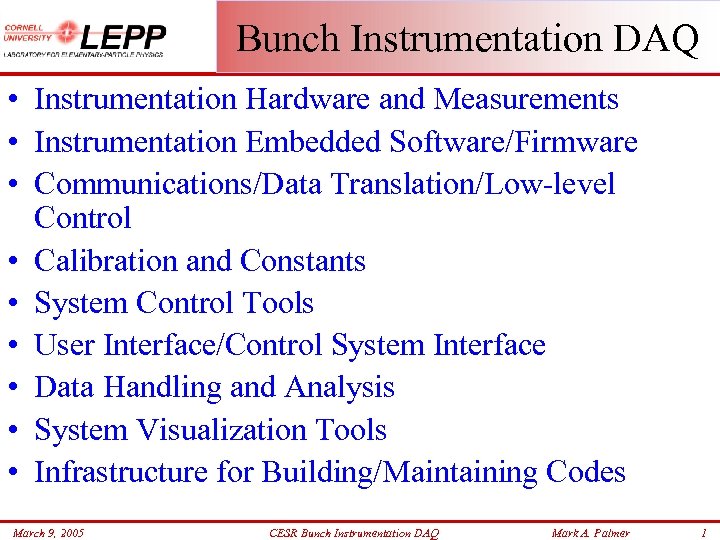
Bunch Instrumentation DAQ • Instrumentation Hardware and Measurements • Instrumentation Embedded Software/Firmware • Communications/Data Translation/Low-level Control • Calibration and Constants • System Control Tools • User Interface/Control System Interface • Data Handling and Analysis • System Visualization Tools • Infrastructure for Building/Maintaining Codes March 9, 2005 CESR Bunch Instrumentation DAQ Mark A. Palmer 1
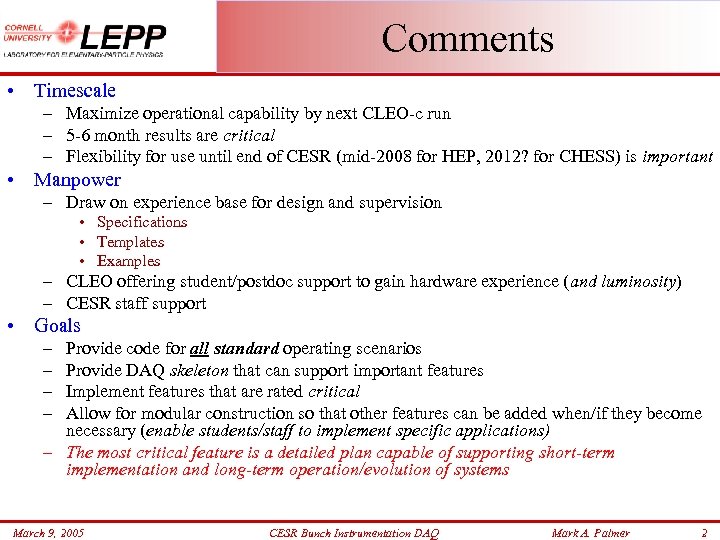
Comments • Timescale – Maximize operational capability by next CLEO-c run – 5 -6 month results are critical – Flexibility for use until end of CESR (mid-2008 for HEP, 2012? for CHESS) is important • Manpower – Draw on experience base for design and supervision • Specifications • Templates • Examples – CLEO offering student/postdoc support to gain hardware experience (and luminosity) – CESR staff support • Goals – – Provide code for all standard operating scenarios Provide DAQ skeleton that can support important features Implement features that are rated critical Allow for modular construction so that other features can be added when/if they become necessary (enable students/staff to implement specific applications) – The most critical feature is a detailed plan capable of supporting short-term implementation and long-term operation/evolution of systems March 9, 2005 CESR Bunch Instrumentation DAQ Mark A. Palmer 2
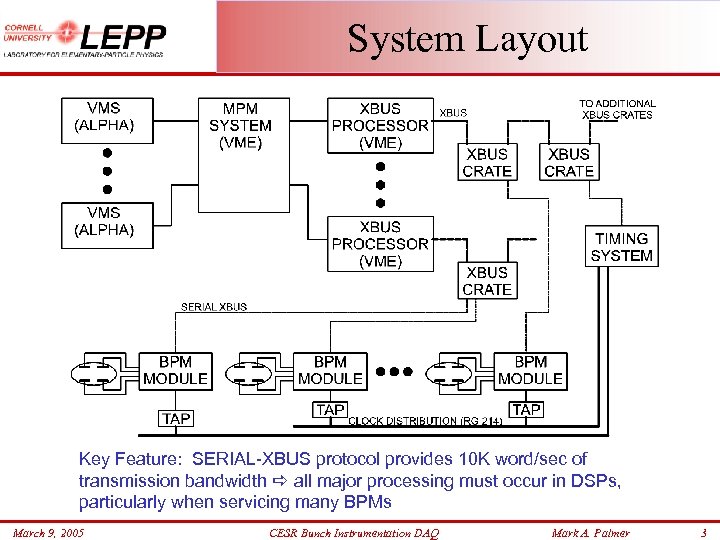
System Layout Key Feature: SERIAL-XBUS protocol provides 10 K word/sec of transmission bandwidth a all major processing must occur in DSPs, particularly when servicing many BPMs March 9, 2005 CESR Bunch Instrumentation DAQ Mark A. Palmer 3
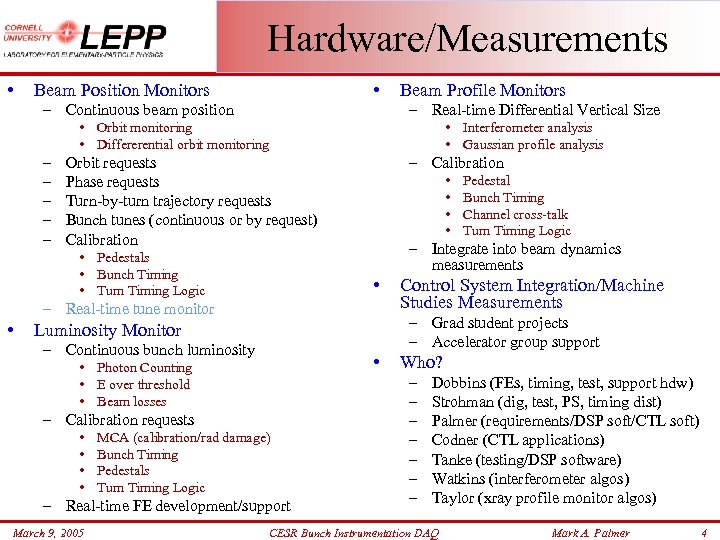
Hardware/Measurements • • Beam Position Monitors – Continuous beam position Beam Profile Monitors – Real-time Differential Vertical Size • Orbit monitoring • Differerential orbit monitoring – – – • Interferometer analysis • Gaussian profile analysis – Calibration Orbit requests Phase requests Turn-by-turn trajectory requests Bunch tunes (continuous or by request) Calibration • Pedestals • Bunch Timing • Turn Timing Logic • • – Integrate into beam dynamics measurements • – Real-time tune monitor • – Continuous bunch luminosity • • Photon Counting • E over threshold • Beam losses – Calibration requests MCA (calibration/rad damage) Bunch Timing Pedestals Turn Timing Logic – Real-time FE development/support March 9, 2005 Control System Integration/Machine Studies Measurements – Grad student projects – Accelerator group support Luminosity Monitor • • Pedestal Bunch Timing Channel cross-talk Turn Timing Logic Who? – – – – Dobbins (FEs, timing, test, support hdw) Strohman (dig, test, PS, timing dist) Palmer (requirements/DSP soft/CTL soft) Codner (CTL applications) Tanke (testing/DSP software) Watkins (interferometer algos) Taylor (xray profile monitor algos) CESR Bunch Instrumentation DAQ Mark A. Palmer 4
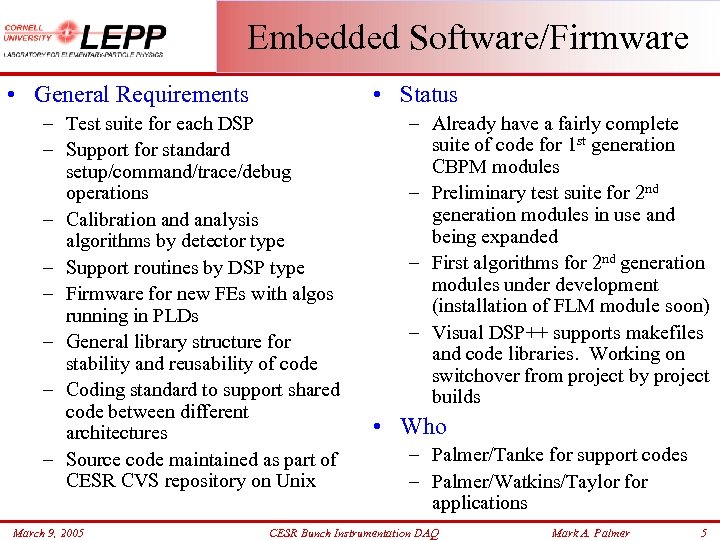
Embedded Software/Firmware • General Requirements • Status – Test suite for each DSP – Support for standard setup/command/trace/debug operations – Calibration and analysis algorithms by detector type – Support routines by DSP type – Firmware for new FEs with algos running in PLDs – General library structure for stability and reusability of code – Coding standard to support shared code between different architectures – Source code maintained as part of CESR CVS repository on Unix March 9, 2005 – Already have a fairly complete suite of code for 1 st generation CBPM modules – Preliminary test suite for 2 nd generation modules in use and being expanded – First algorithms for 2 nd generation modules under development (installation of FLM module soon) – Visual DSP++ supports makefiles and code libraries. Working on switchover from project by project builds • Who – Palmer/Tanke for support codes – Palmer/Watkins/Taylor for applications CESR Bunch Instrumentation DAQ Mark A. Palmer 5
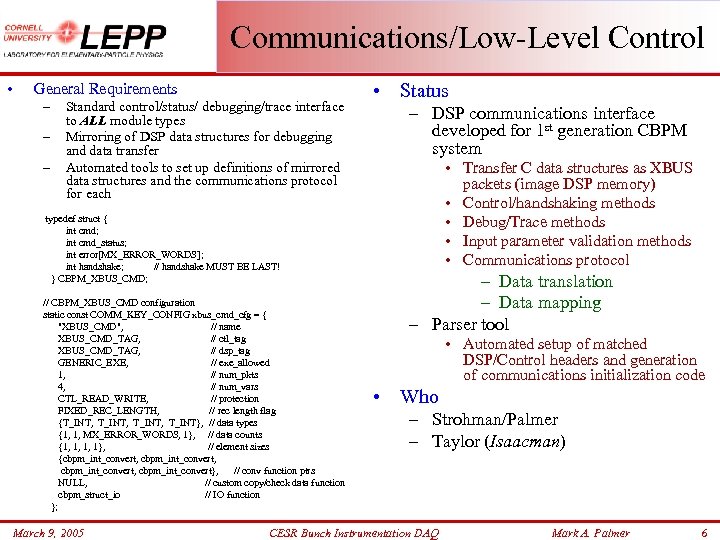
Communications/Low-Level Control • General Requirements – – – Standard control/status/ debugging/trace interface to ALL module types Mirroring of DSP data structures for debugging and data transfer Automated tools to set up definitions of mirrored data structures and the communications protocol for each typedef struct { int cmd; int cmd_status; int error[MX_ERROR_WORDS]; int handshake; // handshake MUST BE LAST! } CBPM_XBUS_CMD; // CBPM_XBUS_CMD configuration static const COMM_KEY_CONFIG xbus_cmd_cfg = { "XBUS_CMD", // name XBUS_CMD_TAG, // ctl_tag XBUS_CMD_TAG, // dsp_tag GENERIC_EXE, // exe_allowed 1, // num_pkts 4, // num_vars CTL_READ_WRITE, // protection FIXED_REC_LENGTH, // rec length flag {T_INT, T_INT}, // data types {1, 1, MX_ERROR_WORDS, 1}, // data counts {1, 1, 1, 1}, // element sizes {cbpm_int_convert, cbpm_int_convert}, // conv function ptrs NULL, // custom copy/check data function cbpm_struct_io // IO function }; March 9, 2005 • Status – DSP communications interface developed for 1 st generation CBPM system • Transfer C data structures as XBUS packets (image DSP memory) • Control/handshaking methods • Debug/Trace methods • Input parameter validation methods • Communications protocol – Data translation – Data mapping – Parser tool • Automated setup of matched DSP/Control headers and generation of communications initialization code • Who – Strohman/Palmer – Taylor (Isaacman) CESR Bunch Instrumentation DAQ Mark A. Palmer 6
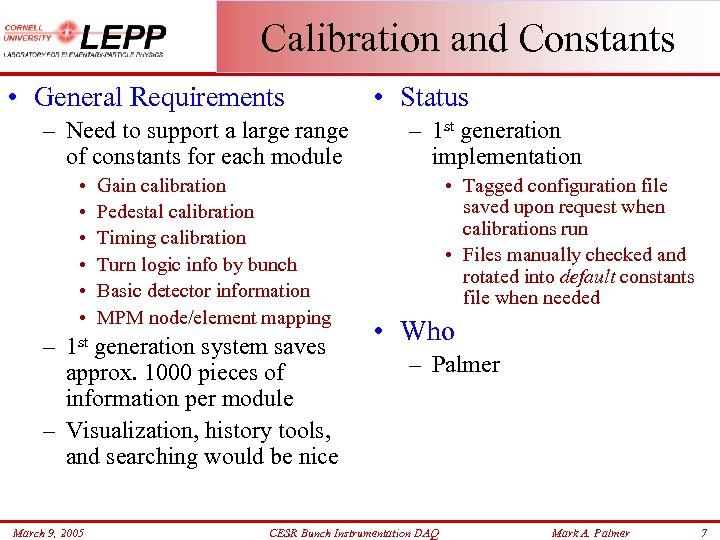
Calibration and Constants • General Requirements – Need to support a large range of constants for each module • • • – 1 st Gain calibration Pedestal calibration Timing calibration Turn logic info by bunch Basic detector information MPM node/element mapping generation system saves approx. 1000 pieces of information per module – Visualization, history tools, and searching would be nice March 9, 2005 • Status – 1 st generation implementation • Tagged configuration file saved upon request when calibrations run • Files manually checked and rotated into default constants file when needed • Who – Palmer CESR Bunch Instrumentation DAQ Mark A. Palmer 7
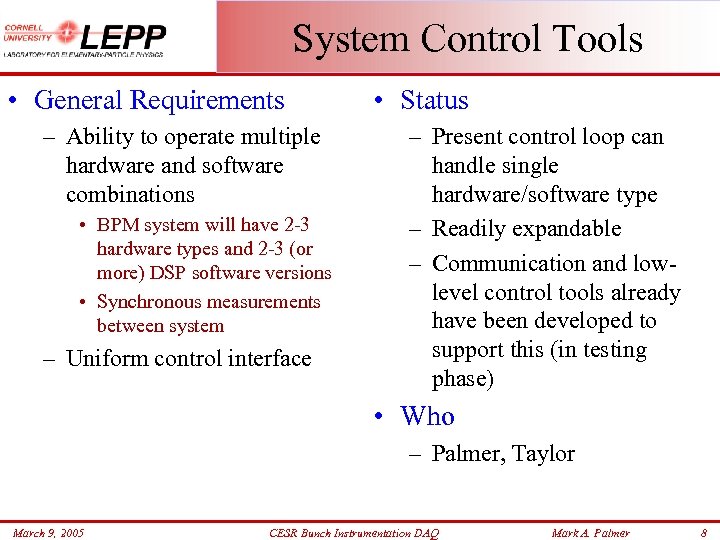
System Control Tools • General Requirements – Ability to operate multiple hardware and software combinations • BPM system will have 2 -3 hardware types and 2 -3 (or more) DSP software versions • Synchronous measurements between system – Uniform control interface • Status – Present control loop can handle single hardware/software type – Readily expandable – Communication and lowlevel control tools already have been developed to support this (in testing phase) • Who – Palmer, Taylor March 9, 2005 CESR Bunch Instrumentation DAQ Mark A. Palmer 8
User/Control System Interaction • General Requirements • Status – Individual systems available for requests for standard event data via server – Provide (some) streaming data for direct control system monitoring (also see following slide) – Provide interface for users to run customized data requests (also see following slide for data issues) • Need to specify interaction with server • Custom requests may require significant re-initialization when control returned to server – Monitoring/Config/Control GUI would expedite maintenance and user interactions – Standard user input tools to avoid “crashing” system March 9, 2005 – Standard CBPM server available for orbit, phase, turn-by-turn trajectory measurements – Does not offer full configuration capability – Needs better implementation of interrupts and failure recovery – User interface through command line menu. Can disable server for long periods (probably need to add interrupt capability) – Standardized user input methods with parameter checking to protect low-level processors • Who – Palmer (Rock) CESR Bunch Instrumentation DAQ Mark A. Palmer 9
Data Handling/Analysis • General Requirements • Status – Support single layer of thinned out data to MPM – Allow access to detailed data at requesting program level – Present methods • Buttons/phase data written to MPM for standard requests • Trajectory data written to file for user read/analysis/display • Differential orbit data written to file for user read/analysis/display • Calibration data wirtten to file for user read/analysis/display • Shared memory on server node • User analysis directly in requesting program – Allow for new communications path (ethernet) for large bandwidth limited data – Support event-like and streaming data – Interface routines for Fortran analysis March 9, 2005 • Who – Palmer CESR Bunch Instrumentation DAQ Mark A. Palmer 10
System Visualization Tools • General Requirements – Built-in package for visualization has been requested • Large data size • Range of data to examine • Desire for standard, easily accessible tools • Status – At present, no built-in visualization tools provided – Accelerator group tools for plotting MPM data – User tools for plotting saved data • Who – Codner March 9, 2005 CESR Bunch Instrumentation DAQ Mark A. Palmer 11
Infrastructure Code Building/Maintenance • General Requirements – Code maintained in CESR CVS repository on Unix – OSF testing of many tools (on CESR machines) is acceptable • Compilers on cesrxx OSF machines match VMS compilers • More development CPU cycles available • Porting tools to move code to VMS and test – Multiple source library implementation to support shared source among several applications • Control codes • DSP codes • Control/DSP codes • Status – Repository structure in place – Porting structure in place – Cesr. BPM and utiltiy libraries (1 st generation system) in place with versioning checks – Range of new codes ready for import into repository • Who – CESR Librarian: Valeriu Smiricinschi – Palmer – Suitable coding standard to handle code that can be run across multi-DSP and CTL architectures – Restrict development to tools available (or portable) to VMS – Versioned releases for stability and problem tracking March 9, 2005 CESR Bunch Instrumentation DAQ Mark A. Palmer 12
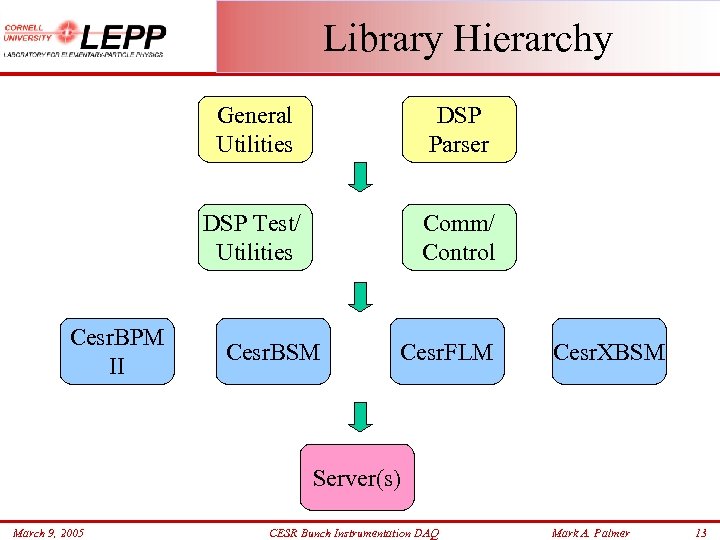
Library Hierarchy General Utilities DSP Test/ Utilities Cesr. BPM II DSP Parser Comm/ Control Cesr. BSM Cesr. FLM Cesr. XBSM Server(s) March 9, 2005 CESR Bunch Instrumentation DAQ Mark A. Palmer 13
Скачать презентацию Bunch Instrumentation DAQ Instrumentation Hardware and Measurements
8026863c6eebf217b75262eafe3c3613.ppt