 Скачать презентацию Bullying Summit Neumann University April 12 2011 Presented
536335e2db1b15159a73f97df28f7651.ppt
- Количество слайдов: 62




Bullying Summit Neumann University April 12, 2011 Presented by Kathleen Conn, Ph. D. , J. D. , LL. M. Assistant Professor, Neumann University Adjunct Professor, Widener University School of Law
What We’ll Talk About Today • • • What is bullying? Cyberbullying? Signs that a student is being bullied Sexting and cyberbullying Why we need to deal with it Regulating bullying/cyberbullying: View from the courts on student speech rights • Efforts to address the problems
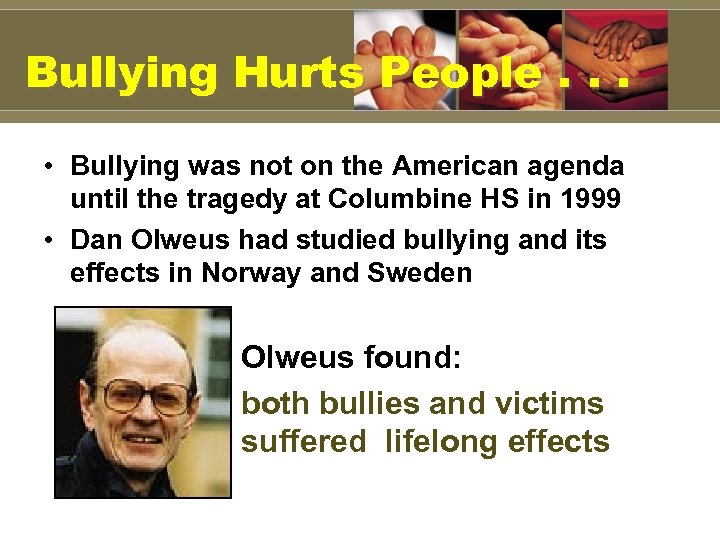
Bullying Hurts People. . . • Bullying was not on the American agenda until the tragedy at Columbine HS in 1999 • Dan Olweus had studied bullying and its effects in Norway and Sweden Olweus found: both bullies and victims suffered lifelong effects
Bullying The Elements of Bullying 1. The bully is bigger or stronger than the target 2. The bully is more favorably situated than the target: more status, more supporters 3. The bully intends to inspire fear 4. The bully lacks empathy
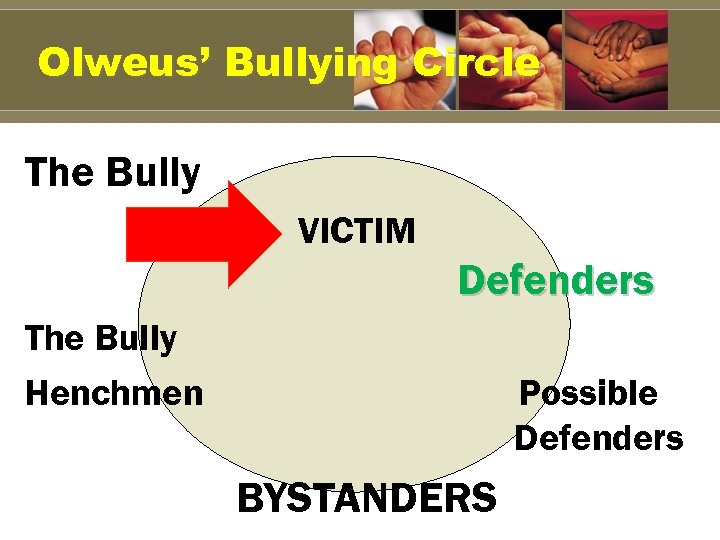
Olweus’ Bullying Circle The Bully VICTIM Defenders The Bully Henchmen Possible Defenders BYSTANDERS
Signs of Bullying May Include: • • Sadness, depression Withdrawal from relationships with peers Bruises, torn/ripped clothing or possessions Frequent visits to the nurse Frequent or no bathroom visits School avoidance Cutting Suicidal ideation, suicide attempts, suicide
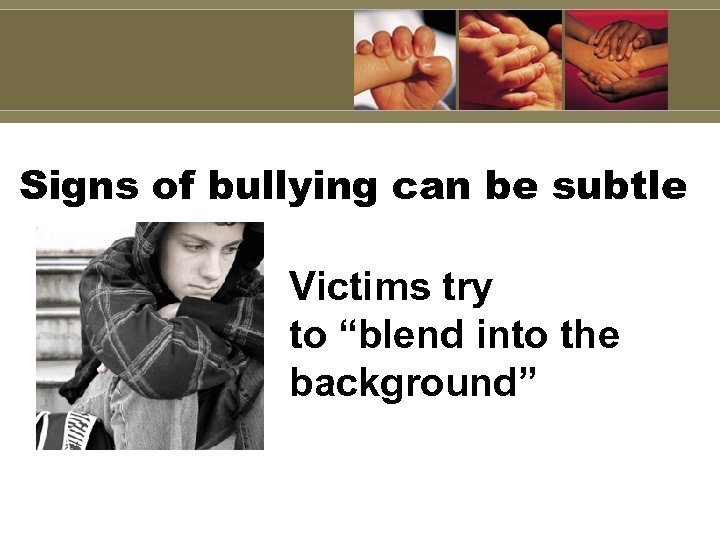
Signs of bullying can be subtle Victims try to “blend into the background”
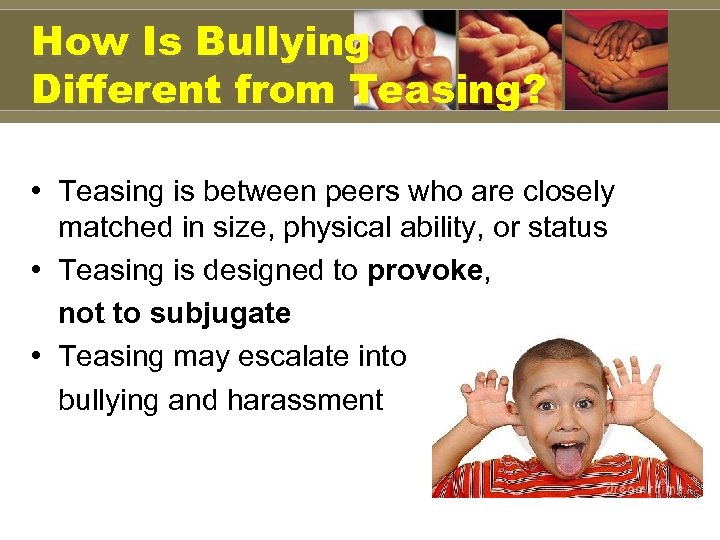
How Is Bullying Different from Teasing? • Teasing is between peers who are closely matched in size, physical ability, or status • Teasing is designed to provoke, not to subjugate • Teasing may escalate into bullying and harassment
Bullying vs. Sexual Harassment • Bullying on the basis of a student’s sex or sexual orientation can be sexual harassment • Sexual harassment can be boy-on-girl, girl -on-boy, or same-sex harassment • GLBTQ students harassed with greater frequency and more severely
Bullying Students with Disabilities • Bullying of students with disabilities, especially cognitive disabilities, is more frequent and more severe • Children who are cognitively disabled may be easily fooled into believing that the bullies are their friends
When Does Bullying Start? • Bullying is not just a middle or high school issue • BULLYING STARTS IN ELEMENTARY SCHOOL
Bullying in Elementary School • Olweus Bullying Prevention Program reported that 23% of students in Grades 4 -6 had been bullied “several times” or more • 20% admitted being bullies themselves
October 2010 • Josephson Institute Center for Youth Ethics surveyed over 43, 000 high school students • 50% of all students interviewed admitted that they bullied someone in the past year • Almost half said they were victims of bullies
February 2011 • Sociologist Robert Faris of UC Davis, surveyed over 3700 MS and HS students from 19 NC schools • Teenagers’ aggressive behaviors directly correlated with increases in their social status, peaking when students hit the 98 th percentile of popularity.
Bullying: We Know It When We See It? • NEA Bullying Survey: March 11, 2011 – 62% of school employees report they have witnessed bullying 2 or more times in last month – 98% believe they should intervene – 46% say they lack the training to know how to intervene
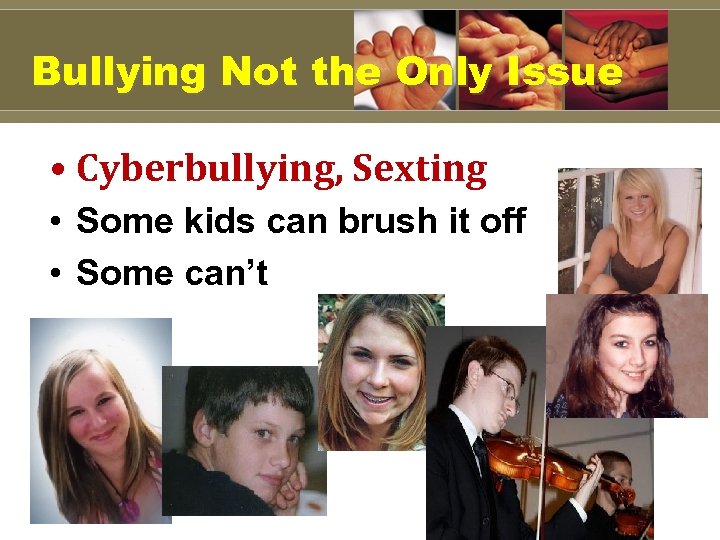
Bullying Not the Only Issue • Cyberbullying, Sexting • Some kids can brush it off • Some can’t
What Is Cyberbullying? • Willful and repeated communications of insulting, humiliating, or intimidating messages sent electronically • Emails, IMs, texts or digital images sent via cell phone, blogs, chat rooms, SNS, You. Tube • “Imposter” profiles • “Hit” lists, “Who Should Die” lists
Face-to-Face Bullying Compared to Cyberbullying • • Face-to-Face Bully lacks empathy Fear on part of target Imbalance of power, bully is physically more powerful or has superior status • “Show off” motivation? • Cyberbullying • Bully lacks empathy • Fear, insecurity, not knowing whom to trust • Reversal of the power imbalance due to the anonymity • “Get even” motivation
Characteristics of Cyberbullying • Can be accomplished by one perpetrator or many • Disinhibited, largely unmonitored • Instantaneous • Pervasive, easily duplicated or edited • Anonymous • “On” 24/7 • A “legal vacuum” for many school administrators and teachers
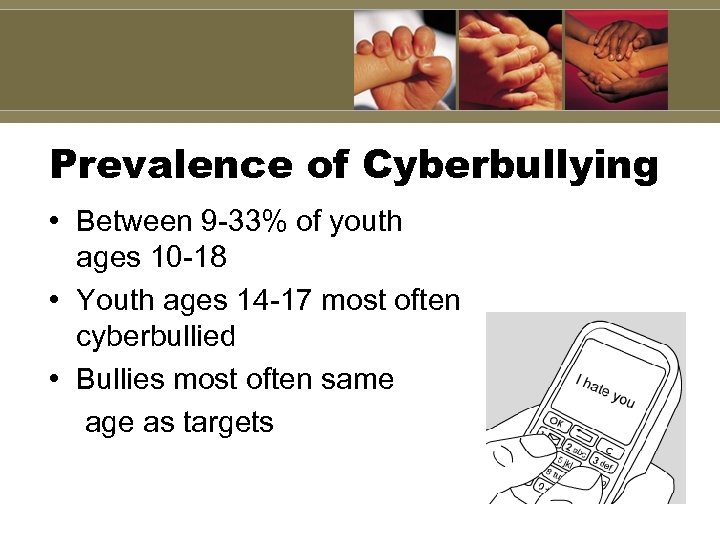
Prevalence of Cyberbullying • Between 9 -33% of youth ages 10 -18 • Youth ages 14 -17 most often cyberbullied • Bullies most often same age as targets
Ways Kids Cyberbully • In a recent Pew study where 32% of online teens reported being cyberbullied: – 15% report that private material was forwarded without permission – 13% had received threatening messages – 13% said someone had spread a rumor about them online – 6% said someone posted an embarrassing photo of them online without permission
Interesting Observations About Cyberbullying • Most of the “discourse” is sexual in nature, focused on body parts, imputations of improper sexual acts, sexual language • While the arena of offensive Websites was dominated almost exclusively by male students, females are catching up in the “new” online cyber-realm
Signs of Cyberbullying • Student unexpectedly stops using her computer or cell phone • Gets jumpy when a text or IM appears • Starts avoiding school or going outside • Appears angry, frustrated, depressed after using the computer or cell phone • Avoids discussing what they are doing online
Sexting • Sending sexually suggestive messages or nude or partially naked photographs via cell phone or other technological device • Creating such messages or images • Sharing or distributing such messages
The Prevalence of Sexting • Reports differ on numbers/percentages depending on the definition used in surveys • From a low of 4% of 12 -17 year-olds • To a high of nearly 20% of teens • Why do they do it? Female teens said “pressure from a male friend”
Kids Have Technology • 75% of 12 -17 year-olds now “own” cell phones, most on parents’ plans, with unlimited texting • Cell phone texting now the preferred way that teens communicate; only 33% talk in person • 1 in 3 teens sends > 100 text messages/day • 50% of texters send at least 50 messages/day • 65% of teen cell owners bring phones to school every day, despite the ban against bringing them
American students have never known a world without the Internet.
Prevalence of Technology Use • Kids 8 -18 years old spend over 7 ½ hours/day using computers, smart phones, TVs, other technology • Teens who use My. Space, Facebook spend on average 2 hours per day, 5 days per week on the sites • Teens with technology in bedroom stay up all hours of the night online/using cell phones

Technology MIS-Use Is the Problem

Teen Beaten to Death on Chicago Street A bystander videotaped the beating on a cell phone
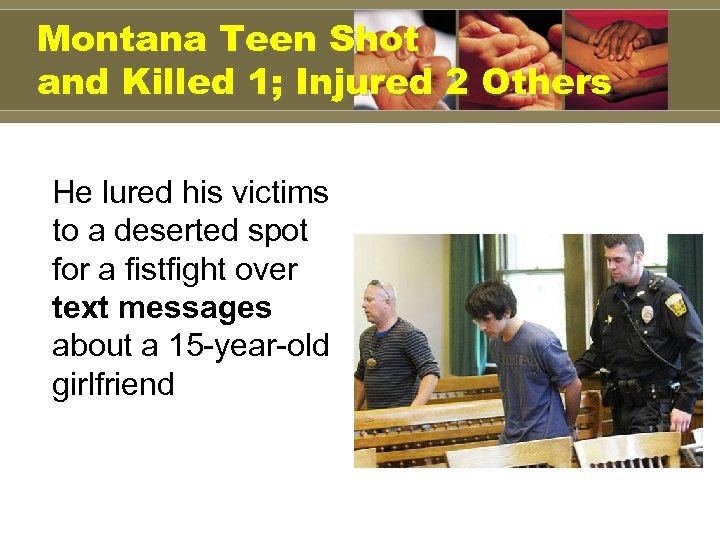
Montana Teen Shot and Killed 1; Injured 2 Others He lured his victims to a deserted spot for a fistfight over text messages about a 15 -year-old girlfriend
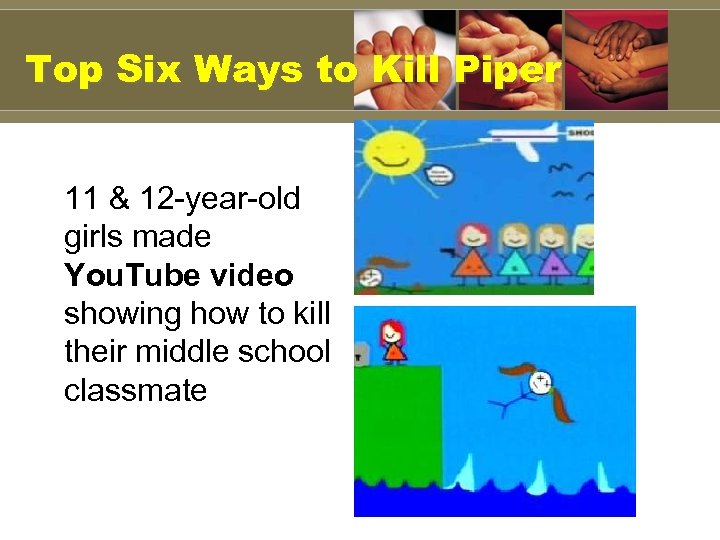
Top Six Ways to Kill Piper 11 & 12 -year-old girls made You. Tube video showing how to kill their middle school classmate

Florida Teens Beat Classmate and Posted Video on You. Tube Girls lured cheerleader to house, beat her in “animalistic attack” while 2 boys stood guard outside house; all 8 criminally charged
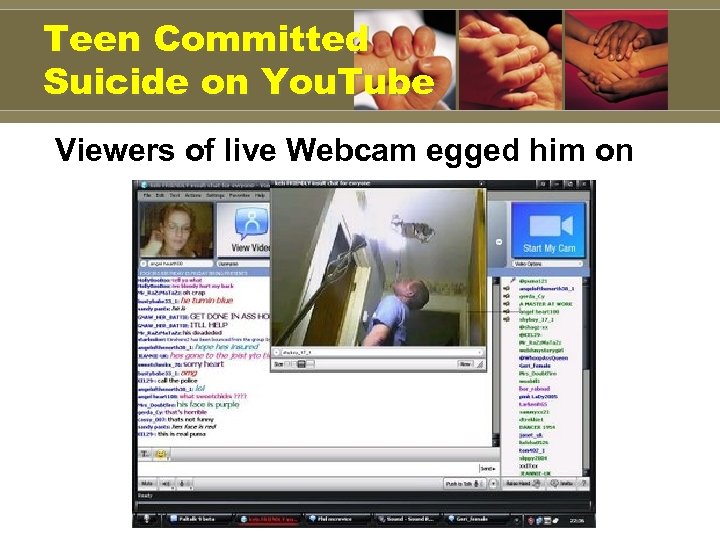
Teen Committed Suicide on You. Tube Viewers of live Webcam egged him on
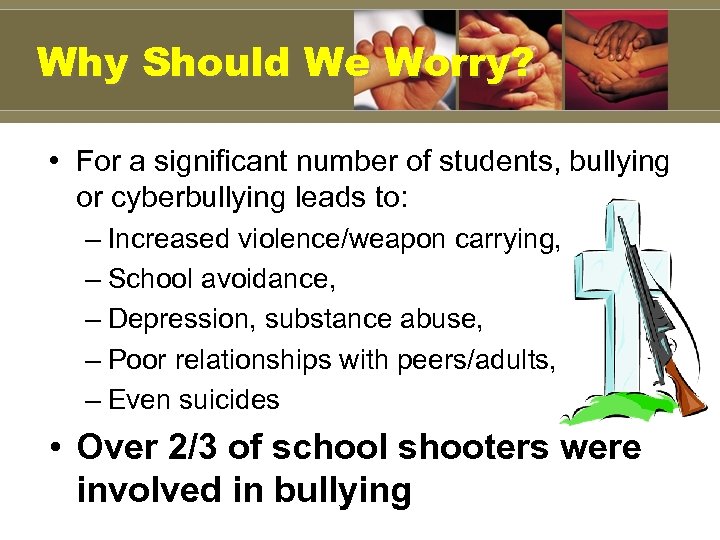
Why Should We Worry? • For a significant number of students, bullying or cyberbullying leads to: – Increased violence/weapon carrying, – School avoidance, – Depression, substance abuse, – Poor relationships with peers/adults, – Even suicides • Over 2/3 of school shooters were involved in bullying
Why Should We Worry? • Bullying and cyberbullying may escalate to criminal acts: – Harassment and stalking – Ethnic intimidation – Terroristic threats – Invasion of privacy – Possession, manufacture or distribution of child pornography
IT’S NOT A JOKE. . . • It’s not “funny” • IT CAN BE A FELONY!

Why Don’t Schools Stop the Bullying? • Bullying is often “under the radar” • Victims often blame themselves – “If I were a cooler kid …” – “If I were more athletic…” • Victims are afraid that if they tell an adult, things will just get worse • Many kids nowadays are not that close to their parents or to any other adult
Why Don’t Schools Stop Cyberbullying? • Administrators are unsure how far the “disciplinary arm” of the school extends • The First Amendment protects an individual’s freedom of speech from infringement by a government official
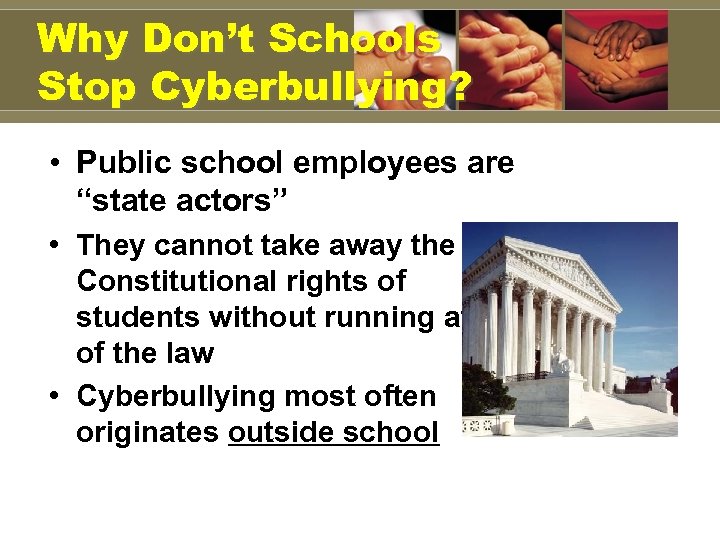
Why Don’t Schools Stop Cyberbullying? • Public school employees are “state actors” • They cannot take away the Constitutional rights of students without running afoul of the law • Cyberbullying most often originates outside school
Three Seminal Student Speech Decisions 1. Tinker v. Des Moines Independent Community School District (1969) 2. Bethel School District No. 403 v. Fraser (1986) 3. Hazelwood School District v. Kuhlmeier (1988)
The “Tinker Test” Does the student speech or expression materially disrupt the school’s educational mission or Does it involve substantial disorder or invasion of the rights of other students to learn?
The “Tinker Test” • Unfortunately courts do not agree on what constitutes material or substantial disruption • The 3 Supreme Court decisions dealt with in-school speech • None of the Supreme Court decisions (1969 -1988) involved technology

4 th Supreme Court Decision • Morse v. Frederick (2007) • Majority opinion avoided what it called the “outer boundaries” of student speech, i. e. , speech or expression originating outside school, but brought to campus by one means or another • Justice Alito’s concurrence: “Schools are places of special danger”
Facebook is trying to tackle the problem of bullying… with a new “Safety Centre” and a way for users to report that they are being bullied and get help from friends… But what about cell phones?
What About Cell Phones? • Klump v. Nazareth Area School District (2006) • Teacher confiscated student’s cell phone when he had it out during school hours • Teacher and asst. principal used phone to call students on phone number directory, accessed student’s text messages, and called student’s brother without identifying themselves
Klump Litigation, cont. • Parents and student sued; alleged 10 causes of action, from wiretap law violations to violations of the Fourth Amendment • Parents owned the cell phone subscription • Court allowed claims of illegal search and seizure to go forward, as well as claims of unlawful access of stored messages, invasion of privacy, and false light for suggesting student was into drugs
Can Public Schools Ban Cell Phones? • New York City Board of Education did! • Price v. N. Y. City Bd. Of Educ. (2008) • School district only needs show their action was not arbitrary, but had rational basis • No fundamental liberty interest of students implicated • Case dismissed • Affirmed on appeal!
Can Law Enforcement Authorities Help? • Bullying and cyberbullying can escalate into harassment, stalking • Face-to-face or cyber messages can be actual threats • Sexting can be child pornography • State and federal laws can be involved
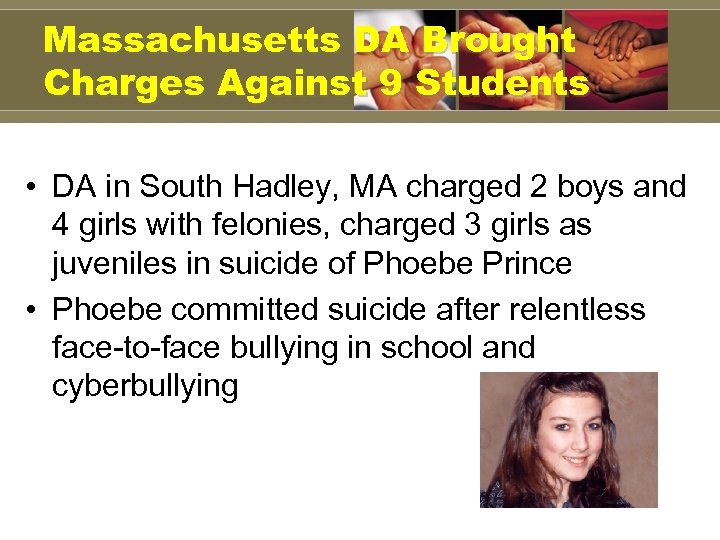
Massachusetts DA Brought Charges Against 9 Students • DA in South Hadley, MA charged 2 boys and 4 girls with felonies, charged 3 girls as juveniles in suicide of Phoebe Prince • Phoebe committed suicide after relentless face-to-face bullying in school and cyberbullying
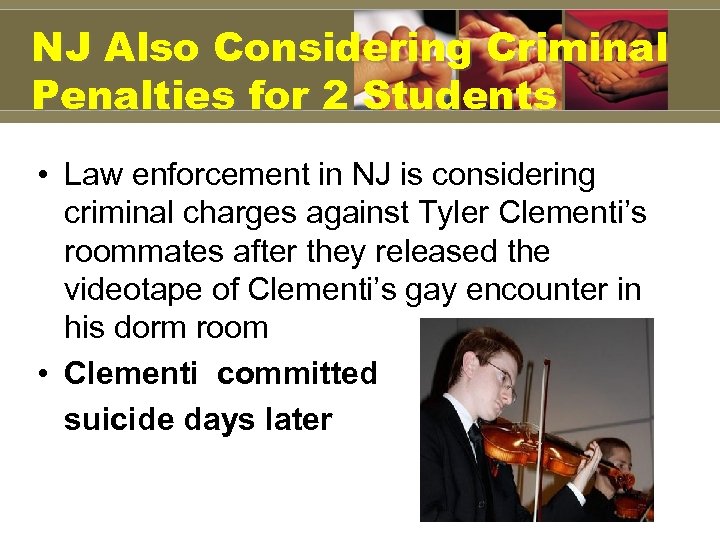
NJ Also Considering Criminal Penalties for 2 Students • Law enforcement in NJ is considering criminal charges against Tyler Clementi’s roommates after they released the videotape of Clementi’s gay encounter in his dorm room • Clementi committed suicide days later

What About Criminalizing Sexting? • Several states have prosecuted students under child pornography laws, e. g. , Florida • Students convicted have to register as sex offenders, may spend time in jail, on probation • Illinois makes sexting a felony, punishable by up to $2, 500 fine, and a year in jail
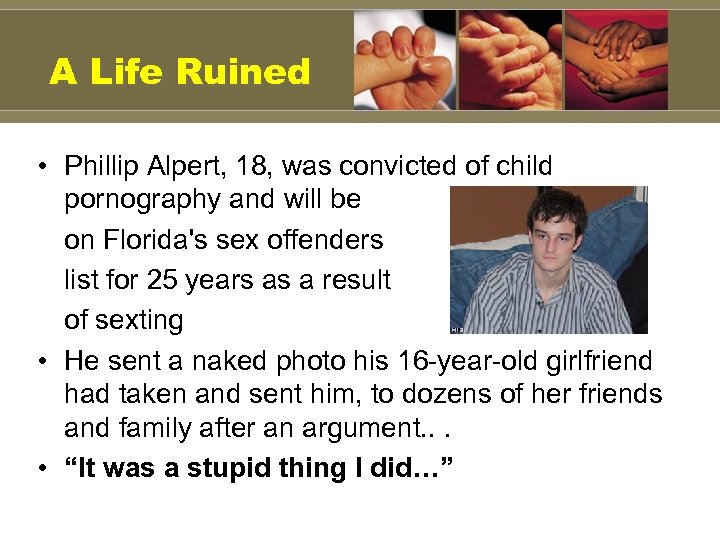
A Life Ruined • Phillip Alpert, 18, was convicted of child pornography and will be on Florida's sex offenders list for 25 years as a result of sexting • He sent a naked photo his 16 -year-old girlfriend had taken and sent him, to dozens of her friends and family after an argument. . . • “It was a stupid thing I did…”
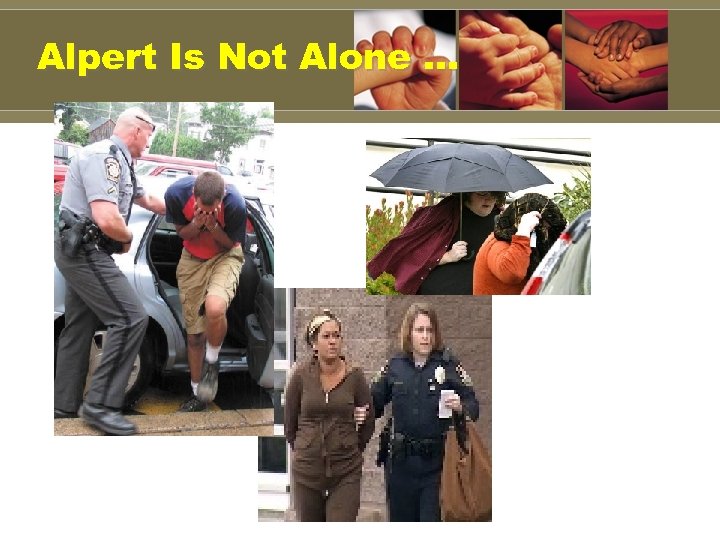
Alpert Is Not Alone …
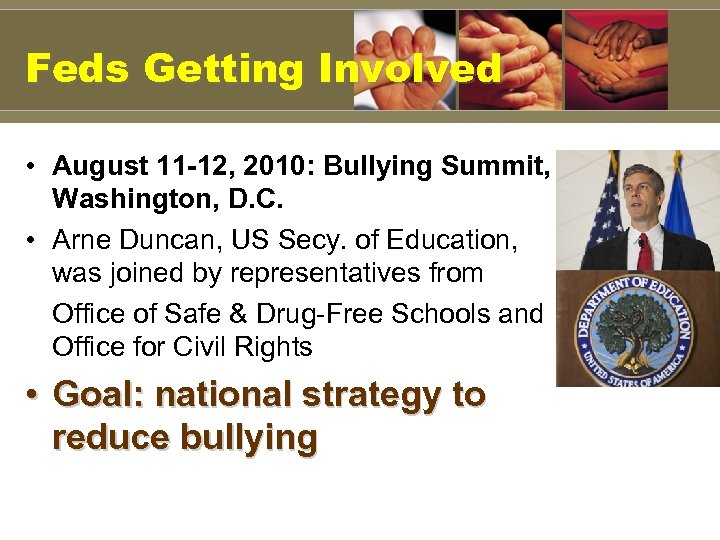
Feds Getting Involved • August 11 -12, 2010: Bullying Summit, Washington, D. C. • Arne Duncan, US Secy. of Education, was joined by representatives from Office of Safe & Drug-Free Schools and Office for Civil Rights • Goal: national strategy to reduce bullying
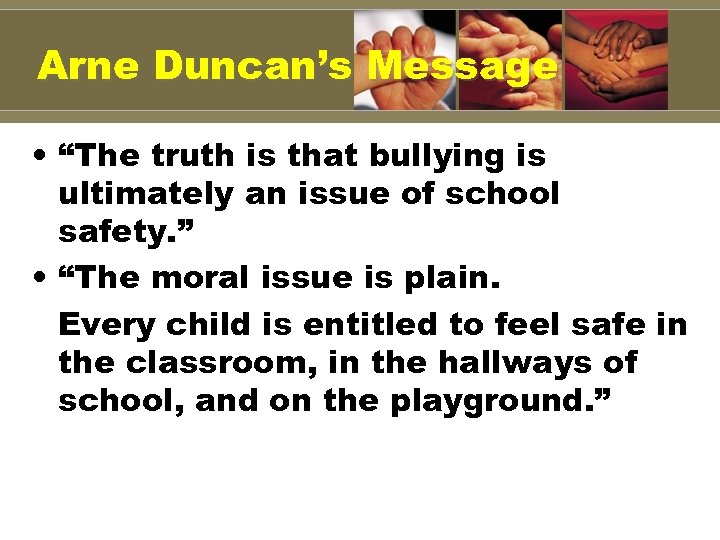
Arne Duncan’s Message • “The truth is that bullying is ultimately an issue of school safety. ” • “The moral issue is plain. Every child is entitled to feel safe in the classroom, in the hallways of school, and on the playground. ”
President and Mrs. Obama • Posted a Facebook message about bullying on March 9, 2011 • They are concerned as parents themselves • And because “modern bullying” follows children “from their schools to their phone and computer screen”
The Take-Home Message • Every child will feel safe only if we work together to eliminate bullying and cyberbullying. • None of us can be bystanders. • Parents, administrators, teachers, staff and students must work together… it is a MORAL OBLIGATION.
Thank you for your attention. I HOPE THIS HAS BEEN HELPFUL. KATHLEEN CONN, PH. D. , J. D. , LL. M. CONNK@NEUMANN. EDU
Скачать презентацию Bullying Summit Neumann University April 12 2011 Presented
536335e2db1b15159a73f97df28f7651.ppt