 Скачать презентацию Building Your School List Health Professions Info Session
5f7a1de029b224d9d3f30f81a8f79aae.ppt
- Количество слайдов: 19



Building Your School List Health Professions Info Session Center for Careers & Internships Spring 2015

Choosing Where to Apply to Medical School • Important & challenging part of the application process • Time consuming • Can be expensive
Commonly Asked Questions 1. 2. 3. 4. 5. 6. 7. 8. 9. 10. 11. 12. 13. 14. How many schools should I apply to? How does my state of residency impact where I should apply? How do I make sense of residency requirements? Are there new medical schools I should consider applying to? Are there special interstate agreements? Should I consider applying to public medical schools that are out-of -state for me? How should my GPA and MCAT score affect where I apply? How important should rankings be as I decide where to apply? Aren’t all mission statements the same? What should I look for as I examine a school’s curriculum? Should cost be a factor in my decision of where to apply? What other factors should I consider? I want to apply to MD/Ph. D programs. How do I decide where to apply? I want to apply to osteopathic medical schools. How do I decide where to apply?

1. How many schools should I apply to? • ~15 -20 schools • 25+ schools generally indicates a lack of strategy and that the schools have not been well researched

2. How does my state of residency impact where I should apply? • Applying as an in-state candidate usually puts you at an advantage • Many state schools have <15% of their class from outside their state • Tuition tends to be lower
3. How do I make sense of residency requirements? • In the Medical School Admissions Requirements (MSAR), each school’s listing includes the numbers of ‘resident’ and ‘nonresident’ applicants, interviewees, and matriculants. • The Princeton Health Professions Advising website is a great resource. • Residency rules vary from state to state, and HOW residents and non-residents are defined by an Admissions committee varies from school to school.
4. Are there new medical schools I should consider applying to? • The AAMC (Association of American Medical Colleges) website is a great resource. (www. aamc. org) • List of recently accredited and new schools are overviewed in Snapshot of the New and Developing Medical Schools in the U. S. and Canada. • There also many new osteopathic schools listed there.
5. Are there special interstate agreements? Yes - some states that either don’t have medical schools or who have very few have created special interstate agreements so that their residents will have in-state privileges • WICHE • Western Interstate Commission for Higher Education operates an exchange program for students from 13 western states that gives them preference in admission & reduced tuition in selected out of state medical & other professional schools • WWAMI • The University of Washington School of Medicine serves as the public school for Washington, Wyoming, Alaska, Montana, and Idaho. • FAME • Finance Authority of Maine’s Access to Medical Education Program, which gives Maine residents preferred access to Dartmouth, Vermont, and UNECOM. • DIMER • Delaware Institute of Medical Education & Research, which has Jefferson Medical College in Philadelphia serve as Delaware’s medical school.
6. Should I consider applying to public medical schools that are out-of-state for me? • It depends on which school… • Consult the Medical School Admissions Requirements (MSAR) and the chart entitled ‘Acceptance & Matriculation Data’ • When a public school has over 25% of its class from outof-state, there’s a reasonable chance of qualified out-ofstaters being considered. • The percentage of in-state versus out-of-state residents is also available on this AAMC Site: http: //www. aamc. org/data/facts/start. htm
7. How should my GPA and MCAT score affect where I apply? • Consult the MSAR (again!) • MSAR Online contains admissions statistics including the school’s mean MCAT and the ranges of overall and science GPAs they accept. • Use this data to assess whether or not you will be a competitive candidate at a specific school. • Make sure you select a mix of schools where you are at or close to the average GPA and some schools where you may be above the average. • Take a similar approach with the MCAT.

8. How important should rankings be as I decide where to apply? • Be careful not to put too much emphasis on rankings. Apply to a diverse group of schools. • The U. S. News and World Report ranking uses a methodology that may change year to year and may emphasize qualities that are not as important to you. • Think about which schools will be the best fit for you; where you can thrive and be a leader.

9. Aren’t all mission statements the same? • Not necessarily. Some vary pretty dramatically. • You want to identify schools whose mission parallels your professional goals and personal values. • You can read each school’s mission statement in the MSAR. • It’s also important to explore the websites of your schools of interest. • They often feature more in-depth information about the school’s philosophy.
10. What should I look for as I examine a school’s curriculum? • Consider your learning style. • The AAMC website has Curriculum Inventory and Reports (CIR) page which provides information about the structure, delivery, and assessment of medical school curricula. • Look at the grading policy of the school. • Pass/No Pass vs. Letter Grading System • Residency program information. (American Medical Association) www. ama-assn. org
11. Should cost be a factor in my decision of where to apply? • Tuition varies considerably based on factors including residency, availability of scholarships, etc. • While nearly all medical students graduate with some debt, the amount of that debt can range from between a few thousand dollars to upwards of $200, 000. • MSAR includes information on financial aid. • Important to balance financial benefits of various programs with how well that school matches your needs. • Consider outside sources of funding. • National Health Services Corps Scholarship Program: http: //nhsc. bhpr. hrsa. gov/applications/ • Armed Forces Health Professions Scholarships are available from each branch of the military.
12. What other factors should I consider? • Location. You will be spending 4 years of your life at medical school, so you want to make sure it’s an environment you like. • Where have you lived before and what did you like about those places? City vs. rural, different climates, cost of living, etc. • Consider international programs where appropriate. • Composition of Student Body. Do you prefer a smaller or a larger class? How diverse is the class? What is the male/female ratio? • Personal Factors. Are you close to your family and want to be at a school near them?
13. I want to apply to MD/Ph. D programs. How do I decide where to apply? • Consider what type of research you’re hoping to do and which faculty members you’d like to work with. • Look at the structure of the program. • Do you do 3 years of your MD and then do your Ph. D and finish your last year of medical school after that? • Or do your Ph. D first and then your MD?
14. I want to apply to osteopathic medical schools. How do I decide where to apply? • Utilize many of the same strategies as when applying to allopathic medical schools. • Ask yourself similar questions about your background, the school’s mission statement and curriculum, cost, location, etc. • Your best source of information about osteopathic medical schools is the American Association of Colleges of Osteopathic Medicine: http: //www. aacom. org/Pages/default. aspx • They publish an Osteopathic Medical College Information Book
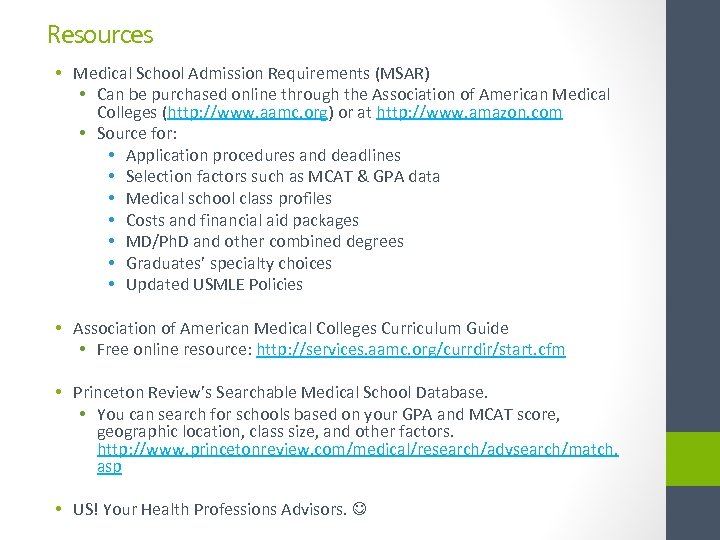
Resources • Medical School Admission Requirements (MSAR) • Can be purchased online through the Association of American Medical Colleges (http: //www. aamc. org) or at http: //www. amazon. com • Source for: • Application procedures and deadlines • Selection factors such as MCAT & GPA data • Medical school class profiles • Costs and financial aid packages • MD/Ph. D and other combined degrees • Graduates’ specialty choices • Updated USMLE Policies • Association of American Medical Colleges Curriculum Guide • Free online resource: http: //services. aamc. org/currdir/start. cfm • Princeton Review’s Searchable Medical School Database. • You can search for schools based on your GPA and MCAT score, geographic location, class size, and other factors. http: //www. princetonreview. com/medical/research/advsearch/match. asp • US! Your Health Professions Advisors.

Questions ?
Скачать презентацию Building Your School List Health Professions Info Session
5f7a1de029b224d9d3f30f81a8f79aae.ppt