 Скачать презентацию Building Women s Political Leadership in Africa October 26
40be62846ddd15ade044f140ad474b99.ppt
- Количество слайдов: 11



Building Women’s Political Leadership in Africa October 26, 2012 Alimata Abdul Karimu Josephine Habba Hauwa Dikko Ssanyu Rebecca
Outline l Introduction l Current Situation l Challenges l Our Recommendations l Conclusion
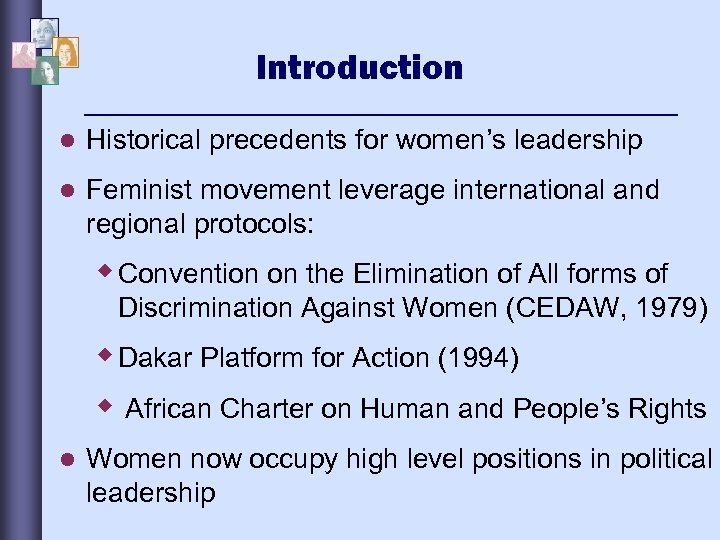
Introduction l Historical precedents for women’s leadership l Feminist movement leverage international and regional protocols: w Convention on the Elimination of All forms of Discrimination Against Women (CEDAW, 1979) w Dakar Platform for Action (1994) w African Charter on Human and People’s Rights l Women now occupy high level positions in political leadership
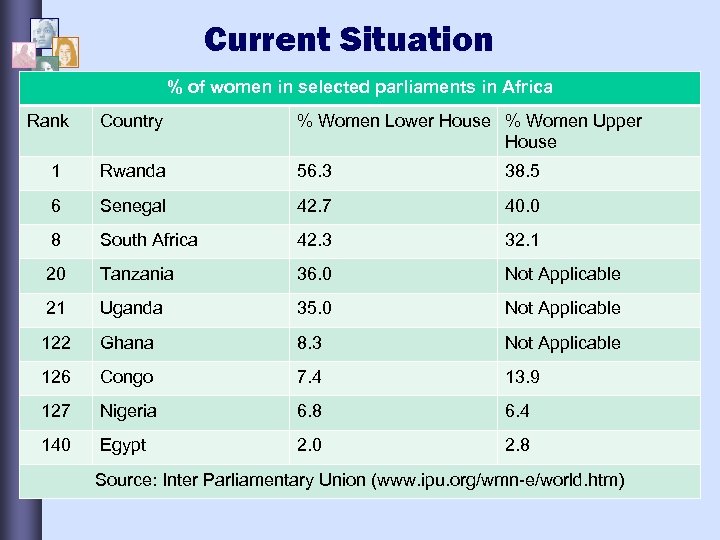
Current Situation % of women in selected parliaments in Africa Rank Country % Women Lower House % Women Upper House 1 Rwanda 56. 3 38. 5 6 Senegal 42. 7 40. 0 8 South Africa 42. 3 32. 1 20 Tanzania 36. 0 Not Applicable 21 Uganda 35. 0 Not Applicable 122 Ghana 8. 3 Not Applicable 126 Congo 7. 4 13. 9 127 Nigeria 6. 8 6. 4 140 Egypt 2. 0 2. 8 Source: Inter Parliamentary Union (www. ipu. org/wmn-e/world. htm)
Challenges l Political party dynamics ØMale dominance across all party structures l Unsupportive social structures ØOverturning of power dynamics within families & communities men oppose women’s leadership
Challenges l Negative media stereotypes l Women’s inadequate capacity to leverage representation into substantive gains l Lack of resources – especially financial l Political violence (including sexual and gender based violence within politics)
How can we sustain and further build on the gains in the face of so many challenges?
Our Recommendations l To donor agencies w UN Women: Support women’s participation in local level governance w European Union: Hold political parties accountable for affirmative action commitments l The African Union Executive Council w To strongly recommend member countries on developing National Action Plans on UNSC Resolution 1325
Our Recommendations l To the African Union Women Gender and Development Directorate − Build capacity of CSOs to facilitate skills development of women leaders l To civil society and philanthropic organisations w On-going mentoring programs w Leadership forums and w Social networking
Conclusion “It is a matter of straightforward justice, and it is also a matter of improving the democratic quality of representation. By having more women as legislators, more concerns – different concerns will be brought to the public arena to respond to the diverse needs of society”. Michelle Bachelet, Executive Director, UN Women

Thank you!
Скачать презентацию Building Women s Political Leadership in Africa October 26
40be62846ddd15ade044f140ad474b99.ppt