 Скачать презентацию Building Vocabulary from Word Roots Lesson 9 Latin
25747bce70491f5e46b51c41385ec2a5.ppt
- Количество слайдов: 15



Building Vocabulary from Word Roots Lesson 9 Latin Bases ver and fall, fals, fail, fault
Prefixes The Latin bases ver, fall, fals, fail, and fault all associate with three Latin prefixes: – ad- (to, toward, add to) – de- (not, down) – in- (not)
ver The Latin base ver means “true. ” This base, in general, is associated with the positive qualities of truth.
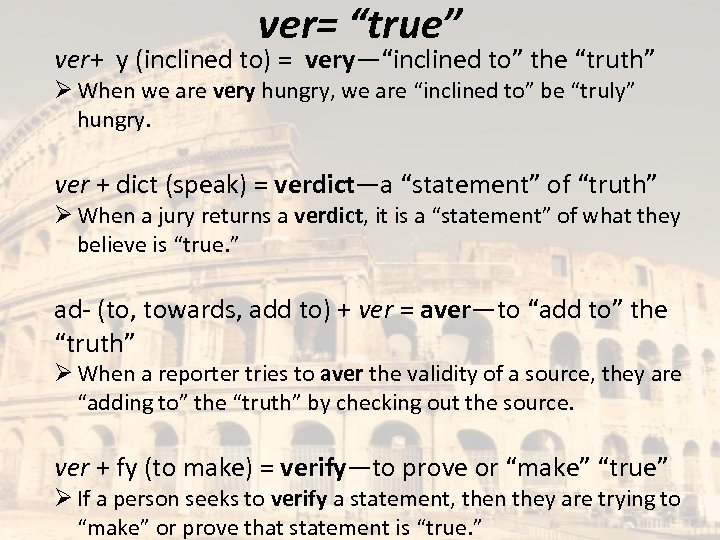
ver= “true” ver+ y (inclined to) = very—“inclined to” the “truth” Ø When we are very hungry, we are “inclined to” be “truly” hungry. ver + dict (speak) = verdict—a “statement” of “truth” Ø When a jury returns a verdict, it is a “statement” of what they believe is “true. ” ad- (to, towards, add to) + ver = aver—to “add to” the “truth” Ø When a reporter tries to aver the validity of a source, they are “adding to” the “truth” by checking out the source. ver + fy (to make) = verify—to prove or “make” “true” Ø If a person seeks to verify a statement, then they are trying to “make” or prove that statement is “true. ”
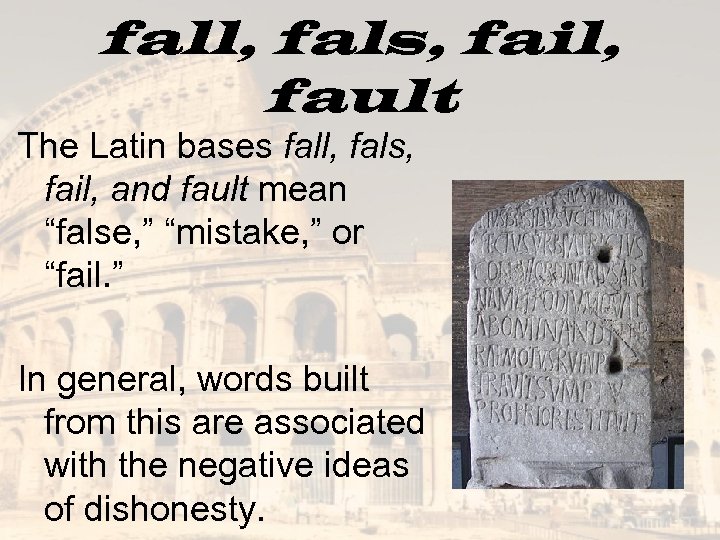
fall, fals, fail, fault The Latin bases fall, fals, fail, and fault mean “false, ” “mistake, ” or “fail. ” In general, words built from this are associated with the negative ideas of dishonesty.
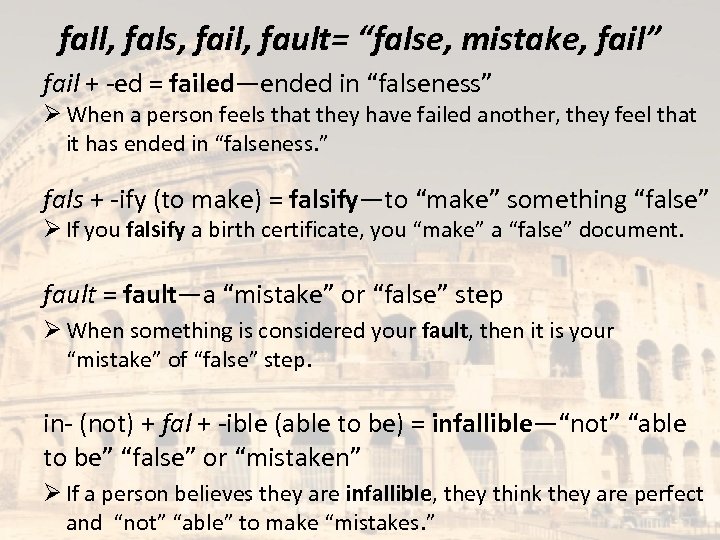
fall, fals, fail, fault= “false, mistake, fail” fail + -ed = failed—ended in “falseness” Ø When a person feels that they have failed another, they feel that it has ended in “falseness. ” fals + -ify (to make) = falsify—to “make” something “false” Ø If you falsify a birth certificate, you “make” a “false” document. fault = fault—a “mistake” or “false” step Ø When something is considered your fault, then it is your “mistake” of “false” step. in- (not) + fal + -ible (able to be) = infallible—“not” “able to be” “false” or “mistaken” Ø If a person believes they are infallible, they think they are perfect and “not” “able” to make “mistakes. ”
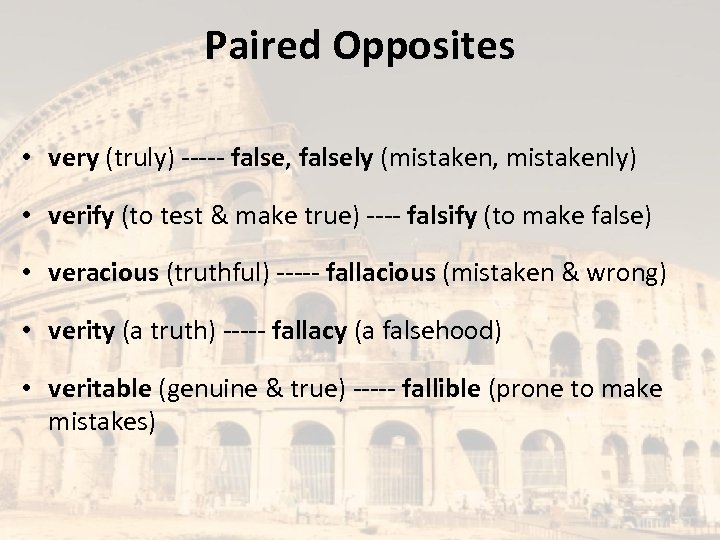
Paired Opposites • very (truly) ----- false, falsely (mistaken, mistakenly) • verify (to test & make true) ---- falsify (to make false) • veracious (truthful) ----- fallacious (mistaken & wrong) • verity (a truth) ----- fallacy (a falsehood) • veritable (genuine & true) ----- fallible (prone to make mistakes)
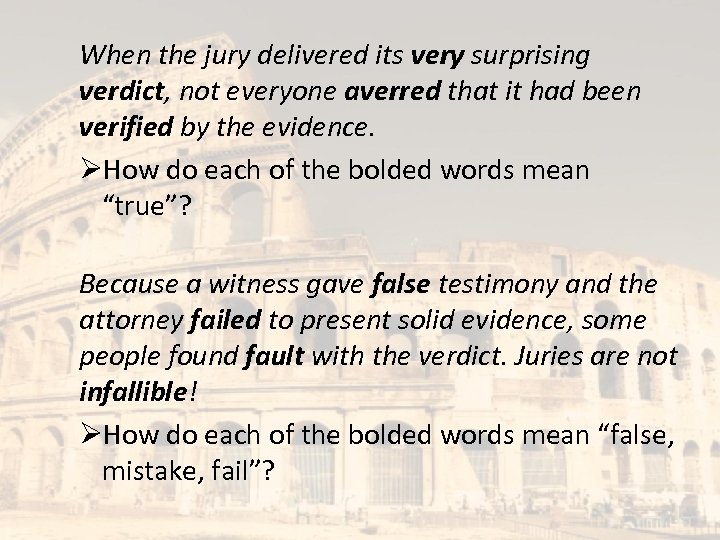
When the jury delivered its very surprising verdict, not everyone averred that it had been verified by the evidence. ØHow do each of the bolded words mean “true”? Because a witness gave false testimony and the attorney failed to present solid evidence, some people found fault with the verdict. Juries are not infallible! ØHow do each of the bolded words mean “false, mistake, fail”?
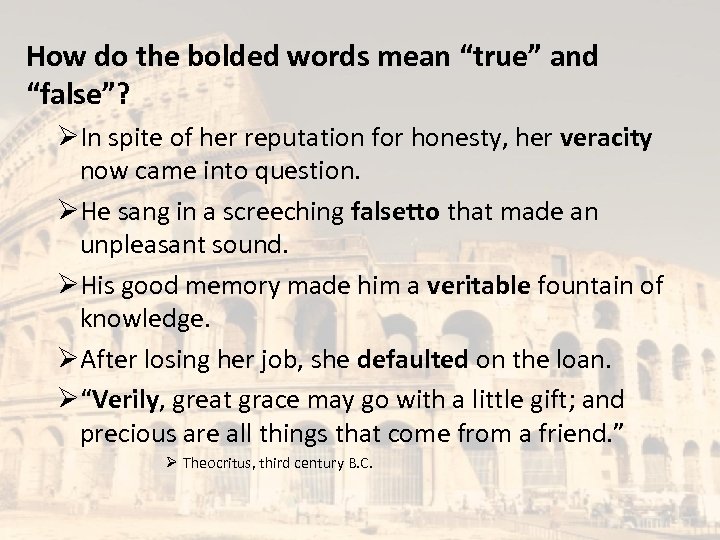
How do the bolded words mean “true” and “false”? ØIn spite of her reputation for honesty, her veracity now came into question. ØHe sang in a screeching falsetto that made an unpleasant sound. ØHis good memory made him a veritable fountain of knowledge. ØAfter losing her job, she defaulted on the loan. Ø“Verily, great grace may go with a little gift; and precious are all things that come from a friend. ” Ø Theocritus, third century B. C.
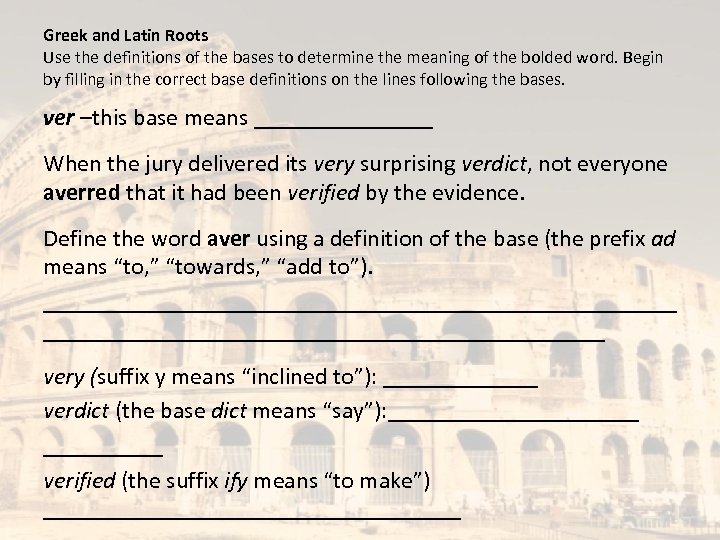
Greek and Latin Roots Use the definitions of the bases to determine the meaning of the bolded word. Begin by filling in the correct base definitions on the lines following the bases. ver –this base means ________ When the jury delivered its very surprising verdict, not everyone averred that it had been verified by the evidence. Define the word aver using a definition of the base (the prefix ad means “to, ” “towards, ” “add to”). ___________________________ very (suffix y means “inclined to”): _______ verdict (the base dict means “say”): ___________ verified (the suffix ify means “to make”) __________________

Greek and Latin Roots Use the definitions of the bases to determine the meaning of the bolded word. Begin by filling in the correct base definitions on the lines following the bases. ver –this base means “true” When the jury delivered its very surprising verdict, not everyone averred that it had been verified by the evidence. Define the word aver using a definition of the base (the prefix ad means “to, ” “towards, ” “add to”) “to” declare or assert its “truth; ” or to “add to” or support the “truth” very (suffix y means “inclined to”): inclined to be “truly” something verdict (the base dict means “say”): “statement” of the “truth” verified (the suffix ify means “to make”) “to make” “true”
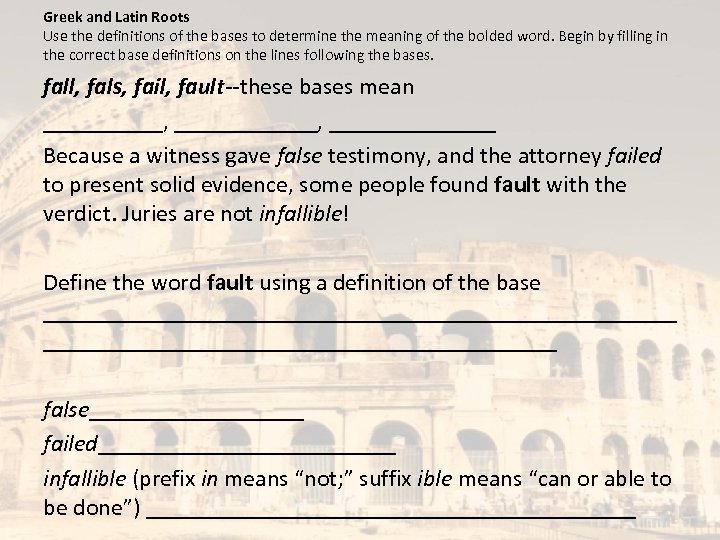
Greek and Latin Roots Use the definitions of the bases to determine the meaning of the bolded word. Begin by filling in the correct base definitions on the lines following the bases. fall, fals, fail, fault--these bases mean __________, ________ Because a witness gave false testimony, and the attorney failed to present solid evidence, some people found fault with the verdict. Juries are not infallible! Define the word fault using a definition of the base ___________________________ false_________ failed_____________ infallible (prefix in means “not; ” suffix ible means “can or able to be done”) _____________________
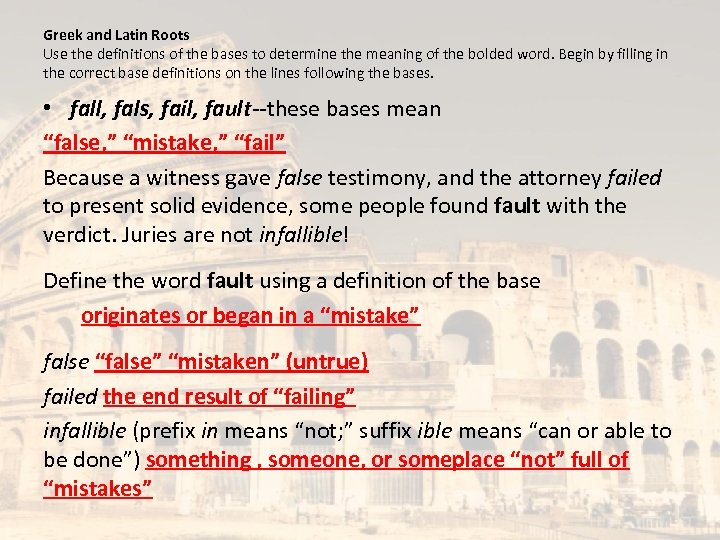
Greek and Latin Roots Use the definitions of the bases to determine the meaning of the bolded word. Begin by filling in the correct base definitions on the lines following the bases. • fall, fals, fail, fault--these bases mean “false, ” “mistake, ” “fail” Because a witness gave false testimony, and the attorney failed to present solid evidence, some people found fault with the verdict. Juries are not infallible! Define the word fault using a definition of the base originates or began in a “mistake” false “false” “mistaken” (untrue) failed the end result of “failing” infallible (prefix in means “not; ” suffix ible means “can or able to be done”) something , someone, or someplace “not” full of “mistakes”
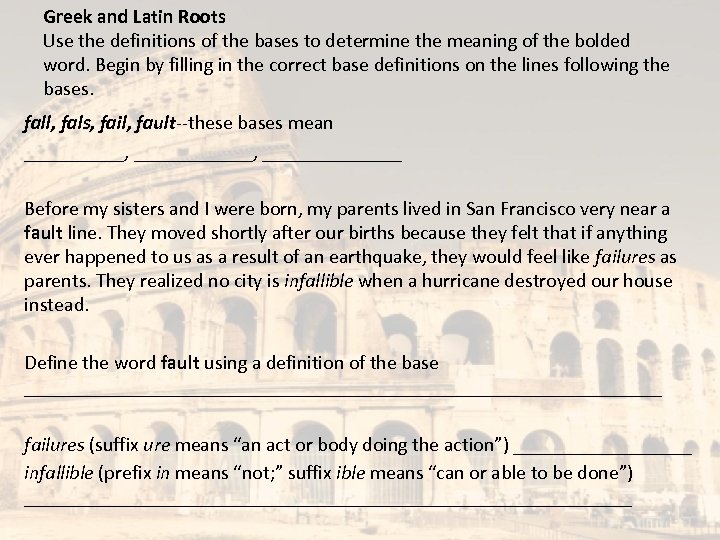
Greek and Latin Roots Use the definitions of the bases to determine the meaning of the bolded word. Begin by filling in the correct base definitions on the lines following the bases. fall, fals, fail, fault--these bases mean __________, ________ Before my sisters and I were born, my parents lived in San Francisco very near a fault line. They moved shortly after our births because they felt that if anything ever happened to us as a result of an earthquake, they would feel like failures as parents. They realized no city is infallible when a hurricane destroyed our house instead. Define the word fault using a definition of the base ________________________________ failures (suffix ure means “an act or body doing the action”) _________ infallible (prefix in means “not; ” suffix ible means “can or able to be done”) _______________________________
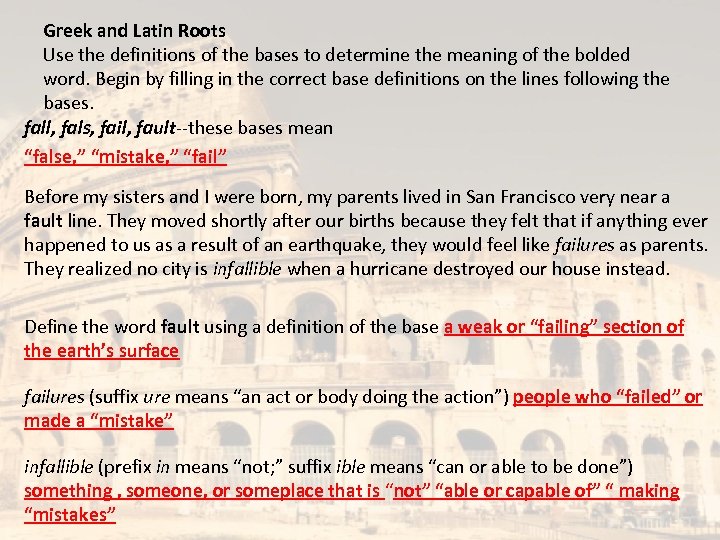
Greek and Latin Roots Use the definitions of the bases to determine the meaning of the bolded word. Begin by filling in the correct base definitions on the lines following the bases. fall, fals, fail, fault--these bases mean “false, ” “mistake, ” “fail” Before my sisters and I were born, my parents lived in San Francisco very near a fault line. They moved shortly after our births because they felt that if anything ever happened to us as a result of an earthquake, they would feel like failures as parents. They realized no city is infallible when a hurricane destroyed our house instead. Define the word fault using a definition of the base a weak or “failing” section of the earth’s surface failures (suffix ure means “an act or body doing the action”) people who “failed” or made a “mistake” infallible (prefix in means “not; ” suffix ible means “can or able to be done”) something , someone, or someplace that is “not” “able or capable of” “ making “mistakes”
Скачать презентацию Building Vocabulary from Word Roots Lesson 9 Latin
25747bce70491f5e46b51c41385ec2a5.ppt