 Скачать презентацию Building Performance and Energy Analysis BPEA Thread Presentation
a547bd2242e24a20cd248e5a672f02da.ppt
- Количество слайдов: 18



Building Performance and Energy Analysis (BPEA) Thread Presentation Outline 1. Definition of Early Design 2. Technical Overview 3. Demonstration Test Model 4. IDM 5. MVD 6. 2 nd Level Space Boundaries 7. External Shading Elements 8. Progress Update OGC Copyright 2008, Open Geospatial Consortium • Making Location Count
How do we define early design? The following are frequently encountered early project design phase sequences: • Feasibility-Programming-Schematic Design (SD)-Design Development (DD)-Construction Documents (CD) (Stanford Project Delivery Process) • Pre-Design, Conceptual Design (CD), SD, DD, CD (Green Studio Handbook) • Pre-Design, SD, DD, CD (AIA IPD Traditional Practice) • Feasibility, CD (Preliminary Concepts and Final Concepts), DD, CD (GSA Project Delivery Process) The context of this Testbed is not to define generic or standard project phase terms, or try to standardize what’s typically in the scope of that phase, but rather define what we want to achieve with the analysis and when, and the nature of and types of information that are required to support that analysis at that time in the project delivery process. OGC Copyright 2008, Open Geospatial Consortium • Making Location Count
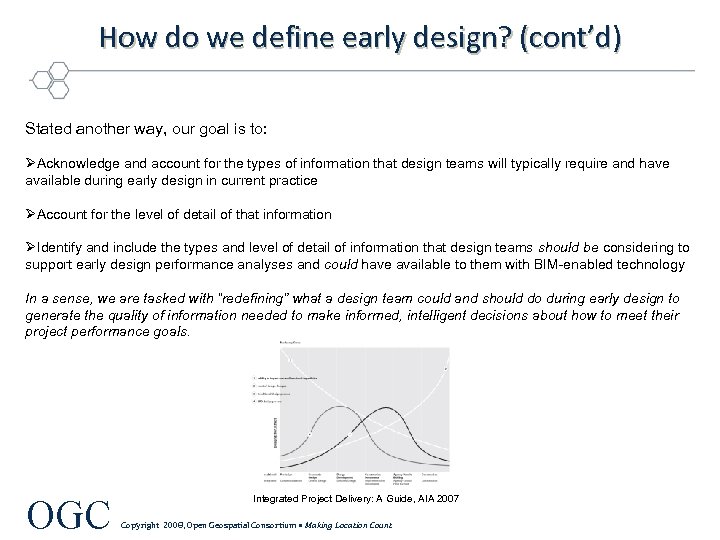
How do we define early design? (cont’d) Stated another way, our goal is to: ØAcknowledge and account for the types of information that design teams will typically require and have available during early design in current practice ØAccount for the level of detail of that information ØIdentify and include the types and level of detail of information that design teams should be considering to support early design performance analyses and could have available to them with BIM-enabled technology In a sense, we are tasked with “redefining” what a design team could and should do during early design to generate the quality of information needed to make informed, intelligent decisions about how to meet their project performance goals. OGC Integrated Project Delivery: A Guide, AIA 2007 Copyright 2008, Open Geospatial Consortium • Making Location Count
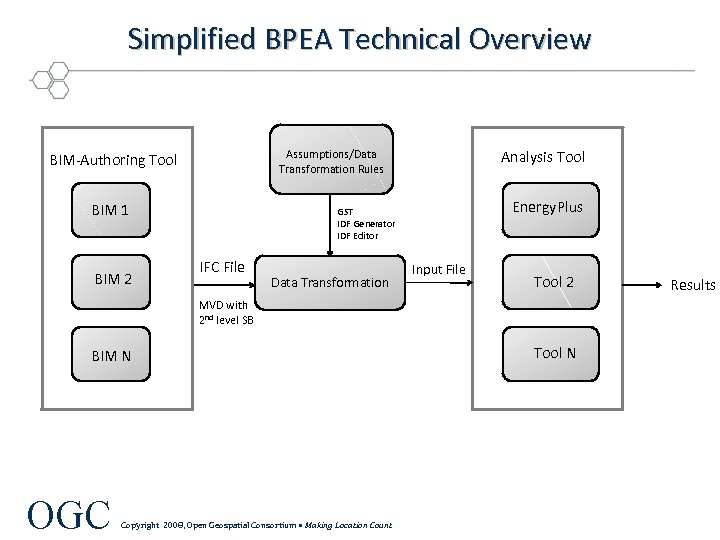
Simplified BPEA Technical Overview BIM 1 BIM 2 Analysis Tool Assumptions/Data Transformation Rules BIM-Authoring Tool Energy. Plus GST IDF Generator IDF Editor IFC File Data Transformation Input File Tool 2 MVD with 2 nd level SB BIM N OGC Copyright 2008, Open Geospatial Consortium • Making Location Count Tool N Results
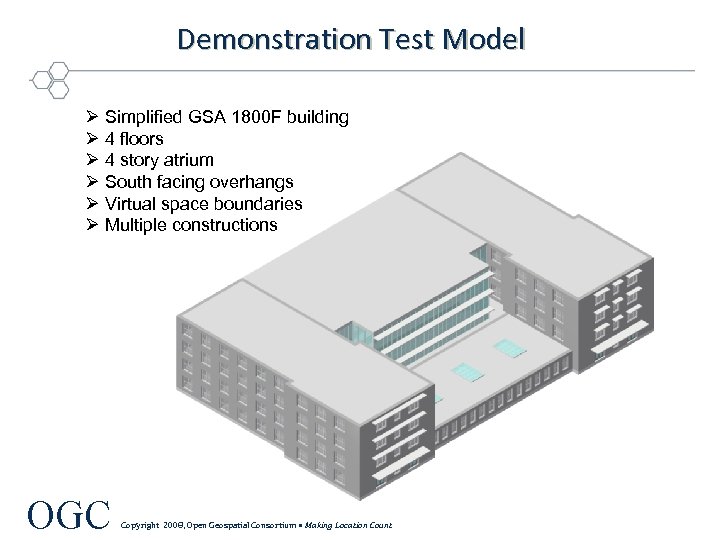
Demonstration Test Model Ø Simplified GSA 1800 F building Ø 4 floors Ø 4 story atrium Ø South facing overhangs Ø Virtual space boundaries Ø Multiple constructions OGC Copyright 2008, Open Geospatial Consortium • Making Location Count
BPEA Information Delivery Manual (IDM)Background and Overview Background • Starting point: building. SMART Norway and GSA IDM • 5 months of participant and public review • Alignment with QTO IDM Overview • Process Model • Specification of process • Specification of data objects • Specification of decision point gateways • Exchange Requirements for Energy Simulation Input • Exchange Requirements for Energy Simulation Output OGC Copyright 2008, Open Geospatial Consortium • Making Location Count
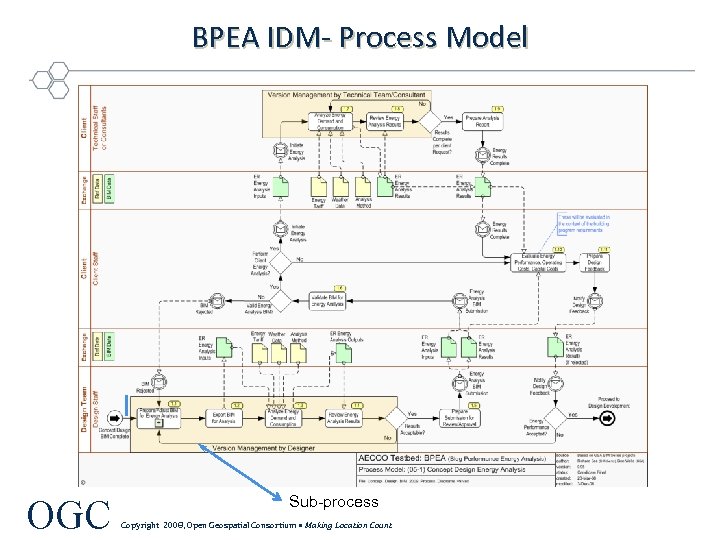
BPEA IDM- Process Model OGC Sub-process Copyright 2008, Open Geospatial Consortium • Making Location Count
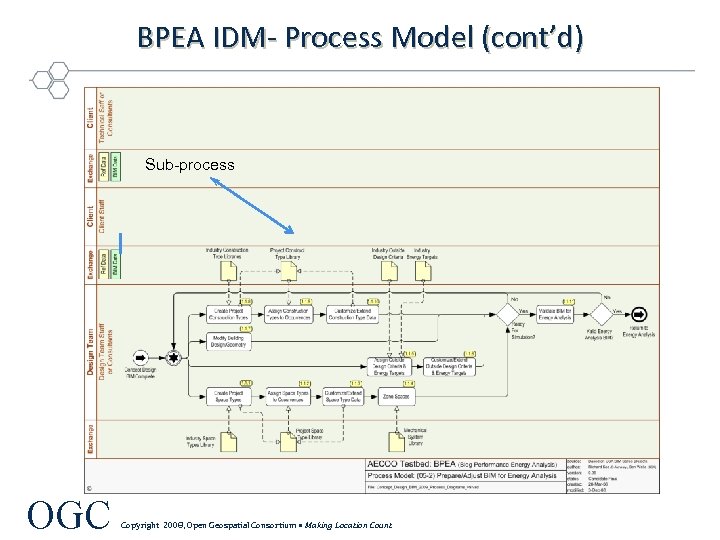
BPEA IDM- Process Model (cont’d) Sub-process OGC Copyright 2008, Open Geospatial Consortium • Making Location Count
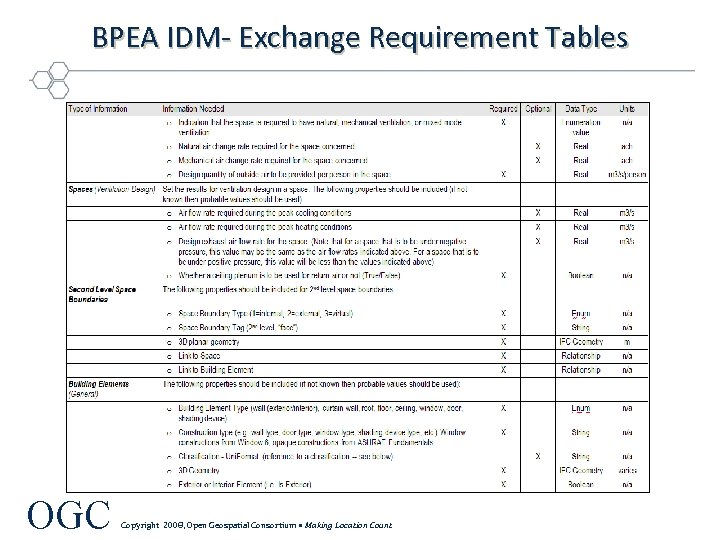
BPEA IDM- Exchange Requirement Tables OGC Copyright 2008, Open Geospatial Consortium • Making Location Count
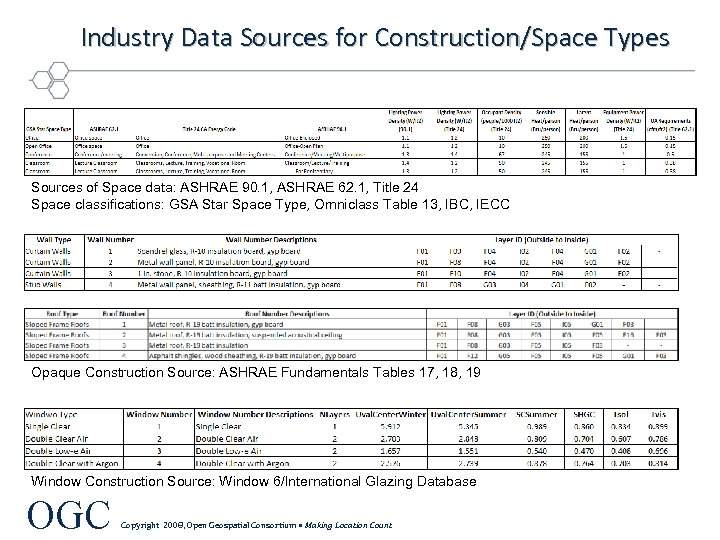
Industry Data Sources for Construction/Space Types Sources of Space data: ASHRAE 90. 1, ASHRAE 62. 1, Title 24 Space classifications: GSA Star Space Type, Omniclass Table 13, IBC, IECC Opaque Construction Source: ASHRAE Fundamentals Tables 17, 18, 19 Window Construction Source: Window 6/International Glazing Database OGC Copyright 2008, Open Geospatial Consortium • Making Location Count
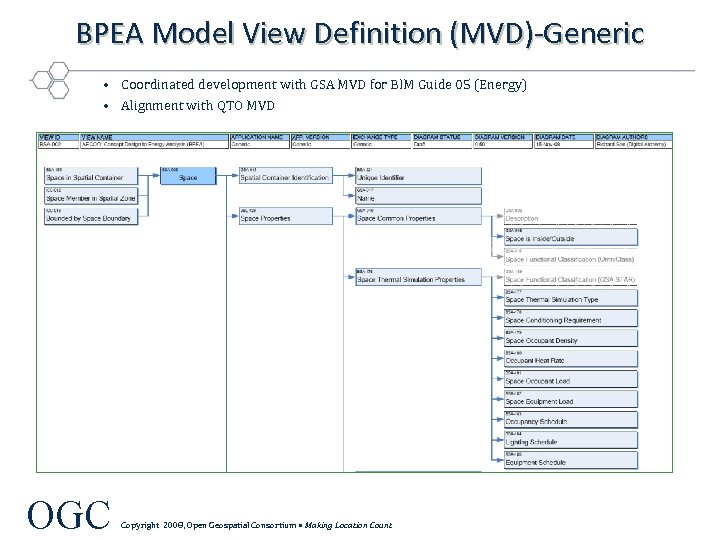
BPEA Model View Definition (MVD)-Generic • Coordinated development with GSA MVD for BIM Guide 05 (Energy) • Alignment with QTO MVD OGC Copyright 2008, Open Geospatial Consortium • Making Location Count
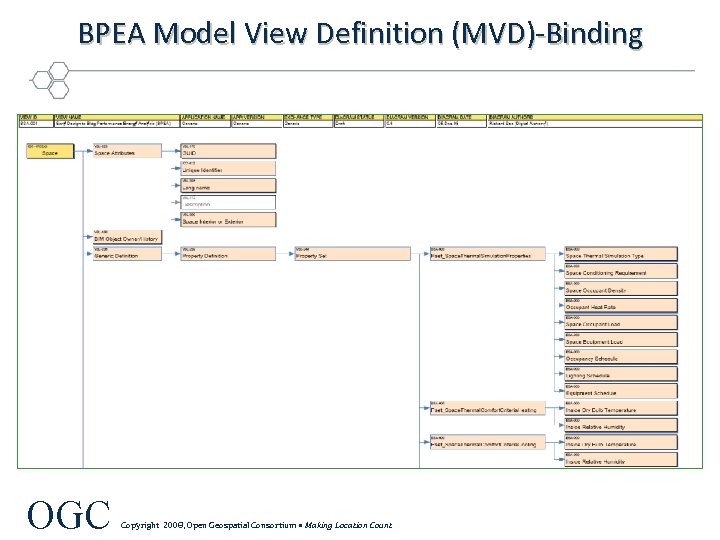
BPEA Model View Definition (MVD)-Binding OGC Copyright 2008, Open Geospatial Consortium • Making Location Count
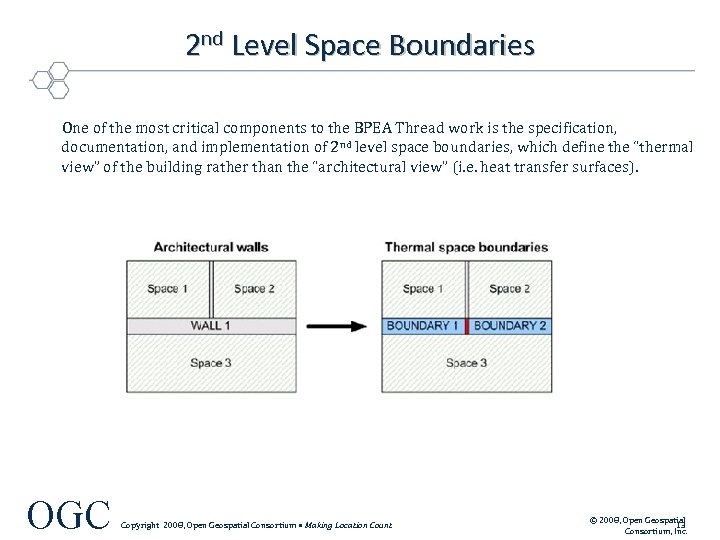
2 nd Level Space Boundaries One of the most critical components to the BPEA Thread work is the specification, documentation, and implementation of 2 nd level space boundaries, which define the “thermal view” of the building rather than the “architectural view” (i. e. heat transfer surfaces). OGC Copyright 2008, Open Geospatial Consortium • Making Location Count © 2008, Open Geospatial 13 Consortium, Inc.
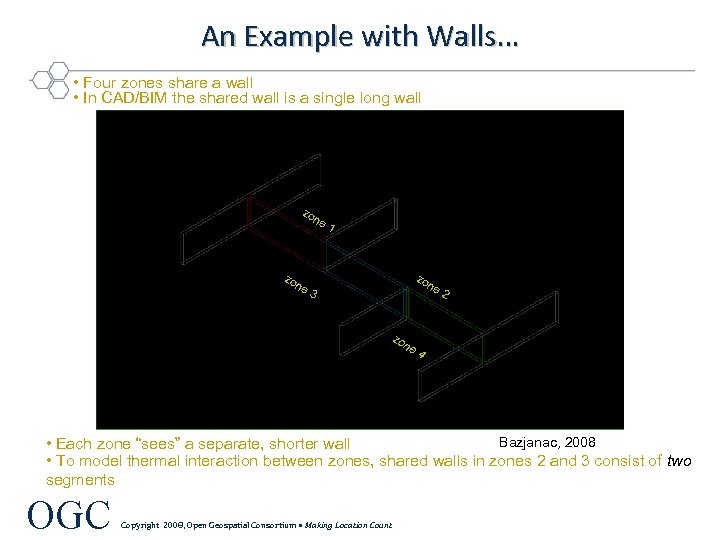
An Example with Walls… • Four zones share a wall • In CAD/BIM the shared wall is a single long wall zo ne zo 1 zo ne ne 3 zo ne 2 4 Bazjanac, 2008 • Each zone “sees” a separate, shorter wall • To model thermal interaction between zones, shared walls in zones 2 and 3 consist of two segments OGC Copyright 2008, Open Geospatial Consortium • Making Location Count
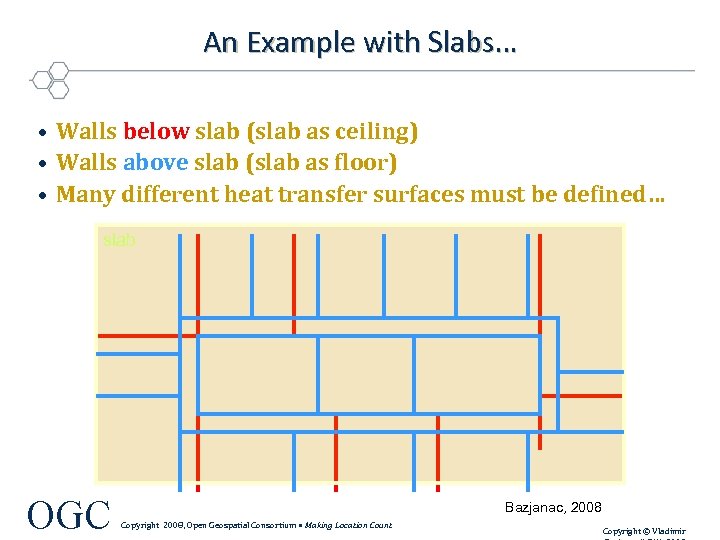
An Example with Slabs… • Walls below slab (slab as ceiling) • Walls above slab (slab as floor) • Many different heat transfer surfaces must be defined… slab OGC Bazjanac, 2008 Copyright 2008, Open Geospatial Consortium • Making Location Count Copyright © Vladimir
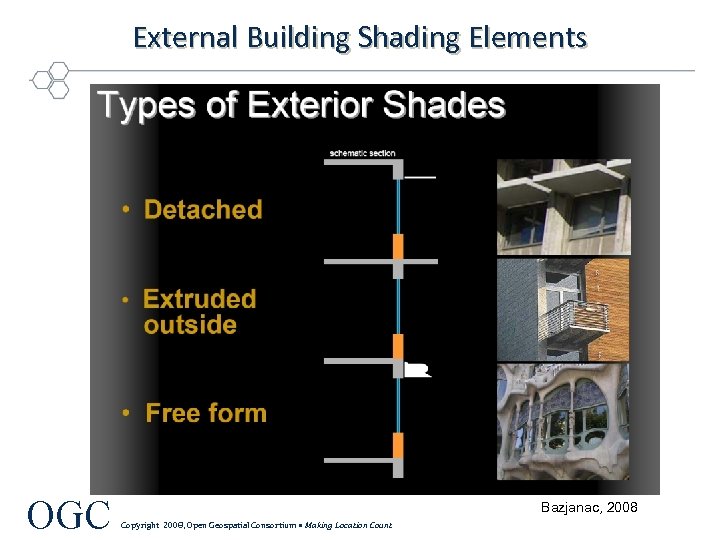
External Building Shading Elements OGC Bazjanac, 2008 Copyright 2008, Open Geospatial Consortium • Making Location Count
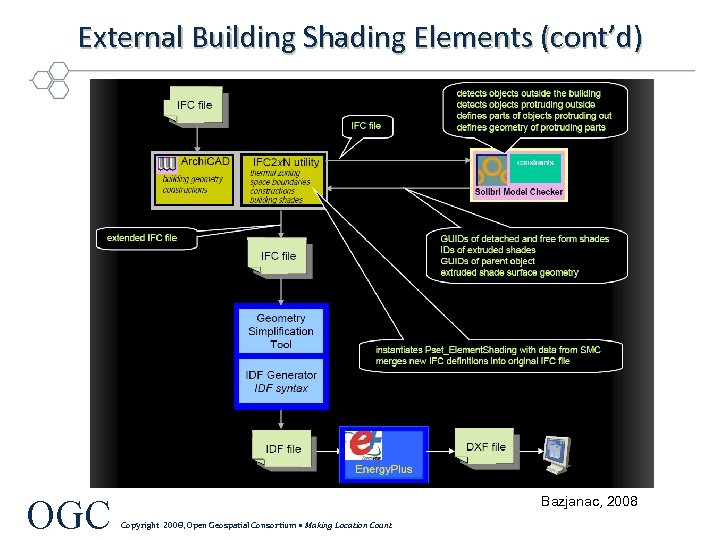
External Building Shading Elements (cont’d) OGC Bazjanac, 2008 Copyright 2008, Open Geospatial Consortium • Making Location Count
BPEA Thread Progress Update Tasks completed: 1. BPEA IDM 2. General BPEA MVD and IFC bindings 3. Demo test model Tasks in progress: 1. Demo model testing protocols and implementation (NIST) 2. 2 nd level space boundaries (LBNL, Granlund, Digital Alchemy, AEC 3) 3. Space mapping (OGC/Stanford) 4. External building shade implementation strategy (LBNL) OGC Copyright 2008, Open Geospatial Consortium • Making Location Count
Скачать презентацию Building Performance and Energy Analysis BPEA Thread Presentation
a547bd2242e24a20cd248e5a672f02da.ppt