 Скачать презентацию Building Europe Knowledge From the 6 th to
faf6241df578cd0ffea56e0767f713ea.ppt
- Количество слайдов: 39



Building Europe Knowledge From the 6 th to the 7 th RTD Framework Programme in Biotechnology, Agriculture and Food Budapest 12 May 2005 Dr. Christian Patermann Director Biotechnology, Agriculture and Food Research European Commission, DG Research 1
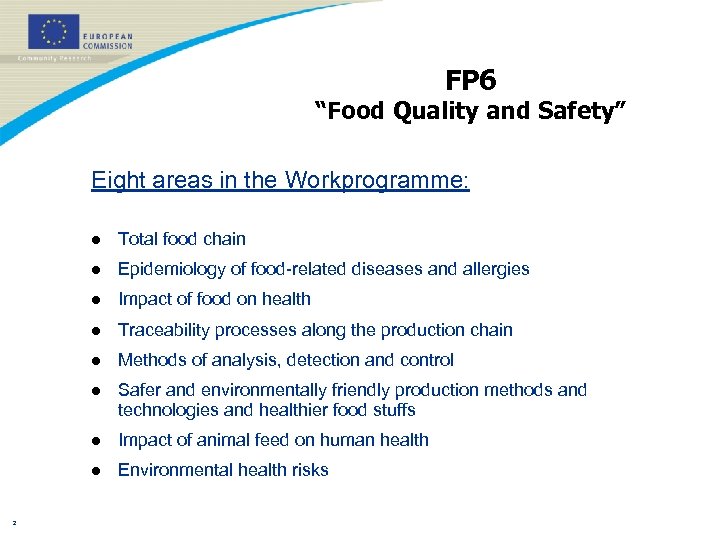
FP 6 “Food Quality and Safety” Eight areas in the Workprogramme: l l Epidemiology of food-related diseases and allergies l Impact of food on health l Traceability processes along the production chain l Methods of analysis, detection and control l Safer and environmentally friendly production methods and technologies and healthier food stuffs l Impact of animal feed on human health l 2 Total food chain Environmental health risks
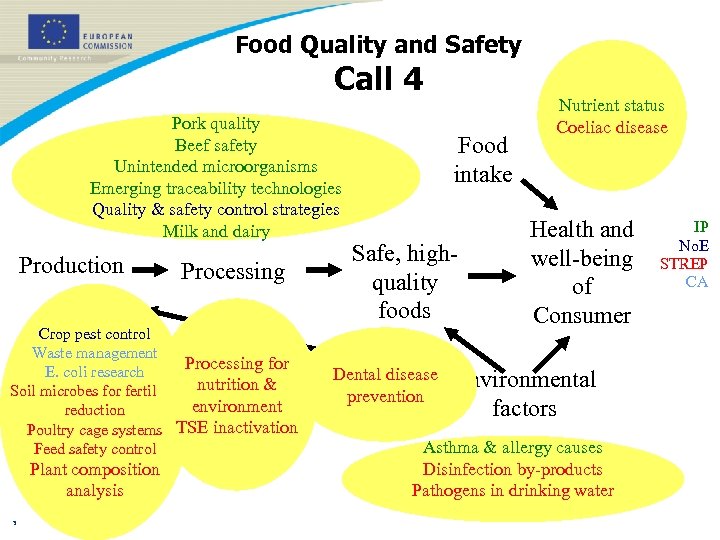
Food Quality and Safety Call 4 Pork quality Beef safety Unintended microorganisms Emerging traceability technologies Quality & safety control strategies Milk and dairy Production Processing Crop pest control Waste management Processing for E. coli research Soil microbes for fertilizer nutrition & environment reduction Poultry cage systems TSE inactivation Feed safety control Plant composition analysis 3 Food intake Safe, highquality foods Dental disease prevention Nutrient status Coeliac disease Health and well-being of Consumer Environmental factors Asthma & allergy causes Disinfection by-products Pathogens in drinking water IP No. E STREP CA
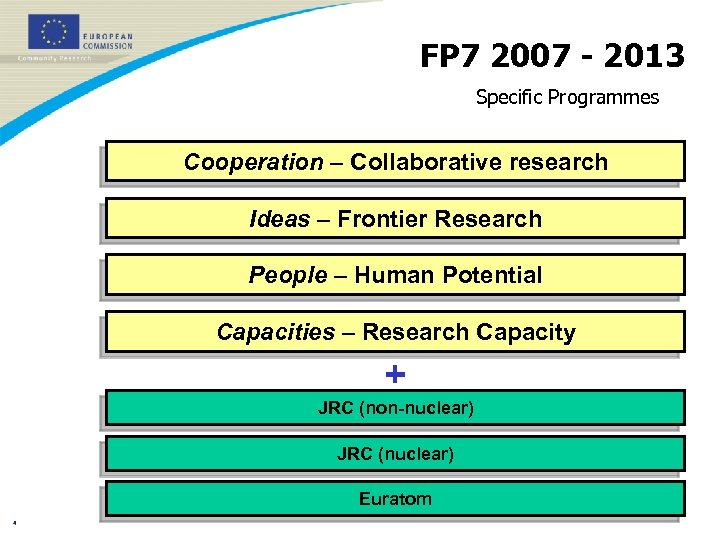
FP 7 2007 - 2013 Specific Programmes Cooperation – Collaborative research Ideas – Frontier Research People – Human Potential Capacities – Research Capacity + JRC (non-nuclear) JRC (nuclear) Euratom 4
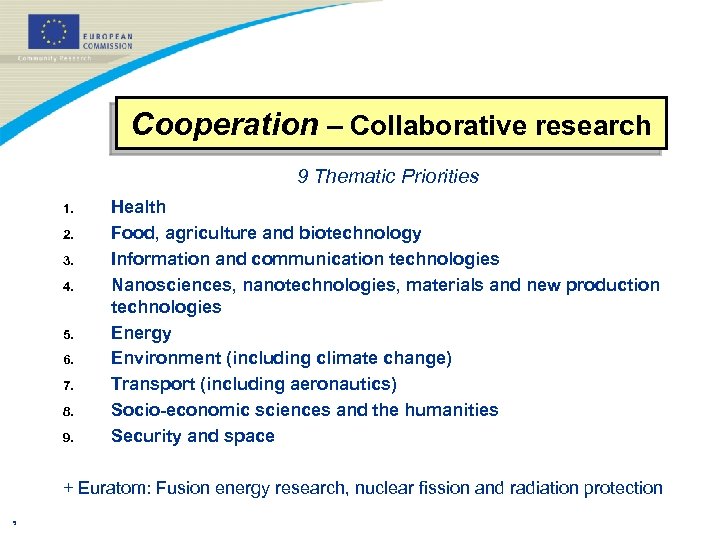
Cooperation – Collaborative research 9 Thematic Priorities 1. 2. 3. 4. 5. 6. 7. 8. 9. Health Food, agriculture and biotechnology Information and communication technologies Nanosciences, nanotechnologies, materials and new production technologies Energy Environment (including climate change) Transport (including aeronautics) Socio-economic sciences and the humanities Security and space + Euratom: Fusion energy research, nuclear fission and radiation protection 5
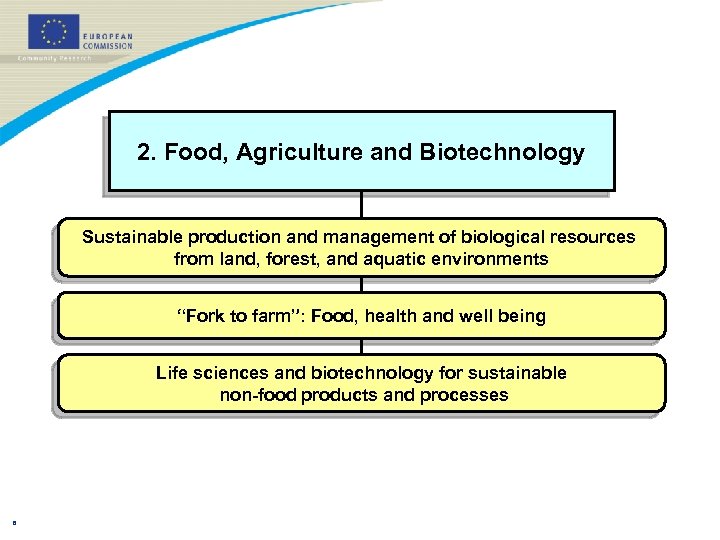
2. Food, Agriculture and Biotechnology Sustainable production and management of biological resources from land, forest, and aquatic environments “Fork to farm”: Food, health and well being Life sciences and biotechnology for sustainable non-food products and processes 6
Food, agriculture and biotechnology research: Objectives Ø Build a European Knowledge-Based Bio-Economy (KBBE) Ø Respond to social and economic challenges: – High quality food and sustainable food production – Food-related disorders (cardiovascular, obesity …) – Infectious animal diseases and zoonoses – Sustainable agriculture/fishery and climate change – Clean biomaterials from renewable bio-resources Ø Ø Support CAP and CFP Ø 7 Involve all stakeholders (incl. industry) in research Respond quickly to emerging research needs
Food, agriculture and biotechnology research: Rationale ü ü Society demands safer and healthier food ü Renewable resources and biomass for non-food applications helps reducing dependence on hydrocarbonbased economy ü Society demands sustainable and eco-efficient production methods in agriculture/fishery/forestry ü 8 Biotechnology and food companies / SMEs need to be competitive on the world market (‘European Strategy on Life Sciences and Biotechnology’) International cooperation ensures optimal exploitation of resources and application of results
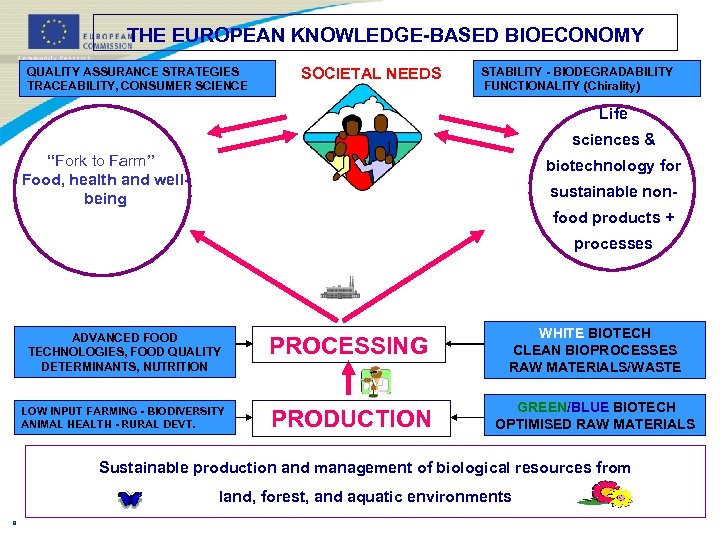
THE EUROPEAN KNOWLEDGE-BASED BIOECONOMY QUALITY ASSURANCE STRATEGIES TRACEABILITY, CONSUMER SCIENCE SOCIETAL NEEDS STABILITY - BIODEGRADABILITY FUNCTIONALITY (Chirality) Life sciences & “Fork to Farm” Food, health and wellbeing biotechnology for sustainable nonfood products + processes ADVANCED FOOD TECHNOLOGIES, FOOD QUALITY DETERMINANTS, NUTRITION LOW INPUT FARMING - BIODIVERSITY ANIMAL HEALTH - RURAL DEVT. PROCESSING WHITE BIOTECH CLEAN BIOPROCESSES RAW MATERIALS/WASTE PRODUCTION GREEN/BLUE BIOTECH OPTIMISED RAW MATERIALS Sustainable production and management of biological resources from land, forest, and aquatic environments 9
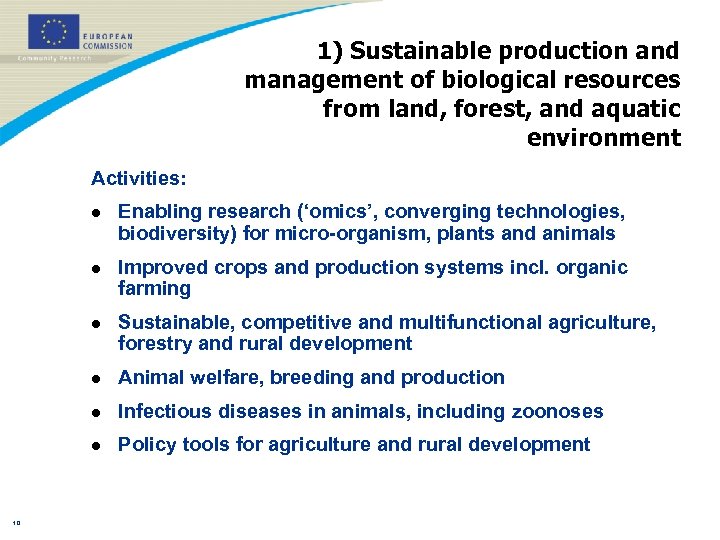
1) Sustainable production and management of biological resources from land, forest, and aquatic environment Activities: l l Improved crops and production systems incl. organic farming l Sustainable, competitive and multifunctional agriculture, forestry and rural development l Animal welfare, breeding and production l Infectious diseases in animals, including zoonoses l 10 Enabling research (‘omics’, converging technologies, biodiversity) for micro-organism, plants and animals Policy tools for agriculture and rural development
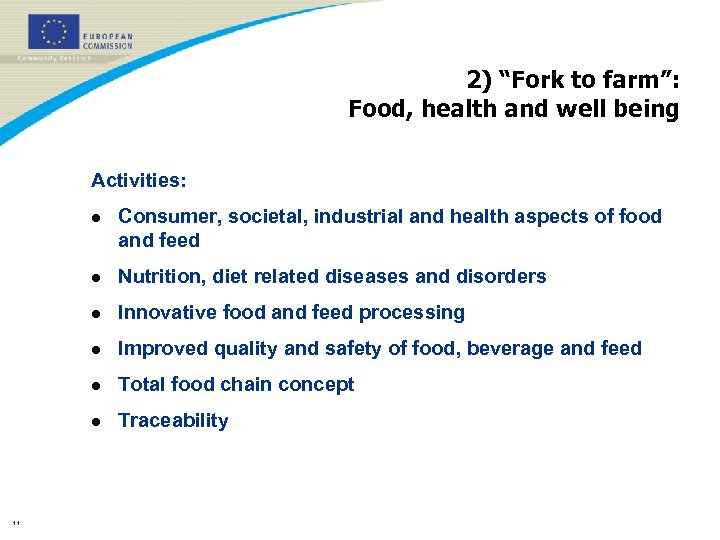
2) “Fork to farm”: Food, health and well being Activities: l l Nutrition, diet related diseases and disorders l Innovative food and feed processing l Improved quality and safety of food, beverage and feed l Total food chain concept l 11 Consumer, societal, industrial and health aspects of food and feed Traceability
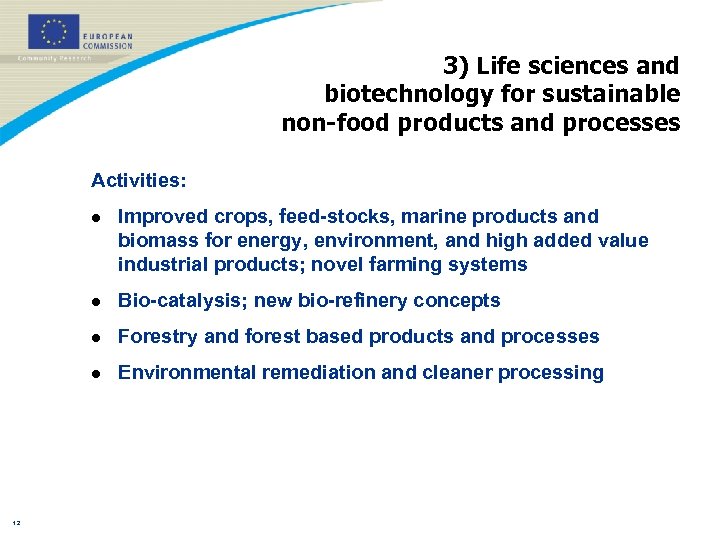
3) Life sciences and biotechnology for sustainable non-food products and processes Activities: l l Bio-catalysis; new bio-refinery concepts l Forestry and forest based products and processes l 12 Improved crops, feed-stocks, marine products and biomass for energy, environment, and high added value industrial products; novel farming systems Environmental remediation and cleaner processing
Food, agriculture and biotechnology research: What’s new! ü ü New: Pillar 1 “Sustainable production and management of biological resources” and pillar 3 “Life sciences and biotech for sustainable non-food products and processes” ü Some topics under pillar 1&3 partly financed in FP 4 and FP 5 (BIOTECH, FAIR, Qo. L, etc. ), but FP 6 efforts scattered and not of sufficient critical mass (some activities under materials, energy and environment) providing no synergies ü 13 Pillar 2 “Food, health and well-being” ensures continuity of FP 6 “Food quality and safety” research Technology platforms in the area of plant biotechnology, animal breeding, global animal health, forestry, food and industrial biotechnology
Food, agriculture and biotechnology research: Borderline with other FP 7 themes ü ü Complementary research relating to the management/conservation of natural resources addressed under the “Environment including Climate Change” theme. ü 14 Enabling/systems biology research on plants, animals and microbes complementary to systems biology for human health applications in theme 1. Demonstration of bioprocesses for biomass conversion to energy/materials under this priority – up-scaling and complete process design under materials and energy themes
Food, agriculture and biotechnology research: NEST; policy support; international cooperation New activities within themes: ü Integration of new and emerging science and technologies ü Support to policy development (CAP, CPF, public health, food safety, animal health, …) ü International co-operation … to be defined on the level of the specific programme or workprogramme 15
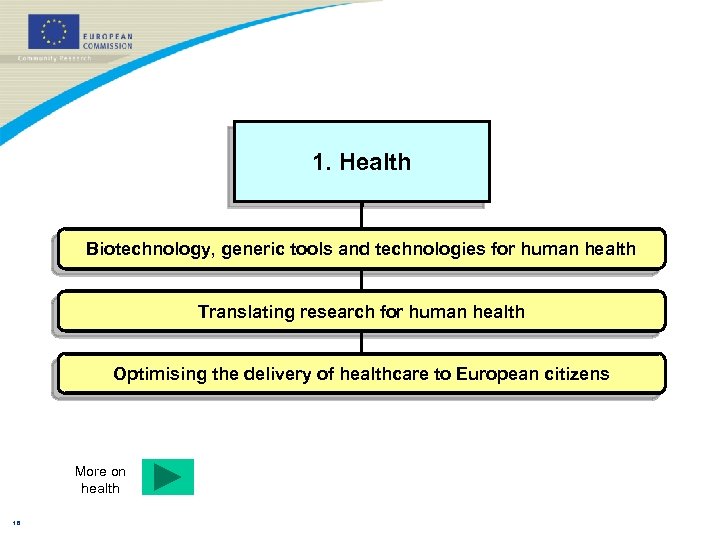
1. Health Biotechnology, generic tools and technologies for human health Translating research for human health Optimising the delivery of healthcare to European citizens More on health 16
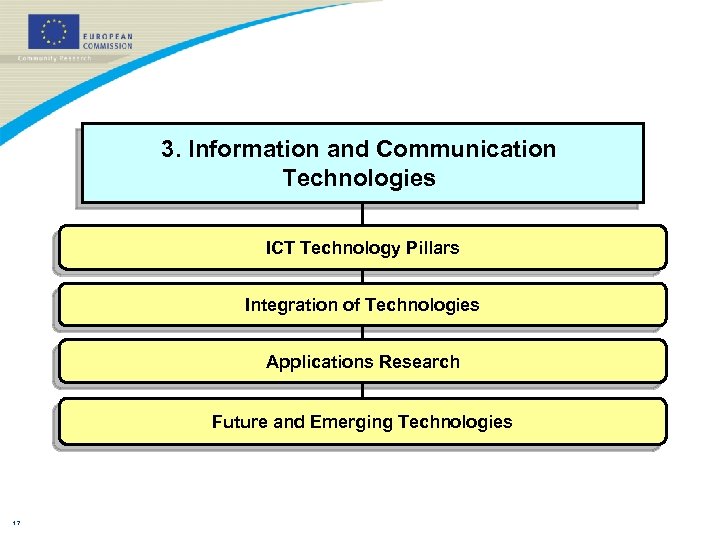
3. Information and Communication Technologies ICT Technology Pillars Integration of Technologies Applications Research Future and Emerging Technologies 17
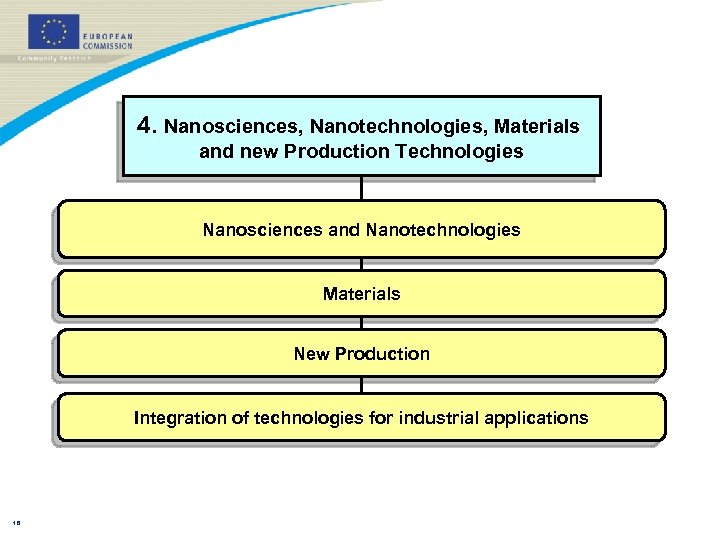
4. Nanosciences, Nanotechnologies, Materials and new Production Technologies Nanosciences and Nanotechnologies Materials New Production Integration of technologies for industrial applications 18
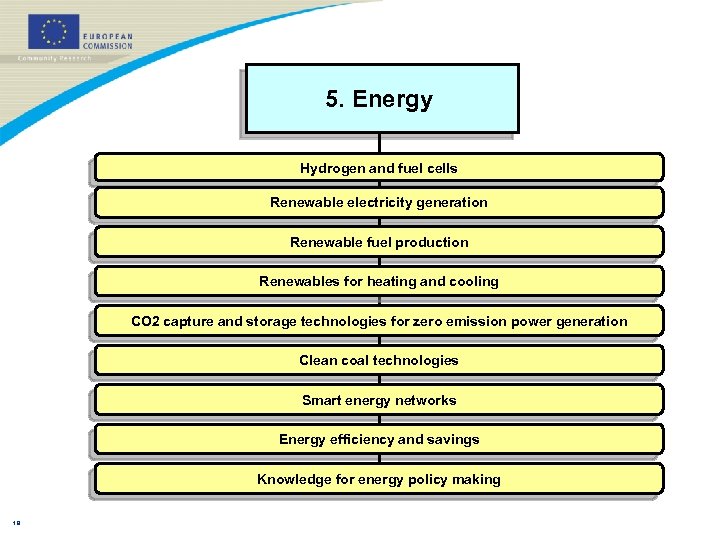
5. Energy Hydrogen and fuel cells Renewable electricity generation Renewable fuel production Renewables for heating and cooling CO 2 capture and storage technologies for zero emission power generation Clean coal technologies Smart energy networks Energy efficiency and savings Knowledge for energy policy making 19
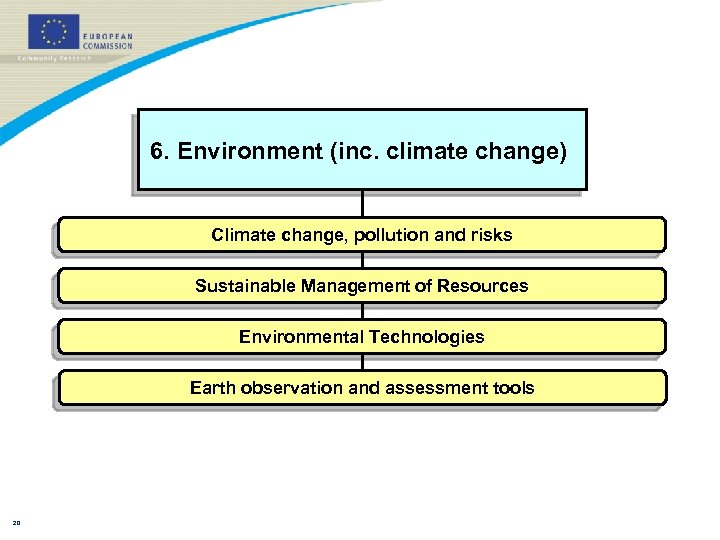
6. Environment (inc. climate change) Climate change, pollution and risks Sustainable Management of Resources Environmental Technologies Earth observation and assessment tools 20
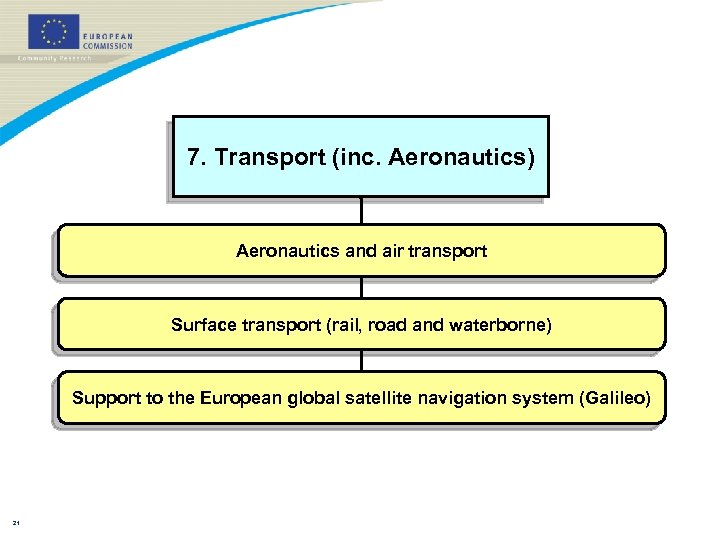
7. Transport (inc. Aeronautics) Aeronautics and air transport Surface transport (rail, road and waterborne) Support to the European global satellite navigation system (Galileo) 21
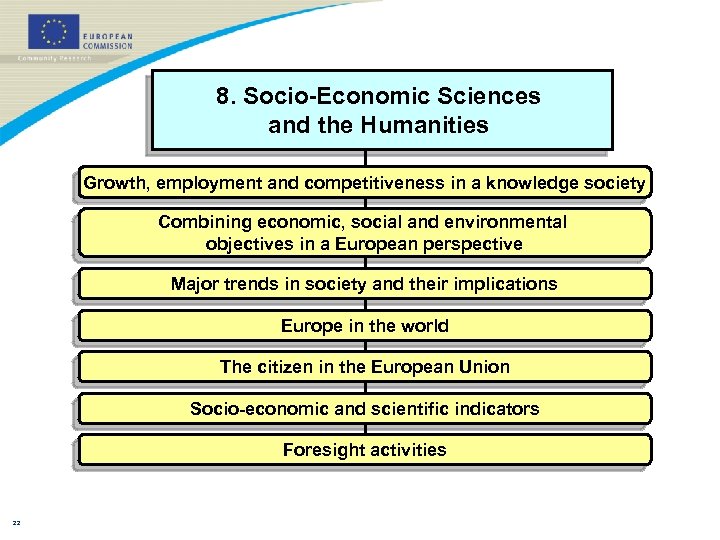
8. Socio-Economic Sciences and the Humanities Growth, employment and competitiveness in a knowledge society Combining economic, social and environmental objectives in a European perspective Major trends in society and their implications Europe in the world The citizen in the European Union Socio-economic and scientific indicators Foresight activities 22
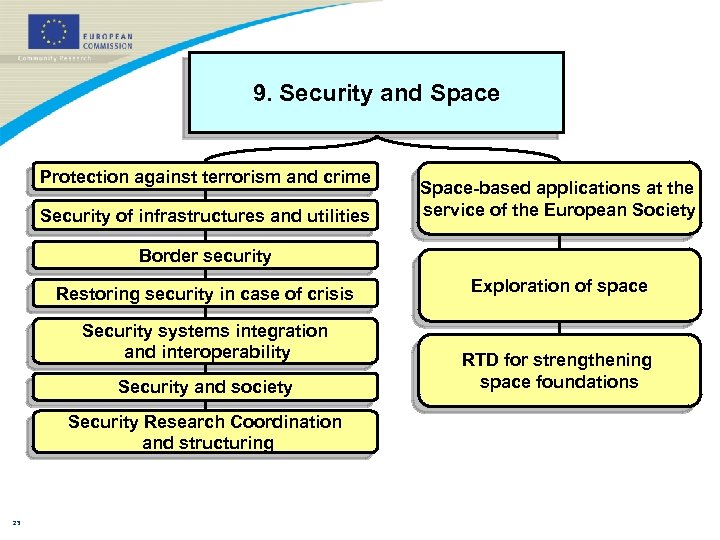
9. Security and Space Protection against terrorism and crime Security of infrastructures and utilities Space-based applications at the service of the European Society Border security Restoring security in case of crisis Security systems integration and interoperability Security and society Security Research Coordination and structuring 23 Exploration of space RTD for strengthening space foundations
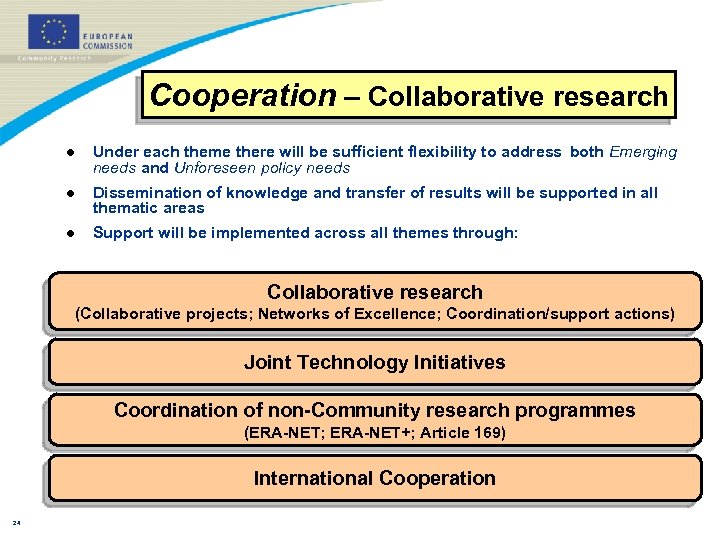
Cooperation – Collaborative research l Under each theme there will be sufficient flexibility to address both Emerging needs and Unforeseen policy needs l Dissemination of knowledge and transfer of results will be supported in all thematic areas l Support will be implemented across all themes through: Collaborative research (Collaborative projects; Networks of Excellence; Coordination/support actions) Joint Technology Initiatives Coordination of non-Community research programmes (ERA-NET; ERA-NET+; Article 169) International Cooperation 24
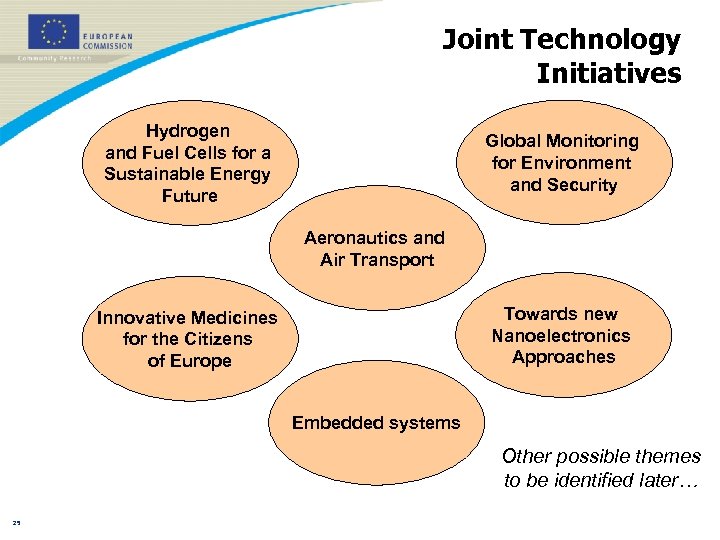
Joint Technology Initiatives Hydrogen and Fuel Cells for a Sustainable Energy Future Global Monitoring for Environment and Security Aeronautics and Air Transport Towards new Nanoelectronics Approaches Innovative Medicines for the Citizens of Europe Embedded systems Other possible themes to be identified later… 25
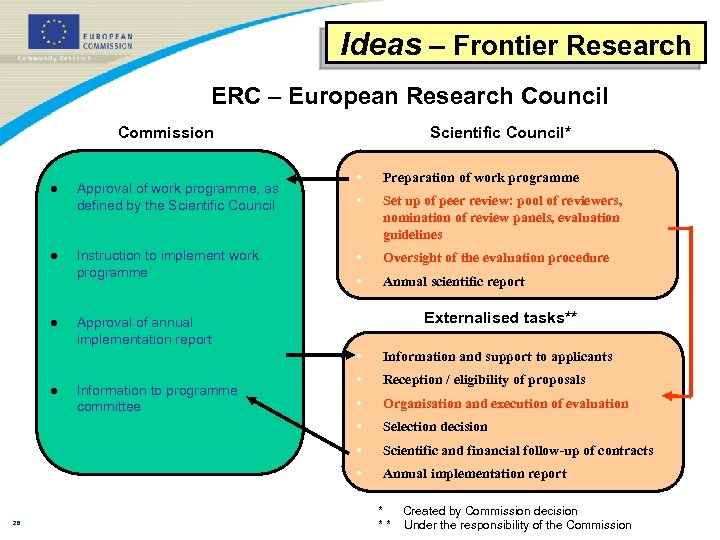
Ideas – Frontier Research ERC – European Research Council Commission l Approval of work programme, as defined by the Scientific Council l Instruction to implement work programme l Scientific Council* • Preparation of work programme • Set up of peer review: pool of reviewers, nomination of review panels, evaluation guidelines • Oversight of the evaluation procedure • Annual scientific report Externalised tasks** Approval of annual implementation report • • Organisation and execution of evaluation Selection decision Scientific and financial follow-up of contracts • 26 Reception / eligibility of proposals • Information to programme committee • • l Information and support to applicants Annual implementation report * Created by Commission decision * * Under the responsibility of the Commission
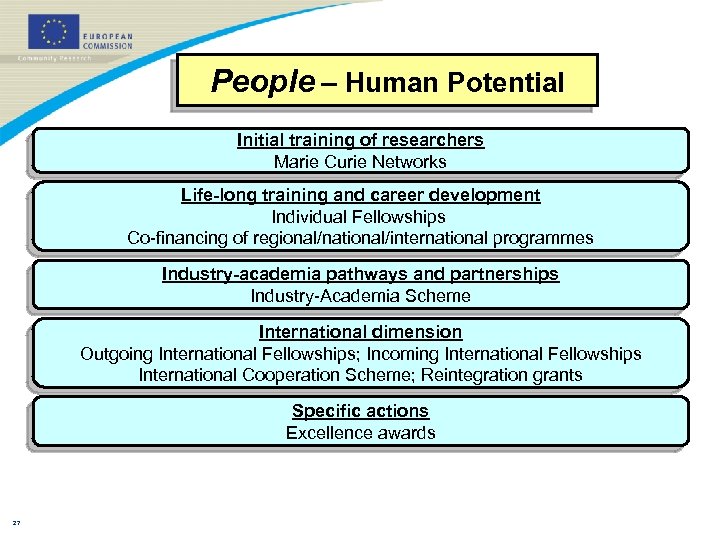
People – Human Potential Initial training of researchers Marie Curie Networks Life-long training and career development Individual Fellowships Co-financing of regional/national/international programmes Industry-academia pathways and partnerships Industry-Academia Scheme International dimension Outgoing International Fellowships; Incoming International Fellowships International Cooperation Scheme; Reintegration grants Specific actions Excellence awards 27
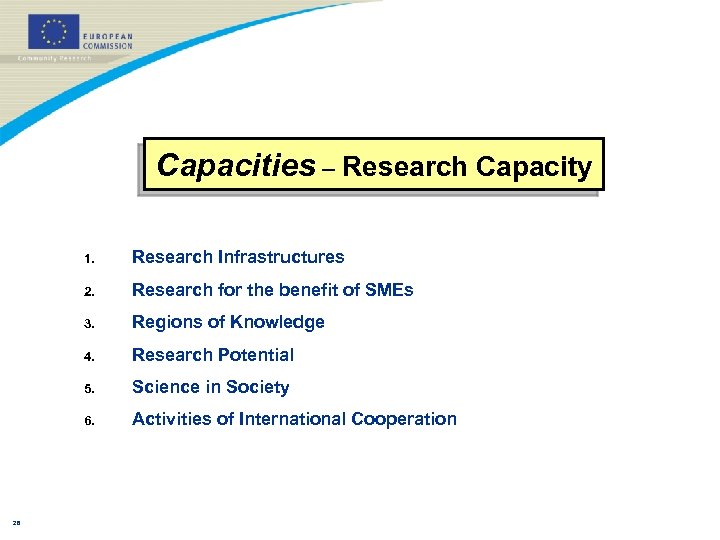
Capacities – Research Capacity 1. 2. Research for the benefit of SMEs 3. Regions of Knowledge 4. Research Potential 5. Science in Society 6. 28 Research Infrastructures Activities of International Cooperation
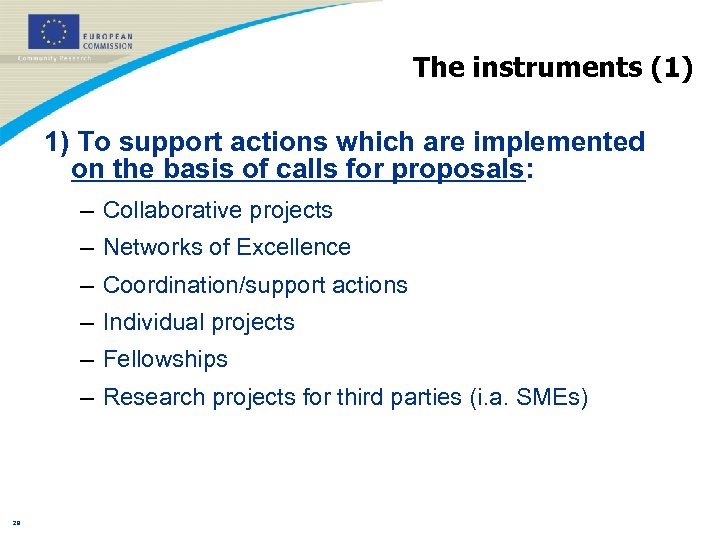
The instruments (1) 1) To support actions which are implemented on the basis of calls for proposals: – Collaborative projects – Networks of Excellence – Coordination/support actions – Individual projects – Fellowships – Research projects for third parties (i. a. SMEs) 29
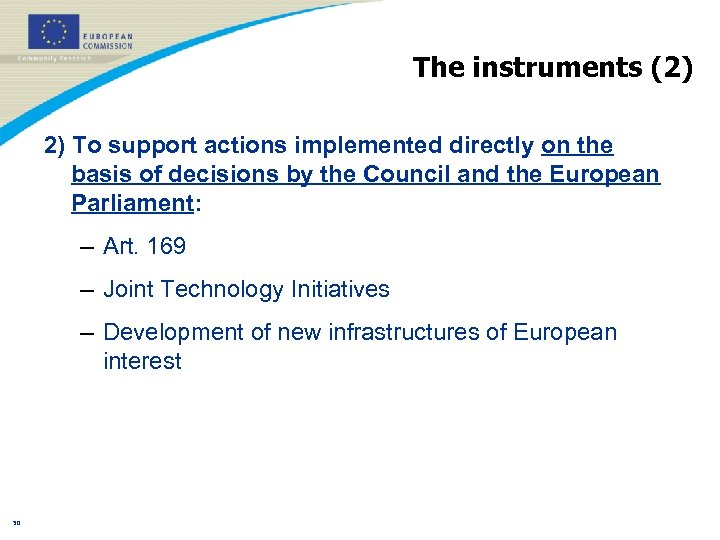
The instruments (2) 2) To support actions implemented directly on the basis of decisions by the Council and the European Parliament: – Art. 169 – Joint Technology Initiatives – Development of new infrastructures of European interest 30
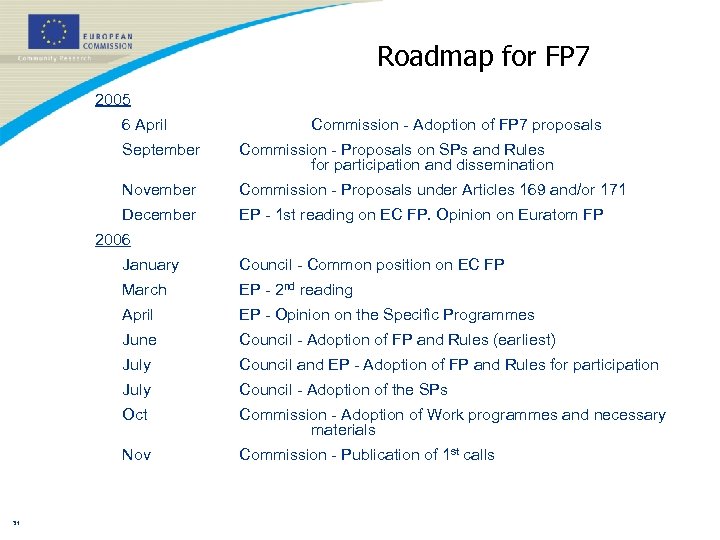
Roadmap for FP 7 2005 6 April Commission - Adoption of FP 7 proposals September Commission - Proposals on SPs and Rules for participation and dissemination November Commission - Proposals under Articles 169 and/or 171 December EP - 1 st reading on EC FP. Opinion on Euratom FP 2006 January March EP - 2 nd reading April EP - Opinion on the Specific Programmes June Council - Adoption of FP and Rules (earliest) July Council and EP - Adoption of FP and Rules for participation July Council - Adoption of the SPs Oct Commission - Adoption of Work programmes and necessary materials Nov 31 Council - Common position on EC FP Commission - Publication of 1 st calls
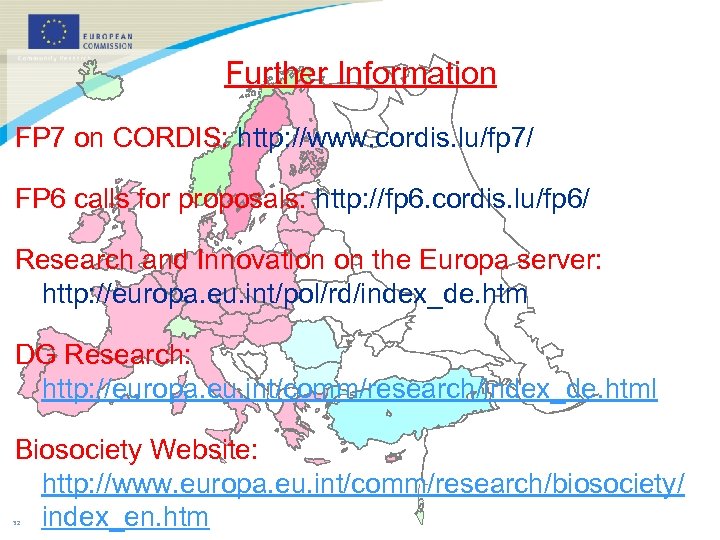
Further Information FP 7 on CORDIS: http: //www. cordis. lu/fp 7/ FP 6 calls for proposals: http: //fp 6. cordis. lu/fp 6/ Research and Innovation on the Europa server: http: //europa. eu. int/pol/rd/index_de. htm DG Research: http: //europa. eu. int/comm/research/index_de. html Biosociety Website: http: //www. europa. eu. int/comm/research/biosociety/ index_en. htm 32
HEALTH RESEARCH Objective: l Improving the health of European citizens l l 33 Increasing the competitiveness of European health-related industries and businesses Addressing global health issues including emerging epidemics
HEALTH RESEARCH Rationale (I): l l Translational research (translation of basic discoveries in clinical applications) to combat diseases of global importance l Clinical research international multi-centre trials l 34 Sequencing of human genome and recent advances in post-genomics vast amounts of data Health policy-driven research comparisons of the national models & data
HEALTH RESEARCH Rationale (II): l l Child health and the health of the ageing population strategic issues across activities l 35 Strong EU-based biomedical and research to strengthen the competitiveness of large industries (pharma) as well as SMEs (healthcare biotech & medical technology) European Technology Platform on Innovative Medicines to remove bottlenecks hampering the efficiency of the development of new medicines and where research is the key
HEALTH RESEARCH Activities: l l Translating research for human health l 36 Biotechnology, generic tools and technologies for human health Optimising the delivery of health care to European citizens
HEALTH RESEARCH Biotechnology, generic tools and technologies for human health l l Detection, diagnosis and monitoring. l Predicting suitability, safety and efficacy of therapies (incl. alternatives to animal testing) l 37 High-throughput research Innovative therapeutic approaches and intervention
HEALTH RESEARCH Translating research for human health l l Research on the brain and related diseases, human development and ageing l Translational research in infectious diseases (incl. HIV/AIDS, malaria, tuberculosis, SARS, etc. ) l 38 Integrating biological data and processes: large-scale data gathering, systems biology Translational research in major diseases: cancer, cardiovascular disease, diabetes/obesity; rare diseases; and other chronic diseases (e. g. osteoarthritis).
HEALTH RESEARCH Optimising the delivery of health care to European citizens l Translating clinical outcome into clinical practice l Quality, efficiency and solidarity of health systems including transitional health systems (i. e. health systems that are currently under a reform process) l Enhanced disease prevention and better use of medicines l Appropriate use of new health therapies and technologies Return to main presentation 39
Скачать презентацию Building Europe Knowledge From the 6 th to
faf6241df578cd0ffea56e0767f713ea.ppt