 Скачать презентацию Building Epidemiologic Capacity in Wisconsin February 2005 Lorna
d555b004ef2e15bf402532d47fc2b4ec.ppt
- Количество слайдов: 31



Building Epidemiologic Capacity in Wisconsin February 2005 Lorna Will RN, MA Surveillance Epidemiologist Wisconsin Division of Public Health
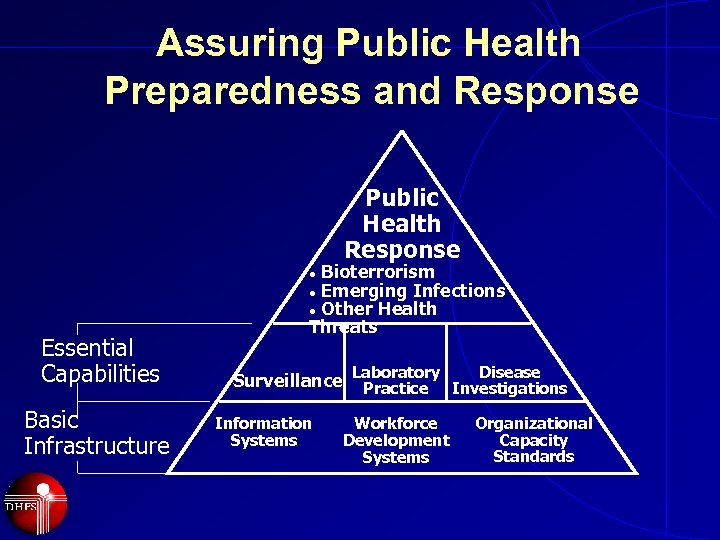
Assuring Public Health Preparedness and Response Public Health Response Bioterrorism l Emerging Infections l Other Health Threats l Essential Capabilities Basic Infrastructure Surveillance Information Systems Laboratory Disease Practice Investigations Workforce Development Systems Organizational Capacity Standards
A lack of epidemiologists. . . • Multiple reports (GAO, CSTE, ASTHO, CDC) have identified a lack of qualified epidemiologists in public health across the nation
A lack of epidemiologists. . . • Despite the recent funding for bioterrorism and emergency preparedness, CSTE’s 2004 report showed that “The current number of epidemiologists is far below the perceived ‘estimate of need’ to provide essential services of public health across epidemiology program areas” (CSTE, 2004 National Assessment of Epidemiologic Capacity: Findings and Recommendations, http: //www. cste. org/assessment/eca/pdffiles/ecafinal 05. pdf)
Problem: insufficient epidemiologic capacity at local level in WI
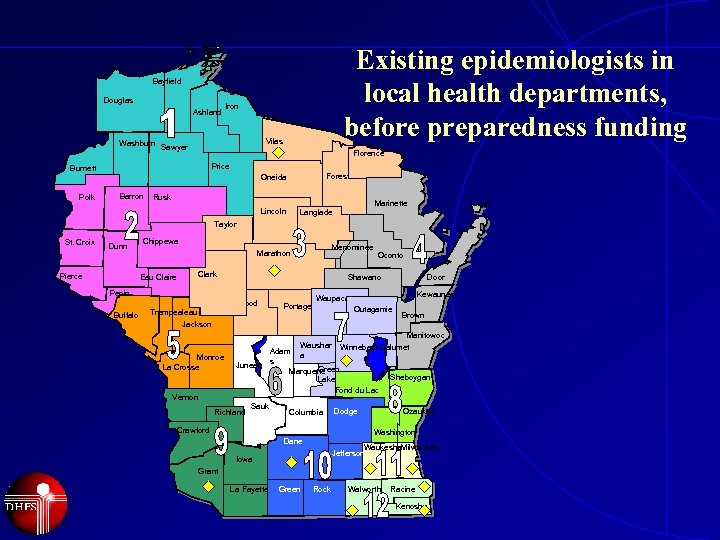
Existing epidemiologists in local health departments, before preparedness funding Bayfield Douglas Ashland Iron Vilas Washburn Sawyer Florence Price Burnett Polk Forest Oneida Barron Rusk Lincoln Marinette Langlade Taylor St. Croix Dunn Pierce Chippewa Menominee Marathon Eau Claire Clark Shawano Pepin Wood Buffalo Trempealeau Jackson Monroe La Crosse Oconto Portage Door Kewaunee Waupaca Outagamie Brown Manitowoc Waushar Winnebago. Calumet a Juneau Vernon Richland Sauk Adam s Green Marquette Lake Fond du Lac Columbia Crawford Dodge Sheboygan Ozaukee Washington Dane Waukesha. Milwaukee Jefferson Iowa Grant La Fayette Green Rock Walworth Racine Kenosha
Public Health in Wisconsin • State public health has central office and five regional offices • “Home rule” state means that local public health departments are independent, and funded by local government • There are 96 local and 12 tribal health departments
Public Health in Wisconsin • State public health provides guidelines, assistance, has control over multijurisdictional issues • State public health has epidemiologists in all specialties at main office in Madison WI; none in regional offices
Public Health in Wisconsin • Local public health is funded by local boards of health • Funding is a combination of board passthrough from state tax dollars returned to local government, grants, and contracts • Local health departments are not equally funded throughout state
Wisconsin has a budget deficit • Like many states, Wisconsin has spent the last few years on a very tight budget • Hiring is generally frozen, with few positions filled if they become vacant, and very few new hires are allowed • Governor ran on a platform of decreasing size of government - goal is to cut 10, 000 jobs from state service in six year term
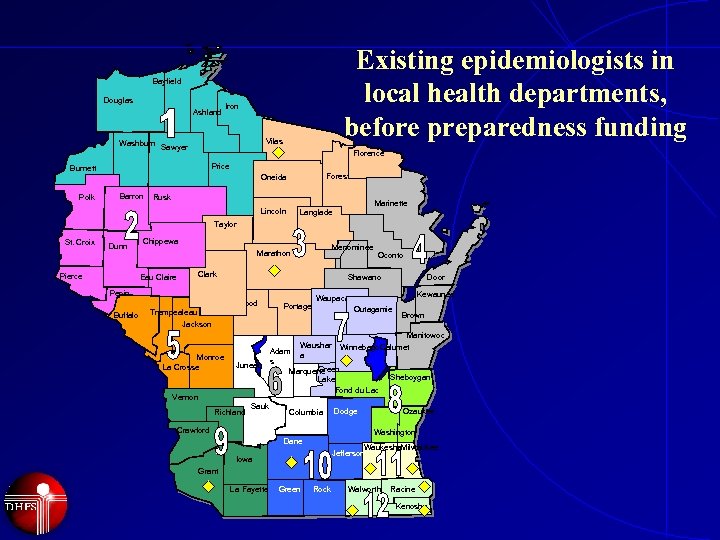
Existing epidemiologists in local health departments, before preparedness funding Bayfield Douglas Ashland Iron Vilas Washburn Sawyer Florence Price Burnett Polk Forest Oneida Barron Rusk Lincoln Marinette Langlade Taylor St. Croix Dunn Pierce Chippewa Menominee Marathon Eau Claire Clark Shawano Pepin Wood Buffalo Trempealeau Jackson Monroe La Crosse Oconto Portage Door Kewaunee Waupaca Outagamie Brown Manitowoc Waushar Winnebago. Calumet a Juneau Vernon Richland Sauk Adam s Green Marquette Lake Fond du Lac Columbia Crawford Dodge Sheboygan Ozaukee Washington Dane Waukesha. Milwaukee Jefferson Iowa Grant La Fayette Green Rock Walworth Racine Kenosha
How to address shortage of epidemiologists? • Can’t hire as state employees • Local funding is variable and federal grants not trusted by local entities as a lasting source of funds
How to address shortage of epidemiologists? • Hire through consortia • Educate those already in place • Coordinate and collaborate to maximize the capabilities of the few

Hiring
Wisconsin’s Public Health Emergency Preparedness (PHEP) Funding Distribution • WI received approximately $15 million in bioterrorism and emergency preparedness funding • Funding is allocated to 12 public health consortia (voluntary groupings of local and tribal health departments) using a formula which includes population, number of separate entities, and area
Use of PHEP Funding to Hire Epidemiologists • $1, 200, 000 per year allocated for epidemiologists in the 12 consortia in 2004 and 2005 • Nine consortia have hired full- or part-time epidemiologists (all at least mastersprepared, though not all in epidemiology) • One consortium still planning to hire halftime epidemiologist
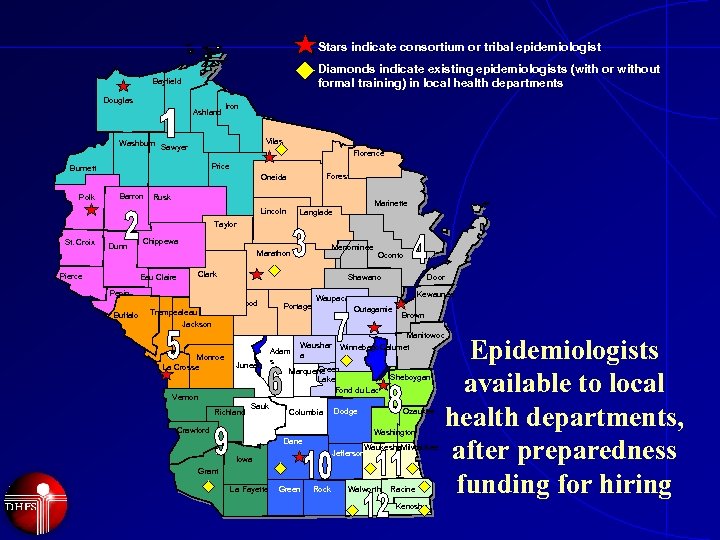
Stars indicate consortium or tribal epidemiologist Diamonds indicate existing epidemiologists (with or without formal training) in local health departments Bayfield Douglas Ashland Iron Vilas Washburn Sawyer Florence Price Burnett Polk Forest Oneida Barron Rusk Lincoln Marinette Langlade Taylor St. Croix Dunn Pierce Chippewa Menominee Marathon Eau Claire Clark Shawano Pepin Wood Buffalo Trempealeau Jackson Monroe La Crosse Oconto Portage Door Kewaunee Waupaca Outagamie Brown Manitowoc Waushar Winnebago. Calumet a Juneau Vernon Richland Sauk Adam s Green Marquette Lake Fond du Lac Columbia Crawford Dodge Sheboygan Ozaukee Washington Dane Waukesha. Milwaukee Jefferson Iowa Grant La Fayette Green Rock Walworth Racine Kenosha Epidemiologists available to local health departments, after preparedness funding for hiring
Education of Existing Staff
Education of Existing Staff • CDC and state staff provided “Epi in Action” course to more than 100 local health department (LHD) staff in southeast part of state (paid by PHEP funds) • Course will be repeated this spring, with intermediate course to be given in fall 2005 (paid by PHEP funds)
Education of Existing Staff • One consortium contracted with LHD staff to complete the CDC “Principles of Epidemiology” self-study course, with $250 paid on presentation of certificate of completion • 24 staff completed the course and were certified
Education of Existing Staff • One consortium delegated epidemiology duties to experienced PHN and sanitarian staff, who were then given work time to complete the “Principles of Epidemiology” course • Result is 6 staff trained in five rural counties
Education of Existing Staff • Newly-hired epidemiologists have been providing training throughout their consortia • State staff provide education for local health officers and staff on how to use epi skills in daily work, using local data • Contract with UW-La Crosse provides two week-long courses in beginning epi skills each year (paid for by PHEP funds)
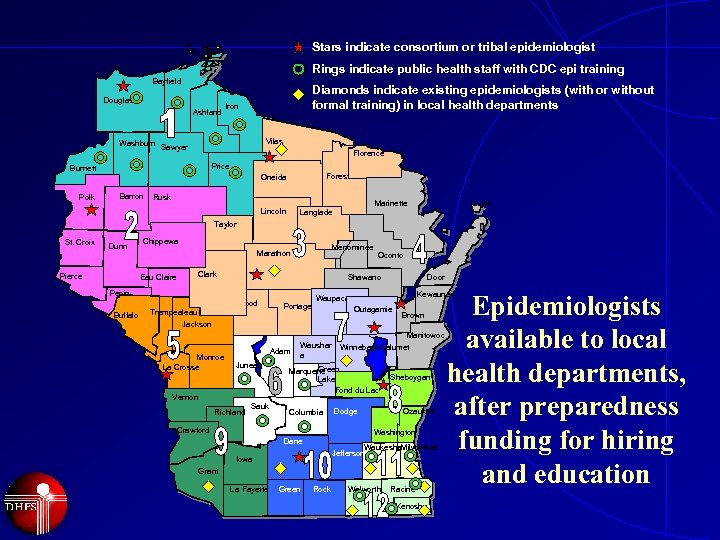
Stars indicate consortium or tribal epidemiologist Rings indicate public health staff with CDC epi training Bayfield Douglas Ashland Diamonds indicate existing epidemiologists (with or without formal training) in local health departments Iron Vilas Washburn Sawyer Florence Price Burnett Polk Forest Oneida Barron Rusk Lincoln Marinette Langlade Taylor St. Croix Dunn Pierce Chippewa Menominee Marathon Eau Claire Clark Shawano Pepin Wood Buffalo Trempealeau Jackson Monroe La Crosse Oconto Portage Door Outagamie Brown Manitowoc Waushar Winnebago. Calumet a Juneau Vernon Richland Sauk Adam s Green Marquette Lake Fond du Lac Columbia Crawford Dodge Sheboygan Ozaukee Washington Dane Waukesha. Milwaukee Jefferson Iowa Grant La Fayette Green Rock Epidemiologists available to local health departments, after preparedness funding for hiring and education Kewaunee Waupaca Walworth Racine Kenosha
Coordination and Collaboration
Coordination and Collaboration • Funding to consortia is performance-based, with identified objectives and deliverables • Four epidemiology objectives were identified for 2005 contract year: two standard and two of consortium’s choice
Coordination and Collaboration • Teleconferences are allowing consortia epi staff to collaborate on data elements, collection methods, and analysis for their common objectives • Wisconsin Epi Network is in early stages of getting all public health epidemiologists to talk with each other and, we hope, to collaborate (meeting 3/4/05)
What’s next • Need to address education of existing employees at state level; as reported by CSTE, many of our epidemiologists have no formal training in epidemiology • Collaboration is an ongoing process that needs much encouragement • Issues of authority and access to epi staff for LHD’s
How to Assess the Impact of Increased Epi Capacity? • • Surveys on staff self-assessment of abilities Evaluation of LHD annual reports Evaluation of response to outbreaks ?
Thanks to: • CDC for public health preparedness funding • Herb Bostrom, Interim Administrator for WI Division of Public Health • Jeff Davis, MD, Chief Medical Officer and State Epidemiologist for Communicable Diseases and Preparedness, WI DPH • All the epi’s and state, LHD, and consortia staff who have worked so hard to build epi capacity in Wisconsin
Lorna Will RN, MA Surveillance Epidemiologist Bureau of Communicable Diseases and Preparedness Wisconsin Division of Public Health willlr@dhfs. state. wi. us 608 -261 -6387
 Скачать презентацию Building Epidemiologic Capacity in Wisconsin February 2005 Lorna
d555b004ef2e15bf402532d47fc2b4ec.ppt