 Скачать презентацию BUILDING CONSTRUCTION II ECM 3154 WEEK 5 STAIRS-
BCII-Week 5-Stairs1.ppt
- Количество слайдов: 16



BUILDING CONSTRUCTION II ECM 3154 WEEK 5 STAIRS- PART 1 Power. Point® Slides by Zamzarina Bt Md. Judyar Last Updated: © LMS SEGi education group 1
CHAPTER OVERVIEW • Last Updated: This chapter brings the student through the introduction of stairs focus on terminology and performance requirements of stairs. © LMS SEGi education group 2
LEARNING OBJECTIVES • • Last Updated: Exposes to the students: The terminology of stairs including requirements and important elements of stairs. © LMS SEGi education group 3
LEARNING OUTCOMES • • Last Updated: At the end of the class, students must be able to: Understand explain all terminology related to stairs with particular reference to satisfying current legislation © LMS SEGi education group 4
INTRODUCTION Definition • A stair is a number of steps leading from one level to another. • Any form of stairs is primarily a means of providing circulation and communication between the various levels within a building Last Updated: © LMS SEGi education group 5
Introduction (cont’d) • • Last Updated: Stairs have a responsibility as transport human in the building or out side building. It is the way connect the floor below and the upper floor or it can mean that joining the differential high level in some places. © LMS SEGi education group 6
REQUIREMENTS OF STAIRS 1. 2. 3. 4. 5. Last Updated: Constructed from non-combustible materials Stairways protected by a fire-resisting enclosure Separated from the main floor area by a set or sets of self-closing fire-resisting doors Limitations as to riser heights, tread length and handrail requirement usually based upon use of building In common with all forms of stairs, all riser heights must be equal throughout the rise of the stairs © LMS SEGi education group 7
THE BASIC REQUIREMENTS OF CONSTRUCTION The construction of simple reinforced concrete stairs • Concrete mix usually specified as 1: 1. 5: 3/3 -10 mm aggregate (25 -30 N/mm 2) • Minimum cover of concrete over reinforcement 15 mm or bar diameter whichever is the greater to give a 1 -hour fire resistance • Waist thickness usually between 100 and 250 mm depending on stair types • Mild steel or high yield steel bars can be used as reinforcement • Continuous handrails of non-combustible materials at a height of between 900 mm and 1, 000 mm above the pitch line are required to all stairs and to both sides if the stair width exceeds 1. 000 m Last Updated: © LMS SEGi education group 8
TECHNICAL TERMS OF STAIR • • • Last Updated: Baluster: the vertical member which is fixed between string and handrail to give support to the handrail. Balustrade or barrister: The combined framework of handrail and balusters. Flight: This is defined as an unbroken series of steps between landings. Going: The horizontal distance between the faces of two consecutive risers. Handrail: the inclined rail over the string is known as a handrail. Handrail serves as a guard-rail and it should be provided at a convenient height so as to give grasp to hand during ascent and descent © LMS SEGi education group 9
TECHNICAL TERMS OF STAIR (cont’d) • • Last Updated: Landing: the horizontal platform between two flights of a stair. A landing facilities change of direction and provides an opportunity for taking rest during the use of a stair. Newel post: the vertical member which is placed at the ends of flights to connect the ends of strings and handrail. Nosing: the projecting part of the tread beyond the face of riser. Riser: the vertical or front member of the step, which is connected to treads. © LMS SEGi education group 10
TECHNICAL TERMS OF STAIR (cont’d) • • • Last Updated: Step: a combination of tread and riser. The common types of steps: bullnose step, commode step, dancing step, flier, round-ended step, splayed step, winder. Tread: the horizontal upper portion of a step. Waist: the thickness of structural slab in case of an R. C. C. stair. © LMS SEGi education group 11
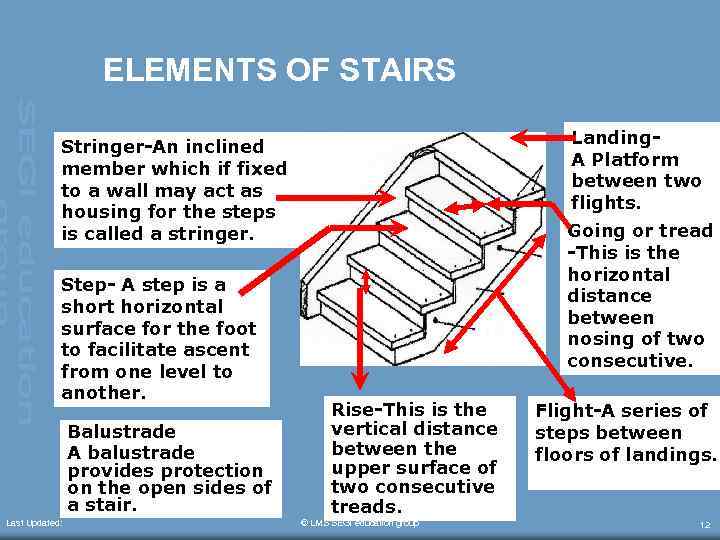
ELEMENTS OF STAIRS Landing. A Platform between two flights. Stringer-An inclined member which if fixed to a wall may act as housing for the steps is called a stringer. Step- A step is a short horizontal surface for the foot to facilitate ascent from one level to another. Balustrade A balustrade provides protection on the open sides of a stair. Last Updated: Going or tread -This is the horizontal distance between nosing of two consecutive. Rise-This is the vertical distance between the upper surface of two consecutive treads. © LMS SEGi education group Flight-A series of steps between floors of landings. 12
QUIZZES 1. Define stairs. ……………………………………………………………… 2. Identify any two functions of stairs. ……………………………………… Last Updated: © LMS SEGi education group 13
KEY TERMS a. Non-combustible materials Definition Material of which no part will ignite and burn when subjected to fire b. Sheathing material Definition material forming any such covering Last Updated: © LMS SEGi education group 14
REFERENCES • • • Last Updated: Chudley, R. , & Greeno, R. , 2005. Construction Technology, 4 th ed. England: Pearson. Chudley, R. , & Greeno, R. , 2001. Advanced Construction. Technology, 3 rd ed. England: Longman. Spence, W. , D. , 2006. Construction Materials, Methods, and Techniques, 2 nd ed. US: Delmar. © LMS SEGi education group 15

• Last Updated: Thank You © LMS SEGi education group 16
Скачать презентацию BUILDING CONSTRUCTION II ECM 3154 WEEK 5 STAIRS-
BCII-Week 5-Stairs1.ppt