 Скачать презентацию Building Community Networks Supporting Employment Sponsored by the
6b846fb91c4a84f8802334666532b61e.ppt
- Количество слайдов: 23



Building Community Networks Supporting Employment Sponsored by the Department of Veterans’ Affairs/Veteran’s Employment an Training Institute and Virginia Commonwealth Institute HVRP National Technical Assistance Center Gary Shaheen, MPA Syracuse University Burton Blatt Institute geshahee@syr. edu/ 315 -443 -9819/315 -443 -9725 FAX
Topics for today n n n Cooperation/Coordination/Collaboration-Essential Differences Primer on WIA and One Stops Work for All, or - Can homeless vets get there from here? Overview of key VA and DOL/Vets employment initiatives Examples and common themes for designing effective services Key steps in improving access to mainstream employment services in One Stops
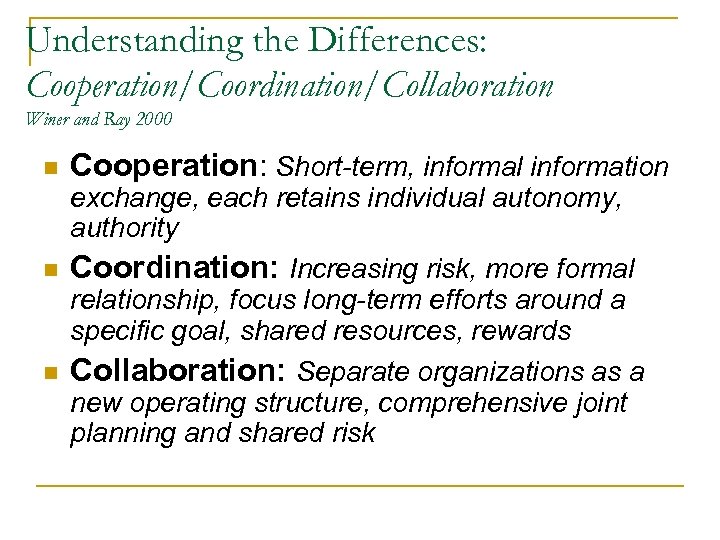
Understanding the Differences: Cooperation/Coordination/Collaboration Winer and Ray 2000 n n n Cooperation: Short-term, informal information exchange, each retains individual autonomy, authority Coordination: Increasing risk, more formal relationship, focus long-term efforts around a specific goal, shared resources, rewards Collaboration: Separate organizations as a new operating structure, comprehensive joint planning and shared risk
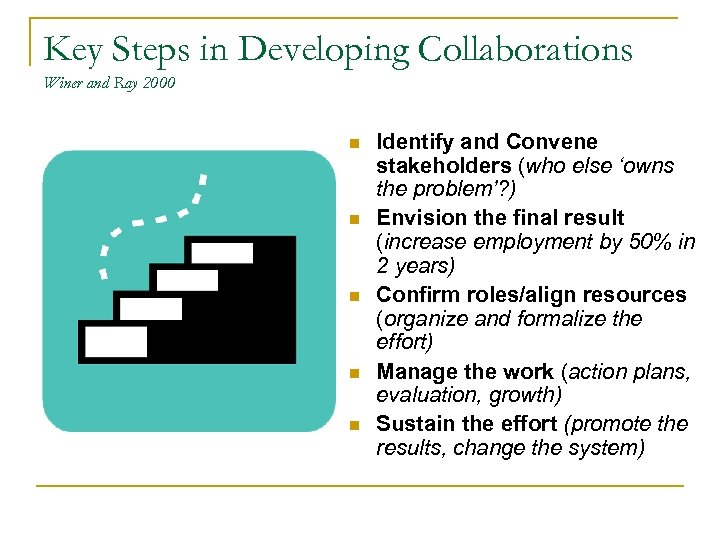
Key Steps in Developing Collaborations Winer and Ray 2000 n n n Identify and Convene stakeholders (who else ‘owns the problem’? ) Envision the final result (increase employment by 50% in 2 years) Confirm roles/align resources (organize and formalize the effort) Manage the work (action plans, evaluation, growth) Sustain the effort (promote the results, change the system)
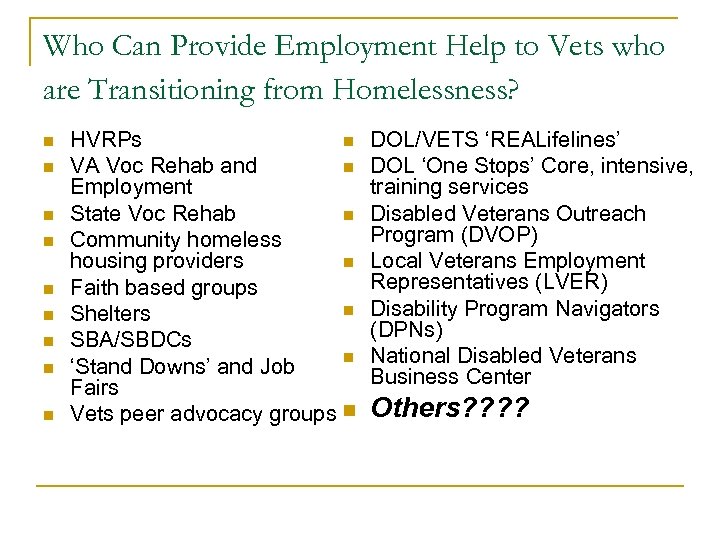
Who Can Provide Employment Help to Vets who are Transitioning from Homelessness? n n n n n HVRPs n VA Voc Rehab and n Employment State Voc Rehab n Community homeless housing providers n Faith based groups n Shelters SBA/SBDCs n ‘Stand Downs’ and Job Fairs Vets peer advocacy groups n DOL/VETS ‘REALifelines’ DOL ‘One Stops’ Core, intensive, training services Disabled Veterans Outreach Program (DVOP) Local Veterans Employment Representatives (LVER) Disability Program Navigators (DPNs) National Disabled Veterans Business Center Others? ?
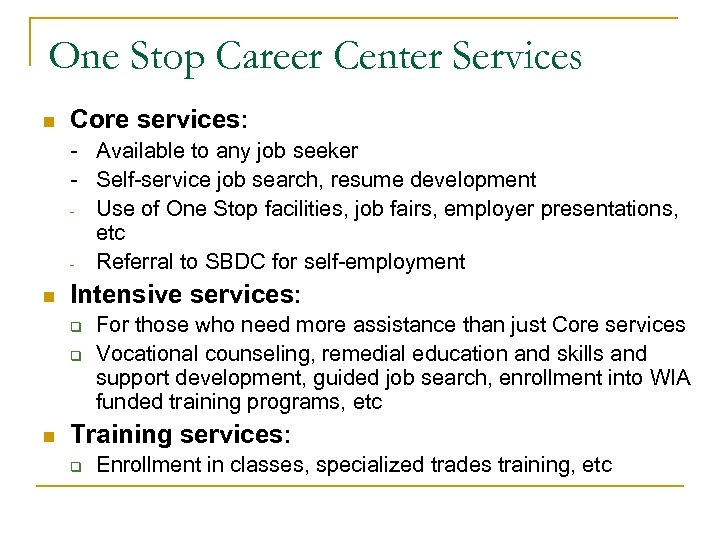
One Stop Career Center Services n Core services: - Available to any job seeker - Self-service job search, resume development Use of One Stop facilities, job fairs, employer presentations, etc Referral to SBDC for self-employment n Intensive services: q q n For those who need more assistance than just Core services Vocational counseling, remedial education and skills and support development, guided job search, enrollment into WIA funded training programs, etc Training services: q Enrollment in classes, specialized trades training, etc
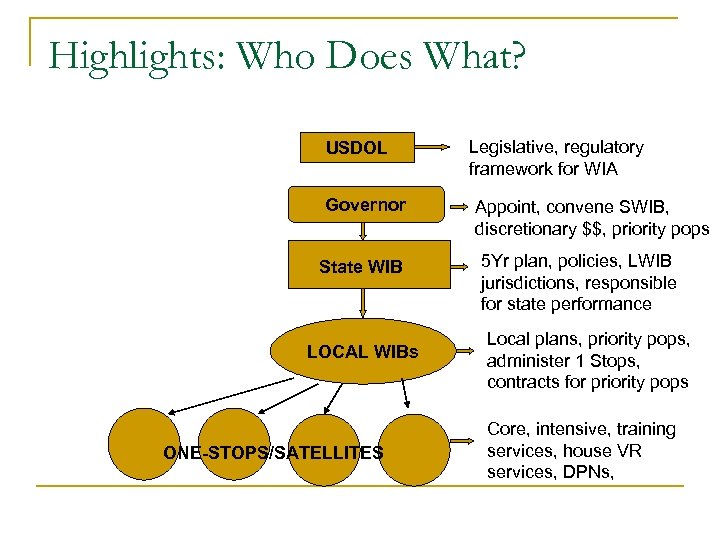
Highlights: Who Does What? USDOL Governor State WIB LOCAL WIBs ONE-STOPS/SATELLITES Legislative, regulatory framework for WIA Appoint, convene SWIB, discretionary $$, priority pops 5 Yr plan, policies, LWIB jurisdictions, responsible for state performance Local plans, priority pops, administer 1 Stops, contracts for priority pops Core, intensive, training services, house VR services, DPNs,
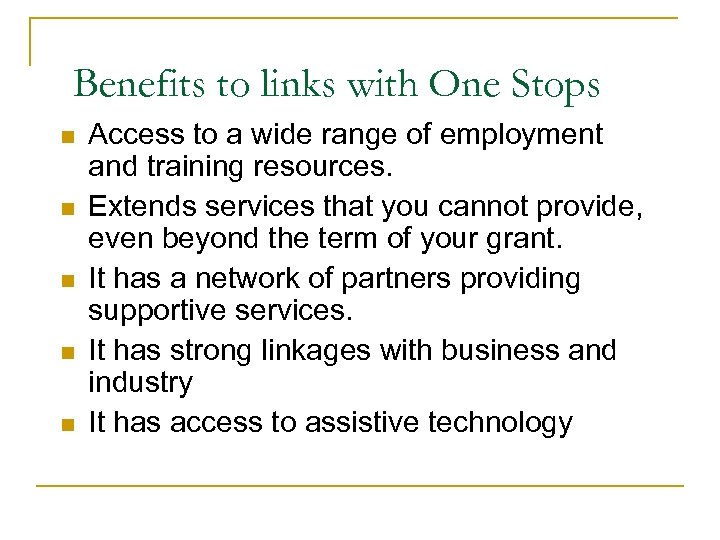
Benefits to links with One Stops n n n Access to a wide range of employment and training resources. Extends services that you cannot provide, even beyond the term of your grant. It has a network of partners providing supportive services. It has strong linkages with business and industry It has access to assistive technology
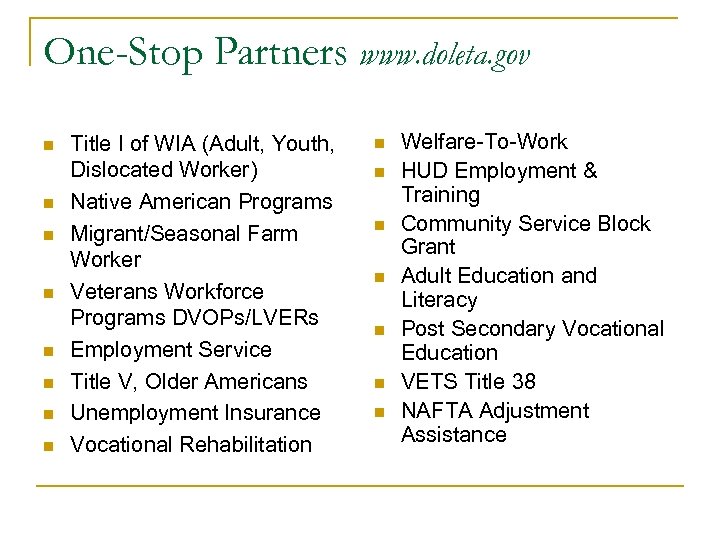
One-Stop Partners www. doleta. gov n n n n Title I of WIA (Adult, Youth, Dislocated Worker) Native American Programs Migrant/Seasonal Farm Worker Veterans Workforce Programs DVOPs/LVERs Employment Service Title V, Older Americans Unemployment Insurance Vocational Rehabilitation n n n Welfare-To-Work HUD Employment & Training Community Service Block Grant Adult Education and Literacy Post Secondary Vocational Education VETS Title 38 NAFTA Adjustment Assistance
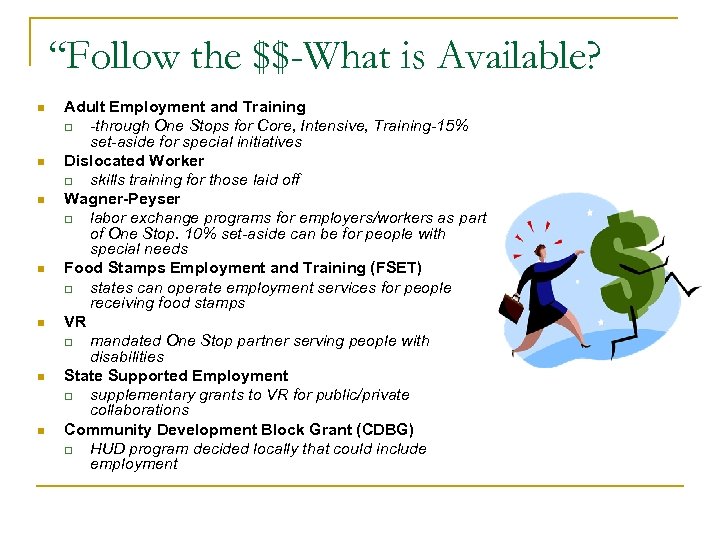
“Follow the $$-What is Available? n n n n Adult Employment and Training q -through One Stops for Core, Intensive, Training-15% set-aside for special initiatives Dislocated Worker q skills training for those laid off Wagner-Peyser q labor exchange programs for employers/workers as part of One Stop. 10% set-aside can be for people with special needs Food Stamps Employment and Training (FSET) q states can operate employment services for people receiving food stamps VR q mandated One Stop partner serving people with disabilities State Supported Employment q supplementary grants to VR for public/private collaborations Community Development Block Grant (CDBG) q HUD program decided locally that could include employment
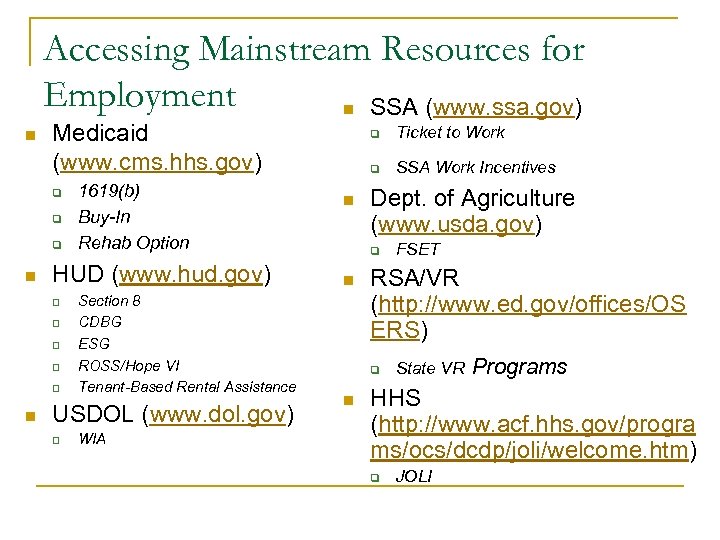
Accessing Mainstream Resources for Employment n SSA (www. ssa. gov) n Medicaid (www. cms. hhs. gov) q q q n HUD (www. hud. gov) q q q n 1619(b) Buy-In Rehab Option Section 8 CDBG ESG ROSS/Hope VI Tenant-Based Rental Assistance USDOL (www. dol. gov) q WIA q q n Ticket to Work SSA Work Incentives Dept. of Agriculture (www. usda. gov) q n RSA/VR (http: //www. ed. gov/offices/OS ERS) q n FSET State VR Programs HHS (http: //www. acf. hhs. gov/progra ms/ocs/dcdp/joli/welcome. htm) q JOLI
Challenges………………. . n n n Addressing WIA performance measures incl. entered employment rate, wage growth, job retention Leveraging resources for specialized training Collaborative leadership and vision Trust and access “Paradigm paralysis” (“Vets who are homeless are not work-ready”)
Who in your community now prioritizes the employment needs of Vets who are homeless ? q q q q q Continuums of Care? Local and State DOL/WIA planners? Regional and State VR planners? 10 Year Plan to End Homelessness Committee? Local Economic Development Planners? ‘Wired’ and other DOL workforce strategies? ‘United We Ride’ and other transportation initiatives? SSA Work Incentive Planning Assistants (WIPA? ) Business Councils, Chambers of Commerce, Downtown Business Associations, Business Leadership Networks? Be at their table and help solve their problem!
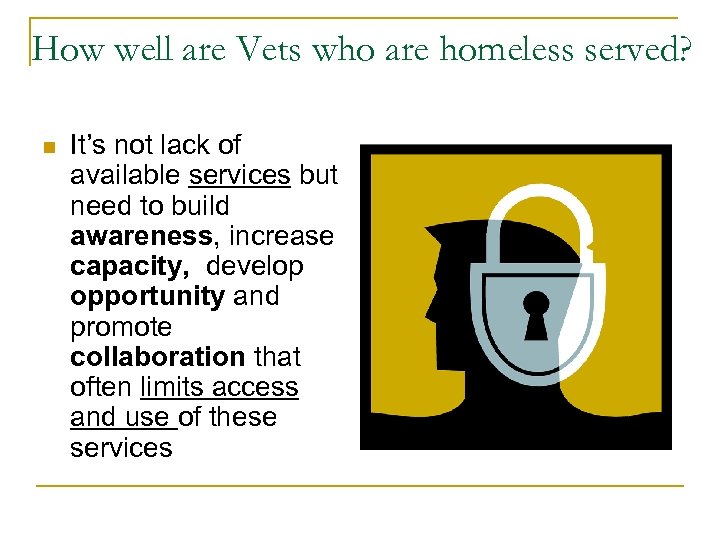
How well are Vets who are homeless served? n It’s not lack of available services but need to build awareness, increase capacity, develop opportunity and promote collaboration that often limits access and use of these services
The “Readiness to Work Challenge”-How can we help Vets who are homeless get jobs? n n n n n Redefine “job ready” Provide flexible early opportunities to work Recognize skills and strengths gained through survival Develop customized employment plans View setbacks as learning opportunities Build and use peer support systems Use evidence based employment practices Reduce employer fears and stigma through awareness building efforts Develop partnerships and collaborations
Example: CTWorks-Bridgeport, CT n n n Operated by Career Resources, Inc. , Partnerships with LWIB, Bridgeport Continuum of Care, the CT Division of Rehabilitation Services, the CT Department of Mental Health and Addiction Services and the Veterans Employment Service. 50+ corporate donors, the United Way, US Department of Education grant , DOL Work Incentive Grant and Disability Program Navigator funding
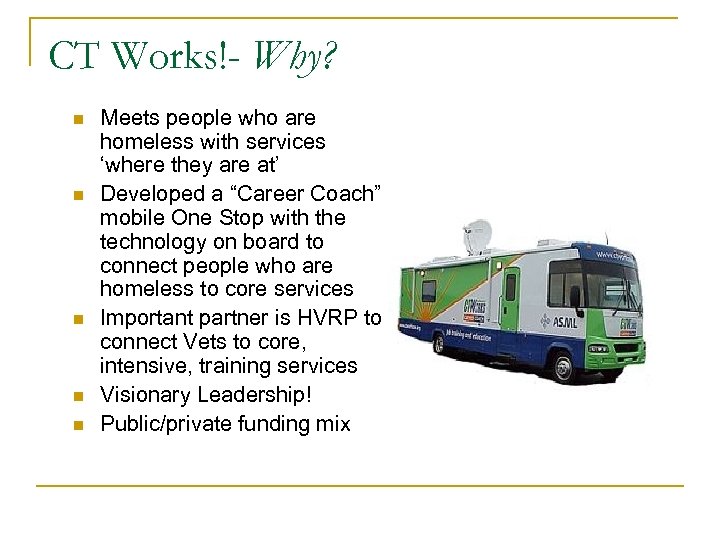
CT Works!- Why? n n n Meets people who are homeless with services ‘where they are at’ Developed a “Career Coach” mobile One Stop with the technology on board to connect people who are homeless to core services Important partner is HVRP to connect Vets to core, intensive, training services Visionary Leadership! Public/private funding mix
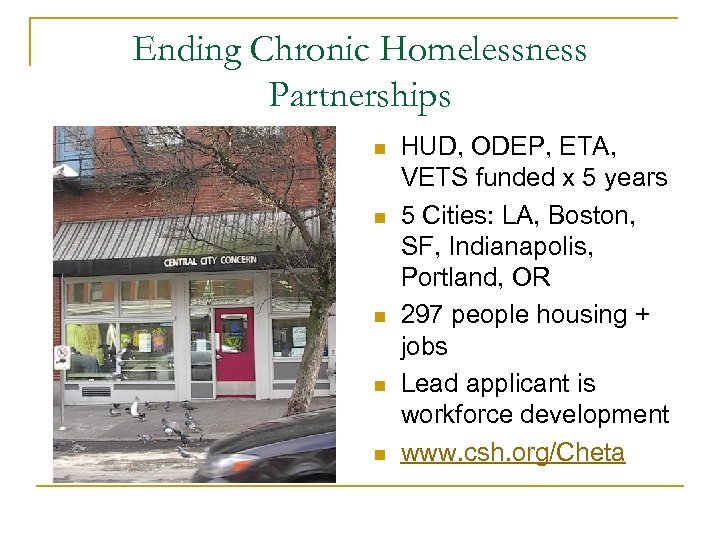
Ending Chronic Homelessness Partnerships n n n HUD, ODEP, ETA, VETS funded x 5 years 5 Cities: LA, Boston, SF, Indianapolis, Portland, OR 297 people housing + jobs Lead applicant is workforce development www. csh. org/Cheta
Principle #1: Workforce Investment System is Localized in your community-you should be at that table q q q States and localities have broad discretion to design and operate systems; establish priorities and performance expectations The Workforce Board and the Continuum of Care should be linked if we are to address homelessness through jobs All the mandated partners should be present in the One. Stop as well as non-required partners serving those with special needs You should weigh-in on the workforce plan in your community-ensure your customers are considered Collaboration is the key
Principle #2: Services to prepare and support people in employment n n Respond to people’s needs and desires about work from the point of outreach Understand the job market Engage and utilize partners from the workforce system, employers and private sources to build collaborations, resources Recognize that job and career growth, like recovery is not always linear and that the One Stop may not be the “first and only stop”
Questions for the future: Providing Services n n What are your challenges in providing effective, quality outcomes for Vets who are homeless? What strategies are you using to achieve those outcomes? What resources do you have and use to achieve those outcomes? What resources do you need to achieve those outcomes?
Questions for the future: Building Systems n n n Who are your local partners? How will you add stakeholders to increase employment of Vets who are homeless? What does each stakeholder bring to the table that helps meet those outcomes? What challenges do you anticipate in developing partnerships and collaborations? What training, technical assistance and support do you need to develop and sustain these partnerships/collaborations?
More resources n “Work as a Priority” Guidebook q n http: //mentalhealth. samhsa. gov/publications/allpubs/SMA 033834/default. asp Earn. Works: a free service that connects employers looking for quality employees with skilled job candidates q n Abilities Fund: resources for self-employment q n http: //www. abilitiesfund. org/ Job Accommodation Network: assistance on ADA+ more q n http: //www. earnworks. com/ http: //www. jan. wvu. edu/ “Implementing Work as a Priority” q http: //www. springerlink. com/content/c 60 q 43162 l 024844/? p=0 f 948 8 b 372964898 ac 5 c 855 fb 694 f 385&pi=0
Скачать презентацию Building Community Networks Supporting Employment Sponsored by the
6b846fb91c4a84f8802334666532b61e.ppt