 Скачать презентацию Building Capacity at the Tertiary Tier of SW-PBS
b781958617cfc06d45292b4bbb6138e0.ppt
- Количество слайдов: 140



Building Capacity at the. Tertiary Tier of SW-PBS: System, Data and Practices May 20 -21, 2009 Lucille Eber Ed. D IL PBIS Network www. pbisillinois. org
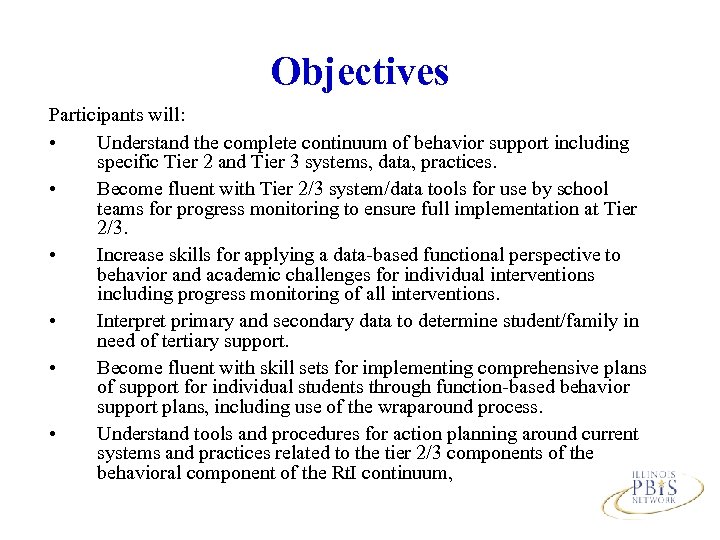
Objectives Participants will: • Understand the complete continuum of behavior support including specific Tier 2 and Tier 3 systems, data, practices. • Become fluent with Tier 2/3 system/data tools for use by school teams for progress monitoring to ensure full implementation at Tier 2/3. • Increase skills for applying a data-based functional perspective to behavior and academic challenges for individual interventions including progress monitoring of all interventions. • Interpret primary and secondary data to determine student/family in need of tertiary support. • Become fluent with skill sets for implementing comprehensive plans of support for individual students through function-based behavior support plans, including use of the wraparound process. • Understand tools and procedures for action planning around current systems and practices related to the tier 2/3 components of the behavioral component of the Rt. I continuum,
As George Sugai would say… “What are the BIG Ideas for Today? ” The System, Practice and Data components needed to establish fluency and effectiveness for Tertiary Tier implementation of SW-PBS
Applying Your Learning BIG Question: What will you do with this information when you leave this training? Strategies for Today to Ensure Application of Learning: 1. Focus on Systems, Data, and Practices with “case examples” 2. Practice through application of tools and techniques are part of today’s agenda 3. Immediate application/practice of tools and techniques will be scheduled before you leave today
Agenda Morning > Setting the Context: Full Continuum of Tier 2/3 > System Features Needed > District Examples w/System Data > Activity: Designing your Tertiary System Afternoon > Nuts and Bolts of Tier 3 Practices > Student Examples w/Data > Activity: Assessing Student Intervention History > Activity: Practice with Behavior Pathway and Practice with Wraparound Engagement techniques
Handouts 1. 2. 3. 4. 5. 6. PPT Tertiary District and Building Action Plans Tertiary Student Action Plan Tier 2/3 Tracking Tool Systems Response Tool Home-School Community Tool
BIG Idea: Systems • Components of the Tertiary Systems Structure needed to build Tier 3 fluency – Role of Tier 3 Coaches – Role of team facilitators for Tier 3 student plans – Role/function of Tertiary Systems Planning Team – District Role/function in building Tier 3 capacity
BIG Idea: PRACTICES • Interventions (practices) at Tier 2/3 are often “layered” for individual students. – When is an FBA/BIP is needed? – When is Wraparound approach needed? – How are Tier 1 and Tier 2 Interventions integrated into Tier 3 Plans for Individual students? • Interventions (practices) include specific and purposeful steps/techniques to engage families and teachers to coalesce on behalf of a student with complex needs. – How are function and Big Need related? – How is data used in engagement, intervention design , and progress monitoring? – How are natural supports used in Tier 3 student plans?
BIG Idea: Data • How is Data embedded in all system and practice components of Tier 3? – – – To identify students in need of Tier 3 (sooner) To guide team development (engagement) To ensure proactive strength-based focus To guide intervention design, implementation To ensure fidelity (dosage and intensity commensurate with level of need) – To ensure timely positive response (effectiveness)
A Tribute to Dr. Jane Knitzer A great leader and advocate who left this world on March 29, 2009 but not before giving us the knowledge and courage to do things differently for kids and families with mental heath needs. • Championed the need to redesign systems to ensure better youth outcomes • Insisted that families have access to effective interventions and supports as early as needed (birth-3, early childhood) – Unclaimed Children – At the Schoolhouse Door
Setting The Context
Why Are More Effective Practices Needed? • Over use of restrictive settings • Disproportionality-over representation of specific population subgroups • Lack of structures for fidelity implementation • Failure to intervene early with adequate dosage and fidelity increases “cost”
Effectiveness Matters • Failed Interventions are Not Neutral. – Be vigilant to avoid interventions that are too low dosage or implemented with low fidelity • Time is the “enemy”. – Move quickly to interventions, scaling up as needed. – Move through steps/phases of interventions making sure you engage/assess, establish strengths/needs via date, design interventions, progress monitor, continue/repeat. – Establish natural supports and use natural environments early on in the process – Use data at every step
Response to Intervention (Rt. I) “RTI essentially layers instruction over time, in response to ongoing assessments using scientifically reliable and valid measures, that is directly proportional to each student’s identified need in order to make demonstrable progress in the curriculum. ” – Wayne Sailor
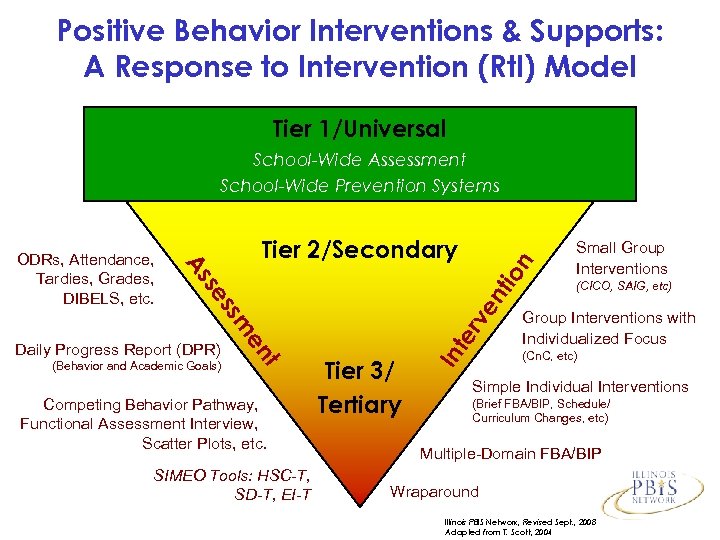
Positive Behavior Interventions & Supports: A Response to Intervention (Rt. I) Model Tier 1/Universal Competing Behavior Pathway, Functional Assessment Interview, Scatter Plots, etc. SIMEO Tools: HSC-T, SD-T, EI-T te Tier 3/ Tertiary In t en (Behavior and Academic Goals) rv sm es Daily Progress Report (DPR) en tio Tier 2/Secondary s As ODRs, Attendance, Tardies, Grades, DIBELS, etc. n School-Wide Assessment School-Wide Prevention Systems Small Group Interventions (CICO, SAIG, etc) Group Interventions with Individualized Focus (Cn. C, etc) Simple Individual Interventions (Brief FBA/BIP, Schedule/ Curriculum Changes, etc) Multiple-Domain FBA/BIP Wraparound Illinois PBIS Network, Revised Sept. , 2008 Adapted from T. Scott, 2004
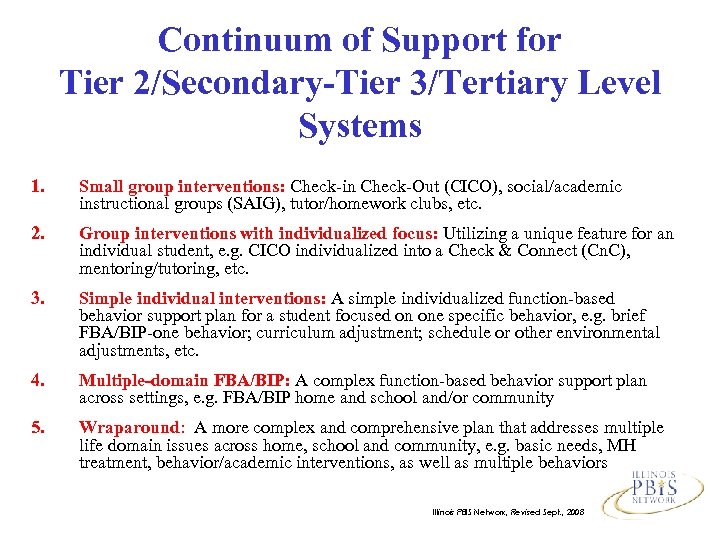
Continuum of Support for Tier 2/Secondary-Tier 3/Tertiary Level Systems 1. Small group interventions: Check-in Check-Out (CICO), social/academic instructional groups (SAIG), tutor/homework clubs, etc. 2. Group interventions with individualized focus: Utilizing a unique feature for an individual student, e. g. CICO individualized into a Check & Connect (Cn. C), mentoring/tutoring, etc. 3. Simple individual interventions: A simple individualized function-based behavior support plan for a student focused on one specific behavior, e. g. brief FBA/BIP-one behavior; curriculum adjustment; schedule or other environmental adjustments, etc. 4. Multiple-domain FBA/BIP: A complex function-based behavior support plan across settings, e. g. FBA/BIP home and school and/or community 5. Wraparound: A more complex and comprehensive plan that addresses multiple life domain issues across home, school and community, e. g. basic needs, MH treatment, behavior/academic interventions, as well as multiple behaviors Illinois PBIS Network, Revised Sept. , 2008
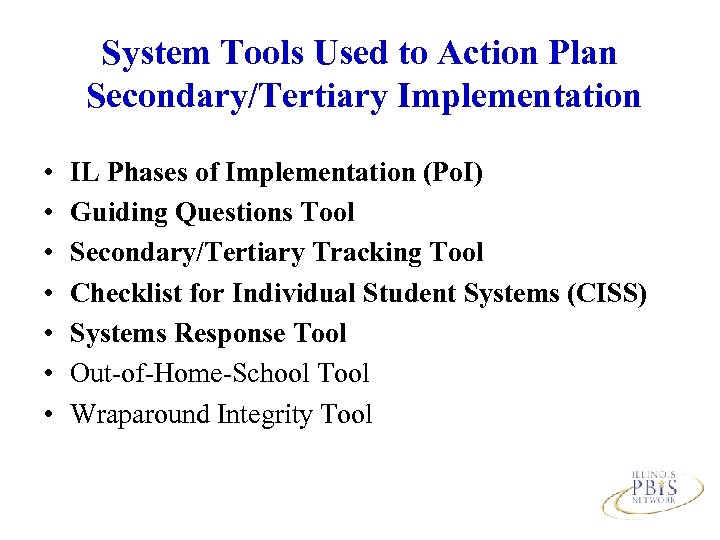
System Tools Used to Action Plan Secondary/Tertiary Implementation • • IL Phases of Implementation (Po. I) Guiding Questions Tool Secondary/Tertiary Tracking Tool Checklist for Individual Student Systems (CISS) Systems Response Tool Out-of-Home-School Tool Wraparound Integrity Tool
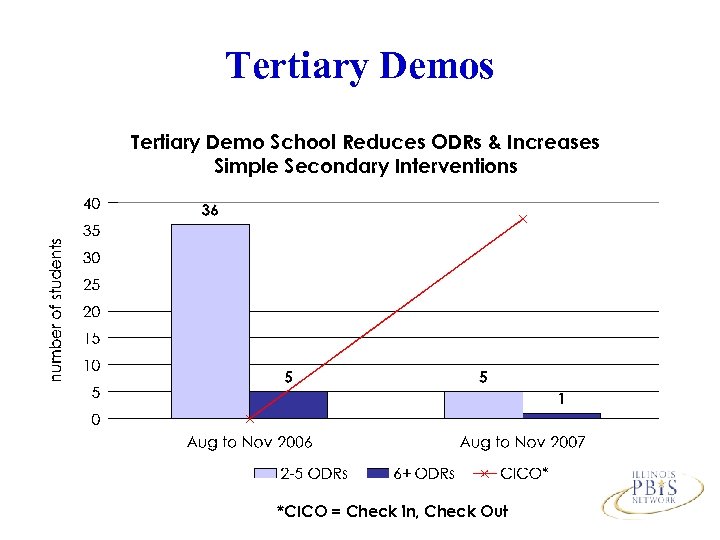
Tertiary Demos Tertiary Demo School Reduces ODRs & Increases Simple Secondary Interventions *CICO = Check in, Check Out
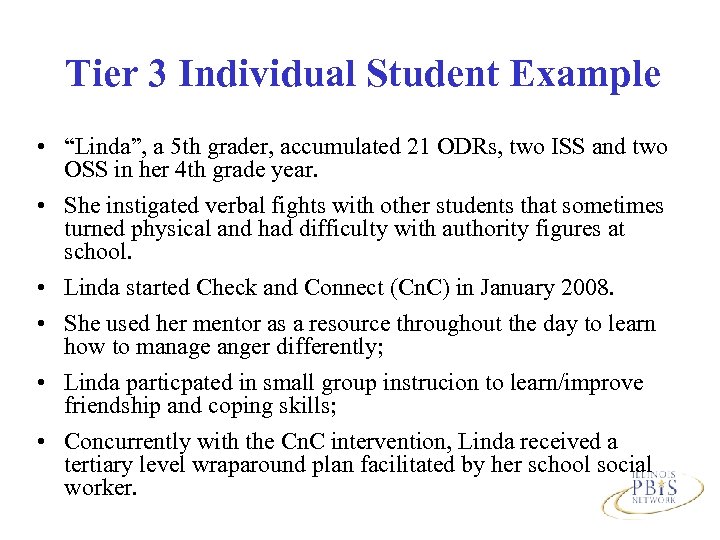
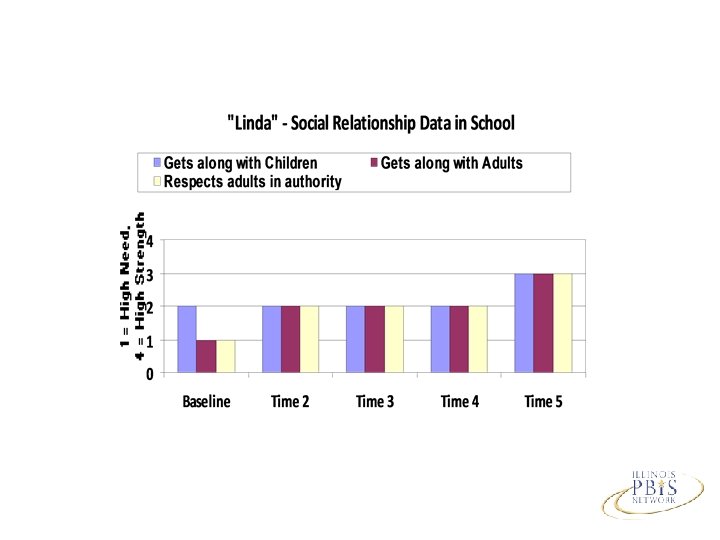
Tier 3 Individual Student Example • “Linda”, a 5 th grader, accumulated 21 ODRs, two ISS and two OSS in her 4 th grade year. • She instigated verbal fights with other students that sometimes turned physical and had difficulty with authority figures at school. • Linda started Check and Connect (Cn. C) in January 2008. • She used her mentor as a resource throughout the day to learn how to manage anger differently; • Linda particpated in small group instrucion to learn/improve friendship and coping skills; • Concurrently with the Cn. C intervention, Linda received a tertiary level wraparound plan facilitated by her school social worker.
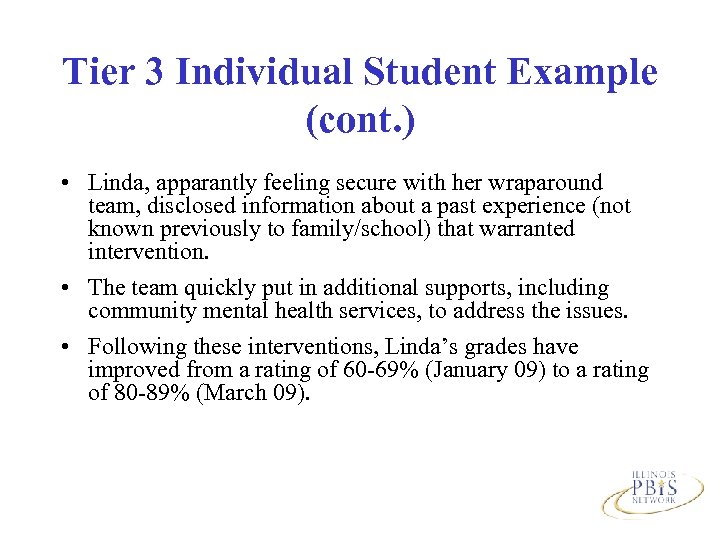
Tier 3 Individual Student Example (cont. ) • Linda, apparantly feeling secure with her wraparound team, disclosed information about a past experience (not known previously to family/school) that warranted intervention. • The team quickly put in additional supports, including community mental health services, to address the issues. • Following these interventions, Linda’s grades have improved from a rating of 60 -69% (January 09) to a rating of 80 -89% (March 09).
Tertiary Systems Components Needed to Establish Capacity for Effective Tier 3 Practices
Commitments for Success* Examples of District/Building Tier 2/3 Commitments : – Tier 2/3 Coaching FTE – Position Personnel to Facilitate Tertiary Intervention Teams for 3 -5% of Students – Comprehensive Training and “Practice” – Data-based decision-making is part of all practices – Tertiary District Leadership Team – Review Special Education and Disproportionality Data – Review District Policies *See IL PBIS Network Commitment for Success Agreement
District-wide Tertiary Implementation Process • District meeting quarterly – District outcomes – Capacity/sustainability – Other schools/staff • Building meeting monthly – Check on all levels – Cross-planning with all levels – Effectiveness of practices (FBA/Wrap) • Tertiary Coaching Capacity • Facilitators for complex FBA/BIP and wraparound teams
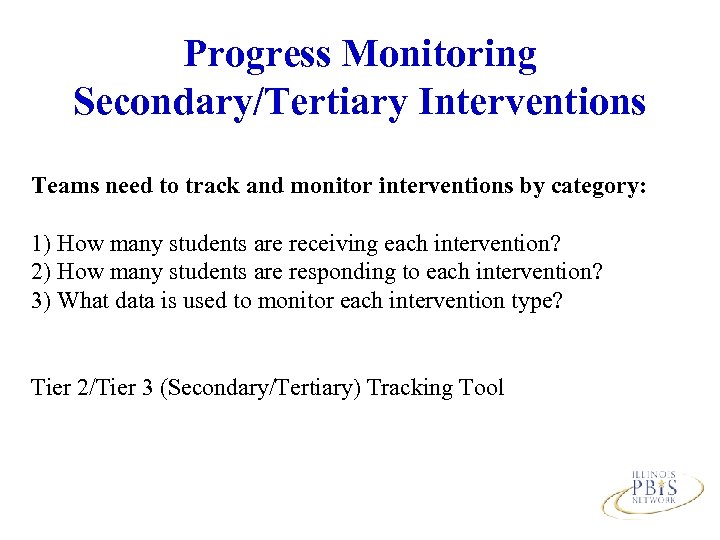
Progress Monitoring Secondary/Tertiary Interventions Teams need to track and monitor interventions by category: 1) How many students are receiving each intervention? 2) How many students are responding to each intervention? 3) What data is used to monitor each intervention type? Tier 2/Tier 3 (Secondary/Tertiary) Tracking Tool
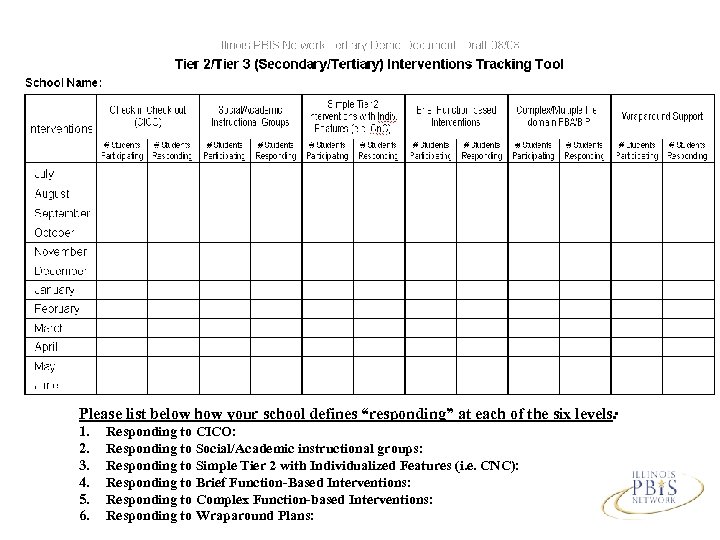
Please list below how your school defines “responding” at each of the six levels: 1. 2. 3. 4. 5. 6. Responding to CICO: Responding to Social/Academic instructional groups: Responding to Simple Tier 2 with Individualized Features (i. e. CNC): Responding to Brief Function-Based Interventions: Responding to Complex Function-based Interventions: Responding to Wraparound Plans:
Problem • Students cannot benefit from interventions they do not experience © Dean Fixsen, Karen Blase, Robert Horner, George Sugai, 2008
“Finding” Students in Need of Tertiary Supports • Systems Response Tool
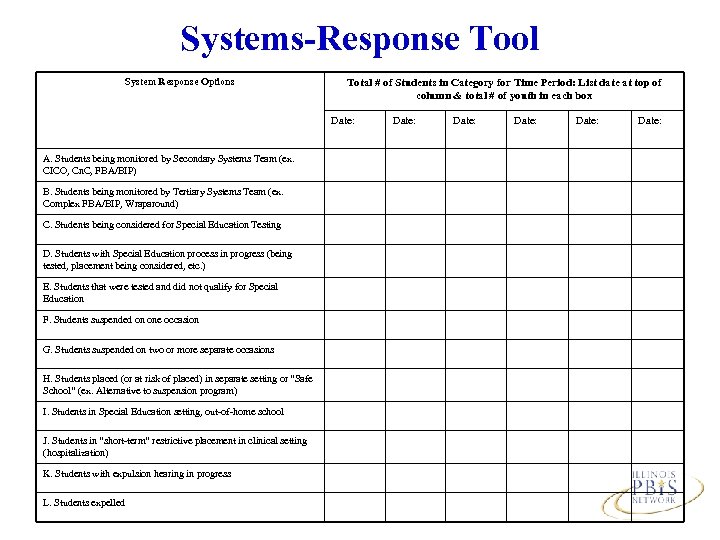
Systems-Response Tool System Response Options Total # of Students in Category for Time Period: List date at top of column & total # of youth in each box Date: A. Students being monitored by Secondary Systems Team (ex. CICO, Cn. C, FBA/BIP) B. Students being monitored by Tertiary Systems Team (ex. Complex FBA/BIP, Wraparound) C. Students being considered for Special Education Testing D. Students with Special Education process in progress (being tested, placement being considered, etc. ) E. Students that were tested and did not qualify for Special Education F. Students suspended on one occasion G. Students suspended on two or more separate occasions H. Students placed (or at risk of placed) in separate setting or “Safe School” (ex. Alternative to suspension program) I. Students in Special Education setting, out-of-home school J. Students in “short-term” restrictive placement in clinical setting (hospitalization) K. Students with expulsion hearing in progress L. Students expelled Date: Date:
District Examples to Illustrate: • Role/function of Tertiary External Coach • Role/function of District leadership Team • Role Function of Building-based tertiary Systems Planning Team
IL Tertiary Demo District Example #1 • District-level Review of Building Data used by building-based Tertiary Systems Planning Team • Facilitated by External Coach • Data used to Guide District-Action Plan
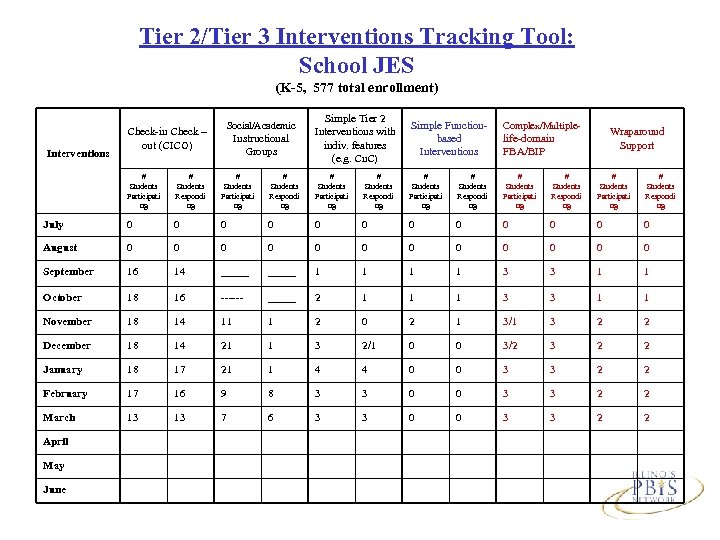
Tier 2/Tier 3 Interventions Tracking Tool: School JES (K-5, 577 total enrollment) Interventions Social/Academic Check-in Check – out (CICO) Instructional Groups Simple Tier 2 Interventions with indiv. features (e. g. Cn. C) Simple Functionbased Interventions Complex/Multiple- Wraparound Support life-domain FBA/BIP # Students Participati ng # Students Respondi ng # Students Participati ng # Students Respondi ng July 0 0 0 August 0 0 0 September 16 14 _____ 1 1 3 3 1 1 October 18 16 ------ _____ 2 1 1 1 3 3 1 1 November 18 14 11 1 2 0 2 1 3/1 3 2 2 December 18 14 21 1 3 2/1 0 0 3/2 3 2 2 January 18 17 21 1 4 4 0 0 3 3 2 2 February 17 16 9 8 3 3 0 0 3 3 2 2 March 13 13 7 6 3 3 0 0 3 3 2 2 April May June
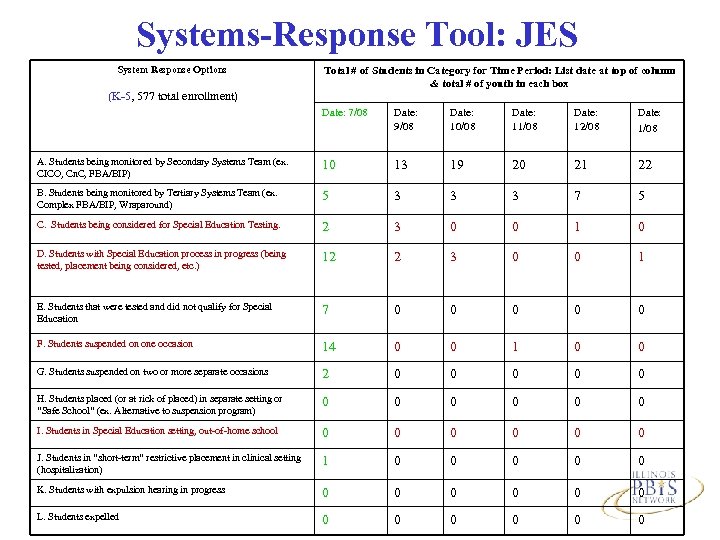
Systems-Response Tool: JES System Response Options (K-5, 577 total enrollment) Total # of Students in Category for Time Period: List date at top of column & total # of youth in each box Date: 7/08 Date: 9/08 Date: 10/08 Date: 11/08 Date: 12/08 Date: 1/08 A. Students being monitored by Secondary Systems Team (ex. CICO, Cn. C, FBA/BIP) 10 13 19 20 21 22 B. Students being monitored by Tertiary Systems Team (ex. Complex FBA/BIP, Wraparound) 5 3 3 3 7 5 C. Students being considered for Special Education Testing. 2 3 0 0 1 0 D. Students with Special Education process in progress (being tested, placement being considered, etc. ) 12 2 3 0 0 1 E. Students that were tested and did not qualify for Special Education 7 0 0 0 F. Students suspended on one occasion 14 0 0 1 0 0 G. Students suspended on two or more separate occasions 2 0 0 0 H. Students placed (or at rick of placed) in separate setting or “Safe School” (ex. Alternative to suspension program) 0 0 0 I. Students in Special Education setting, out-of-home school 0 0 0 J. Students in “short-term” restrictive placement in clinical setting (hospitalization) 1 0 0 0 K. Students with expulsion hearing in progress 0 0 0 L. Students expelled 0 0 0
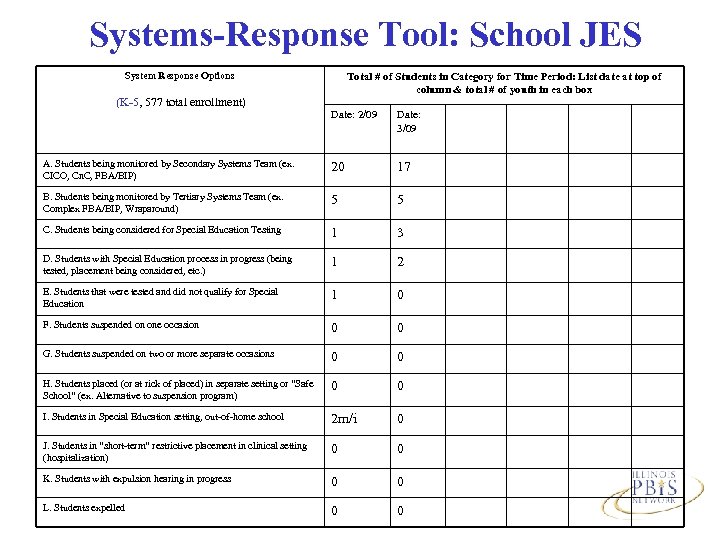
Systems-Response Tool: School JES System Response Options (K-5, 577 total enrollment) Total # of Students in Category for Time Period: List date at top of column & total # of youth in each box Date: 2/09 Date: 3/09 A. Students being monitored by Secondary Systems Team (ex. CICO, Cn. C, FBA/BIP) 20 17 B. Students being monitored by Tertiary Systems Team (ex. Complex FBA/BIP, Wraparound) 5 5 C. Students being considered for Special Education Testing 1 3 D. Students with Special Education process in progress (being tested, placement being considered, etc. ) 1 2 E. Students that were tested and did not qualify for Special Education 1 0 F. Students suspended on one occasion 0 0 G. Students suspended on two or more separate occasions 0 0 H. Students placed (or at rick of placed) in separate setting or “Safe School” (ex. Alternative to suspension program) 0 0 I. Students in Special Education setting, out-of-home school 2 m/i 0 J. Students in “short-term” restrictive placement in clinical setting (hospitalization) 0 0 K. Students with expulsion hearing in progress 0 0 L. Students expelled 0 0
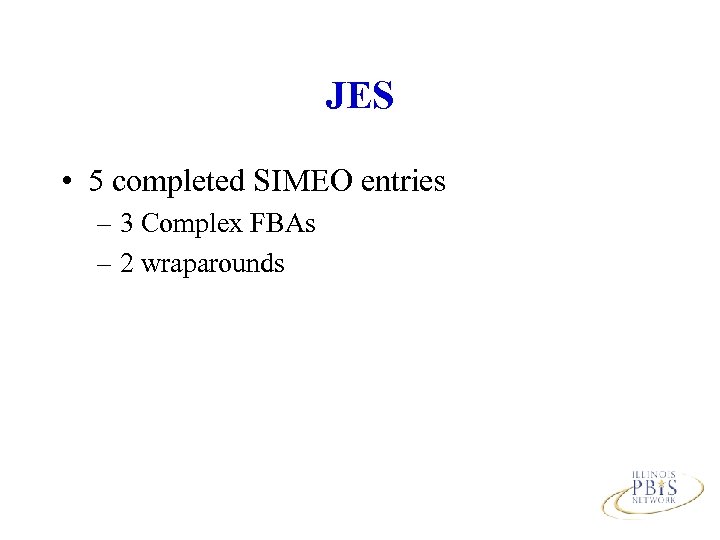
JES • 5 completed SIMEO entries – 3 Complex FBAs – 2 wraparounds
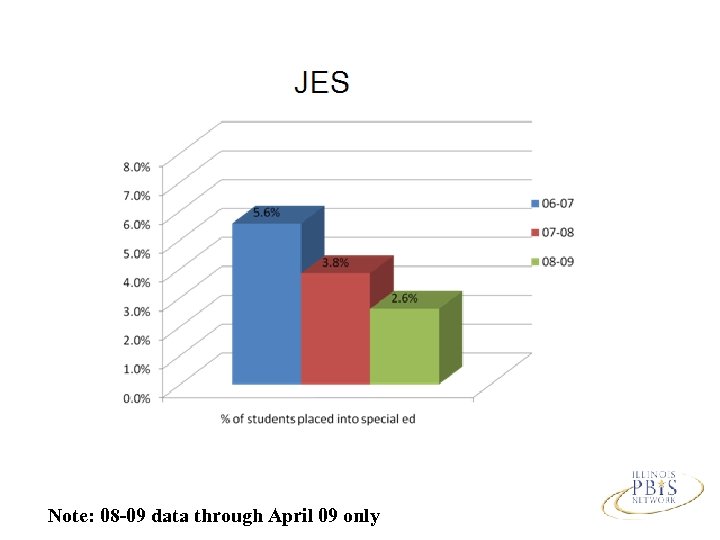
Note: 08 -09 data through April 09 only
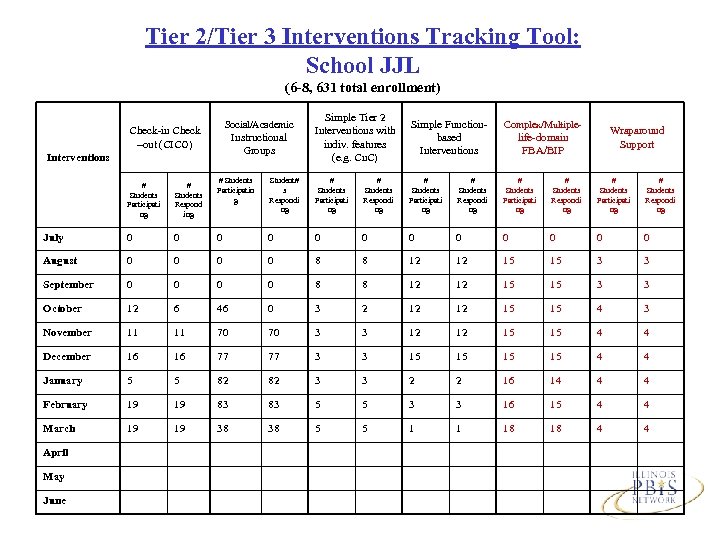
Tier 2/Tier 3 Interventions Tracking Tool: School JJL (6 -8, 631 total enrollment) Social/Academic Check-in Check –out (CICO) Instructional Groups Interventions Simple Tier 2 Interventions with indiv. features (e. g. Cn. C) Simple Functionbased Interventions Complex/Multiple- Wraparound Support life-domain FBA/BIP # Students Participatin g Student# s Respondi ng # Students Participati ng # Students Respondi ng 0 0 0 0 8 8 12 12 15 15 3 3 September 0 0 8 8 12 12 15 15 3 3 October 12 6 46 0 3 2 12 12 15 15 4 3 November 11 11 70 70 3 3 12 12 15 15 4 4 December 16 16 77 77 3 3 15 15 4 4 January 5 5 82 82 3 3 2 2 16 14 4 4 February 19 19 83 83 5 5 3 3 16 15 4 4 March 19 19 38 38 5 5 1 1 18 18 4 4 # Students Participati ng # Students Respond ing July 0 August April May June
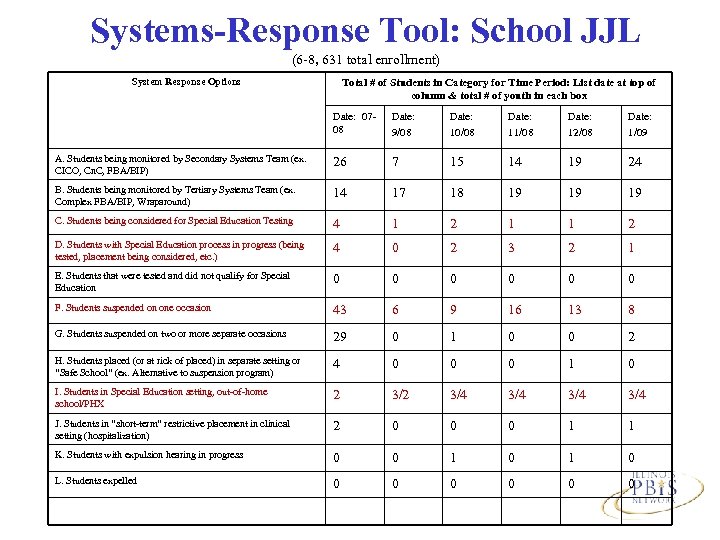
Systems-Response Tool: School JJL (6 -8, 631 total enrollment) System Response Options Total # of Students in Category for Time Period: List date at top of column & total # of youth in each box Date: 0708 Date: 9/08 Date: 10/08 Date: 11/08 Date: 12/08 Date: 1/09 A. Students being monitored by Secondary Systems Team (ex. CICO, Cn. C, FBA/BIP) 26 7 15 14 19 24 B. Students being monitored by Tertiary Systems Team (ex. Complex FBA/BIP, Wraparound) 14 17 18 19 19 19 C. Students being considered for Special Education Testing 4 1 2 1 1 2 D. Students with Special Education process in progress (being tested, placement being considered, etc. ) 4 0 2 3 2 1 E. Students that were tested and did not qualify for Special Education 0 0 0 F. Students suspended on one occasion 43 6 9 16 13 8 G. Students suspended on two or more separate occasions 29 0 1 0 0 2 H. Students placed (or at rick of placed) in separate setting or “Safe School” (ex. Alternative to suspension program) 4 0 0 0 1 0 I. Students in Special Education setting, out-of-home school/PHX 2 3/4 3/4 3/4 J. Students in “short-term” restrictive placement in clinical setting (hospitalization) 2 0 0 0 1 1 K. Students with expulsion hearing in progress 0 0 1 0 L. Students expelled 0 0 0
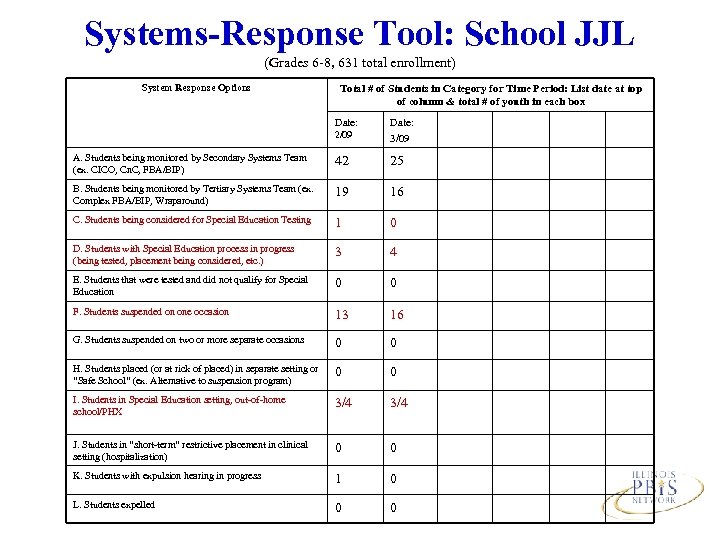
Systems-Response Tool: School JJL (Grades 6 -8, 631 total enrollment) System Response Options Total # of Students in Category for Time Period: List date at top of column & total # of youth in each box Date: 2/09 Date: 3/09 A. Students being monitored by Secondary Systems Team (ex. CICO, Cn. C, FBA/BIP) 42 25 B. Students being monitored by Tertiary Systems Team (ex. Complex FBA/BIP, Wraparound) 19 16 C. Students being considered for Special Education Testing 1 0 D. Students with Special Education process in progress (being tested, placement being considered, etc. ) 3 4 E. Students that were tested and did not qualify for Special Education 0 0 F. Students suspended on one occasion 13 16 G. Students suspended on two or more separate occasions 0 0 H. Students placed (or at rick of placed) in separate setting or “Safe School” (ex. Alternative to suspension program) 0 0 I. Students in Special Education setting, out-of-home school/PHX 3/4 J. Students in “short-term” restrictive placement in clinical setting (hospitalization) 0 0 K. Students with expulsion hearing in progress 1 0 L. Students expelled 0 0
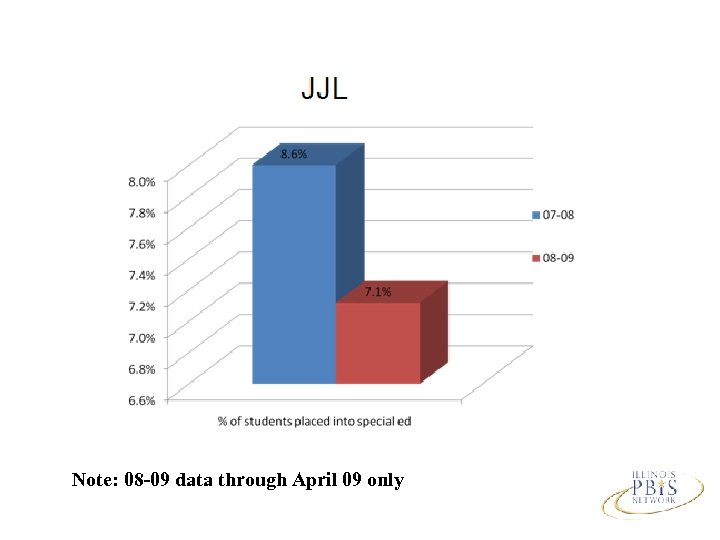
Note: 08 -09 data through April 09 only
JJL • 16 completed SIMEO entries – 16 Complex FBAs – 4 wraparounds
At District Team Meeting: Prioritize and Strategize Next Steps • Repositioning staff • Secondary/Tertiary continuum of practices • Tools for data-based decision-making (SSBD, WIT, etc. ) • District-level data-based decision-making (EE) • Integrating related initiatives – Which of the above topics are top priority? – Use the action plan to record steps
IL Tertiary Demo District Example #3 • District-level review of fidelity of practices • Conducted by District External Coach • Results uses to guide District Action Plan
Evaluating a FBA/BIP Using the ISSET • ISSET – Individual Student Systems Evaluation Tool • Intensive Individualized Interventions Features Checklist • 2 questions about FBA • 9 questions about Behavior Support Plans • 3 rd grade student • Complex FBA
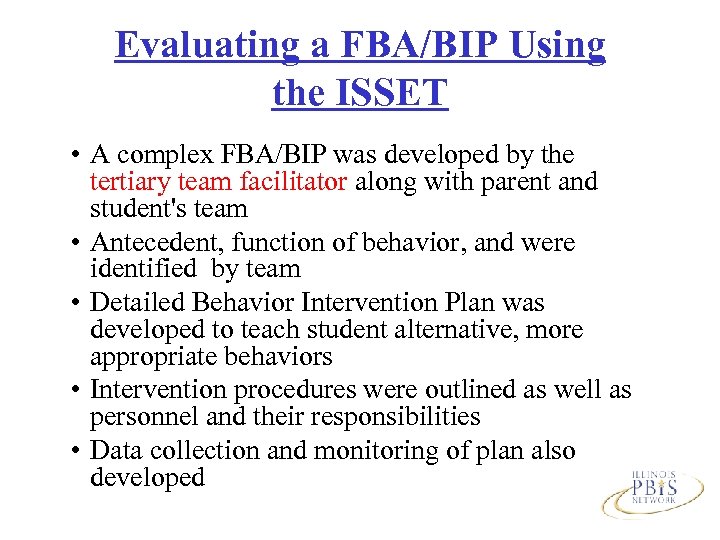
Evaluating a FBA/BIP Using the ISSET • A complex FBA/BIP was developed by the tertiary team facilitator along with parent and student's team • Antecedent, function of behavior, and were identified by team • Detailed Behavior Intervention Plan was developed to teach student alternative, more appropriate behaviors • Intervention procedures were outlined as well as personnel and their responsibilities • Data collection and monitoring of plan also developed
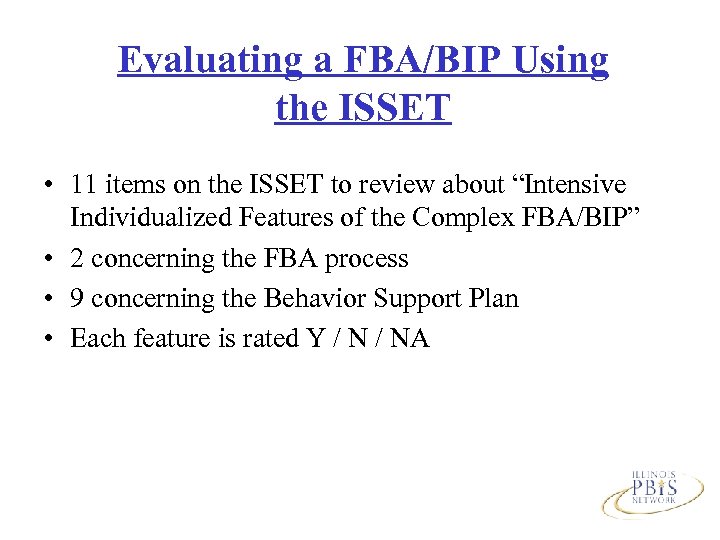
Evaluating a FBA/BIP Using the ISSET • 11 items on the ISSET to review about “Intensive Individualized Features of the Complex FBA/BIP” • 2 concerning the FBA process • 9 concerning the Behavior Support Plan • Each feature is rated Y / NA
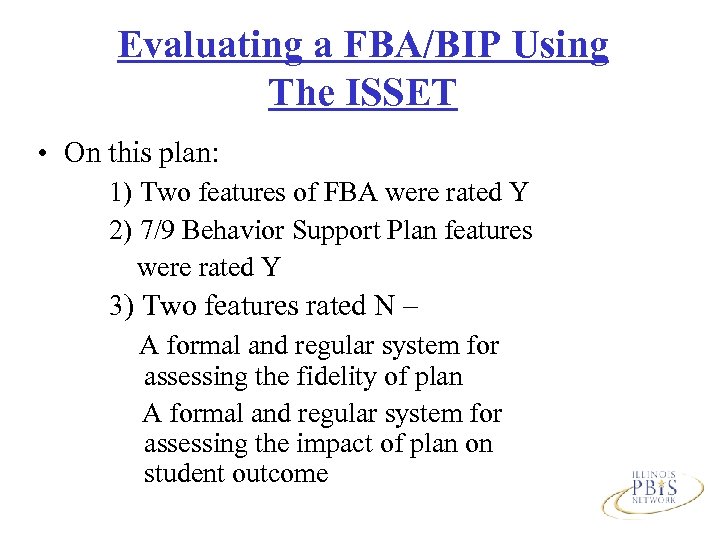
Evaluating a FBA/BIP Using The ISSET • On this plan: 1) Two features of FBA were rated Y 2) 7/9 Behavior Support Plan features were rated Y 3) Two features rated N – A formal and regular system for assessing the fidelity of plan A formal and regular system for assessing the impact of plan on student outcome
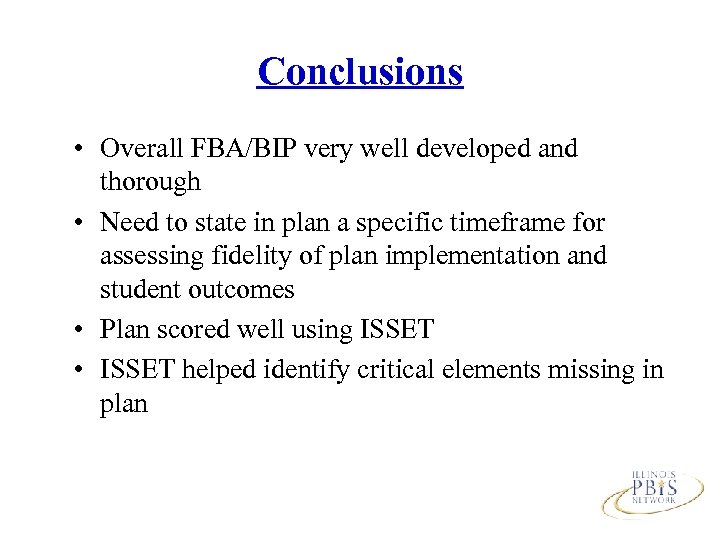
Conclusions • Overall FBA/BIP very well developed and thorough • Need to state in plan a specific timeframe for assessing fidelity of plan implementation and student outcomes • Plan scored well using ISSET • ISSET helped identify critical elements missing in plan
District Conclusions/Next Steps • Increased Secondary training in Simple FBA/BIP has resulted in plans being developed/implemented • Secondary Intervention binder utilized by grade level Data/BIT teams • Increased training in Complex FBA for Tertiary sites and Wraparound Facilitators (WF) • 17 WF trained in district • Fluency in Wrap process improved • ISSET tool to be utilized at several sites for 20092010
IL Tertiary Demo District Example #4 • District-level review of fidelity of practices • Conducted by District External Coach • Results used to guide District Action Plan
Incorporating FBA/BIP into Continuum of Supports • Data for identifying needs of students • Tools for practice of developing FBA/BIP • Defined systems of support
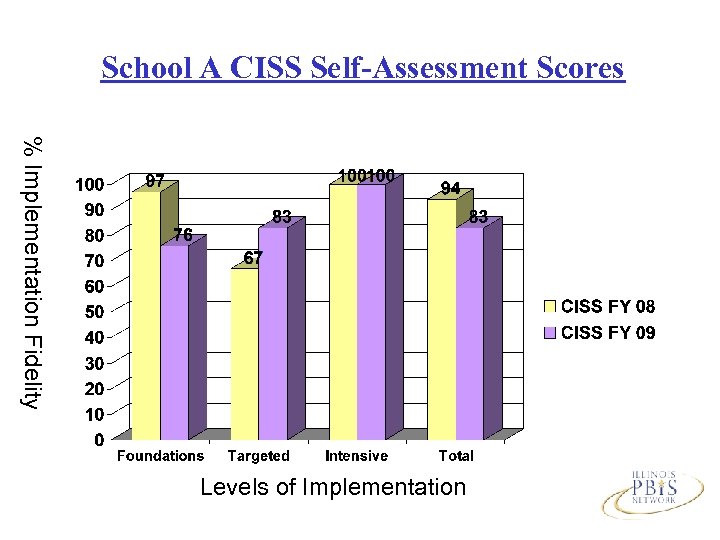
School A CISS Self-Assessment Scores % Implementation Fidelity Levels of Implementation
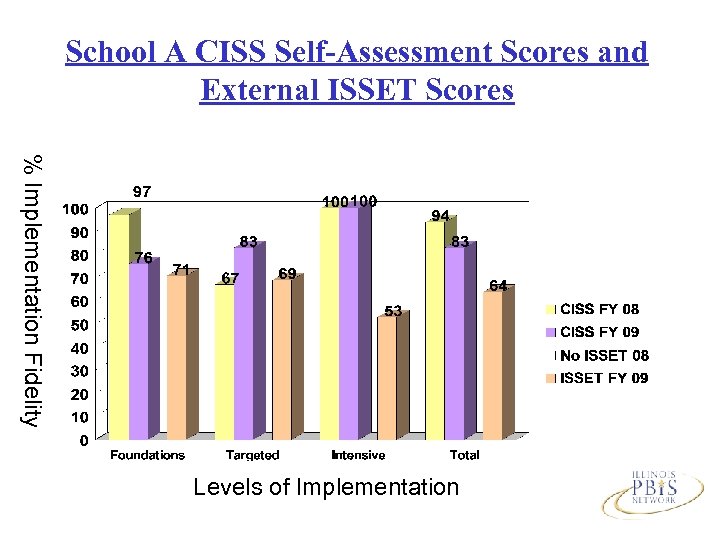
School A CISS Self-Assessment Scores and External ISSET Scores % Implementation Fidelity Levels of Implementation
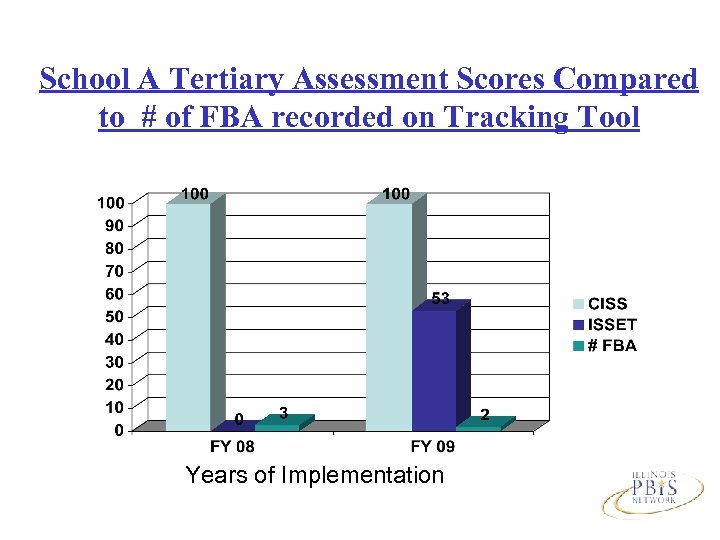
School A Tertiary Assessment Scores Compared to # of FBA recorded on Tracking Tool Years of Implementation
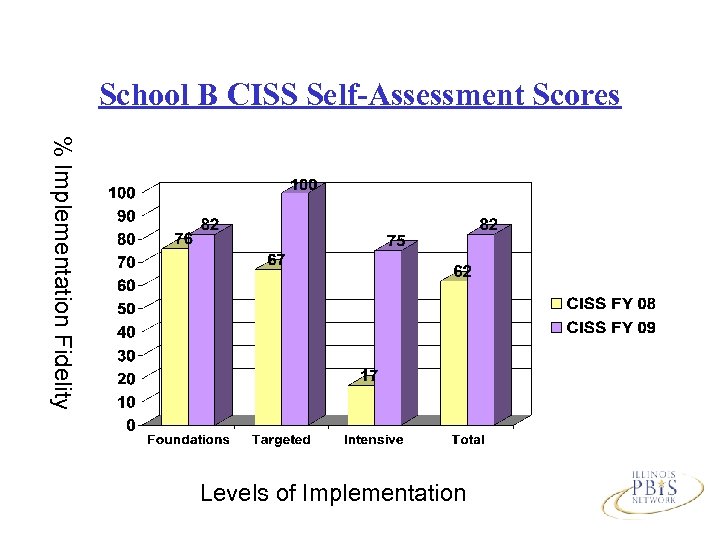
School B CISS Self-Assessment Scores % Implementation Fidelity Levels of Implementation
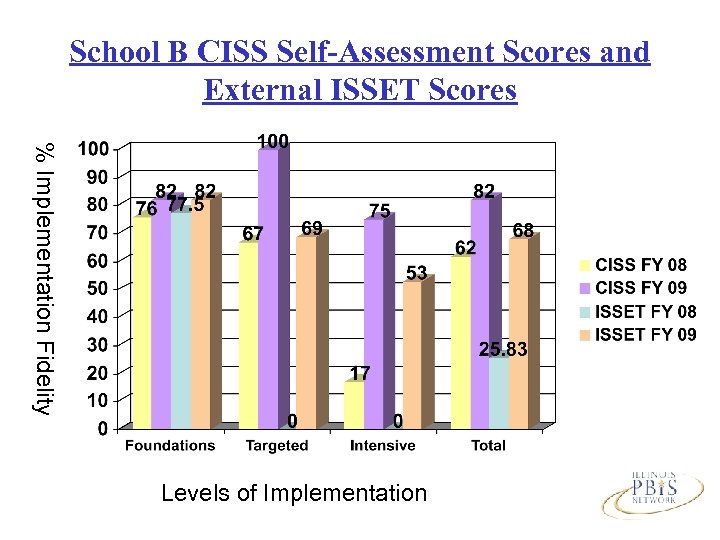
School B CISS Self-Assessment Scores and External ISSET Scores % Implementation Fidelity Levels of Implementation
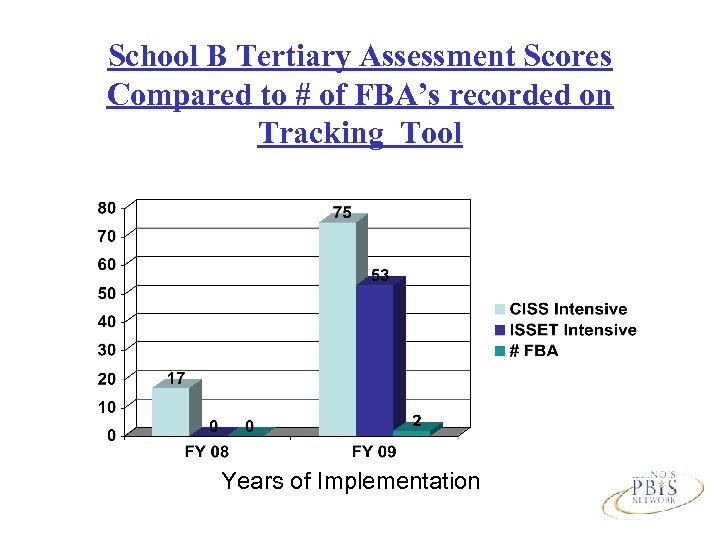
School B Tertiary Assessment Scores Compared to # of FBA’s recorded on Tracking Tool Years of Implementation
District Next Steps Establish Structures to Ensure Building Accountability for Delivering Interventions
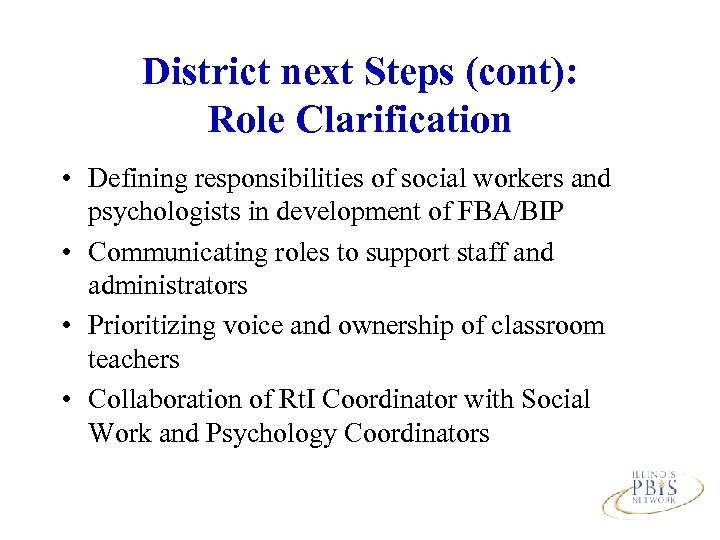
District next Steps (cont): Role Clarification • Defining responsibilities of social workers and psychologists in development of FBA/BIP • Communicating roles to support staff and administrators • Prioritizing voice and ownership of classroom teachers • Collaboration of Rt. I Coordinator with Social Work and Psychology Coordinators
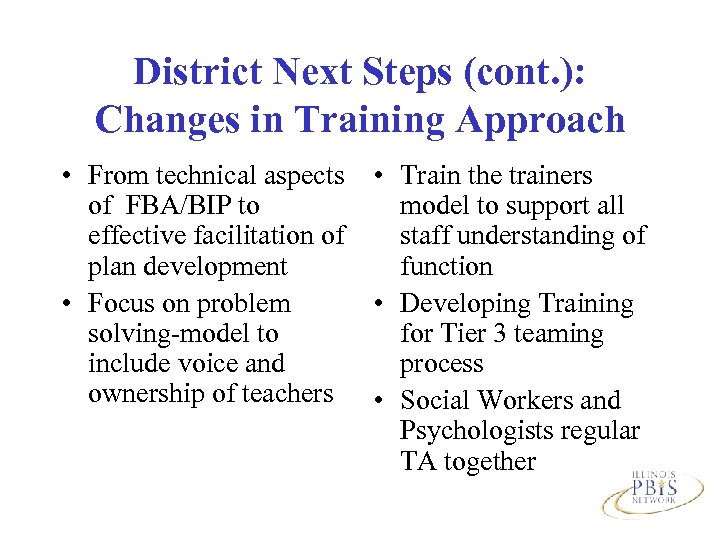
District Next Steps (cont. ): Changes in Training Approach • From technical aspects • Train the trainers of FBA/BIP to model to support all effective facilitation of staff understanding of plan development function • Focus on problem • Developing Training solving-model to for Tier 3 teaming include voice and process ownership of teachers • Social Workers and Psychologists regular TA together
District Next Steps (cont. ): Action Steps • Solicit input from psychologists and social workers • Commitment to technical assistance days with paired psychologists and social worker • District Tier 3 committee specifying individual problem solving and entitlement criteria
Practices • Steps/Phases for Developing Effective Individualized Tier 3 Plans
Individualized Teams at the Tertiary Level • Are unique to the individual child & family – Blend the family’s supports with the school representatives who know the child best • Meeting Process – Meet frequently – Regularly develop & review interventions • Facilitator Role – Role of bringing team together – Role of blending perspectives
Individualized Comprehensive Teams/Plans Who? • Youth with multiple needs across home, school, community • Youth with multiple life domain needs • The adults in youth’s life are not effectively engaged in comprehensive planning (i. e. adults not getting along very well) What? The development of a very unique, individualized, strength-based team & plan with the youth and family that is designed to improve quality of life as defined by the youth/family.
Individualized, Comprehensive Teams/Plans What Do Tertiary Plans include? Supports and interventions across multiple life domains and settings (i. e. behavior support plans, academic interventions, basic living supports, multi-agency strategies, family supports, community supports, etc. ) What’s Different? Natural supports and unique strengths are emphasized in team and plan development. Youth/family access, voice, ownership are critical features. Plans include supports for adults/family, as well as youth.
Interventions… Ownership & Voice: A Key to Intervention Design The person who is supposed to implement the strategy needs to be actively involved in designing it; or it probably won’t work!
“The task is not redesign the individual but to redesign the environment in order to prevent problem behavior and ensure an acceptable behavior is produced instead. ” -Rob Horner
Effective Behavior Interventions: Ø Function – based Ø Proactive Ø Have adequate dosage of: üInstruction üPractice üSupport üEncouragement üMonitoring
Points to Keep in Mind When Action Planning with a Team… Scientifically sound strategies can fail if they don’t fit with values and skills of those who are supposed to implement them. Contextual Fit
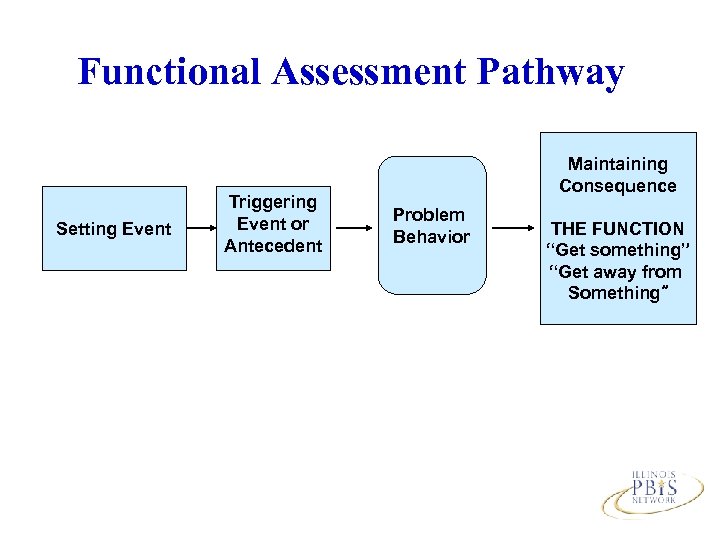
Functional Assessment Pathway Setting Event Triggering Event or Antecedent Maintaining Consequence Problem Behavior THE FUNCTION “Get something” “Get away from Something”
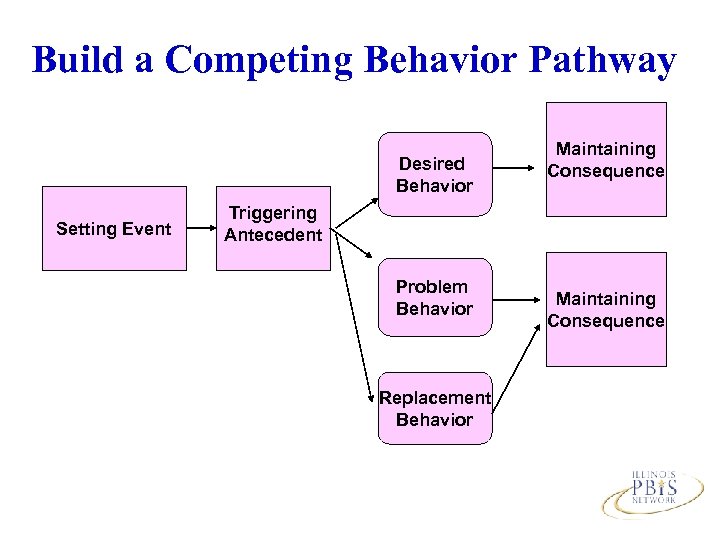
Build a Competing Behavior Pathway Desired Behavior Setting Event Maintaining Consequence Triggering Antecedent Problem Behavior Replacement Behavior Maintaining Consequence
Integrating Wraparound into Tier 3 Interventions…
“Bruce” • 5 th grade • Difficulty socially interacting with peers at school and in the community • Entered the 2007/08 school year with a Behavior Intervention Plan from the previous school year • DCFS involvement (in a foster placement)
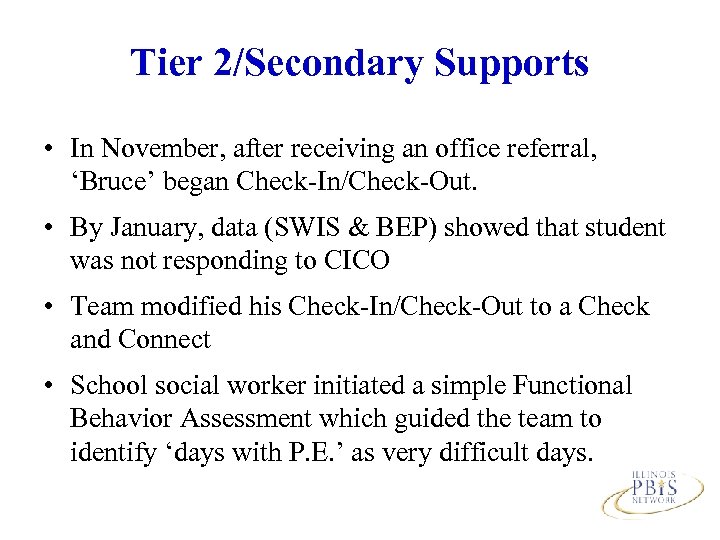
Tier 2/Secondary Supports • In November, after receiving an office referral, ‘Bruce’ began Check-In/Check-Out. • By January, data (SWIS & BEP) showed that student was not responding to CICO • Team modified his Check-In/Check-Out to a Check and Connect • School social worker initiated a simple Functional Behavior Assessment which guided the team to identify ‘days with P. E. ’ as very difficult days.
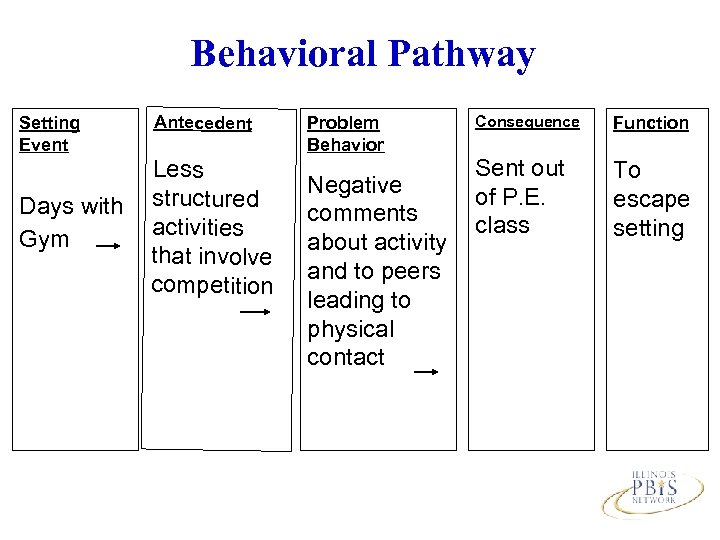
Behavioral Pathway Setting Event Days with Gym Antecedent Less structured activities that involve competition Problem Behavior Negative comments about activity and to peers leading to physical contact Consequence Function Sent out of P. E. class To escape setting
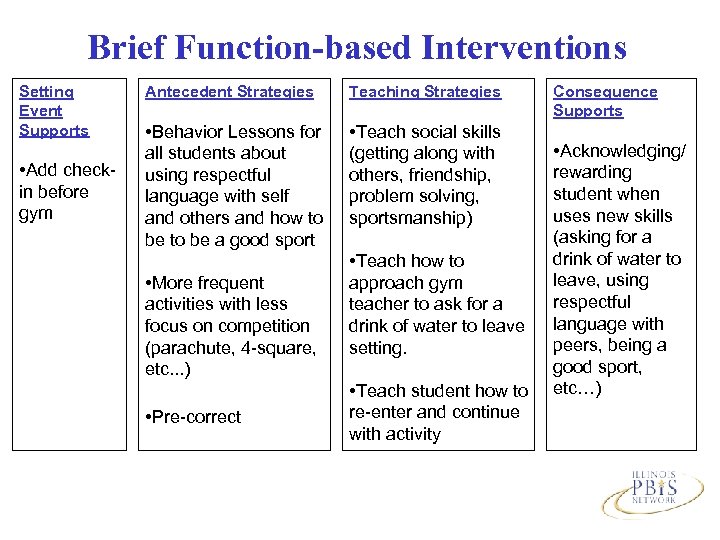
Brief Function-based Interventions Setting Event Supports • Add checkin before gym Antecedent Strategies Teaching Strategies • Behavior Lessons for all students about using respectful language with self and others and how to be a good sport • Teach social skills (getting along with others, friendship, problem solving, sportsmanship) • More frequent activities with less focus on competition (parachute, 4 -square, etc. . . ) • Pre-correct • Teach how to approach gym teacher to ask for a drink of water to leave setting. • Teach student how to re-enter and continue with activity Consequence Supports • Acknowledging/ rewarding student when uses new skills (asking for a drink of water to leave, using respectful language with peers, being a good sport, etc…)
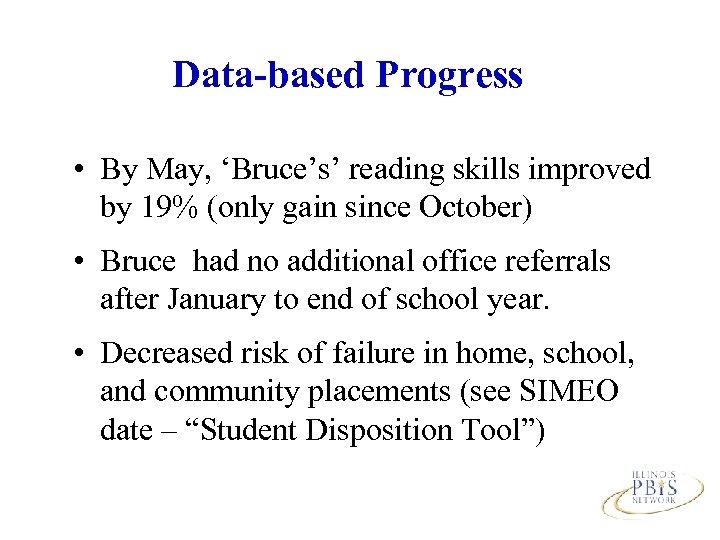
Data-based Progress • By May, ‘Bruce’s’ reading skills improved by 19% (only gain since October) • Bruce had no additional office referrals after January to end of school year. • Decreased risk of failure in home, school, and community placements (see SIMEO date – “Student Disposition Tool”)
“Bruce’s” Tier 3/Tertiary Support Plan • Wraparound process lead to identified community interests and LAN funding to support these • Student attended summer camp and is involved in football
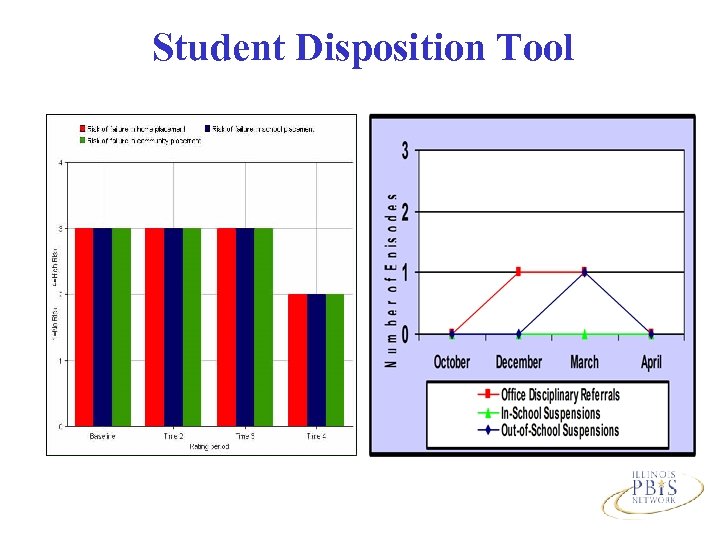
Student Disposition Tool
Why/when to lead with the wrapround process? The wraparound process creates a context for design & implementation of researchbased behavioral, academic and clinical interventions.
Who is Wraparound for? • Youth with multiple needs across home, school, community • Youth at-risk for change of placement (youth not responding to current systems/practices) • The adults in youth’s life are not effectively engaged in comprehensive planning (i. e. adults not getting along very well)
What is Wraparound? Ø Wraparound is a process for developing familycentered teams and plans that are strength and needs based q (not deficit based) q across multiple settings and life domains.
Features of Wraparound: u individual students u built upon strengths u voice, priorities of youth and family u based on unique youth and family needs u culturally relevant teams and plans u plans include natural supports u traditional and non-traditional interventions u multiple life domains u unconditional
Unique Fit Wraparound plans should be uniquely designed to fit individual students needs as opposed to making a student fit into existing services or a prescribed program.
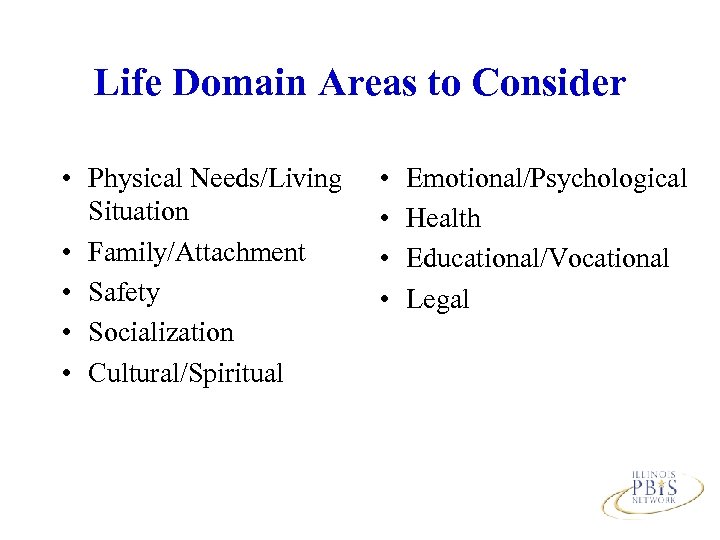
Life Domain Areas to Consider • Physical Needs/Living Situation • Family/Attachment • Safety • Socialization • Cultural/Spiritual • • Emotional/Psychological Health Educational/Vocational Legal
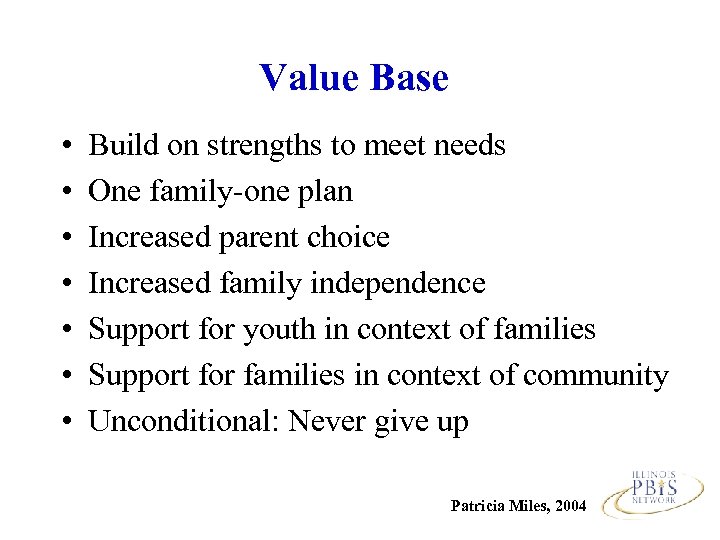
Value Base • • Build on strengths to meet needs One family-one plan Increased parent choice Increased family independence Support for youth in context of families Support for families in context of community Unconditional: Never give up Patricia Miles, 2004
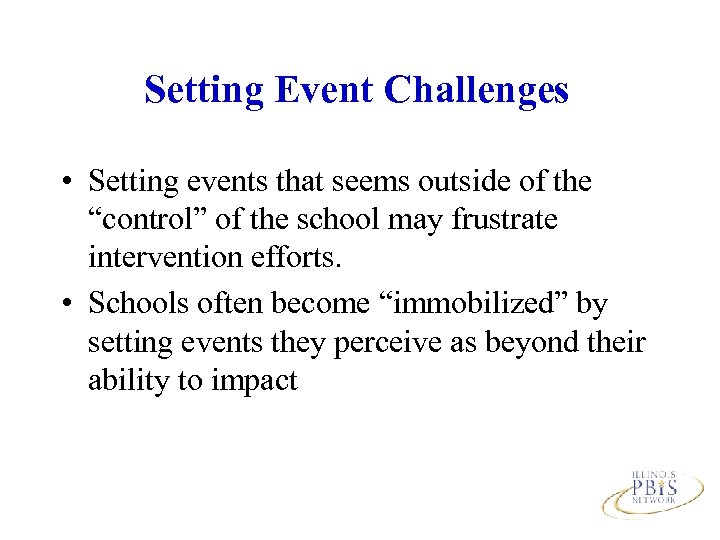
Setting Event Challenges • Setting events that seems outside of the “control” of the school may frustrate intervention efforts. • Schools often become “immobilized” by setting events they perceive as beyond their ability to impact
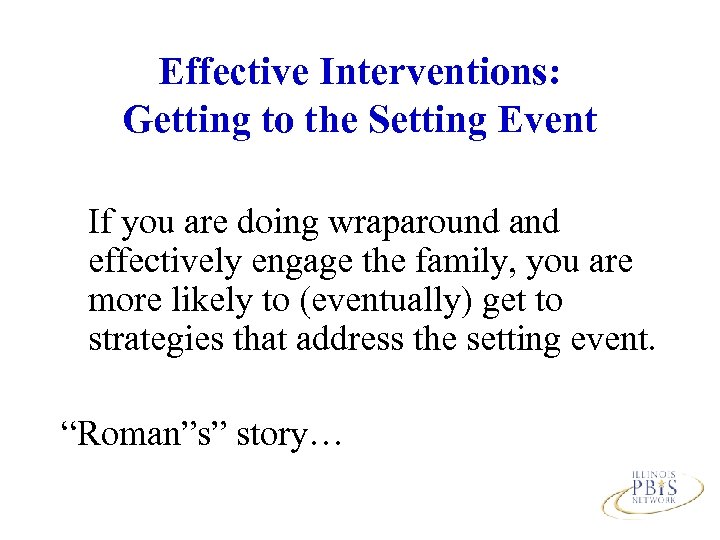
Effective Interventions: Getting to the Setting Event If you are doing wraparound and effectively engage the family, you are more likely to (eventually) get to strategies that address the setting event. “Roman”s” story…
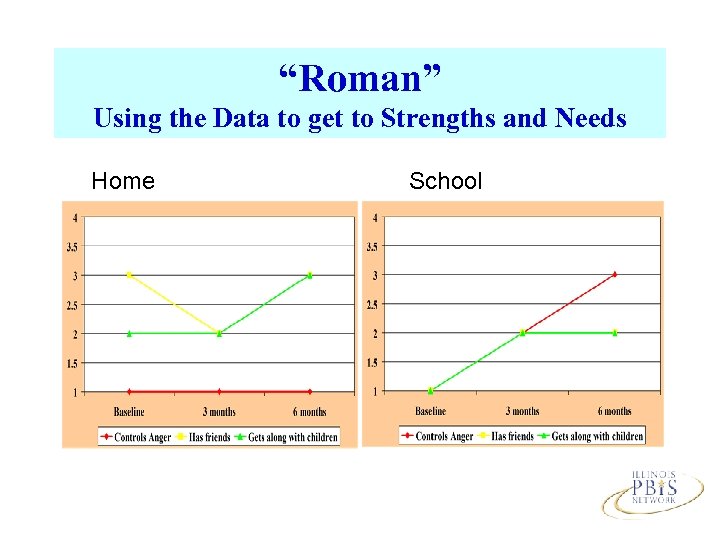
“Roman” Using the Data to get to Strengths and Needs Home School
Activity IT-I: Using FBA/BIP to Get to Voice/Ownership • Choose a problem behavior with a setting event that seems outside of the control. • Brainstorm possible strategies for changing the problem behavior in as many places as possible in the pathway. • Brainstorm additional wraparound strategies that could help impact setting events over time.
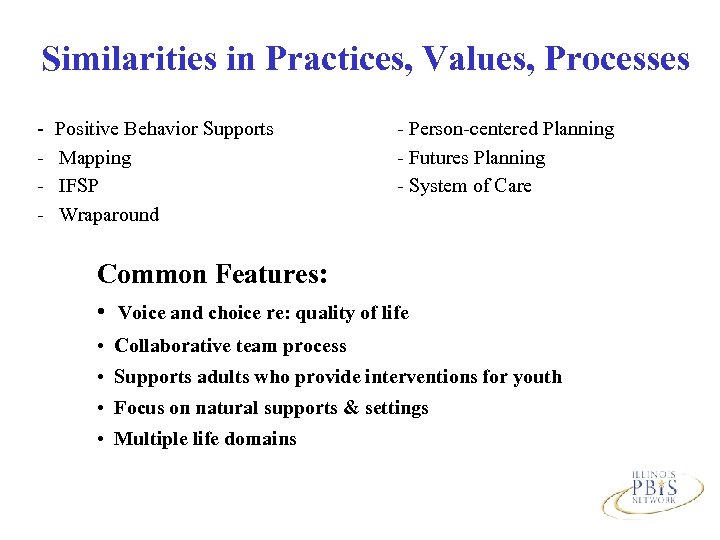
Similarities in Practices, Values, Processes - Positive Behavior Supports - Mapping - IFSP - Wraparound - Person-centered Planning - Futures Planning - System of Care Common Features: • Voice and choice re: quality of life • Collaborative team process • Supports adults who provide interventions for youth • Focus on natural supports & settings • Multiple life domains
What’s New in Wraparound? • • Skill set specificity Focus on intervention design/effectiveness Integration with school-wide PBS Phases to guide implementation/supervision Data-based decision-making Integrity/fidelity assessment (WIT) Tools to guide teams: – Home School Community – Education Information Tool
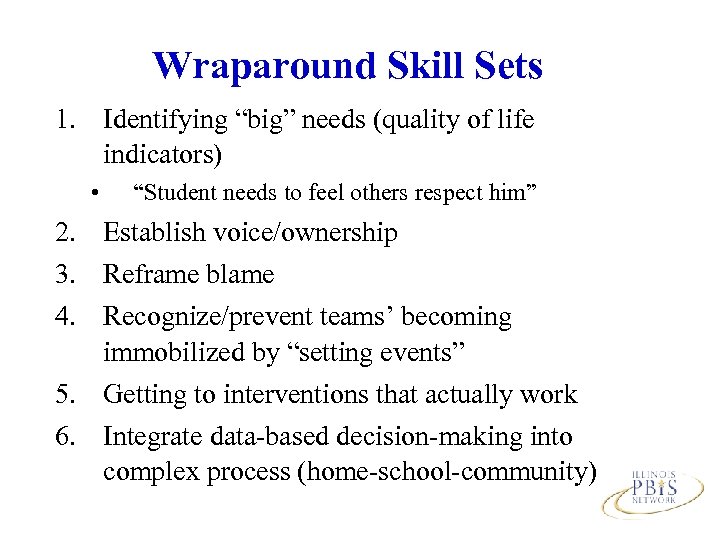
Wraparound Skill Sets 1. Identifying “big” needs (quality of life indicators) • “Student needs to feel others respect him” 2. Establish voice/ownership 3. Reframe blame 4. Recognize/prevent teams’ becoming immobilized by “setting events” 5. Getting to interventions that actually work 6. Integrate data-based decision-making into complex process (home-school-community)
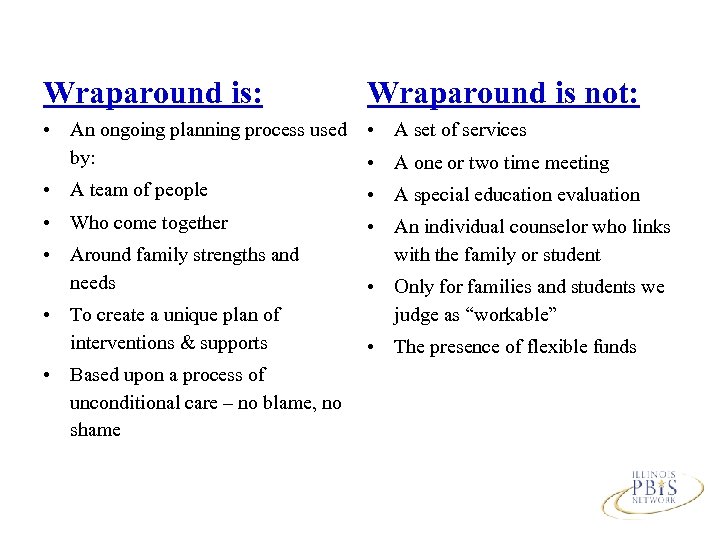
Wraparound is: Wraparound is not: • An ongoing planning process used • A set of services by: • A one or two time meeting • A team of people • A special education evaluation • Who come together • Around family strengths and needs • To create a unique plan of interventions & supports • Based upon a process of unconditional care – no blame, no shame • An individual counselor who links with the family or student • Only for families and students we judge as “workable” • The presence of flexible funds
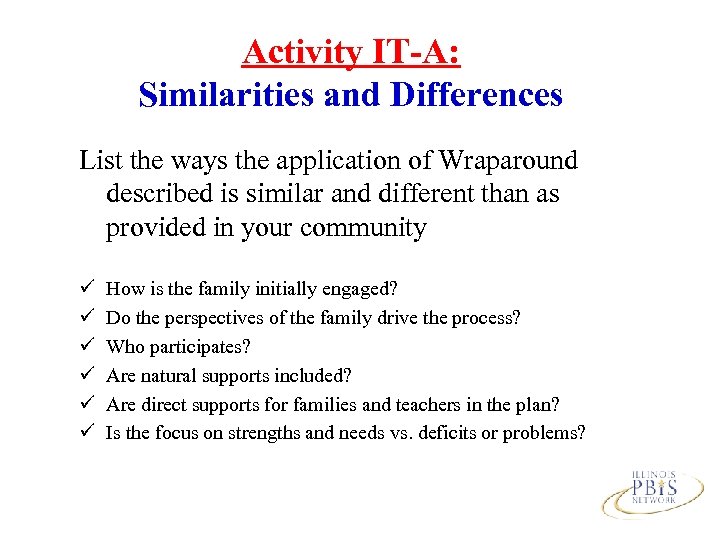
Activity IT-A: Similarities and Differences List the ways the application of Wraparound described is similar and different than as provided in your community ü ü ü How is the family initially engaged? Do the perspectives of the family drive the process? Who participates? Are natural supports included? Are direct supports for families and teachers in the plan? Is the focus on strengths and needs vs. deficits or problems?
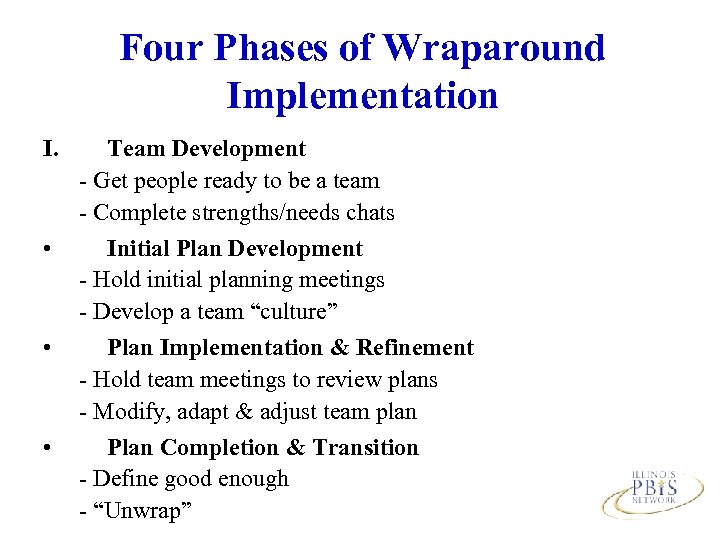
Four Phases of Wraparound Implementation I. Team Development - Get people ready to be a team - Complete strengths/needs chats • Initial Plan Development - Hold initial planning meetings - Develop a team “culture” Plan Implementation & Refinement - Hold team meetings to review plans - Modify, adapt & adjust team plan Plan Completion & Transition - Define good enough - “Unwrap” • •
Phase I: Team Development Initiating the Wraparound Process Ø Prepare for wraparound meetings through individual conversations with core team members is a critical first step. Ø The first contact/s with the family should feel different than being invited to a meeting. Ø Gather information for a rich strength profile (this will be a valuable tool for action planning).
Points to Remember about Engaging Families Ø Apply Rt. I to Family Engagement: don’t keep doing what hasn’t worked up Ø If engagement didn’t happen, how would you change your approach to effectively engage? Ø professionals don’t get to choose or judge how families raise their kids. Ø Always start with a conversation ( not a meeting) with the family, getting their trust and permission before talking with others.
Phase I: Team Development Wraparound Facilitator: – – – – Meets with family & stakeholders Gathers perspectives on strengths & needs Assess for safety & rest Provides or arranges stabilization response if safety is compromised Explains the wraparound process Identifies, invites & orients Child & Family Team members Completes strengths summaries & inventories Arranges initial wraparound planning meeting
Establish Family Voice & Ownership Ø Communicate differently… ØNo blaming, no shaming ØStart with strengths ØFamily’s needs are priority ØListen to their story before the meeting ØValidate their perspective
Checking for Family Voice & Ownership • Family chooses team members • Team meets when & where family is comfortable • Family (including the youth) feels like it is their meeting and their plan instead of feeling like they are attending a meeting the school or agency is having about them.
Team Composition: Roles are the focus (not job titles) • Parents/caretakers and youth • Person/s the family turns to for support (extended family, friend of parent or child, neighbor, medical/professionals) • Person representing strengths/interests (coach, specific teacher) • Agencies Involved: mental health, DCFS, Juvenile Justice, Early Intervention, etc. • Spiritual Supports • Facilitator • Mentor
Data-Based Decision-Making and Wraparound Can wraparound teams use data-based decision-making to prioritize needs, design strategies, & monitor progress of the child/family team? ü more efficient teams, meetings, and plans? ü less reactive (emotion-based) actions? ü more strategic actions? ü more effective outcomes? ü longer-term commitment to maintain success?
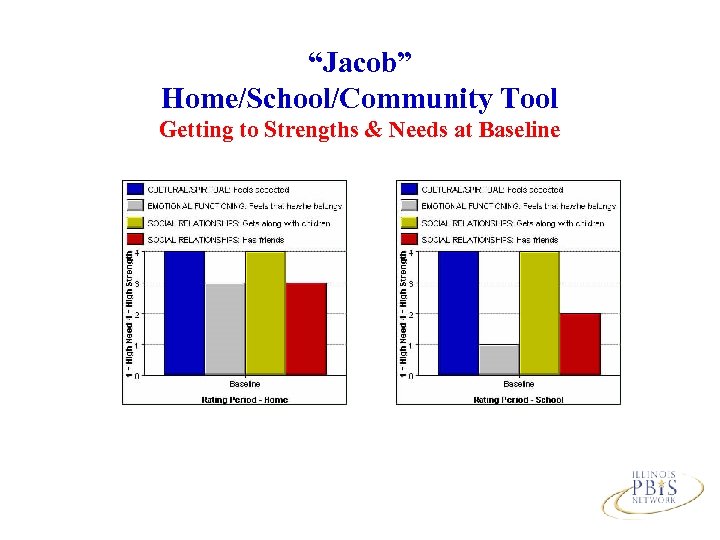
Data-based Decision-Making Tools Introduced at Engagement (Phase I) and used throughout the process (Phases I –IV) • Student Disposition Tool (SD-T) • Home/School/Community Tool (HSC-T) • Education Information Tool (EI-T)
Mary Ellen 7 th grade student Referred to the Student Assistant Team as a potential WRAP because she had formed a strong attachment to a teacher that interfered with her ability to transition between classes. The team determined that when Mary Ellen transitioned between classes her anxiety increased because she wanted attention from her teacher. Staff escorts were assigned to her between classes as a safety precaution and to alleviate anxiety of the student and teacher. A staff member was also assigned outside the classroom teachers’ room. The anxiety continued and the wraparound process was initiated.
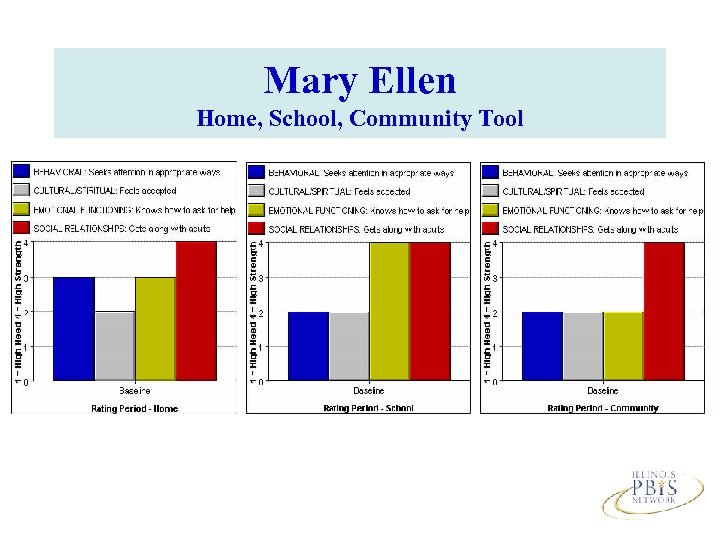
Mary Ellen Home, School, Community Tool
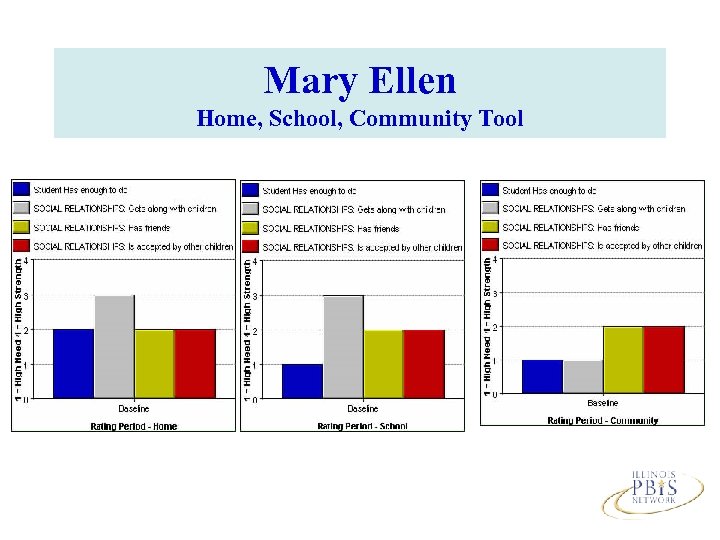
Mary Ellen Home, School, Community Tool
Mary Ellen Wraparound Phase One • The escort service was gradually faded and Mary Ellen’s anxiety began to decrease. • Mary Ellen met with her counselor, D. D. , to set goals (Universal level intervention). Mary Ellen set the goal: “to walk to class by herself”. • The wrap team plans to meet to address social and recreational needs identified by the family and school via data and conversation. • The team has also started to plan ways that Mary Ellen can interact with peers (Trivia game, safety presentation). • The family is in the process of completing an outside evaluation, which may lead Mary Ellen being diagnosed with Asperger’s Syndrome Disorder.
Unique Youth/Family Teams • Best Practice Targets – High ownership of process by youth/family – Each youth/family has their own unique team – Teams meet over time rather than once or twice – Teams are empowered to make decisions about resources as well as youth/family lives – More informal supports on each team than system representatives Patricia Miles, 2002
Phase II Wraparound: Plan Development Facilitator: • • • Holds an initial (or 2) wraparound plan development meeting Introduces process & team members Presents strengths & distributes strength summary Solicits additional strength information from gathered group Leads team in creating a mission statement Introduces needs statements & solicits additional perspectives on needs from team Facilitates team prioritizing needs Leads the team in generating strategies to meet needs Identifies person/s responsible for follow-through with action plan items Documents & distributes the plan to all team members
Introducing Fidelity into the Wraparound Process: Wraparound Integrity Tool (WIT) Purpose of the WIT: – to ensure wraparound is done with integrity; – assist family in thinking through previous/most recent meeting experiences (baseline rating) – team self-assess fidelity over time. Trainer models/role play: – How to introduce during Phase I; – How to introduce/use at team meetings over time
Strengths & Wraparound • Strategies are created based on strengths. • Action Plan is guided by strengths. • More is documented about strengths than problems. • Strengths of each family member and the family as a whole are recorded.
Strengths & Wraparound Assumptions About Strengths • All people have strengths • Each person’s strengths are unique • Change is supported by building on strengths • People know their own strengths and needs • All environments have strengths to be built upon
How are strengths used continuously in the wraparound process? • To support the collaborative relationship of team members • To establish ownership of team and plan • To ensure interventions are proactive • To continuously build on successes
Points to Consider As You Do Strengths Profile • • • Specific and functional Multiple settings Multiple life domains Hidden strengths Family strengths
Needs-based • Assumptions & Values – Difficult behaviors result from unmet needs – Difficult behaviors tell us important things about a person’s life – Needs are not services – Allow family/youth to voice their needs rather than assessing needs for them – Team measures family experience of “met need” rather than service provided Patricia Miles, 2002
Good Needs-based Interventions Will: • Change the environment around the situation rather than waiting for the person with the unmet need to do the changing • Help build skills for the youth and the youth’s supporters (family, teachers, neighbors, kin, etc. ) • Access existing resources when there is fit, avoid existing resources when there is not Patricia Miles, 2002
Jacob Reasons for Wrap Referral Baseline –Poor school attendance –Tardiness –Refusal to participate in 2 nd grade classroom activities. Did work independently in office/partial school days. –Previous hospitalization (Bipolar Disorder) –Retention – currently repeating 2 nd grade year –Failing Grades –Family Support Needs
“Jacob” Home/School/Community Tool Getting to Strengths & Needs at Baseline
Effective Plans • Modify the family’s/youth’s context in home, school or community • Support skills development • Creates a process which builds on youth/family strengths • Builds clear pathways for resource acquisition – Get the right stuff at the right time in the right way for the right price
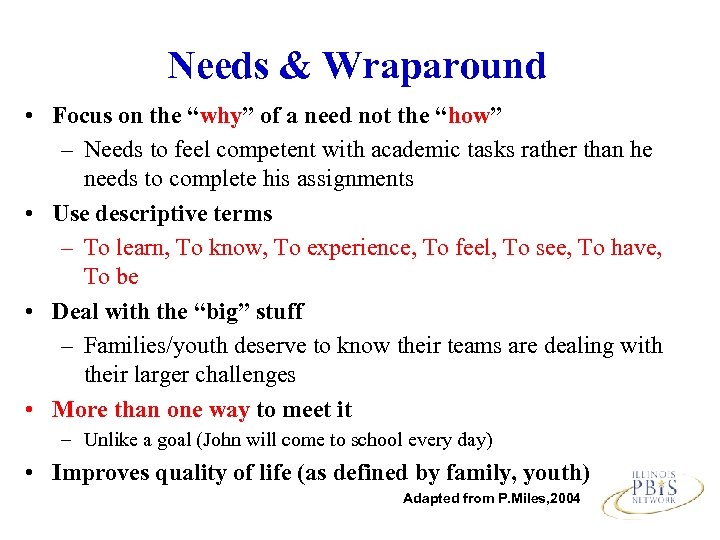
Needs & Wraparound • Focus on the “why” of a need not the “how” – Needs to feel competent with academic tasks rather than he needs to complete his assignments • Use descriptive terms – To learn, To know, To experience, To feel, To see, To have, To be • Deal with the “big” stuff – Families/youth deserve to know their teams are dealing with their larger challenges • More than one way to meet it – Unlike a goal (John will come to school every day) • Improves quality of life (as defined by family, youth) Adapted from P. Miles, 2004
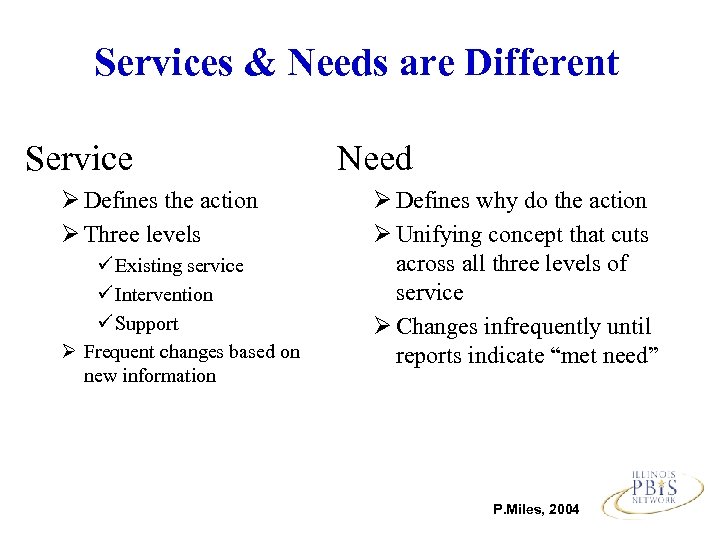
Services & Needs are Different Service Ø Defines the action Ø Three levels ü Existing service ü Intervention ü Support Ø Frequent changes based on new information Need Ø Defines why do the action Ø Unifying concept that cuts across all three levels of service Ø Changes infrequently until reports indicate “met need” P. Miles, 2004
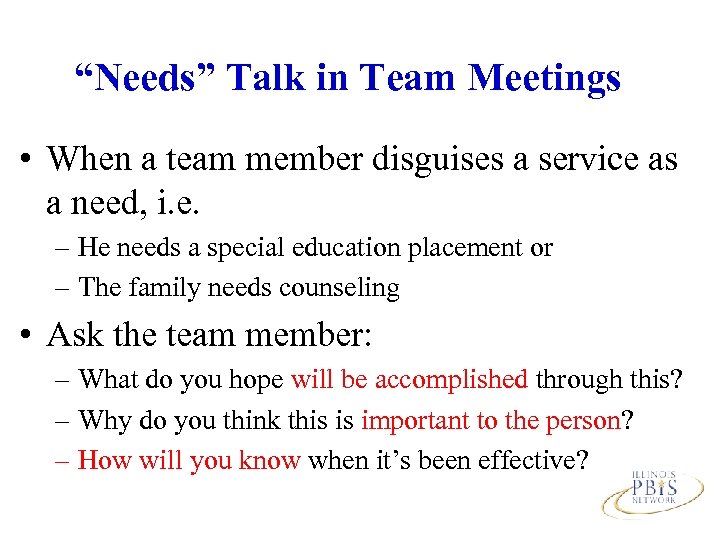
“Needs” Talk in Team Meetings • When a team member disguises a service as a need, i. e. – He needs a special education placement or – The family needs counseling • Ask the team member: – What do you hope will be accomplished through this? – Why do you think this is important to the person? – How will you know when it’s been effective?
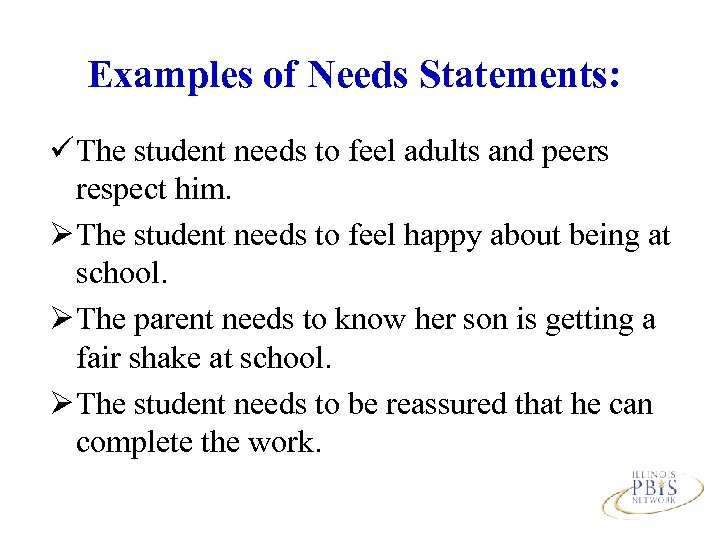
Examples of Needs Statements: ü The student needs to feel adults and peers respect him. Ø The student needs to feel happy about being at school. Ø The parent needs to know her son is getting a fair shake at school. Ø The student needs to be reassured that he can complete the work.
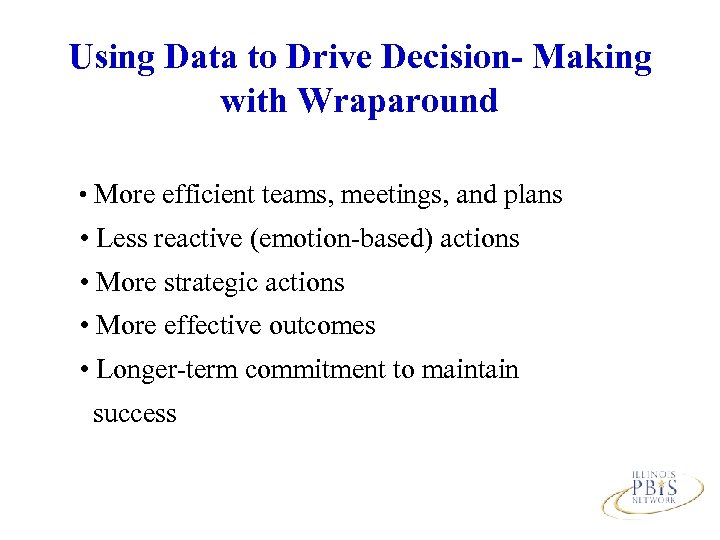
Using Data to Drive Decision- Making with Wraparound • More efficient teams, meetings, and plans • Less reactive (emotion-based) actions • More strategic actions • More effective outcomes • Longer-term commitment to maintain success
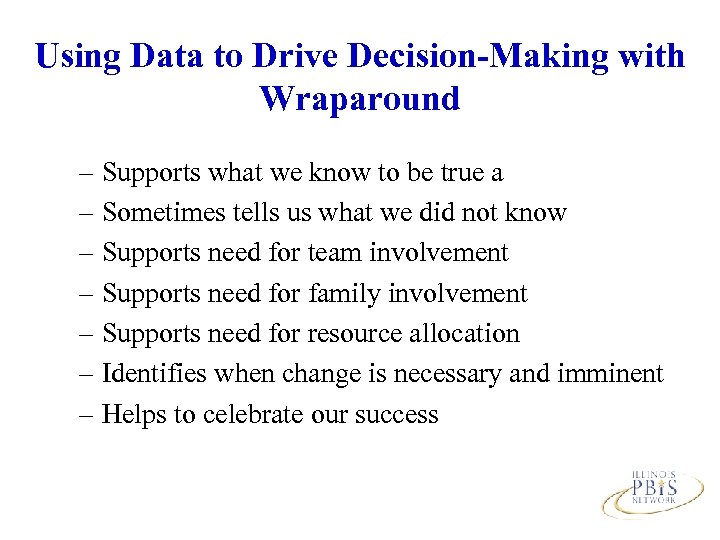
Using Data to Drive Decision-Making with Wraparound – Supports what we know to be true a – Sometimes tells us what we did not know – Supports need for team involvement – Supports need for family involvement – Supports need for resource allocation – Identifies when change is necessary and imminent – Helps to celebrate our success
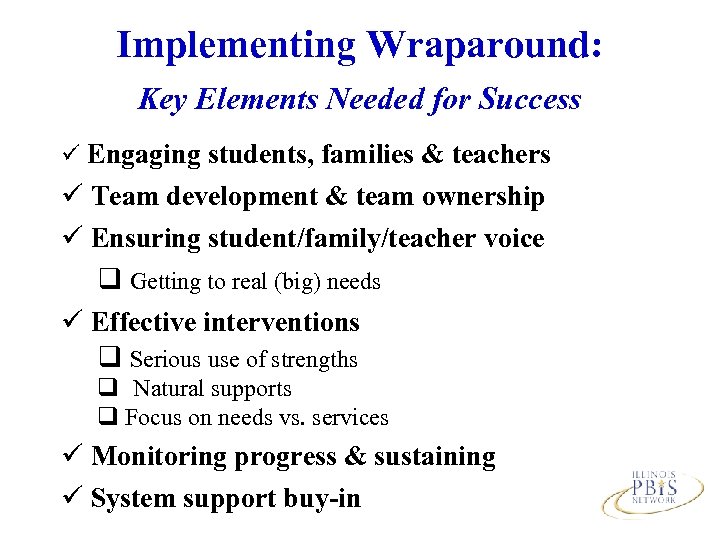
Implementing Wraparound: Key Elements Needed for Success ü Engaging students, families & teachers ü Team development & team ownership ü Ensuring student/family/teacher voice q Getting to real (big) needs ü Effective interventions q Serious use of strengths q Natural supports q Focus on needs vs. services ü Monitoring progress & sustaining ü System support buy-in
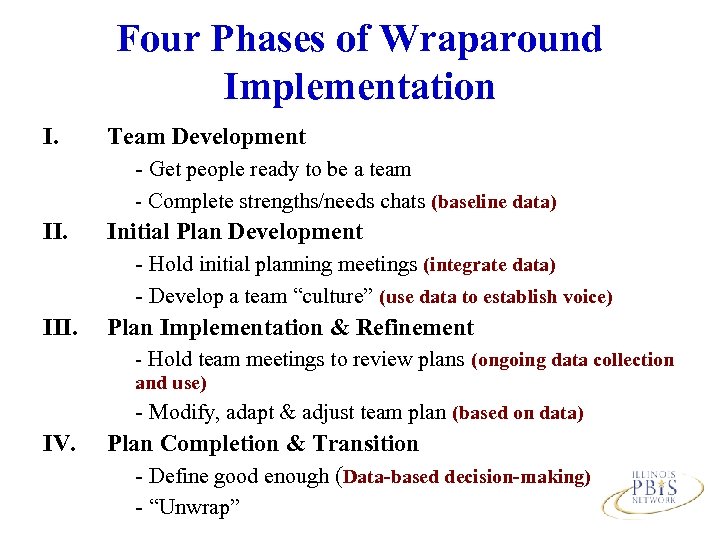
Four Phases of Wraparound Implementation I. Team Development - Get people ready to be a team - Complete strengths/needs chats (baseline data) II. Initial Plan Development - Hold initial planning meetings (integrate data) - Develop a team “culture” (use data to establish voice) Plan Implementation & Refinement - Hold team meetings to review plans (ongoing data collection and use) IV. - Modify, adapt & adjust team plan (based on data) Plan Completion & Transition - Define good enough (Data-based decision-making) - “Unwrap”
Wraparound Phase III • Develop strategies to meet “big needs” using strengths • After implementing strategies to improve quality of life (strength-based strategies addressing big needs), • The team will probably need to zero in on specific behaviors that need function based interventions
Phase III of Wraparound: Plan Implementation & Refinement • Facilitator – Sponsors & holds regular team meetings – Facilitates team feedback on accomplishments – Leads team members in progress-monitoring • Plan implementation • Plan effectiveness – Creates an opportunity for modification • Maintain, modify or transition interventions – Documents & distributes team meeting minutes
Early Success with Wraparound: Using Data to Keep the Team Moving “Andy”
“Andy” • • • 6 th grade student Behavior difficulties and academic failure GPA 1. 25 (2 nd quarter) 6 ODRs (1 st two quarters) 15 Out-of-School Suspensions (safety) Family support needs –history of mobility with plan to move at the end current school year. Student moved nine times since first grade
“Andy” The team developed a mission statement: “Andy will be happy and confident in school”
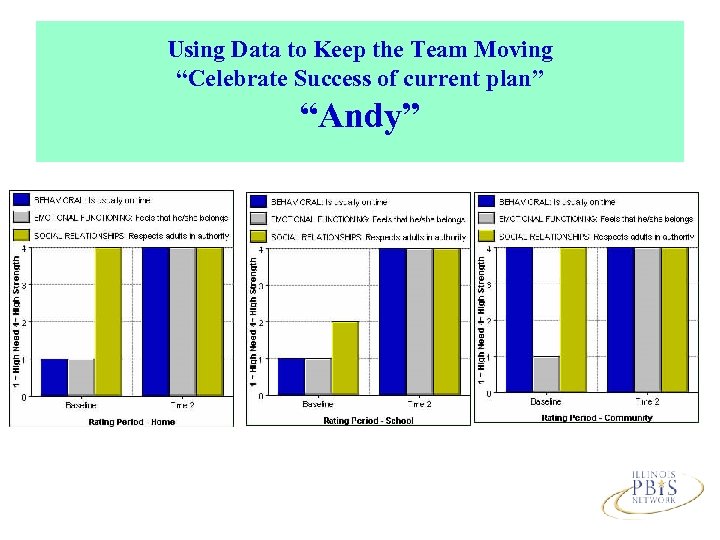
Using Data to Keep the Team Moving “Celebrate Success of current plan” “Andy”
“Andy” • Andy was happy at school and his mother was pleased with the help that the wrap team provided. Teachers were pleased with the change in Andy. • Data is used to then identify “next steps”.
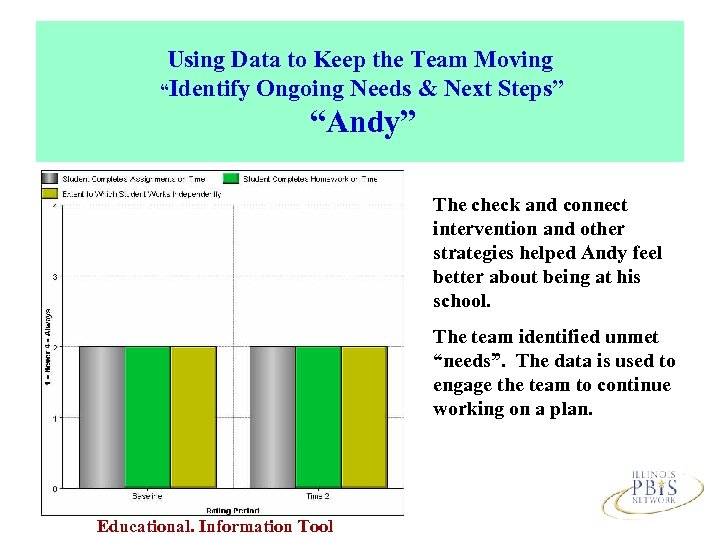
Using Data to Keep the Team Moving “Identify Ongoing Needs & Next Steps” “Andy” The check and connect intervention and other strategies helped Andy feel better about being at his school. The team identified unmet “needs”. The data is used to engage the team to continue working on a plan. Educational. Information Tool
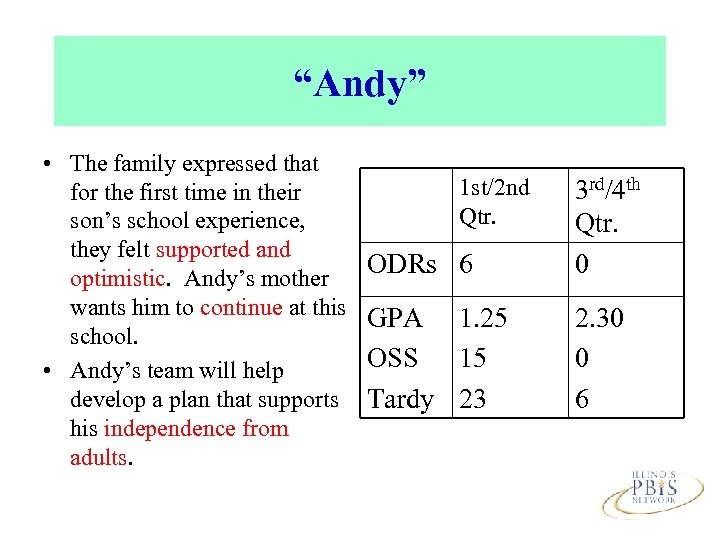
“Andy” • The family expressed that for the first time in their son’s school experience, they felt supported and optimistic. Andy’s mother wants him to continue at this school. • Andy’s team will help develop a plan that supports his independence from adults. 1 st/2 nd Qtr. ODRs 6 3 rd/4 th Qtr. 0 GPA 1. 25 OSS 15 Tardy 23 2. 30 0 6
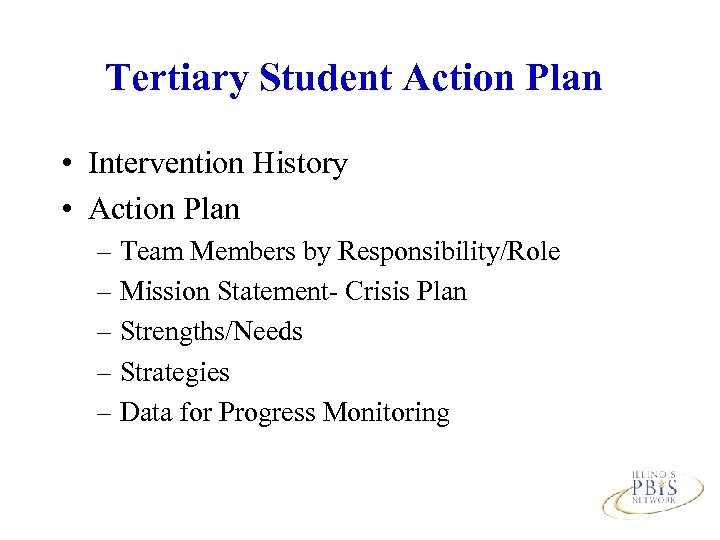
Tertiary Student Action Plan • Intervention History • Action Plan – Team Members by Responsibility/Role – Mission Statement- Crisis Plan – Strengths/Needs – Strategies – Data for Progress Monitoring
Student Intervention History Quick Practice For a student in need of a wraparound plan, complete page 1 of the “Tertiary Student Action Plan & Progress Update”
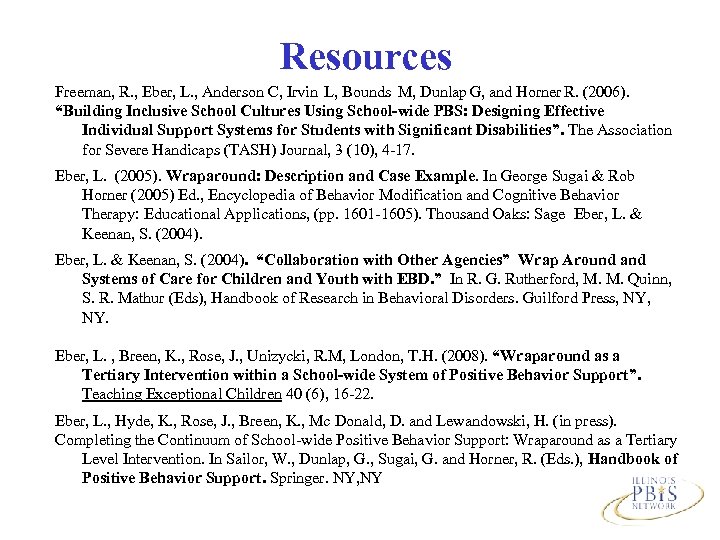
Resources Freeman, R. , Eber, L. , Anderson C, Irvin L, Bounds M, Dunlap G, and Horner R. (2006). “Building Inclusive School Cultures Using School-wide PBS: Designing Effective Individual Support Systems for Students with Significant Disabilities”. The Association for Severe Handicaps (TASH) Journal, 3 (10), 4 -17. Eber, L. (2005). Wraparound: Description and Case Example. In George Sugai & Rob Horner (2005) Ed. , Encyclopedia of Behavior Modification and Cognitive Behavior Therapy: Educational Applications, (pp. 1601 -1605). Thousand Oaks: Sage Eber, L. & Keenan, S. (2004). “Collaboration with Other Agencies” Wrap Around and Systems of Care for Children and Youth with EBD. ” In R. G. Rutherford, M. M. Quinn, S. R. Mathur (Eds), Handbook of Research in Behavioral Disorders. Guilford Press, NY, NY. Eber, L. , Breen, K. , Rose, J. , Unizycki, R. M, London, T. H. (2008). “Wraparound as a Tertiary Intervention within a School-wide System of Positive Behavior Support”. Teaching Exceptional Children 40 (6), 16 -22. Eber, L. , Hyde, K. , Rose, J. , Breen, K. , Mc Donald, D. and Lewandowski, H. (in press). Completing the Continuum of School-wide Positive Behavior Support: Wraparound as a Tertiary Level Intervention. In Sailor, W. , Dunlap, G. , Sugai, G. and Horner, R. (Eds. ), Handbook of Positive Behavior Support. Springer. NY, NY
Скачать презентацию Building Capacity at the Tertiary Tier of SW-PBS
b781958617cfc06d45292b4bbb6138e0.ppt