 Скачать презентацию Building a SEM Organization as a Data Driven
d4338506a3a497c6b5222d5f6af7c918.ppt
- Количество слайдов: 152



Building a SEM Organization as a Data Driven Consultant Jay W. Goff, Vice Provost and Dean for Enrollment Management Missouri University of Science & Technology ACAP Annual Conference, Memphis, TN March 16, 2009
OVERVIEW • SEM Primer & Positioning: the In-House Consultant (IHC) Performance Paradigm • Environmental Scan • SEM Strategies • Implementing the IHC SEM Platform with the Entire Campus • Preparing to be an IHC SEM professional • Creating the SEM Plan with the IHC positioning perspective
Learn More about SEM & Effective Retention Strategies • Retention 2009: An International Conference on Student Retention May 27 -29, 2009, New Orleans, LA www. educationalpolicy. org • SEM: AACRAO’s 19 th annual Strategic Enrollment Management Conference November 9 -11, 2009, Dallas, TX www. aacrao. org/sem 19
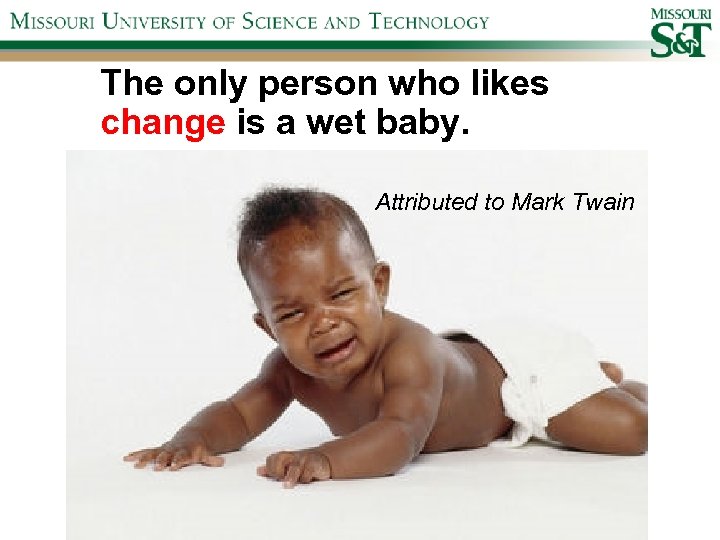
The only person who likes change is a wet baby. Attributed to Mark Twain
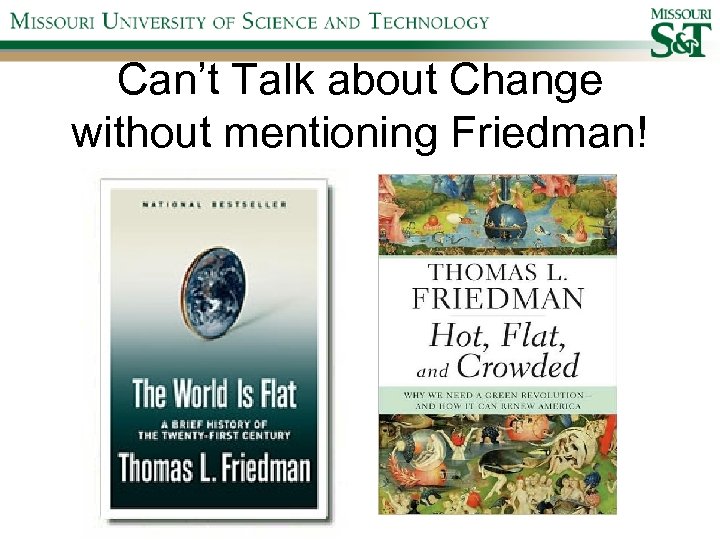
Can’t Talk about Change without mentioning Friedman!
What is SEM? • Strategic Enrollment Management (SEM) is defined as “a comprehensive process designed to help an institution achieve and maintain the optimum recruitment, retention, and graduation rates of students where ‘optimum’ is designed within the academic context of the institution. As such, SEM is an institution-wide process that embraces virtually every aspect of an institution’s function and culture. ” Michael Dolence, AACRAO SEM 2001 • Research • Recruitment • Retention
The External Environment in which Colleges and Universities Operate is Changing Quickly • Dramatic changes in student markets. • Public expectations for a wide variety of high quality student services. • Greater needs for an institution-wide understanding of how to best react to the emerging student trends, needs and markets.
Today’s Enrollment Manager • “Successful senior enrollment managers have to operate simultaneously on multiple levels. They need to be up to date, even on the cutting edge of technology, marketing, recruitment, the latest campus practices to enhance student persistence, and financial aid practices. ” SOURCE: THE ENROLLMENT MANAGEMENT REVIEW Volume 23, Issue 1 Fall, 2007, Editor: Don Hossler Associate Editors: Larry Hoezee and Dan Rogalski
Hossler continued • “(Enrollment Managers) need to be able to guide and use research to inform institutional practices and strategies. Successful enrollment managers need to be good leaders, managers, and strategic thinkers. • They have to have a thorough understanding of the institutions where they work and a realistic assessment of the competitive position in which it resides and the niche within which it can realistically aspire to compete. Furthermore, to be effective, enrollment managers must also have a sense of how public, societal, and competitive forces are likely to move enrollmentrelated policies and practices in the future. ” SOURCE: THE ENROLLMENT MANAGEMENT REVIEW Volume 23, Issue 1 Fall, 2007, Editor: Don Hossler Associate Editors: Larry Hoezee and Dan Rogalski
Embracing Consulting Expectations Similarities between external consultants and current expectations of SEM professionals is only one step in embracing the IHC approach. • Both Structure and Orientation are important • Philosophical orientation (e. g. , administrative, student focused, academic, or market-centered) can impact how the SEM units operate • Due to the manner in which universities actually work, neither structure nor orientation fully optimizes the SEM units’ impact on the overall function of the university if the POSITIONING of SEM processes and its leaders are not commonly appreciated and valued.
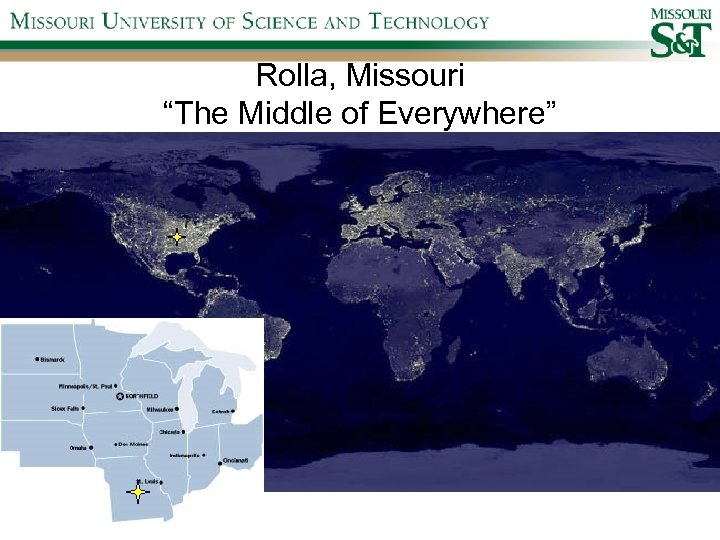
Rolla, Missouri “The Middle of Everywhere”
What is Missouri S&T? • • A Top 50 Technological Research University 6100 students: 4700 Undergrad, 1400 Graduate 90% majoring in Engineering, Science, Comp. Sci. Ave. Student ACT/SAT: upper 10% in nation +60% of Freshmen from upper 20% of HS class 20% Out of State Enrollment 96% 5 Year Average Placement Rate within 3 months of Grad • Ave. Starting Salary in 2007: +$53, 000
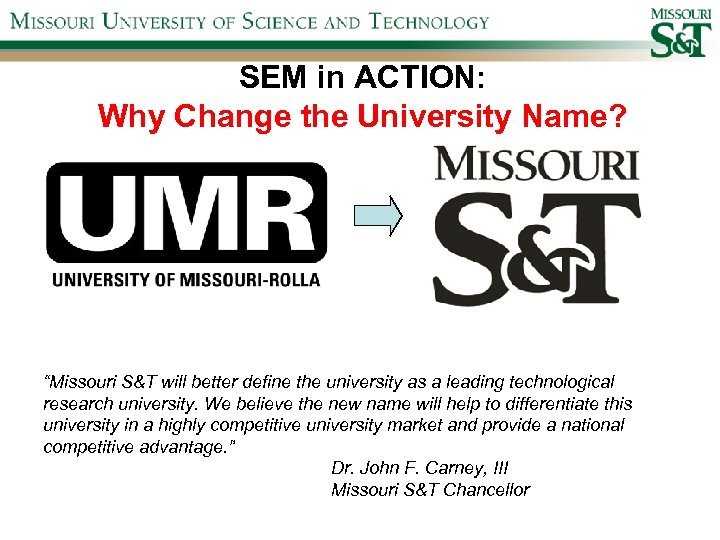
SEM in ACTION: Why Change the University Name? “Missouri S&T will better define the university as a leading technological research university. We believe the new name will help to differentiate this university in a highly competitive university market and provide a national competitive advantage. ” Dr. John F. Carney, III Missouri S&T Chancellor
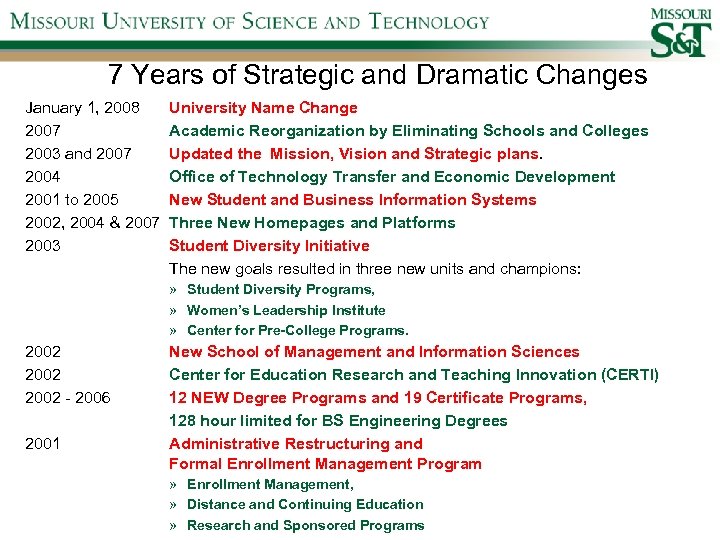
7 Years of Strategic and Dramatic Changes January 1, 2008 University Name Change 2007 Academic Reorganization by Eliminating Schools and Colleges 2003 and 2007 Updated the Mission, Vision and Strategic plans. 2004 Office of Technology Transfer and Economic Development 2001 to 2005 New Student and Business Information Systems 2002, 2004 & 2007 Three New Homepages and Platforms 2003 Student Diversity Initiative The new goals resulted in three new units and champions: » Student Diversity Programs, » Women’s Leadership Institute » Center for Pre-College Programs. 2002 - 2006 2001 New School of Management and Information Sciences Center for Education Research and Teaching Innovation (CERTI) 12 NEW Degree Programs and 19 Certificate Programs, 128 hour limited for BS Engineering Degrees Administrative Restructuring and Formal Enrollment Management Program » Enrollment Management, » Distance and Continuing Education » Research and Sponsored Programs
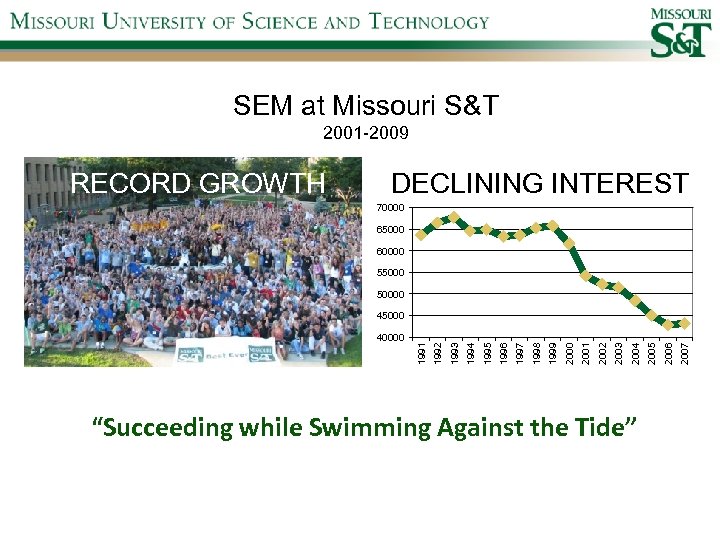
SEM at Missouri S&T 2001 -2009 RECORD GROWTH DECLINING INTEREST 70000 65000 60000 550000 “Succeeding while Swimming Against the Tide” 2007 2006 2005 2004 2003 2002 2001 2000 1999 1998 1997 1996 1995 1994 1993 1992 40000 1991 45000
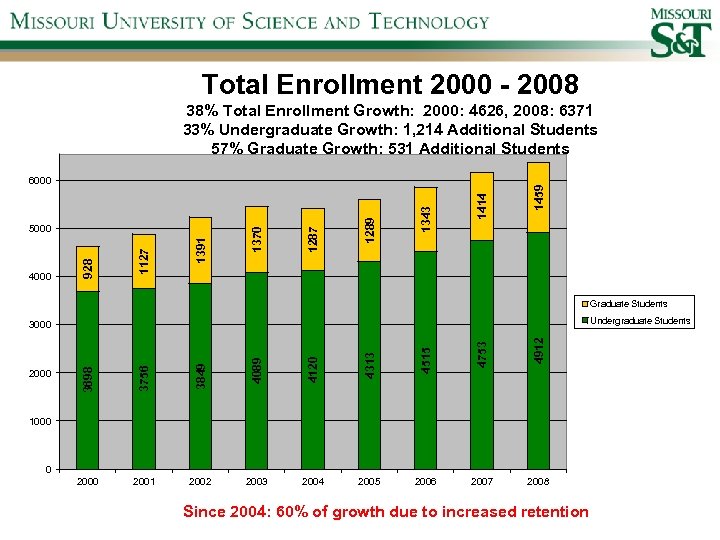
Total Enrollment 2000 - 2008 1414 1343 1289 1287 1391 1127 4000 928 5000 1370 6000 1459 38% Total Enrollment Growth: 2000: 4626, 2008: 6371 33% Undergraduate Growth: 1, 214 Additional Students 57% Graduate Growth: 531 Additional Students Graduate Students Undergraduate Students 2004 2005 2006 4912 2003 4753 4515 2002 4313 2001 4120 3849 2000 4089 3756 2000 3698 3000 2007 2008 1000 0 Since 2004: 60% of growth due to increased retention
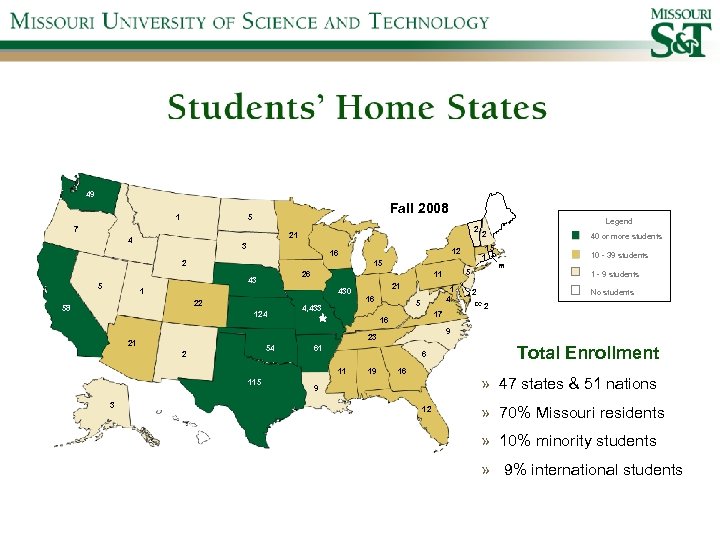
49 1 Fall 2008 5 7 2 21 4 3 15 26 43 5 1 430 22 58 124 1 4 5 4, 433 17 16 54 2 61 6 11 115 19 10 - 39 students 1 - 9 students 2 No students DC 2 9 23 21 3 16 40 or more students RI 5 11 21 2 15 1 12 16 2 Legend 16 Total Enrollment » 47 states & 51 nations 9 12 » 70% Missouri residents » 10% minority students » 9% international students
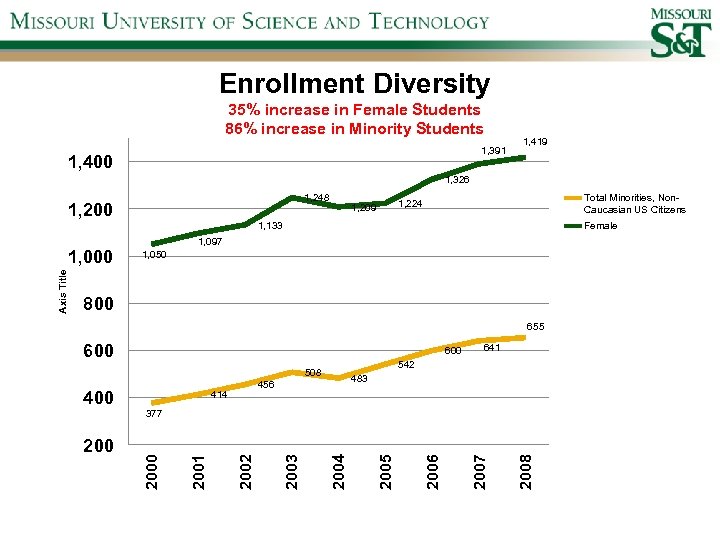
Enrollment Diversity 35% increase in Female Students 86% increase in Minority Students 1, 391 1, 400 1, 419 1, 326 1, 248 1, 200 1, 133 Female 1, 097 1, 050 800 655 600 2008 2007 2006 2005 2004 2003 377 2002 200 483 456 414 2001 400 641 542 508 2000 Axis Title 1, 000 Total Minorities, Non. Caucasian US Citizens 1, 224 1, 209
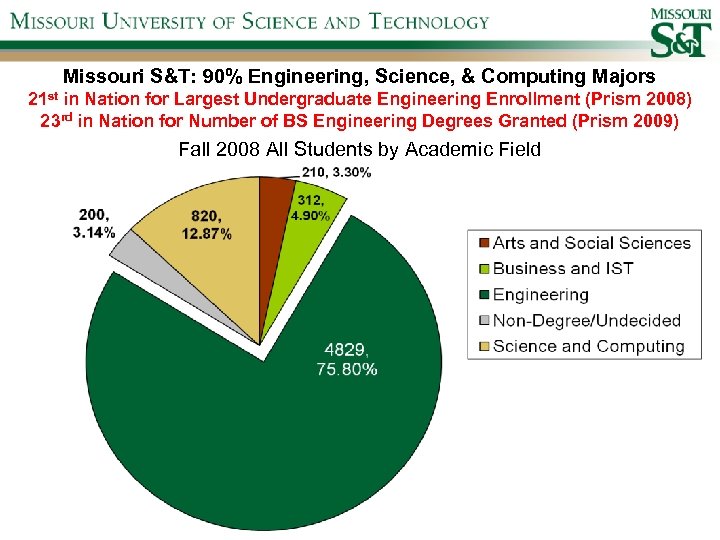
Missouri S&T: 90% Engineering, Science, & Computing Majors 21 st in Nation for Largest Undergraduate Engineering Enrollment (Prism 2008) 23 rd in Nation for Number of BS Engineering Degrees Granted (Prism 2009) Fall 2008 All Students by Academic Field
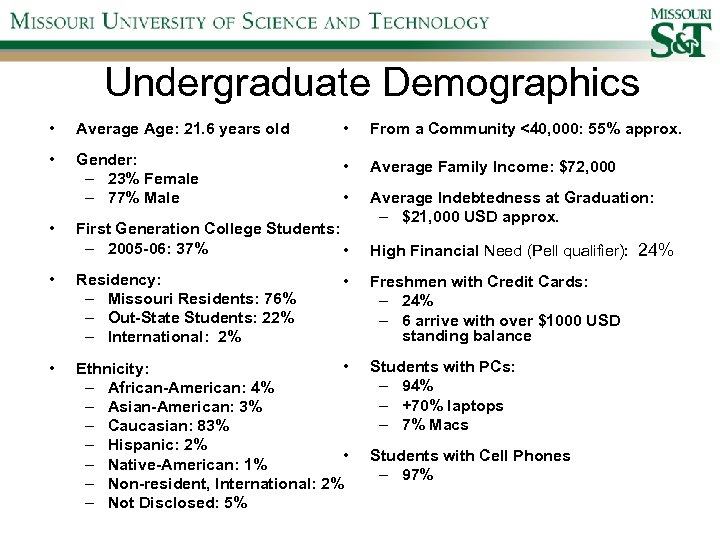
Undergraduate Demographics • Average Age: 21. 6 years old • From a Community <40, 000: 55% approx. • Gender: – 23% Female – 77% Male • Average Family Income: $72, 000 • Average Indebtedness at Graduation: – $21, 000 USD approx. • First Generation College Students: – 2005 -06: 37% • • Residency: – Missouri Residents: 76% – Out-State Students: 22% – International: 2% • • Ethnicity: – African-American: 4% – Asian-American: 3% – Caucasian: 83% – Hispanic: 2% • – Native-American: 1% – Non-resident, International: 2% – Not Disclosed: 5% • High Financial Need (Pell qualifier): 24% Freshmen with Credit Cards: – 24% – 6 arrive with over $1000 USD standing balance Students with PCs: – 94% – +70% laptops – 7% Macs Students with Cell Phones – 97%
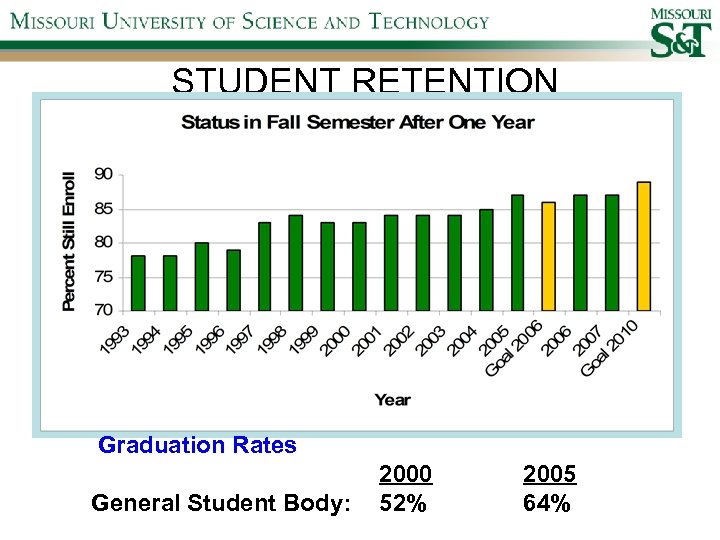
STUDENT RETENTION Graduation Rates General Student Body: 2000 52% 2005 64%
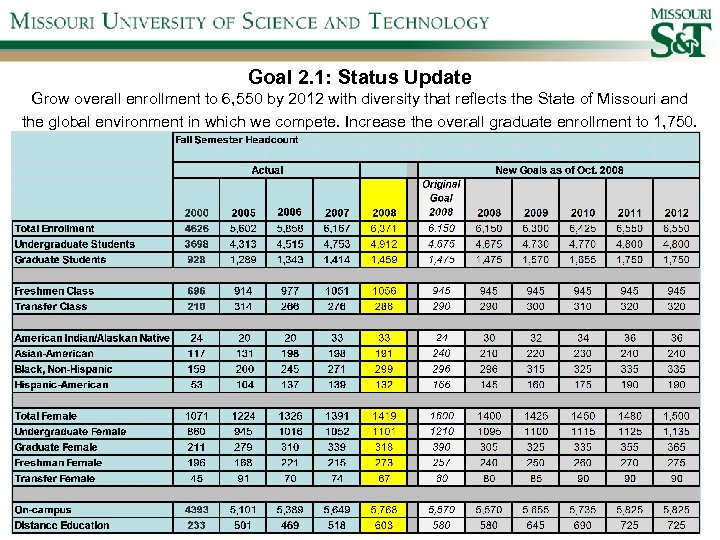
Goal 2. 1: Status Update Grow overall enrollment to 6, 550 by 2012 with diversity that reflects the State of Missouri and the global environment in which we compete. Increase the overall graduate enrollment to 1, 750.
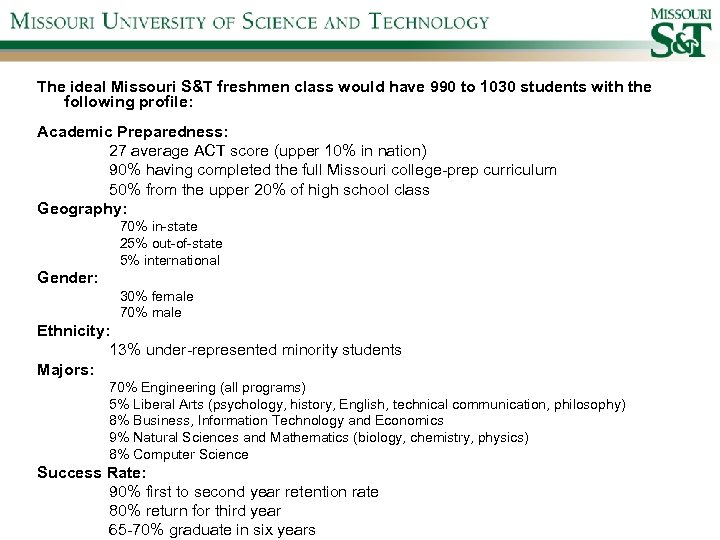
The ideal Missouri S&T freshmen class would have 990 to 1030 students with the following profile: Academic Preparedness: 27 average ACT score (upper 10% in nation) 90% having completed the full Missouri college-prep curriculum 50% from the upper 20% of high school class Geography: 70% in-state 25% out-of-state 5% international Gender: 30% female 70% male Ethnicity: 13% under-represented minority students Majors: 70% Engineering (all programs) 5% Liberal Arts (psychology, history, English, technical communication, philosophy) 8% Business, Information Technology and Economics 9% Natural Sciences and Mathematics (biology, chemistry, physics) 8% Computer Science Success Rate: 90% first to second year retention rate 80% return for third year 65 -70% graduate in six years
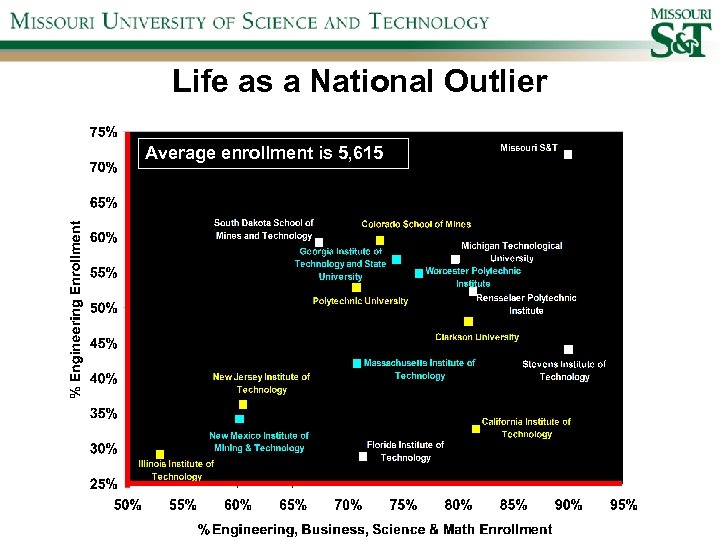
Life as a National Outlier Average enrollment is 6, 457 Average enrollment is 5, 615
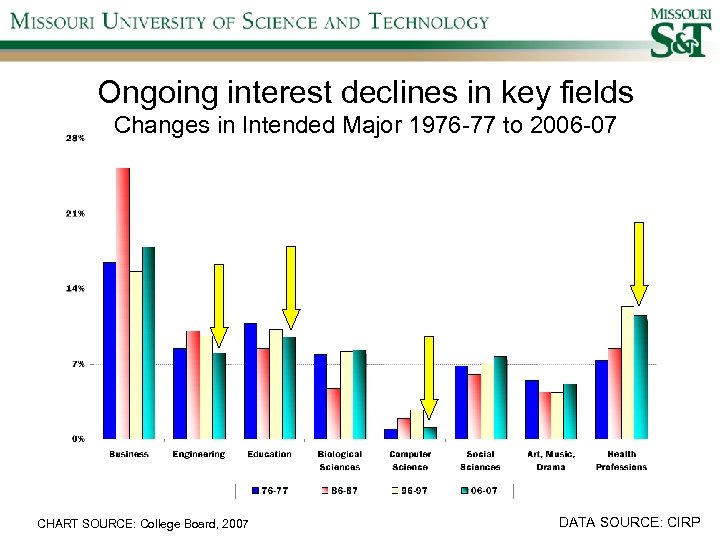
Ongoing interest declines in key fields Changes in Intended Major 1976 -77 to 2006 -07 CHART SOURCE: College Board, 2007 DATA SOURCE: CIRP
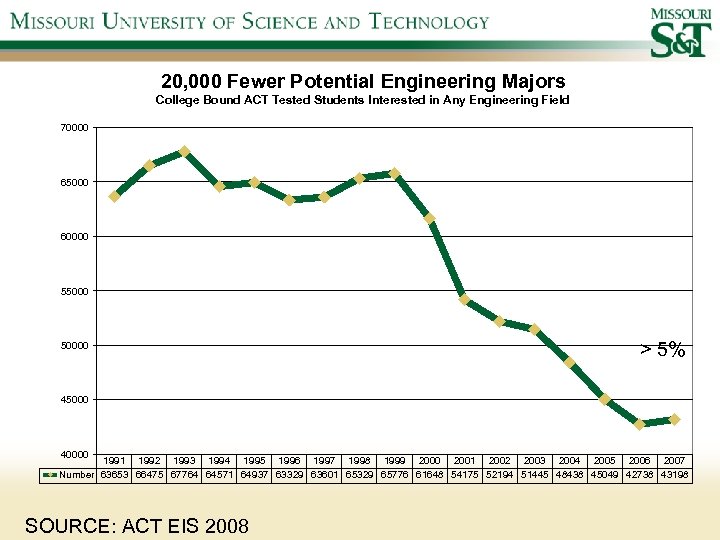
20, 000 Fewer Potential Engineering Majors College Bound ACT Tested Students Interested in Any Engineering Field 70000 65000 60000 550000 > 5% 45000 40000 1991 1992 1993 1994 1995 1996 1997 1998 1999 2000 2001 2002 2003 2004 2005 2006 2007 Number 63653 66475 67764 64571 64937 63329 63601 65329 65776 61648 54175 52194 51445 48438 45049 42738 43198 SOURCE: ACT EIS 2008
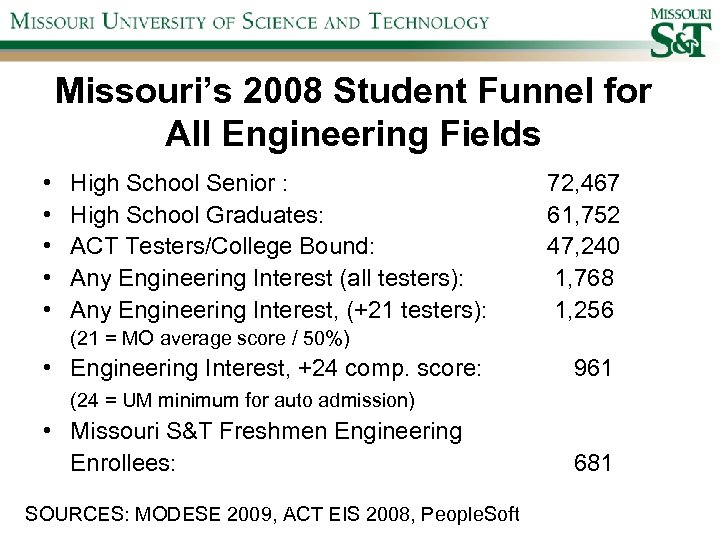
Missouri’s 2008 Student Funnel for All Engineering Fields • • • High School Senior : High School Graduates: ACT Testers/College Bound: Any Engineering Interest (all testers): Any Engineering Interest, (+21 testers): 72, 467 61, 752 47, 240 1, 768 1, 256 (21 = MO average score / 50%) • Engineering Interest, +24 comp. score: 961 (24 = UM minimum for auto admission) • Missouri S&T Freshmen Engineering Enrollees: SOURCES: MODESE 2009, ACT EIS 2008, People. Soft 681
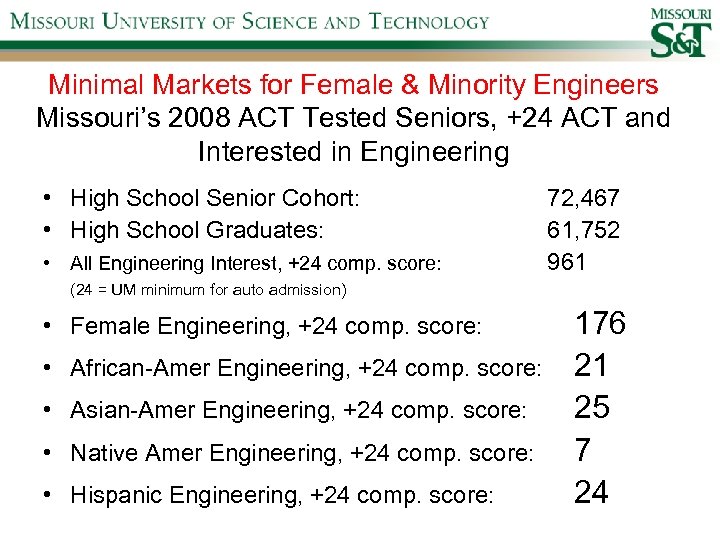
Minimal Markets for Female & Minority Engineers Missouri’s 2008 ACT Tested Seniors, +24 ACT and Interested in Engineering • High School Senior Cohort: • High School Graduates: • All Engineering Interest, +24 comp. score: 72, 467 61, 752 961 (24 = UM minimum for auto admission) 176 African-Amer Engineering, +24 comp. score: 21 Asian-Amer Engineering, +24 comp. score: 25 Native Amer Engineering, +24 comp. score: 7 Hispanic Engineering, +24 comp. score: 24 • Female Engineering, +24 comp. score: • •
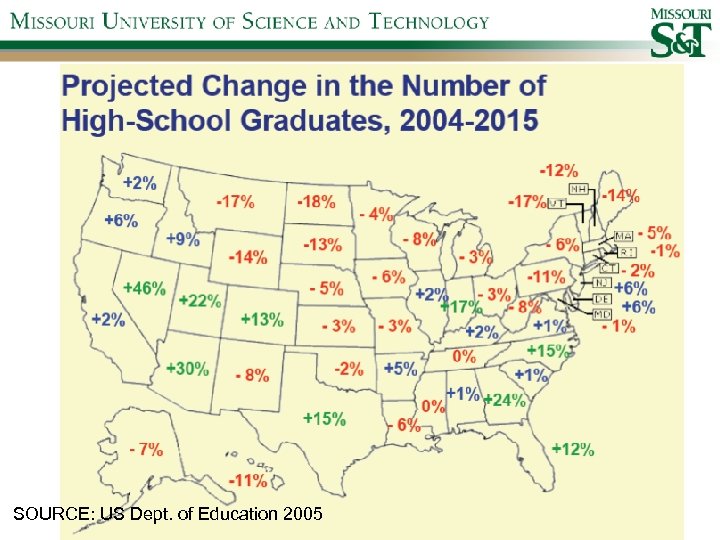
SOURCE: US Dept. of Education 2005
#1 Question: How did you do it?
Silver Bullet OR Strike of Lightening?
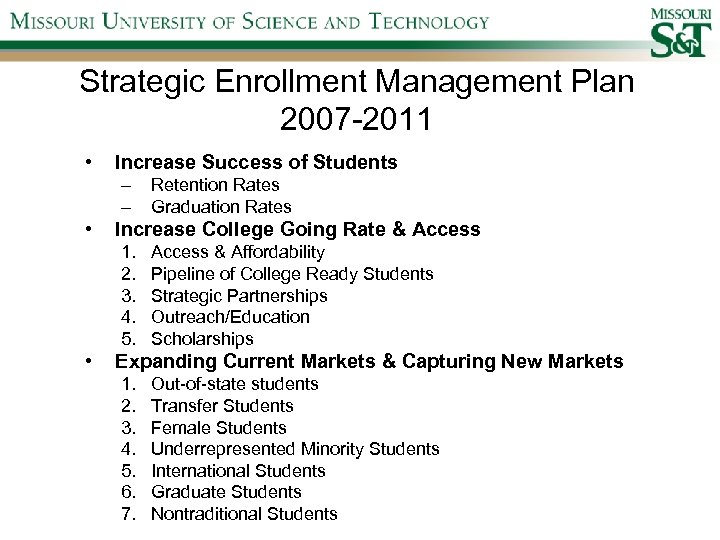
Strategic Enrollment Management Plan 2007 -2011 • Increase Success of Students – – • Increase College Going Rate & Access 1. 2. 3. 4. 5. • Retention Rates Graduation Rates Access & Affordability Pipeline of College Ready Students Strategic Partnerships Outreach/Education Scholarships Expanding Current Markets & Capturing New Markets 1. 2. 3. 4. 5. 6. 7. Out-of-state students Transfer Students Female Students Underrepresented Minority Students International Students Graduate Students Nontraditional Students
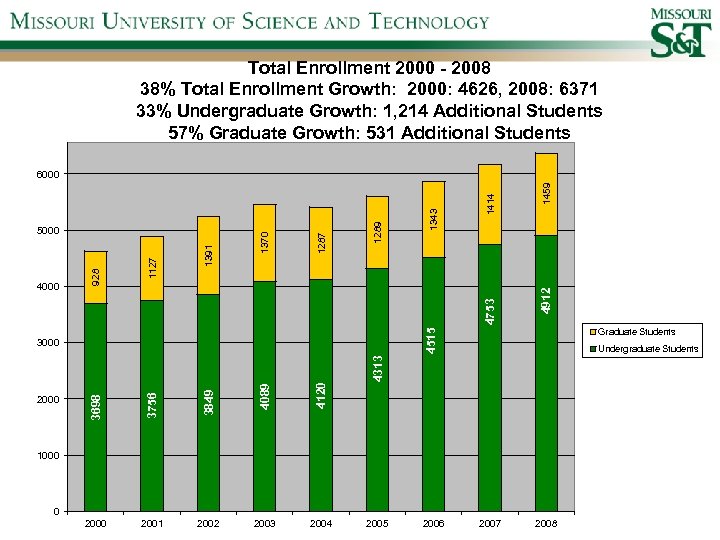
Total Enrollment 2000 - 2008 38% Total Enrollment Growth: 2000: 4626, 2008: 6371 33% Undergraduate Growth: 1, 214 Additional Students 57% Graduate Growth: 531 Additional Students 1459 Graduate Students 4515 3849 2001 2002 2003 2004 Undergraduate Students 4313 4120 3756 2000 4089 3698 3000 2000 4912 1414 1343 1289 1287 1391 1127 4753 4000 928 5000 1370 6000 1000 0 2005 2006 2007 2008
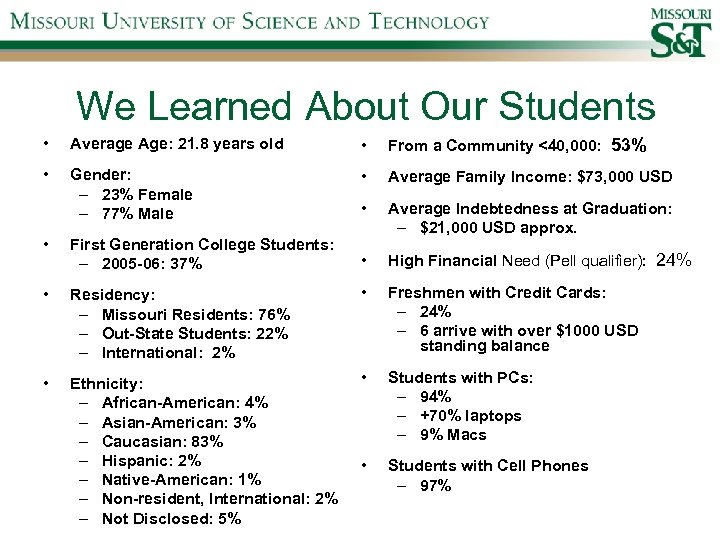
We Learned About Our Students • Average Age: 21. 8 years old • From a Community <40, 000: 53% • Gender: – 23% Female – 77% Male • Average Family Income: $73, 000 USD • Average Indebtedness at Graduation: – $21, 000 USD approx. • High Financial Need (Pell qualifier): 24% • First Generation College Students: – 2005 -06: 37% • Residency: – Missouri Residents: 76% – Out-State Students: 22% – International: 2% • Freshmen with Credit Cards: – 24% – 6 arrive with over $1000 USD standing balance • Ethnicity: – African-American: 4% – Asian-American: 3% – Caucasian: 83% – Hispanic: 2% – Native-American: 1% – Non-resident, International: 2% – Not Disclosed: 5% • Students with PCs: – 94% – +70% laptops – 9% Macs • Students with Cell Phones – 97%
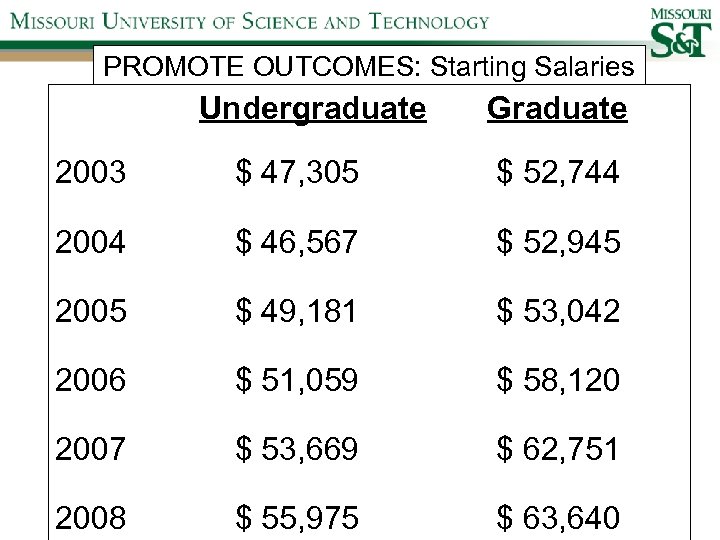
PROMOTE OUTCOMES: Starting Salaries Undergraduate Graduate 2003 $ 47, 305 $ 52, 744 2004 $ 46, 567 $ 52, 945 2005 $ 49, 181 $ 53, 042 2006 $ 51, 059 $ 58, 120 2007 $ 53, 669 $ 62, 751 2008 $ 55, 975 $ 63, 640
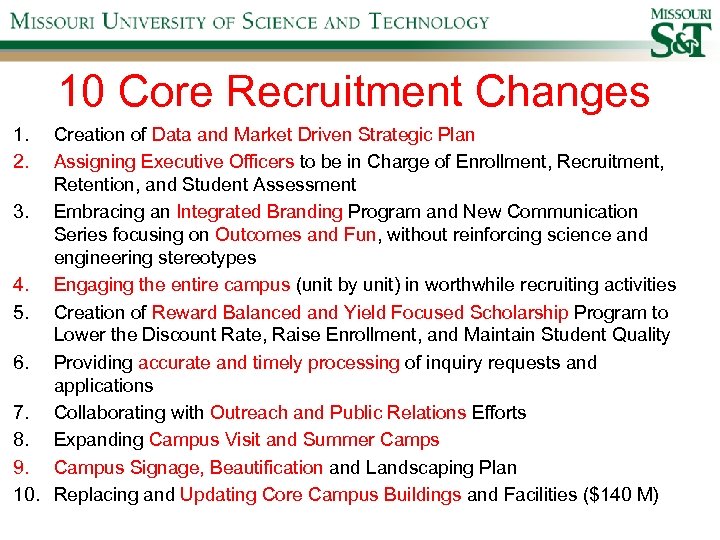
10 Core Recruitment Changes 1. 2. Creation of Data and Market Driven Strategic Plan Assigning Executive Officers to be in Charge of Enrollment, Recruitment, Retention, and Student Assessment 3. Embracing an Integrated Branding Program and New Communication Series focusing on Outcomes and Fun, without reinforcing science and engineering stereotypes 4. Engaging the entire campus (unit by unit) in worthwhile recruiting activities 5. Creation of Reward Balanced and Yield Focused Scholarship Program to Lower the Discount Rate, Raise Enrollment, and Maintain Student Quality 6. Providing accurate and timely processing of inquiry requests and applications 7. Collaborating with Outreach and Public Relations Efforts 8. Expanding Campus Visit and Summer Camps 9. Campus Signage, Beautification and Landscaping Plan 10. Replacing and Updating Core Campus Buildings and Facilities ($140 M)
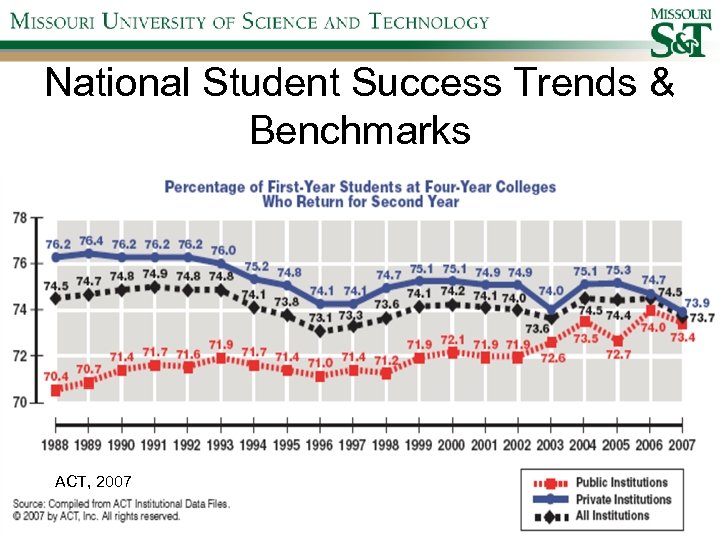
National Student Success Trends & Benchmarks ACT, 2007
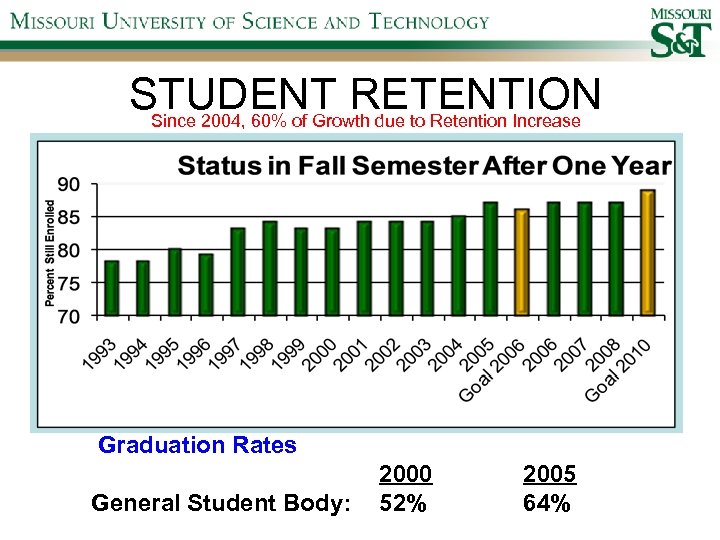
STUDENT RETENTION Since 2004, 60% of Growth due to Retention Increase Graduation Rates General Student Body: 2000 52% 2005 64%
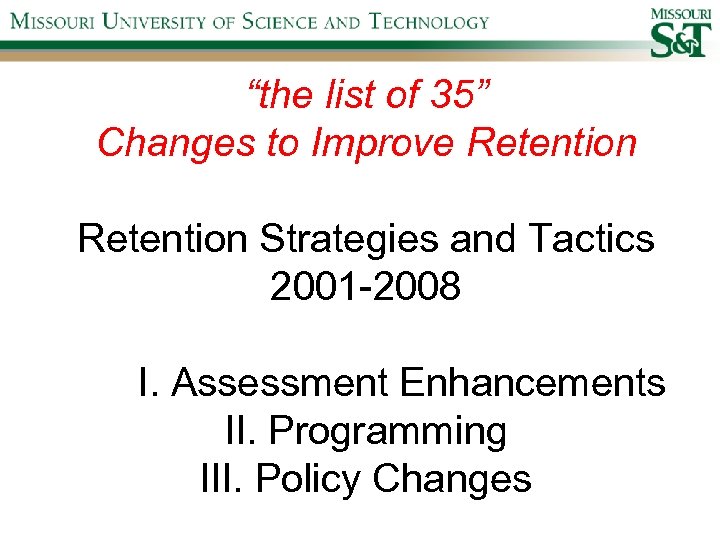
“the list of 35” Changes to Improve Retention Strategies and Tactics 2001 -2008 I. Assessment Enhancements II. Programming III. Policy Changes
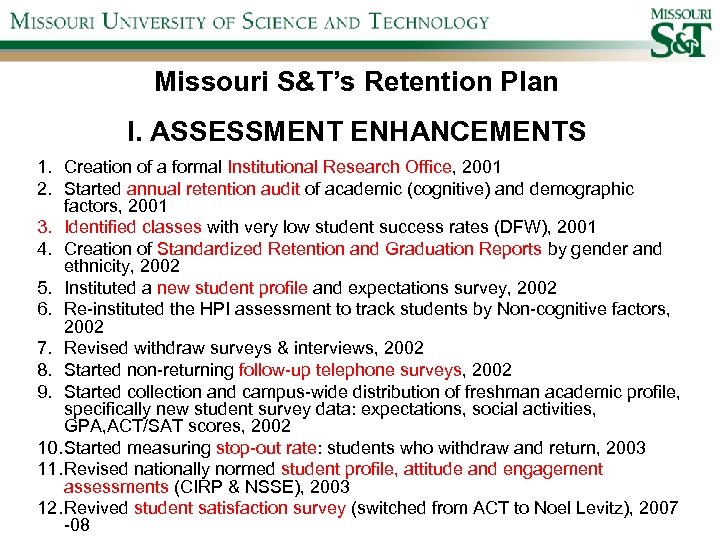
Missouri S&T’s Retention Plan I. ASSESSMENT ENHANCEMENTS 1. Creation of a formal Institutional Research Office, 2001 2. Started annual retention audit of academic (cognitive) and demographic factors, 2001 3. Identified classes with very low student success rates (DFW), 2001 4. Creation of Standardized Retention and Graduation Reports by gender and ethnicity, 2002 5. Instituted a new student profile and expectations survey, 2002 6. Re-instituted the HPI assessment to track students by Non-cognitive factors, 2002 7. Revised withdraw surveys & interviews, 2002 8. Started non-returning follow-up telephone surveys, 2002 9. Started collection and campus-wide distribution of freshman academic profile, specifically new student survey data: expectations, social activities, GPA, ACT/SAT scores, 2002 10. Started measuring stop-out rate: students who withdraw and return, 2003 11. Revised nationally normed student profile, attitude and engagement assessments (CIRP & NSSE), 2003 12. Revived student satisfaction survey (switched from ACT to Noel Levitz), 2007 -08
II. PROGRAMMING: Focus on Advising, tutoring, learning communities, faculty training and support 1. 2. 3. 4. 5. 6. 7. 8. 9. Provided a public expectation of student success (VERY IMPORTANT). Addressed expectations of student success in all recruitment and orientation speeches (Chancellor – look to your left, look to your right), 2001 -02 Learning Enhancement Across Disciplines (LEAD) tutoring program expanded beyond Physics, Fall 2002 Address group building (making friends) and study skills (not flunking out) in all orientation activities, 2002 -2003 Online tutor request program, 2003 Distribution of student profiles and survey summaries to create a better understanding of faculty and student expectations. Actively embrace the “social norming” concept. 2003 Restructured Opening Week activities around a group project activity and to address core learning objectives and student fears (Making Friends and Flunking Out) , 2002 & 2003 Provided ACT’s EIS & AIM student profile data bases to all academic departments for more intrusive advising, 2003 Joint Academic Management (JAM) Sessions (student to student tutoring) to assist low performing students, 2004
II. Programming Continued 11. 12. 13. 14. 15. 16. 17. 18. New on-line Early Warning System, 2005 Strategic Retention Intervention: Focus on a rapid response “Academic Alert System” (2005), on-line student communication system “Success Chain” (20052006), advisor engagement (training sessions and awards, 2002) and more quantitative knowledge of S&T student strengths (Sharing of student profiles and new student survey data prior to beginning of academic year, 2002) Creation and expansion of Learning Communities & First Year Experience Programs: Focus to address student academic skills development and social engagement through group student life oriented events, 2002 -2003 Pre-College Transition Programs: Focus to promote greater student preparation to meet student and S&T academic expectations through a 3 -week intense course – Hit the Ground Running (HGR) and creation of the Center for Pre-College Programs (CPCP) to expand the K-12 student workshops and STEM summer camps, 2003 -04 Creation of the Center for Educational Research and Teaching Innovation (CERTI): Focus to address improving the S&T learning environment and student learning outcomes through collaborative learning, experiential learning, technology enhanced learning and educational research practices, 2003 -04 Expanded Experiential Learning Programs: Focus to promote greater campuswide “learning by doing” student engagement through student design teams, undergraduate research (OURE expansion), and service learning participation, 2002 -ongoing Creation of formal first-year experience office and staff, 2008 Creation of formal second-year experience office and staff, 2008
III. POLICY CHANGES 1. 2. 3. 4. 5. 6. Incomplete grade time limit change, 2002 Repeat course GPA adjustment policy, 2002 Scholarship Reinstatement Policy, 2002 All BS degree programs reduced to between 124 to 128 hours, 2002 -2003 Added 3 degree programs most often requested by exiting students: Business, IST, Technical Communication, Architectural Engineering, 2002 -2003 Revised S&T Advising Program: Focus on faculty development for student formal and developmental advising, advisor recognition and advising program evaluation, 2002 -2004
BREAK - SESSION II • Implementing the IHC SEM Platform with the Entire Campus • Preparing to be an IHC SEM professional • Creating the SEM Plan with the IHC positioning perspective
What is SEM? • Strategic Enrollment Management (SEM) is defined as “a comprehensive process designed to help an institution achieve and maintain the optimum recruitment, retention, and graduation rates of students where ‘optimum’ is designed within the academic context of the institution. As such, SEM is an institution-wide process that embraces virtually every aspect of an institution’s function and culture. ” Michael Dolence, AACRAO SEM 2001 • Research • Recruitment • Retention
The IHC Orientation to SEM Institutions embracing SEM must start with: • Organizational Structure • Philosophical Orientation (Academic vs. Student Affairs) • IHC Positioning cannot happen until the first two are established.
Review: In-House Consulting SEM Model IHC approach provides: 1. a rhetorical strategy of providing help to all constituents 2. a values-based training philosophy, 3. an institutional expectation for collaboration 4. a push for a heightened sense of professionalism. 5. continuity – the consultant does not leave!
The IHC Orientation to SEM Institutions embracing SEM must start with: • Organizational Structure • Philosophical Orientation (Academic vs. Student Affairs) • IHC Positioning cannot happen until the first two are established.
IHC: the POWER of Metaphor SEM professionals could be more effective if the campus community views them in a “consultant” or helping role, rather than just “another administrator” running a support unit. Positioning SEM professional as an In-House Consultant signals: • campus leaders are serious about meeting the institution’s enrollment goals • A willingness to take steps necessary to support a SEMbased organization.
SEM Fundamentals Ø Strategic Planning Ø Context of Setting Enrollment Goals • Alignment with the College’s/University’s Vision, Mission, Values, and Goals • Factors of Enrollment Planning Ø Enhancing the Educational Experience for Students
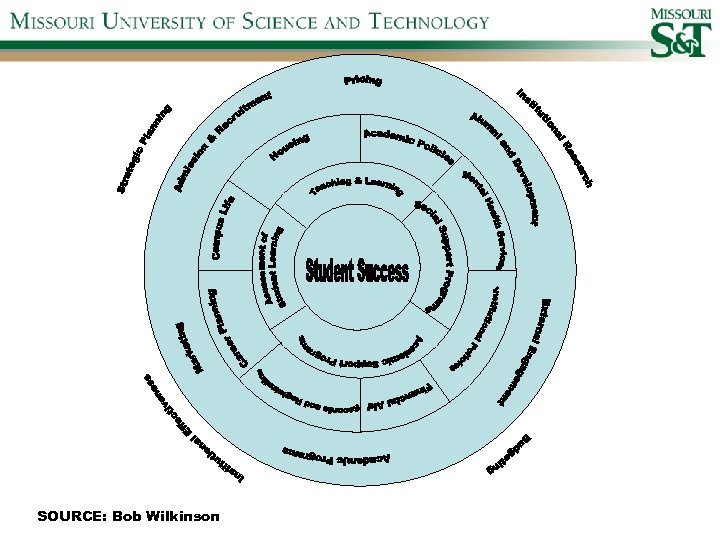
SOURCE: Bob Wilkinson
The Strategy of SEM • Stabilizing Enrollments • Reducing Vulnerabilities • Aligning EM with Academic Programs • Stabilize Finances • Optimize Resources • Evaluate Strategies and Tactics • Improve Services • Improve Quality • Improve Access to Information Adapted from Jim Black, 2003
How Research Is Used In Strategic Enrollment Management 1. To improve retention 2. To build relationships with high schools and community colleges 3. To target admissions efforts and predict enrollments 4. To recommend changes to admissions policy 5. To examine issues of how best to accommodate growth 6. To improve the educational experience of students 7. To identify needs of unique student groups 8. To project and plan for student enrollment behavior 9. To determine financial aid policies 10. To assess student outcomes
Easy Benchmarking • • Determine Competitors & Comparators www. collegeresults. com College Board: Institutional Comparison US News (United States) Mc. Cleans (Canada) Higher Ed Times (Great Britain) Shanghi Jiaotong (China)
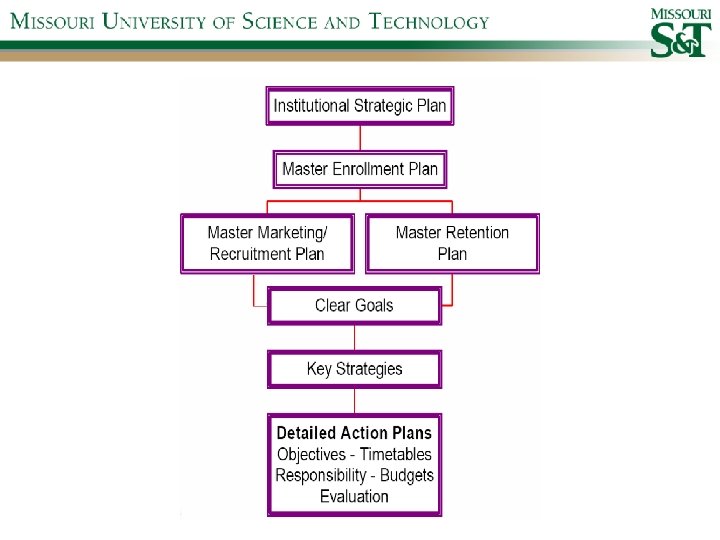
Key Components to SEM The following four steps are fundamental to the development of a comprehensive recruitment and retention Plan 1. Determine the institution’s capacity to serve students by degree program and types of students (traditional, nontraditional, graduate, etc. ) 2. Establish Goals: need to be agreed upon by all involved 3. Formulate Strategies based on data 4. Develop action plan with tactics and an operational calendar: – – – What exactly is going to be done When will it be completed Who is responsible How much will it cost How will you know if it has been accomplished (evaluation)
What is included in a SEM Plan? 1. 2. 3. 4. 5. 6. 7. 8. 9. 10. 11. 12. Strategic Framework: Mission, Values, Vision Overview of Strategic Plan Goals & Institutional Capacity Environmental Scan: Market Trends & Competition Analysis Evaluation and Assessment of Position in Market Enrollment Goals, Objectives, & Assessment Criteria Marketing and Communication Plan Recruitment Plan Retention Plan Student Aid and Scholarship Funding Staff Development and Training Student/Customer Service Philosophy Process Improvements and Technology System Enhancements 13. Internal Communication and Data Sharing Plan 14. Campus wide Coordination of Enrollment Activities
Traditional Core SEM Objectives • Establishing Clear Enrollment Goals and Determining Capacity to Serve • Promoting Student Success • Determining, Achieving and Maintaining Optimum Enrollment • Enabling the Delivery of Effective Academic Programs • Generating Tuition • Enabling Financial Planning • Increasing Organizational Efficiency • Improving Service Levels
Fundamental Question: “What is an effective approach to implementing SEM that is sustainable and likely to be embraced by the entire campus? ”
Complexity of SEM & the Belief that External Knowledge is Best • Core planning activities • Environmental scans • Assessment of strategic needs • Development of marketing plans • Execution of Plans and Training
There is a time and place for colleges and universities to seek outside help. FACT: Many schools need a SEM “road map” that only an external agent can help construct.
Familiar Scenario? • • a problem is identified a consultant hired a plan written, and… THE CONSULTANT LEAVES • The task of supporting the external consultant and carrying out the plan is often left to the very individuals who had the training and capacity to write the plan; but were disregarded because of their internal position.
The professional SEM consulting field has become highly valued • Over 200 consultants with focuses in 50 different categories • Over 130 firms were noted for their abilities to assist universities with implementing SEM – Change Management – Diversity – Distance Education Research – Strategic Planning - Marketing - Financial Aid - Student Market - Communications
Comparing Roles Consultant vs. SEM Leaders Consultants SEM Leaders 1. A track record of presenting workable solutions to clients 1. Solid foundations in job experience, education and a record of enrollment successes 2. Strong organizational and analytical 2. Ability to diagnose problems skills 3. Ability to lead teams and generate 3. Ability to collaborate with faculty and staff consensus 4. The ability to implement solutions 4. Provide a team-work philosophy (systems, training, budget distribution, etc. ) 5. High energy and passion for student success and higher education 5. Facilitate consensus and commitment to the plan of action 6. Strong communication, budgeting and 6. Strong interpersonal and public personnel development skills communication skills ADAPTED FROM: Barbara Kibbe & Fred Setterber (1992) Succeeding with Consultants, Packard Foundation
The fundamentals of SEM are aligned with Successful Consulting Practices, they focus on: • the use of research • cross-unit collaboration to drive student recruitment and retention activities • Use of analytics and tactical skills to engage the entire campus community in knowledge and activities that spur student success and optimize institutional resources.
IHC: a SEM performance concept The “in-house consultant” model (IHC) is a means to more clearly position the chief enrollment officer, and SEM units, as a campus wide support team focused on helping most offices achieve and sustain core institutional strategic initiatives. The IHC metaphor would address the mind- and skill-sets required by enrollment management professionals to help their institutions operate in a more efficient and proactive manner.
IHC Model in a Nutshell The In-House Consultant is expected to: • Stay abreast of current trends & market activities • Actively engage and inform the campus – BE PRESENT • Regularly “take the plan off the shelf” and…. . • Put the plan into action.
Shifting Student Populations “The demographic shifts we are beginning to experience are largely the result of welcome advances in technology and public health that have extended life expectancy, improved living standards, and reduced population growth. ” SOURCE: Jane Sneddon Little and Robert K. Triest. (2001) SEISMIC SHIFTS: THE ECONOMIC IMPACT OF DEMOGRAPHIC CHANGE.
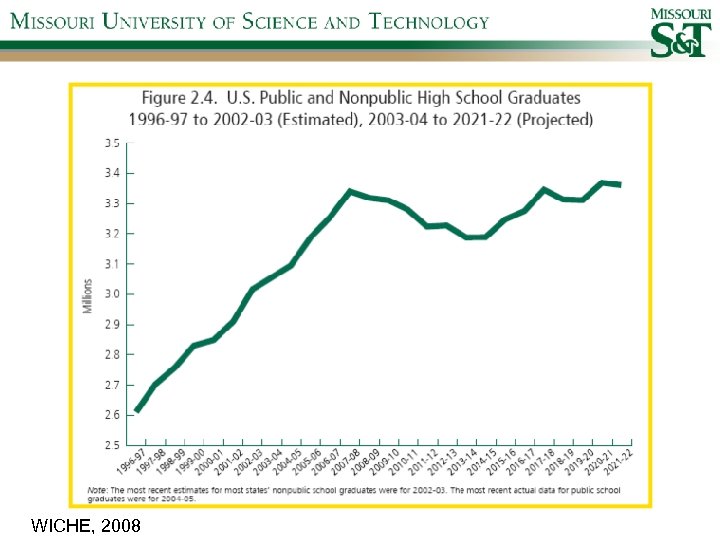
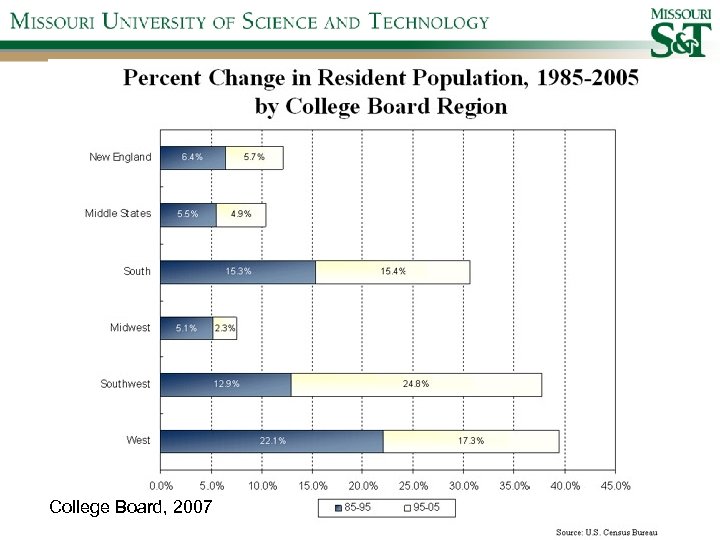
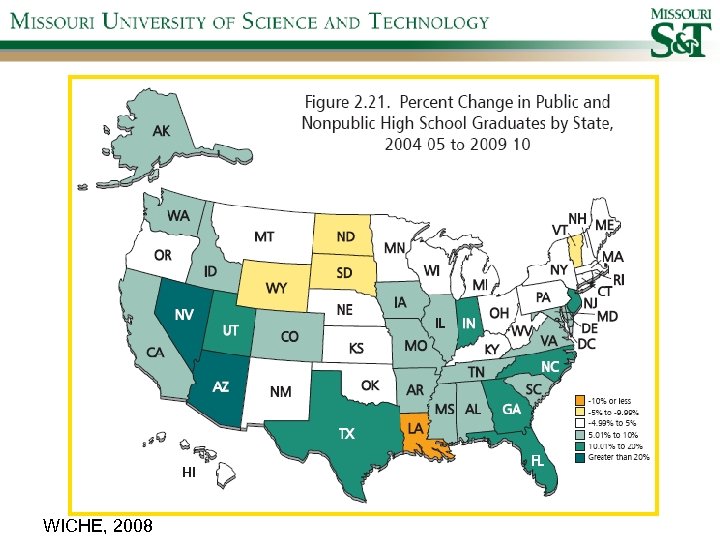
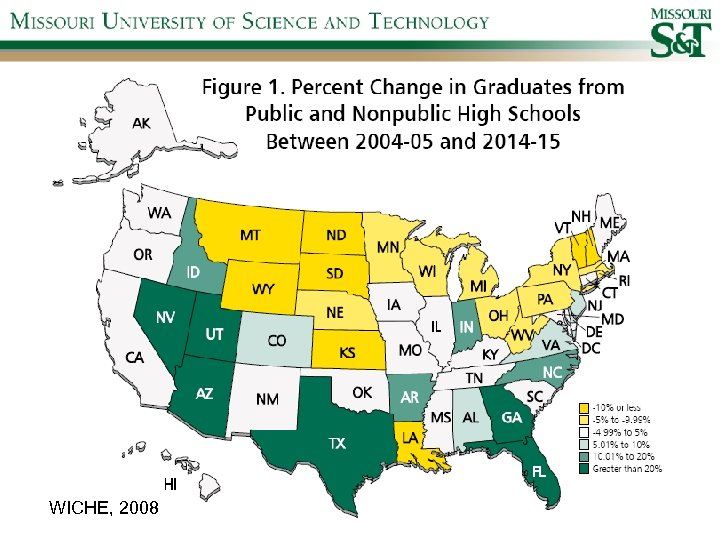
Future Students: Demographic and Population Changes • Fewer first-time, traditional students in the overall pipeline until between 2015 -2017— while older population is growing • More students of color • More students of lower socioeconomic status • More students unprepared college level work WICHE, 2003 & 2008

A National Environmental Scan
RESOURCES • • • • • www. act. org www. ama. com www. collegeboard. org www. collegeresults. org www. educationalpolicy. org (retention calculator) www. nces. gov (2007 Digest of Education Statistics) www. higheredinfo. org www. noellevitz. com www. stamats. com www. wiche. org www. educationtrust. org www. lumina. org www. greentreegazette. com www. pewinternet. org www. postsecondary. org www. communicationbriefings. com Recruitment and Retention in Higher Education
Factors Most Noted in Choosing a College • • • Majors & Career Programs Offered Location/Campus Characteristics Cost/Affordability Campus Size/Safety Characteristics of Enrolled Students • Selectivity
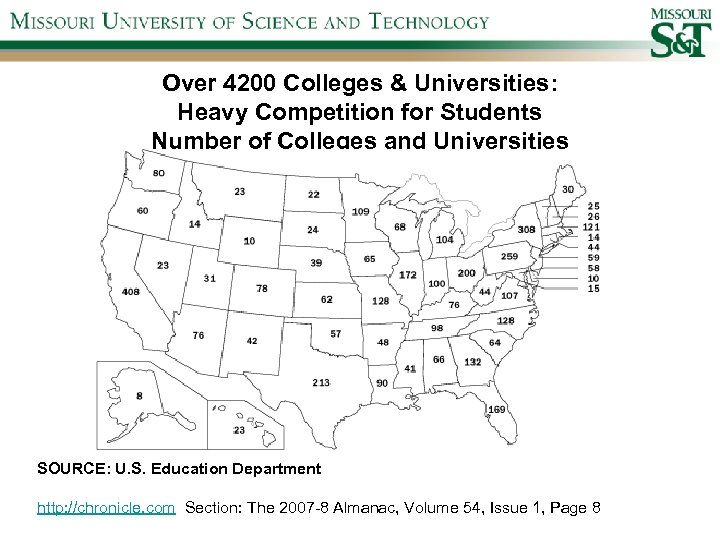
Over 4200 Colleges & Universities: Heavy Competition for Students Number of Colleges and Universities SOURCE: U. S. Education Department http: //chronicle. com Section: The 2007 -8 Almanac, Volume 54, Issue 1, Page 8
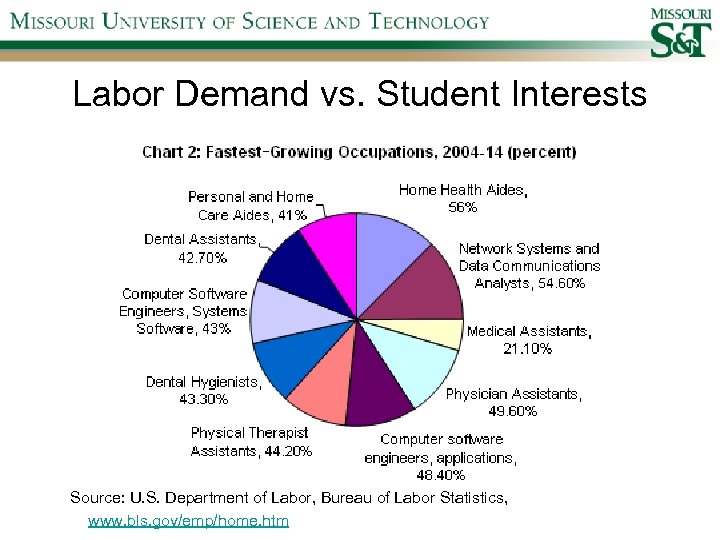
Labor Demand vs. Student Interests Source: U. S. Department of Labor, Bureau of Labor Statistics, www. bls. gov/emp/home. htm
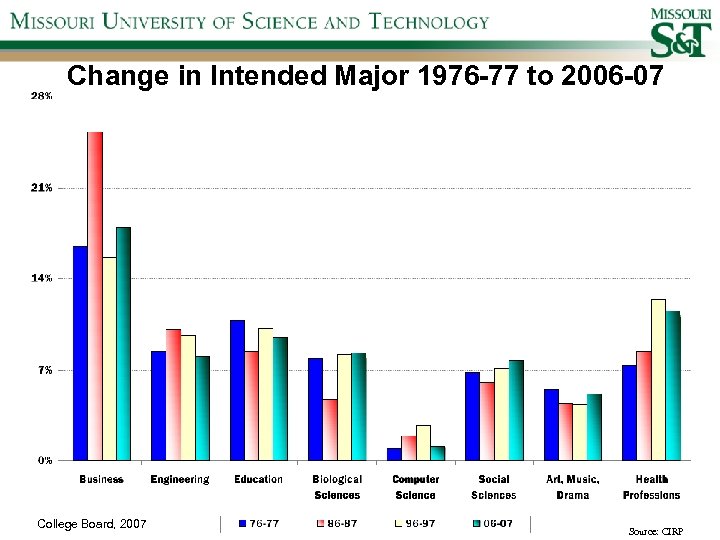
Change in Intended Major 1976 -77 to 2006 -07 College Board, 2007 Source: CIRP
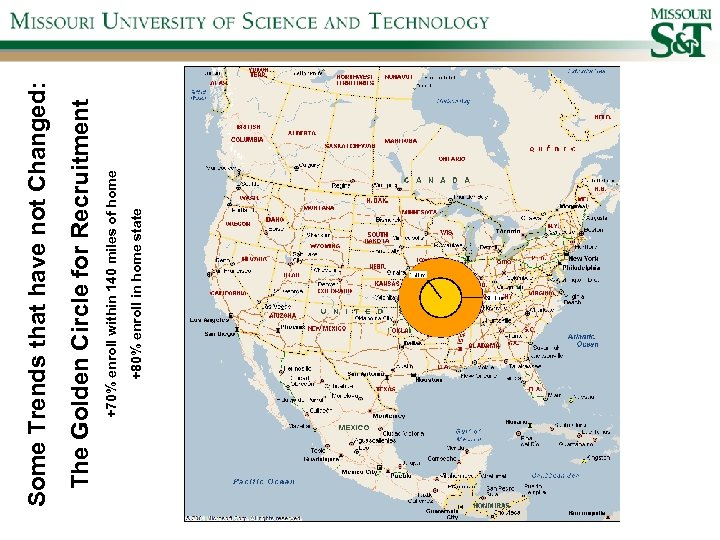
+80% enroll in home state +70% enroll within 140 miles of home The Golden Circle for Recruitment Some Trends that have not Changed:
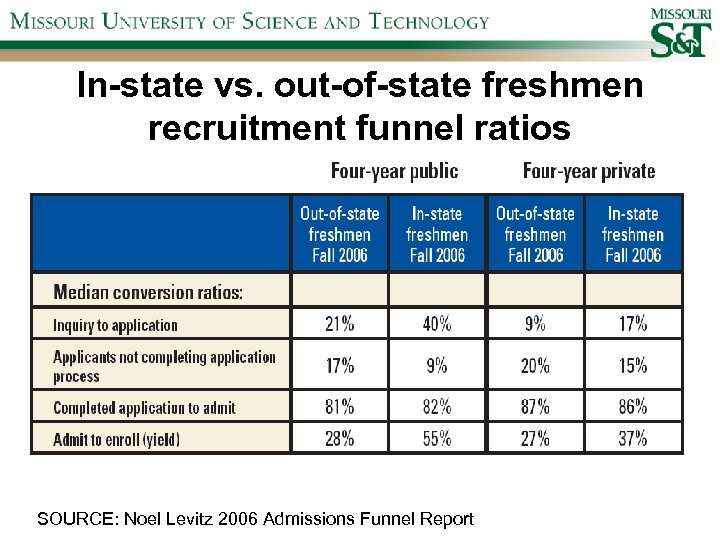
In-state vs. out-of-state freshmen recruitment funnel ratios SOURCE: Noel Levitz 2006 Admissions Funnel Report
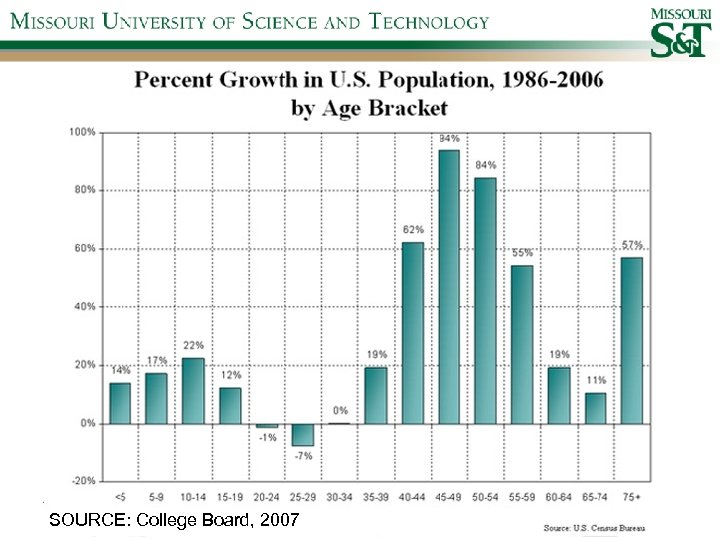
SOURCE: College Board, 2007
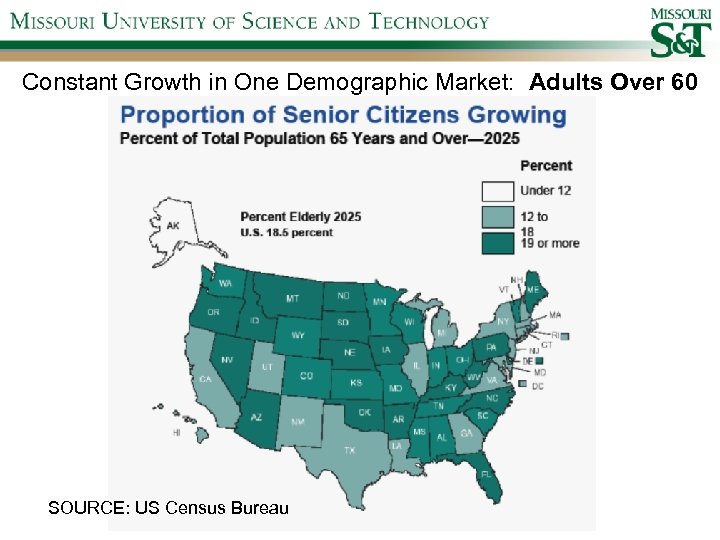
Constant Growth in One Demographic Market: Adults Over 60 SOURCE: US Census Bureau
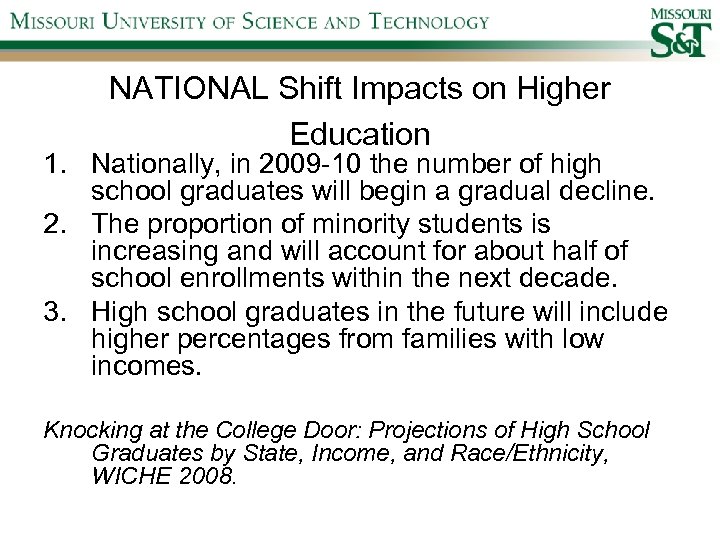
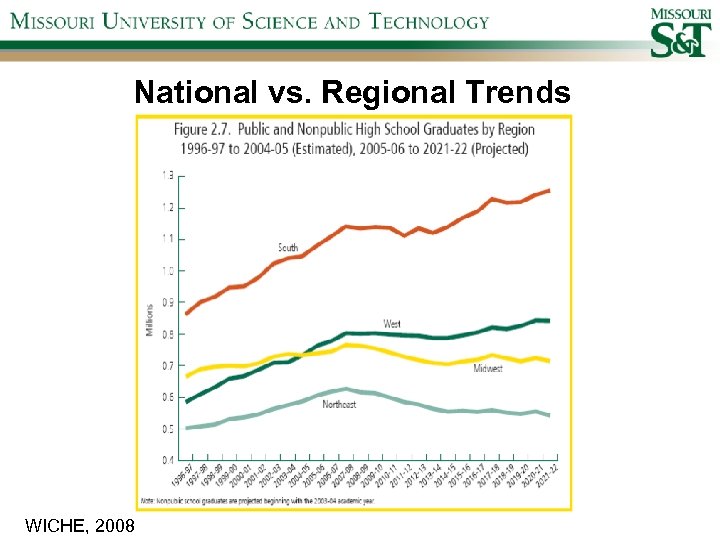
NATIONAL Shift Impacts on Higher Education 1. Nationally, in 2009 -10 the number of high school graduates will begin a gradual decline. 2. The proportion of minority students is increasing and will account for about half of school enrollments within the next decade. 3. High school graduates in the future will include higher percentages from families with low incomes. Knocking at the College Door: Projections of High School Graduates by State, Income, and Race/Ethnicity, WICHE 2008.
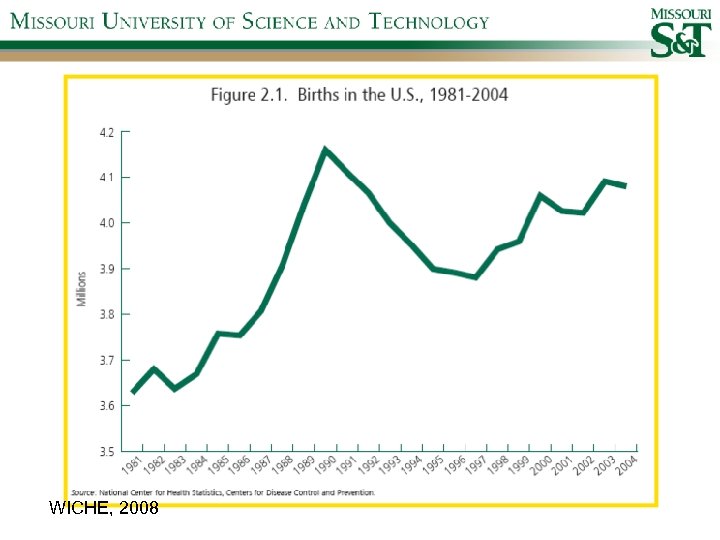
WICHE, 2008
WICHE, 2008
College Board, 2007
National vs. Regional Trends WICHE, 2008
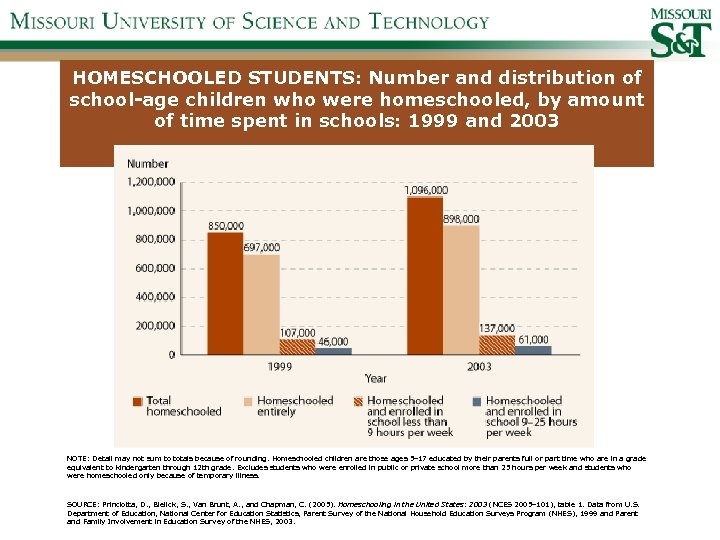
HOMESCHOOLED STUDENTS: Number and distribution of school-age children who were homeschooled, by amount of time spent in schools: 1999 and 2003 NOTE: Detail may not sum to totals because of rounding. Homeschooled children are those ages 5– 17 educated by their parents full or part time who are in a grade equivalent to kindergarten through 12 th grade. Excludes students who were enrolled in public or private school more than 25 hours per week and students who were homeschooled only because of temporary illness. SOURCE: Princiotta, D. , Bielick, S. , Van Brunt, A. , and Chapman, C. (2005). Homeschooling in the United States: 2003 (NCES 2005– 101), table 1. Data from U. S. Department of Education, National Center for Education Statistics, Parent Survey of the National Household Education Surveys Program (NHES), 1999 and Parent and Family Involvement in Education Survey of the NHES, 2003.
WICHE, 2008
WICHE, 2008
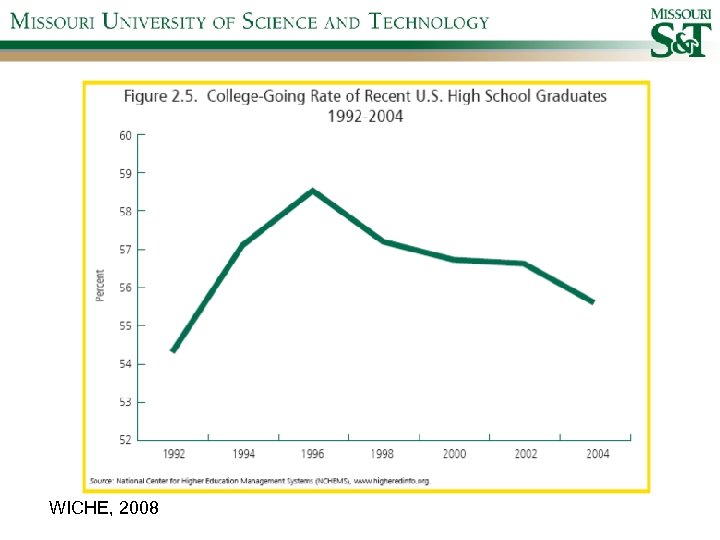
WICHE, 2008
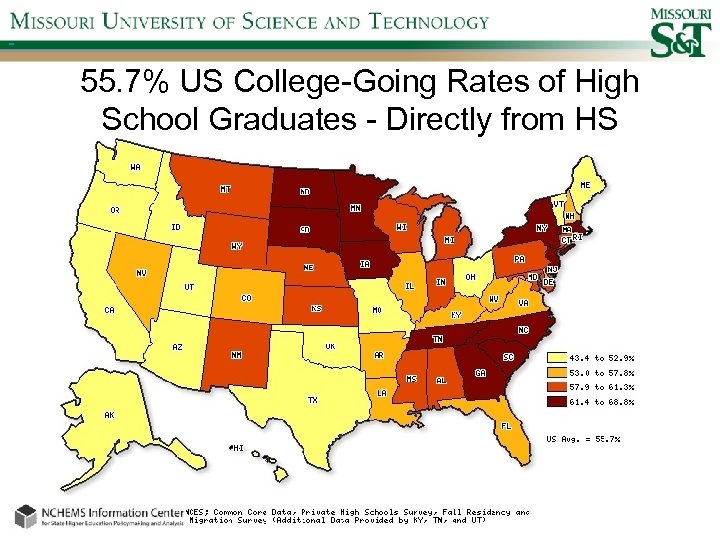
55. 7% US College-Going Rates of High School Graduates - Directly from HS
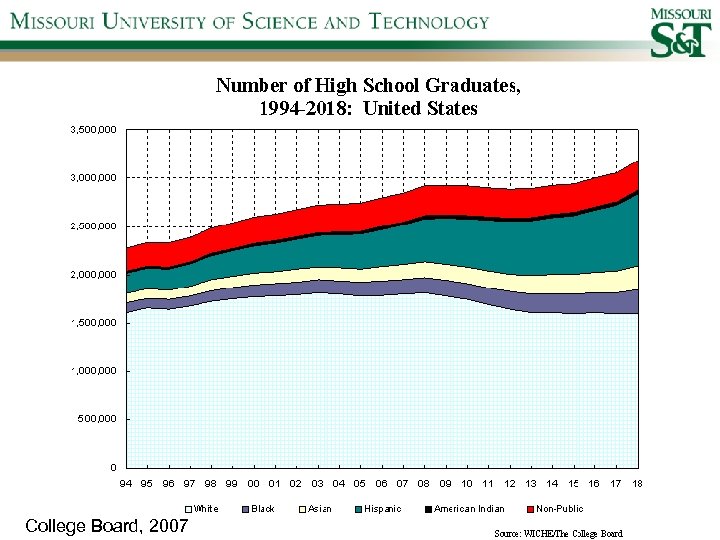
College Board, 2007
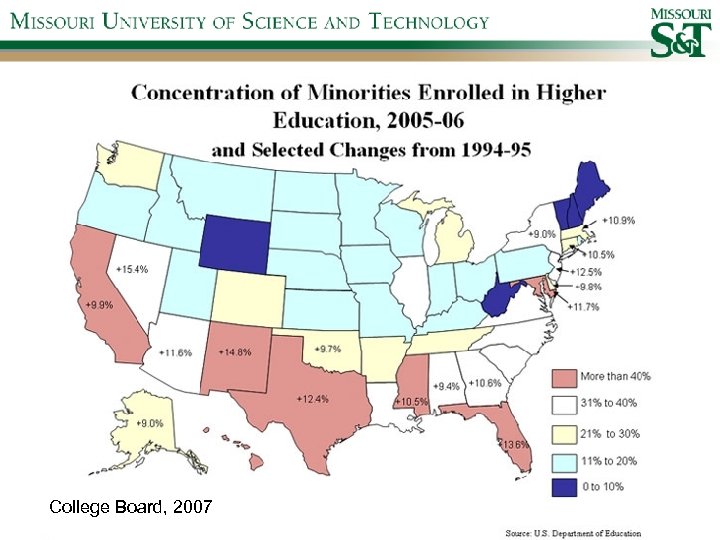
College Board, 2007
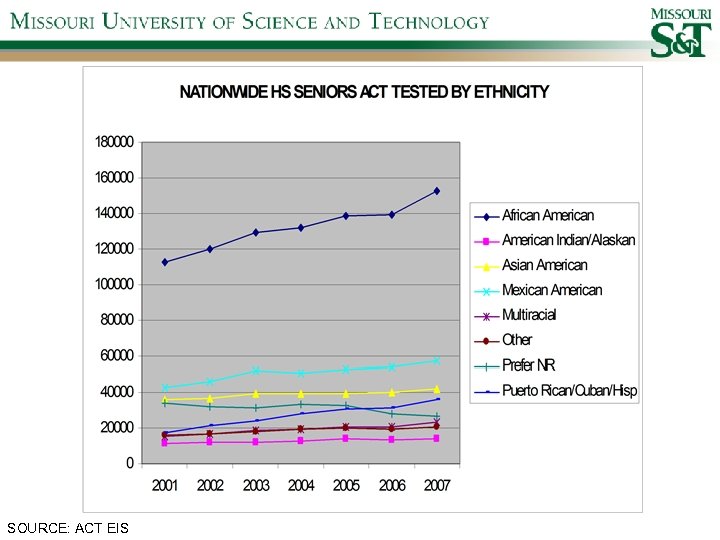
SOURCE: ACT EIS
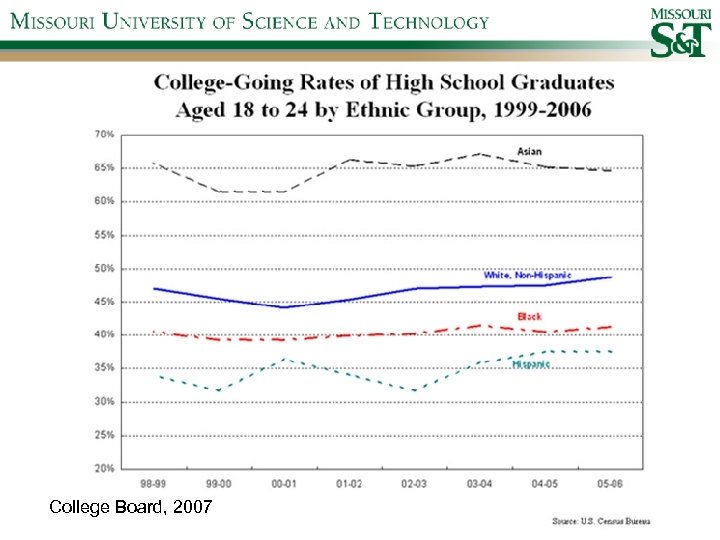
College Board, 2007
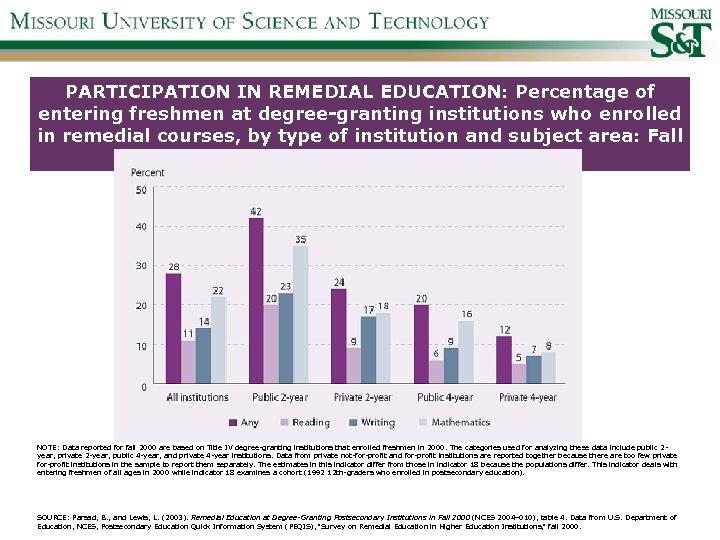
PARTICIPATION IN REMEDIAL EDUCATION: Percentage of entering freshmen at degree-granting institutions who enrolled in remedial courses, by type of institution and subject area: Fall 2000 NOTE: Data reported for fall 2000 are based on Title IV degree-granting institutions that enrolled freshmen in 2000. The categories used for analyzing these data include public 2 year, private 2 -year, public 4 -year, and private 4 -year institutions. Data from private not-for-profit and for-profit institutions are reported together because there are too few private for-profit institutions in the sample to report them separately. The estimates in this indicator differ from those in indicator 18 because the populations differ. This indicator deals with entering freshmen of all ages in 2000 while indicator 18 examines a cohort (1992 12 th-graders who enrolled in postsecondary education). SOURCE: Parsad, B. , and Lewis, L. (2003). Remedial Education at Degree-Granting Postsecondary Institutions in Fall 2000 (NCES 2004– 010), table 4. Data from U. S. Department of Education, NCES, Postsecondary Education Quick Information System (PEQIS), “Survey on Remedial Education in Higher Education Institutions, ” fall 2000.
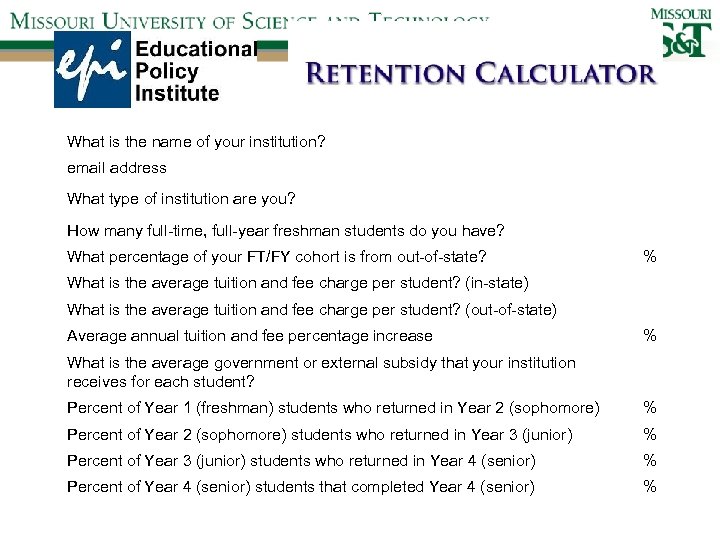
What is the name of your institution? email address What type of institution are you? How many full-time, full-year freshman students do you have? What percentage of your FT/FY cohort is from out-of-state? % What is the average tuition and fee charge per student? (in-state) What is the average tuition and fee charge per student? (out-of-state) Average annual tuition and fee percentage increase % What is the average government or external subsidy that your institution receives for each student? Percent of Year 1 (freshman) students who returned in Year 2 (sophomore) % Percent of Year 2 (sophomore) students who returned in Year 3 (junior) % Percent of Year 3 (junior) students who returned in Year 4 (senior) % Percent of Year 4 (senior) students that completed Year 4 (senior) %
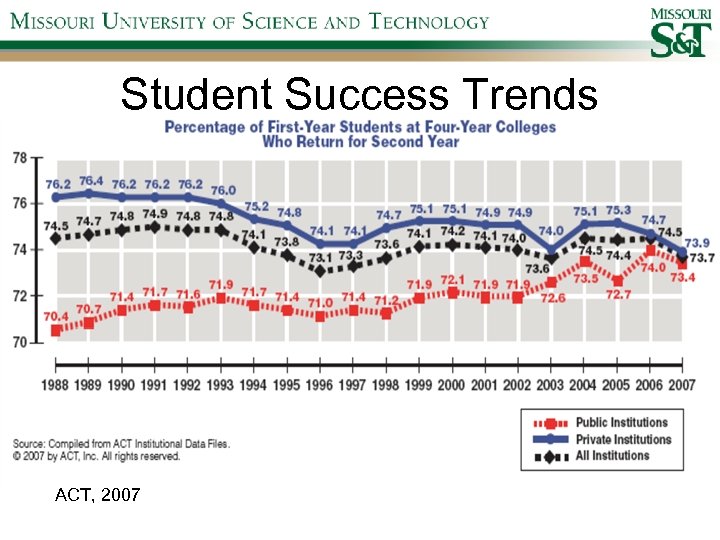
Student Success Trends ACT, 2007
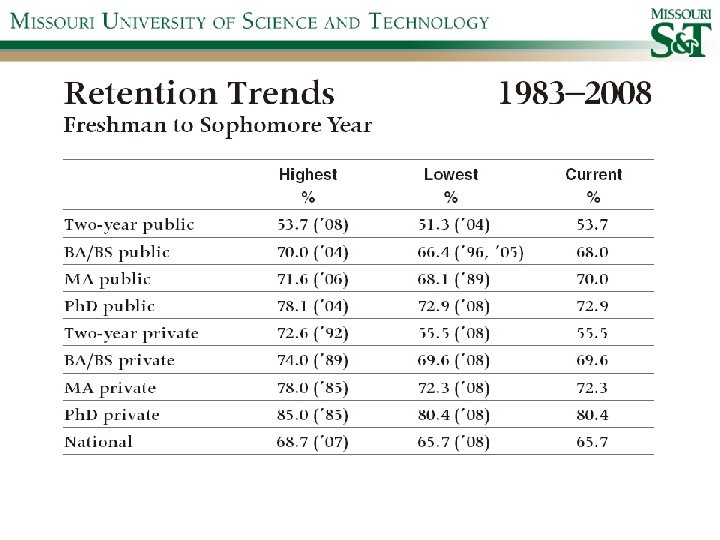
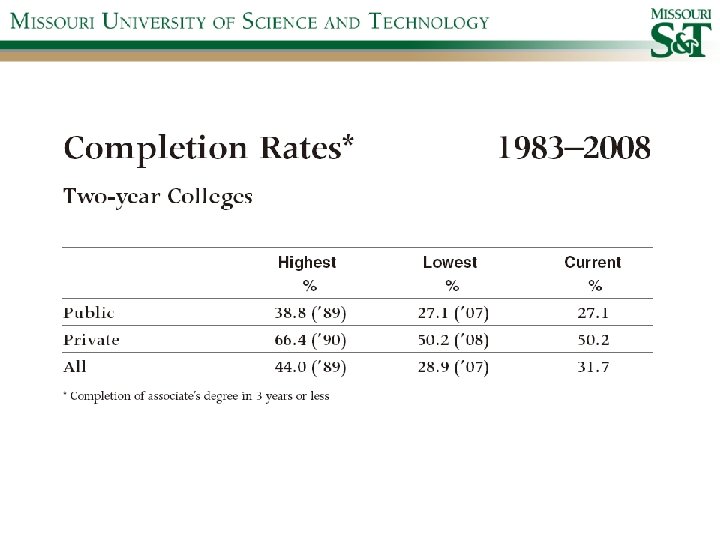
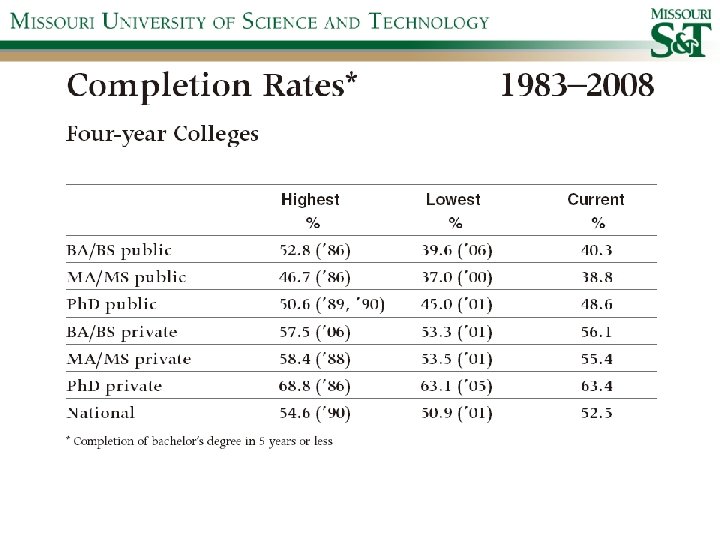
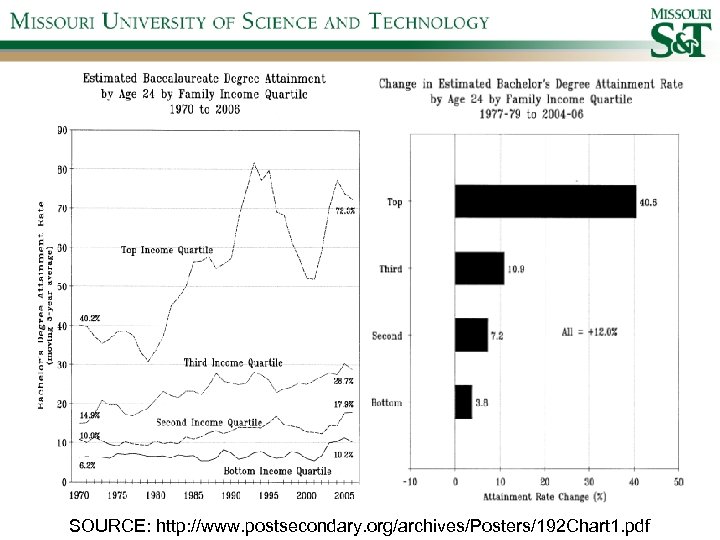
SOURCE: http: //www. postsecondary. org/archives/Posters/192 Chart 1. pdf
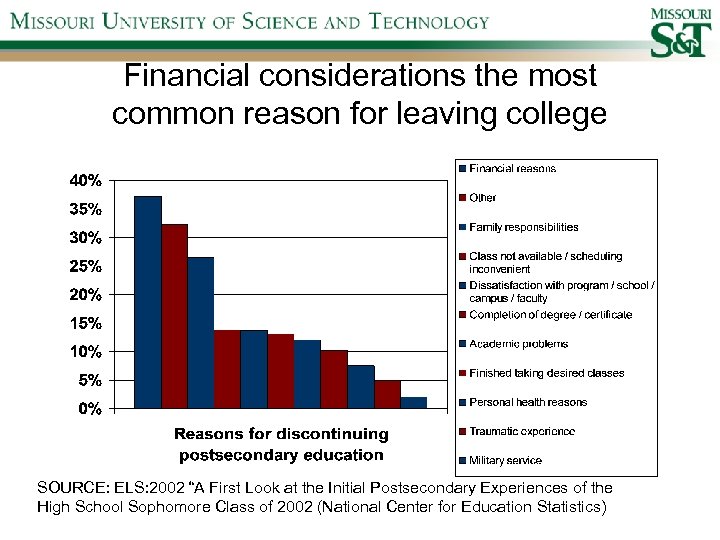
Financial considerations the most common reason for leaving college SOURCE: ELS: 2002 “A First Look at the Initial Postsecondary Experiences of the High School Sophomore Class of 2002 (National Center for Education Statistics)
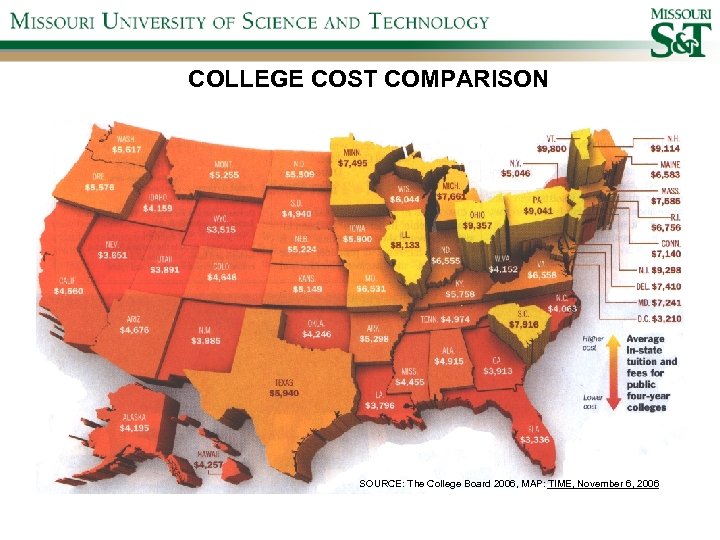
COLLEGE COST COMPARISON SOURCE: The College Board 2006, MAP: TIME, November 6, 2006
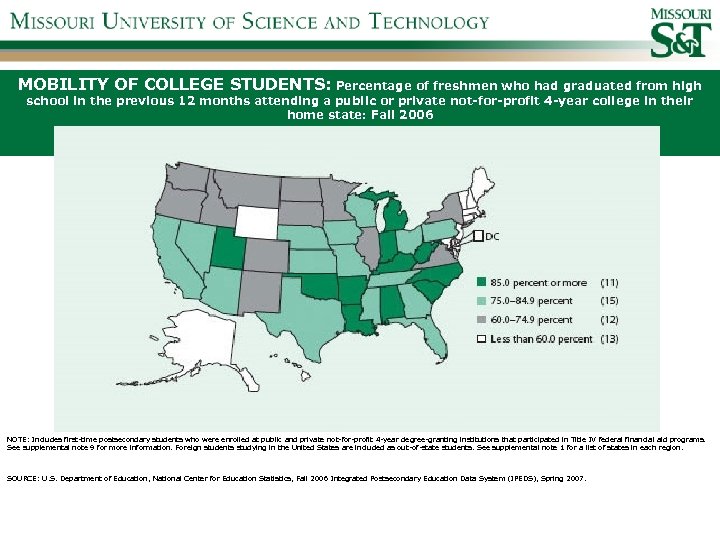
MOBILITY OF COLLEGE STUDENTS: Percentage of freshmen who had graduated from high school in the previous 12 months attending a public or private not-for-profit 4 -year college in their home state: Fall 2006 NOTE: Includes first-time postsecondary students who were enrolled at public and private not-for-profit 4 -year degree-granting institutions that participated in Title IV federal financial aid programs. See supplemental note 9 for more information. Foreign students studying in the United States are included as out-of-state students. See supplemental note 1 for a list of states in each region. SOURCE: U. S. Department of Education, National Center for Education Statistics, Fall 2006 Integrated Postsecondary Education Data System (IPEDS), Spring 2007.
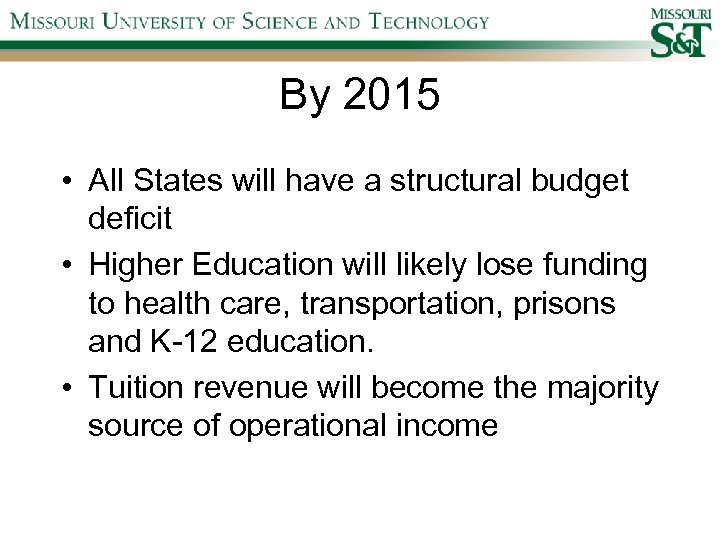
By 2015 • All States will have a structural budget deficit • Higher Education will likely lose funding to health care, transportation, prisons and K-12 education. • Tuition revenue will become the majority source of operational income
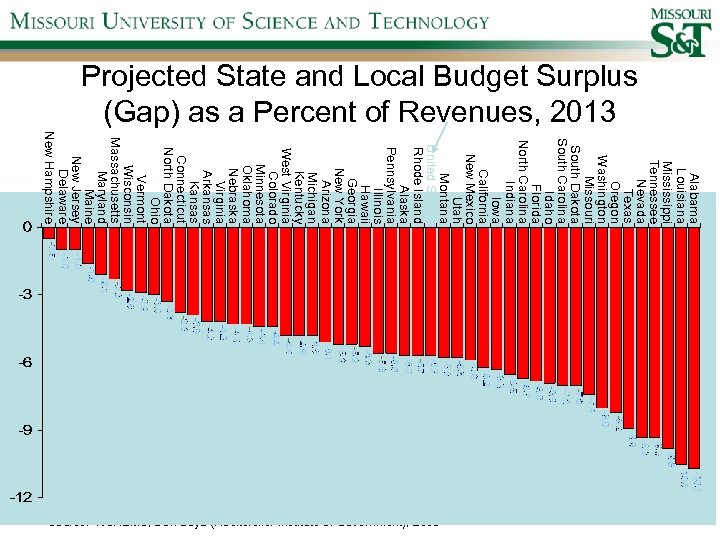
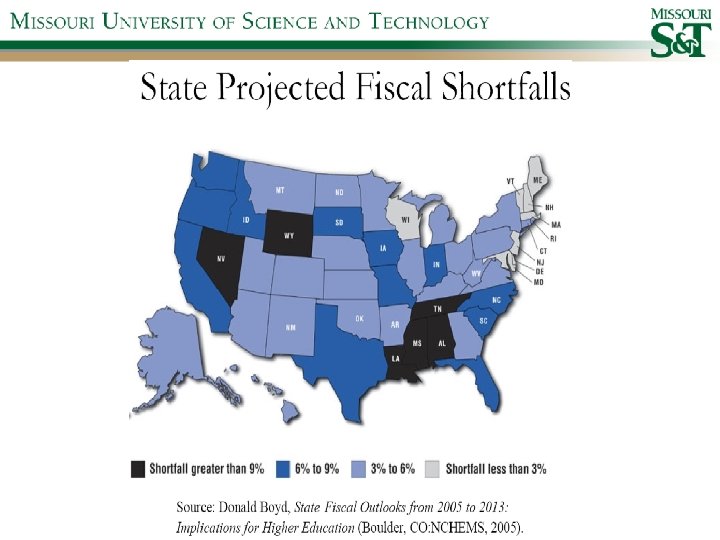
Projected State and Local Budget Surplus (Gap) as a Percent of Revenues, 2013 Alabama Louisiana Mississippi Tennessee Nevada Texas Oregon Washington Missouri South Dakota South Carolina Idaho Florida North Carolina Indiana Iowa California New Mexico Utah Montana United States Rhode Island Alaska Pennsylvania Illinois Hawaii Georgia New York Arizona Michigan Kentucky West Virginia Colorado Minnesota Oklahoma Nebraska Virginia Arkansas Kansas Connecticut North Dakota Ohio Vermont Wisconsin Massachusetts Maryland Maine New Jersey Delaware New Hampshire Source: NCHEMS; Don Boyd (Rockefeller Institute of Government), 2005
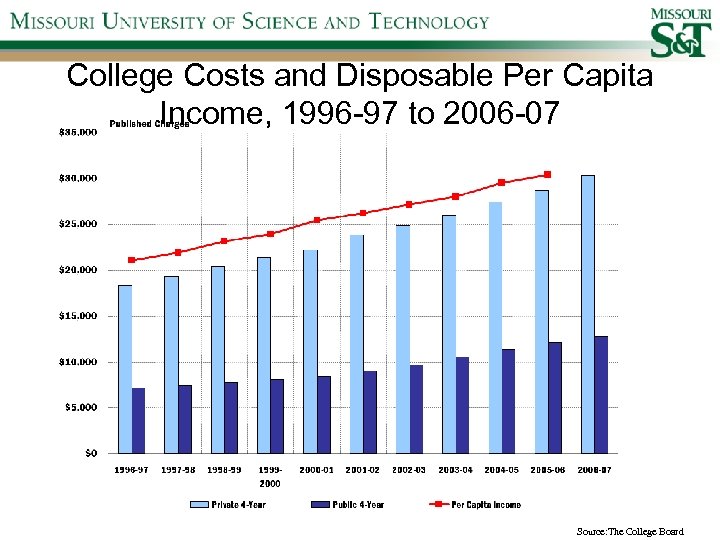
College Costs and Disposable Per Capita Income, 1996 -97 to 2006 -07 Source: The College Board
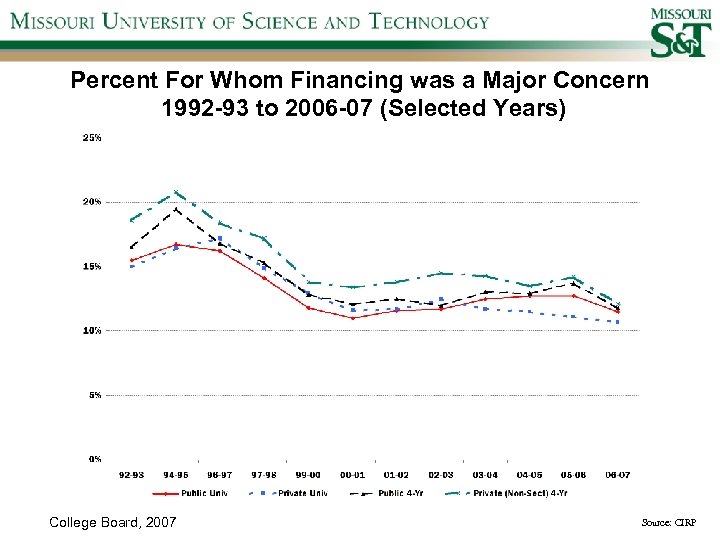
Percent For Whom Financing was a Major Concern 1992 -93 to 2006 -07 (Selected Years) College Board, 2007 Source: CIRP
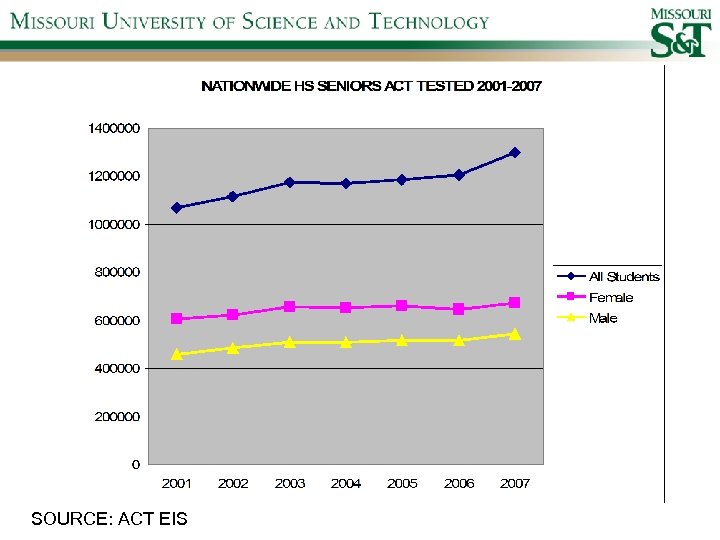
SOURCE: ACT EIS
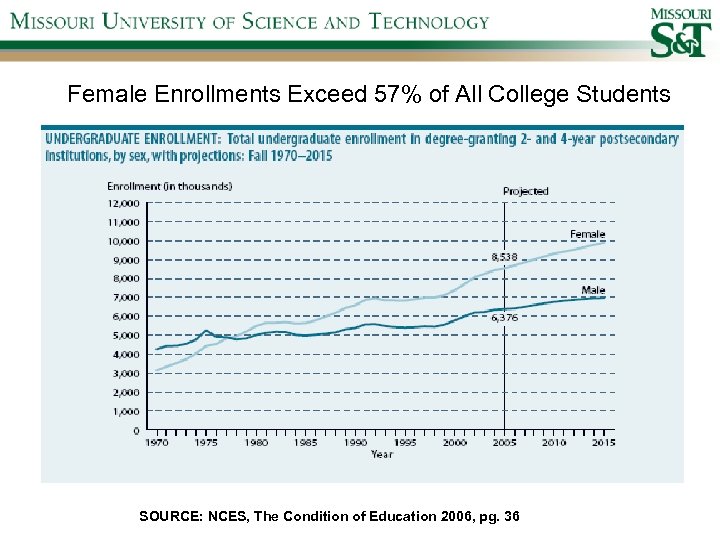
Female Enrollments Exceed 57% of All College Students SOURCE: NCES, The Condition of Education 2006, pg. 36
Today’s Teens and Social Media • The use of social media gains a greater foothold in teen life as they embrace the conversational nature of interactive online media • Some 93% of teens use the internet, and more of them than ever are treating it as a venue for social interaction – a place where they can share creations, tell stories, and interact with others. • SOURCE: PEW 12/19/2007
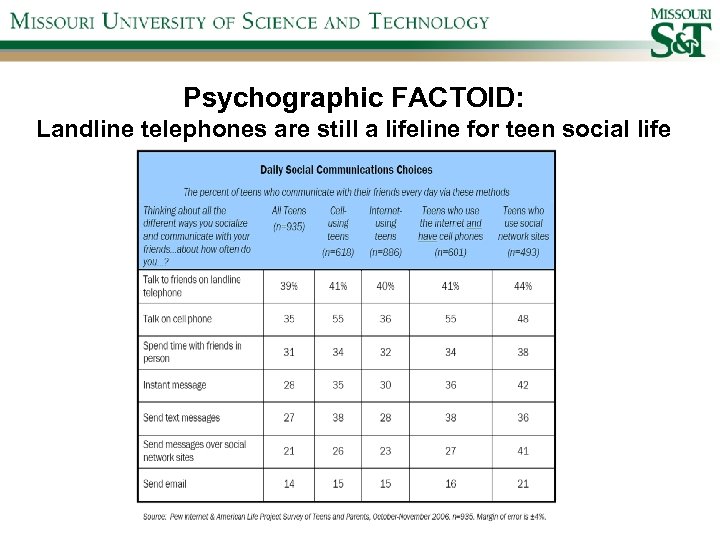
Psychographic FACTOID: Landline telephones are still a lifeline for teen social life
Girls continue to lead the charge as the teen blogosphere grows • 28% of online teens have created a blog, up from 19% in 2004. • Overall, girls dominate the teen blogosphere; 35% of all online teen girls blog, compared with 20% of online teen boys. • This gender gap for blogging has grown larger over time. Virtually all of the growth in teen blogging between 2004 and 2006 is due to the increased activity of girls. • Older teen girls are still far more likely to blog when compared with older boys (38% vs. 18%), but younger girl bloggers have grown at such a fast clip that they are now outpacing even the older boys (32% of girls ages 12 -14 blog vs. 18% of boys ages 15 -17). • SOURCE: PEW 12/19/2007
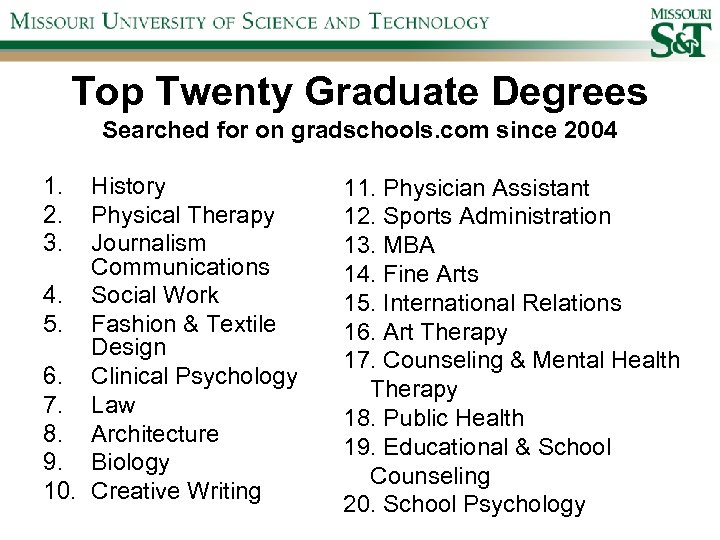
Top Twenty Graduate Degrees Searched for on gradschools. com since 2004 1. 2. 3. History Physical Therapy Journalism Communications 4. Social Work 5. Fashion & Textile Design 6. Clinical Psychology 7. Law 8. Architecture 9. Biology 10. Creative Writing 11. Physician Assistant 12. Sports Administration 13. MBA 14. Fine Arts 15. International Relations 16. Art Therapy 17. Counseling & Mental Health Therapy 18. Public Health 19. Educational & School Counseling 20. School Psychology
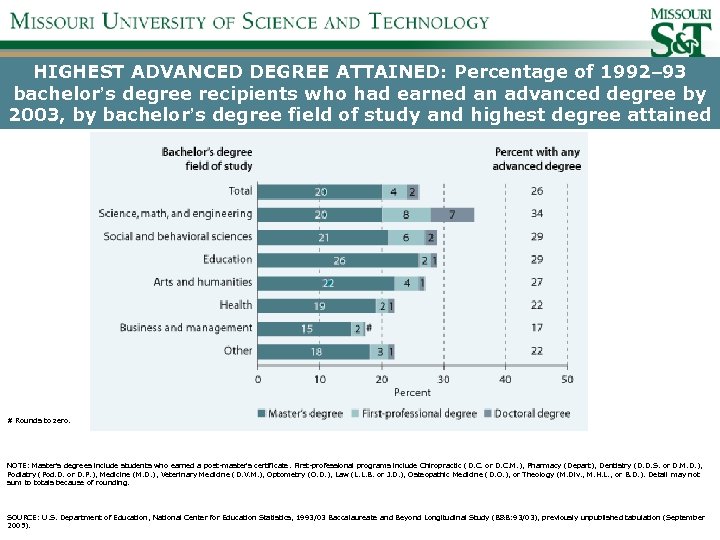
HIGHEST ADVANCED DEGREE ATTAINED: Percentage of 1992– 93 bachelor’s degree recipients who had earned an advanced degree by 2003, by bachelor’s degree field of study and highest degree attained # Rounds to zero. NOTE: Master’s degrees include students who earned a post-master’s certificate. First-professional programs include Chiropractic (D. C. or D. C. M. ), Pharmacy (Depart), Dentistry (D. D. S. or D. M. D. ), Podiatry (Pod. D. or D. P. ), Medicine (M. D. ), Veterinary Medicine (D. V. M. ), Optometry (O. D. ), Law (L. L. B. or J. D. ), Osteopathic Medicine (D. O. ), or Theology (M. Div. , M. H. L. , or B. D. ). Detail may not sum to totals because of rounding. SOURCE: U. S. Department of Education, National Center for Education Statistics, 1993/03 Baccalaureate and Beyond Longitudinal Study (B&B: 93/03), previously unpublished tabulation (September 2005).
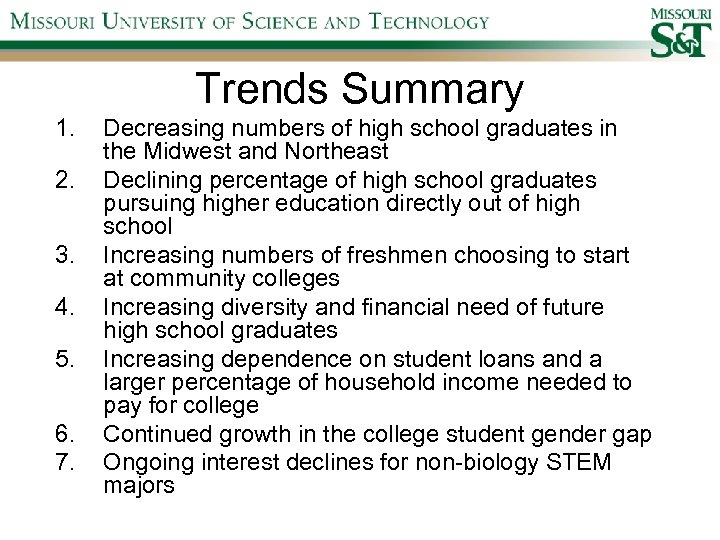
Trends Summary 1. 2. 3. 4. 5. 6. 7. Decreasing numbers of high school graduates in the Midwest and Northeast Declining percentage of high school graduates pursuing higher education directly out of high school Increasing numbers of freshmen choosing to start at community colleges Increasing diversity and financial need of future high school graduates Increasing dependence on student loans and a larger percentage of household income needed to pay for college Continued growth in the college student gender gap Ongoing interest declines for non-biology STEM majors
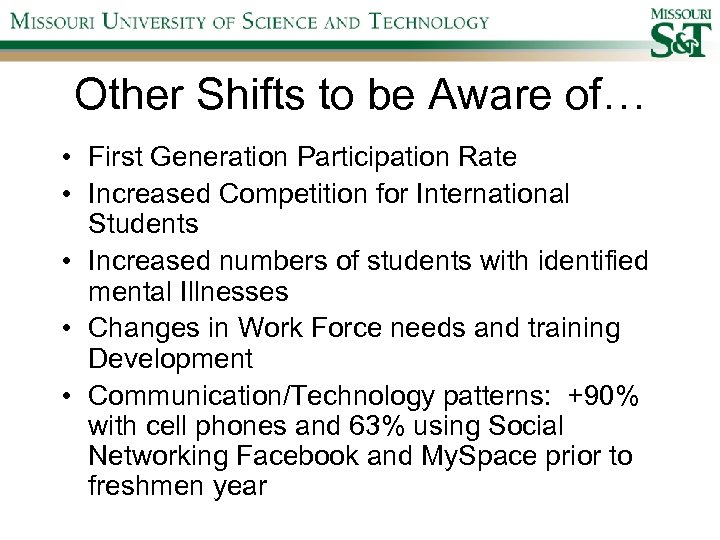
Other Shifts to be Aware of… • First Generation Participation Rate • Increased Competition for International Students • Increased numbers of students with identified mental Illnesses • Changes in Work Force needs and training Development • Communication/Technology patterns: +90% with cell phones and 63% using Social Networking Facebook and My. Space prior to freshmen year
Shift Conclusions “Virtually all public and private colleges and institutions will see changes in their student bodies during the next decade. The only exceptions might be the top-tier, most popular institutions that already have many more highly qualified applicants than available spaces. ” College Board, 2005
SEM Strategies for Success 1. 2. 3. 4. Increase the College Going Rate Increase Retention Reach-out Further Increase College Participation in Primary Markets 5. Look for Post Retirement Student Opportunities - Certificate Programs 6. Focus on Transfers from 2 -year Colleges 7. Further develop Graduate Outreach and Graduate Certificate Programs
Strategic Enrollment Management Plan 2007 -2011 • Increase Success of Students – – • Increase College Going Rate & Access 1. 2. 3. 4. 5. • Retention Rates Graduation Rates Access & Affordability Pipeline of College Ready Students Strategic Partnerships Outreach/Education Scholarships Expanding Current Markets & Capturing New Markets 1. 2. 3. 4. 5. 6. 7. Out-of-state students Transfer Students Female Students Underrepresented Minority Students International Students Graduate Students Nontraditional Students
Why Hire a Consultant? • You are faced with a task or problem that won’t go away • You have a complex project that creates additional work for the existing employees • You want to save time and money by temporarily employing someone with a special expertise that can help you move forward on overcoming an obstacle SOURCE: Barbara Kibbe & Fred Setterber (1992) Succeeding with Consultants, Packard Foundation
Consultants are Help Agents Who can Help Unite the Campus
Consultants HELP by. . • • • Providing and Sharing a Variety of Skills Supplementing Staff Expertise Objectivity Credibility Providing Advise on Political and Legal Issues SOURCE: Barbara Kibbe & Fred Setterber (1992) Succeeding with Consultants, Packard Foundation
Today’s Consultants embrace Change Management and Rarely take on just one Task • • • Diagnosis & Assessment Problem Solving Research and Analysis Strategic Planning Organizational Process System Development • • • Training Mediation Facilitation Systems Development Search for Potential Employees SOURCE: Barbara Kibbe & Fred Setterber (1992) Succeeding with Consultants, Packard Foundation
The IHC concept is not new, but seldom publicly embraced by executive leaders • Michael Hovland’s (2006) “Experts Close to Home: How to work Like a Consultant on Your Own Campus” – many traditional consulting tactics can be systematically applied by SEM professionals. • Jim Black’s SEM framework papers (2003) and SEM business practices workshops (2002) promotes: – using diagnostic tools, – establishing staff technical competencies & training systems – using key performance indicators (KPIs) for cross-campus data sharing – outcomes assessment.
“If you don’t know where you’re going, any path will take you there. ” Sioux proverb

The Power of Alignment
EMBRACE the Phases of Consulting Process 1. Engaging in initial contact and defining the work 2. Formulating a contract and establishing a helping relationship 3. Gather all decision makers and discuss the plan, their roles and what they can contribute 4. Identifying problems through diagnostic analysis 5. Set goals and planning for action with all decision makers 6. Taking action and cycling feedback 7. Completing the project ADAPTED FROM: Gordon L. Lippitt, Ronald Lippitt (1994). The Consulting Process in Action, 2 nd Edition
A Significant Challenge • Creating a unified SEM structure is complicated by the fact that the university is structured to be decentralized and protect academic units from environmental shifts (such as what occurs in enrollments). • Most faculty do not know about (and even more do not understand the importance) of strategic enrollment management. • The faculty need to know the difference!
The Entire Campus Must be Engaged in the Solution “Changing demographics is not simply an issue for enrollment managers—and enrollment managers cannot “do magic” to perpetuate the status quo. Trustees, presidents, deans, faculty, and other administrators need to engage in some serious strategic planning to project manageable goals, not only from the institution’s perspective, but also from the perspective of providing access and opportunity to this new group of students. ” SOURCE: College Board. (2005). “The Impact of Demographic Changes on Higher Education”
Faculty SEM Needs • Faculty need information/data: start with Deans/Chairs. EX: student demand for general education courses • Help predict workload (# of student by program) • Admissions and Student Profile Trends: What are their learning needs and classroom expectations? • What are issues with international recruitment and admissions • Identification of roadblocks or obstacles keeping students from graduating. • Effective recruiting strategies and the faculty’s role
How to Engage Faculty • Reach out, invite, feed • Provide information: – Understanding Current Students needs/activities (psychographics) – Understanding “Helicopter” Parents • Ask for Departments to determine their capacity to serve with current resources • Ask for a desired student profile • GRAD PROGRAMS: Ask for preferred top 10 feeder schools
Student Services SEM Needs Building the “Caring Campus” atmosphere depends on Student Services understanding of the students’ needs and the institution’s performance goals • The Campus Visit’s impact on Recruitment • Retention implications: Outside of the classroom, largest interaction with students • Learning New Students’ Profile and College Expectations and Needs for Outside of Class and best matching the campus services…plus dealing with Helicopter Parents • Understanding how to serve the Needs of Institution’s Targeted Student Markets • Knowing new students’ previous co-curricular experiences in high school, at the community college, or through work.
“Administrator” to “In-House Consultant” can be a natural transition Institute of Management Consultancy’s 2002 model for professional managerial consultants: Consultants must be individuals who: 1. regularly manage complexity and responsibility, 2. seek personal growth, 3. use analytical and pro-active thinking, 4. have strong interpersonal interactions, and 5. have delivery effectiveness.
Unite the Isolated IHC builds an organizational culture that: 1. better motivates staff and faculty collaboration, 2. demonstrates a dedication to intelligent planning and strategy execution, 3. promotes a stronger passion for academic and student success through shared governance 4. embraces the regular use of solid analytical and data-driven skill-sets.
Getting Started with the IHC SEM Model
Characteristics of Successful Internal Consultants (Lawrence & Lorsch, 1967) 1. Ability to bridge goals and build trust between different departments. 2. Respect earned through demonstration of an expert knowledge base. 3. Understanding and communicating institutional vision. 4. A high profile throughout the organization. Active individuals who are familiar to the organization, have an intimate knowledge of the organization, and are trusted by the organization and its members possess great capacity for initiating and sustaining change.
Phases of Consulting Process SUSTAINABILITY THROUGH A PROCESS FOCUS 1. Engaging in initial contact and defining the work 2. Formulating a contract and establishing a helping relationship 3. Gather all decision makers and discuss the plan, their roles and what they can contribute 4. Identifying problems through diagnostic analysis 5. Set goals and planning for action with all decision makers 6. Taking action and cycling feedback 7. Completing the project ADAPTED FROM: Gordon L. Lippitt, Ronald Lippitt (1994). The Consulting Process in Action, 2 nd Edition
Key Components to SEM The following four steps are fundamental to the development of a comprehensive recruitment and retention plan 1. Determine the institution’s capacity to serve students by degree program and types of students (traditional, nontraditional, graduate, etc. ) 2. Establish Goals: need to be agreed upon by all involved 3. Formulate Strategies based on data 4. Develop action plan with tactics and an operational calendar: – – – What exactly is going to be done When will it be completed Who is responsible How much will it cost How will you know if it has been accomplished (evaluation)
Create an Enrollment Development Team • • • Faculty from each division Admissions Registrar Financial Aid Campus Housing Student Activities Counseling Center Orientation Teacher Training Director Faculty Senate Leaders • Execs: Academic, Student & Enrollment Affairs • Advising • Info Tech • Institutional Research • Minority Programs • International Affairs • Cashier/Billing • Pre-College Programs • Reporting Services NOTE: The EDT does not replace the campus recruitment and retention committees
IHC’s Use and SHARE Data • Become a data expert • Translate the data into a form and with messages attached that engage the interests of faculty and administrators • Train your staff to use data and expect them to use it • Share data and invite others to help you interpret it Michael Hovland, 2006
What does an IHC Read? In addition to ACT pubs & AACRAO SEM updates…. . • • • Chronicle of Higher Education Greentree Gazette University Business Inside Higher Ed (like Chronicle, but free) ACT News You Can Use (www. act. org) Google News Search: “University Enrollment” • Postsecondary Education OPPORTUNITY • State Economic & Demographic Reviews (OSEDA) • Anything by Michael Dolence, Tom Mortenson, Bob Bontager, David Kalsbiek, Bob Sevier, Richard Whitesides, Bob Johnson, Stan Henderson, and Jim Black • Much, much more
What Reports Do IHCs Produce? • Weekly “Funnel” Reports • Key Performance Indicators (KPIs) • Annual Environmental Scans & SWOT updates • New Student Profiles Prior to Start of Classes • Student Profile after Census Date
Basic Analysis for SEM • • • Capacity Study Preferred New Student Profile Primary Market Penetration Price Elasticity Un-met Need Gap (key for fundraising) Student Need/Support Alignment
Core IHC Retention Assessments 1. New Student Survey (prior to start of classes) 2. Withdrawal Survey (prior to cancelling classes) 3. Phone/Email Survey of Non-Returning Students (24 weeks prior to start of semester) 4. Student Satisfaction Survey (all returning students) 5. Graduating Student Survey (prior to commencement or within the first six months after graduating)
. Long-Term Benefits of IHC Model • Cost savings • Greater organizational unity and engagement on core business practices. • Increased likelihood for sustainable change due to a stronger understanding of the culture that exists on campus. • Establish better internal linkages and trust needed to create a stronger and more coordinated strategic plan through regular communication and requests for unit input.
Can Internal Consultants be Effective? 1. Setting and establishing linkages, shared goals, improved communication, and synergy across all institutional units. Unit objectives need to be tied directly to enterprise-wide goals, rather than functioning as stand -alone systems. 2. Using an analytical, empirical, data-driven approach to problem solving and decision-making. Intuition is important but not sufficient. The “culture of evidence” is a cornerstone of effective enrollment management. 3. Providing critical leadership. Enrollment management almost always means changes in structure, reporting lines, communication, goals, etc. The challenges and risks of change should never be underestimated. Effective enrollment leaders are willing to accept the risks where they see the need for change. Skannel and Kurz, 2007
Conclusion • IHC model is an ideal for strategic levels of performance and professionalism. • IHC: an ideal performance model for SEM professionals, not an argument against using external consultants. • Promoting the idea of internal, experienced SEM practitioners developing institution-wide partnerships and plans to better ensure the university lives up to its promises to students, families, faculty, and alumni.
Learn More about SEM & Effective Retention Strategies • Retention 2009: An International Conference on Student Retention May 27 -29, 2009, New Orleans, LA www. educationalpolicy. org • SEM: AACRAO’s 19 th annual Strategic Enrollment Management Conference November 9 -11, 2009, Dallas, TX www. aacrao. org/sem 19
QUESTIONS? Building a SEM Organization as a Data Driven Consultant Jay W. Goff Vice Provost & Dean for Enrollment Management 573 -341 -4378 goffjw@mst. edu http: /enrollment. mst. edu
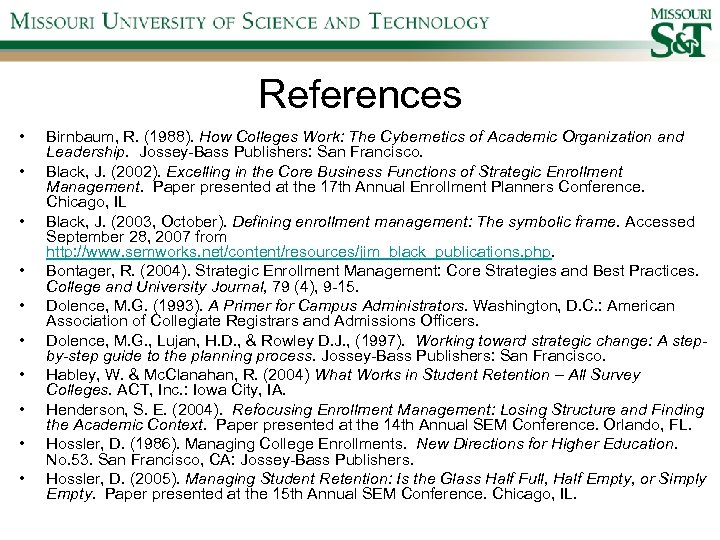
References • • • Birnbaum, R. (1988). How Colleges Work: The Cybernetics of Academic Organization and Leadership. Jossey-Bass Publishers: San Francisco. Black, J. (2002). Excelling in the Core Business Functions of Strategic Enrollment Management. Paper presented at the 17 th Annual Enrollment Planners Conference. Chicago, IL Black, J. (2003, October). Defining enrollment management: The symbolic frame. Accessed September 28, 2007 from http: //www. semworks. net/content/resources/jim_black_publications. php. Bontager, R. (2004). Strategic Enrollment Management: Core Strategies and Best Practices. College and University Journal, 79 (4), 9 -15. Dolence, M. G. (1993). A Primer for Campus Administrators. Washington, D. C. : American Association of Collegiate Registrars and Admissions Officers. Dolence, M. G. , Lujan, H. D. , & Rowley D. J. , (1997). Working toward strategic change: A stepby-step guide to the planning process. Jossey-Bass Publishers: San Francisco. Habley, W. & Mc. Clanahan, R. (2004) What Works in Student Retention – All Survey Colleges. ACT, Inc. : Iowa City, IA. Henderson, S. E. (2004). Refocusing Enrollment Management: Losing Structure and Finding the Academic Context. Paper presented at the 14 th Annual SEM Conference. Orlando, FL. Hossler, D. (1986). Managing College Enrollments. New Directions for Higher Education. No. 53. San Francisco, CA: Jossey-Bass Publishers. Hossler, D. (2005). Managing Student Retention: Is the Glass Half Full, Half Empty, or Simply Empty. Paper presented at the 15 th Annual SEM Conference. Chicago, IL.
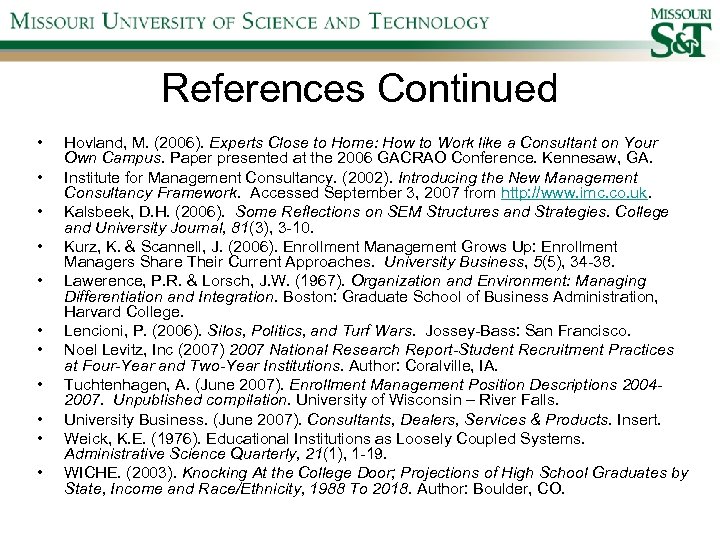
References Continued • • • Hovland, M. (2006). Experts Close to Home: How to Work like a Consultant on Your Own Campus. Paper presented at the 2006 GACRAO Conference. Kennesaw, GA. Institute for Management Consultancy. (2002). Introducing the New Management Consultancy Framework. Accessed September 3, 2007 from http: //www. imc. co. uk. Kalsbeek, D. H. (2006). Some Reflections on SEM Structures and Strategies. College and University Journal, 81(3), 3 -10. Kurz, K. & Scannell, J. (2006). Enrollment Management Grows Up: Enrollment Managers Share Their Current Approaches. University Business, 5(5), 34 -38. Lawerence, P. R. & Lorsch, J. W. (1967). Organization and Environment: Managing Differentiation and Integration. Boston: Graduate School of Business Administration, Harvard College. Lencioni, P. (2006). Silos, Politics, and Turf Wars. Jossey-Bass: San Francisco. Noel Levitz, Inc (2007) 2007 National Research Report-Student Recruitment Practices at Four-Year and Two-Year Institutions. Author: Coralville, IA. Tuchtenhagen, A. (June 2007). Enrollment Management Position Descriptions 20042007. Unpublished compilation. University of Wisconsin – River Falls. University Business. (June 2007). Consultants, Dealers, Services & Products. Insert. Weick, K. E. (1976). Educational Institutions as Loosely Coupled Systems. Administrative Science Quarterly, 21(1), 1 -19. WICHE. (2003). Knocking At the College Door; Projections of High School Graduates by State, Income and Race/Ethnicity, 1988 To 2018. Author: Boulder, CO.
Скачать презентацию Building a SEM Organization as a Data Driven
d4338506a3a497c6b5222d5f6af7c918.ppt