 Скачать презентацию Building a Regional Collaborative Partnering for a Purpose
69cf26f173d79f9566a2107cfe3dc6b4.ppt
- Количество слайдов: 46



Building a Regional Collaborative: Partnering for a Purpose Brian Smith, Vermont Dept. of Health Catherine Friedman, Chester County Ray Allen, Community Technology Alliance Carlos Jimenez, Oxnard Housing Department September 18 -19, 2006 – Denver, Colorado Sponsored by the U. S. Department of Housing and Urban Development
Overview • • • Learning Objectives New England Regional Collaborative Mid Atlantic Regional Collaborative Bay Area California Collaborative Southern Central Coastal Regional California September 18 -19, 2006 - Denver, Colorado Sponsored by the U. S. Department of Housing and Urban Development 2
Learning Objectives • To increase understanding of benefits of collaborating among Co. Cs at the regional level • To share real-world examples of how and why multiple Co. Cs choose to partner together and for what purpose • To offer various models of shared decision-making and governance issues with collaborations, including an overview of necessary agreements September 18 -19, 2006 - Denver, Colorado Sponsored by the U. S. Department of Housing and Urban Development 3
Building Elements for a Regional Approach • Recognize your purpose…………. • Know your scope and capitalize on willing supporters. • Consider the Responsibility you are taking on September 18 -19, 2006 - Denver, Colorado Sponsored by the U. S. Department of Housing and Urban Development 4
Models of Regional Collaboration • Joint deployment of software • Regional data warehouse project • Regional technical assistance • Shared staffing, training, or data entry resources September 18 -19, 2006 - Denver, Colorado Sponsored by the U. S. Department of Housing and Urban Development 5
NERHMIS Collaborative Participating states: Maine, New Hampshire, Vermont, Connecticut, Massachusetts & Rhode Island Brian M. Smith, Vermont Dept. of Health September 18 -19, 2006 - Denver, Colorado Sponsored by the U. S. Department of Housing and Urban Development 6
Regional Approach to Homeless Management Information System Collaboration NERHMIS • NERHMIS is a regional technical assistance collaborative that has begun its 4 th year! • The original tri-state partnership involved the states of Maine, New Hampshire and Vermont and was launched at the AHAR meeting of July 2003. Shortly thereafter NERHMIS grew to include Massachusetts, Connecticut, and Rhode Island. • Initial meetings were held in Concord, New Hampshire with eight participants and one HUD field representative. Today there are 76 members, 3 HUD field representatives, and approximately 20 members who attend monthly meetings at the HUD field office in Manchester, New Hampshire • Mutual concerns with vendor issues and HUD compliance brought the founders together. The potential for a New England Regional research demonstration project is still a goal of the group September 18 -19, 2006 - Denver, Colorado Sponsored by the U. S. Department of Housing and Urban Development 7
The Goals of the Group • To include various HMIS • To build knowledge, stakeholders from the partnerships, and effective member states HMIS and improve homeless programs and services • To foster regional through best practices collaboration in a systematic approach • To mutually support the membership with monthly • To develop and support meetings, trainings, technical strategies that introduce, assistance, and annual adapt, and apply uniform regional conferences and consistent practices in our region September 18 -19, 2006 - Denver, Colorado Sponsored by the U. S. Department of Housing and Urban Development 8
Responding to Challenges • NERHMIS is uniquely poised for the six member states to meet in person regularly this is not always the case in other regions • Reducing duplication of effort among partners and creating efficiencies in the process • Recognizing costly implementation issues and reducing cost September 18 -19, 2006 - Denver, Colorado • Overcoming limited opportunities to share knowledge base and expertise with local and regional colleagues • Mutual support for member organizations when they are in the midst of staff transition • Strength in numbers when dealing with vendor issues Sponsored by the U. S. Department of Housing and Urban Development 9
NERHMIS Attributes • Member organizations dedicate time, experience, resources, and assets for the overall betterment of the group • NERHMIS is strictly a volunteer organization the is pursuing a 501 c 3 • It is a best practice focused group • It is collaborative and inclusive September 18 -19, 2006 - Denver, Colorado • Responsive to local and regional conditions • Develops mechanisms to build on experience and lessons learned from members • Gets creative in addressing HMIS rollout challenges • Is Results and Outcome oriented Sponsored by the U. S. Department of Housing and Urban Development 10
Things to Consider in Developing a Regional Approach • Developing a committee • Decision making regarding structure for the multiple core membership is crucial tasks. This maximizes the • Work with your HUD field capacities of members ( IT office if at all possible. Administrators, Vendor Involve field representatives Relations, Consumer and CPD hierarchy Involvement, UW 211, DV, • Leadership should develop PATH, Webpage, Strategic policies and procedures, Planning/steering, conference levels of participation, • Develop a mission statement expectations of members, and to guide the efforts of the a strategic plan incorporating group all membership input • Survey needs to guide first steps September 18 -19, 2006 - Denver, Colorado Sponsored by the U. S. Department of Housing and Urban Development 11
Some Issues Ahead in Developing a Regional Approach • The variety of vendors and the need to support all members choices • The lack of uniformity and consistency among various federal homeless program reporting requirements and standards • Complexities of Local Co. Cs, Statewide Co. Cs, and individual providers within September 18 -19, 2006 - Denver, Colorado • Funding limits and limited staff capacity • Competition for scarce resources and competing priorities • The need for HMIS to take place locally Sponsored by the U. S. Department of Housing and Urban Development 12
Developing a Process to Advance the Model • Identify your region and document efforts to support Co. Cs HMIS implementation • Use HMIS. info as a source to support predevelopment • Invite organizations and local HUD field reps to particpate in information sharing meetings September 18 -19, 2006 - Denver, Colorado • Prepare information on the benefits of a regional model and disseminate materials to proposed membership in a formal meeting • Document the group effort and develop policies, procedures, process and move toward strategic planning as a group exercise Sponsored by the U. S. Department of Housing and Urban Development 13
Elements to Include for Maintenance of Effort • Clear vision, trust within the membership, and a strategic vision of HMIS outcomes that mutually supports constituents • Insure a community ownership of the organization, mutual accountability for actions of the group, balanced interests, and use of HUD or another sponsor to create the neutral meeting space • Insure that there is buy in from state or local government, Co. Cs those responsible for HMIS implementation in jurisdictions, vendors participating in jurisdictions, consumers and providers • An individual HMIS can improve the delivery of housing and services, however, with a regional approach you can amplify the efforts and achieve the goals in a more efficient, uniform and consistent manner September 18 -19, 2006 - Denver, Colorado Sponsored by the U. S. Department of Housing and Urban Development 14
Mid-Atlantic Regional HMIS Users Group “MARHMIS” Catherine Friedman, Chester County September 18 -19, 2006 - Denver, Colorado Sponsored by the U. S. Department of Housing and Urban Development 15
Who Is Invited • • • Eastern Pennsylvania and Balance of State New Jersey Delaware Maryland HUD Philadelphia Regional Office Abt Associates, Inc: National HMIS Technical Assistance Initiative September 18 -19, 2006 - Denver, Colorado Sponsored by the U. S. Department of Housing and Urban Development 16
Group Specifics • Volunteer Participation • No Formal Agreements or Memos of Understanding • Possibility of future Data Sharing • Meeting Format – Fixed date every other month – Set location: HUD offices, Philadelphia, PA – Agenda format • • Introductions Announcements Presentations Open Discussion: Hot Topics • Agenda Items for next meetings September 18 -19, 2006 - Denver, Colorado Sponsored by the U. S. Department of Housing and Urban Development 17
Regional Objectives • Identifying common problems and sharing effective solutions. • Creating a stronger voice as a group for better delivery of Technical Assistance Services. • Resource/Information Sharing: – – – Handling Data Quality Issues Training Staffing/resource issues Data Analysis Techniques Performance Measurement Tools September 18 -19, 2006 - Denver, Colorado Sponsored by the U. S. Department of Housing and Urban Development 18
Samples of Presentations • How to Develop a Project Plan, Abram Hillson, NJ • Using HMIS Data for Point in Time Count, Karen Booth, MD • Local Uses of HMIS, Aimee Tyson, PA • Research Potential of HMIS, Steve Poulin, UPENN • City of Philadelphia’s Performance Contracting Methods, Matt Berg & Megan Parrington, PA September 18 -19, 2006 - Denver, Colorado Sponsored by the U. S. Department of Housing and Urban Development 19
Strengths • Regional HUD Involvement – This has definitely been a strength for the group. Offering consistent meeting space and tools. – Also helps to keep HUD abreast of HMIS rollout and startup issues. • Strong Attendance Across Region • ABT Associates Assistance – With out the guidance of ABT Associates Staff this group would not have gotten off of the ground. September 18 -19, 2006 - Denver, Colorado Sponsored by the U. S. Department of Housing and Urban Development 20
More Strengths… • Varied Stages of Implementation – The group includes Co. Cs at all stages of implementation from HUD Application and Vendor Selection to 10 years of Data Collection. • This allows for the sharing of a wealth of experience and has been the nature of the group. • Periodically a portion of the meeting includes all attendees providing an update about respective implementations highlighting successes and barriers. September 18 -19, 2006 - Denver, Colorado Sponsored by the U. S. Department of Housing and Urban Development 21
Next Steps for MARHMIS • Active Listserv – Hosted by Google (Free) – Managed by group volunteer • Discussion Forum September 18 -19, 2006 - Denver, Colorado Sponsored by the U. S. Department of Housing and Urban Development 22
Things to Consider in Forming a Regional Collaborative • • • Regional Diversity HUD Involvement Usefulness to Attendees Consistent Location Use of Technology: – For very large or Rural Areas Conference Calls or discussion forums may be a better/more cost effective solution than physically getting together. September 18 -19, 2006 - Denver, Colorado Sponsored by the U. S. Department of Housing and Urban Development 23
MARHMIS Contact Information Abram L. Hillson HMIS Project Manager Special Needs Division, Policy and Community Development NJHMFA Phone: 609 -278 -7567 FAX: 609 -278 -1149 September 18 -19, 2006 - Denver, Colorado Sponsored by the U. S. Department of Housing and Urban Development 24
Regional Collaboration in the San Francisco and Monterey Bay Area Ray Allen Community Technology Alliance Santa Clara County California September 18 -19, 2006 - Denver, Colorado Sponsored by the U. S. Department of Housing and Urban Development 25
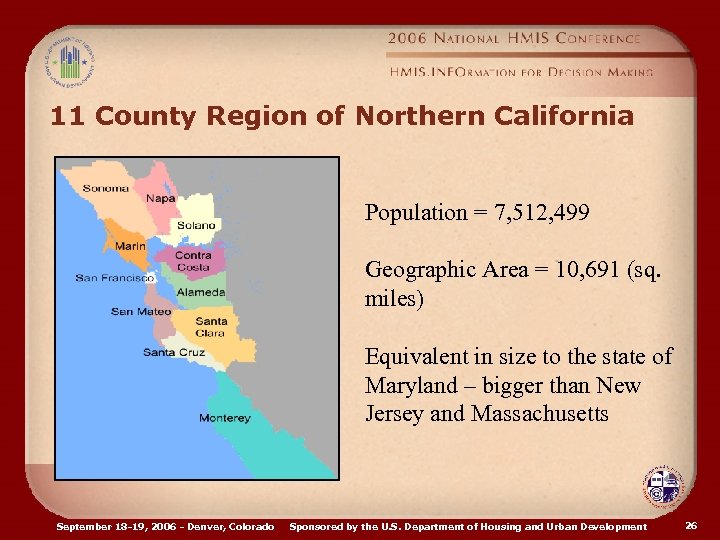
11 County Region of Northern California Population = 7, 512, 499 Geographic Area = 10, 691 (sq. miles) Equivalent in size to the state of Maryland – bigger than New Jersey and Massachusetts September 18 -19, 2006 - Denver, Colorado Sponsored by the U. S. Department of Housing and Urban Development 26
Who is involved? • 11 Counties of the San Francisco and Monterey Bay area • 11 Separate and independent Continuums of Care • Local Foundation (Charles and Helen Schwab Foundation) initially interested in getting a regional picture of homelessness • Brought 11 Continuums of Care together for initial conversation • Each of 11 Continuums represented by County Homelessness Coordinator or person overseeing Continuum • Foundation agreed to fund facilitation of group of 11 Continuums to discuss possible areas of collaboration September 18 -19, 2006 - Denver, Colorado Sponsored by the U. S. Department of Housing and Urban Development 27
How the Partnership Evolved • All Continuums working on HMIS but in different stages of implementation • Agreed to pool HMIS data for the Region to get a Regional picture of homelessness • Many different HMIS softwares in use across the Region so needed a way to pool information from local HMIS’s • Community Technology Alliance (local nonprofit 501 c 3) brought in to give technical advice and build Data Warehouse. • Agreed Data Warehouse concept. • Formation of “official” grouping to pursue idea and creation of project RHINO (Regional Homeless Information Network) September 18 -19, 2006 - Denver, Colorado Sponsored by the U. S. Department of Housing and Urban Development 28
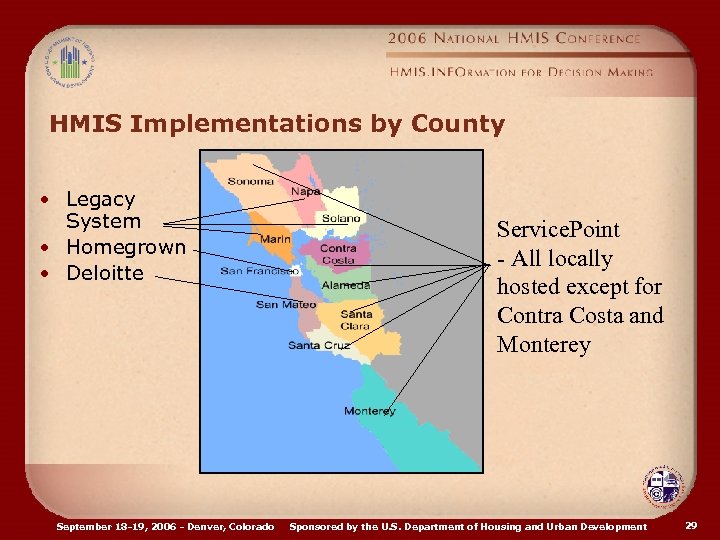
HMIS Implementations by County • Legacy System • Homegrown • Deloitte September 18 -19, 2006 - Denver, Colorado Service. Point - All locally hosted except for Contra Costa and Monterey Sponsored by the U. S. Department of Housing and Urban Development 29
BACHIC Bay Area Counties Homeless Information Collaborative Mission: To better enable policy makers, service agencies, and funders to understand service the needs of the homeless within the community • Goals: – – – Obtain unduplicated regional count of homeless persons Identify prevalence of cross-county chronic homelessness Understand client movement across continuum boundaries Analyze service usage across continuums Inform funders about effectiveness of sponsored programs in the region – Leverage HMIS learning and expertise across multiple communities; increase success factors, reduce risk factors September 18 -19, 2006 - Denver, Colorado Sponsored by the U. S. Department of Housing and Urban Development 30
BACHIC • Product: Regional HMIS Data Warehouse • Outcomes: – Better planning and resource management – Clearer vision of the present and future needs of the homeless – Best Practice for other communities • Original planning sponsored and funded by the Charles and Helen Schwab Foundation • Association of Bay Area Governments (ABAG) interested in regional data for 10 Year Planning regionally • HUD interested in project for Best Practice possibilities. September 18 -19, 2006 - Denver, Colorado Sponsored by the U. S. Department of Housing and Urban Development 31
BACHIC Agreements and Protocols • BACHIC currently considering Guiding Principles for how it will conduct its work. • Likely that all 11 Continuums of Care will agree and sign a Memorandum of Understanding. • Memorandum of Understanding needs to be a delicate balance between a loose agreement to collaborate and a firm enough commitment to ensure “buy-in” and provision of data by all. • Protocols on release of regional data will also need to be agreed. September 18 -19, 2006 - Denver, Colorado Sponsored by the U. S. Department of Housing and Urban Development 32
Strategies to Share What We Learn • HUD agreed to fund further development of regional data warehouse in order to produce Best Practice documentation for other communities. • Documentation to include: – – – Organization and Planning Design and building the infrastructure Implementing and operating and data warehouse Generating reports and using regional data Policy and Protocols Handbook Training Manual September 18 -19, 2006 - Denver, Colorado Sponsored by the U. S. Department of Housing and Urban Development 33
Southern Central Coastal Region of California Encompassing Santa Barbara and Ventura Counties and the City of Oxnard Carlos Jimenez, Oxnard Housing Department September 18 -19, 2006 - Denver, Colorado Sponsored by the U. S. Department of Housing and Urban Development 34
Background of Partnership • Regional Models supported by HUD Field Office and Washington • Initial Partnership involved Santa Barbara, San Luis Obispo, Kern and Ventura Counties as well as the City of Oxnard • Preliminary meeting hosted in Kern County, City of Bakersfield in 2002 • Overarching goal: to consider establishing a common computing platform for a regional HMIS • Other perceived benefits: potential for costs savings resulting from project and improved aggregate data through time September 18 -19, 2006 - Denver, Colorado Sponsored by the U. S. Department of Housing and Urban Development 35
Continuing Planning • Longer term goal: • Second meeting was systematic implementation hosted in Santa Barbara of a common computing County, including platform for data collection representatives from all • Provisions: ability of any counties and the City of participating entity to opt Oxnard out of selecting any • Santa Barbara agreed to particular software based serve as leader in on procurement coordinating the project requirements or local • Immediate Goal: preference; however, coordinated planning and could still participate based applications for HMIS on collective benefits of funding through continuum joint planning September 18 -19, 2006 - Denver, Colorado Sponsored by the U. S. Department of Housing and Urban Development 36
Reality/Perception -Based Limitations • Geography (planning): Kern County was somewhat a geographic outlier in terms of physical distance • Geography (perception) Kern County shared more in common in terms of homeless populations with neighboring Fresno County than Coastal regions September 18 -19, 2006 - Denver, Colorado • Paradoxically, lack of effective teleconferencing capacity limited consideration of Kern’s continued participation early on in the process based upon mutual agreement • Diffuse cost/benefits of continued participation Sponsored by the U. S. Department of Housing and Urban Development 37
Memorandum of Agreement • A Memorandum of Agreement (MOA) was entered into by Counties of Ventura, Santa Barbara and San Luis Obispo, and City of Oxnard • MOA was approved by Board of Supervisors of Ventura and Santa Barbara County, and Oxnard City Council; San Luis Obispo had implied Board Approval September 18 -19, 2006 - Denver, Colorado • Non-binding agreement was executed by CEOs of Santa Barbara and Ventura Counties, City of Oxnard City Manager, And Planning Director of San Luis Obispo County • Established a platform/basis for allocation of shared staff time and resources, and collective benefits to knowledge/research gathering Sponsored by the U. S. Department of Housing and Urban Development 38
Initial Work Program • Ongoing Monthly • Structural impediments based on individual meetings; alternated continuums planning hosting largely between structures as well as Santa Barbara and Ventura federal policy; segregation Counties of grants and funding • Identification of barriers; • Staffing issues, no staff as project was new in a support at City of Oxnard number of ways, it was • Coordination of and difficult to navigate consultation with other through the process; planning entities and unclear information outside parties, including regarding process/model vendors September 18 -19, 2006 - Denver, Colorado Sponsored by the U. S. Department of Housing and Urban Development 39
2003 Grant Applications • Santa Barbara County • Benefit to Planning: improved information Lead applicant for regarding software Continuum of Care products, pricing and • San Luis Obispo, Lead potential for information Applicant sharing • Barrier: Competitive • Structures Redux: nature of funding; Ventura County and City of and Oxnard were awarded Oxnard coordinated applications under the HMIS funding in 2003, umbrella of Project Santa Barbara and San Sponsor, United Way of Luis Obispo were not Ventura County September 18 -19, 2006 - Denver, Colorado Sponsored by the U. S. Department of Housing and Urban Development 40
Ongoing Planning • Regional/Collaborative Joint planning continued • Santa Barbara County awarded HMIS funding under 2004 Continuum of Care competition • San Luis Obispo has not received funding to date; not at the table most recently, however, relationship is always open for continued partnership September 18 -19, 2006 - Denver, Colorado • Resulting from different grant funding cycles, implementation process was protracted • Planning, regular meetings continued at next level, e. g. , ongoing technical and documentation requirements, hiring of Systems Administrator, software procurement, technical assistance Sponsored by the U. S. Department of Housing and Urban Development 41
Technical Assistance • Greatly assisted in guidance related to second -tier issues regarding documentation requirements, leading focused workshops among non-profits related to HMIS policies, procedures and technical requirements September 18 -19, 2006 - Denver, Colorado • Periodic rough spots • Re-evaluation and strategic modification • Objective, focused assessment as opposed to muddling through • Reality: collaborative models require constant adjustment, attention and inertia Sponsored by the U. S. Department of Housing and Urban Development 42
Elements to Sustaining Forward Progress • Consistent meeting schedules between core planning groups • Alternate between meeting sites when conceivable • Provide opportunities for shared training and administrative resources • Allow flexibility; take into consideration different local constituencies and practices September 18 -19, 2006 - Denver, Colorado • Understand that progress may require trade-offs between expediency and continuation of collaborative • Be willing to adjust to unforeseen circumstances and barriers that may not have existed if working autonomously • Be nice to one another; it’s not a zero-sum game Sponsored by the U. S. Department of Housing and Urban Development 43
Overall Costs/Benefits • Difficult to fully account for all planning costs • Potential for cost saving in terms of negotiating with vendors based on “economies of scale” also difficult to assess • Perception of higher than normal planning costs due to scope and scale September 18 -19, 2006 - Denver, Colorado • Vendors were interested in engaging collaborative based on scale • Willingness from vendors to consider adaptation of business/pricing models based on competition • Information, research and transaction costs savings • Support network Sponsored by the U. S. Department of Housing and Urban Development 44
Current Project Status • Currently implementation underway; data being collected by HUDsponsored continuum grant recipients • Data-sharing currently not underway; stand alone data being collected, working through kinks • Planning/discussion towards shared system ongoing as well means and mechanisms of achieving this September 18 -19, 2006 - Denver, Colorado • Infrastructure and relationships in place to enhance future datasharing: common vendor, shared systems administration, common computing platform • Need to develop and refine further documentation, policies and procedures regarding sharing and aggregation Sponsored by the U. S. Department of Housing and Urban Development 45
Where do we go from here? • Open-entry system for collaborative partner, San Luis Obispo, to re-engage partnership once funded • Third-tier implementation strategy development concerning future datasharing, de-identified aggregation and trend analysis • Ongoing training and staff development September 18 -19, 2006 - Denver, Colorado • Strategic development of means of engaging non. HUD-funded beds, programs and service providers • Cost specification analysis • Identification of emerging issues and trends • Broadening of conversation and discussion regarding resources allocation and cost effectiveness in addressing homelessness Sponsored by the U. S. Department of Housing and Urban Development 46
Скачать презентацию Building a Regional Collaborative Partnering for a Purpose
69cf26f173d79f9566a2107cfe3dc6b4.ppt