 Скачать презентацию Building a Digital Library of the Middle East
e4d0f9647d74637940c2c4fe9a540489.ppt
- Количество слайдов: 37



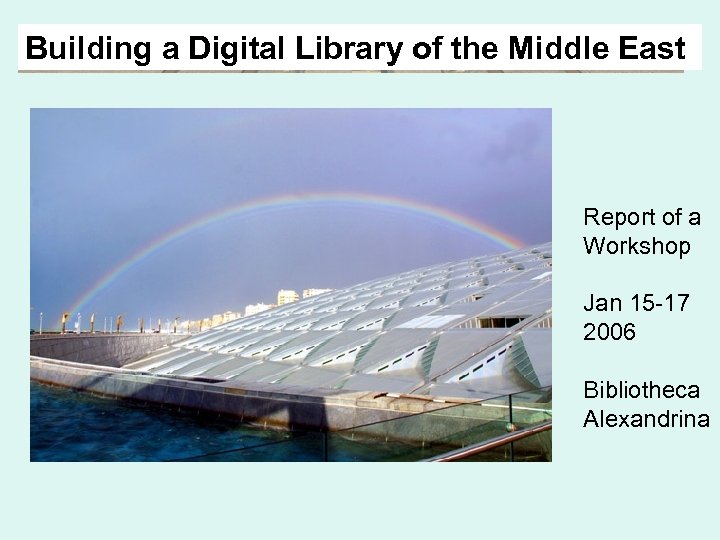
Building a Digital Library of the Middle East Report of a Workshop Jan 15 -17 2006 Bibliotheca Alexandrina
• Presenters: - Steve Griffin, National Science Foundation - Joan Lippincott, Coalition for Networked Information - Joyce Ray, Institute of Museum and Library Services - Don Waters, Mellon Foundation
Workshop Sponsors
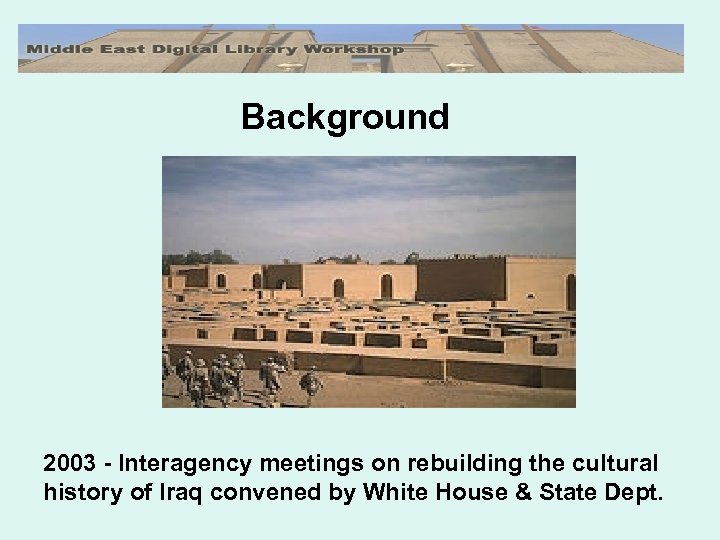
Background 2003 - Interagency meetings on rebuilding the cultural history of Iraq convened by White House & State Dept.
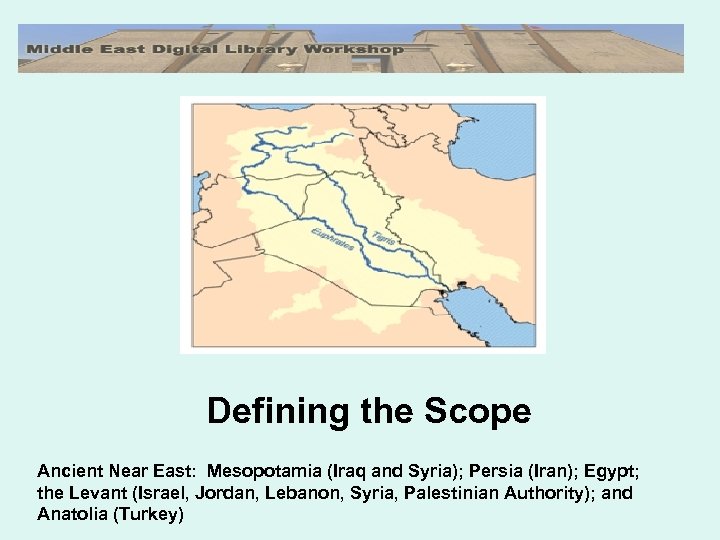
Defining the Scope Ancient Near East: Mesopotamia (Iraq and Syria); Persia (Iran); Egypt; the Levant (Israel, Jordan, Lebanon, Syria, Palestinian Authority); and Anatolia (Turkey)
U. S. -Egypt Joint Science & Technology Fund Grant to The Institute of Museum & Library Services and Bibliotheca Alexandrina June 2005
Coordinating Committee Noha Adly - Director of Information and Communication Technology Department and ISIS (International School of Information Science), Bibliotheca Alexandrina Stephen Griffin - Program Director, Computer and Information Science and Engineering, National Science Foundation Kenneth Hamma - Executive Director, Digital Policy and Initiatives, J. Paul Getty Trust Ronald Larsen - Dean, School of Information Sciences, University of Pittsburgh Joan Lippincott - Associate Executive Director, Coalition for Networked Information Magdy Nagi - Head of the Information and Communication Technology Sector, Bibliotheca Alexandrina Joyce Ray - Associate Deputy Director for Library Services, Institute of Museum and Library Services
Workshop Objectives August 2005 Planning Meeting • Agree on a long-term vision • Assess the current information infrastructure in the Middle East and examine the potential for establishing advanced research networks • Identify a model for content aggregation, management, and preservation • Identify content scope and services • Document requirements as a roadmap for future actions
Desirable Characteristics of the Digital Library August 2005 Planning Meeting • A framework that can accommodate resources from many sources and subject areas • Content that has public value, is easily navigable, and is unrestricted for use • Connected to a large network supporting wide-scale access and exchange • Maintained in a trusted repository with appropriate redundancy to ensure long-term preservation and continuity of access
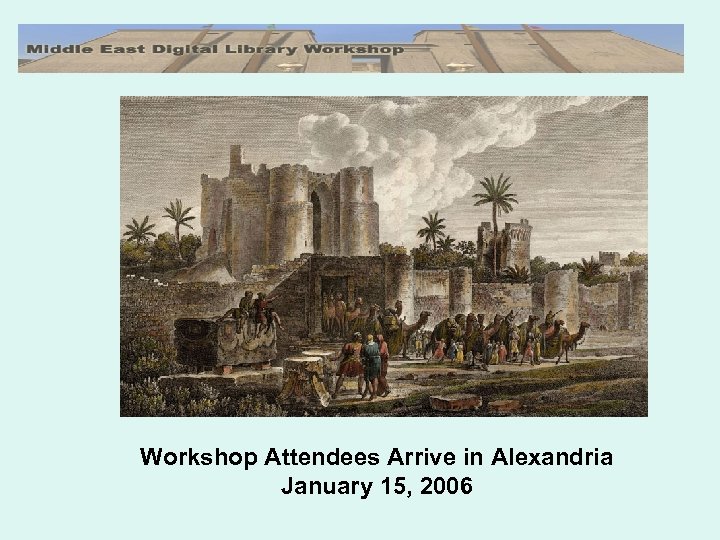
Workshop Attendees Arrive in Alexandria January 15, 2006
Working Groups • Vision and Mission • Network Infrastructure • Content, Collections and Users • Interoperability and Standards
Vision and Mission Working Group Steve Griffin, NSF Ron Larsen, University of Pittsburgh
• High-level Vision: - A global knowledge infrastructure that supports the free flow of information; captures many forms of human expression; maximizes use of resources; and serves the research, education and information needs of all people
• Vision for MEDL: - To promote the preservation and understanding of the cultural heritage of the Middle East through the collection, curation and dissemination of a sustainable digital record
• Scope: - Worldwide resources from and about the cultures and societies of the Middle Eastern and Arab worlds
• Features: - Multilingual & Multimedia - Distributed, Open & Interoperable - Integrated into the global knowledge infrastructure - Collaborative - Adaptable for Different Audiences - Sustained
• Anticipated Results: - New relationships among cultural heritage organizations - New scholarly collaborations - New resources for education and study - A fuller, shared understanding of the historic human experience and its bearing on the present
Network Infrastructure Working Group Heather Boyles, Internet 2
• Egyptian R&E Community - 124 Research Centers and Institutes covering 32 Ministries - 16 Governmental Universities - Private Universities and Research Centers - Bibliotheca Alexandrina
• Digital Library Support - Memorandum of Understanding with Internet 2 - Increase bandwidth and bandwidth reservation to move materials such as images, audio and video into general use - Support digital library research such as indexing, new services and capabilities
Egypt NRENS http: //www. frcu. eun. eg/docs-n/index-ee. php http: //www. sti. sci. eg/index 2. htm
Content, Collections and Users Working Group Ken Hamma, Getty Trust Joan Lippincott, CNI
• “Content View” – Focus on inexpensively acquired content – Build the mass of the library – Attract users who would find this content useful • “User View” – Identify likely user communities – Build content to meet their needs
• Conclusion: focus on users – Produce scenarios of use – Develop measures based on targeted outcomes in education, training, and technology literacy
• Content – Determine scope • Cultural heritage or broader, e. g. scientific • Primarily educational? – Give attention to born-digital materials, not just digitized collections – Consider priority for aggregation projects, those that bring together related, dispersed resources
• Content – Balance of library-style and museum-style (curated, exhibit type) collections – Balance needs of scholars and general public – Develop a preservation strategy
• Services – Develop nuanced identification of user groups – Assess technology readiness of user groups – Encourage the community to create content and not just access it – Develop a structure that encompasses development of community as well as delivery of content and services
• Services – Develop a research/evaluation agenda • • Needs assessment Usability studies Use analysis Outcomes appraisal
• Next steps: – Inventory content already available in digital form – Clarify interests of institutional partners – Conduct preliminary needs assessment – Identify issues - connectivity, access, infrastructure - of importance near-term – Small pilot projects
• Next steps: - Workshop • Potential partners from many countries • Refine a plan for the digital library • Secure commitments from participants to contribute content and/or services
Interoperability and Standards Working Group Sam Quigley, Harvard Don Waters, Mellon Foundation
Assumptions • MEDL will involve a federation of participating institutions, but these have yet to be identified and readiness and need to implement particular standards will likely vary • Content focus of MEDL also has not been identified, but will likely involve various formats • Experience suggests the value of standardcompliant procedures, but it is not fruitful at this stage to articulate a full suite of applicable standards at all levels
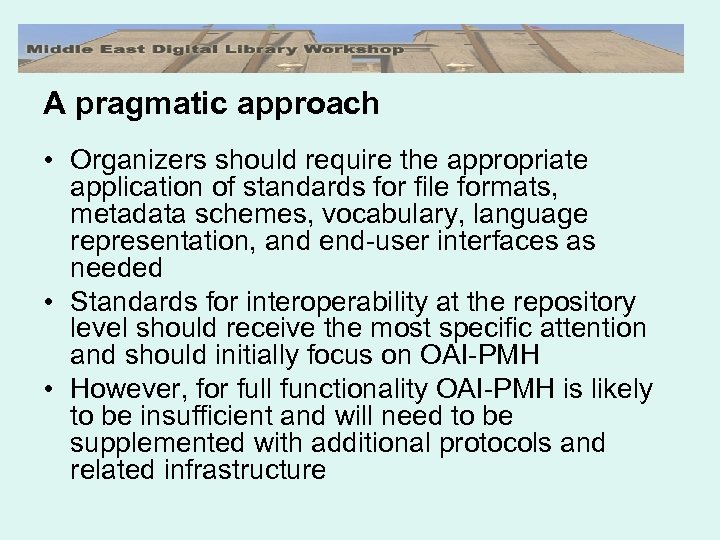
A pragmatic approach • Organizers should require the appropriate application of standards for file formats, metadata schemes, vocabulary, language representation, and end-user interfaces as needed • Standards for interoperability at the repository level should receive the most specific attention and should initially focus on OAI-PMH • However, for full functionality OAI-PMH is likely to be insufficient and will need to be supplemented with additional protocols and related infrastructure
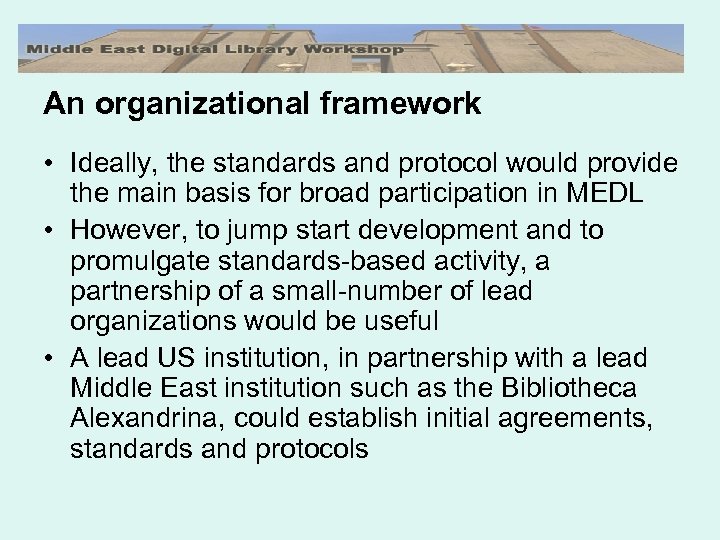
An organizational framework • Ideally, the standards and protocol would provide the main basis for broad participation in MEDL • However, to jump start development and to promulgate standards-based activity, a partnership of a small-number of lead organizations would be useful • A lead US institution, in partnership with a lead Middle East institution such as the Bibliotheca Alexandrina, could establish initial agreements, standards and protocols
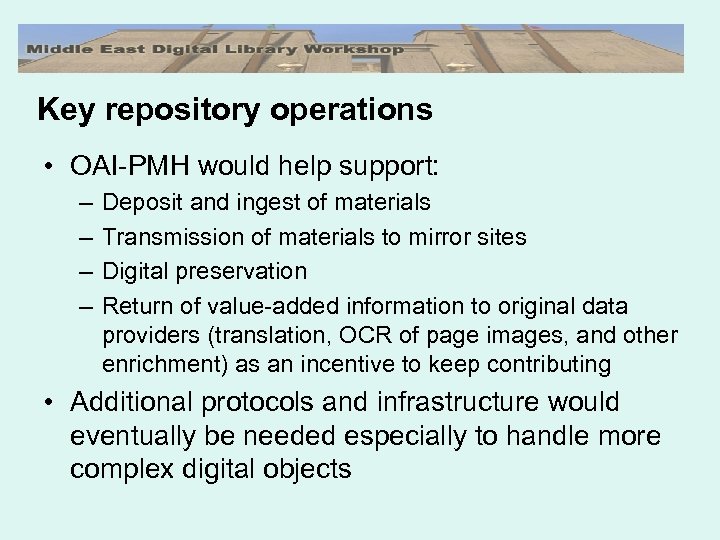
Key repository operations • OAI-PMH would help support: – – Deposit and ingest of materials Transmission of materials to mirror sites Digital preservation Return of value-added information to original data providers (translation, OCR of page images, and other enrichment) as an incentive to keep contributing • Additional protocols and infrastructure would eventually be needed especially to handle more complex digital objects
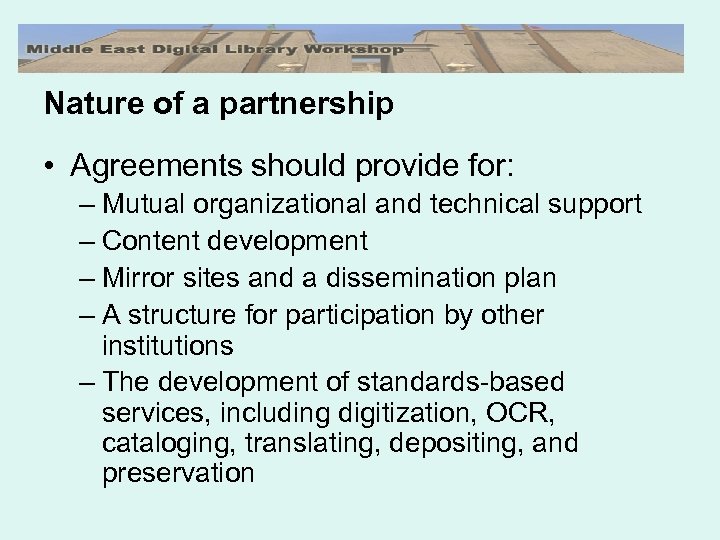
Nature of a partnership • Agreements should provide for: – Mutual organizational and technical support – Content development – Mirror sites and a dissemination plan – A structure for participation by other institutions – The development of standards-based services, including digitization, OCR, cataloging, translating, depositing, and preservation
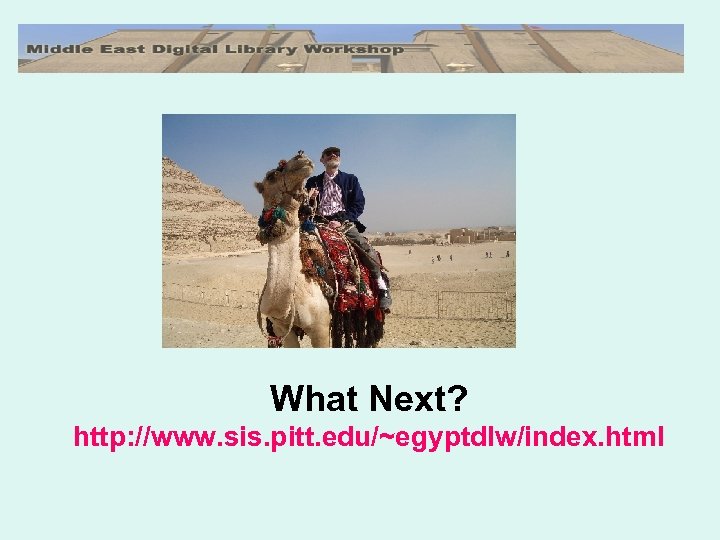
What Next? http: //www. sis. pitt. edu/~egyptdlw/index. html
Скачать презентацию Building a Digital Library of the Middle East
e4d0f9647d74637940c2c4fe9a540489.ppt