 Скачать презентацию Building a Culture of Peace Shaping the Vision
cfe98630946e89262dc3ae8034cf7db7.ppt
- Количество слайдов: 81



“Building a Culture of Peace: Shaping the Vision, Living the Dream” Media, Technology and Peace Carolyn O. Arguillas Minda. News Catholic Educators Association of the Philippines 2011 National Convention 22 September 2011


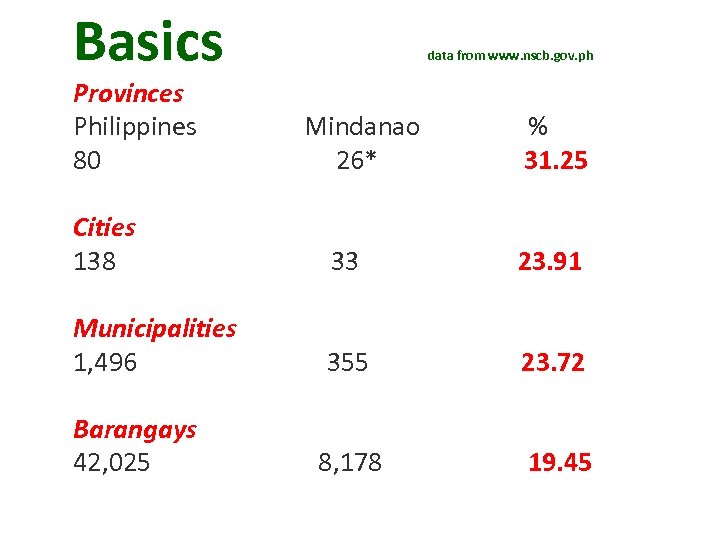
Basics data from www. nscb. gov. ph Provinces Philippines Mindanao % 80 26* 31. 25 Cities 138 33 23. 91 Municipalities 1, 496 355 23. 72 Barangays 42, 025 8, 178 19. 45
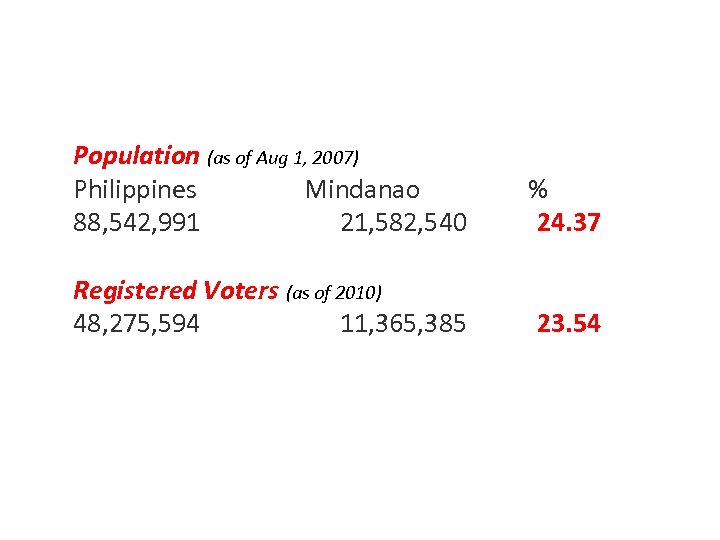
Population (as of Aug 1, 2007) Philippines Mindanao % 88, 542, 991 21, 582, 540 24. 37 Registered Voters (as of 2010) 48, 275, 594 11, 365, 385 23. 54
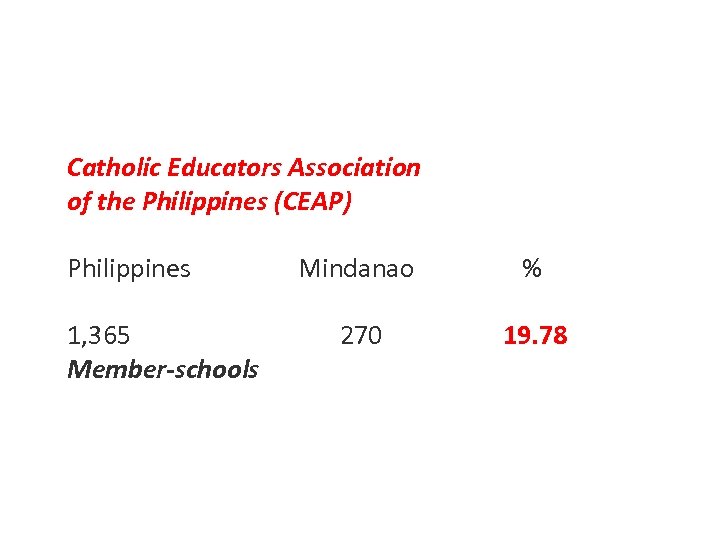
Catholic Educators Association of the Philippines (CEAP) Philippines Mindanao % 1, 365 270 19. 78 Member-schools
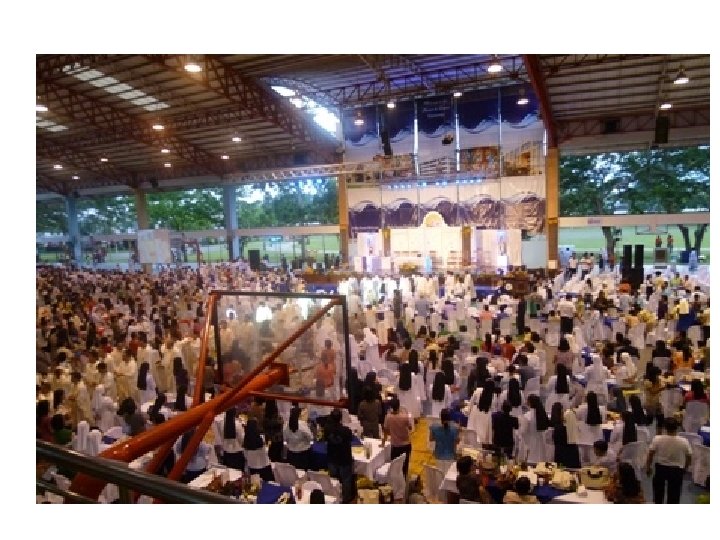
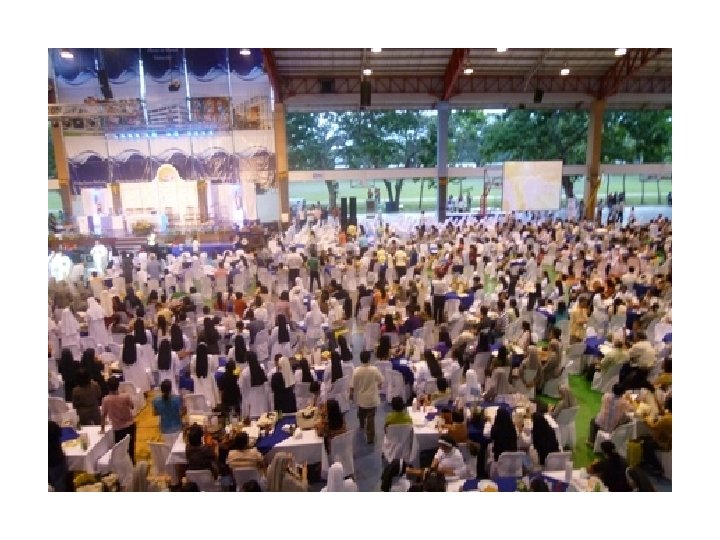
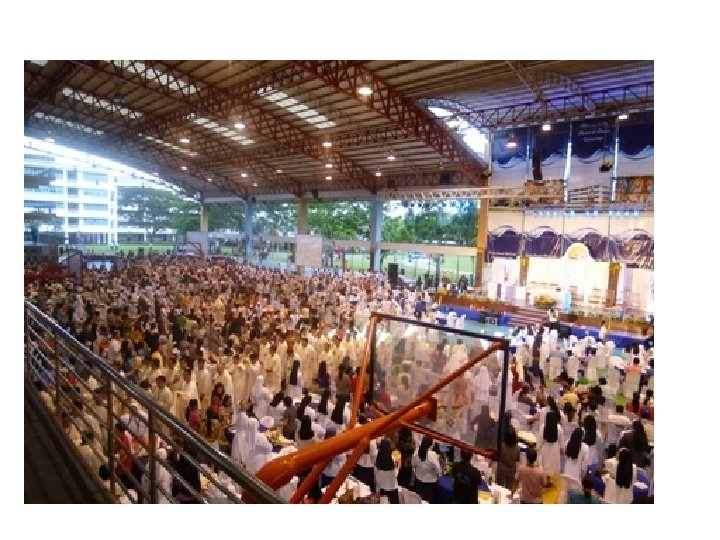
CEAP Mindanao schools are not just in the cities but also in Moro and Lumad areas CEAP Mindanao schools have produced governors, mayors, doctors, nurses, engineers, generals, priests, nuns, revolutionary leaders, journalists, etc. .
How many CEAP member-schools are offering mass communications courses?
How many journalists* have been produced by CEAP member-schools? * Graduates of Mass Comm or other disciplines
Top 15 networking sites
Internet, social networking sites, Youtube, etc. have changed our lives We can watch the uprising in Libya right in our own bedrooms We can comment on issues anytime We can connect with friends worldwide We can correct misconceptions, errors in fact quickly, etc. .
The reality is: not everyone has access to the internet and social networking sites, especially in rural areas in Mindanao and other rural areas in Luzon and Visayas But in rural areas, you can be sure that no matter how limited their access is or how few the copies are, there are textbooks in schools and they can listen to the radio or television stations
Internet, Social networking sites, Youtube, Mobile phones, 24/7 news, etc… But what is the message? How where these messages shaped by schools, by media?
Keynote address of Fr. Alejo Textbooks and Posters used Grade 1 to 6; 1 st year to 4 th year High School Based on Social Studies/Sibika textbooks studied (authors mostly from Metro Manila) Dominant images of Mindanao: war zone land of conflict predominantly Muslim
Dominant images of Mindanao based on textbooks studied: no heroes no tourist spots no economic contribution to the country no contribution to the protest movement under martial law, etc. . Errors in fact Taosug in Lanao Maguindanaons in Davao del Sur Maranaos in Sulu, Tawi-tawi, etc. .
Alejo’s keynote address: “ Is it possible that in our ordinary school life we are actually hurting other groups? ” “Is it possible that in the midst of our classrooms, we are engaged in violence? This textual violence is hurting the sensibilities of our brothers (and sisters)”
Alejo’s keynote address: “ How can schools contribute to peace? ” “How can schools contribute to unpeace? ” “Can we admit that we are part of the problem? ”
Teachers can pass on their ignorance to at least 40 Grade school and High School students per schoolyear or about the same number of college students per semester Journalists can pass on their ignorance to millions of people every day, every hour, every second

Wittingly or unwittingly we are part of the problem But can we be part of the solution, too?
“Mindanao” Mention and the word evokes images of
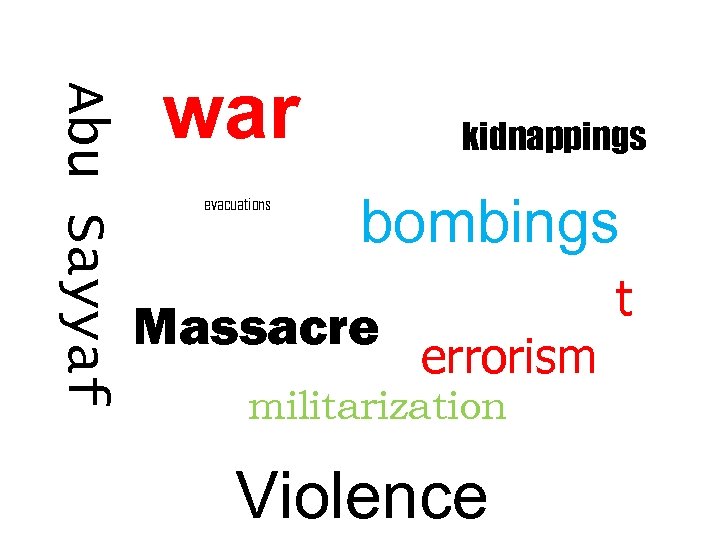
Abu Sayyaf war evacuations kidnappings bombings Massacre errorism militarization Violence t
Mindanao is - home to more than half of the country’s armed forces; - home to all Moro liberation fronts (MNLF, MILF) - home to the largest concentration of communist guerrillas (CPP-NPA-NDF now referred to by the Aquino administration as C-N-N)* - home to the Abu Sayyaf - home to private armies** - breeding ground for military rebels * CNN is nationwide ** also nationwide
Mindanao is - richest in natural resources (vast agricultural lands, mineral resources such as gold, silver, nickel, copper, uranium…) - home to so many peace-building initiatives (NGOs and POs, church, media, academe, military, business, etc. . ) - paradise for its 21. 5 million residents
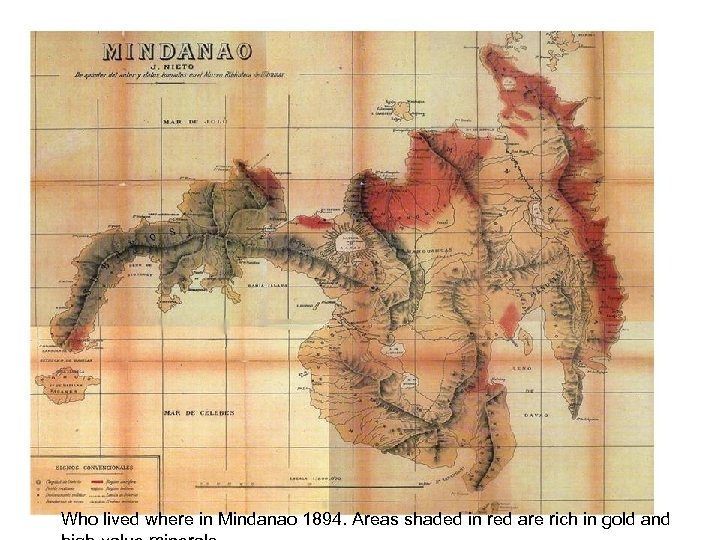
Who lived where in Mindanao 1894. Areas shaded in red are rich in gold and
1898 Through the Treaty of Paris of 1898, Spain sold what is now the Philippines (including areas in Mindanao it failed to conquer in its three-century reign) to America for 20 million dollars. The Bangsamoro Sultanates in Sulu and Maguindanao and the Pat a Pangampong ko Ranao (Confederation of the Four Lake- based Emirates) in Lanao del Sur which had their own governance systems, as well as the Lumads (indigenous peoples) were taken over by American laws and decrees Subsequent land laws pushed the Bangsamoro into the margins and as more settlers came from the Visayas and Luzon islands, the Moro and Lumads were also minoritized
1968 (founding of the Mindanao Independence Movement and Moro National Liberation Front) 1898 to 1968 =70 years Bangsamoro, Lumad marginalized, minoritized Land laws favored settlers and corporations
Martial Law 1972 -1986 ( “paper lifting” of martial law in 1981) newspapers, radio and TV stations closed in 1972; only government-owned and government-controled papers and stations operated Imagine Mindanao in the 1970 s? Telephones as of 1986: easier to drive/commute to Tagum City (56 kms away) than to call
1976 Afraid of an oil embargo, Marcos opened peace talks with the Moro National Liberation Front (MNLF) under chair Nur Misuari n 1974, culminating in the Tripoli Agreement of 1976. Despite the MNLF’s protest, Marcos managed to set up two instead of one autonomous region in Muslim Mindanao. They were “autonomous” in name only. Late 1970 s, Early 1980 s MNLF vice chair Salamat Hashim break away, forms Moro Islamic Liberation Front (MILF)
1986 Marcos ousted; Democracy restored; Corazon Aquino is President (among the first things she did was to meet with Moro rebel leader Nur Misuari in Jolo, Sulu, against the wishes of her military; but no peace agreement was signed under her administration) Under her term, a Constitutional provision granted “autonomy” to Muslim Mindanao, purportedly to implement the 1976 Tripoli Agreement 1996 Sept. 2 Final Peace Agreeement between government and MNLF signed (as of June 2011, implementation is still under review) 1996 November Bishops-Ulama Forum (now Conference) established; first meeting in Cebu 1997 Peace Process with Moro Islamic Liberation Front (MILF) starts
1988 Workshop on Reporting for Peace in Mindanao El Corazon Hotel, Cotabato City, September 8 -10 National Conference-Workshop on the Role of Communication in Christian-Muslim Mindanao, Zamboanga City
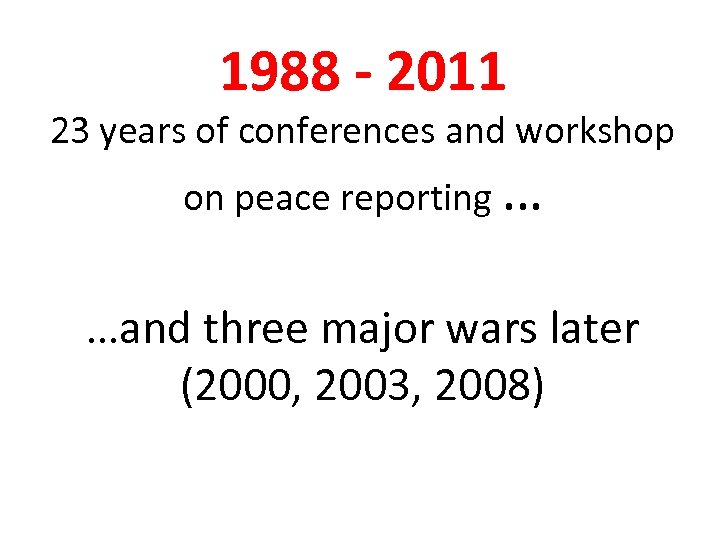
1988 - 2011 23 years of conferences and workshop on peace reporting … …and three major wars later (2000, 2003, 2008)
Why are the problems on reportage persisting?
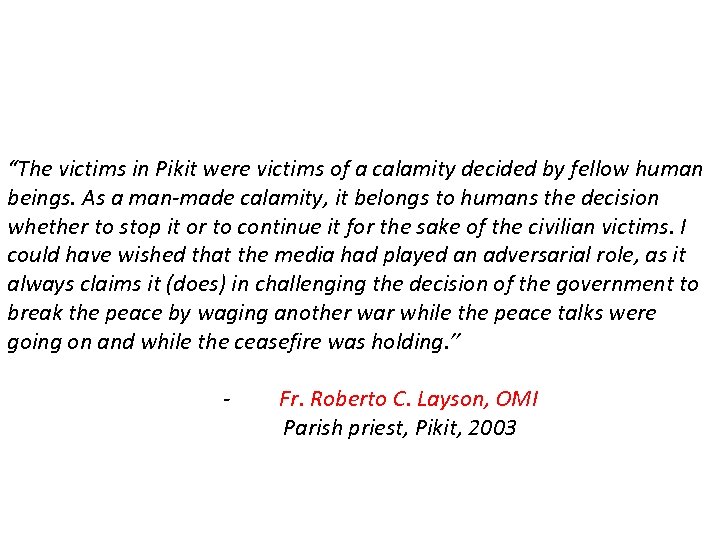
“The victims in Pikit were victims of a calamity decided by fellow human beings. As a man-made calamity, it belongs to humans the decision whether to stop it or to continue it for the sake of the civilian victims. I could have wished that the media had played an adversarial role, as it always claims it (does) in challenging the decision of the government to break the peace by waging another war while the peace talks were going on and while the ceasefire was holding. ” - Fr. Roberto C. Layson, OMI Parish priest, Pikit, 2003
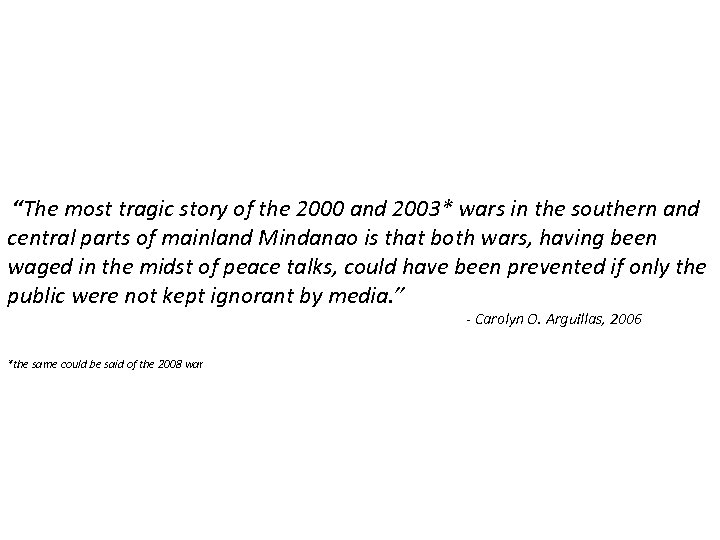
“The most tragic story of the 2000 and 2003* wars in the southern and central parts of mainland Mindanao is that both wars, having been waged in the midst of peace talks, could have been prevented if only the public were not kept ignorant by media. ” - Carolyn O. Arguillas, 2006 *the same could be said of the 2008 war
The truth is -most Filipinos, the media included, do not know the history of the Bangsamoro and the Lumads of Mindanao; that a major historical injustice was done to them; the history that was passed on to us was history written by the “victors” who taught us the Lumads were “uncivilized” and that “a good Moro is a dead Moro” -over the decades, the Moro has been referred to as “them” and the predominantly Catholic majority as “us” -in the earlier stages of the Moro struggle, vested interest groups made it appear religion was the cause of the problem; it is not
The truth is -those who learn the history of the Bangsamoro and the Lumad understand the need to rectify the historical injustices - findings from a series of consultations nationwide (Konsult Mindanaw in 2009 and Dialogue Mindanaw in 2010) showed people are sick and tired of war and want peace, and are willing to do their share as stakeholders of peace - findings also showed that people are interested in learning more about the peace processes
Challenges (External/outside Mindanao) 1. International wire agencies dictate what IS and what is NOT news for the rest of the world Manila, seat of all the national newspapers, radio and television networks, dictates what IS and what is NOT news for the rest of the country (although thanks to the internet, mobile phones, social networking sites, this is slowly changing) 2. For Manila, Mindanao is just a “defense beat, ” the source of headline or front page stories: war, bombings, terrorism, kidnapping, etc.
3. When major story in Mindanao breaks out, networks send over their reporters instead of rely on their Mindanao-based team 4. Reporters sent, like soldiers deployed to Mindanao, are generally not briefed on, say, the government-Moro conflict; no briefing, too, on the peace talks. Some do research but many don’t. 5. Mindanao gets caught in a crossfire between warring networks; who gets to put “exclusive” first, not necessarily who gets it right first; reporters issued memo when rival network gets “exclusive”
6. Mindanao assignment for Manila media is a much-coveted assignment. Like military assignments, a Mindanao assignment can be a source of promotion; more money (read: “racket” or “sideline”; read: new car, new house, etc. . ), fame (read: war correspondents are popular) 7. Majority of the population unaware of what Prof. Rodil, the expert on Moro and Lumad history, is talking about 8. Majority of the population ignorant of roots of the government-Moro conflict; biases/prejudices high [Mindanao’s state u presidents met in early January 2010 in Penang, Malaysia] 9. Martial law carryover. And more…
In fairness, there have been some changes in the last decade among the Manila-based media Glenda M. Gloria cites factors behind these changes: 1. ) Intense focus on Mindanao 2. ) Opening of the public sphere to diverse views 3. ) Global scrutiny of the media 4. ) A more discriminating audience
Challenges (Internal) 1. Journalists are not briefed on the roots of the GPH-MNLF, GPH-MILF conflict. Few bother to research because of deadlines 2. Media culture in one’s area not conducive 3. Media culture is reflective of the prevailing culture in the area
4. The issue is too complex 5. No briefing either on the peace processes (GPHMNLF, GPH-MILF, GPH-NDF) 6. Very few Mindanao-based media have regular staff 7. Many Mindanao branches of Manila-based media radio/TV rely on public officials’ “blocktime programs” for survival
8. Martial law carryover (Mindanao = military/defense beat) 9. Very few media practitioners are Moro 10. Very few media practitioners are Lumad, etc. .
Mindanao in the National Media Who is telling our stories, our narratives, our pains, our struggles, our triumphs? From whose perspectives are our stories told? From whose framing?
so many noble efforts undertaken but. . tired of complaining we decided to do something

Changing the discourse Communicating Mindanao
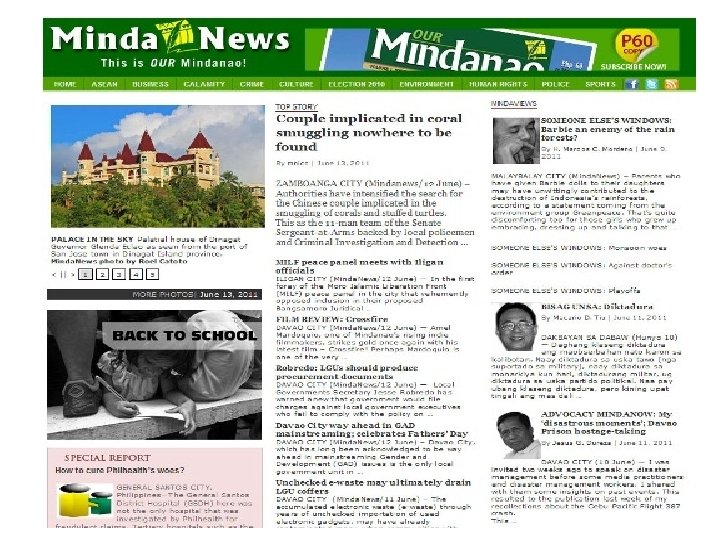
2001 - A year after Estrada’s “all out war, ” at least 15 of us Mindanao journalists of like mind and heart, mostly from the country’s largest newspaper, resigned to set up Minda. News, a daily news service operated by a media cooperative - as a struggling media cooperative, we knew we couldn’t afford to come up with a newspaper. Thanks to the internet, we could share with the rest of the world our stories
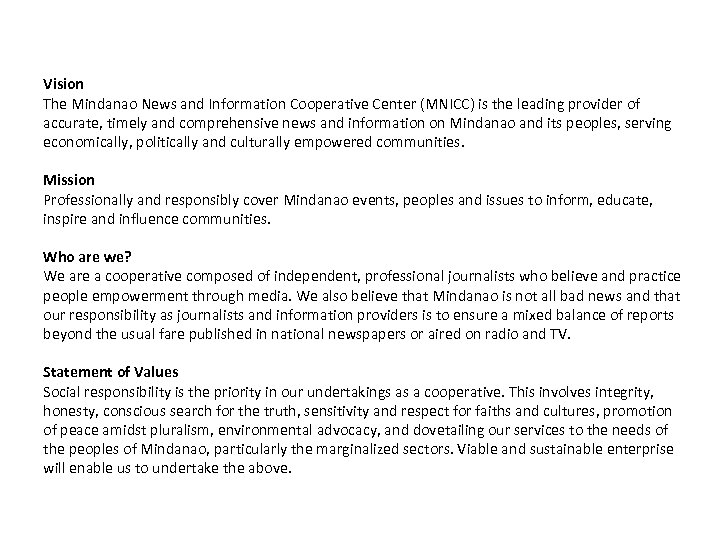
Vision The Mindanao News and Information Cooperative Center (MNICC) is the leading provider of accurate, timely and comprehensive news and information on Mindanao and its peoples, serving economically, politically and culturally empowered communities. Mission Professionally and responsibly cover Mindanao events, peoples and issues to inform, educate, inspire and influence communities. Who are we? We are a cooperative composed of independent, professional journalists who believe and practice people empowerment through media. We also believe that Mindanao is not all bad news and that our responsibility as journalists and information providers is to ensure a mixed balance of reports beyond the usual fare published in national newspapers or aired on radio and TV. Statement of Values Social responsibility is the priority in our undertakings as a cooperative. This involves integrity, honesty, conscious search for the truth, sensitivity and respect for faiths and cultures, promotion of peace amidst pluralism, environmental advocacy, and dovetailing our services to the needs of the peoples of Mindanao, particularly the marginalized sectors. Viable and sustainable enterprise will enable us to undertake the above.

elucidate, not exacerbate
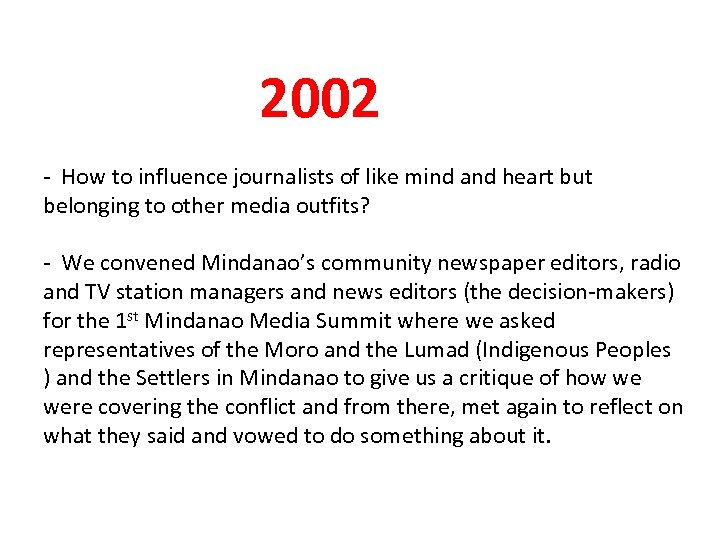
2002 - How to influence journalists of like mind and heart but belonging to other media outfits? - We convened Mindanao’s community newspaper editors, radio and TV station managers and news editors (the decision-makers) for the 1 st Mindanao Media Summit where we asked representatives of the Moro and the Lumad (Indigenous Peoples ) and the Settlers in Mindanao to give us a critique of how we were covering the conflict and from there, met again to reflect on what they said and vowed to do something about it.
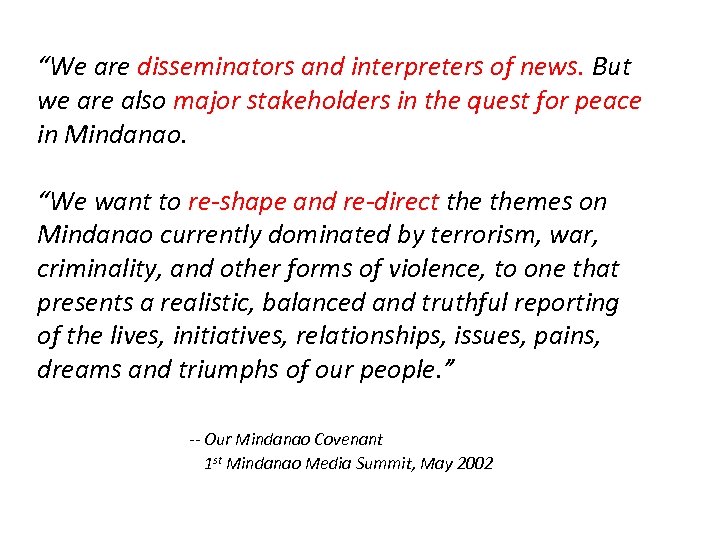
“We are disseminators and interpreters of news. But we are also major stakeholders in the quest for peace in Mindanao. “We want to re-shape and re-direct themes on Mindanao currently dominated by terrorism, war, criminality, and other forms of violence, to one that presents a realistic, balanced and truthful reporting of the lives, initiatives, relationships, issues, pains, dreams and triumphs of our people. ” -- Our Mindanao Covenant 1 st Mindanao Media Summit, May 2002
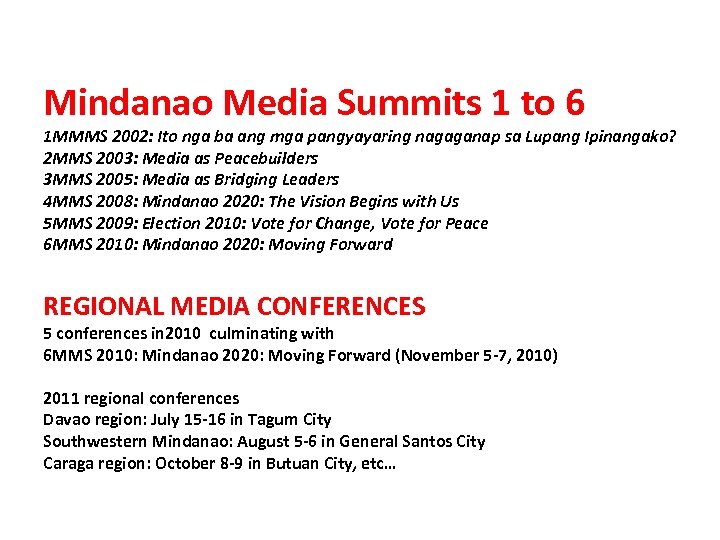
Mindanao Media Summits 1 to 6 1 MMMS 2002: Ito nga ba ang mga pangyayaring nagaganap sa Lupang Ipinangako? 2 MMS 2003: Media as Peacebuilders 3 MMS 2005: Media as Bridging Leaders 4 MMS 2008: Mindanao 2020: The Vision Begins with Us 5 MMS 2009: Election 2010: Vote for Change, Vote for Peace 6 MMS 2010: Mindanao 2020: Moving Forward REGIONAL MEDIA CONFERENCES 5 conferences in 2010 culminating with 6 MMS 2010: Mindanao 2020: Moving Forward (November 5 -7, 2010) 2011 regional conferences Davao region: July 15 -16 in Tagum City Southwestern Mindanao: August 5 -6 in General Santos City Caraga region: October 8 -9 in Butuan City, etc…
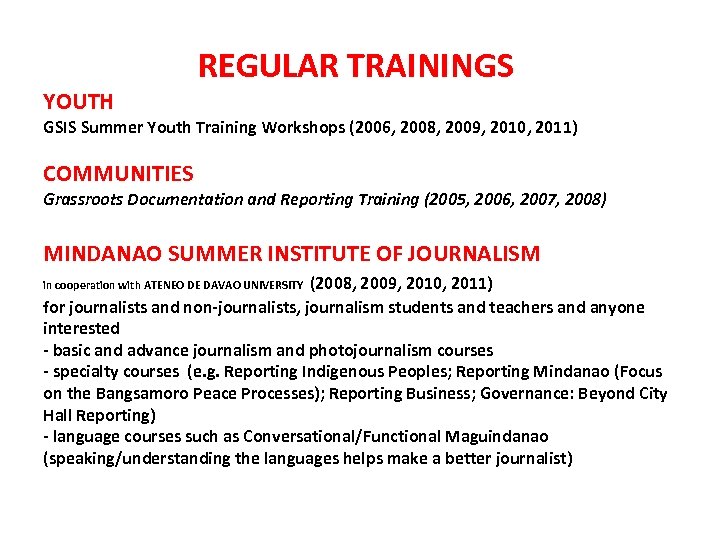
YOUTH REGULAR TRAININGS GSIS Summer Youth Training Workshops (2006, 2008, 2009, 2010, 2011) COMMUNITIES Grassroots Documentation and Reporting Training (2005, 2006, 2007, 2008) MINDANAO SUMMER INSTITUTE OF JOURNALISM (2008, 2009, 2010, 2011) for journalists and non-journalists, journalism students and teachers and anyone interested - basic and advance journalism and photojournalism courses - specialty courses (e. g. Reporting Indigenous Peoples; Reporting Mindanao (Focus on the Bangsamoro Peace Processes); Reporting Business; Governance: Beyond City Hall Reporting) - language courses such as Conversational/Functional Maguindanao (speaking/understanding the languages helps make a better journalist) in cooperation with ATENEO DE DAVAO UNIVERSITY
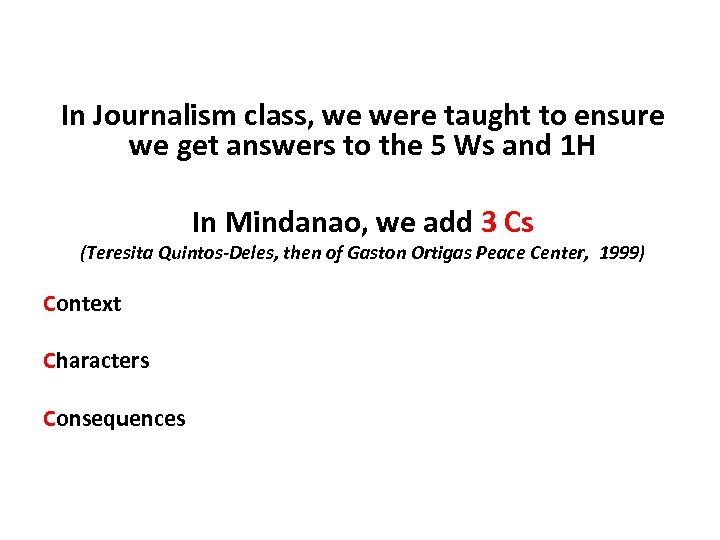
In Journalism class, we were taught to ensure we get answers to the 5 Ws and 1 H In Mindanao, we add 3 Cs (Teresita Quintos-Deles, then of Gaston Ortigas Peace Center, 1999) Context Characters Consequences
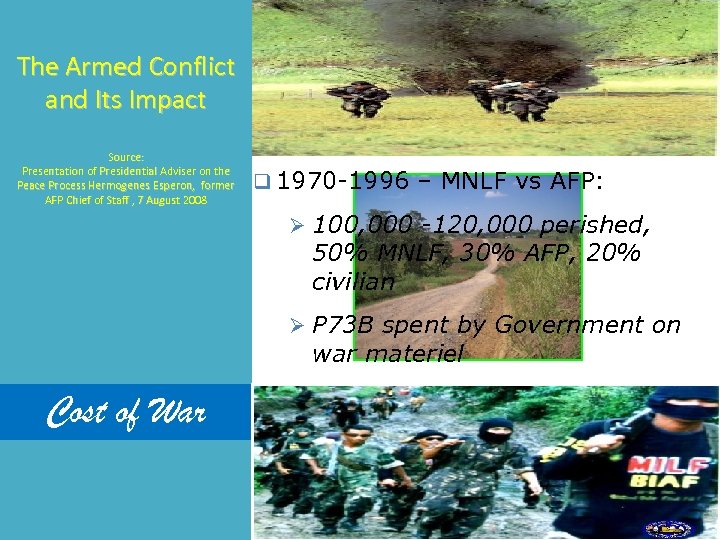
The Armed Conflict and Its Impact Source: Presentation of Presidential Adviser on the Peace Process Hermogenes Esperon, former AFP Chief of Staff , 7 August 2008 q 1970 -1996 – MNLF vs AFP: Ø 100, 000 -120, 000 perished, 50% MNLF, 30% AFP, 20% civilian Ø P 73 B spent by Government on war materiel Cost of War
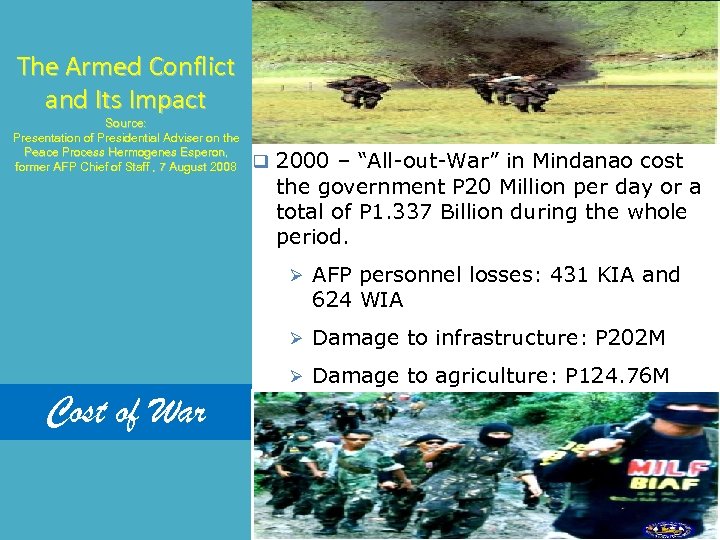
The Armed Conflict and Its Impact Source: Presentation of Presidential Adviser on the Peace Process Hermogenes Esperon, former AFP Chief of Staff , 7 August 2008 q 2000 – “All-out-War” in Mindanao cost the government P 20 Million per day or a total of P 1. 337 Billion during the whole period. Ø AFP personnel losses: 431 KIA and 624 WIA Ø Damage to infrastructure: P 202 M Cost of War Ø Damage to agriculture: P 124. 76 M
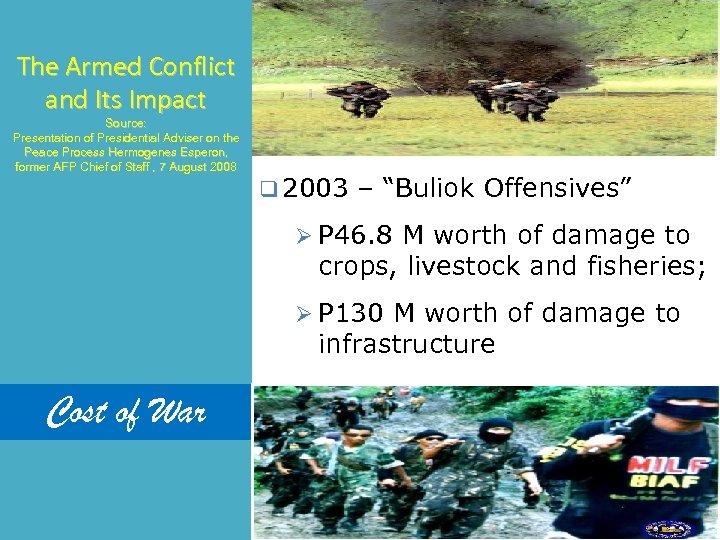
The Armed Conflict and Its Impact Source: Presentation of Presidential Adviser on the Peace Process Hermogenes Esperon, former AFP Chief of Staff , 7 August 2008 q 2003 – “Buliok Offensives” Ø P 46. 8 M worth of damage to crops, livestock and fisheries; Ø P 130 M worth of damage to infrastructure Cost of War
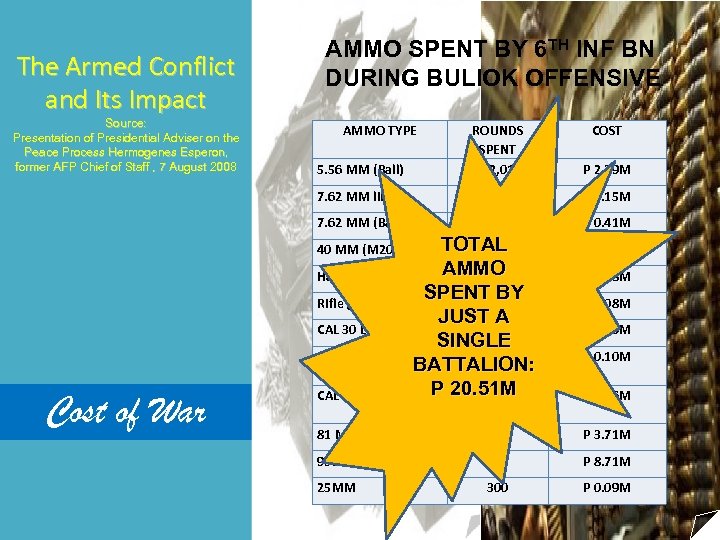
The Armed Conflict and Its Impact Source: Presentation of Presidential Adviser on the Peace Process Hermogenes Esperon, former AFP Chief of Staff , 7 August 2008 AMMO SPENT BY 6 TH INF BN DURING BULIOK OFFENSIVE AMMO TYPE 5. 56 MM (Ball) ROUNDS SPENT 212, 019 P 2. 39 M 7. 62 MM linked 53667 P 1. 15 M 7. 62 MM (Ball) 26821 P 0. 41 M TOTAL 2407 AMMO Hand grenade 126 SPENT 356 BY Rifle grenade JUST A CAL 30 LMG 10348 SINGLE CAL 50 HMG (linked) 16967 BATTALION: P CAL 50 (Ball) spotting 20. 51 M 1200 40 MM (M 203) Cost of War COST P 3. 86 M P 0. 08 M P 0. 59 M P 0. 10 M P 2. 96 M 81 MM Mortar 799 P 3. 71 M 90 MM RR 448 P 8. 71 M 25 MM 300 P 0. 09 M
The Cost of War -Civilians, mostly children and elderly, killed in crossfire or in evacuation centers - mass evacuation -houses, crops, livelihood abandoned -disrupted schooling, disrupted lives, etc. .
The Cost of War - psychological - trauma, hatred, etc… - an even greater divide
Video Documentaries Sana wala nang gyera, Sana wala nang bakwit, 2004 (May there be no war, May there be no more evacuees [ internally displaced persons]) Gyera 2008: Through our Lenses, 2009 (2008 war through photojournalists’ lenses) The “Presidentiables” and Mindanao: Presidential candidates air their views on Mindanao issues, 2009
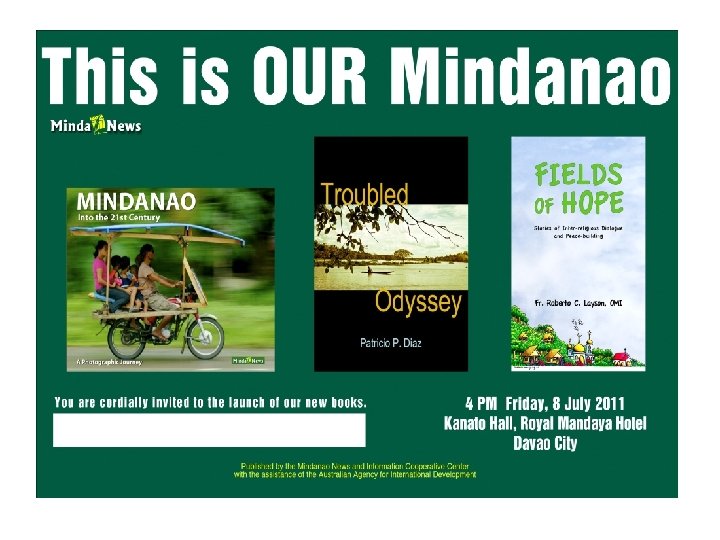
Books Mindanao Under Martial Law: Turning Rage into Courage, 2002 (Minda. News Publications) Understanding Mindanao Conflict by Patricio P. Diaz, 2003 (Minda. News Publications) The GRP-MILF Peace Drafts 2010: Analysis and Comments by Patricio P. Diaz and Rudy Buhay Rodil , 2010 (Minda. News Publications) LAUNCHED 8 JULY 2011 Fields of Hope: Everyday stories of inter-faith dialogues and peace-building. by Fr. Roberto C. Layson, OMI The Troubled Odyssey by Patricio P. Diaz (on the GRP-MILF Peace Process) Mindanao into the 21 st century: A photographic journey FOR LAUNCHING LATER THIS YEAR Handbook on Reporting Mindanao (Forcus on the Bangsamoro Peace Processes)
IGNORANCE OF THE ISSUE EXCUSES NO ONE…. Every January , Minda. News lists books on Mindanao or by Mindanawons published the previous year TOTAL: 259 books from 2000 to 2010, mostly on history and peace-building ONLINE resources are also available
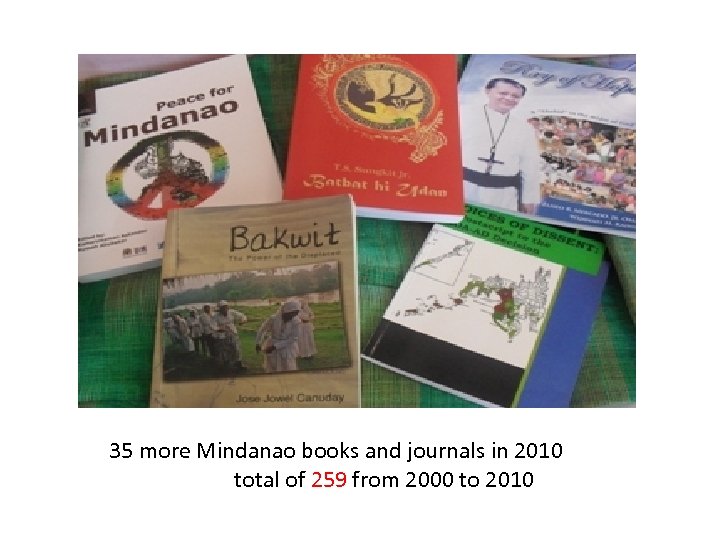
35 more Mindanao books and journals in 2010 total of 259 from 2000 to 2010
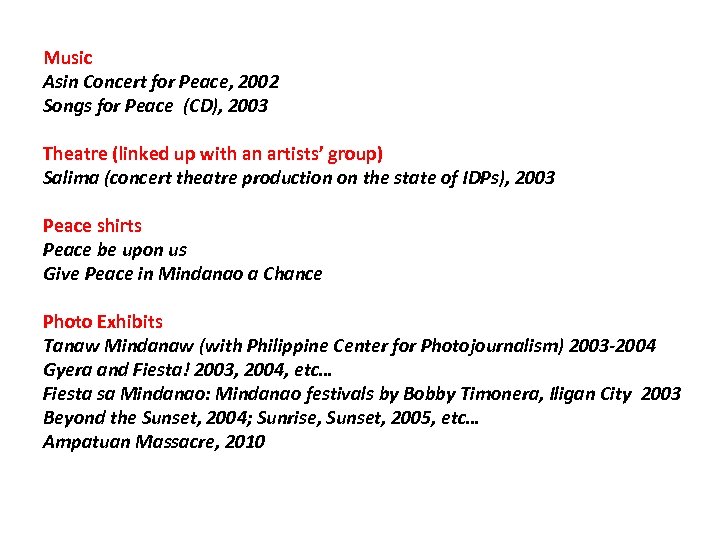
Music Asin Concert for Peace, 2002 Songs for Peace (CD), 2003 Theatre (linked up with an artists’ group) Salima (concert theatre production on the state of IDPs), 2003 Peace shirts Peace be upon us Give Peace in Mindanao a Chance Photo Exhibits Tanaw Mindanaw (with Philippine Center for Photojournalism) 2003 -2004 Gyera and Fiesta! 2003, 2004, etc… Fiesta sa Mindanao: Mindanao festivals by Bobby Timonera, Iligan City 2003 Beyond the Sunset, 2004; Sunrise, Sunset, 2005, etc… Ampatuan Massacre, 2010
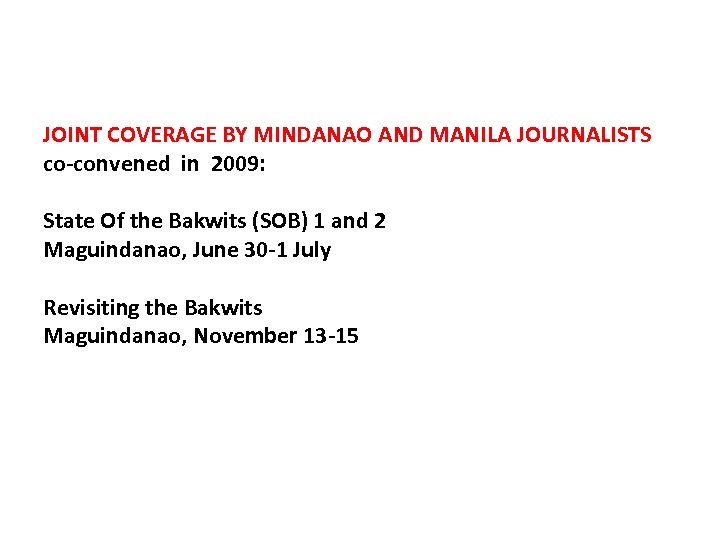
JOINT COVERAGE BY MINDANAO AND MANILA JOURNALISTS co-convened in 2009: State Of the Bakwits (SOB) 1 and 2 Maguindanao, June 30 -1 July Revisiting the Bakwits Maguindanao, November 13 -15
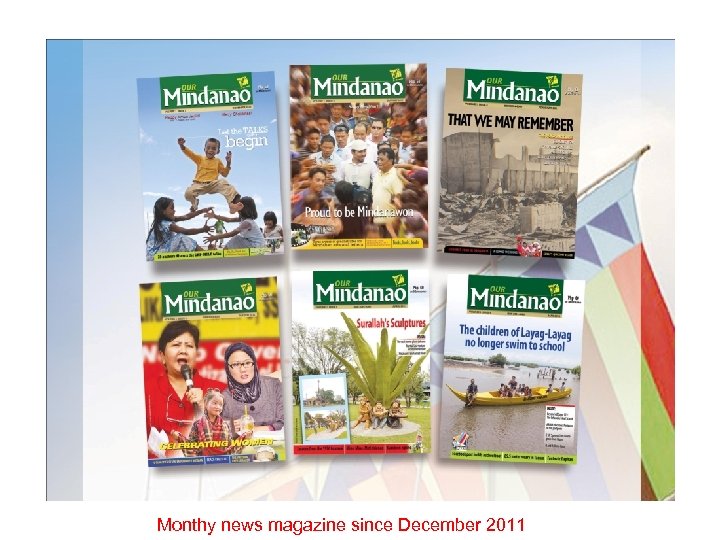
Monthy news magazine since December 2011
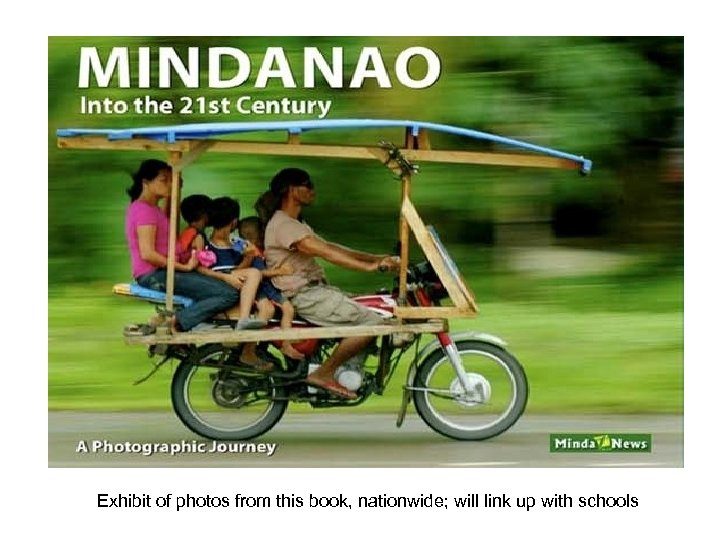
Exhibit of photos from this book, nationwide; will link up with schools

We are a small media outfit. The bigger media outfits can do more
Schools can do a lot more 1. Review textbooks used esp. in Elem and HS 2. Use modules that will be produced by the “Righting History” team 3. Review Mass Comm curriculum 4. Alay Kapwa; Duyog Ramadan– discontinued; some are doing it again like NDU 5. Language courses
Schools can do a lot more What language courses are CEAP schools offering nationwide? French, Japanese, Chinese, etc… Who is offering Maguindanaon language? Taosug? Maranao? Manobo? T’boli? Mandaya?
Schools can do a lot more 6. If there is a UN Day, cannot we have a Luzon Day, Visayas Day, Mindanao Day in school so children grow up knowing our country? 7. Make use of technology to get children interact with children of other faiths and cultures within the country (e. g. through Skype) 8. Interfaith and Intrafaith dialogues should not be for adults only but for children as well 9. What else can you do?
Thank you! Salamat po! Sukran!/Shukran Magsukol! Salamat Karajaw
Скачать презентацию Building a Culture of Peace Shaping the Vision
cfe98630946e89262dc3ae8034cf7db7.ppt