 Скачать презентацию Budget Reform in South Africa National Treasury 2
725c87841f160717cf8aba1e419a11f1.ppt
- Количество слайдов: 28



Budget Reform in South Africa National Treasury 2 December 2004
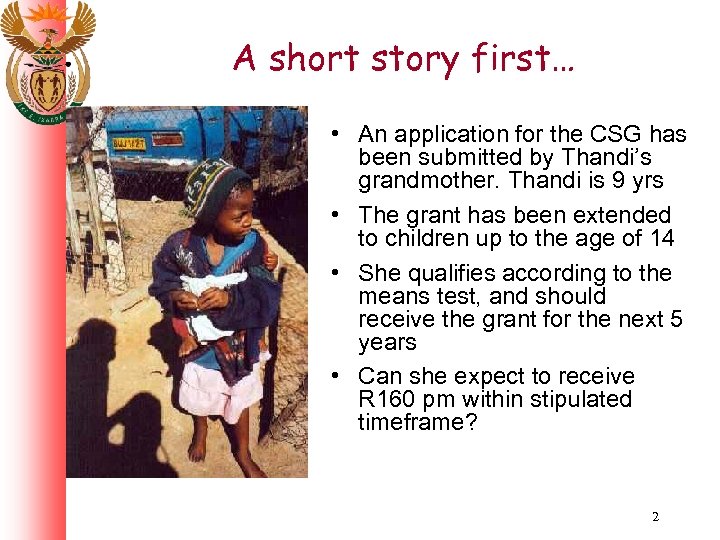
A short story first… • An application for the CSG has been submitted by Thandi’s grandmother. Thandi is 9 yrs • The grant has been extended to children up to the age of 14 • She qualifies according to the means test, and should receive the grant for the next 5 years • Can she expect to receive R 160 pm within stipulated timeframe? 2
So Thandi satisfies all the requirements, but! Diffulty in obtaining ID All of the above solved, but another ten months to process application No payment contractor appointed in her village 3
Why the story? “The MTEF and the full gambit of budget and other public sector reforms is central to ensuring that Thandi’s application for the Child Support Grant is processed speedily and paid without delay” 4
Reforming SA budgeting systems • Shared objectives and design principles integrate different technical aspects • Aspects include – – – IGFR MTEF Budget documentation Public financial management Budgeting for improved service delivery 5
Objectives driving reforms • Ensuring affordable programme budgets • Better link between policy priorities and public expenditure • Ensuring efficient service delivery 6
Principles driving reforms • Alignment between fiscal policy and budget framework – Comprehensiveness, integration and contestability • Political oversight and focus on policy priorities – Policy decisions in budget context, budget decisions in policy context • Using information strategically – Transparency and accountability • Changing behaviour by changing incentives – Devolving responsibility for decision-making to those who have best information and holding them accountable • Ensuring budget stability and predictability while facilitating change at the margin – Managing uncertainty, ensuring stability, forcing change at margin 7
Have we seen results? • Fiscal balances stabilised – Improved macro-economic environment – Reduced debt service cost – Net result: more funds for spending on development priorities, reduced tax burden • Expenditure composition shifted – More on social services – More on poor communities – More investment spending • Budget credibility improved 8
This presentation • Holistic system view of SA reforms • Discussing • (Briefly) IGFR; MTEF; Financial and Performance Management aspects • Benefits • Remaining challenges • Reform process 9
Stabilise the IGFR system • First wave of change to old system focused on stabilising IGFR system • SA unitary state with 3 spheres of government – 1 national; 9 provinces; 284 municipalities – Most revenue collected nationally, shared through equitable shares and conditional grants – Cooperative governance • Determining equitable shares an output of budget process – Intergovernmental forums – Transparent process and formulae 10
MTEF: improving budget preparation The MTEF matches the overall resource envelope, estimated through ‘top-down’ macroeconomic and fiscal policy processes, with the bottom-up estimation of the current and medium-term cost of existing departmental plans and expenditure programmes. But what has it really achieved? • • • More focus on priorities Strengthened link between planning and budgeting Greater certainty in policy implementation Improved efficiency in resource allocation More disciplined fiscal decisions 11
Approach to MTEF reform • Framework approach, rather than sophisticated system – About changing budget process to involve all actors, both political and at official level, not only financial experts – About changing outputs of budget process from annual, incremental plans to affordable, multi-year estimates – First put framework in place, allow quality improvements over time • Important to change incentives in process – Design and implementation • Objectives clear: – Affordable spending plans – Strengthened link between policy and budgeting 12
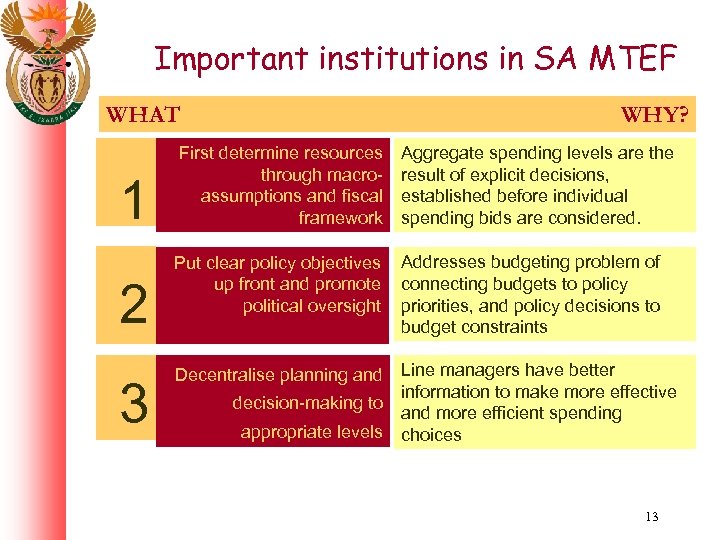
Important institutions in SA MTEF WHAT 1 2 3 WHY? First determine resources through macroassumptions and fiscal framework Aggregate spending levels are the result of explicit decisions, established before individual spending bids are considered. Put clear policy objectives up front and promote political oversight Addresses budgeting problem of connecting budgets to policy priorities, and policy decisions to budget constraints Decentralise planning and Line managers have better information to make more effective and more efficient spending choices decision-making to appropriate levels 13
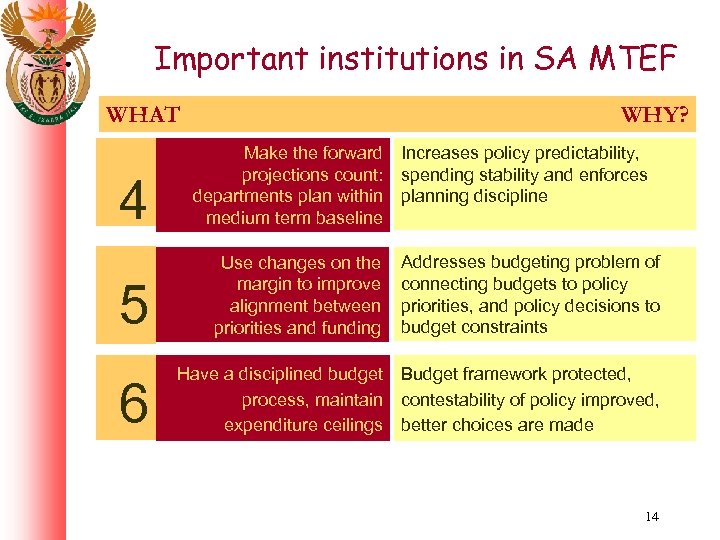
Important institutions in SA MTEF WHAT WHY? 4 Make the forward projections count: departments plan within medium term baseline Increases policy predictability, spending stability and enforces planning discipline 5 Use changes on the margin to improve alignment between priorities and funding Addresses budgeting problem of connecting budgets to policy priorities, and policy decisions to budget constraints 6 Have a disciplined budget process, maintain expenditure ceilings Budget framework protected, contestability of policy improved, better choices are made 14
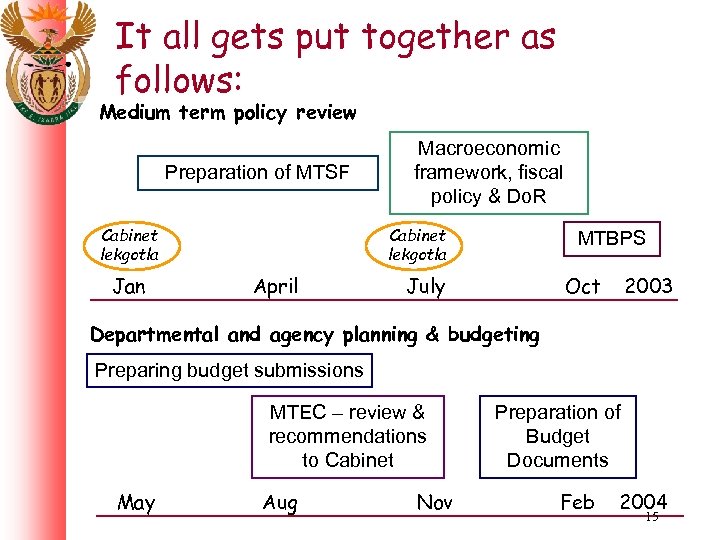
It all gets put together as follows: Medium term policy review Preparation of MTSF Cabinet lekgotla Jan Macroeconomic framework, fiscal policy & Do. R Cabinet lekgotla April MTBPS July Oct 2003 Departmental and agency planning & budgeting Preparing budget submissions MTEC – review & recommendations to Cabinet May Aug Nov Preparation of Budget Documents Feb 2004 15
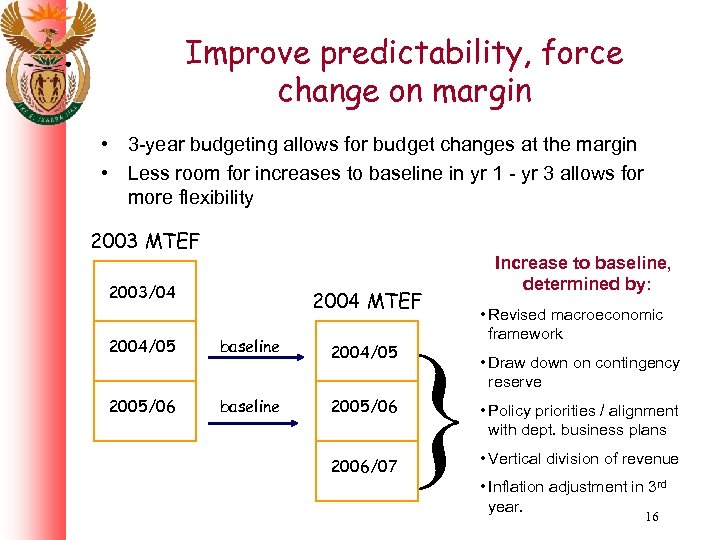
Improve predictability, force change on margin • 3 -year budgeting allows for budget changes at the margin • Less room for increases to baseline in yr 1 - yr 3 allows for more flexibility 2003 MTEF 2003/04 2004 MTEF 2004/05 baseline 2004/05 2005/06 baseline 2005/06 2006/07 } Increase to baseline, determined by: • Revised macroeconomic framework • Draw down on contingency reserve • Policy priorities / alignment with dept. business plans • Vertical division of revenue • Inflation adjustment in 3 rd year. 16
Political oversight • Executive responsible for policy and prioritisation – Faciliated by MTEF budget process • Manage the tension between competing policy priorities and budget realities – Textbooks or infrastructure or more police or all three • Approve final MTEF allocation to departmental programmes – And you thought this was done by the Treasury 17
Improve budget documentation • Improves transparency, which in turn supports accountability and better policy making and implementation • MTBPS – Public pre-budget statement – Serves to signal decisions in budget process – Provides macro-assumptions and fiscal and expenditure policy priorities driving budget • Budget Documentation – Budget Review – Estimates of National Expenditure – Division of Revenue Bill • Other – – IGF Review; Strategic plans and annual reports In-year releases on State of the Budget Auditor General Reports 18
Improved classification • Improves quality of spending information – – Better oversight both internal and external – Better information for managers • Programmatic, administrative, functional and economic classification • New economic reporting format – – – Replaces archaic line item and economic classification Links budget and accounts information Compatible with international standards (GFS 2001) But adapted for SA circumstances (more transparency) Implementation support for spending departments 19
Better financial management • Cornerstone is Public Finance Management Act (PFMA, 2000) – Previously financial administration rule-bound and management input focused, lack of reliable information and poor management of assets and liabilities • Onus of financial management shifted from Treasury to managers of spending agencies • Framework legislation – Sets out roles and responsibilities, establishes reporting requirements and stipulates sanctions – Does not legislate specific procedures, but stipulates what procedures should achieve and who is responsible – Shortens the budget cycle – Providing, but limiting in-year flexibility • Implementation over a five year period – Support for implementing (spending) departments 20
Improved monitoring and reporting • System under review • Appropriate level of detail at appropriate levels to – Enable better managerial decisions – Better oversight and enhance accountability – Fulfill legal requirements • Currently monthly, quarterly and yearly financial reporting, quarterly and yearly performance reporting 21
Improving Budgeting for service delivery • In 1997 information on policy and budget performance meager • Steady improvement – NES, ENE, measurable objectives • Not easy reform – – New concepts and tools Requires new capacity Learning by doing Slow progress 22
Improving budgeting for service delivery (cntd) Measurable Objectives • Increasingly important in budget allocation decisions • Conveys programme impact, outputs achieved and performance level • Should link to subprogramme output targets Increase market access for South African exports in targeted countries through the successful conclusion of trade agreements which are aimed at ensuring fair, predictable and where possible preferential treatment for South African products in foreign markets Subprogramme Output International Trade Development agreements Measure/Indicator Target Number of bilateral and multilateral agreements concluded 23
Preparation of departmental MTEF proposals • Prepare budgets within programmes and economic classifications • Steps 1. Decide on priorities 2. Examine resource envelope (baseline + likely growth) 3. Cost new priorities 4. Reprioritise savings 5. Finalise policy options (objectives, outputs and costs) 6. Any fiscal risks 7. 5 year non-recurrent costs • Need to improve planning budgeting reporting link 24
Benefits of reforms • More stable public finance environment • Improved political involvement and oversight • Improved policy environment and improved performance • Greater transparency All contributing to improved fiscal outcomes as detailed earlier 25
Remaining challenges • Some reform objectives not yet tackled (accrual accounting); other slow to materialise • Specific challenges – Strengthening the planning, budgeting, reporting link – Building capacity throughout system to realise quality improvements – Improving parallel systems – Reforming financing of specific services – Integrating donor financing – Introducing accrual accounting – Improving intergovernmental coordination and support – Improving municipal financing and budgeting 26
Insights from SA reform process • Political commitment to sound public finances and sound budgeting essential • Keep framework simple, make norms transparent • Comprehensive implementation • Make sure it matters • Convince stakeholders that you are serious • A strong central Treasury helps • Build capacity by demanding it, but support its development • Demonstrate ‘wins’ early to build support for reforms 27
Last words • It requires political support from Executive Authority • Dependent on credible forecasts and fiscal discipline • Basics in place and necessary capacity • Having one planning and budget allocation process helps • All relevant parties should participate – transparent system 28
Скачать презентацию Budget Reform in South Africa National Treasury 2
725c87841f160717cf8aba1e419a11f1.ppt