 Скачать презентацию Budget Appropriations and the Chesapeake Bay Program 2017
64da30b02e6b32267c89ed8ba03b5349.ppt
- Количество слайдов: 22



Budget, Appropriations and the Chesapeake Bay Program 2017 -18 Jim Edward - CBPO Deputy Director CITIZENS ADVISORY COMMITTEE MAY 25, 2017
Overview § Timeline § CBP Authorization § Budget Process § Appropriations Process § Where are we now? § 2017 § 2018 § Possible Scenarios § New CBP Budget And Financing Web Pages
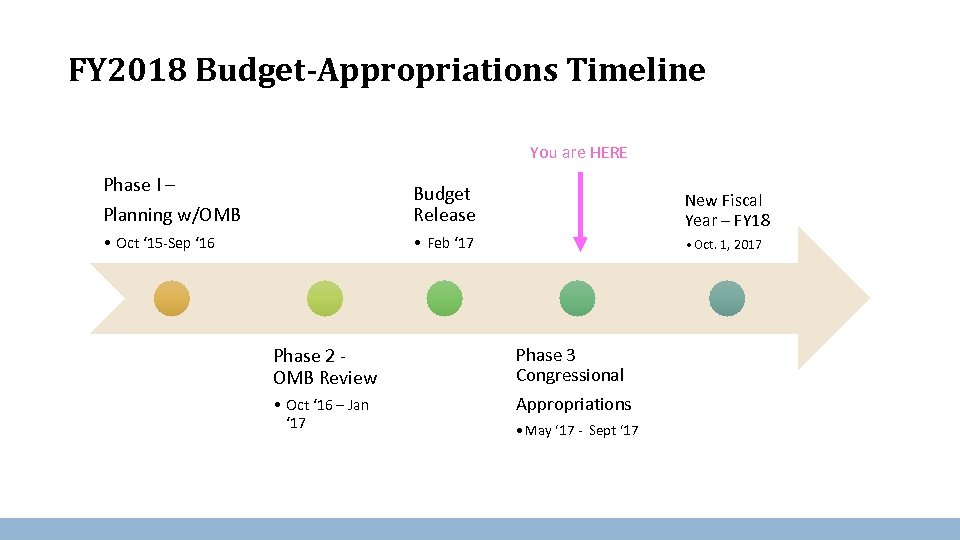
FY 2018 Budget-Appropriations Timeline You are HERE Phase I – Planning w/OMB Budget Release New Fiscal Year – FY 18 • Oct ‘ 15 -Sep ‘ 16 • Feb ‘ 17 • Oct. 1, 2017 Phase 2 - OMB Review Phase 3 Congressional • Oct ‘ 16 – Jan ‘ 17 Appropriations • May ‘ 17 - Sept ‘ 17
CBP Authorization and Appropriation § Clean Water Act, Section 117, provides authority for the Chesapeake Bay Program and directs the EPA to maintain a Chesapeake Bay Program Office (CBPO) and to coordinate many of the activities of the program. It was last amended Nov. 7, 2000 § CBP’s current maximum authorization level is set at $40 million per year (through 2005). § Okay to exceed that level – and has for years. § CBP’s current congressional appropriations funding level is $73 million
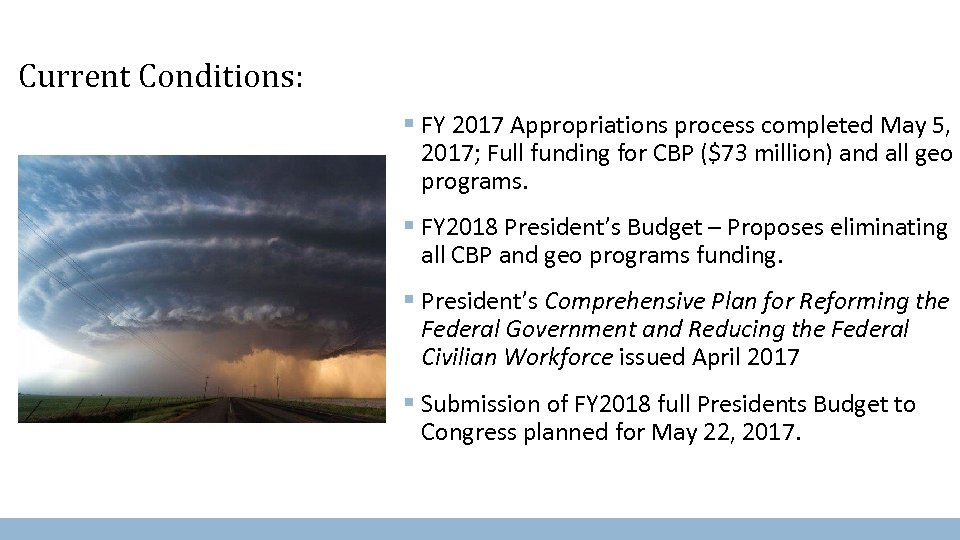
Current Conditions: § FY 2017 Appropriations process completed May 5, 2017; Full funding for CBP ($73 million) and all geo programs. § FY 2018 President’s Budget – Proposes eliminating all CBP and geo programs funding. § President’s Comprehensive Plan for Reforming the Federal Government and Reducing the Federal Civilian Workforce issued April 2017 § Submission of FY 2018 full Presidents Budget to Congress planned for May 22, 2017.
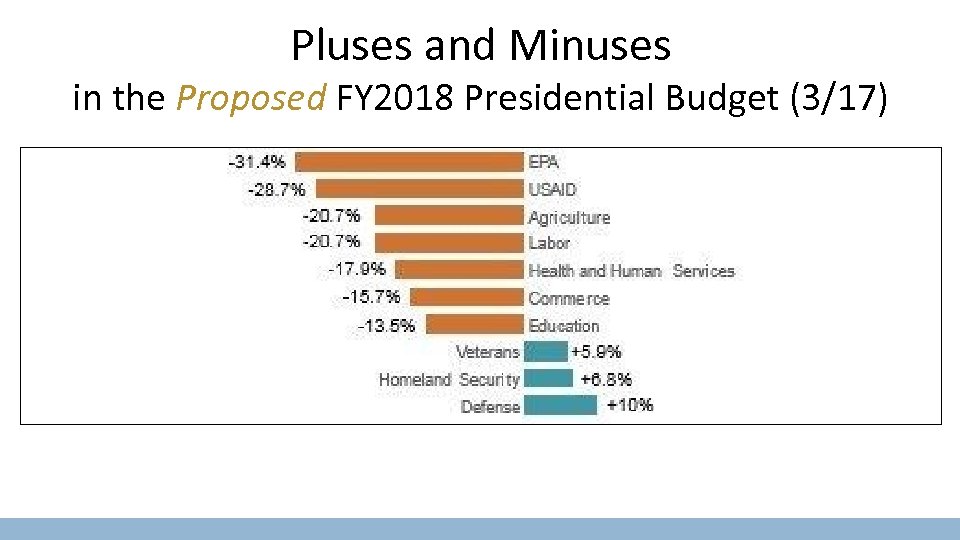
Pluses and Minuses in the Proposed FY 2018 Presidential Budget (3/17)
FY 2018 President’s Budget (03/17) § Proposed elimination of funding in FY 2018 for: CBP, Great Lakes Restoration Initiative, NEPs and other geographic programs - Sea Grant Program, Coastal Zone Management Program, and National Estuarine Research Reserve Program in NOAA. - § Proposed reductions in funding for: Overall EPA funding by 31%; CWA Sec. 106 and Sec. 319 funding, etc. - Funding for the National Science Foundation, National Institutes of Health (-18%), EPA's Office of Research and Development (-48%), NOAA's extramural research grants, National Institute for Standards and Technology (NIST), NASA's Earth science portfolio, and the U. S. Geological Service (-15%) - § Some reductions would take place retroactively in 2017: NSF, Sea Grant, NOAA and NIST.
Appropriations Process The President’s Budget conveys the White House’s desired funding levels. But, it is Congress that actually grants the funding through 12 appropriations bills which § Step 1: Congress passes annual budget resolution which sets the overall framework for funding. It is not actually law, but essentially binds appropriation decisions later. They establish the top-line numbers for revenues, mandatory or direct spending, and discretionary spending. Should be completed by April 15, but often delayed. § Step 2: House Appropriations Committees and subcommittees produce spending bills followed by Senate appropriations committees. § Step 3: President signs funding bills into law.
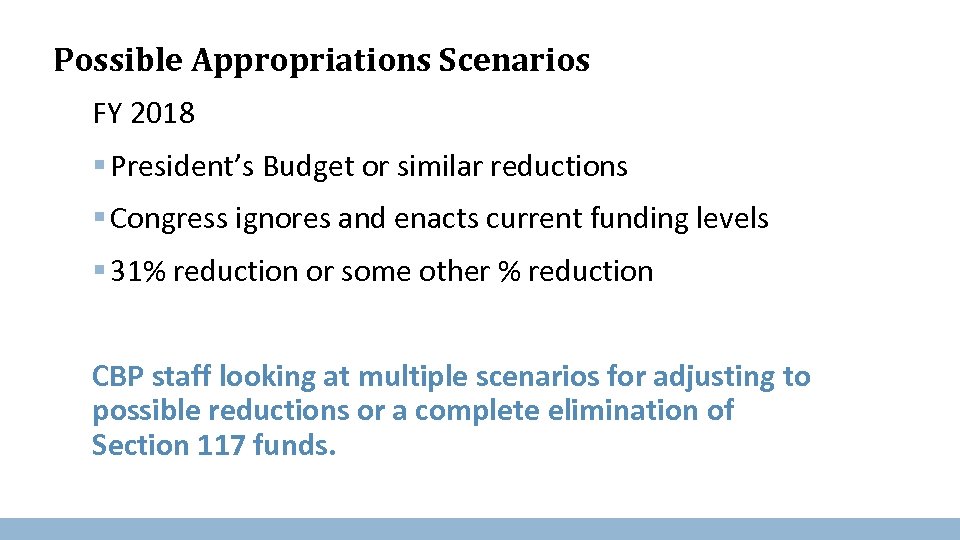
Possible Appropriations Scenarios FY 2018 § President’s Budget or similar reductions § Congress ignores and enacts current funding levels § 31% reduction or some other % reduction CBP staff looking at multiple scenarios for adjusting to possible reductions or a complete elimination of Section 117 funds.
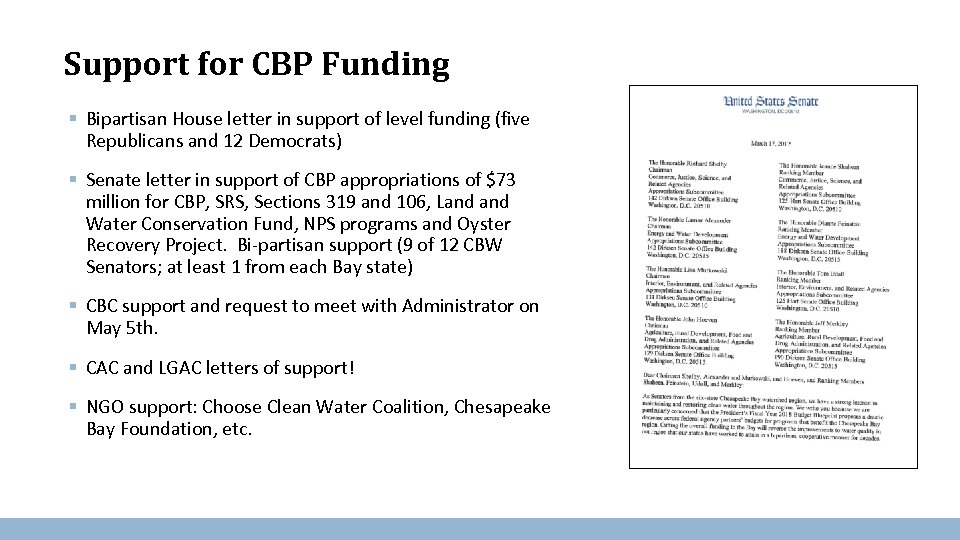
Support for CBP Funding § Bipartisan House letter in support of level funding (five Republicans and 12 Democrats) § Senate letter in support of CBP appropriations of $73 million for CBP, SRS, Sections 319 and 106, Land Water Conservation Fund, NPS programs and Oyster Recovery Project. Bi-partisan support (9 of 12 CBW Senators; at least 1 from each Bay state) § CBC support and request to meet with Administrator on May 5 th. § CAC and LGAC letters of support! § NGO support: Choose Clean Water Coalition, Chesapeake Bay Foundation, etc.
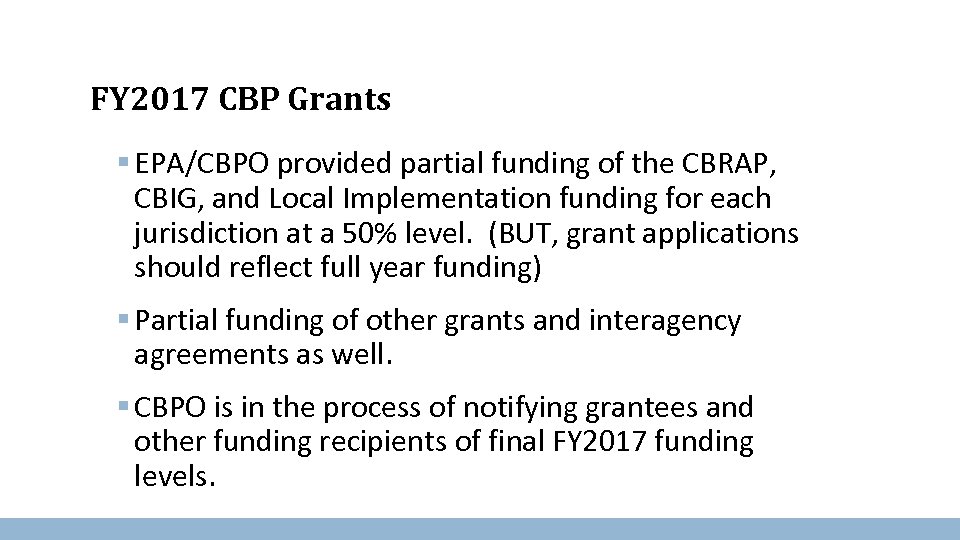
FY 2017 CBP Grants § EPA/CBPO provided partial funding of the CBRAP, CBIG, and Local Implementation funding for each jurisdiction at a 50% level. (BUT, grant applications should reflect full year funding) § Partial funding of other grants and interagency agreements as well. § CBPO is in the process of notifying grantees and other funding recipients of final FY 2017 funding levels.
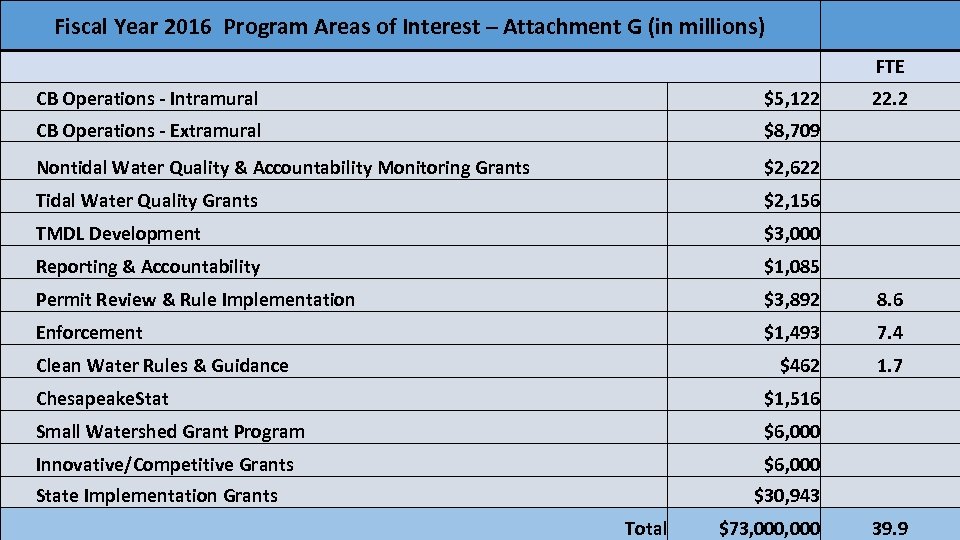
Fiscal Year 2016 Program Areas of Interest – Attachment G (in millions) FTE CB Operations - Intramural $5, 122 CB Operations - Extramural $8, 709 Nontidal Water Quality & Accountability Monitoring Grants $2, 622 Tidal Water Quality Grants $2, 156 TMDL Development $3, 000 Reporting & Accountability $1, 085 Permit Review & Rule Implementation $3, 892 8. 6 Enforcement $1, 493 7. 4 $462 1. 7 Clean Water Rules & Guidance Chesapeake. Stat $1, 516 Small Watershed Grant Program $6, 000 Innovative/Competitive Grants 22. 2 $6, 000 State Implementation Grants $30, 943 Total $73, 000 39. 9
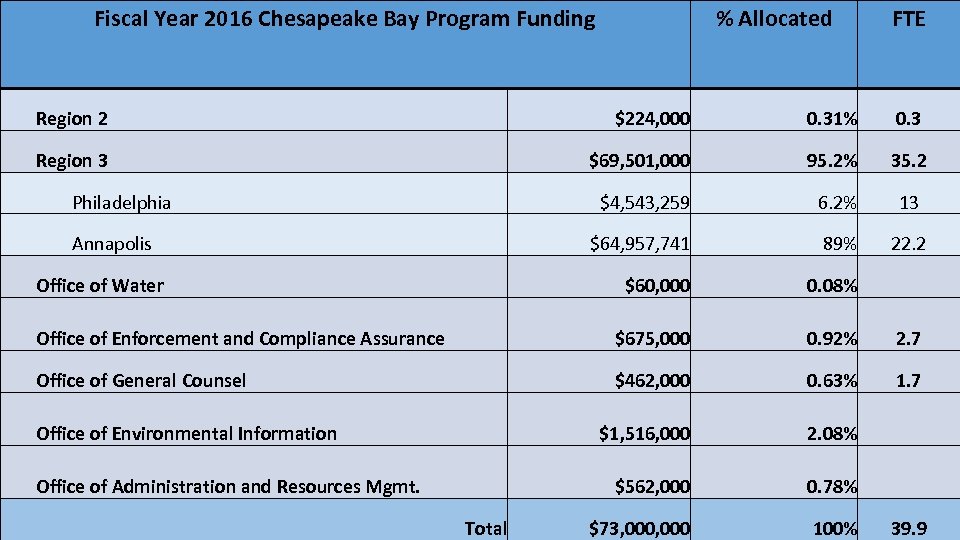
Fiscal Year 2016 Chesapeake Bay Program Funding % Allocated FTE Region 2 $224, 000 0. 31% 0. 3 Region 3 $69, 501, 000 95. 2% 35. 2 $4, 543, 259 6. 2% 13 $64, 957, 741 89% 22. 2 $60, 000 0. 08% Office of Enforcement and Compliance Assurance $675, 000 0. 92% 2. 7 Office of General Counsel $462, 000 0. 63% 1. 7 $1, 516, 000 2. 08% $562, 000 0. 78% $73, 000 100% Philadelphia Annapolis Office of Water Office of Environmental Information Office of Administration and Resources Mgmt. Total 39. 9
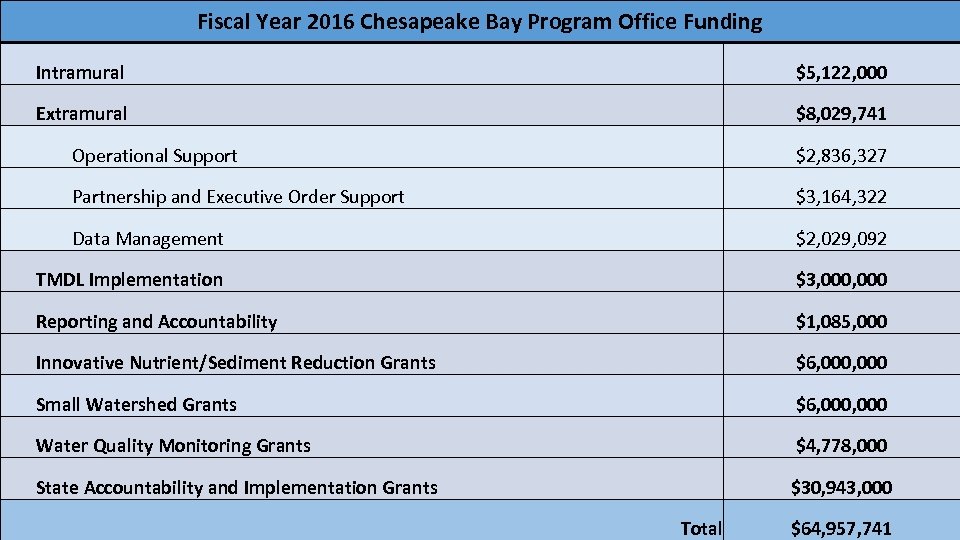
Fiscal Year 2016 Chesapeake Bay Program Office Funding Intramural $5, 122, 000 Extramural $8, 029, 741 Operational Support $2, 836, 327 Partnership and Executive Order Support $3, 164, 322 Data Management $2, 029, 092 TMDL Implementation $3, 000 Reporting and Accountability $1, 085, 000 Innovative Nutrient/Sediment Reduction Grants $6, 000 Small Watershed Grants $6, 000 Water Quality Monitoring Grants $4, 778, 000 State Accountability and Implementation Grants $30, 943, 000 Total $64, 957, 741
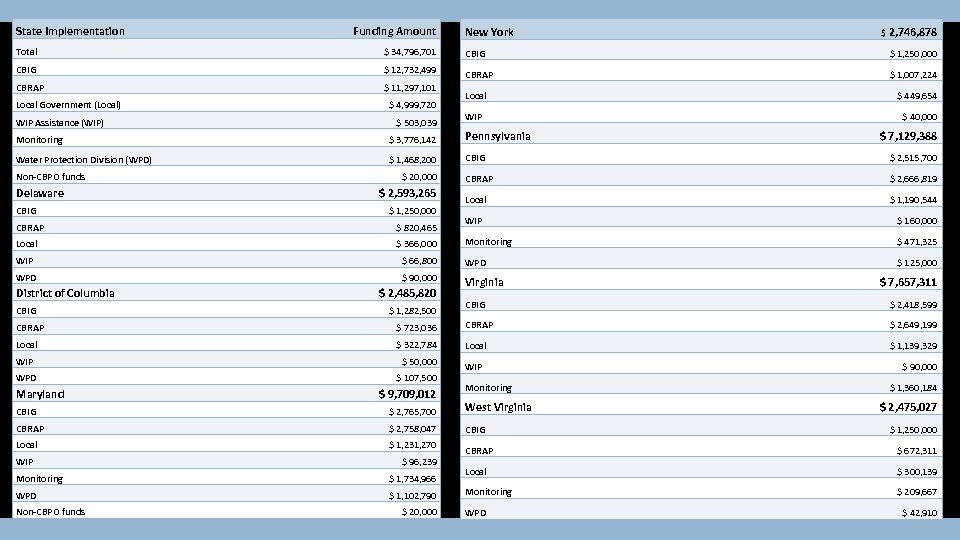
State Implementation Funding Amount New York $ 2, 746, 878 Total $ 34, 796, 701 CBIG $ 1, 250, 000 CBIG $ 12, 732, 499 CBRAP $ 1, 007, 224 CBRAP $ 11, 297, 101 Local Government (Local) WIP Assistance (WIP) $ 4, 999, 720 $ 503, 039 Local $ 449, 654 WIP $ 40, 000 Monitoring $ 3, 776, 142 Pennsylvania Water Protection Division (WPD) $ 1, 468, 200 CBIG $ 2, 515, 700 CBRAP $ 2, 666, 819 Local $ 1, 190, 544 Non-CBPO funds Delaware CBIG $ 20, 000 $ 2, 593, 265 $ 1, 250, 000 WIP $ 160, 000 Monitoring $ 471, 325 $ 66, 800 WPD $ 125, 000 $ 90, 000 Virginia CBRAP $ 820, 465 Local $ 366, 000 WIP WPD District of Columbia CBIG $ 7, 129, 388 $ 2, 485, 820 $ 1, 282, 500 $ 7, 657, 311 CBIG $ 2, 418, 599 CBRAP $ 723, 036 CBRAP $ 2, 649, 199 Local $ 322, 784 Local $ 1, 139, 329 WIP $ 50, 000 WPD $ 107, 500 Maryland $ 9, 709, 012 WIP Monitoring CBIG $ 2, 765, 700 West Virginia CBRAP $ 2, 758, 047 CBIG Local $ 1, 231, 270 WIP $ 96, 239 Monitoring $ 1, 734, 966 WPD $ 1, 102, 790 Non-CBPO funds $ 20, 000 $ 90, 000 $ 1, 360, 184 $ 2, 475, 027 $ 1, 250, 000 CBRAP $ 672, 311 Local $ 300, 139 Monitoring $ 209, 667 WPD $ 42, 910
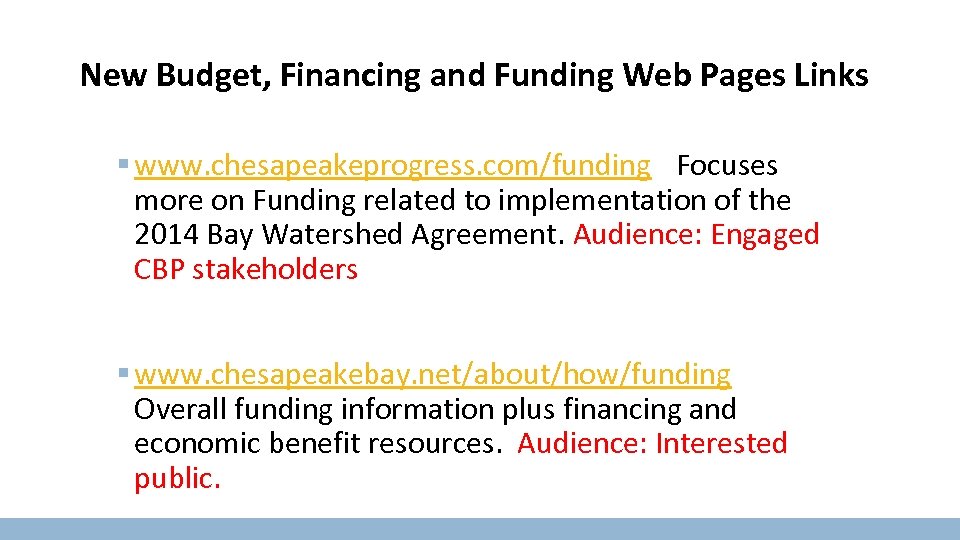
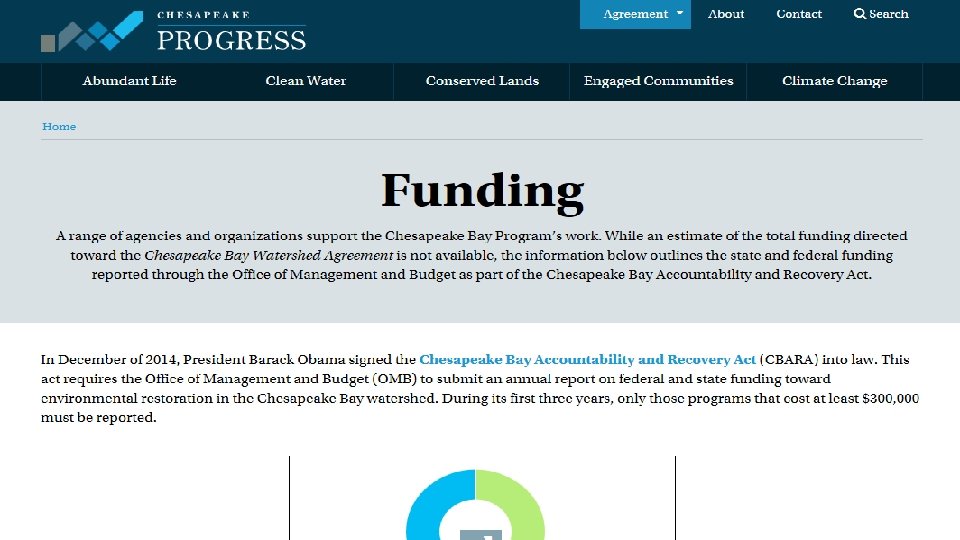
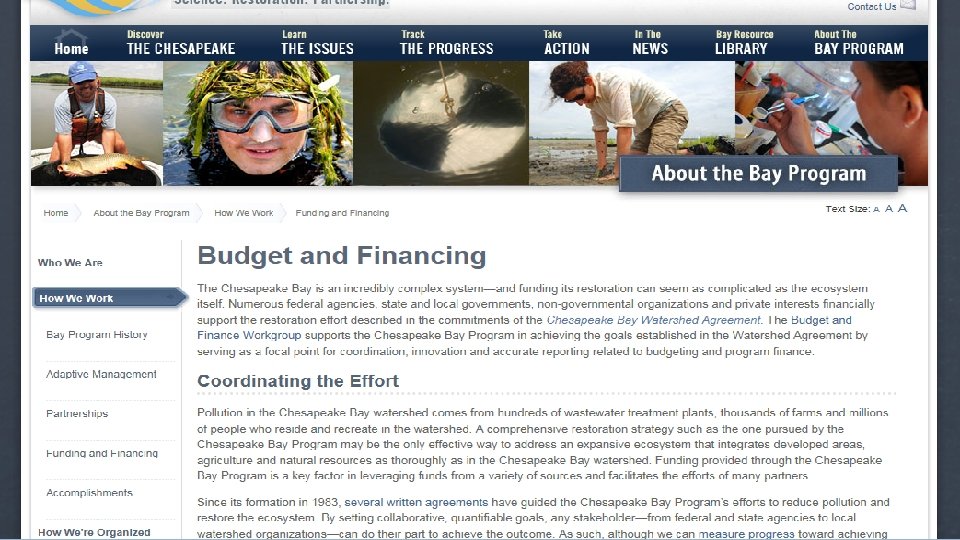
New Budget, Financing and Funding Web Pages Links § www. chesapeakeprogress. com/funding - Focuses more on Funding related to implementation of the 2014 Bay Watershed Agreement. Audience: Engaged CBP stakeholders. § www. chesapeakebay. net/about/how/funding - Overall funding information plus financing and economic benefit resources. Audience: Interested public.
EPA Priorities: High-level Overview Guiding Philosophies § Rule of law: EPA’s work won’t go anywhere if it constantly faces legal challenges. By administering laws enacted by Congress and issuing environmental rules tethered to those statutes, EPA can achieve so much more for the protection of human health and our environment. § Cooperative federalism: States and tribes are our partners in enforcing environmental laws and programs—EPA wants to build trust and a strong working relationship with these partners to get results for all Americans. § Public participation: EPA’s authority is derived from the democratic process, and that process is made more credible by engaging with the diverse views of the American public, and addressing stakeholder input on the impacts of rules on families, jobs, and communities.
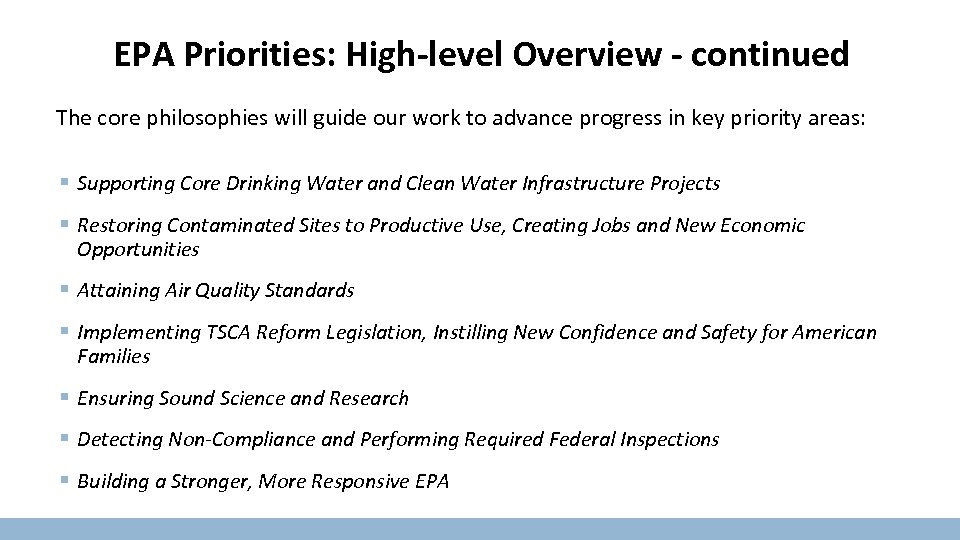
EPA Priorities: High-level Overview - continued The core philosophies will guide our work to advance progress in key priority areas: § Supporting Core Drinking Water and Clean Water Infrastructure Projects § Restoring Contaminated Sites to Productive Use, Creating Jobs and New Economic Opportunities § Attaining Air Quality Standards § Implementing TSCA Reform Legislation, Instilling New Confidence and Safety for American Families § Ensuring Sound Science and Research § Detecting Non-Compliance and Performing Required Federal Inspections § Building a Stronger, More Responsive EPA
QUESTIONS?
Скачать презентацию Budget Appropriations and the Chesapeake Bay Program 2017
64da30b02e6b32267c89ed8ba03b5349.ppt