 Скачать презентацию Budget 2010 -2011 Impact of BUDGET on Individuals
2263fdc35ac344781ed73dcc9d68b82c.ppt
- Количество слайдов: 21



Budget 2010 -2011 Impact of BUDGET on Individuals
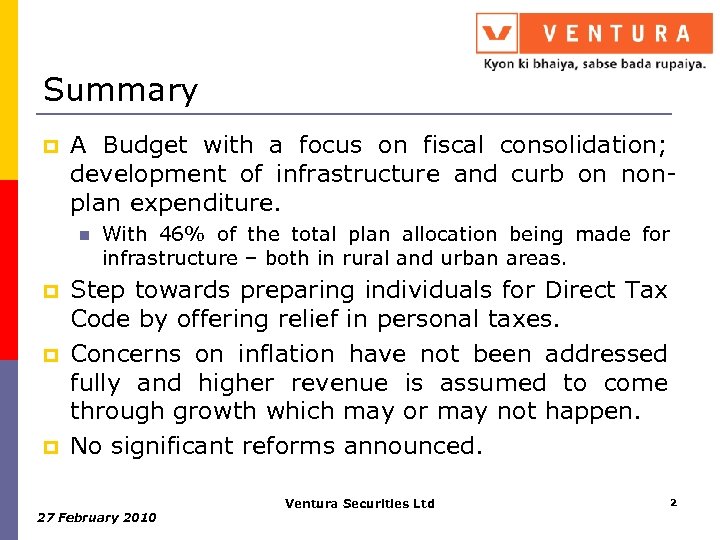
Summary p A Budget with a focus on fiscal consolidation; development of infrastructure and curb on nonplan expenditure. n p p p With 46% of the total plan allocation being made for infrastructure – both in rural and urban areas. Step towards preparing individuals for Direct Tax Code by offering relief in personal taxes. Concerns on inflation have not been addressed fully and higher revenue is assumed to come through growth which may or may not happen. No significant reforms announced. 27 February 2010 Ventura Securities Ltd 2
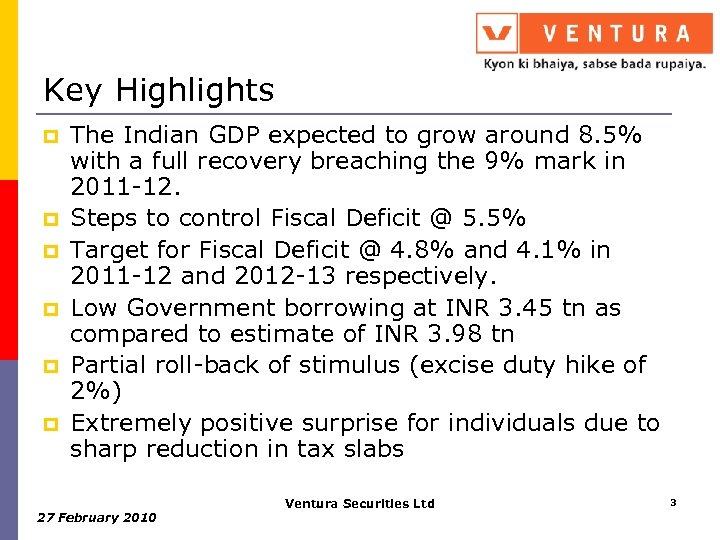
Key Highlights p p p The Indian GDP expected to grow around 8. 5% with a full recovery breaching the 9% mark in 2011 -12. Steps to control Fiscal Deficit @ 5. 5% Target for Fiscal Deficit @ 4. 8% and 4. 1% in 2011 -12 and 2012 -13 respectively. Low Government borrowing at INR 3. 45 tn as compared to estimate of INR 3. 98 tn Partial roll-back of stimulus (excise duty hike of 2%) Extremely positive surprise for individuals due to sharp reduction in tax slabs 27 February 2010 Ventura Securities Ltd 3
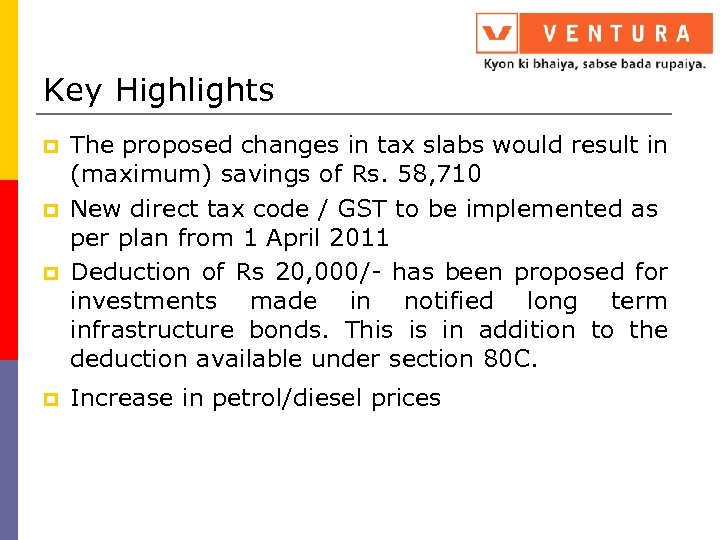
Key Highlights p p The proposed changes in tax slabs would result in (maximum) savings of Rs. 58, 710 New direct tax code / GST to be implemented as per plan from 1 April 2011 Deduction of Rs 20, 000/- has been proposed for investments made in notified long term infrastructure bonds. This is in addition to the deduction available under section 80 C. Increase in petrol/diesel prices
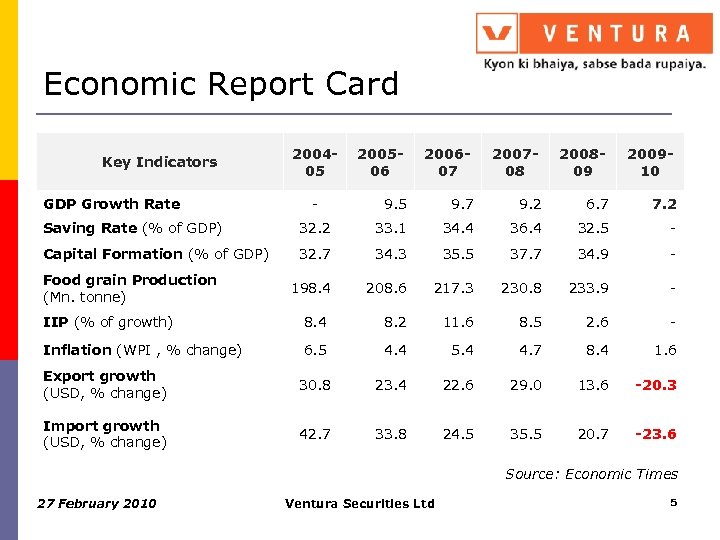
Economic Report Card Key Indicators GDP Growth Rate 200405 - 200506 200607 200708 200809 200910 9. 5 9. 7 9. 2 6. 7 7. 2 Saving Rate (% of GDP) 32. 2 33. 1 34. 4 36. 4 32. 5 - Capital Formation (% of GDP) 32. 7 34. 3 35. 5 37. 7 34. 9 - Food grain Production (Mn. tonne) 198. 4 208. 6 217. 3 230. 8 233. 9 - IIP (% of growth) 8. 4 8. 2 11. 6 8. 5 2. 6 - Inflation (WPI , % change) 6. 5 4. 4 5. 4 4. 7 8. 4 1. 6 23. 4 22. 6 29. 0 13. 6 -20. 3 24. 5 35. 5 20. 7 -23. 6 Export growth 30. 8 (USD, % change) Import growth 42. 7 33. 8 (USD, % change) Source: Economic Times 27 February 2010 Ventura Securities Ltd 5
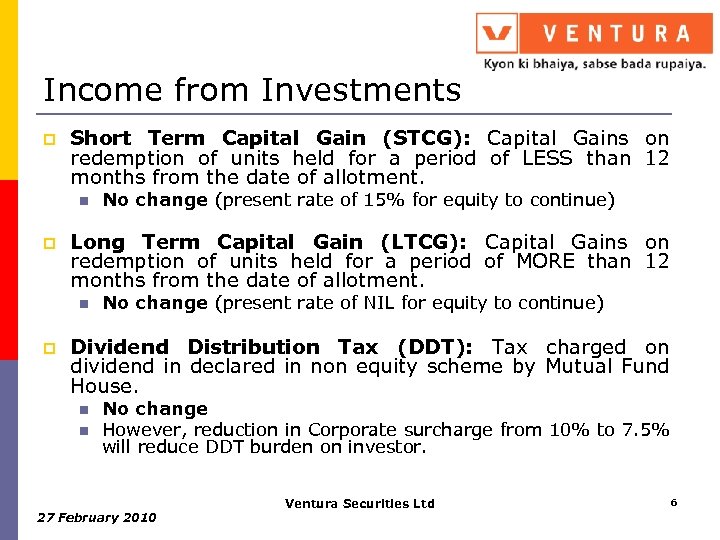
Income from Investments p Short Term Capital Gain (STCG): Capital Gains on redemption of units held for a period of LESS than 12 months from the date of allotment. n p Long Term Capital Gain (LTCG): Capital Gains on redemption of units held for a period of MORE than 12 months from the date of allotment. n p No change (present rate of 15% for equity to continue) No change (present rate of NIL for equity to continue) Dividend Distribution Tax (DDT): Tax charged on dividend in declared in non equity scheme by Mutual Fund House. n n No change However, reduction in Corporate surcharge from 10% to 7. 5% will reduce DDT burden on investor. 27 February 2010 Ventura Securities Ltd 6
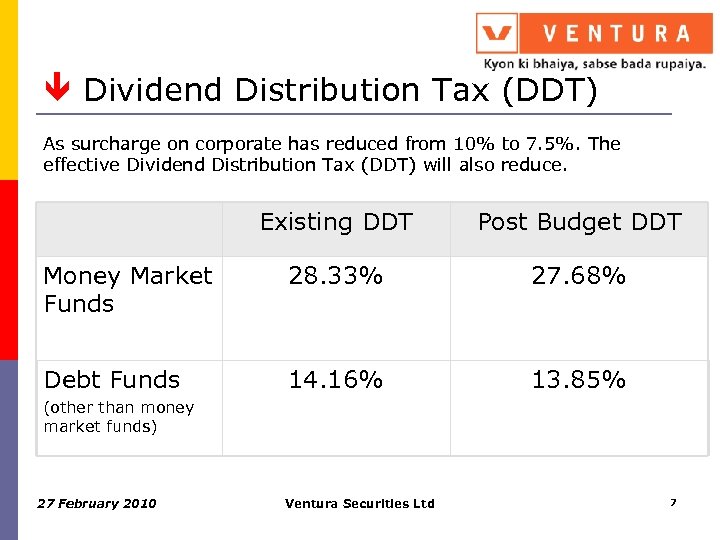
Dividend Distribution Tax (DDT) As surcharge on corporate has reduced from 10% to 7. 5%. The effective Dividend Distribution Tax (DDT) will also reduce. Existing DDT Post Budget DDT Money Market Funds 28. 33% 27. 68% Debt Funds 14. 16% 13. 85% (other than money market funds) 27 February 2010 Ventura Securities Ltd 7
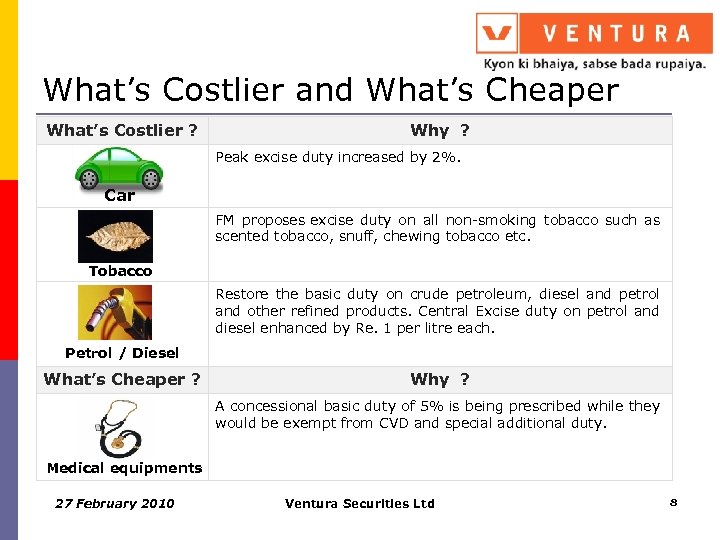
What’s Costlier and What’s Cheaper What’s Costlier ? Why ? Peak excise duty increased by 2%. Car FM proposes excise duty on all non-smoking tobacco such as scented tobacco, snuff, chewing tobacco etc. Tobacco Restore the basic duty on crude petroleum, diesel and petrol and other refined products. Central Excise duty on petrol and diesel enhanced by Re. 1 per litre each. Petrol / Diesel What’s Cheaper ? Why ? A concessional basic duty of 5% is being prescribed while they would be exempt from CVD and special additional duty. Medical equipments 27 February 2010 Ventura Securities Ltd 8
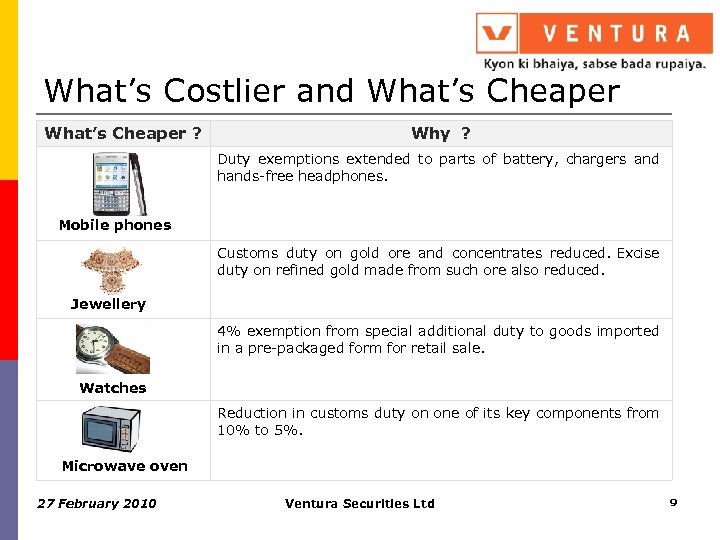
What’s Costlier and What’s Cheaper ? Why ? Duty exemptions extended to parts of battery, chargers and hands-free headphones. Mobile phones Customs duty on gold ore and concentrates reduced. Excise duty on refined gold made from such ore also reduced. Jewellery 4% exemption from special additional duty to goods imported in a pre-packaged form for retail sale. Watches Reduction in customs duty on one of its key components from 10% to 5%. Microwave oven 27 February 2010 Ventura Securities Ltd 9
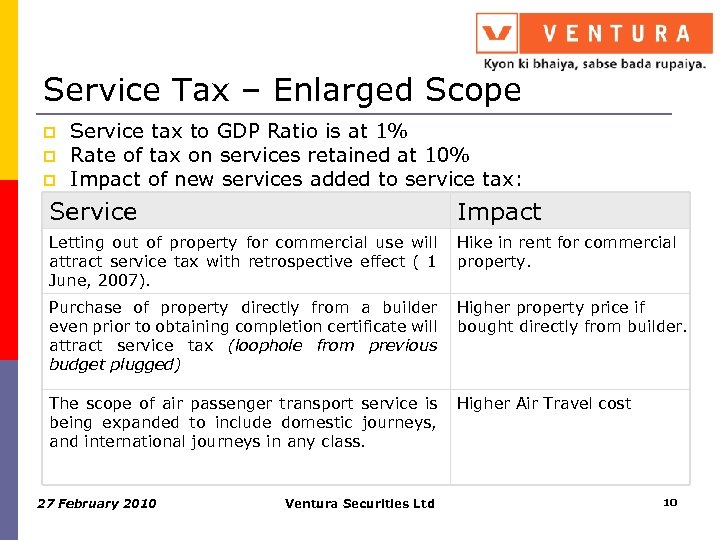
Service Tax – Enlarged Scope p p p Service tax to GDP Ratio is at 1% Rate of tax on services retained at 10% Impact of new services added to service tax: Service Impact Letting out of property for commercial use will Hike in rent for commercial attract service tax with retrospective effect ( 1 property. June, 2007). Purchase of property directly from a builder Higher property price if even prior to obtaining completion certificate will bought directly from builder. attract service tax (loophole from previous budget plugged) The scope of air passenger transport service is Higher Air Travel cost being expanded to include domestic journeys, and international journeys in any class. 27 February 2010 Ventura Securities Ltd 10
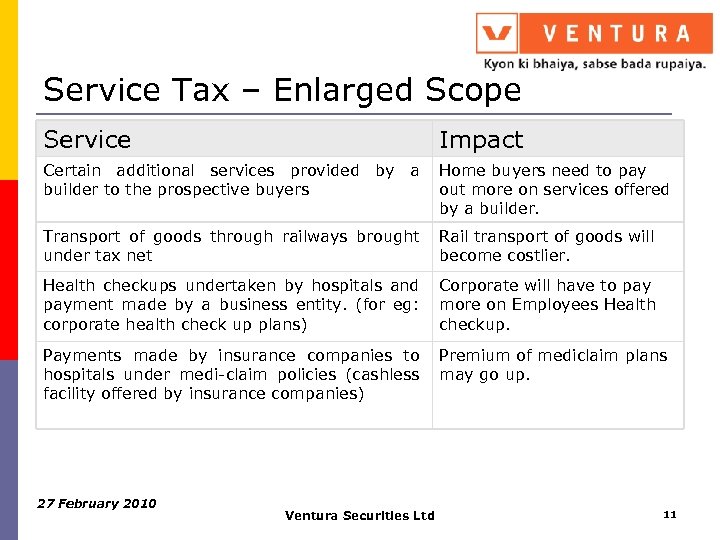
Service Tax – Enlarged Scope Service Impact Certain additional services provided by a Home buyers need to pay builder to the prospective buyers out more on services offered by a builder. Transport of goods through railways brought Rail transport of goods will under tax net become costlier. Health checkups undertaken by hospitals and Corporate will have to payment made by a business entity. (for eg: more on Employees Health corporate health check up plans) checkup. Payments made by insurance companies to Premium of mediclaim plans hospitals under medi-claim policies (cashless may go up. facility offered by insurance companies) 27 February 2010 Ventura Securities Ltd 11
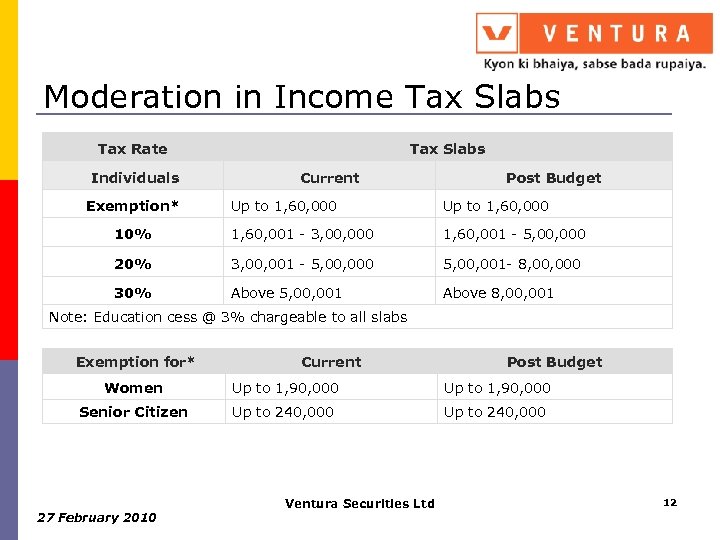
Moderation in Income Tax Slabs Tax Rate Individuals Exemption* Tax Slabs Current Post Budget Up to 1, 60, 000 10% 1, 60, 001 - 3, 000 1, 60, 001 - 5, 000 20% 3, 001 - 5, 000 5, 001 - 8, 000 30% Above 5, 001 Above 8, 001 Note: Education cess @ 3% chargeable to all slabs Exemption for* Women Senior Citizen 27 February 2010 Current Post Budget Up to 1, 90, 000 Up to 240, 000 Ventura Securities Ltd 12
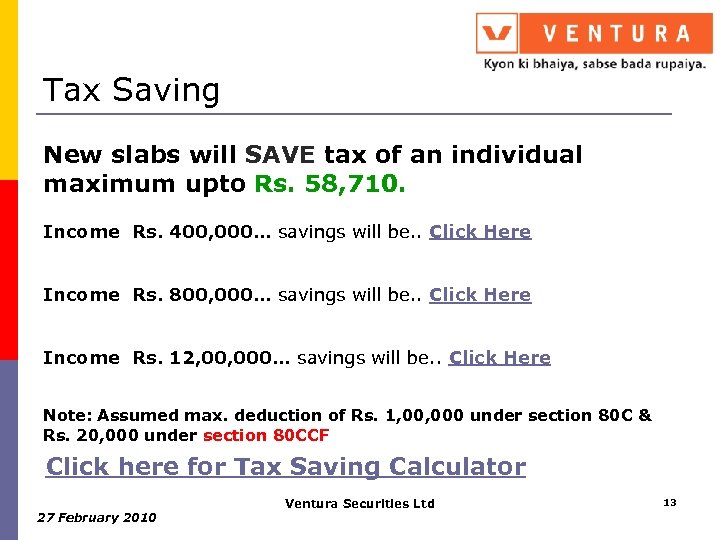
Tax Saving New slabs will SAVE tax of an individual maximum upto Rs. 58, 710. Income Rs. 400, 000… savings will be. . Click Here Income Rs. 800, 000… savings will be. . Click Here Income Rs. 12, 000… savings will be. . Click Here Note: Assumed max. deduction of Rs. 1, 000 under section 80 C & Rs. 20, 000 under section 80 CCF Click here for Tax Saving Calculator 27 February 2010 Ventura Securities Ltd 13
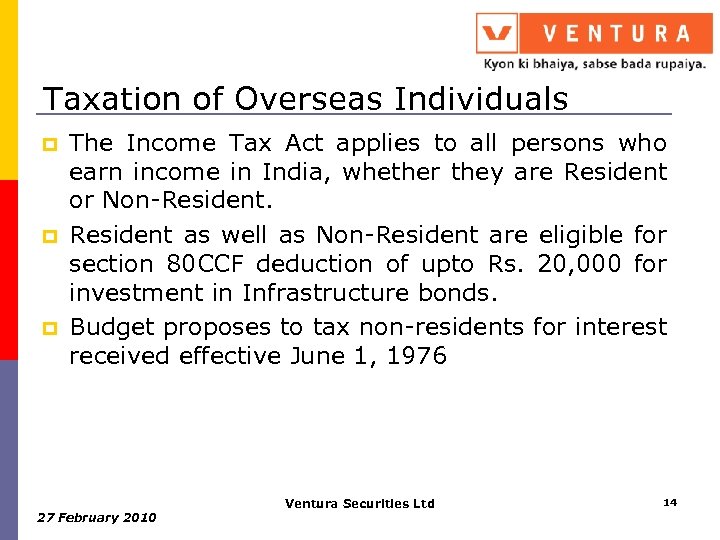
Taxation of Overseas Individuals p p p The Income Tax Act applies to all persons who earn income in India, whether they are Resident or Non-Resident as well as Non-Resident are eligible for section 80 CCF deduction of upto Rs. 20, 000 for investment in Infrastructure bonds. Budget proposes to tax non-residents for interest received effective June 1, 1976 27 February 2010 Ventura Securities Ltd 14
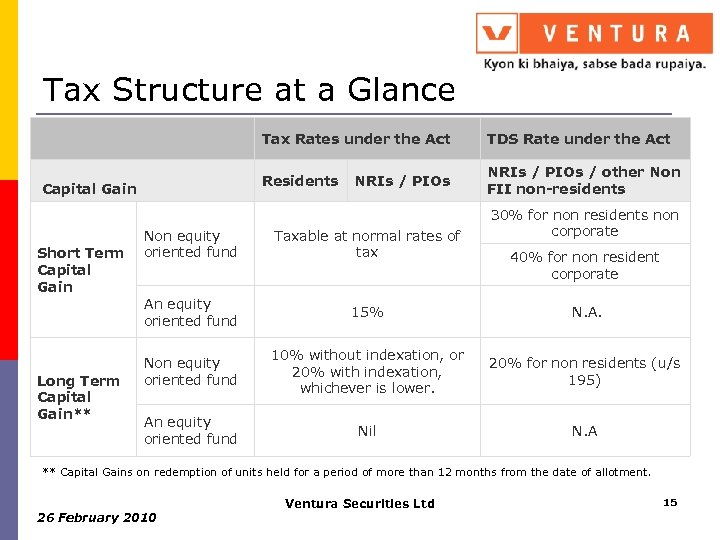
Tax Structure at a Glance Tax Rates under the Act TDS Rate under the Act Capital Gain Residents NRIs / PIOs / other Non FII non-residents Non equity Short Term oriented fund Capital Gain An equity oriented fund Long Term Capital Gain** NRIs / PIOs Taxable at normal rates of tax 30% for non residents non corporate 40% for non resident corporate 15% N. A. Non equity oriented fund 10% without indexation, or 20% with indexation, whichever is lower. 20% for non residents (u/s 195) An equity oriented fund Nil N. A ** Capital Gains on redemption of units held for a period of more than 12 months from the date of allotment. 26 February 2010 Ventura Securities Ltd 15
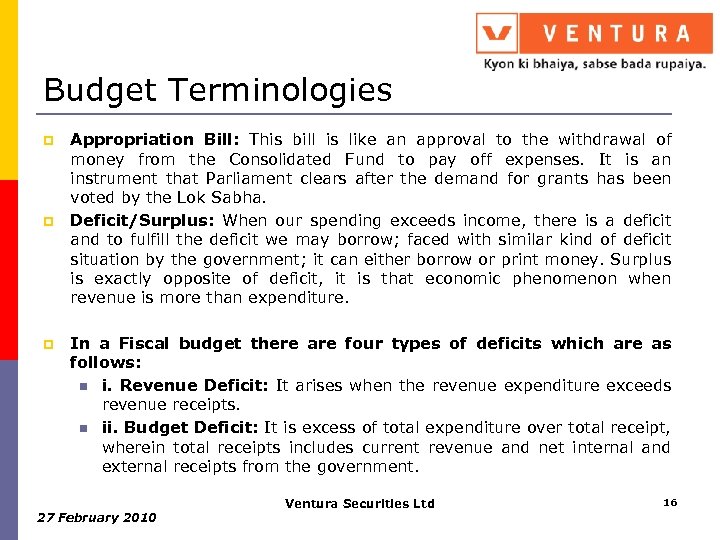
Budget Terminologies p p p Appropriation Bill: This bill is like an approval to the withdrawal of money from the Consolidated Fund to pay off expenses. It is an instrument that Parliament clears after the demand for grants has been voted by the Lok Sabha. Deficit/Surplus: When our spending exceeds income, there is a deficit and to fulfill the deficit we may borrow; faced with similar kind of deficit situation by the government; it can either borrow or print money. Surplus is exactly opposite of deficit, it is that economic phenomenon when revenue is more than expenditure. In a Fiscal budget there are four types of deficits which are as follows: n i. Revenue Deficit: It arises when the revenue expenditure exceeds revenue receipts. n ii. Budget Deficit: It is excess of total expenditure over total receipt, wherein total receipts includes current revenue and net internal and external receipts from the government. 27 February 2010 Ventura Securities Ltd 16
Budget Terminologies n n n p iii. Fiscal Deficit: It arises when Total Expenditure exceeds Revenue Receipts. Fiscal deficit gives the signal to the government about the total borrowing requirements from all sources. iv. Primary Deficit: It is a nothing but Fiscal deficit minus interest payment. Current account: This shows the difference between the nation's exports and imports and the import being higher than exports shows deficit and export being more than import shows surplus. Expenditure: n The expenditure is classified as : Revenue and Capital Expenditure and further as planned and Non planned. n i. Revenue Expenditure: It is incurred for the normal functioning of the government departments and various other services such as salaries to government employees, subsidies, interest payment made to service debt etc. 27 February 2010 Ventura Securities Ltd 17
Budget Terminologies n n n p ii. Capital Expenditure: Long-term in nature they are used for acquiring fixed assets such as land, building, machinery and equipment. Other items that also fall under this category include loans and advances sanctioned by the Centre to the State governments, union territories and public sector undertakings etc. iii. Plan Expenditure: As the name implies, it is incurred in connection with all expenditures which fall under the purview of Country’s Five year plan. iv. Non-plan Expenditure: It consists of Revenue and Capital Expenditure on interest payments, Defense Expenditure, subsidies, postal deficit, police, pensions, economic services, loans to public sector enterprises and loans as well as grants to State governments, Union territories and foreign governments etc. Gross Domestic Product (GDP): Total market value of the goods and services manufactured within the country in a financial year. 27 February 2010 Ventura Securities Ltd 18
Budget Terminologies p GDP Growth rate: It measures the growth of the GDP of the economy compared to the last year. This is a measure of the progress of the economy and is an important economic indicator. p Receipts: Receipts are classified into Revenue & Capital Receipts: n Revenue Receipts: Revenue comes from 2 sources: 1. Tax revenue 2. Non Tax revenue n Tax Revenue: Tax revenue refers to funds raised through taxes paid by Public & Corporate Entities. Taxes are of two types Direct & Indirect tax. Direct taxes are Income tax, Wealth tax and Gift tax while Indirect Tax includes Custom Duty, Excise Duty, Service tax etc. n Non Tax Revenue: As the name suggests, Non Tax Revenue is raised through sources other than taxes. This revenue emanates from Public Sector Undertakings (PSUs), State undertakings like railways, State Transport, Telecom, etc. Revenue from social services like education & Public health. Voluntary aid to Government charitable trust /institution, Revenue from public properties etc. 27 February 2010 Ventura Securities Ltd 19
Budget Terminologies p p Capital Receipt: It includes loan raised by Government of India from public at large, borrowings from RBI (through sale of Treasury bonds) as well as external borrowings International institution like (IMF, World Bank etc) recoveries from loans granted to states/Union territories, savings invested in PPF. Per Capita Income: The national income of a country divided by its population. Subsidies: Financial aid provided by the Centre to any entity to be competitive or to restrict price for the buyer. Inflation: Inflation rate is the percentage rate of change in the price level of a commodity. 27 February 2010 Ventura Securities Ltd 20

Disclaimer Ventura Securities Limited. Corporate Office: C-112/116, Bldg No. 1, Kailash Industrial Complex, Park Site, Vikhroli (W), Mumbai – 400079 This report is neither an offer nor a solicitation to purchase or sell securities. The information and views expressed herein are believed to be reliable, but no responsibility (or liability) is accepted for errors of fact or opinion. Writers and contributors may be trading in or have positions in the securities mentioned in their articles. Neither Ventura Securities Limited nor any of the contributors accepts any liability arising out of the above information/articles. Reproduction in whole or in part without written permission is prohibited. This report is for private circulation. 27 February 2010 Ventura Securities Ltd 21
Скачать презентацию Budget 2010 -2011 Impact of BUDGET on Individuals
2263fdc35ac344781ed73dcc9d68b82c.ppt