 Скачать презентацию Buddies NOT Bullies Parent Workshop Copyright c 2017
7a986d72094445039fb549a4d44df4cb.ppt
- Количество слайдов: 31



Buddies NOT Bullies Parent Workshop Copyright (c) 2017 Children's Health Fund All Rights Reserved
Today’s Takeaways: • Learn How to Spot Bullying. Understand what bullying looks like and sounds like. • Talking Tips. Know some ways to talk to your children so you can help prevent bullying. • Advocate. Find out what your child’s school is already doing to prevent bullying and how you can help out. Copyright (c) 2017 Children's Health Fund All Rights Reserved 2
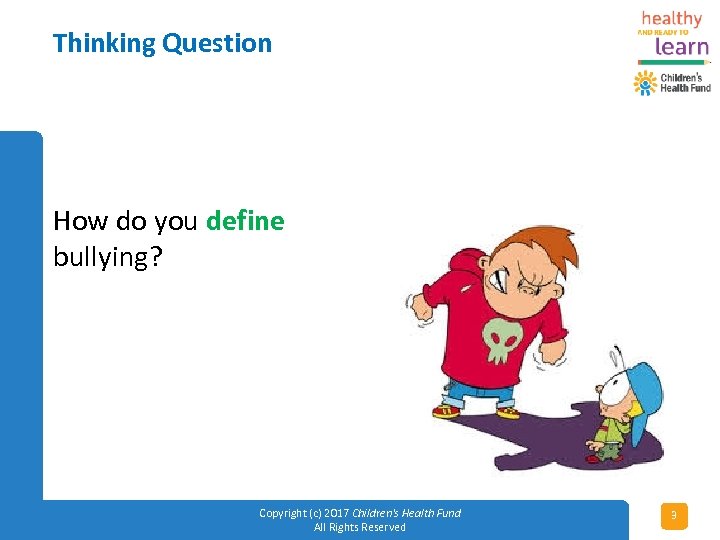
Thinking Question How do you define bullying? Copyright (c) 2017 Children's Health Fund All Rights Reserved 3
What is Bullying? Bullying is unwanted, repeated behavior that involves a real or perceived power imbalance between two people. Power Imbalance When a child who has more “power” uses it to bully a child with less power. Power differences can be physical, social, or emotional. Copyright (c) 2017 Children's Health Fund All Rights Reserved 4
What is Bullying? • Physical • Verbal • Social/Relational • Cyber Copyright (c) 2017 Children's Health Fund All Rights Reserved 5
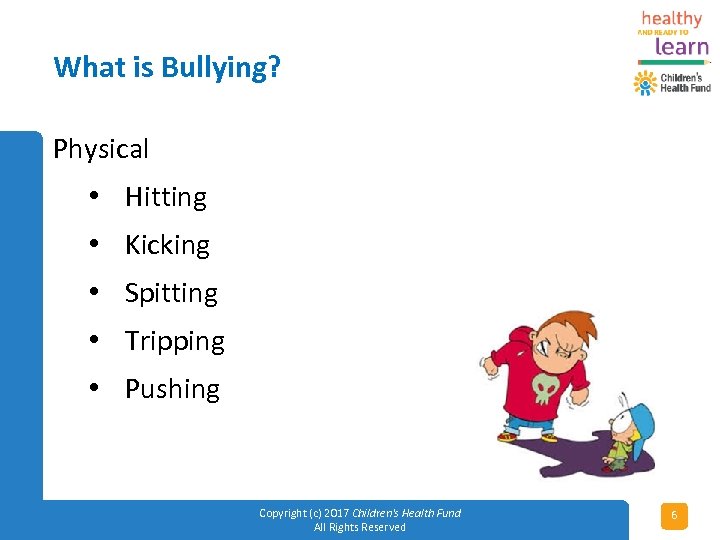
What is Bullying? Physical • Hitting • Kicking • Spitting • Tripping • Pushing Copyright (c) 2017 Children's Health Fund All Rights Reserved 6
What is Bullying? Verbal • Teasing • Name-calling • Threatening to cause harm • Taunting Copyright (c) 2017 Children's Health Fund All Rights Reserved 7
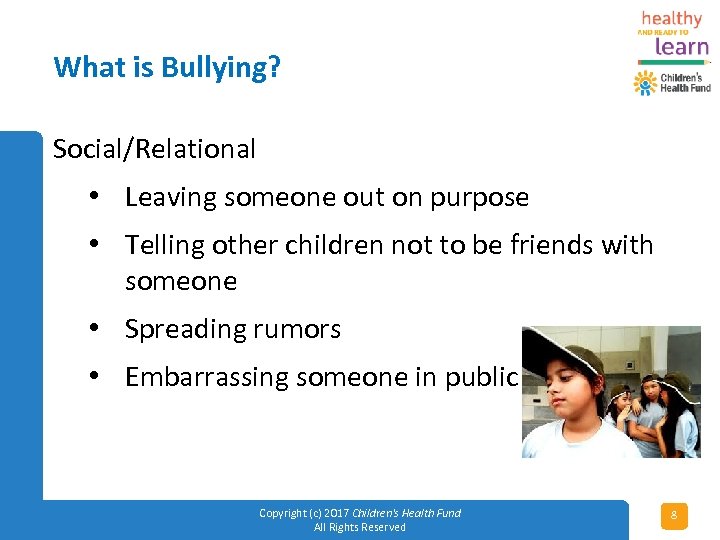
What is Bullying? Social/Relational • Leaving someone out on purpose • Telling other children not to be friends with someone • Spreading rumors • Embarrassing someone in public Copyright (c) 2017 Children's Health Fund All Rights Reserved 8
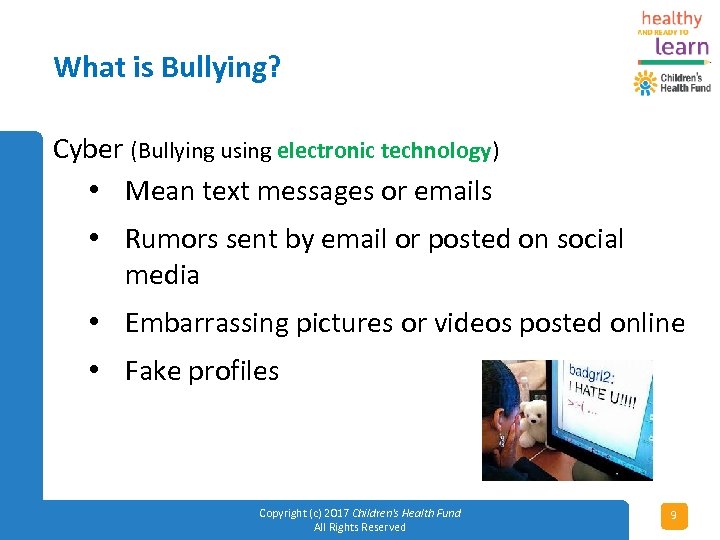
What is Bullying? Cyber (Bullying using electronic technology) • Mean text messages or emails • Rumors sent by email or posted on social media • Embarrassing pictures or videos posted online • Fake profiles Copyright (c) 2017 Children's Health Fund All Rights Reserved 9
The Impact of Bullying Kids who are bullied are more likely to: • Perform poorly in school • Delay going to school in the morning • Miss school days or drop out of school • Have depression and anxiety • Feel sadness and loneliness • Change their sleeping or eating patterns • Lose interest in activities they used to enjoy Copyright (c) 2017 Children's Health Fund All Rights Reserved 10
The Impact of Bullying Kids who bully other kids are more likely to: • Get into fights • Drop out of school • Abuse alcohol and other drugs • Engage in early sexual activity • Have trouble understanding and expressing their emotions • Be abusive toward their partners, spouses, or children when they are adults Copyright (c) 2017 Children's Health Fund All Rights Reserved 11
The Impact of Bullying Kids who witness bullying are more likely to: • Miss or skip school • Have increased use of tobacco, alcohol, or other drugs • Have increased mental health problems, including depression and anxiety Copyright (c) 2017 Children's Health Fund All Rights Reserved 12
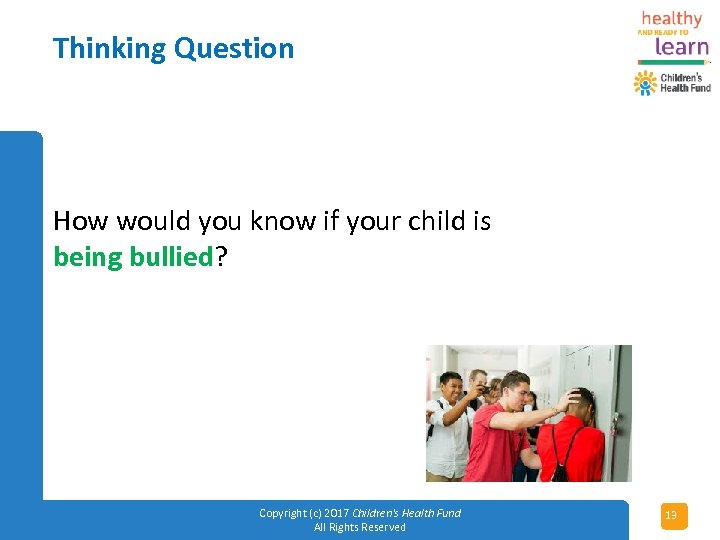
Thinking Question How would you know if your child is being bullied? Copyright (c) 2017 Children's Health Fund All Rights Reserved 13
Knowing the Signs a child might be being bullied: • Declining grades • Loss of interest in schoolwork • Not wanting to go to school • Unexplainable injuries • Lost or destroyed clothing, books, electronics, or jewelry • Frequent headaches or stomach aches, feeling sick or faking illness • Changes in eating habits Copyright (c) 2017 Children's Health Fund All Rights Reserved 14
Knowing the Signs Continued… • Difficulty sleeping or frequent nightmares • Sudden loss of friends or avoidance of social situations • Feelings of helplessness or decreased self esteem • Self-destructive behaviors such as running away from home, harming themselves, or talking about suicide Copyright (c) 2017 Children's Health Fund All Rights Reserved 15
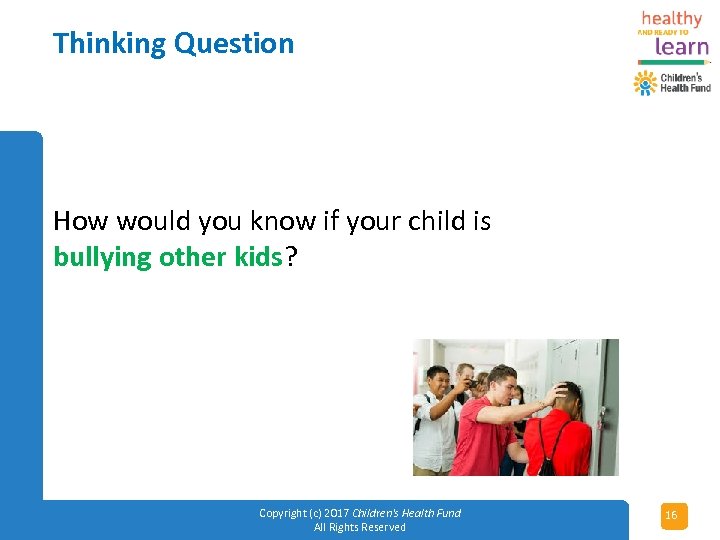
Thinking Question How would you know if your child is bullying other kids? Copyright (c) 2017 Children's Health Fund All Rights Reserved 16
Knowing the Signs a child might be bullying other children (engaging in bullying behavior): • Gets into physical or verbal fights • Has friends who bully others • Is increasingly aggressive • Gets sent to the principal’s office or to detention frequently • Has unexplained extra money or new belongings Copyright (c) 2017 Children's Health Fund All Rights Reserved 17
Knowing the Signs Continued… • Blames others for their problems • Doesn’t accept responsibility for their actions • Changes the types of TV shows, movies, or social media posts that they enjoy, which may involve bullying or making fun of others • Is competitive and worries about their reputation or popularity Copyright (c) 2017 Children's Health Fund All Rights Reserved 18
Copyright (c) 2017 Children's Health Fund All Rights Reserved 19
Parent Share: Have you ever had a conversation with your child about bullying? If so, do you have any Tips. Copyright (c) 2017 Children's Health Fund All Rights Reserved 20
Talking Tips • Check in with your kids often, using open-ended questions • Talk to kids about bullying • Show your kids how to treat others with kindness and respect by being a role model and treating others this way • Encourage kids to speak to a trusted adult if they are bullied or see others being bullied. Start by asking, “who are 3 adults you trust at school that you could talk to if you were being bullied? ” Copyright (c) 2017 Children's Health Fund All Rights Reserved 21
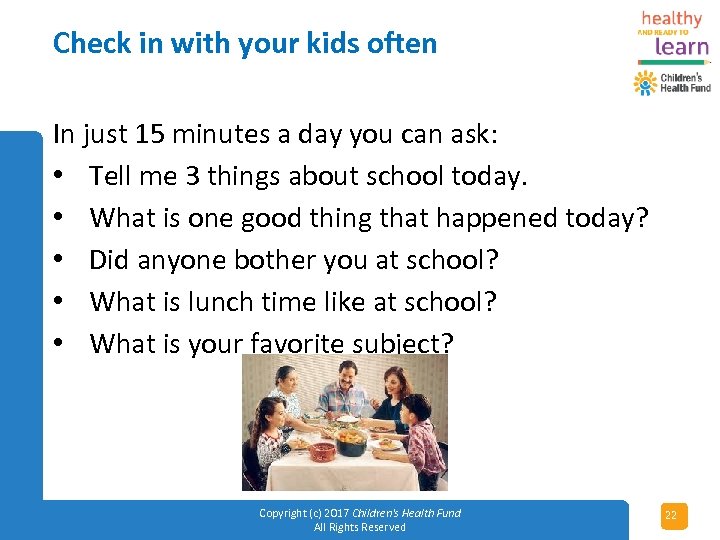
Check in with your kids often In just 15 minutes a day you can ask: • Tell me 3 things about school today. • What is one good thing that happened today? • Did anyone bother you at school? • What is lunch time like at school? • What is your favorite subject? Copyright (c) 2017 Children's Health Fund All Rights Reserved 22
Talk to kids about bullying • What does bullying mean to you? • Why do you think people bully? • Do you ever see kids at your school being bullied by other kids? How does it make you feel? • Do you know what to do if you see bullying? Copyright (c) 2017 Children's Health Fund All Rights Reserved 23
Copyright (c) 2017 Children's Health Fund All Rights Reserved 24
Advocate Do you know? What are some ways that this school is currently trying to prevent bullying? Copyright (c) 2017 Children's Health Fund All Rights Reserved 25
Advocate Do you know? What can you do as a parent to help prevent bullying in your child’s school? Copyright (c) 2017 Children's Health Fund All Rights Reserved 26
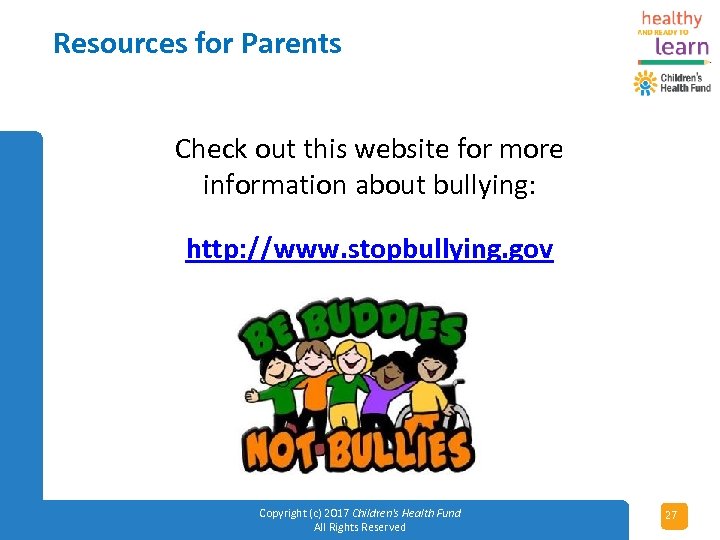
Resources for Parents Check out this website for more information about bullying: http: //www. stopbullying. gov Copyright (c) 2017 Children's Health Fund All Rights Reserved 27
If you are concerned that your child is being bullied or bullying others, please speak with the school principal, your child’s teacher, or the school counselor. Copyright (c) 2017 Children's Health Fund All Rights Reserved 28
Today’s Takeaways: • Learn How to Spot Bullying. Understand what bullying looks like and sounds like. • Talking Tips. Know some ways to talk to your children so you can help prevent bullying. • Advocate. Find out what your child’s school is already doing to prevent bullying and how you can help out. Copyright (c) 2017 Children's Health Fund All Rights Reserved 29
Question? www. hrl. nyc Copyright (c) 2017 Children's Health Fund All Rights Reserved 30
Thank You ! If you would like to see other mental and behavioral health resources or find information on additional Health Barriers to Learning, please visit the Healthy and Ready to Learn Resource and Training Center at www. hrl. nyc Copyright (c) 2017 Children's Health Fund All Rights Reserved 31
Скачать презентацию Buddies NOT Bullies Parent Workshop Copyright c 2017
7a986d72094445039fb549a4d44df4cb.ppt