 Скачать презентацию Bt Crops Paul Jepson Integrated Plant Protection Center
0a1eb44392b9bb1f005a0619a116431b.ppt
- Количество слайдов: 39



Bt Crops Paul Jepson Integrated Plant Protection Center Oregon State University
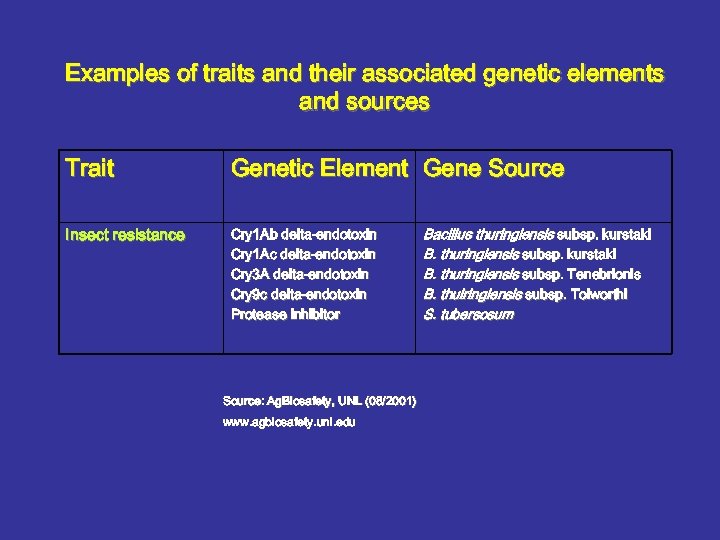
Examples of traits and their associated genetic elements and sources Trait Genetic Element Gene Source Insect resistance Cry 1 Ab delta-endotoxin Cry 1 Ac delta-endotoxin Cry 3 A delta-endotoxin Cry 9 c delta-endotoxin Protease inhibitor Source: Ag. Biosafety, UNL (08/2001) www. agbiosafety. unl. edu Bacillus thuringiensis subsp. kurstaki B. thuringiensis subsp. Tenebrionis B. thuiringiensis subsp. Tolworthi S. tubersosum
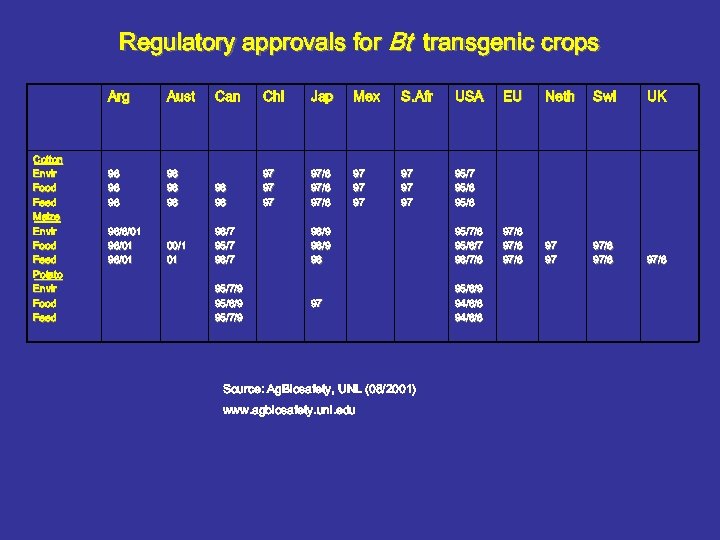
Regulatory approvals for Bt transgenic crops Arg Cotton Envir Food Feed Maize Envir Food Feed Potato Envir Food Feed Aust Can Chi Jap Mex S. Afr USA 98 98 98 96 96 96 97 97/8 97 97 97 95/7 95/8 00/1 01 96/7 95/7 96/9 96 95/7/8 95/6/7 96/7/8 95/7/9 95/6/9 95/7/9 97 95/6/9 94/6/8 96/8/01 98/01 Source: Ag. Biosafety, UNL (08/2001) www. agbiosafety. unl. edu EU Neth Swi UK 97/8 97 97 97/8
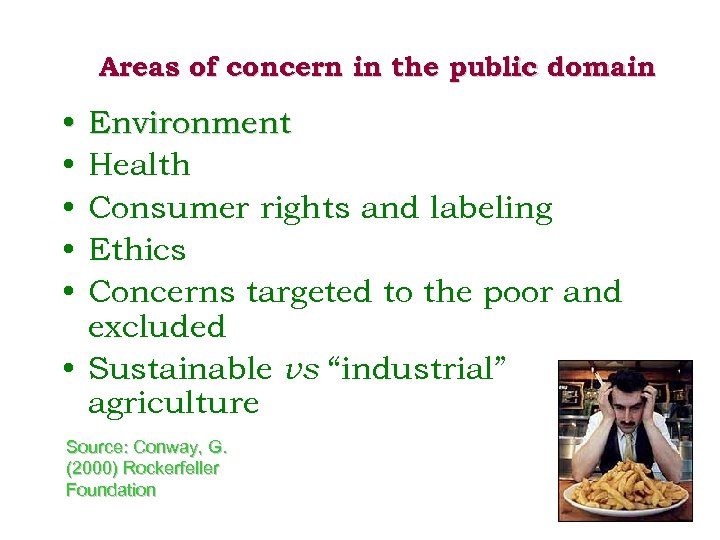
Areas of concern in the public domain • • • Environment Health Consumer rights and labeling Ethics Concerns targeted to the poor and excluded • Sustainable vs “industrial” agriculture Source: Conway, G. (2000) Rockerfeller Foundation
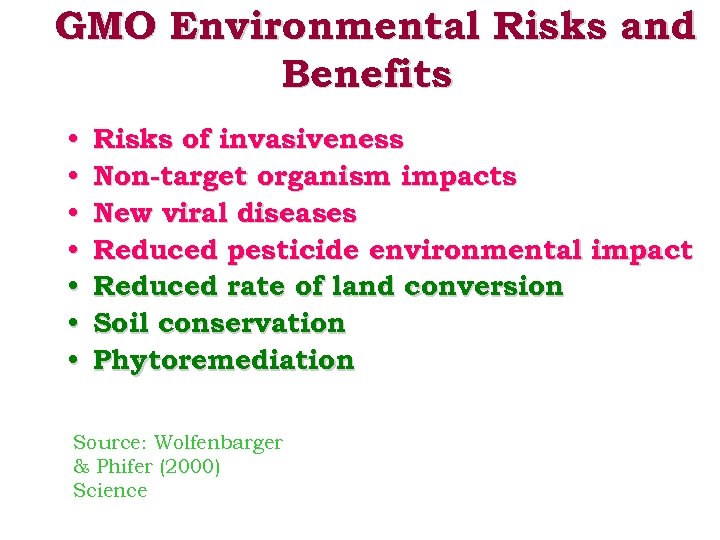
GMO Environmental Risks and Benefits • • Risks of invasiveness Non-target organism impacts New viral diseases Reduced pesticide environmental impact Reduced rate of land conversion Soil conservation Phytoremediation Source: Wolfenbarger & Phifer (2000) Science
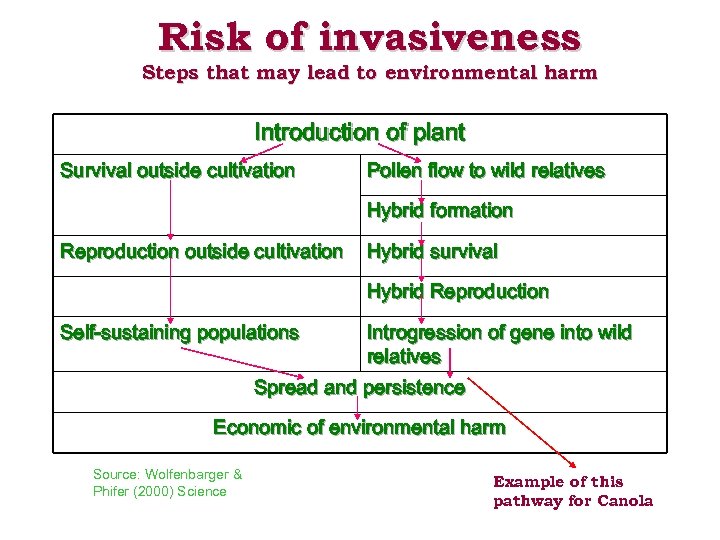
Risk of invasiveness Steps that may lead to environmental harm Introduction of plant Survival outside cultivation Pollen flow to wild relatives Hybrid formation Reproduction outside cultivation Hybrid survival Hybrid Reproduction Self-sustaining populations Introgression of gene into wild relatives Spread and persistence Economic of environmental harm Source: Wolfenbarger & Phifer (2000) Science Example of this pathway for Canola
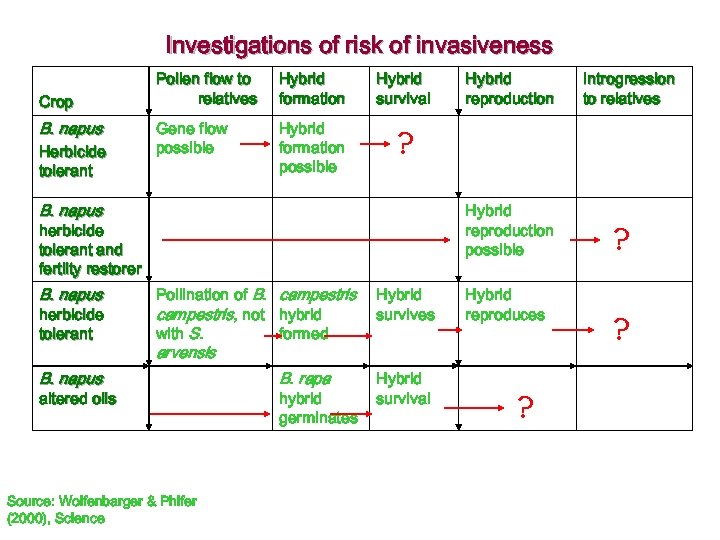
Investigations of risk of invasiveness Crop B. napus Herbicide tolerant Pollen flow to relatives Hybrid formation Hybrid survival Gene flow possible Hybrid formation possible ? B. napus Hybrid reproduction possible herbicide tolerant and fertlity restorer B. napus herbicide tolerant Hybrid reproduction Pollination of B. campestris, not hybrid with S. formed Hybrid survives Hybrid reproduces arvensis B. napus altered oils Source: Wolfenbarger & Phifer (2000), Science B. rapa hybrid germinates Hybrid survival ? Introgression to relatives ? ?
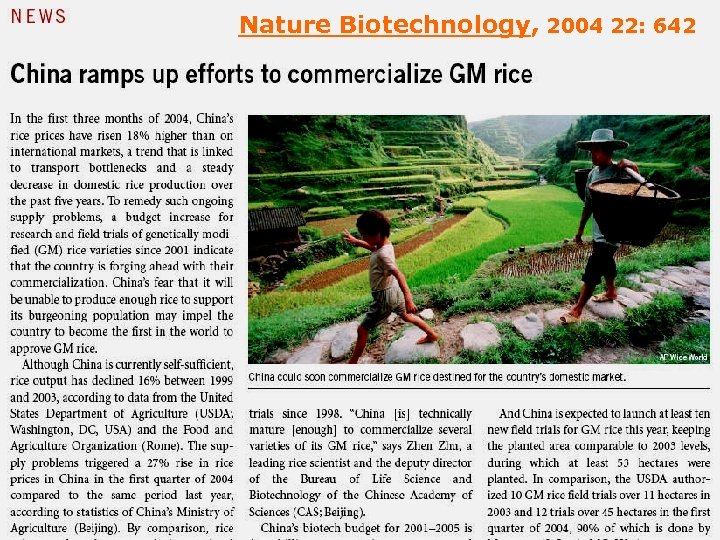
Nature Biotechnology, 2004 22: 642
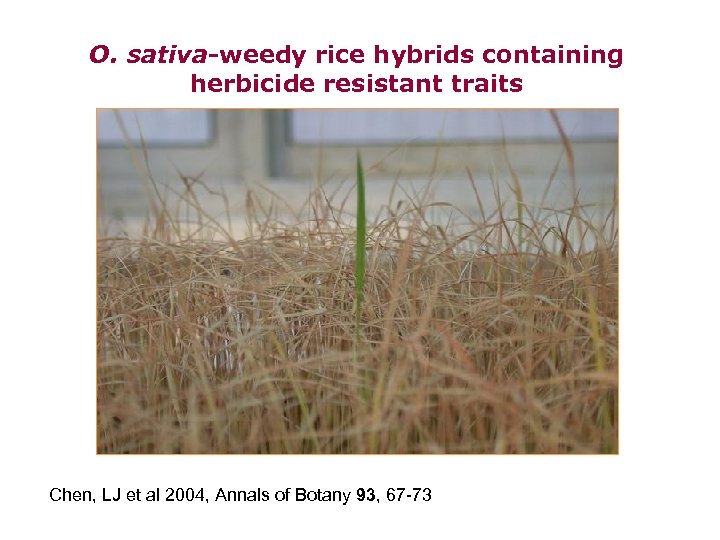
O. sativa-weedy rice hybrids containing herbicide resistant traits Chen, LJ et al 2004, Annals of Botany 93, 67 -73
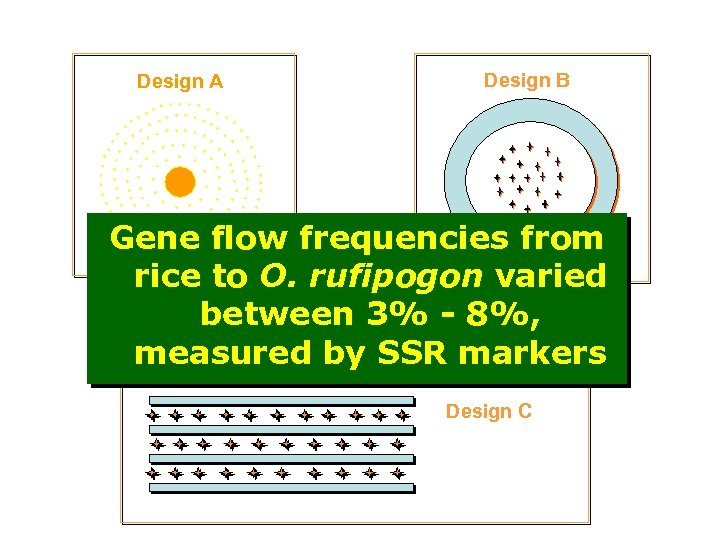
Design A Design B Gene flow frequencies from rice to O. rufipogon varied betweenrufipogon O. sativa O. 3% - 8%, measured by SSR markers Design C Bao. Rong Lu
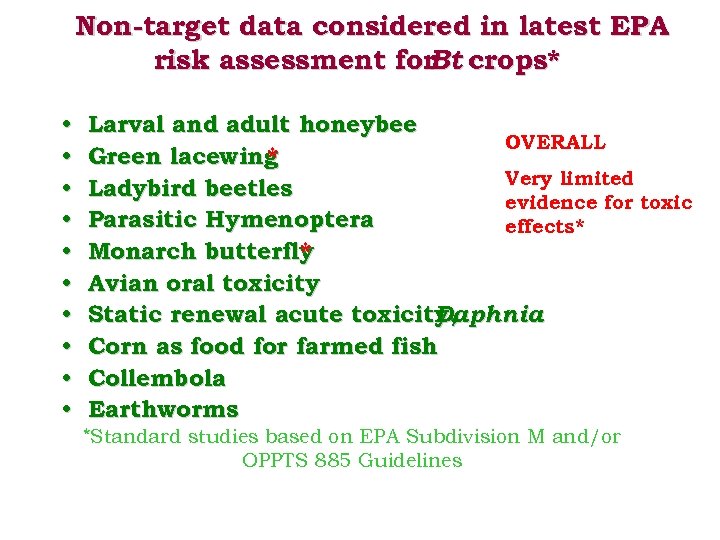
Non-target data considered in latest EPA risk assessment for crops* Bt • • • Larval and adult honeybee OVERALL Green lacewing * Very limited Ladybird beetles evidence for toxic Parasitic Hymenoptera effects* Monarch butterfly * Avian oral toxicity Static renewal acute toxicity, Daphnia Corn as food for farmed fish Collembola Earthworms *Standard studies based on EPA Subdivision M and/or OPPTS 885 Guidelines
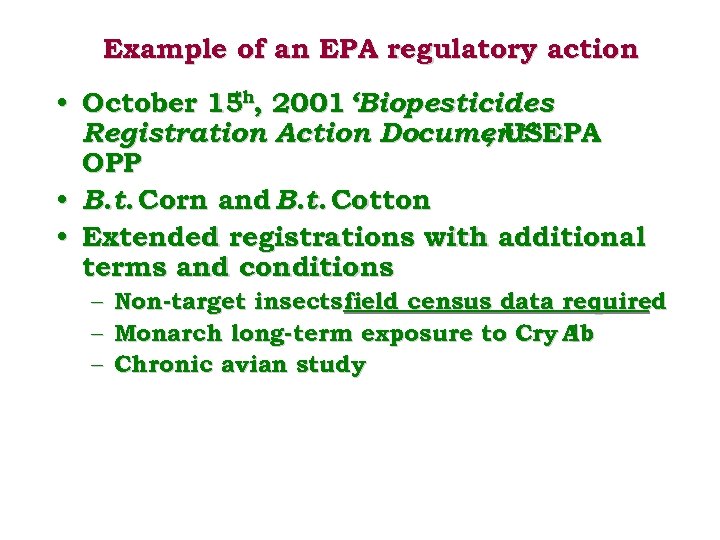
Example of an EPA regulatory action th • October 15 , 2001 ‘Biopesticides Registration Action Document’ , USEPA OPP • B. t. Corn and B. t. Cotton • Extended registrations with additional terms and conditions – Non-target insects: field census data required – Monarch long-term exposure to Cry Ab 1 – Chronic avian study
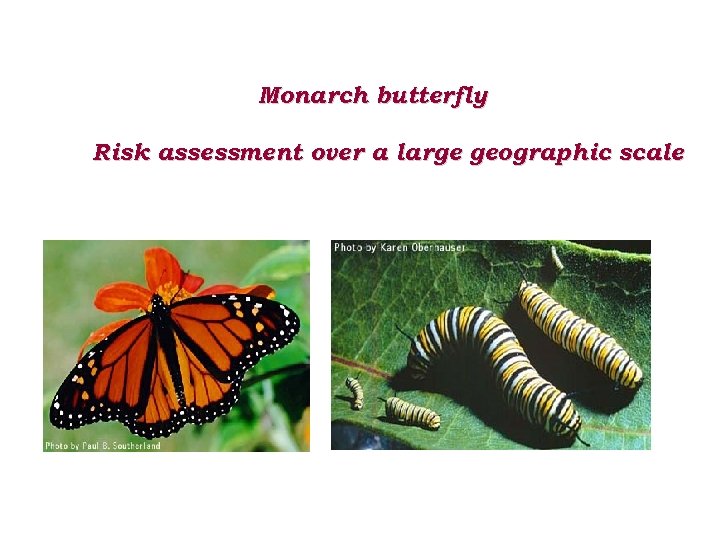
Monarch butterfly Risk assessment over a large geographic scale
Monarch butterfly research • Published in PNAS, 2001 • Research addressed – Sensitivity to B. t. protein and pollen in the lab – Pollen burden on milkweed in and near corn – Exposure assessment – Effects in the field – Overall risk assessment • Corn used more extensively as a habitat by Monarch butterfly than expected • Risks to butterflies of most corn events low B. t. • The most toxic event removed from the market-place
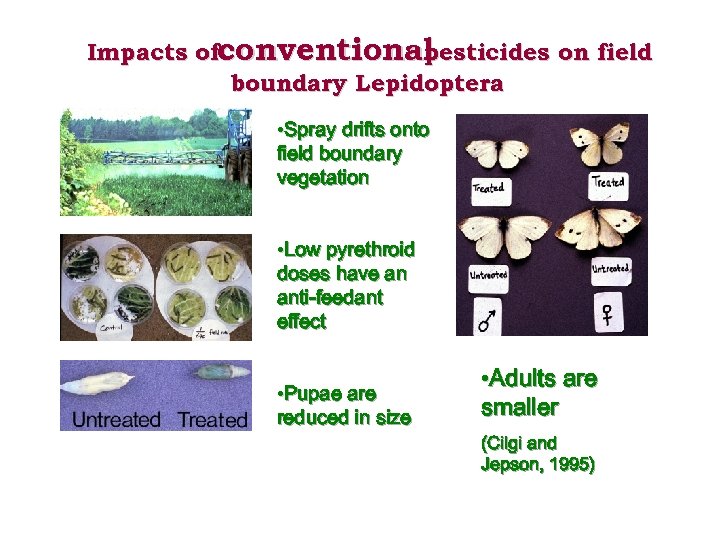
Impacts ofconventional pesticides on field boundary Lepidoptera • Spray drifts onto field boundary vegetation • Low pyrethroid doses have an anti-feedant effect • Pupae are reduced in size • Adults are smaller (Cilgi and Jepson, 1995)
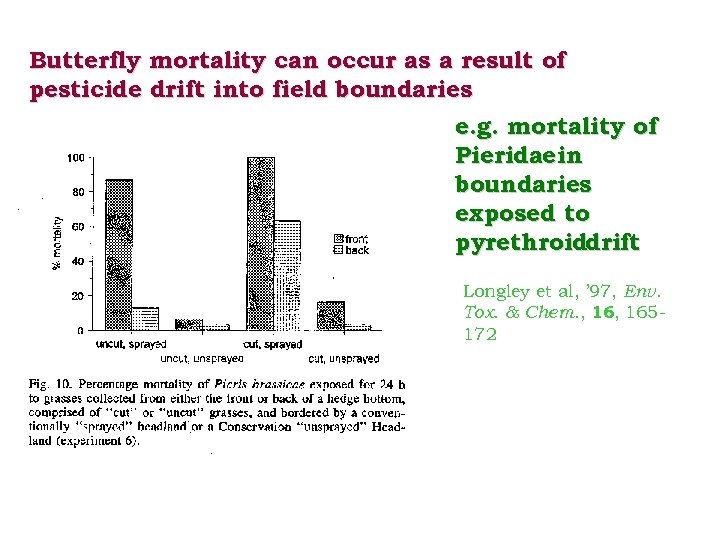
Butterfly mortality can occur as a result of pesticide drift into field boundaries e. g. mortality of Pieridaein boundaries exposed to pyrethroiddrift Longley et al, ’ 97, Env. Tox. & Chem. , 165172
Field census data: Natural Enemy Abundance in B. t. and Conventional Cotton Fields Head, G. , Freeman, B. , Moar, W. , Ruberson J. , And Turnipseed S. ,
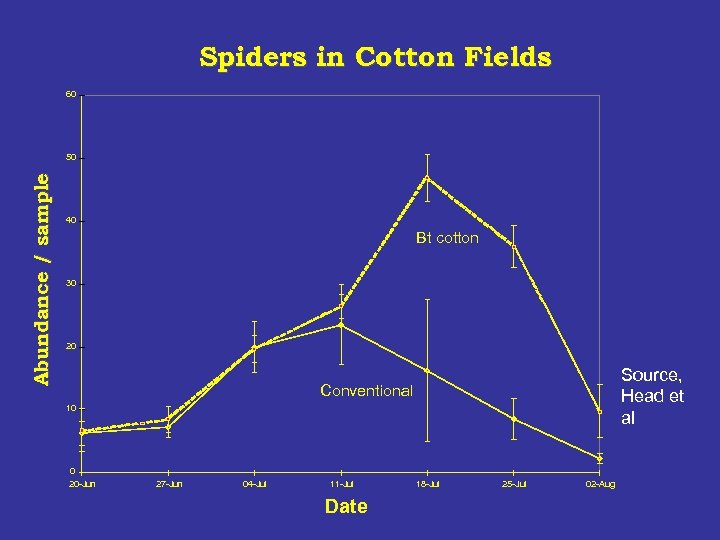
Spiders in Cotton Fields 60 Abundance / sample 50 40 Bt cotton 30 20 Source, Head et al Conventional 10 0 20 -Jun 27 -Jun 04 -Jul 11 -Jul Date 18 -Jul 25 -Jul 02 -Aug
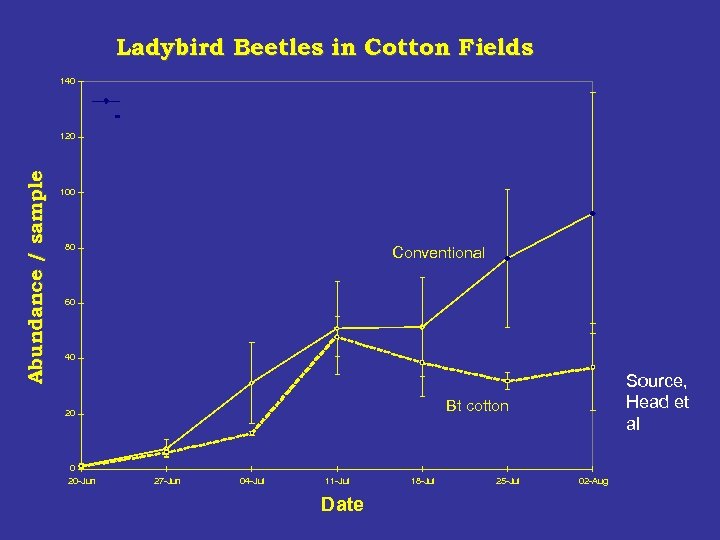
Ladybird Beetles in Cotton Fields 140 Abundance / sample 120 100 80 Conventional 60 40 Bt cotton 20 0 20 -Jun Source, Head et al 27 -Jun 04 -Jul 11 -Jul Date 18 -Jul 25 -Jul 02 -Aug
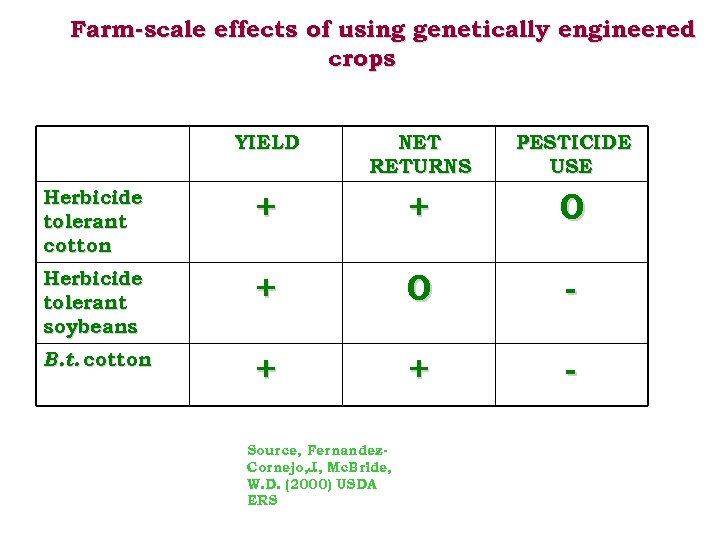
Farm-scale effects of using genetically engineered crops YIELD NET RETURNS PESTICIDE USE Herbicide tolerant cotton + + 0 Herbicide tolerant soybeans + 0 - B. t. cotton + + - Source, Fernandez. Cornejo, J Mc. Bride, . , W. D. (2000) USDA ERS
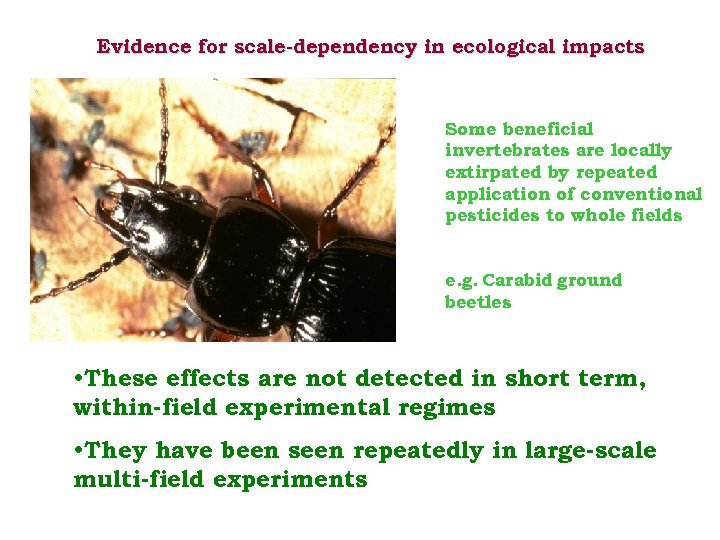
Evidence for scale-dependency in ecological impacts Some beneficial invertebrates are locally extirpated by repeated application of conventional pesticides to whole fields e. g. Carabid ground beetles 30, 696 -705 • These effects are not detected. , in short term, within-field experimental regimes • They have been seen repeatedly in large-scale multi-field experiments
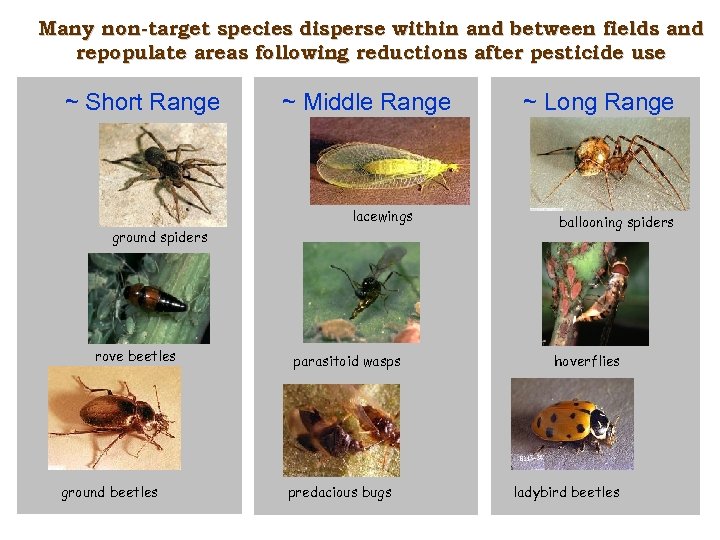
Many non-target species disperse within and between fields and repopulate areas following reductions after pesticide use ~ Short Range ~ Middle Range lacewings ground spiders rove beetles ground beetles parasitoid wasps predacious bugs ~ Long Range ballooning spiders hoverflies ladybird beetles
Transgenicvs. conventional delivery Indirect effects may be more important than direct effects – Specialist natural enemies may be reduced because of profound impacts on target herbivores in all B. t. fields Exposure pathways very different – Most non-target taxa are not exposed to plantincorporated protectants at all: a feeding pathway is required for toxicity – Certain taxa exposed to PIP’s via diet, for the whole season, and some of these may be susceptible – Exposure is synchronized between fields
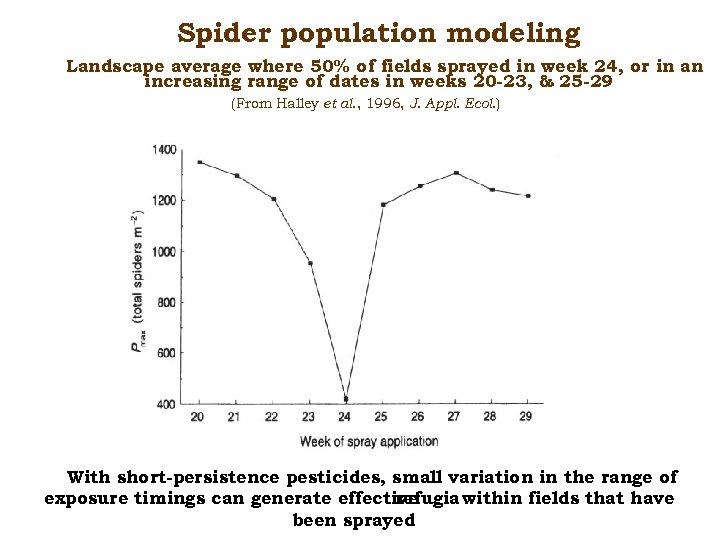
Spider population modeling Landscape average where 50% of fields sprayed in week 24, or in an increasing range of dates in weeks 20 -23, & 25 -29 (From Halley et al. , 1996, J. Appl. Ecol. ) With short-persistence pesticides, small variation in the range of exposure timings can generate effective refugia within fields that have been sprayed
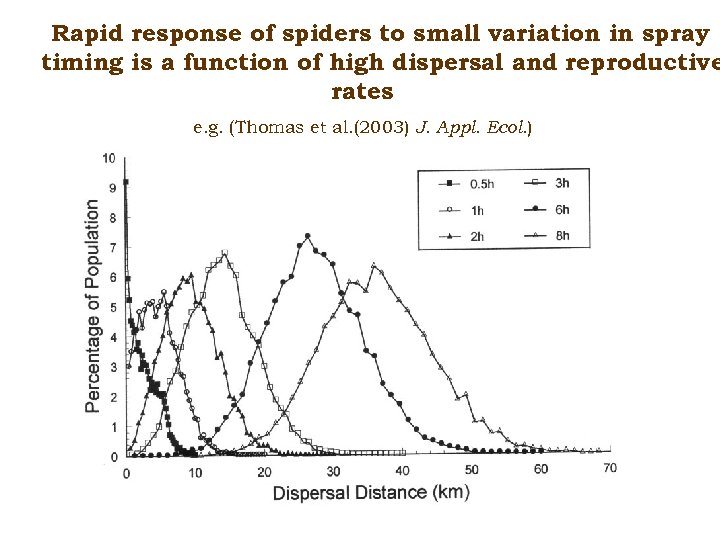
Rapid response of spiders to small variation in spray timing is a function of high dispersal and reproductive rates e. g. (Thomas et al. (2003) J. Appl. Ecol. )
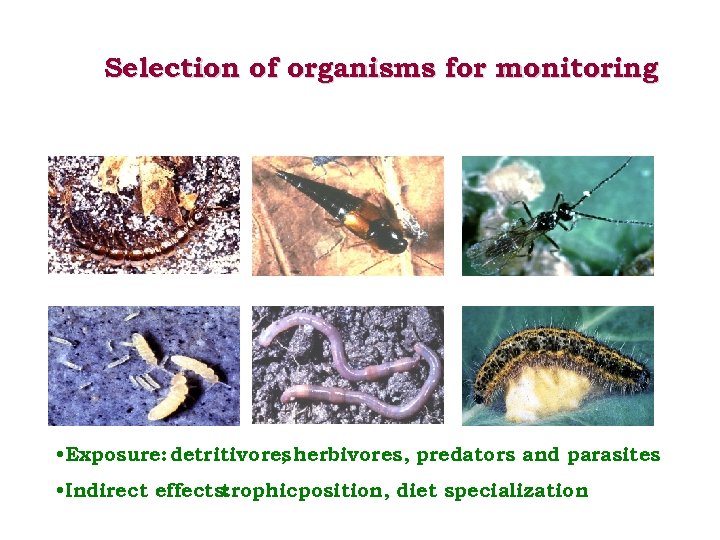
Selection of organisms for monitoring • Exposure: detritivores herbivores, predators and parasites , • Indirect effects: trophicposition, diet specialization
Conclusions (Part 1) • Environmental risk assessment still under development, particularly for risk of gene flow, and for large scale effects • Ability to determine higher risk situations improving • PIP’s significantly different to pesticides • Benefits of pesticide reductions need to be examined • Potential use within sustainable development programs not certain: many other factors are important • Acceptance of work demonstrating negative impacts has been poor Ag. &Env. Ethics (2001) 14: (J. . 3028)
FIFRA Scientific Advisory Panel Concerns about data submitted by industry • Many ‘tier 1’ tests submitted by industry are flawed or incomplete – – • • • Presence of toxin not demonstrated in artificial diets for test species Control mortality so high that it masks possible effects Some tests (e. g. treated insect eggs), do not expose certain insect predators to the toxin No statistical analysis of some tests Field evaluation no substitute for tier 1 risk assessment testing Data do not support EPA statement that Bt corn (MON 863) results in less impact on non-target invertebrates than conventional pest management practices Several field studies had no statistical analysis to support them Plot sizes were trivial, reducing likelihood of detecting treatment effects (even highly toxic pesticide effects were nor detectable in some investigations) Statistical power halved in GM crop plots as a result of flawed experimental design
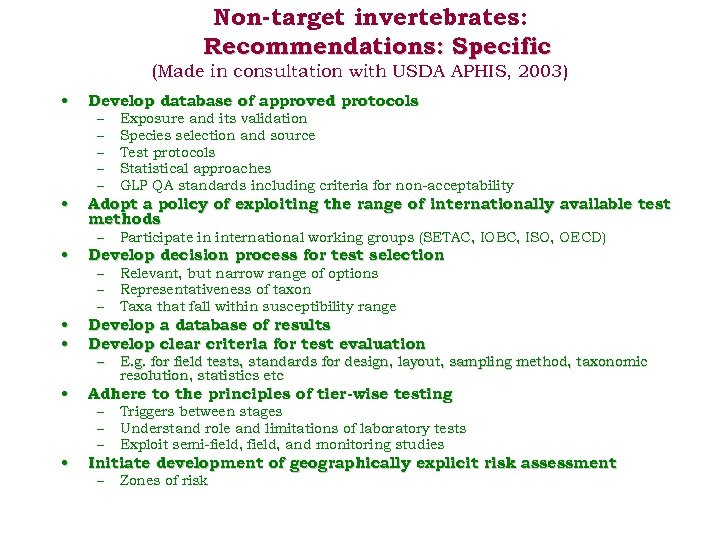
Non-target invertebrates: Recommendations: Specific (Made in consultation with USDA APHIS, 2003) • • Develop database of approved protocols – – – Adopt a policy of exploiting the range of internationally available test methods – • • • Exposure and its validation Species selection and source Test protocols Statistical approaches GLP QA standards including criteria for non-acceptability Participate in international working groups (SETAC, IOBC, ISO, OECD) Develop decision process for test selection – – – Relevant, but narrow range of options Representativeness of taxon Taxa that fall within susceptibility range Develop a database of results Develop clear criteria for test evaluation – E. g. for field tests, standards for design, layout, sampling method, taxonomic resolution, statistics etc Adhere to the principles of tier-wise testing – – – Triggers between stages Understand role and limitations of laboratory tests Exploit semi-field, and monitoring studies Initiate development of geographically explicit risk assessment – Zones of risk
Use of Environmental Impact Quotients to compare pesticide environmental risks in conventional and transgenic cotton
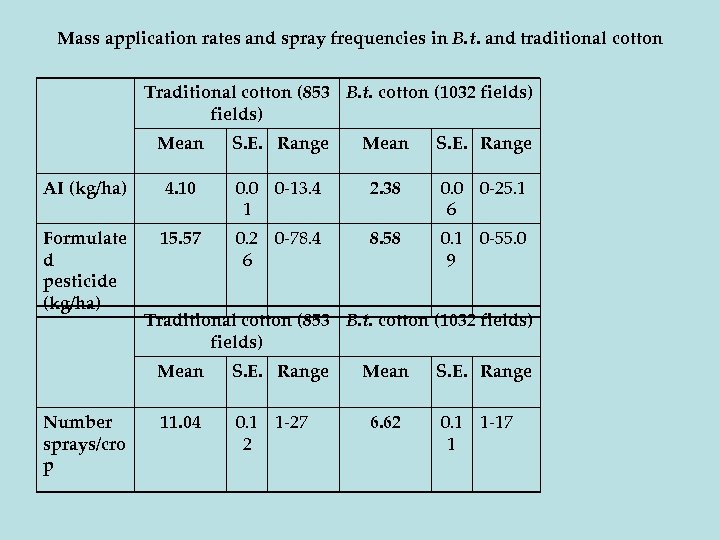
Mass application rates and spray frequencies in B. t. and traditional cotton Traditional cotton (853 B. t. cotton (1032 fields) Mean S. E. Range AI (kg/ha) 4. 10 0. 0 0 -13. 4 1 2. 38 0. 0 0 -25. 1 6 Formulate d pesticide (kg/ha) 15. 57 0. 2 0 -78. 4 6 8. 58 0. 1 0 -55. 0 9 Traditional cotton (853 B. t. cotton (1032 fields) Mean Number sprays/cro p S. E. Range 11. 04 0. 1 1 -27 2 Mean 6. 62 S. E. Range 0. 1 1 -17 1
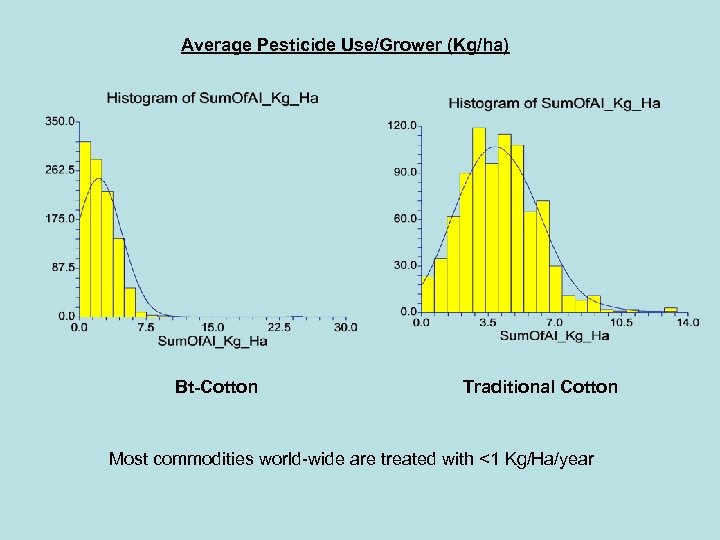
Average Pesticide Use/Grower (Kg/ha) Bt-Cotton Traditional Cotton Most commodities world-wide are treated with <1 Kg/Ha/year
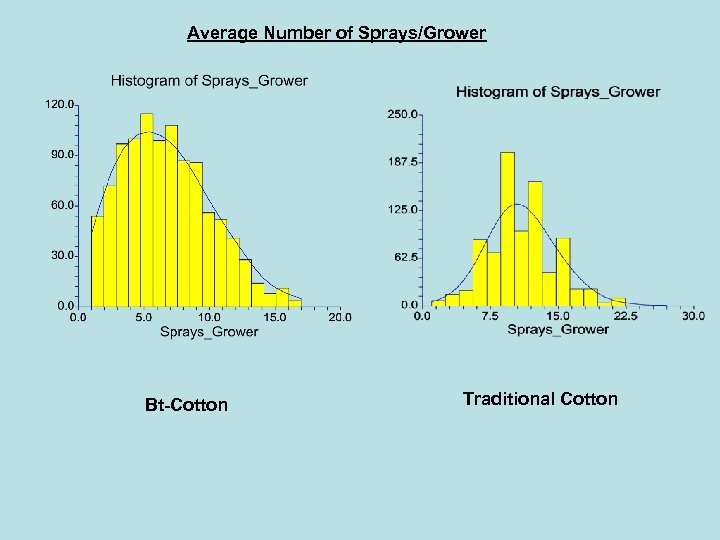
Average Number of Sprays/Grower Bt-Cotton Traditional Cotton
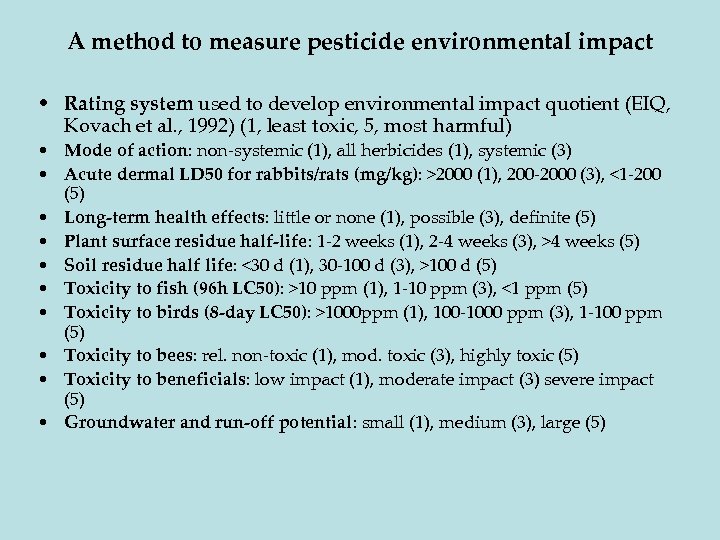
A method to measure pesticide environmental impact • Rating system used to develop environmental impact quotient (EIQ, Kovach et al. , 1992) (1, least toxic, 5, most harmful) • Mode of action: non-systemic (1), all herbicides (1), systemic (3) • Acute dermal LD 50 for rabbits/rats (mg/kg): >2000 (1), 200 -2000 (3), <1 -200 (5) • Long-term health effects: little or none (1), possible (3), definite (5) • Plant surface residue half-life: 1 -2 weeks (1), 2 -4 weeks (3), >4 weeks (5) • Soil residue half life: <30 d (1), 30 -100 d (3), >100 d (5) • Toxicity to fish (96 h LC 50): >10 ppm (1), 1 -10 ppm (3), <1 ppm (5) • Toxicity to birds (8 -day LC 50): >1000 ppm (1), 100 -1000 ppm (3), 1 -100 ppm (5) • Toxicity to bees: rel. non-toxic (1), mod. toxic (3), highly toxic (5) • Toxicity to beneficials: low impact (1), moderate impact (3) severe impact (5) • Groundwater and run-off potential: small (1), medium (3), large (5)
![Calculating the EIQ • EIQ = [C[(DT*5)+(DT*P)]+[C*((S+P)/2*SY)+(L)]+[(F*R) +(D*((S+P)/2)*3)+(Z*P*3)+(B*P*5)]}/3 • DT= dermal toxicity, C= chronic](https://present5.com/presentation/0a1eb44392b9bb1f005a0619a116431b/image-35.jpg "Calculating the EIQ • EIQ = [C[(DT*5)+(DT*P)]+[C*((S+P)/2*SY)+(L)]+[(F*R) +(D*((S+P)/2)*3)+(Z*P*3)+(B*P*5)]}/3 • DT= dermal toxicity, C= chronic")
Calculating the EIQ • EIQ = [C[(DT*5)+(DT*P)]+[C*((S+P)/2*SY)+(L)]+[(F*R) +(D*((S+P)/2)*3)+(Z*P*3)+(B*P*5)]}/3 • DT= dermal toxicity, C= chronic toxicity, SY=systemicity, F= fish toxicity, L=leaching potential, R= surface loss potential, D=bird toxicity, S= soil half life, Z=bee toxicity, B=beneficial arthropod toxicity, P=plant surface half life • EIQ (field use rating)= EIQ *%AI*rate
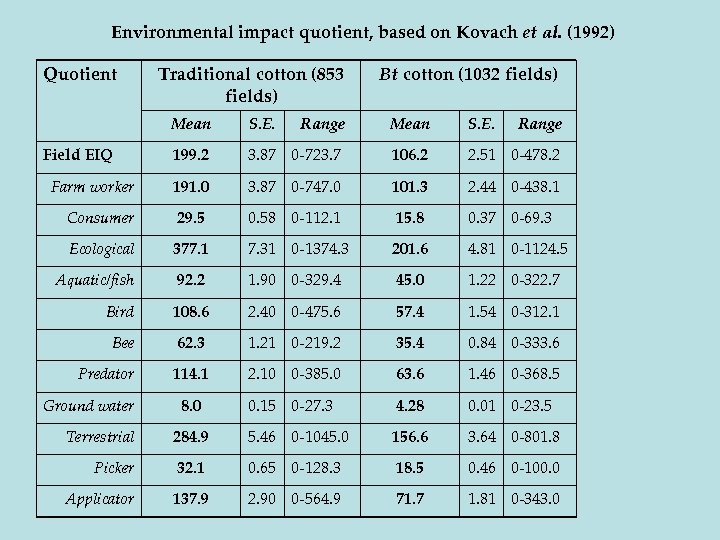
Environmental impact quotient, based on Kovach et al. (1992) Quotient Traditional cotton (853 fields) Bt cotton (1032 fields) Mean S. E. Range Mean S. E. 199. 2 3. 87 0 -723. 7 106. 2 2. 51 0 -478. 2 Farm worker 191. 0 3. 87 0 -747. 0 101. 3 2. 44 0 -438. 1 Consumer 29. 5 0. 58 0 -112. 1 15. 8 0. 37 0 -69. 3 Ecological 377. 1 7. 31 0 -1374. 3 201. 6 4. 81 0 -1124. 5 Aquatic/fish 92. 2 1. 90 0 -329. 4 45. 0 1. 22 0 -322. 7 Bird 108. 6 2. 40 0 -475. 6 57. 4 1. 54 0 -312. 1 Bee 62. 3 1. 21 0 -219. 2 35. 4 0. 84 0 -333. 6 Predator 114. 1 2. 10 0 -385. 0 63. 6 1. 46 0 -368. 5 8. 0 0. 15 0 -27. 3 4. 28 0. 01 0 -23. 5 Field EIQ Ground water Range Terrestrial 284. 9 5. 46 0 -1045. 0 156. 6 3. 64 0 -801. 8 Picker 32. 1 0. 65 0 -128. 3 18. 5 0. 46 0 -100. 0 Applicator 137. 9 2. 90 0 -564. 9 71. 7 1. 81 0 -343. 0
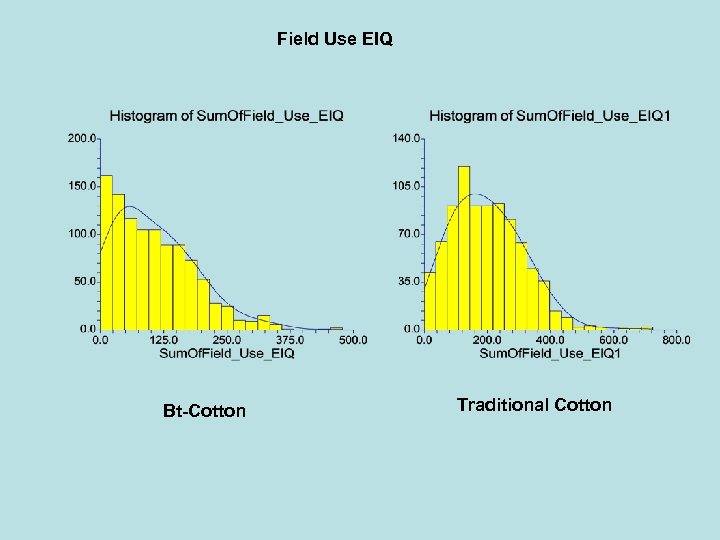
Field Use EIQ Bt-Cotton Traditional Cotton
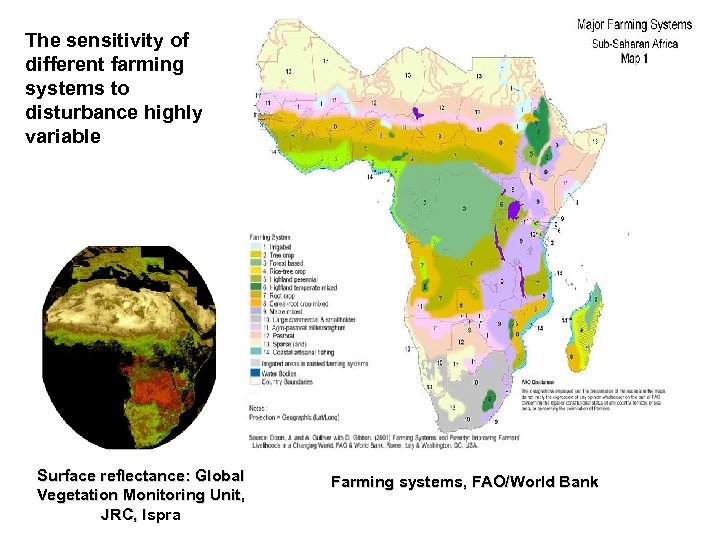
The sensitivity of different farming systems to disturbance highly variable Surface reflectance: Global Vegetation Monitoring Unit, JRC, Ispra Farming systems, FAO/World Bank
Conclusions/questions • At what stage will we know enough to possibly reduce the requirement for extensive testing of Bt crops? • Are we exhibiting dual standards by requiring greater scrutiny of Bt crops, compared with conventional pesticides? • Is equivalent scrutiny required at each new location for GM crop adoption?
Скачать презентацию Bt Crops Paul Jepson Integrated Plant Protection Center
0a1eb44392b9bb1f005a0619a116431b.ppt