 Скачать презентацию Bruxelles January 27 th 2009 Telecom Italia s undertakings
e2452e0f438ea9c2f76c513b4525d9bb.ppt
- Количество слайдов: 24



Bruxelles, January 27 th, 2009 Telecom Italia’s undertakings: building up an operational separation model • Workshop on “Policy for Next Generation Networks: European and US Perspectives” • MIT, Cambridge, 27 th March 2009 Equivalence and Regulatory Affairs Market Analyses, Regulatory Economics & International Regulation Giovanni Battista Amendola 0
Workshop on Policy for Next Generation Networks: European and US Perspectives MIT, Cambridge, 27 th March 2009 Equivalence and Regulatory Affairs MISSION ► Managing the regulatory process to increase the company’s value by affecting market changes in the mid-long term. VISION ► Leading the change, as an influential team and a strategic reference for the company in the development of its business and in consumer protection; establishing a loyal dialogue with the other market players, Authorities and Institutions for the achievement of a simple, efficient and symmetric regulation. G. B. Amendola – ERA. Market Analyses, Regulatory Economics & International Regulation 1
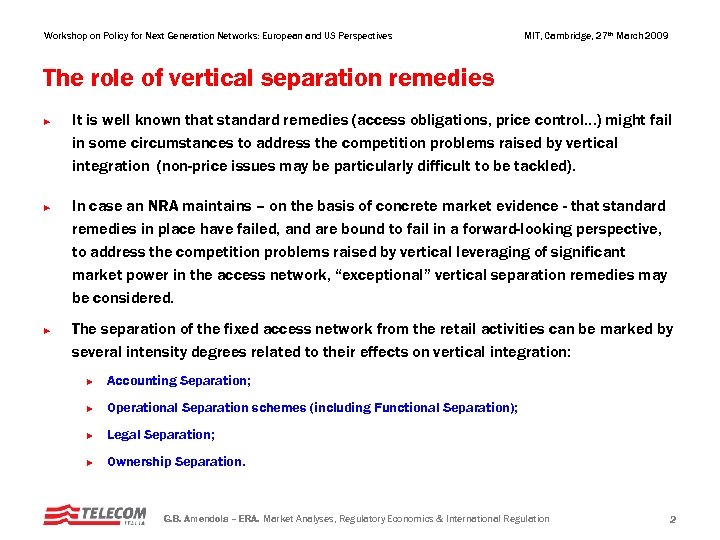
Workshop on Policy for Next Generation Networks: European and US Perspectives MIT, Cambridge, 27 th March 2009 The role of vertical separation remedies ► ► ► It is well known that standard remedies (access obligations, price control. . . ) might fail in some circumstances to address the competition problems raised by vertical integration (non-price issues may be particularly difficult to be tackled). In case an NRA maintains – on the basis of concrete market evidence - that standard remedies in place have failed, and are bound to fail in a forward-looking perspective, to address the competition problems raised by vertical leveraging of significant market power in the access network, “exceptional” vertical separation remedies may be considered. The separation of the fixed access network from the retail activities can be marked by several intensity degrees related to their effects on vertical integration: ► Accounting Separation; ► Operational Separation schemes (including Functional Separation); ► Legal Separation; ► Ownership Separation. G. B. Amendola – ERA. Market Analyses, Regulatory Economics & International Regulation 2
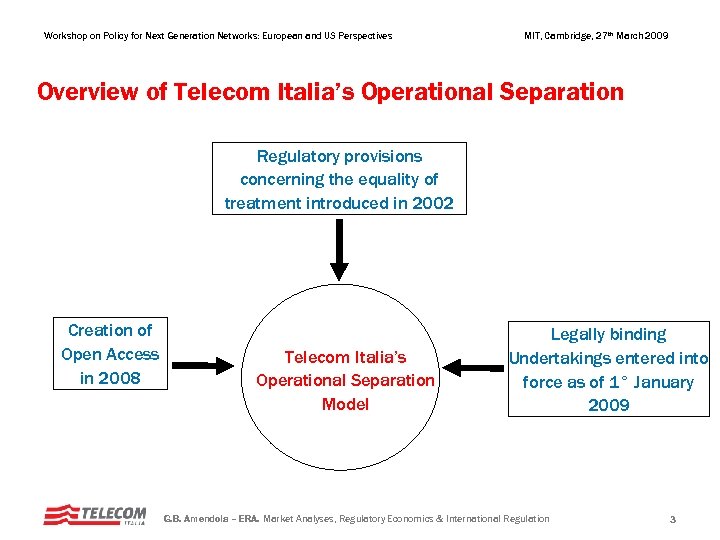
Workshop on Policy for Next Generation Networks: European and US Perspectives MIT, Cambridge, 27 th March 2009 Overview of Telecom Italia’s Operational Separation Regulatory provisions concerning the equality of treatment introduced in 2002 Creation of Open Access in 2008 Telecom Italia’s Operational Separation Model Legally binding Undertakings entered into force as of 1° January 2009 G. B. Amendola – ERA. Market Analyses, Regulatory Economics & International Regulation 3
Workshop on Policy for Next Generation Networks: European and US Perspectives MIT, Cambridge, 27 th March 2009 Regulatory provisions concerning the equality of treatment introduced in 2002 G. B. Amendola – ERA. Market Analyses, Regulatory Economics & International Regulation 4
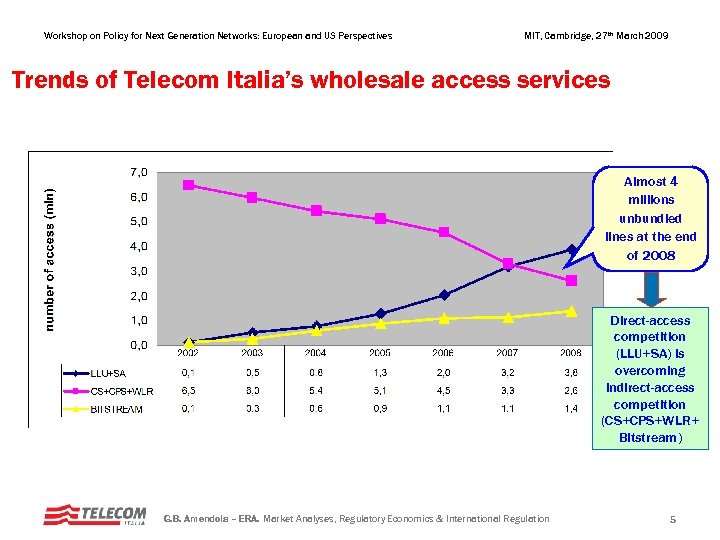
Workshop on Policy for Next Generation Networks: European and US Perspectives MIT, Cambridge, 27 th March 2009 Trends of Telecom Italia’s wholesale access services Almost 4 millions unbundled lines at the end of 2008 Direct-access competition (LLU+SA) is overcoming indirect-access competition (CS+CPS+WLR+ Bitstream) G. B. Amendola – ERA. Market Analyses, Regulatory Economics & International Regulation 5
Workshop on Policy for Next Generation Networks: European and US Perspectives MIT, Cambridge, 27 th March 2009 The creation of Open Access (1/2) The Open Access business unit has been created at the beginning of 2008 ► ► to achieve efficiencies both in operational and maintenance costs and network investments; and to increase transparency in the provision of wholesale access services to TI’s commercial department s and to the alterative Operators (OLOs) by means of TI’s Wholesale department. Open Access manages TI’s access infrastructures and provides the following main services: ► Copper physical link supply between client and local exchange for TI and OLO ► Wholesale Line Rental (WLR) service ► Co-location service supply in the central exchange spaces ► Optical fibre physical link supply ► Maintenance services on copper and fibre links ► Access to ducts ► Wholesale broadband access (bitstream services) G. B. Amendola – ERA. Market Analyses, Regulatory Economics & International Regulation 6
Workshop on Policy for Next Generation Networks: European and US Perspectives MIT, Cambridge, 27 th March 2009 The creation of Open Access (2/2) Open Access plays a key role in ensuring the implementation of TI’s undertakings due to the fact that most of the undertakings concern the equivalence in the provision of SMP network access services produced by Open Access. Therefore, Open Access is the organisational tool to achieve access equivalence for both TI retail divisions and OLOs. For these reasons, even if the creation of Open Access is not part of TI’s Undertakings, any significant organisational change of both Open Access and TI Wholesale, is to be previously submitted to AGCom approval. G. B. Amendola – ERA. Market Analyses, Regulatory Economics & International Regulation 7
Workshop on Policy for Next Generation Networks: European and US Perspectives MIT, Cambridge, 27 th March 2009 Main objectives of TI’s Undertakings On 15 th December 2008, AGCom approved TI’s Undertakings (Decision 718/08/CONS): ► 223 undertakings are legally binding as of 1 st January 2009. TI’s Undertakings are intended to: ► ► ► strengthen the operational separation model by addressing the competition concerns expressed by AGCOM; reduce the degree of litigation with OLOs; ensure competitive conditions in the migration towards new generation networks. TI’s Undertakings are not intended to modify current regulatory remedies imposed by AGCom on TI. The undertakings have been voluntarily added by TI to the current remedies. G. B. Amendola – ERA. Market Analyses, Regulatory Economics & International Regulation 8
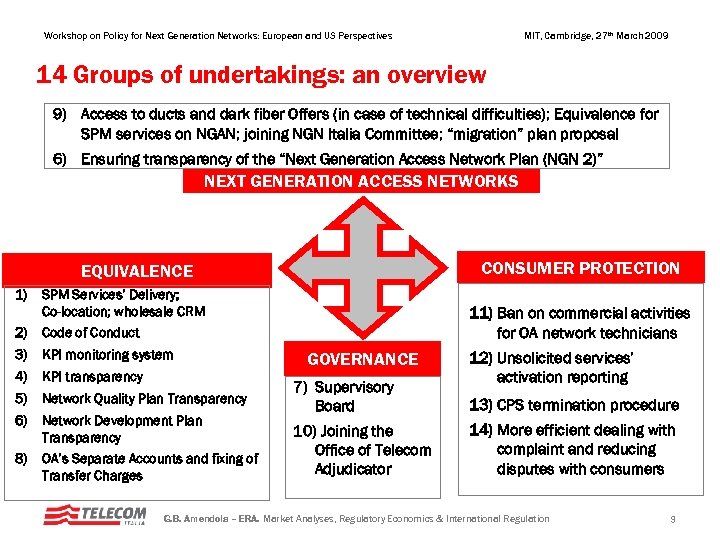
Workshop on Policy for Next Generation Networks: European and US Perspectives MIT, Cambridge, 27 th March 2009 14 Groups of undertakings: an overview 9) Access to ducts and dark fiber Offers (in case of technical difficulties); Equivalence for SPM services on NGAN; joining NGN Italia Committee; “migration” plan proposal 6) Ensuring transparency of the “Next Generation Access Network Plan (NGN 2)” NEXT GENERATION ACCESS NETWORKS CONSUMER PROTECTION EQUIVALENCE 1) SPM Services’ Delivery; Co-location; wholesale CRM 11) Ban on commercial activities for OA network technicians 2) Code of Conduct 3) KPI monitoring system 4) KPI transparency 5) Network Quality Plan Transparency 6) Network Development Plan Transparency 8) OA’s Separate Accounts and fixing of Transfer Charges GOVERNANCE 7) Supervisory Board 10) Joining the Office of Telecom Adjudicator 12) Unsolicited services’ activation reporting 13) CPS termination procedure 14) More efficient dealing with complaint and reducing disputes with consumers G. B. Amendola – ERA. Market Analyses, Regulatory Economics & International Regulation 9
Workshop on Policy for Next Generation Networks: European and US Perspectives MIT, Cambridge, 27 th March 2009 Ensuring Technical Equivalence: the new single delivery process for the provision of access SMP services (1/2) G. B. Amendola – ERA. Market Analyses, Regulatory Economics & International Regulation 10
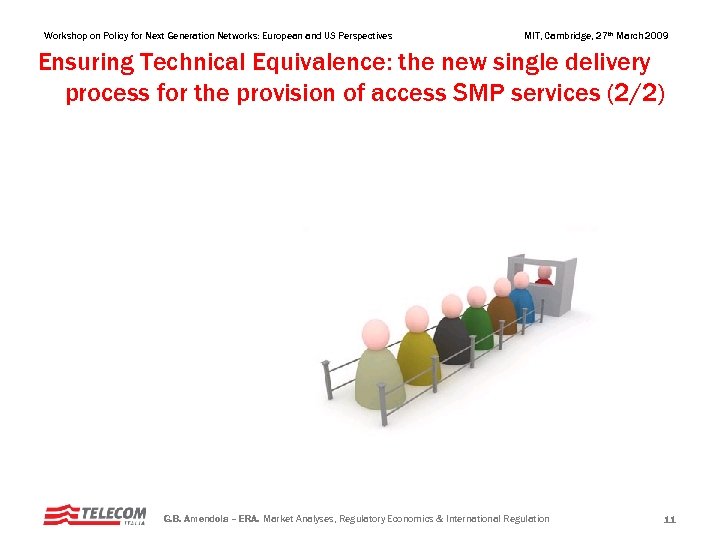
Workshop on Policy for Next Generation Networks: European and US Perspectives MIT, Cambridge, 27 th March 2009 Ensuring Technical Equivalence: the new single delivery process for the provision of access SMP services (2/2) G. B. Amendola – ERA. Market Analyses, Regulatory Economics & International Regulation 11
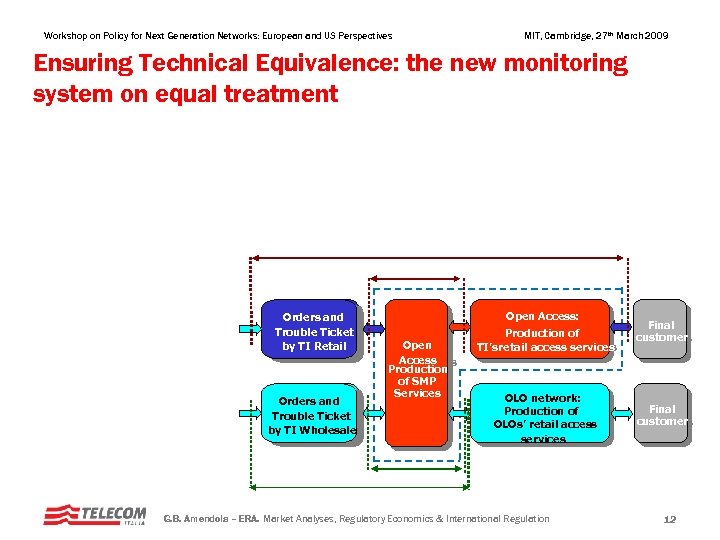
Workshop on Policy for Next Generation Networks: European and US Perspectives MIT, Cambridge, 27 th March 2009 Ensuring Technical Equivalence: the new monitoring system on equal treatment Orders and TI TI Trouble Ticket Retail by TI Retail Orders and TI TI Trouble Ticket Wholesale by TI Wholesale Open Access Production of SMP Services Open Access: Production of Telecom’s retail services TI’s retail access services Final customer OLO network: Production of OLOs’ retail services access retail servicesof OLO services Final customer G. B. Amendola – ERA. Market Analyses, Regulatory Economics & International Regulation 12
Workshop on Policy for Next Generation Networks: European and US Perspectives MIT, Cambridge, 27 th March 2009 Ensuring Economic Equivalence Introduction of internal transfer charges for SMP access services TI is to elaborate and submit to AGCom approval a proposal of internal service contracts based on the economic transfer charges related to the provision of SMP services delivered by Open Access. Integration of TI’s Regulatory Accounting to include Open Access TI is to elaborate and submit to AGCom approval a proposal for a separate regulatory account system related to Open Access. The new accounting separation of Open Access will provide evidence concerning the equivalence between the transfer charges applied to the internal commercial divisions and the relevant economic conditions applied to alternative operators. G. B. Amendola – ERA. Market Analyses, Regulatory Economics & International Regulation 13
Workshop on Policy for Next Generation Networks: European and US Perspectives MIT, Cambridge, 27 th March 2009 Ensuring Access Equivalence to Next Generation Access Networks Access to ducts and dark fibre TI will provide an offer for the access to and sharing of its ducts. If this access is neither technically possible nor economically viable, TI is to provide an alternative solution based on access to dark fibre. Open Access will directly manage the creation of a new system to allow the delivery of the ducts offer directly to OLOs. Access equivalence to NGAN With reference to the second round of AGCom market analysis, the current undertakings shall be extended to all the new wholesale network services, provided over the NGAN, in which Telecom Italia will be found as having SMP. Migration process Also on the basis of the discussions within the “NGN Italy Committee”, TI is to submit to AGCOM’s approval a proposal of guidelines for the migration process towards NGAN and the phasing out of some TI local switches. Transparency on NGAN development plans TI undertakes to release the “New Generation Access Network Plan (NGAN)”, which is to outline the percentage of new generation lines for each local exchange area and municipality, with reference to the so-called “passed home”. In addition, it will include technical information on wholesale services, if any, which might become locally available on the new network platform. G. B. Amendola – ERA. Market Analyses, Regulatory Economics & International Regulation 14
Workshop on Policy for Next Generation Networks: European and US Perspectives MIT, Cambridge, 27 th March 2009 Ensuring achievement of equivalence: the Supervisory Board G. B. Amendola – ERA. Market Analyses, Regulatory Economics & International Regulation 15
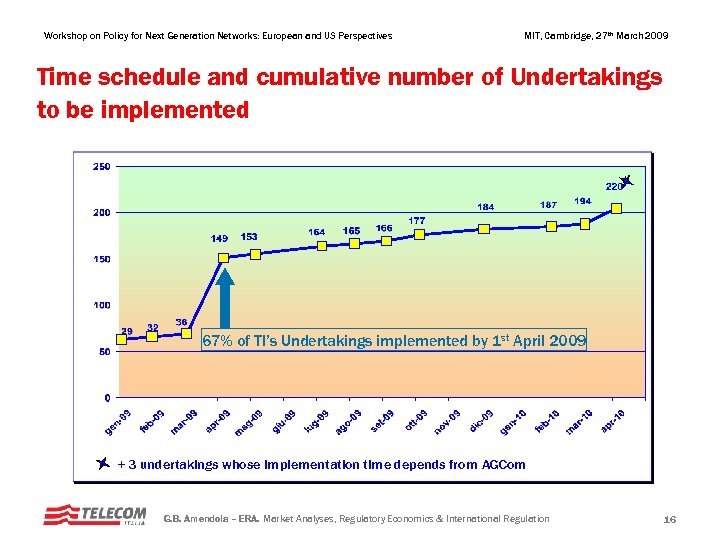
Workshop on Policy for Next Generation Networks: European and US Perspectives MIT, Cambridge, 27 th March 2009 Time schedule and cumulative number of Undertakings to be implemented 67% of TI’s Undertakings implemented by 1 st April 2009 + 3 undertakings whose implementation time depends from AGCom G. B. Amendola – ERA. Market Analyses, Regulatory Economics & International Regulation 16
Workshop on Policy for Next Generation Networks: European and US Perspectives MIT, Cambridge, 27 th March 2009 Telecom Italia’s Operational Separation model: main features ► ► ► ► Creation of a separated business unit – Open Access – providing SMP access services both internally and externally. Physical separation of Open Access and TI Wholesale staff and management. Separated incentive schemes and separated code of conduct for Open Access and TI Wholesale staff and management. Logical/physical separation of information systems. Technical equivalence for both existing and forthcoming SMP access services based on the equivalence of output concept. Economic equivalence based on internal contracts and internal transfer charges consistent with regulated wholesale prices. Governance of the equivalence model ensured by the Supervisory Board. G. B. Amendola – ERA. Market Analyses, Regulatory Economics & International Regulation 17
Workshop on Policy for Next Generation Networks: European and US Perspectives MIT, Cambridge, 27 th March 2009 A comparison between the Operational and the Functional separation models (1/4) The main differences between the operational separation model that will result from the adoption of the Undertakings by TI and the functional separation model adopted by BT can be found in the following areas: ► approach to the non-discrimination in the provision of access services; ► governance of investments in the Access Network. G. B. Amendola – ERA. Market Analyses, Regulatory Economics & International Regulation 18
Workshop on Policy for Next Generation Networks: European and US Perspectives MIT, Cambridge, 27 th March 2009 A comparison between the Operational and the Functional separation models (2/4) Non-discrimination in the provision of access services G. B. Amendola – ERA. Market Analyses, Regulatory Economics & International Regulation 19
Workshop on Policy for Next Generation Networks: European and US Perspectives MIT, Cambridge, 27 th March 2009 A comparison between the Operational and the Functional separation models (3/4) Governance of investments in the Access Network (1/2) BT Model ► ► Separation in the UK means that technical information can flow within BT, but not commercial information: no sharing of commercial information between BT Wholesale, Openreach and BT’s retail units. The Undertakings do not make coordination of the relevant information impossible, but they do make it more difficult because this coordination is carried out with a high level of consultation among a variety of stakeholders which removes some of the benefits and efficiencies emerging from coordinated decision-making. TI Model ► Vertical integration enables the efficient flow of information among retail, network, access and other company’s units to ensure efficient planning of the investments. For the NGAN deployment, information is shared among the network, access and retail units. G. B. Amendola – ERA. Market Analyses, Regulatory Economics & International Regulation 20
Workshop on Policy for Next Generation Networks: European and US Perspectives MIT, Cambridge, 27 th March 2009 A comparison between the Operational and the Functional separation models (4/4) Governance of investments in the Access Network (2/2) BT Model ► In the Openreach-style environment, the “Access” unit will not take into account those cost savings not accountable to itself and must take every investment decision purely on its merits regardless to the commercial interest of other parts of BT Group. TI Model ► Cost savings from TI’s investments in NGAN may be shared between the access network and other parts of the network allowing for an optimal design of the new network. G. B. Amendola – ERA. Market Analyses, Regulatory Economics & International Regulation 21
Workshop on Policy for Next Generation Networks: European and US Perspectives MIT, Cambridge, 27 th March 2009 Impact of TI’s Undertakings on competition and on the evolution of regulation Similarly to the functional separation implemented by BT, the operational separation model of the access network introduced by TI will promote competition in downstream markets by: ► ► promptly implementing effective technical and economic “equality of output” conditions between TI’s retail functions and OLOs; removing any possible competitive risk associated with the incumbent’s vertical integration. AGCom Decision 718/08/CONS stated that TI’s Undertakings “are suitable to structurally improve the competitive setting of the markets affected by the undertakings”. AGCom is to assess - in the market analysis proceedings - the competitive impact of TI’s Undertakings on each specific relevant market, in order to determine whether to impose, maintain, amend or withdraw obligations according to the provisions of the European regulatory framework. G. B. Amendola – ERA. Market Analyses, Regulatory Economics & International Regulation 22
Workshop on Policy for Next Generation Networks: European and US Perspectives MIT, Cambridge, 27 th March 2009 Telecom Italia’s Operational Separation model: concluding remarks ► ► Telecom Italia’s Operational Separation model aims to ensure an effective “equivalence” in the delivery of SMP access services to alternative operators by means of an efficient implementation of the equivalence of output concept. Telecom Italia believes that its Operational Separation model is: ► ► ► as effective as the Functional Separation model in achieving an excellent non discriminatory framework; less expensive in terms of required investments and implementation costs. Telecom Italia’s Operational Separation model carries on the company’s vertical integration, allowing for an efficient flow of information among retail, network, access and other company’s units. Accordingly, efficient planning of investments, including NGAN, is ensured. G. B. Amendola – ERA. Market Analyses, Regulatory Economics & International Regulation 23
Скачать презентацию Bruxelles January 27 th 2009 Telecom Italia s undertakings
e2452e0f438ea9c2f76c513b4525d9bb.ppt