 Скачать презентацию Brown i GEM international genetically engineered machines competition
e03ca2750147da7b43223ec4e186de5a.ppt
- Количество слайдов: 86



Brown i. GEM international genetically engineered machines competition July Update 1/86
What is i. GEM? • Biology • Engineering • Standardization 2/86
Making it easier to engineer biology 3/86
DNA is a language: AATGAATATCCAGATCG 4/86
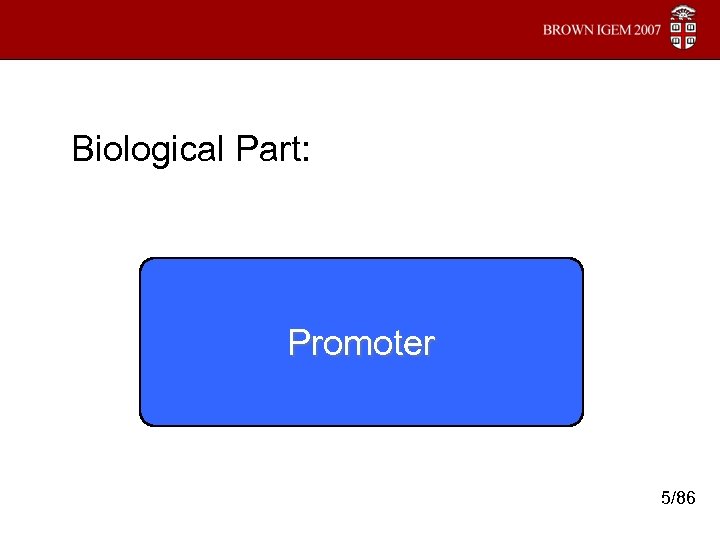
Biological Part: Promoter 5/86
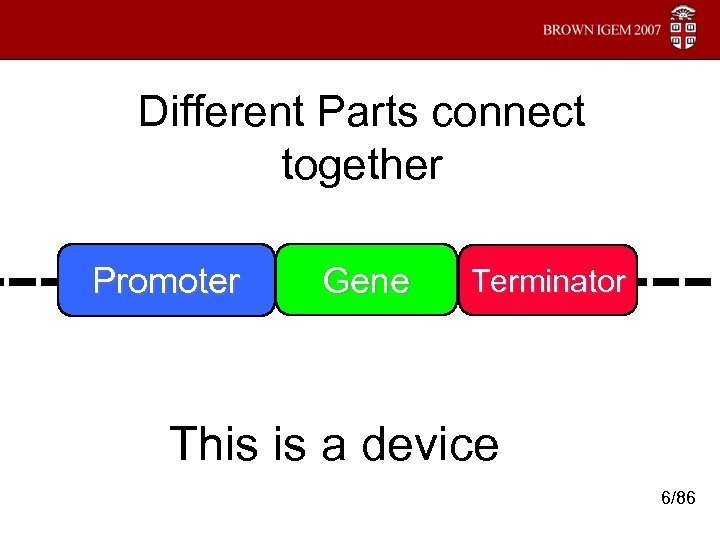
Different Parts connect together ---- Promoter Gene --- Terminator This is a device 6/86
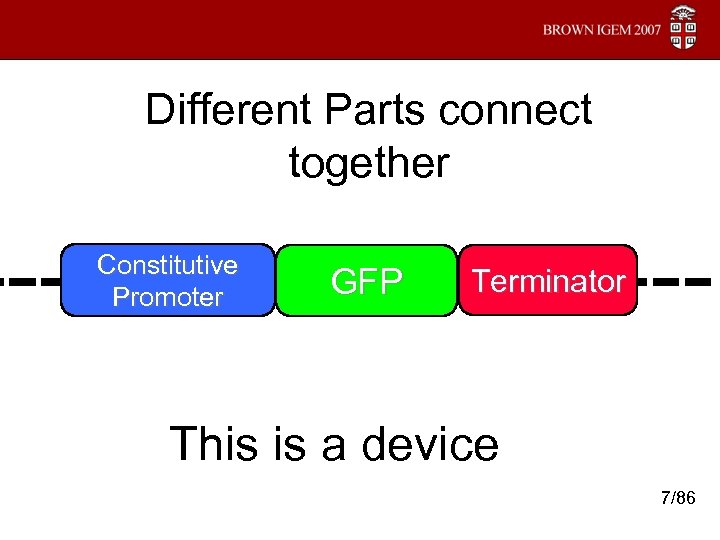
Different Parts connect together ---- Constitutive Promoter GFP --- Terminator This is a device 7/86
Biological parts are building blocks made of genetic material 8/86
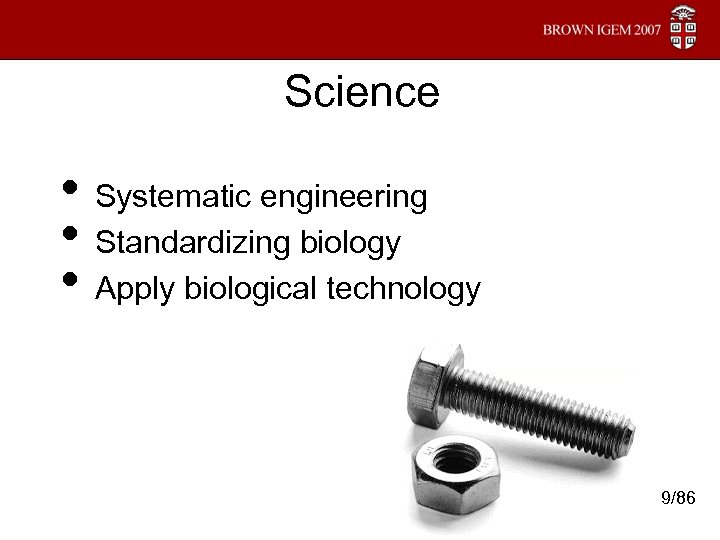
Science • Systematic engineering • Standardizing biology • Apply biological technology 9/86
Brown i. GEM Two projects being built with biological parts • Lead-detector • Tri-stable Switch 10/86
Lead Detector 11/86
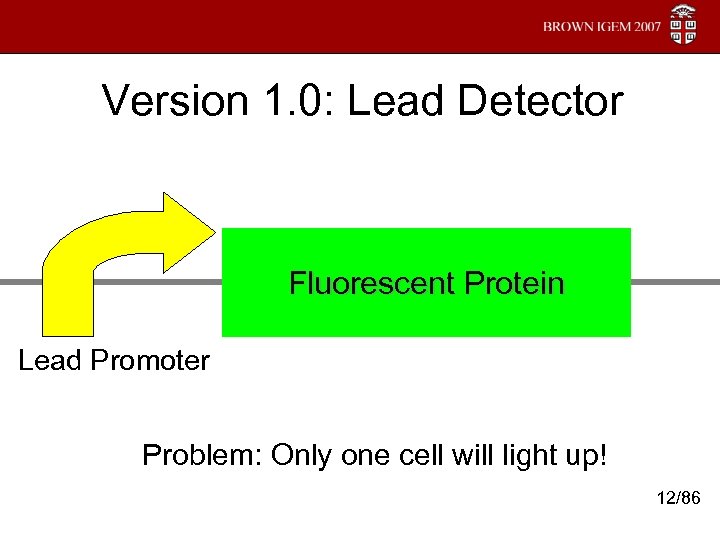
Version 1. 0: Lead Detector Fluorescent Protein Lead Promoter Problem: Only one cell will light up! 12/86
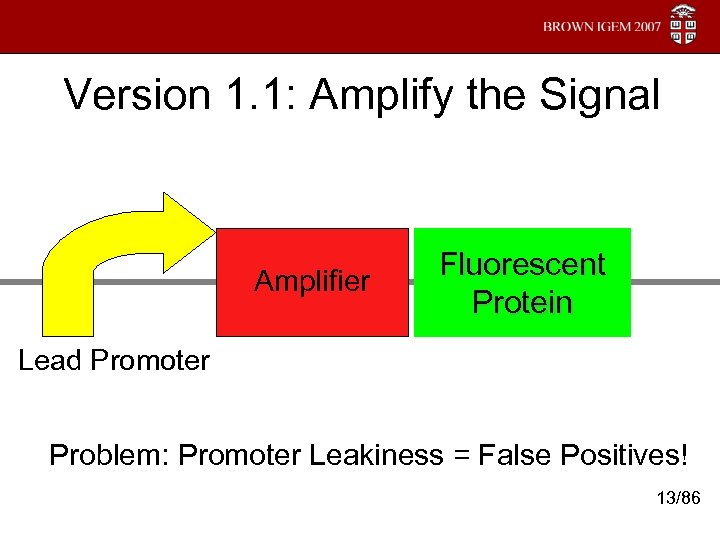
Version 1. 1: Amplify the Signal Amplifier Fluorescent Protein Lead Promoter Problem: Promoter Leakiness = False Positives! 13/86
Version 1. 2: Filter False Positives 1. Three Possible Solutions: 2. Modify the Promoter (weaker baseline) 2. Tight intermediate promoter (T 7) 3. Make amplifier less sensitive (increase threshold) 14/86
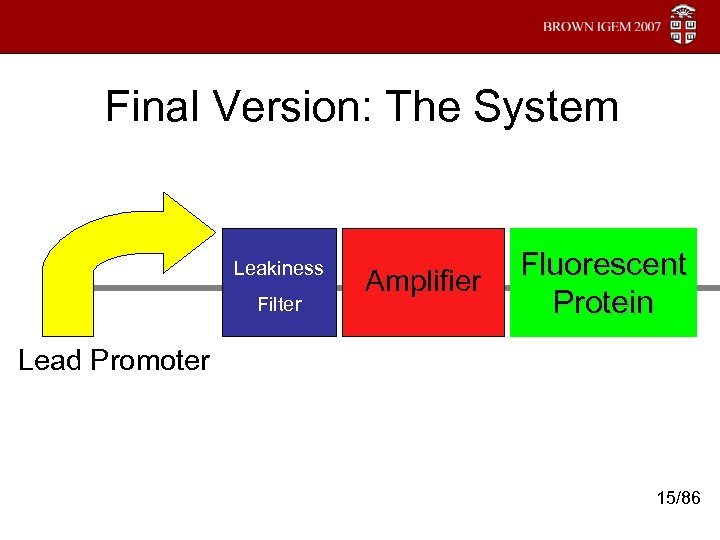
Final Version: The System Leakiness Filter Amplifier Fluorescent Protein Lead Promoter 15/86
So how will this system work in the cell? 16/86
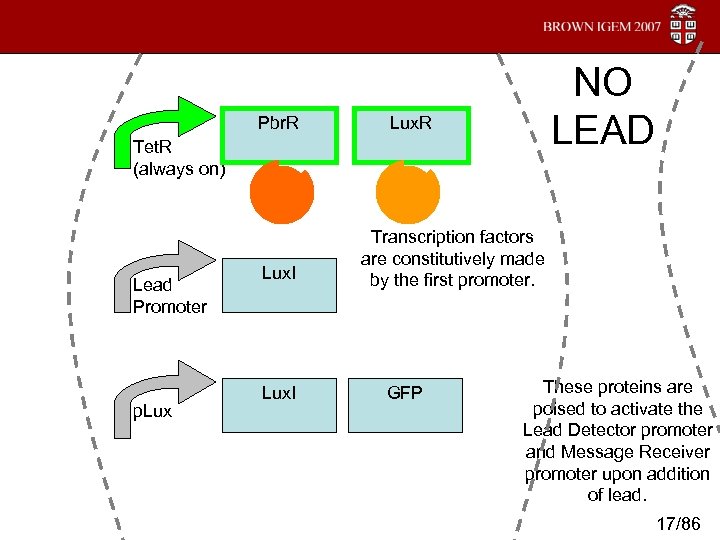
Pbr. R NO LEAD Lux. R Tet. R (always on) Lead Promoter p. Lux. I Transcription factors are constitutively made by the first promoter. GFP These proteins are poised to activate the Lead Detector promoter and Message Receiver promoter upon addition of lead. 17/86
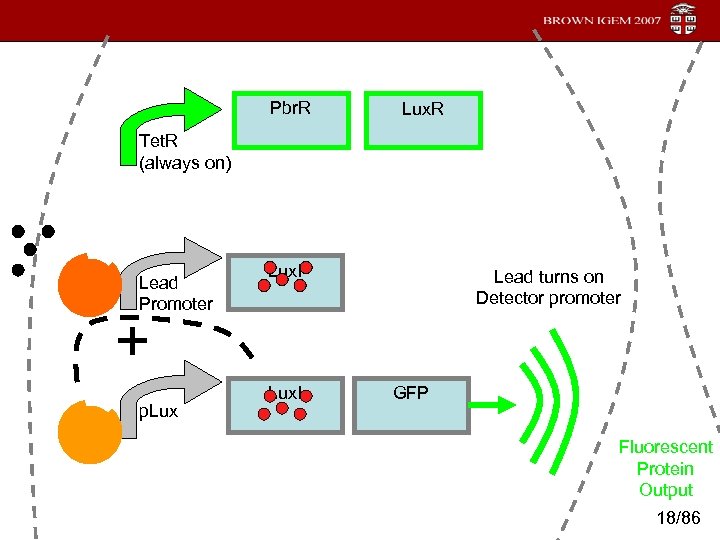
Pbr. R Lux. R Tet. R (always on) Lead Promoter Lux. I Lead turns on Detector promoter + p. Lux. I GFP Fluorescent Protein Output 18/86
Experimental Design i. GEM’s more than just design. This will take some lab work. 19/86
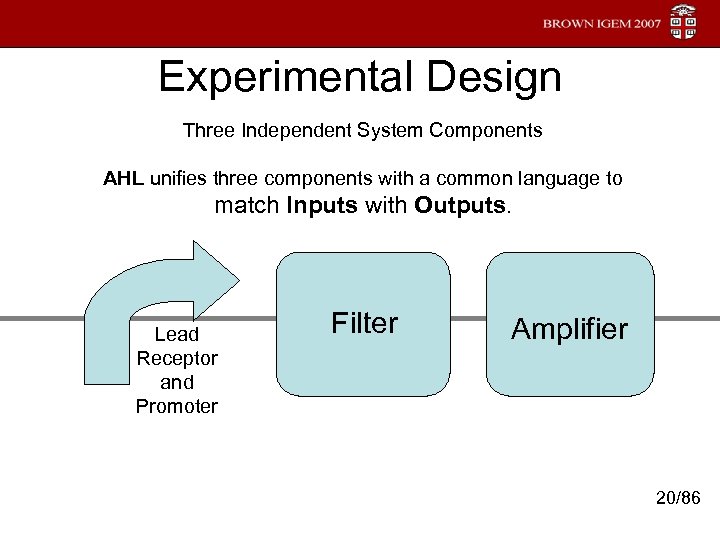
Experimental Design Three Independent System Components AHL unifies three components with a common language to match Inputs with Outputs. Lead Receptor and Promoter Filter Amplifier 20/86
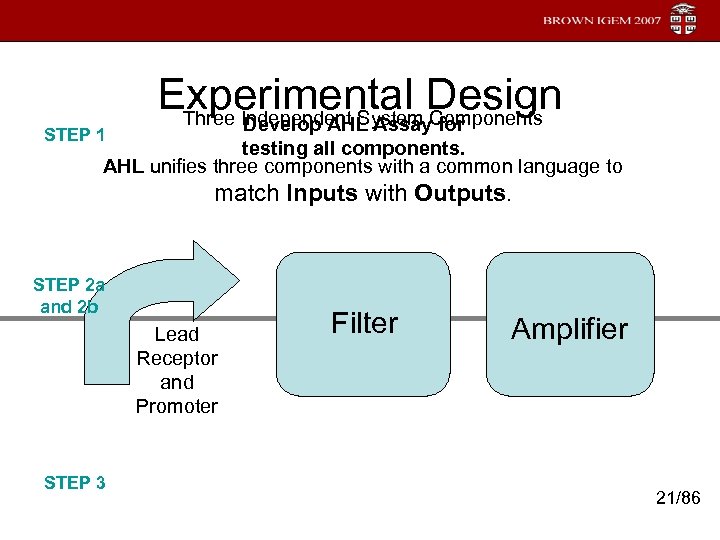
STEP 1 Experimental Design Three Independent System Components Develop AHL Assay for testing all components. AHL unifies three components with a common language to match Inputs with Outputs. STEP 2 a and 2 b Lead Receptor and Promoter STEP 3 Filter Amplifier 21/86
What is AHL? Why and How do we measure it? Cell Signaling Molecule Common input and output of different devices within our system Acyl Homoserine Lactone 22/86
AHL Bio. Assay 23/86
AHL Bio. Assay More AHL --> More GFP Need more than 10 n. M AHL to overcome threshold 24/86
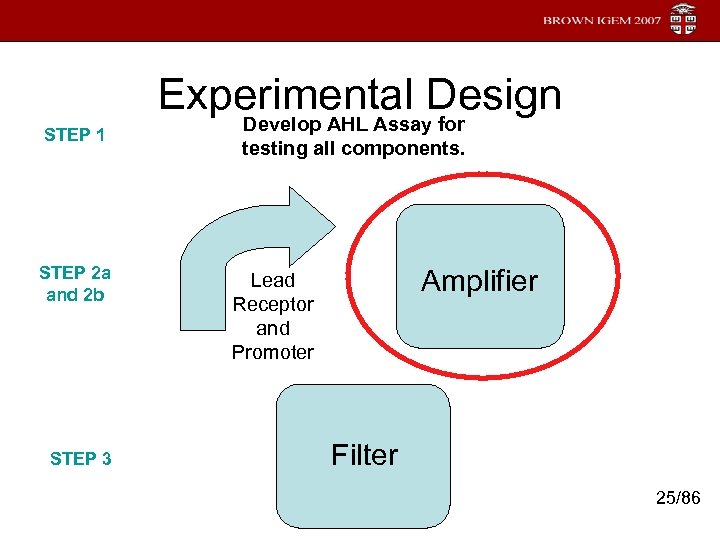
STEP 1 STEP 2 a and 2 b STEP 3 Experimental Design Develop AHL Assay for testing all components. Amplifier Lead Receptor and Promoter Filter 25/86
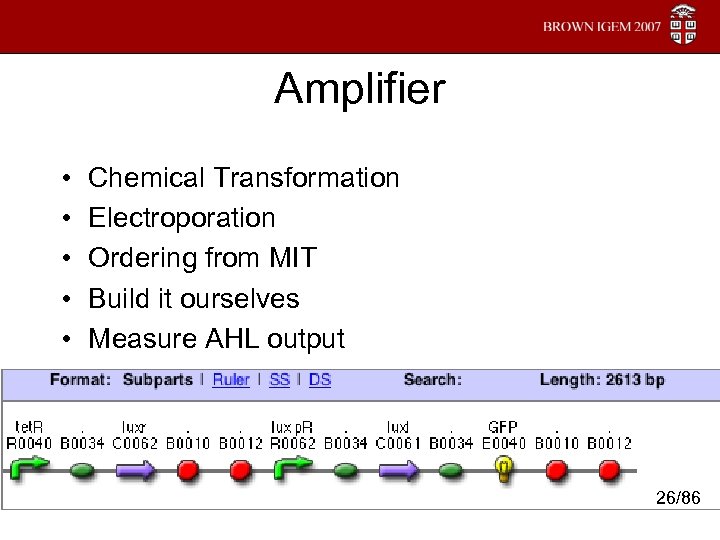
Amplifier • • • Chemical Transformation Electroporation Ordering from MIT Build it ourselves Measure AHL output 26/86
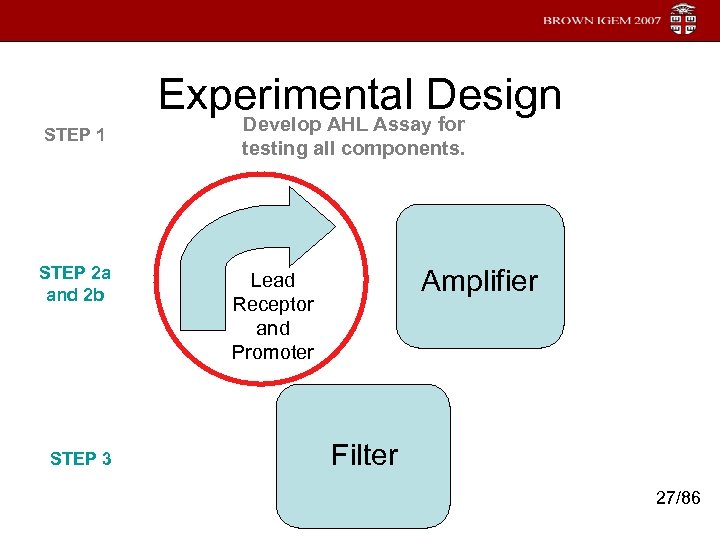
STEP 1 STEP 2 a and 2 b STEP 3 Experimental Design Develop AHL Assay for testing all components. Amplifier Lead Receptor and Promoter Filter 27/86
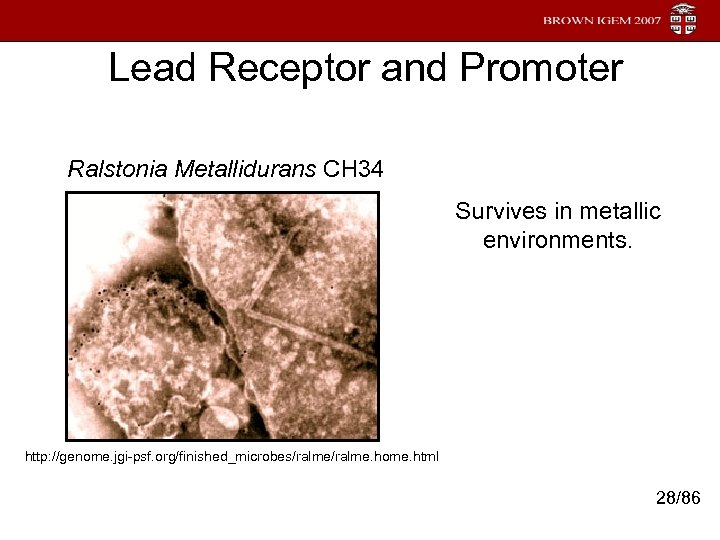
Lead Receptor and Promoter Ralstonia Metallidurans CH 34 Survives in metallic environments. http: //genome. jgi-psf. org/finished_microbes/ralme. home. html 28/86
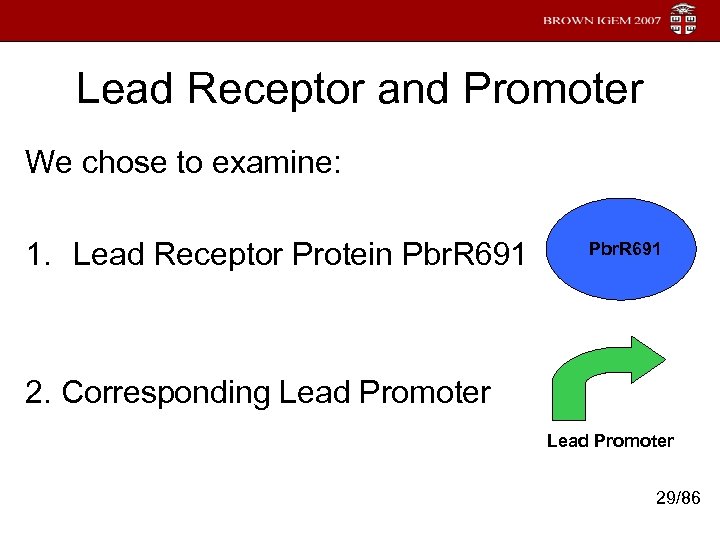
Lead Receptor and Promoter We chose to examine: 1. Lead Receptor Protein Pbr. R 691 2. Corresponding Lead Promoter 29/86
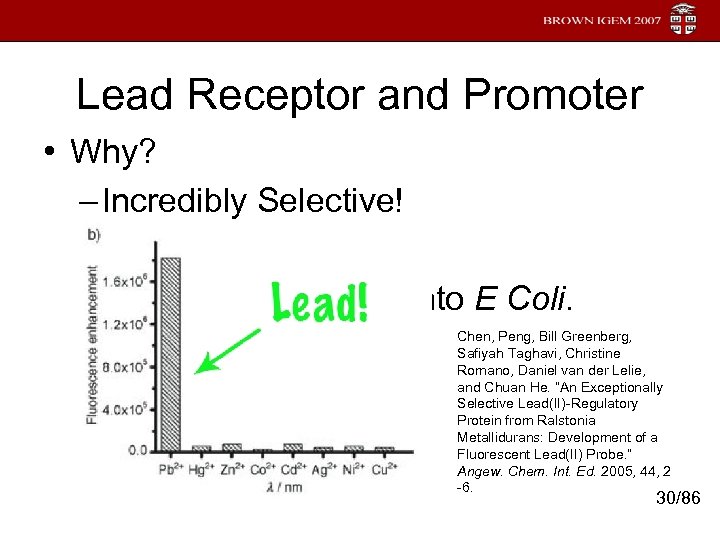
Lead Receptor and Promoter • Why? – Incredibly Selective! – Novel – Successfully cloned into E Coli. Chen, Peng, Bill Greenberg, Safiyah Taghavi, Christine Romano, Daniel van der Lelie, and Chuan He. “An Exceptionally Selective Lead(II)-Regulatory Protein from Ralstonia Metallidurans: Development of a Fluorescent Lead(II) Probe. ” Angew. Chem. Int. Ed. 2005, 44, 2 -6. 30/86
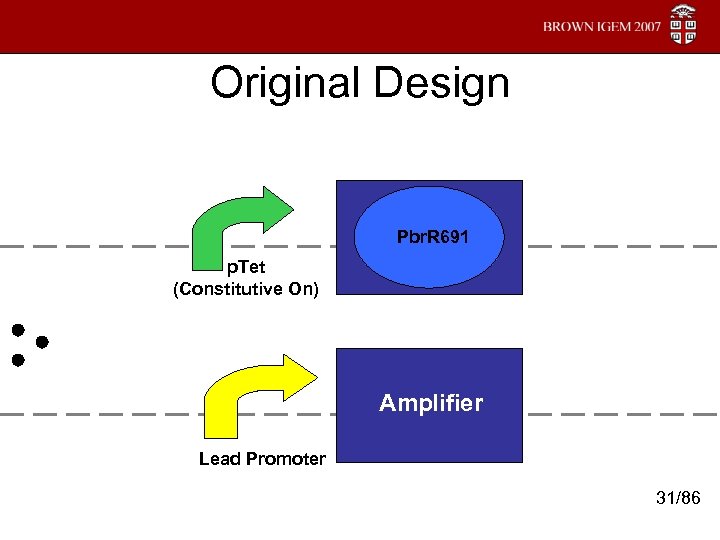
Original Design Pbr. R 691 p. Tet (Constitutive On) Amplifier Lead Promoter 31/86
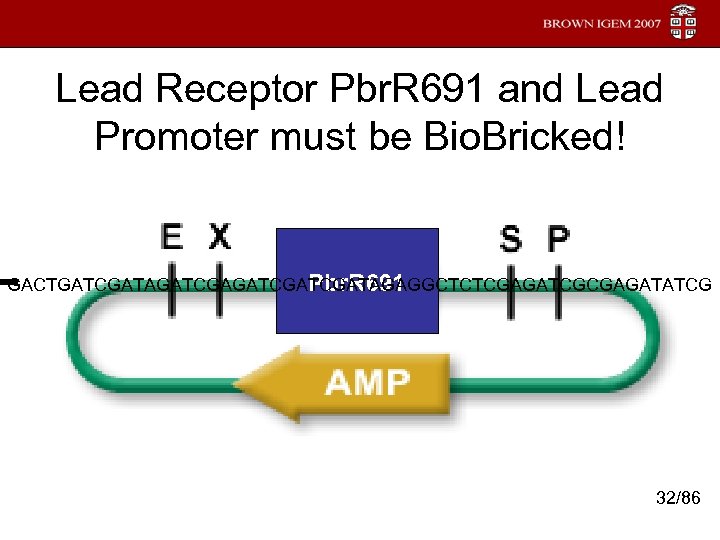
Lead Receptor Pbr. R 691 and Lead Promoter must be Bio. Bricked! Pbr. R 691 GACTGATCGATAGATCGATCGATAGAGGCTCTCGAGATCGCGAGATATCG 32/86
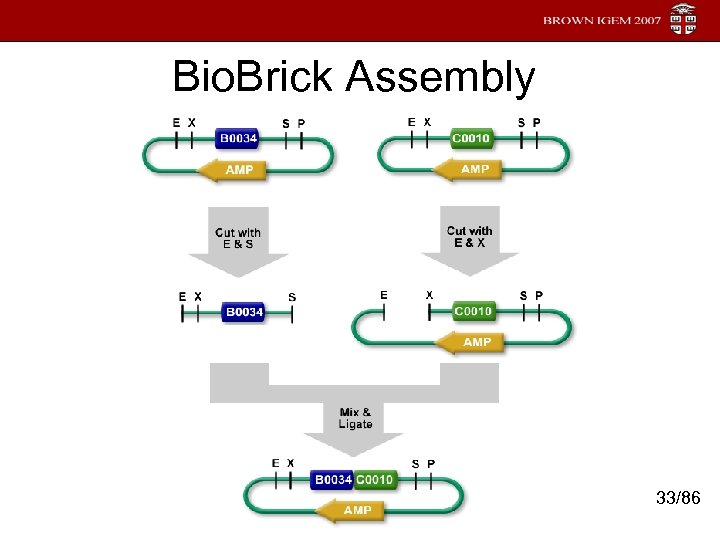
Bio. Brick Assembly 33/86
How do we get Pbr. R 691 and Lead Promoter? PCR 2 Major Obstacles: - Biobricking a promoter adds extra bases from the restriction sites to the ends, which may reduce promoter efficiency. - Length of promoter – very small 34/86
Experimental Plan • Purpose: Match switch components • PCR 12 variations of promoter and gene • Ligate to RBS-Lux. I-GFP-Term • Test with AHL against AHL bioassay curve • Result: promoter output = amplifier input 35/86
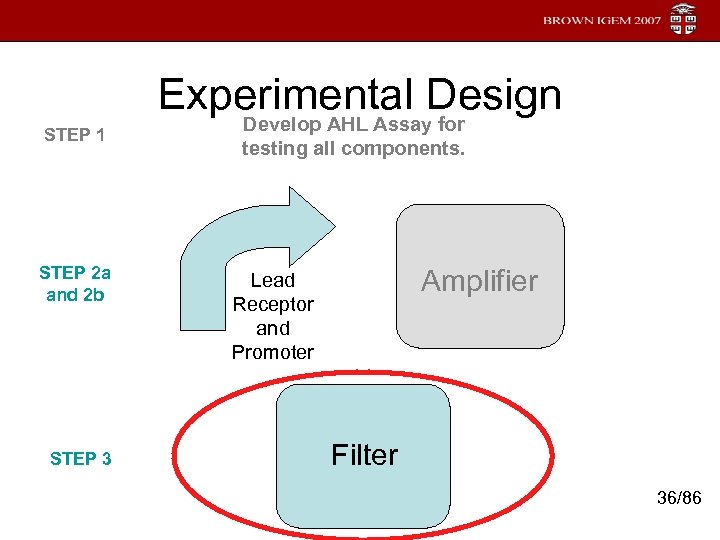
STEP 1 STEP 2 a and 2 b STEP 3 Experimental Design Develop AHL Assay for testing all components. Amplifier Lead Receptor and Promoter Filter 36/86
Problem: Leakiness • What if the baseline is too high? • Possible solution: T 7 promoter control • Advantage: strong repression (not leaky) unless T 7 RNA polymerase is present 37/86
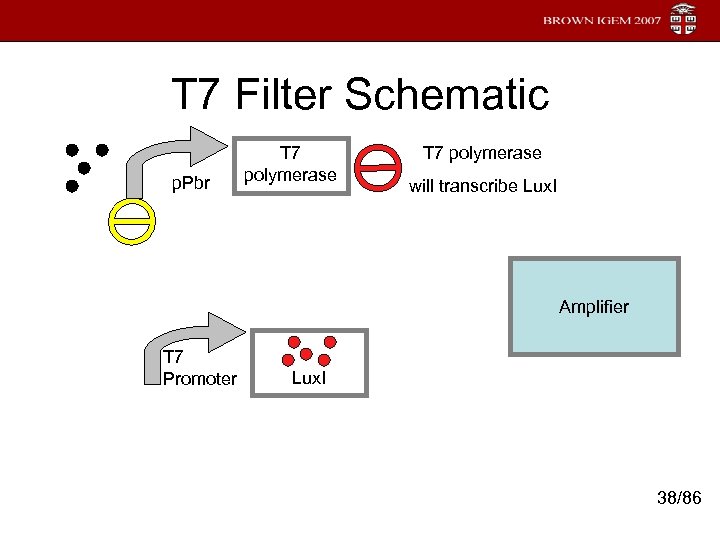
T 7 Filter Schematic p. Pbr T 7 polymerase will transcribe Lux. I Amplifier T 7 Promoter Lux. I 38/86
Possible Issues • Poor sensitivity • Poor p. Pbr induction • Solution: Need to test p. Pbr promoter as well as whole T 7 system • What are our choices for T 7 systems? 39/86
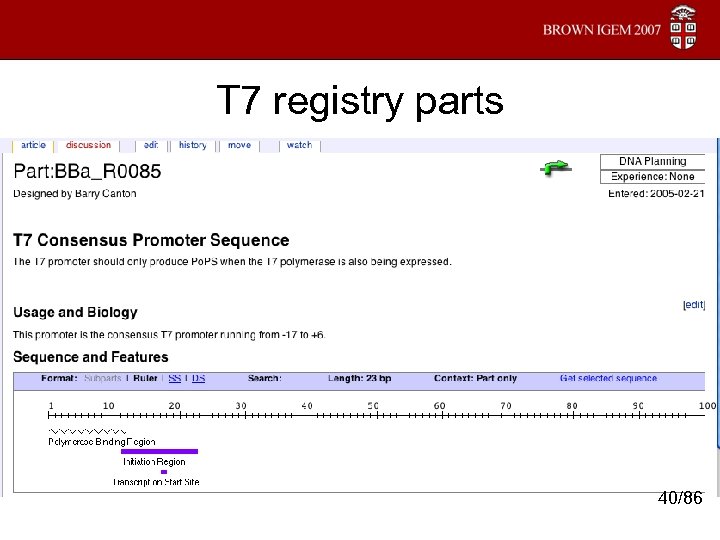
T 7 registry parts 40/86
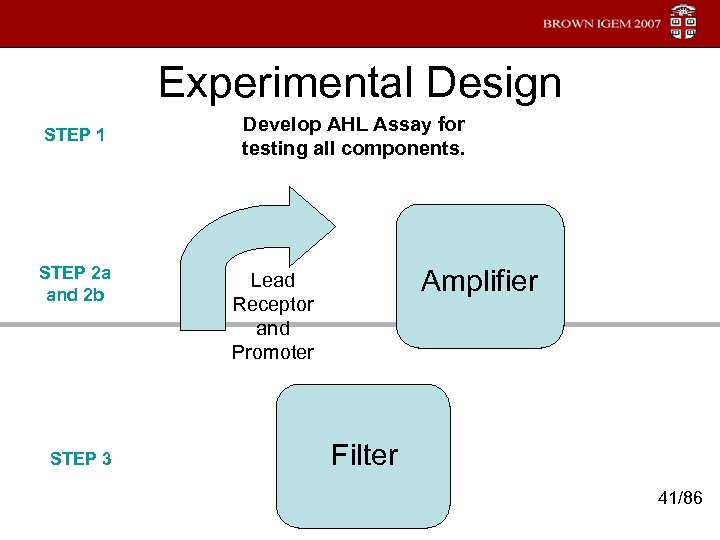
Experimental Design STEP 1 STEP 2 a and 2 b STEP 3 Develop AHL Assay for testing all components. Amplifier Lead Receptor and Promoter Filter 41/86
Tri-Stable Switch 42/86
Tristable Switch Team 1. Introduction 2. System Design 3. Modeling 4. System Tests 5. Labwork 43/86
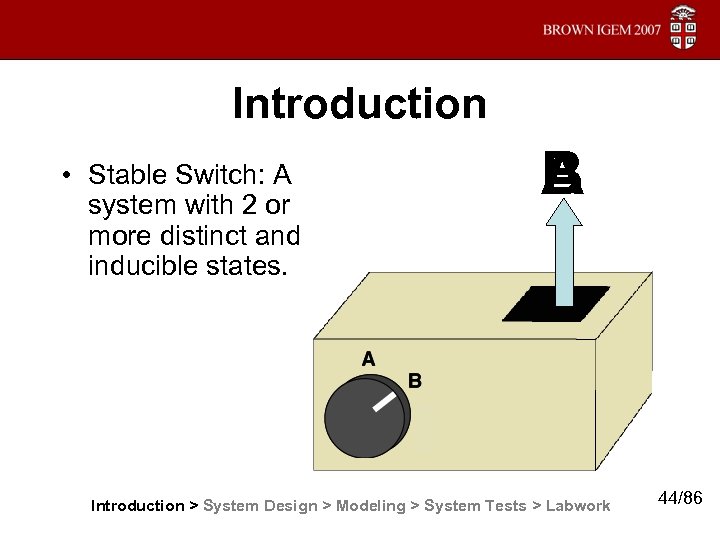
Introduction • Stable Switch: A system with 2 or more distinct and inducible states. B A Introduction > System Design > Modeling > System Tests > Labwork 44/86
Bistable Switch • This is the simplest switch. • It only involves two separate states. Introduction > System Design > Modeling > System Tests > Labwork 45/86
Uses for a Bistable Switch • Drug Delivery • Simple Logic Introduction > System Design > Modeling > System Tests > Labwork 46/86
Bistable Switch • In 2000, three scientists at Boston University managed to create a synthetic Bistable Switch. • They showed that you could create the Bistable Switch using relatively simple, standard parts. Introduction > System Design > Modeling > System Tests > Labwork 47/86
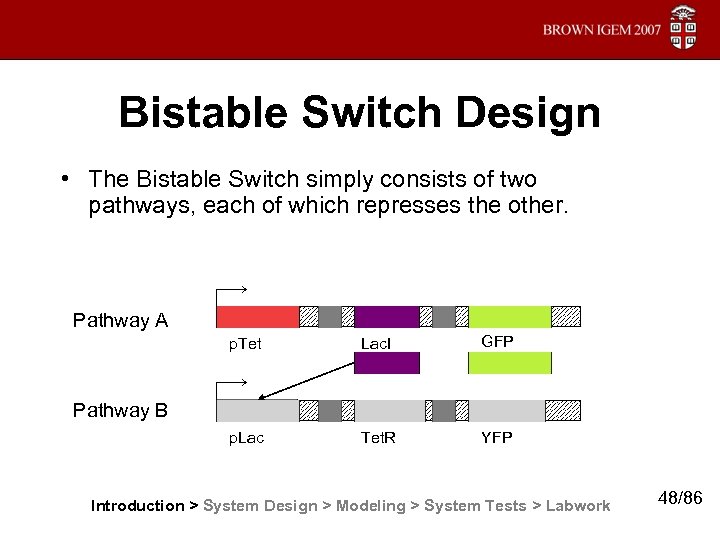
Bistable Switch Design • The Bistable Switch simply consists of two pathways, each of which represses the other. Pathway A p. Tet Lac. I GFP p. Lac Tet. R YFP Pathway B Introduction > System Design > Modeling > System Tests > Labwork 48/86
Importance of Bistable Switch • The Bistable Switch is one of the seminal achievements of Synthetic Biology. • It was one of the first projects that showed that you could combine standard genetic parts together to form working circuits. Introduction > System Design > Modeling > System Tests > Labwork 49/86
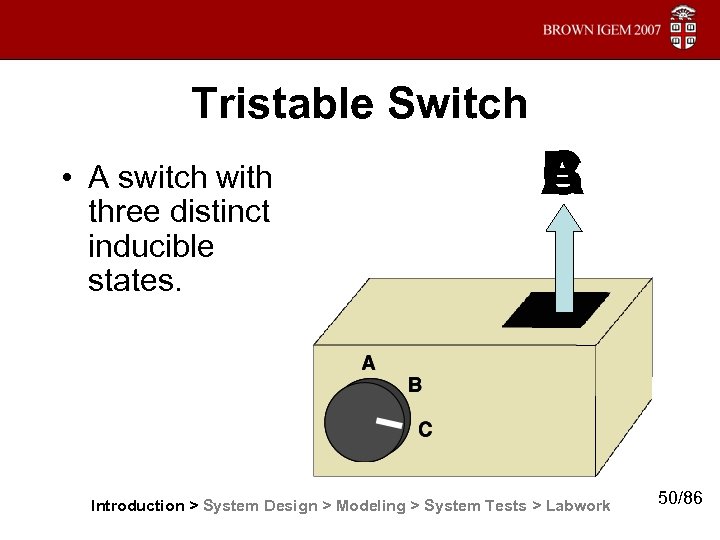
Tristable Switch • A switch with three distinct inducible states. C B A Introduction > System Design > Modeling > System Tests > Labwork 50/86
Tristable Switch Design • The design consists of three pathways, each of which represses the other two. • When one of the pathways is induced it stops the other two from being expressed, and the system achieves stability. Introduction > System Design > Modeling > System Tests > Labwork 51/86
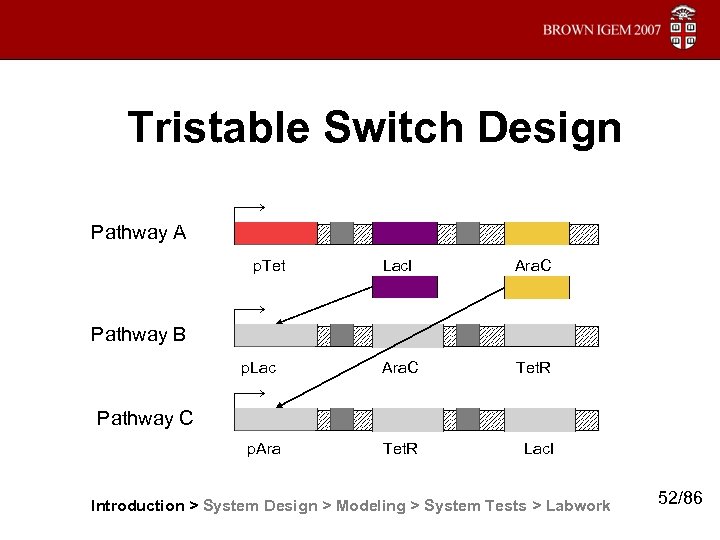
Tristable Switch Design Pathway A p. Tet Lac. I Ara. C Tet. R Lac. I Pathway B p. Lac Pathway C p. Ara Introduction > System Design > Modeling > System Tests > Labwork 52/86
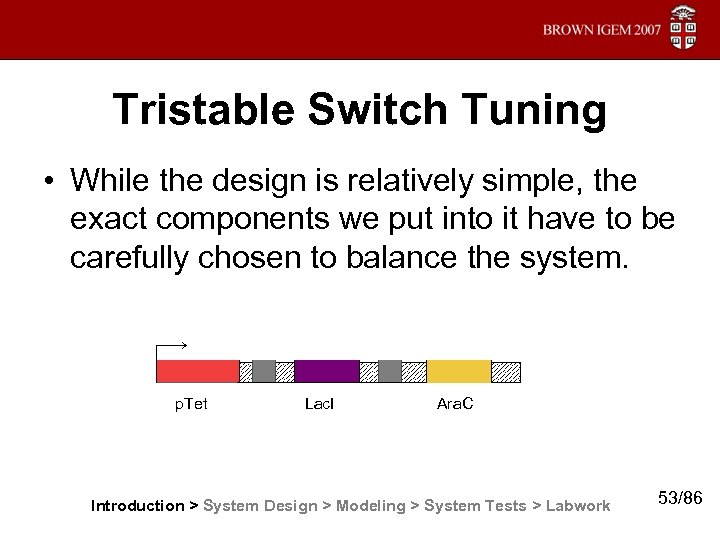
Tristable Switch Tuning • While the design is relatively simple, the exact components we put into it have to be carefully chosen to balance the system. p. Tet Lac. I Ara. C Introduction > System Design > Modeling > System Tests > Labwork 53/86
Modeling Why do we model? • A quick and inexpensive way to quantitatively predict behavior • A foundation to start testing, e. g. what variables do we need to test to understand our system Introduction > System Design > Modeling > System Tests > Labwork 54/86
Modeling Why does our system lend itself to modeling? • Sensitive system • Future adaptations Introduction > System Design > Modeling > System Tests > Labwork 55/86
Variables in the Model 1. Rate of repressor production 2. Strength of repression Introduction > System Design > Modeling > System Tests > Labwork 56/86
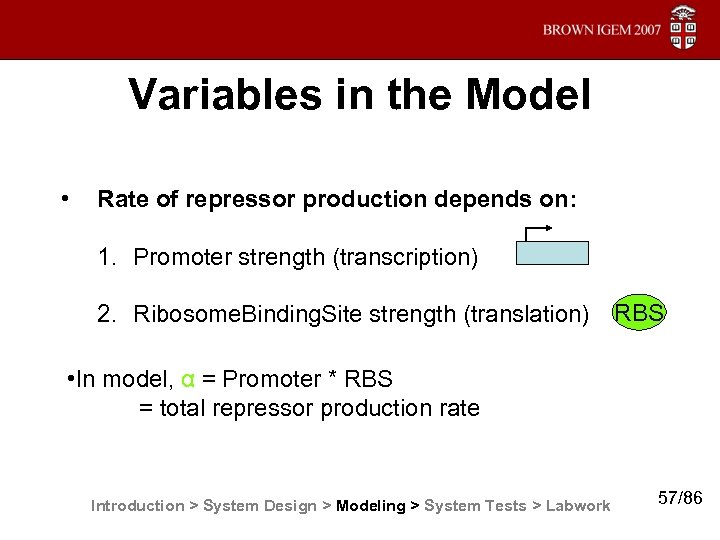
Variables in the Model • Rate of repressor production depends on: 1. Promoter strength (transcription) 2. Ribosome. Binding. Site strength (translation) RBS • In model, α = Promoter * RBS = total repressor production rate Introduction > System Design > Modeling > System Tests > Labwork 57/86
Variables in the Model • Repressor strength depends on: 1. β = the cooperativity of repressors to promoters 2. [repressor] = the concentration of repressor Total strength of repressor = [repressor]^ Introduction > System Design > Modeling > System Tests > Labwork 58/86
![Variables in the Model Graph of [repressor]^ ; where =. 5, 1, 1. 5,](https://present5.com/presentation/e03ca2750147da7b43223ec4e186de5a/image-59.jpg "Variables in the Model Graph of [repressor]^ ; where =. 5, 1, 1. 5,")
Variables in the Model Graph of [repressor]^ ; where =. 5, 1, 1. 5, 2 *β = cooperativity of repression 59/86 Introduction > System Design > Modeling > System Tests > Labwork
![Equations For the Bi-Stable Switch… x and y = [repressor concentration] α = repressor](https://present5.com/presentation/e03ca2750147da7b43223ec4e186de5a/image-60.jpg "Equations For the Bi-Stable Switch… x and y = [repressor concentration] α = repressor")
Equations For the Bi-Stable Switch… x and y = [repressor concentration] α = repressor production rate β = cooperativity of repression Introduction > System Design > Modeling > System Tests > Labwork 60/86
Equations Bistable Tristable Vs. The equations are extended to a tri stable system. Introduction > System Design > Modeling > System Tests > Labwork 61/86
Equations The number of repressors correlates to the number of terms Introduction > System Design > Modeling > System Tests > Labwork 62/86
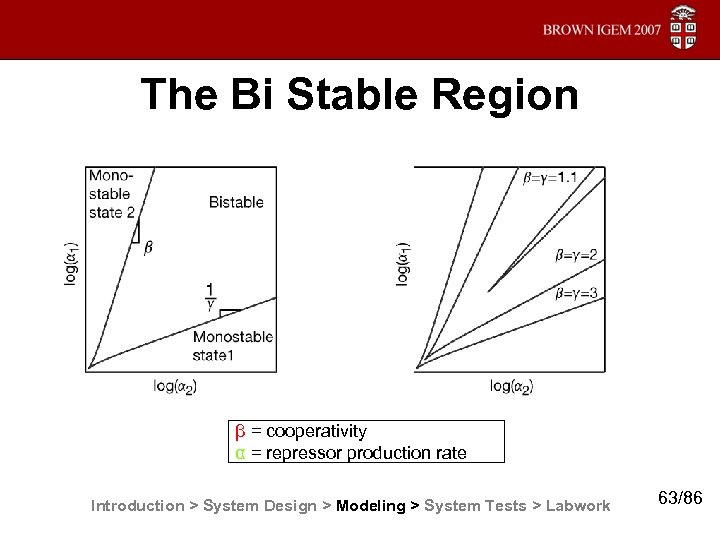
The Bi Stable Region β = cooperativity α = repressor production rate Introduction > System Design > Modeling > System Tests > Labwork 63/86
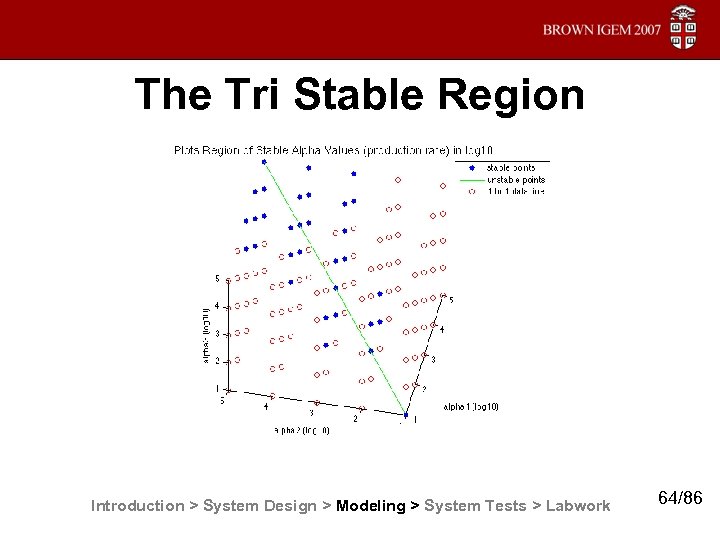
The Tri Stable Region Introduction > System Design > Modeling > System Tests > Labwork 64/86
What the Model Predicts A stable system occurs when: • β > 1 or larger to maximize the stable region • α values are similar for all promoters • α values are within the stable region β = cooperativity α = repressor production rate Introduction > System Design > Modeling > System Tests > Labwork 65/86

So what can we do with the modelling? Introduction > System Design > Modeling > System Tests > Labwork 66/86
1. Systematic Approach to Construction • Design tests to assign values to variables in model – Promoter/RBS Strength, Relative Repressor Cooperativity, etc • Use these values in the model to find the right combination of parts. Introduction > System Design > Modeling > System Tests > Labwork 67/86
Alternative: test, hope it works, if not, test again. Systematic Design is the philosophy of Synthetic Biology Introduction > System Design > Modeling > System Tests > Labwork 68/86
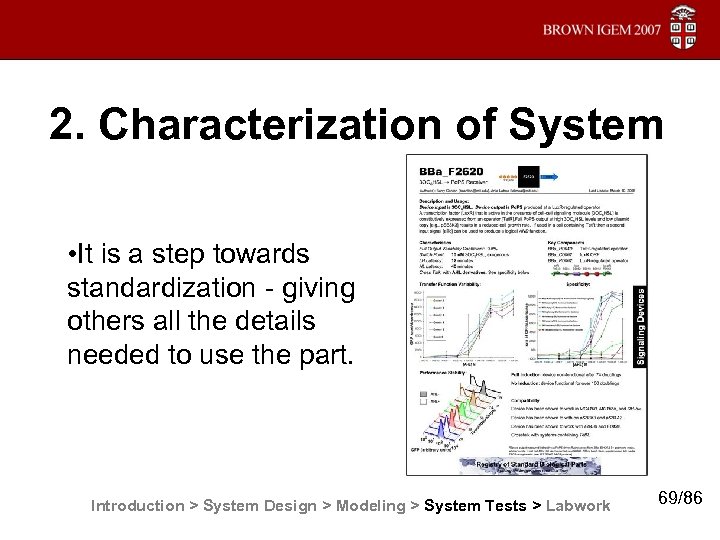
2. Characterization of System • It is a step towards standardization - giving others all the details needed to use the part. Introduction > System Design > Modeling > System Tests > Labwork 69/86
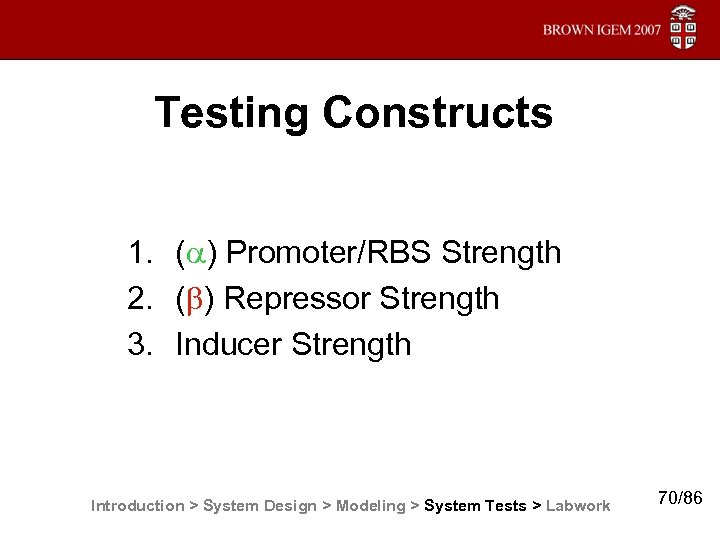
Testing Constructs 1. ( ) Promoter/RBS Strength 2. ( ) Repressor Strength 3. Inducer Strength Introduction > System Design > Modeling > System Tests > Labwork 70/86
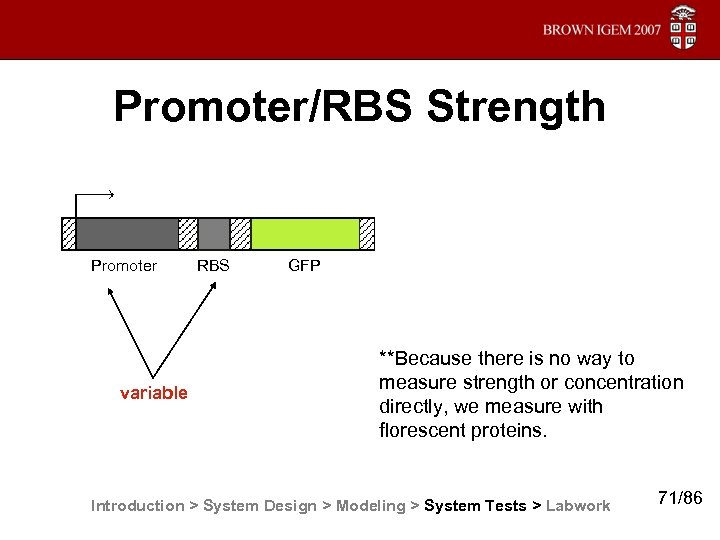
Promoter/RBS Strength Promoter variable RBS GFP **Because there is no way to measure strength or concentration directly, we measure with florescent proteins. Introduction > System Design > Modeling > System Tests > Labwork 71/86
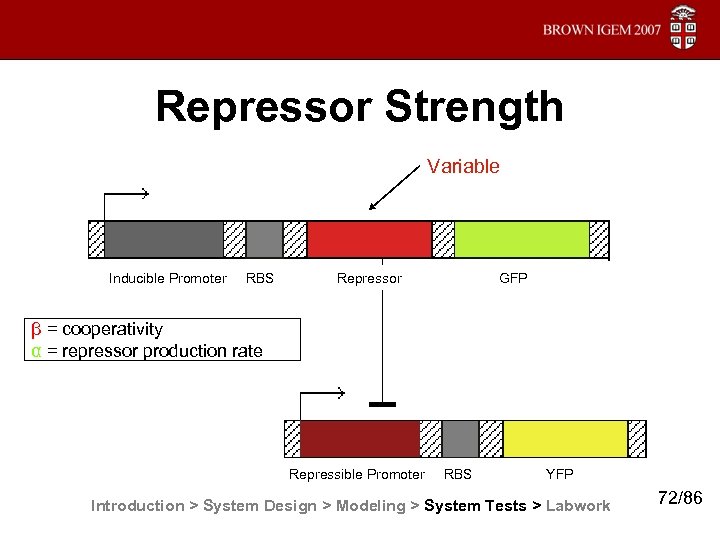
Repressor Strength Variable Inducible Promoter RBS Repressor GFP β = cooperativity α = repressor production rate Repressible Promoter RBS YFP Introduction > System Design > Modeling > System Tests > Labwork 72/86
![Inducer Strength Variable [Inducer] Promoter RBS Repressor X Promoter RBS GFP Introduction > System](https://present5.com/presentation/e03ca2750147da7b43223ec4e186de5a/image-73.jpg "Inducer Strength Variable [Inducer] Promoter RBS Repressor X Promoter RBS GFP Introduction > System")
Inducer Strength Variable [Inducer] Promoter RBS Repressor X Promoter RBS GFP Introduction > System Design > Modeling > System Tests > Labwork 73/86
Testing Restraints Florescent proteins not perfect read out: 1. Indirect measurement of gene a. Protein folding time b. Degradation Rate 2. Rate of Production: Repressor vs GFP 3. High toll on cell machinery and resources Introduction > System Design > Modeling > System Tests > Labwork 74/86
What we’ve been up to… Introduction > System Design > Modeling > System Tests > Labwork 75/86
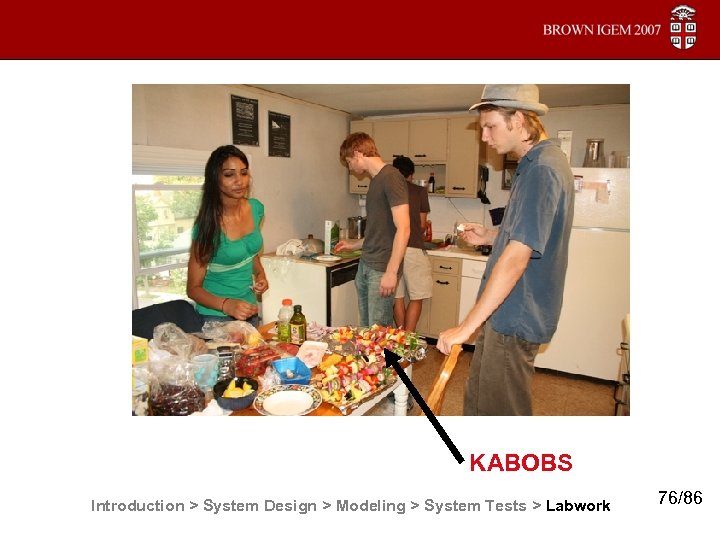
KABOBS Introduction > System Design > Modeling > System Tests > Labwork 76/86
Mastering Cloning • More obstacles than we thought • Transformations, DNA concentration too low, gel readibility, restriction digest buffer compatibility, etc. • Most kinks worked out of the way • First ligations completed Introduction > System Design > Modeling > System Tests > Labwork 77/86
The Project Itself • • Looking through Modeling Designed Tests Created DNA stocks of all parts needed Creating a good record keeping infrastructure Introduction > System Design > Modeling > System Tests > Labwork 78/86
Introduction > System Design > Modeling > System Tests > Labwork 79/86
Goals Testing Ligations Introduction > System Design > Modeling > System Tests > Labwork 80/86
Introduction > System Design > Modeling > System Tests > Labwork 81/86
References • Gardner TS, Cantor CR, Collins JJ. “Construction of a genetic toggle Switch in Escherichia coli. ” Nature 2000 Jan, 20. Introduction > System Design > Modeling > System Tests > Labwork 82/86
2007 Brown i. GEM Team • 7 undergraduates • 7 grad student advisors • 2 Faculty advisors • 9 faculty sponsors 83/86
Sponsors 84/86
Special Thanks To: Office of the Dean of the College Office of the President The Atlantic Philanthropies The Center for Computational and Molecular Biology Department of Physics Engineering Department of Molecular Biology, Cell Biology, and Biochemistry Department of Molecular Pharmacology, Physiology, and Biotechnology The Multi Disciplinary Lab Pfizer Labnet Nanodrop 85/86
Thank you for listening! Questions? 86/86
Скачать презентацию Brown i GEM international genetically engineered machines competition
e03ca2750147da7b43223ec4e186de5a.ppt