 Скачать презентацию Broken Numbers History of Writing Fractions Sketch 4
feb60ece578720b7110d8401a7a53670.ppt
- Количество слайдов: 21



Broken Numbers History of Writing Fractions Sketch 4
A Brief Overview of What’s To Come n Early developments n Egyptians n Babylonians n Chinese n Indians n Hindus n Recent developments
Early Developments n Fractions have been around for about 4000 years but have been modernized since n Influential cultures that aided with this modernization are: Egyptians, Babylonians, Chinese, Hindus n Same basic ideas but refined to fit their own system
Notion of “Parts” fraction fracture fragment: suggest breaking something up n Objects broken down then counted n Underlying principle different from 21 st century: Fractions were looked at in earlier days like: find the largest unit possible and take one of those and repeatedly do that until the amount you need is present 21 st century: instead of using the pint and a cup of milk for a cooking recipe, we use 3 cups n Unit fractions n
But what about two-fifths? n Take the fifth and double it n What do you get? n The third and the fifteenth since you must express the fraction as a sum of unit fractions, Right? n But how?
Resources from each culture n n n Egyptians used Papyri Babylonians used cuneiform tablets Chinese and The Nine Chapters of Mathematical Art 100 A. D. Indian culture used a book called Correct Astronomical System of Brahma, 7 th century A. D. Europeans in the 13 th century used Fibonacci’s Liber Abbaci 1202 A. D.
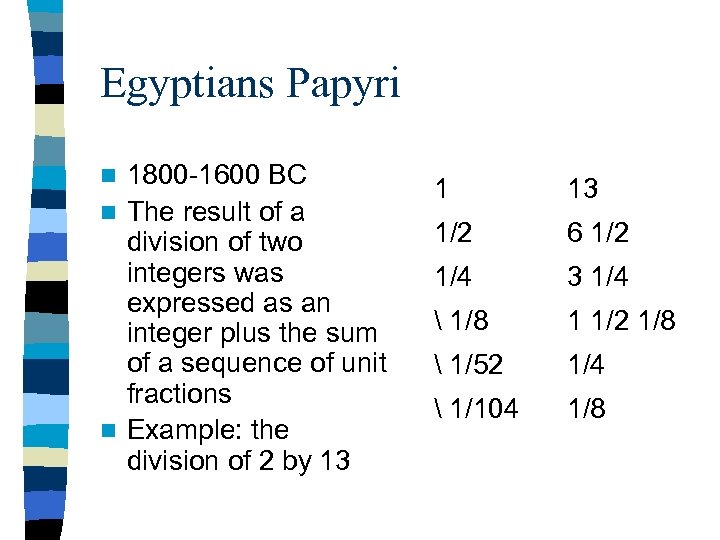
Egyptians Papyri 1800 -1600 BC n The result of a division of two integers was expressed as an integer plus the sum of a sequence of unit fractions n Example: the division of 2 by 13 n 1 13 1/2 6 1/2 1/4 3 1/4 1/8 1 1/2 1/8 1/52 1/4 1/104 1/8
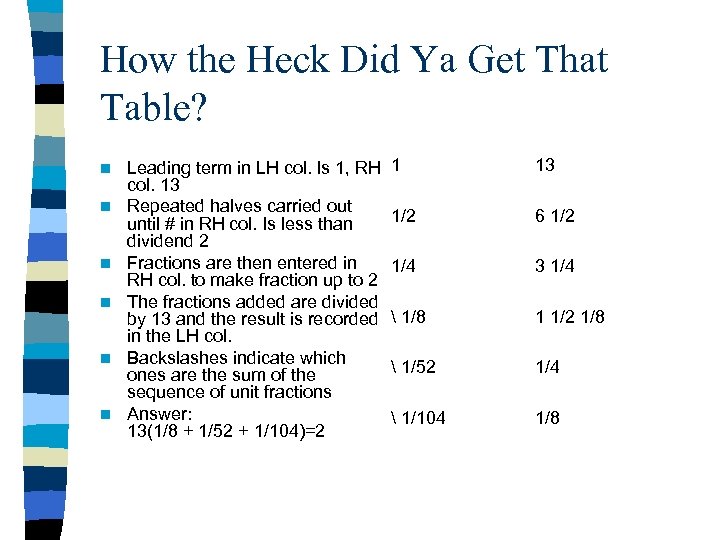
How the Heck Did Ya Get That Table? n n n Leading term in LH col. Is 1, RH col. 13 Repeated halves carried out until # in RH col. Is less than dividend 2 Fractions are then entered in RH col. to make fraction up to 2 The fractions added are divided by 13 and the result is recorded in the LH col. Backslashes indicate which ones are the sum of the sequence of unit fractions Answer: 13(1/8 + 1/52 + 1/104)=2 1 13 1/2 6 1/2 1/4 3 1/4 1/8 1 1/2 1/8 1/52 1/4 1/104 1/8
Babylonians Clay Tablets and the Sexagesimal Place-Value System 1800 -1600 BC n Only used integers n Division of two integers, say m and n, was performed by multiplying one integer , m, and another integer’s inverse, 1/n (m ∙ 1/n) n m ∙ 1/n was to be looked up in a table which only contained invertible numbers whose inverses in base 60 may be written with a finite number of digits (using the elements of the form 2 p 3 q 5 r ) n
Mesopotamian Scribes n Around same time as Babylonians n Used the base-sixty as well but had a unique representation of numbers. n Take the number 72. They would write “ 1, 12” meaning 1 x 60 + 12. If they had a fractional part like 72 1/2, they would write “ 1, 12; 30” meaning 1 x 60 +12 + 30 x 1/60
Yet Another System n n n Still based on the notion of parts, there is another system but only multiplicative The idea was a part of a part… Example: the fifth of two thirds parts and the fourth (1/5 x 2/3) + 1/4 = 23/60 In the 17 th century the Russians used this in some of the manuscripts on surveying i. e. 1/3 of 1/2 of 1/2 = 1/96
Chinese n 100 B. C. n Notion of fractions is very similar to ours (counting a multiple of smaller units than finding largest unit and adding until the amount is reached) n One difference is Chinese avoided using improper fractions, they used mixed fractions
Rules from the Nine Chapters n The rules for fraction operations was found in this book – Reduce fractions – Add fractions – Multiply fractions n Example: rule for addition Each numerator is multiplied by the denominators of the other fractions. Add them as the dividend, multiply the denominators as the divisor. Divide; if there is a remainder let it be the numerator and the divisor be the denominator
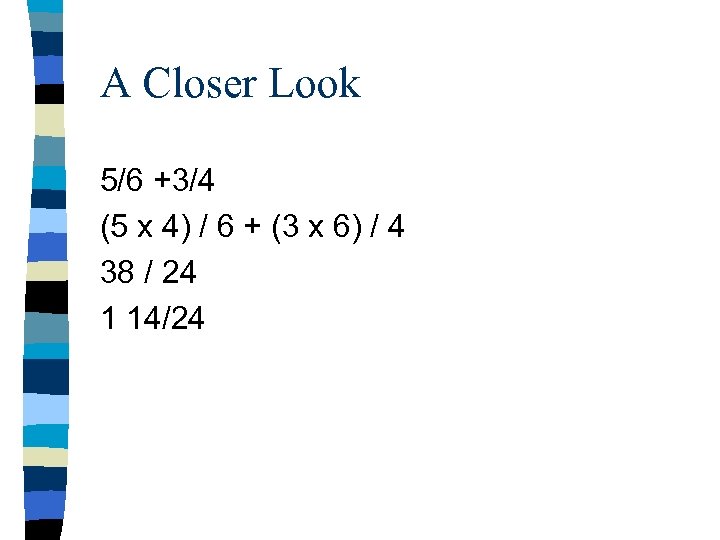
A Closer Look 5/6 +3/4 (5 x 4) / 6 + (3 x 6) / 4 38 / 24 1 14/24
Indian Culture and the System of Brahma n Correct Astronomical System of Brahma written by Brahmagupta in 7 th century A. D. n Presented standard arithmetical rules for calculating fractions and also dealing with negatives n Also addressed the rules dealing with division by zero
Hindus 7 th century A. D. n Similar approach as Chinese (maybe even learned from that particular culture) n Wrote the two numbers one over the other with the size of the part below the number of times to be counted (no horizontal bar) n The invert and multiply rule was used by the Hindu mathematician Mahavira around 850 A. D. (not part of western arithmetic until 16 th century) n
Interesting Additions Arabs inserted the horizontal bar in the 12 th century n Latin writers of the Middle Ages were the first to use the terms numerator and denominator (“counter”, how many, and “namer”, of what size, respectively) n The slash did not appear until about 1850 n The term “percent” began with commercial arithmetic of the 15 th and 16 th centuries n – The percent symbol evolved from: per 100 (1450), per 0/0 (1650), then 0/0, then % sign we use today
Decimal On the Back-burner Chinese and Arabic Cultures had used decimal fractions fairly early in mathematics but in European cultures the first use of the decimal was in the 16 th century n Made popular by Simon Stevin’s ( A Flemish mathematician and engineer) 1585 book, The Tenth n Many representations of the decimal were used: n – Apostrophe, small wedge, left parenthesis, comma, raised dot
A Brief Timeline n n n 1800 -1600 B. C. Notion of parts and the unit fraction are found in Egyptian Papryi and Babylonian clay tablets/sexagesimal system 1800 -1600 B. C. Mesopotamian scribes extended sexagesimal system 100 B. C. Chinese The Nine Chapter of Mathematical Art 7 th century Correct Astronomical System of Brahma written by Brahmagupta. 7 th century Hindu system modeled after Chinese 850 A. D. Mahavira developed the invert and multiply rule for division of fractions
Not So Brief of a Timeline n 12 th century Arabs introduce horizontal bar n 15 th and 16 th century evolution of the percent sign n 16 th century decimal fractions and the decimal introduced to European culture n 1585 Simon Stevin’s book The Tenth
Resources Used Belinghoff, William P. and Fernando Q. Gouvea. Math Through the Ages: a gentle history for teachers and others : Oxton House Publishers, 2002 n Grattan-Guinness, I. Companion Encyclopedia of the History and Philosophy of the Mathematical Sciences : Routledge, 1994 n Victor J. Katz. A History of Mathematics, Pearson/Addison Wesley, 2004 n
Скачать презентацию Broken Numbers History of Writing Fractions Sketch 4
feb60ece578720b7110d8401a7a53670.ppt