 Скачать презентацию Broadcast Technology RTV 151 Internet WWW Video
bd7ede8c7d9c2484f8e28b059ad255ac.ppt
- Количество слайдов: 66



Broadcast Technology RTV 151 Internet & WWW Video Games Broadband & Wireless Digital Automotive Telematics Smart Homes IOT Mobile Communication Telephony
Internet Review G Advanced Research Projects Agency G Pentagon / University relationship G LANs and WANs G Single location / wide geographic area G ARPANET combined with LANs and WANs became the Internet in 1983 G TCP/IP protocol (Bob Kahn and Vint Cerf) G Packet switching and IP addresses
Domain Name System (DNS) G IP address 158. 135. 172. 2 G Text-based DNS translates human language into the computer’s ‘phone number’ G TLD --. com , . net, . edu (sometime g. TLD) G cc. TLD -- country code --. ca , . uk (list) G Determined by IANA, Internet Assigned Numbers Authority G Organizational identifier – tamuc , google G Domain names administered by ICANN -- Internet Corporation for Assigned Names and Numbers G Buy domains from registrars (Mad Dog, Go. Daddy, 1 and 1, Blue. Host, Host. Gator, etc. )
Programs on the Internet… G WWW -- Tim Berners-Lee devised HTML language which led to Mosaic G A browser interprets the HTML (current: 5) G Web page creation. . . G XML--extensible markup language G SOAP--simple objects access protocol (based on XML G XHTML--another form of XML G VRML G App creation – OS connection
Programs on the Internet… G E-mail (now email) G Newsgroups / Usenet (link) see text G Chat / IM (AIM, i. Chat, Meebo) G Telnet (link) G FTP (Fetch, Filezilla, etc. ) G Internet Phone (Skype, Google Voice) G Web 2. 0 (blogs, Second Life, Facebook, podcasts…) Video streams (Bittorent, Veoh, Hulu, clicker)
What’s going on today… G Blogs / moblogs / vlogs G Journalism / bloggers G RSS feeds G Podcasts, etc. / newsreader software G New economic models -- Google G Legal issues -- RIAA, MPAA G Other issues G Malware, Digital Divide, charging fees to Internet sites, net neutrality (Comcast)
Web 2. 0? G Google Docs (You. Tube ‘tutorial’) / Drive G i. Cloud G Apple OS X development, Chrome, Windows G What is ‘Digital Media’? / New Media G What is ‘Internet 2’? G Increase speeds G Spread technologies and applications G Take advantage of digital libraries, virtual laboratories, teleimmersion G What is Web 2. 0?

Web 2. 0
What is… G Digg? G Stumble Upon? G Photobucket? G Jumpcut? G The Way. Back Machine? G The Machine is using us? G A MOOC, Crowdsourcing? G Otherwise going on…………. ?
Mobile Computing Devices G PDAs (personal digital assistant – ‘Newton’) G Functions / changes through the years G GPS G Vehicle fixed / portable (On. Star example) G Satellite connection vs. most others G Cell Phones G i. Phone example (smart phone) G Portable Video Games G Game. Boy, Nintendo DS, Sony PSP / music, movies G Ultra Mobile PCs--Origami / Microsoft (discontinued) G Recent years -- focus on touch / voice recognition G Wearable Computers? (2 min. video)(now? _ G Tablets / smart watches
Broadcasting vs. streaming G DTV – multicasting, ATSC 3. 0 future G DVB-H (digital video broadcasting handheld) standard for broadcasting to handsets G DMB (digital multimedia broadcasting) for multimedia broadcasting -- not available in North America G Streaming allows VOD – (mobile TV)AT&T Mobile (Media. Flo)…failed Verizon (ended 2012) –m. DTV G Backseat TV (ended 12/31/15)
History of Video Games A parallel development to computers, the Internet, broadband mobile media
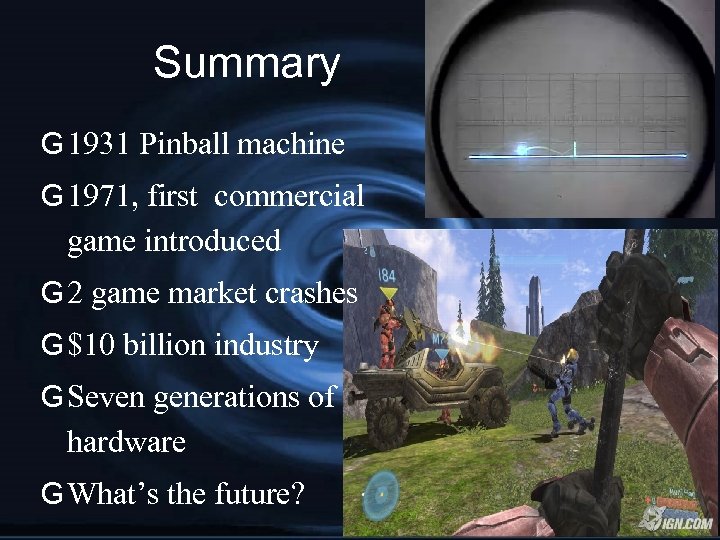
Summary G 1931 Pinball machine G 1971, first commercial game introduced G 2 game market crashes G $10 billion industry G Seven generations of hardware G What’s the future?
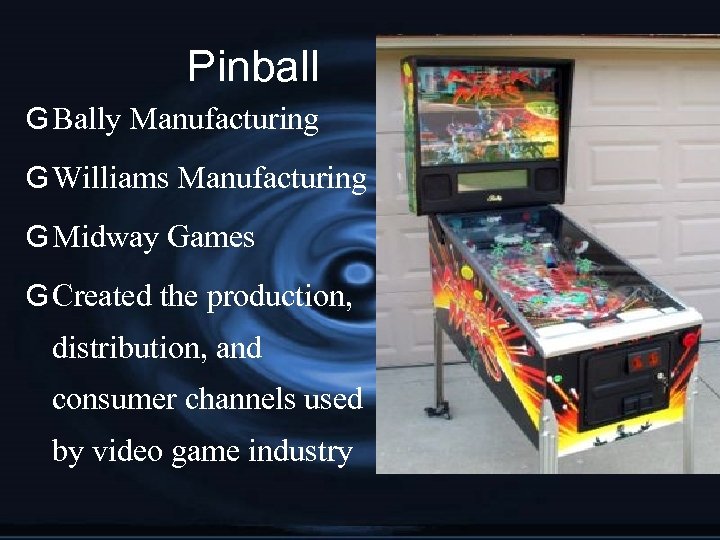
Pinball G Bally Manufacturing G Williams Manufacturing G Midway Games G Created the production, distribution, and consumer channels used by video game industry
Japan (Pre-history) G Early coin operated companies established by foreigners G Taito, (Sega + Rosen Enterprises = Sega Enterprises) G 1966 – Periscope G Imported to the US and Europe, expensive G Set the 25 cent price for coin operated machines
Electronic / Computer games (Prehistory) G 1948: Cathode Ray Tube Amusement Device patent for electronic game. Vacuum tubes controlled missiles firing at a target G 1951: Transistors replacing vacuum tubes at university computers. Students wanted games. G Checkers (1951)
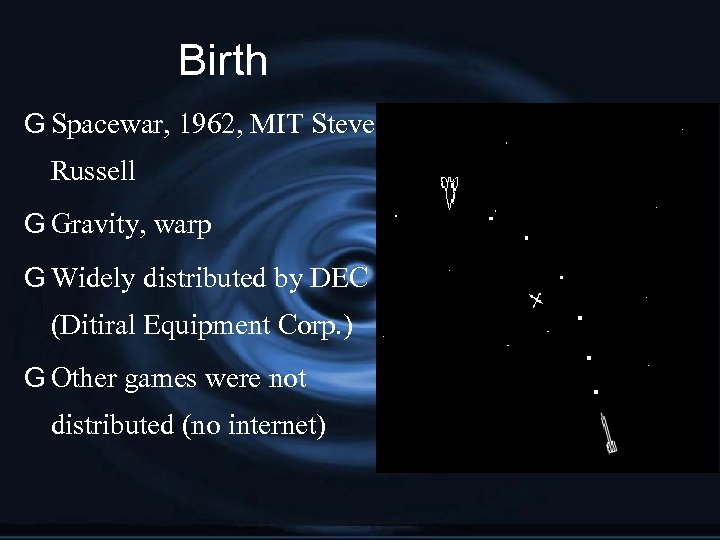
Birth G Spacewar, 1962, MIT Steve Russell G Gravity, warp G Widely distributed by DEC (Ditiral Equipment Corp. ) G Other games were not distributed (no internet)
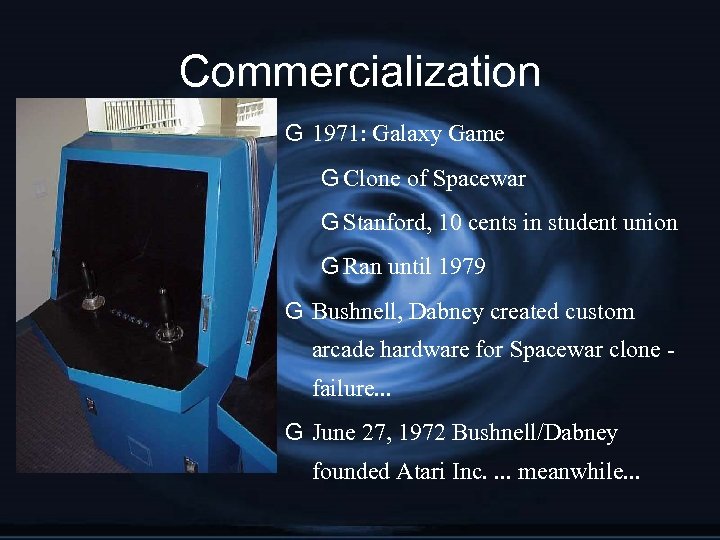
Commercialization G 1971: Galaxy Game G Clone of Spacewar G Stanford, 10 cents in student union G Ran until 1979 G Bushnell, Dabney created custom arcade hardware for Spacewar clone failure. . . G June 27, 1972 Bushnell/Dabney founded Atari Inc. . meanwhile. . .
Games on Television Screens (Consoles) G Ralph Baer G 1967 – chase game G Light gun -> shooting, paddles -> tennis G Prototype played multiple games G No sound, used overlays G 3 dials for vertical, horizontal, and spin G Magnavox bought it, and managed to sell 100 K units
Pong G Al Alcorn, Atari’s first game engineer G 1972: Implemented Pong G Atari tried to get Bally’s to manufacture it G Machine malfunctioned during demo because it was too full of coins! G Atari decided to forget Bally’s and go into manufacturing! G Many Pong clones competed
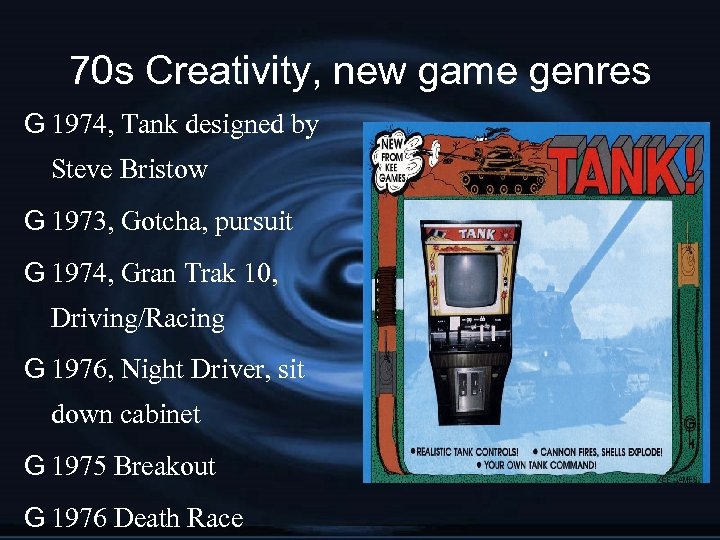
70 s Creativity, new game genres G 1974, Tank designed by Steve Bristow G 1973, Gotcha, pursuit G 1974, Gran Trak 10, Driving/Racing G 1976, Night Driver, sit down cabinet G 1975 Breakout G 1976 Death Race
Golden Age of arcade games (2) G 1978: Space Invaders, (Taito) high score, no name G 1979, Star Fire, (Exidy), added high score initials G 1979, Atari Football, smooth scrolling screen, trackball controller G Many Companies entered the business G Konami, Namco, Irem, SNK, Technos Japan. G Galaga, Defender, Scramble, Moon patrol
Maze Games: Pac-Man G 1980, Namco, Originally Puck-man but changed name before releasing in the US. G Best selling arcade game up to that point G First identifiable video character G Cover of Time G 1981, MIT students enhancement kits for pac- man ended up producing Ms. Pac-Man (4 mazes) G 1982, Namco, Pole Position, Racing, POV
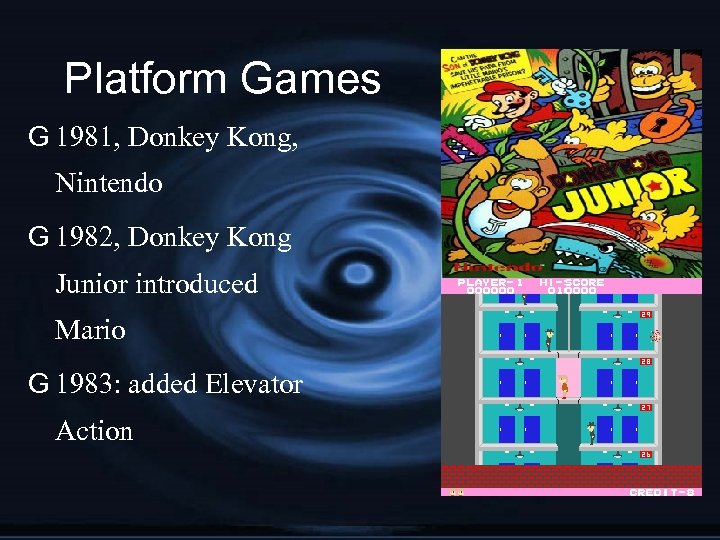
Platform Games G 1981, Donkey Kong, Nintendo G 1982, Donkey Kong Junior introduced Mario G 1983: added Elevator Action
Tech G 1976: game cartridges G 1977: Joystick G Vector graphics G 1979: Asteroids, others (but died after 1983 and raster) G Laserdisc G 1983: Dragon’s Lair, animated sequences, interactive movie
80 s G 1982: EA born G PCs, game source code printed in magazines G Commodore 64 G 1983, Snipes, first networked commerical text- mode game G Maze War (university research game) G Spasim (3 d multiplayer space sim), precursor to Doom and Quake G Handheld LCD console
Crash of 1983 G Too many companies, too many bad games G So many ET the Extra Terrestrial game cartridges were left over that they had to be buried in a big hole in NM! G Lasted One Year!
Video game consoles (3) G Nintendo, NES (Famicon), Super Mario Brothers G Gamepad G 8 direction D pad with 2 or more action buttons G 1986: Dragon Quest precursor to RPG G 1987: Final Fantasy, Role playing game G 1986: Legend of Zelda G 1988: Nintendo Power Magazine
90’s (4) G Rising to match Hollywood G 3 D graphics, sound cards, CDs, fast PCs G Internet based distribution, shareware, G 1992: RTS games, Dune II set the std. G Warcraft, C&C, Star. Craft G 1993: Myst, and adventure puzzle game G Sim games: Sim city, Sim. Earth, . . . The Sims (2000) G Mods, Counterstrike, Half Life mod
Internet Gaming G Multi-User Dungeons G 1996: Quake, FPS G MMORPGS: Ultima Online, Everquest G Persistent worlds, large numbers of players G Java/Flash back to simple games G Decline of arcades, rise of home consoles, PCs
4, 5, 6, 7 generations G Sega Genesis, Super NES G Sega Saturn, Sony Playstation, Nintendo 64 G DDR G Sega Dreamcast, Playstation 2, Game Cube, Xbox G Sims, Halo, GTA, Halo 2, GTA San Andreas, Guitar Hero G PSP, PS 3, Xbox 360, Nintendo DS
Future G Where is it heading? G Speed, storage, bandwidth, haptic / other senses G AI G Immersion, VR, Augmented Reality G Holodeck
Wireless Technologies G 3 G / 4 G / 5 G cell phones -- packet and circuit switching G K-bit to M-bit to giga bit throughput G Wi-Fi G 802. 11 and 802. 11 x refers to a family of specifications developed by the IEEE for wireless LAN technology. G Institute of Electrical and Electronics Engineers, pronounced I-triple-E G Wi. Max (ZYXEL) G Also known as IEEE 802. 16 --intended for wireless "metropolitan area networks". Provides broadband wireless access (BWA) up to 30 miles (50 km) for fixed stations, and 3 - 10 miles (5 - 15 km) for mobile stations. G Wi. Fi/802. 11 wireless local area network standard is limited in most cases to only 100 - 300 feet (30 - 100 m). G Clearwire bought by Sprint (phased out as separate)
Why 802? G The 802 group is the section of the IEEE involved in network operations and technologies, including mid-sized networks and local networks. Group 15 deals specifically with wireless networking technologies, and includes the now ubiquitous 802. 15. 1 working group, which is also known as Bluetooth.
More wireless data transfer… G Like Apple. Watch, Apple. Pay G Near field communication (NFC) is the set of protocols that enable electronic devices to establish radio communication with each other by touching the devices together, or bringing them into proximity to a distance of typically 10 cm or less.
Wireless Technologies G Bluetooth G Name comes from Harald Bluetooth, king of Denmark in the late 900 s G There are lots of different ways that electronic devices can connect to one another--Component cables, Electrical wires, Ethernet cables, Wi. Fi, Infrared signals… G Bluetooth is essentially a networking standard that works at two levels: G It provides agreement at the physical level -- Bluetooth is a radio-frequency standard; G AND, it provides agreement at the protocol level, where products have to agree on when bits are sent, how many will be sent at a time, and how the parties in a conversation can be sure that the message received is the same as the message sent. (headphones, cell phone, GPS, PDA--Starfield example)
Wireless Technologies G Zig. Bee G The set of specs built around the IEEE 802. 15. 4 wireless protocol. G Name "Zig. Bee" derived from the erratic zigging patterns many bees make between flowers when collecting pollen. The standard is regulated by a group known as the Zig. Bee Alliance, with over 150 members worldwide. G Bluetooth focuses on connectivity between large packet user devices--laptops, phones, major peripherals…. G Zig. Bee is designed to provide highly efficient connectivity between small packet devices.
Wirelsss Technologies G WPAN (we had LAN, WAN, MAN…) G Wireless personal area network G Bluetooth and Zigbee G Personal hotspots (wi-fi technology) G RFID G “IBM Uses RFID to Track Conference Attendees” G “New chip promises to track kids from miles away” G Tracks things and people G DTV? / HD Radio G Multicasting channels -- data transmission? G Two way interactivity G FCC approval
Technical changes G Copper wires to fiber optic cable G Circuit Switching to packet switching G Landline to wireless G Convergence of technologies and companies
Technical examples G Fiber Optics (how they work) G Early telephones (women as operators) G Early telephones (dialing a rotary phone) G (push button phone) G Making ‘free’ phone calls (how Vo. IP works) G Skype / Ooma / Magic Jack / Apple Face. Time G Netzero Voice / Messenger / i. Chat G Jajah. com (closed 2013) G Google Voice
Cell Phones G Early -- 2 -way radio type service G Phone / ‘cells’ / towers G Ugly towers? G Connects to Mobile Telephone Switching Office (MTSO) G Going to another cell phone in same area on same service, routed to another tower G To another service or a landline, routed to the Public Switched Telephone Network (PSTN)
Generations G ‘two-way radio’ style G ‘cellular’ process developed by (‘old’) AT&T G IG -- analog -- 1983 -- AMPS -- ‘advanced mobile phone service G 2 G -- digital introduction -- early 1990 s G CDMA, TDMA initially in the U. S. (CDMA: Sprint, Verizon) G GSM type adopted first in Europe (AT&T / TMobile)
Generations G 3 G -- higher data transmission speeds -switch to packet switching (Interim -- ‘ 2. 5 G’ ‘Edge’) * 2 G currently being phased out G Verizon, AT&T, Sprint & T-Mobile all offer high speed 3 G wireless networks. All moving to 4 G. . . but, interim technologies G 3 G -- about 3 mbps throughput; 4 G about 10 mbps (about 10 x faster) G Based on phone AND network infrastructure
Today… G Although GSM and CDMA are often the foundation…also LTE, HSPDA, UMTS G High-Speed Downlink Packet Access (HSDPA) is an enhanced 3 G system G UMTS (Universal Mobile Telecommunications Service) is a 3 G broadband, packet-based transmission of text, VOIP, video, and multimedia at data rates up to 2 Mbps. UMTS is based on the Global System for Mobile (GSM) communication.
3 G vs. 4 G G Explanation as 4 G emerged: G Direct link
Cell phone as hybrid medium G Delivery of video to cellular phones became widespread… voice / data … and G Verizon’s V-Cast service (3 G EV-DO) Mobi. TV service. G Both use the cellular network to deliver the content. G New service and technology, Media. Flo, developed by Qualcomm, used part of the television broadcasting spectrum (channel 55) to send multi-media content to mobile phones (as noted before). G Allows wireless carriers to offer video content without taking up much needed bandwidth in their cellular network.
What is broadband? G ITU -- minimum speed of 256 kilobits/second G FCC -- 1996 Telecommunications Act: 200 Kb/s bidirectionally, G 2015 change from FCC: download of 4 Mbps to 25 Mbps, and the minimum upload speed from 1 Mbps to 3 Mbps, G Wired, Wireless, Satellite G Alternate: DTV multicast channels (etc. )
Broadband delivery -- wired G DSLAM / extenders (digital subscriber line access multiplexer) G IPTV (AT&T: U-verse, Verizon: Fi. OS) G Dedicated line (no slowdown) G Cable modem (DOCSIS -- 1. 0 / 2. 0 / 3. 0) G Data Over Cable Service Interface Specification G Shared down trunk line (slowdown) G Fiber to the home/premises (FTTH/P) G FTTN -- fiber to the node (last mile is coaxial cable for cable & twisted-pair copper for DSL) … vs. AT&T now with U-verse build G Broadband over power line (BPL) G Interference G State approval G 2016: AT&T Air. Gig
Broadband delivery -- wireless G Fixed wireless broadband (FWB) (from MMDS) G 3 G mobile wireless (4 G / pre-4 G) G Wi-Fi (IEEE 802. 11) (‘WLAN’) G Wi-Max (802. 16) G Satellite G Hughes. Net & Wild. Blue (several now) G Latency problem (Vo. IP, games) “a time delay between the moment something is initiated, and the moment one of its effects begins or becomes detectable”
Broadband today (3) G Discussion over past several years as Hulu, Netflix and others changed how we get TV shows and movies. G Consumers themselves are driving this "broadband or TV" debate into irrelevance. G They're busy accessing programming on demand - whether "broadband" or "TV" through a host of devices and services whose popularity is only going to skyrocket in the future. These include Ti. Vo, Xbox, Netflix, Amazon and many others.
Go back and forward a bit G Games G HMD, virtual reality, immersive action G Automotive telematics G Smart car G Now, smart homes and smart cities G E-Health G Wearables G Body monitor and communication
Home Networks G Residential gateway (aka - cable/DSL router) G ‘the key device in most home networks’ G Wired (server / hub / router) LAN G Wireless (wi-fi / WLAN / 802. 11) G Interconnects all computers and other IP devices G Connects the home network to the broadband connection
‘Specs’ Technical specifications or standards G Like all issues – establish technical standards G HPNA -- Home Phoneline Networking Alliance -- technology, built on Ethernet, allows all the components of a home network to interact over the home's existing telephone wiring without disturbing the existing voice or fax services G IEEE -- Institute of Electrical and Electronics Engineers
Proprietary or agreed-upon? G VHS vs. Beta (home) G DVD-R / DVD-RW vs. DVD+R / RW vs. RAM G SD cards or compact flash cards G HD-DVD vs. Blu. Ray G WMA vs. Real. Player vs. Quicktime etc. codecs G HDTV (8 -VSB / COFDM)
Home ‘hot spot’ Applications? GMultiple networked computers GComputers share one printer GIntegration of phone / cable or satellite systems / DVR, Slingbox, Netflix, digital linear channels, etc. with IP GSecurity system connections G Automotive telematics
Home ‘hot spot’ Applications? G Control any IP device -- Microsoft has been working with Whirlpool to allow users to monitor their laundry with their home network, computer, TV, and cell phone. G Continuing growth in American homes operating a wireless network, making the US the leader in adoption of wireless home networks.
Wireless security G Wireless ‘cloud’ -- public places G Encryption types G WEP -- Wired Equivalency Privacy G easily hacked -- do a ‘Cracking wi-fi’ or cracking WEP search on You. Tube Wireless Hacking / WEP hacking / Free wi-fi anywhere G WPA -- Wi-Fi Protected Access G 128 bit encryption G WPA Personal -- password protected G WPA-Enterprise -- server verified G Evil Twins G Phony hotspots to steal information
What else? G RFID (ubiquitous? ) G Smart Home (video) / robotics G Speech recognition G Types: Discrete, continuous & complete G Speech recognition gone awry G Better success demo (click screen when page loads) G Ultra HD video (cinema--replace film projection) G Electronic paper (Kindle, i. Pad) (e-paper demo) G Wikis G GIGO conundrum? G LA Times experiment G Google docs as collaborative authoring?
Big Data G Big Data is “large pools of data that can be captured, communicated, aggregated, stored analyzed” G Notice the ads on the screen after you’ve searched for something? G Google is watching you…
How generated? G When you use Facebook, Instagram or Snapchat, you contribute to datasets of Big Data. G When you take a picture with your smart phone, your phone—through all its sensors to collect and store data— adds to the pool of stored data, and…
How generated? G …your online actions with this digital image add to the pool of stored data. G When you add a video to You. Tube, G when you do a search on Google, G when your automotive telematics communicate your location through its wireless, connected system, and…
How generated? G …when you comment on someone’s blog, you contribute to the evergrowing pool of Big Data. G Are you concerned about your privacy or security of your information?
Where is this Big Data stored? G Two options: a company may own its own hardware—a data center—and do its own data storage and pay its own people to maintain the system, or G A company can outsource its data storage to a third-party provider— where the server is ‘in the cloud’
Bottom line G The bottom line is that the data stored and mined by companies have value. G A report by Economist Intelligence Unit says “Big Data analysis, or the mining of extremely large data sets to identify trends and patterns, is fast becoming standard business practice”
Virtual / Augmented Reality (RWWW) G Second Life (promo/commercial) G Google Earth and other competitors G Education, Entertainment, etc. in a ‘virtual world’? G Google Glass
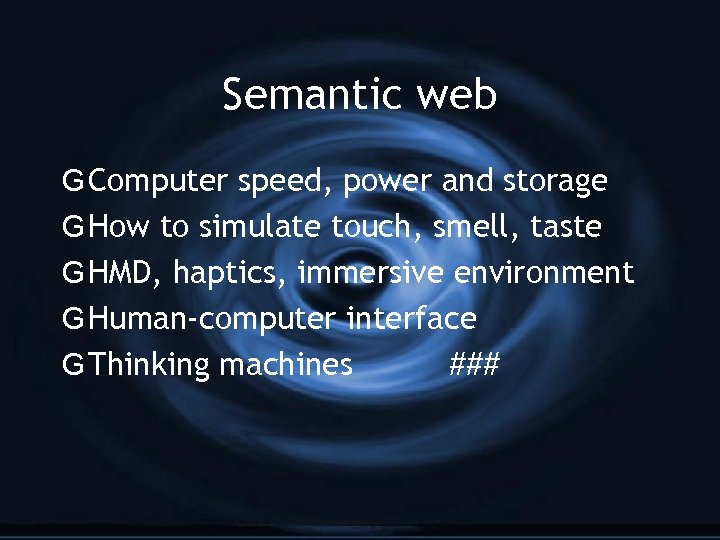
Semantic web G Computer speed, power and storage G How to simulate touch, smell, taste G HMD, haptics, immersive environment G Human-computer interface G Thinking machines ###
Скачать презентацию Broadcast Technology RTV 151 Internet WWW Video
bd7ede8c7d9c2484f8e28b059ad255ac.ppt