 Скачать презентацию Broadband Wireless World Forum San Francisco February
98c7aeacf2108c065aeddc8cd32951fb.ppt
- Количество слайдов: 36



Broadband Wireless World Forum San Francisco – February 2001 Unlocking the Broadband Residential Market – Advances in Low-Cost CPE and Installation Eric Stonestrom CEO BWWF Feb 2001 - (c) Airspan Networks Inc
Outline • Main themes • Broadband wireless – Residential market characteristics and trends • Technology trends to address market needs • Airspan’s response • Conclusion BWWF Feb 2001 - (c) Airspan Networks Inc
Main themes • Broadband wireless is happening now • Combining voice AND data is the key to a successful business model • The introduction of residential broadband wireless will drive volumes up and costs down • Many systems deployed already – especially in 3. 5 GHz, PCS and MMDS bands BWWF Feb 2001 - (c) Airspan Networks Inc
Residential market characteristics and trends • Data speeds comparable to DSL – 512 k today; 2 Mbit/s by end 2001 – 4 X year-on-year speed increases! • Distance independence from exchange – A uniform service must be delivered by the operator – significant numbers of residential subscribers live out of reach of DSL • Combined delivery of high quality voice AND high-speed data are key to success – Voice alone is not enough – operators need to offer high speed data in order to remain competitive – Data alone can rarely generate sufficient revenues to justify the business case for ANY technology • High Churn rates – Some markets churn at 2 percent per month BWWF Feb 2001 - (c) Airspan Networks Inc
Technology trends to address market needs • Data speeds – Wireless DSL systems available today to meet data speed requirements – Many technical developments underway to achieve future data needs • 64 QAM; MIMO; OFDM; multi-carrier CDMA; etc • Distance independence from exchange – Frequency band is critical to achieving good range: LMDS is not appropriate for residential market – Below 5 GHz is best compromise – Wireless DSL systems deliver! • Combined delivery of high quality voice AND high-speed data – Vo. IP to end customer is not the best solution for residential – But integration with Vo. IP networks is a clear industry trend • High churn rates – Need to be able to recover large proportion of installed equipment when subscriber churns away: Integrated external subscriber equipment – Very short installation/recovery time: auto configuration of subs equipment, subscriber installs BWWF Feb 2001 - (c) Airspan Networks Inc
Technical and Technology Aspects BWWF Feb 2001 - (c) Airspan Networks Inc
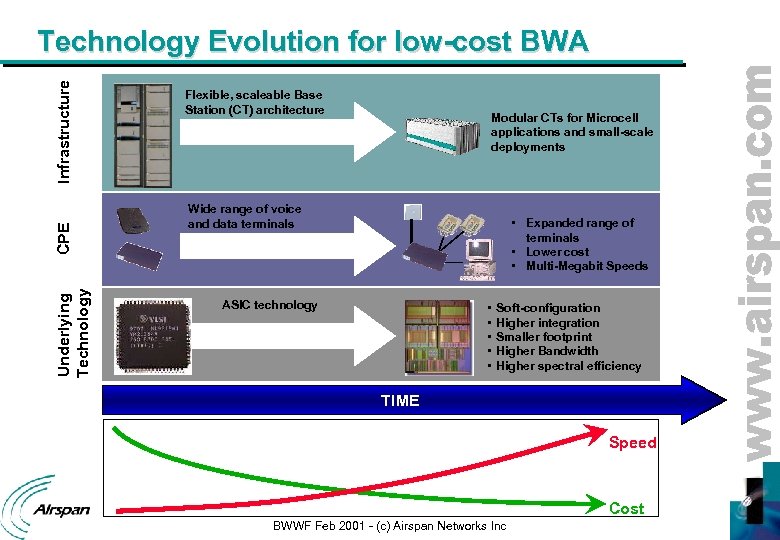
Underlying Technology CPE Infrastructure Technology Evolution for low-cost BWA Flexible, scaleable Base Station (CT) architecture Modular CTs for Microcell applications and small-scale deployments Wide range of voice and data terminals • Expanded range of terminals • Lower cost • Multi-Megabit Speeds ASIC technology • • • Soft-configuration Higher integration Smaller footprint Higher Bandwidth Higher spectral efficiency TIME Speed Cost BWWF Feb 2001 - (c) Airspan Networks Inc
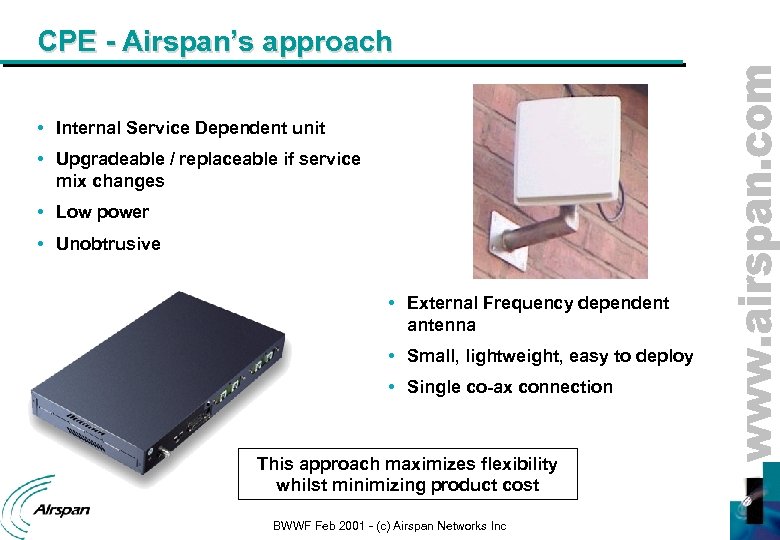
CPE - Airspan’s approach • Internal Service Dependent unit • Upgradeable / replaceable if service mix changes • Low power • Unobtrusive • External Frequency dependent antenna • Small, lightweight, easy to deploy • Single co-ax connection This approach maximizes flexibility whilst minimizing product cost BWWF Feb 2001 - (c) Airspan Networks Inc
Lower costs through standardization • Agreement on standards can make a significant impact on technology costs - viz the (GSM/cdma. One) mobile markets. • However in the broadband wireless access market, the needs are different: – Non-uniform regulation and allocation of spectrum – Customers are not mobile – Much proprietary development has been undertaken already • Some fora are active: – – IEEE 802. 16 (Wireless. MAN) - Widest industry support today WDSL Consortium ETSI BRAN/Hyper. Access …. Others • Standards may evolve - but not before many systems have been deployed! BWWF Feb 2001 - (c) Airspan Networks Inc
System range and performance • This is key to the ultimate economics of a given system: – 5 x range will typically need 25 x fewer base stations to cover given area – There also 25 fewer backhaul links to be installed • HOWEVER this depends on having sufficient system capacity for large range systems AND sufficient spectrum – Where many small sites are deployed, INTERFERENCE is often the limiting factor • In comparing the economics of various systems, it is essential to examine the detailed tradeoffs between – Capacity – Deployed spectral efficiency – Associated costs of (e. g. backhaul, site acquisition, power) BWWF Feb 2001 - (c) Airspan Networks Inc
Quality and DFM (Design For Manufacture) • Operational costs are in many cases highly dependent on the maturity of the product, the quality of the build and the experience of the manufacturer concerned • Operating BWA equipment requires: – Extremely rugged tried-and-tested designs capable of withstanding a wide range of climatic conditions – A product that can be easily maintained or upgraded, with minimal downtime while upgrades are undertaken – Comprehensive O&M facilities • To manufacture such high performance equipment requires excellent DFM techniques, and access to high-volume production lines in order to achieve lowest-cost product. BWWF Feb 2001 - (c) Airspan Networks Inc
System Architecture • Frequency – Many different frequency bands and allocations in many different global markets – No world-wide frequency standards – Inevitable consequence: an architecture that restricts frequency flexibility will not achieve ultimate low-cost - insufficient manufacturing volumes • Services – Wide variations in service requirements and mix – Mixtures of 10 b. T, n x POTS, leased lines, ISDN – Combinations of service delivery to customers – such as voice and data – Dictates need for flexible subscriber service delivery unit • HOWEVER - more modularity generally leads to higher costs: therefore careful design that achieves both flexibility and low-cost needs to be thought through from the outset. BWWF Feb 2001 - (c) Airspan Networks Inc
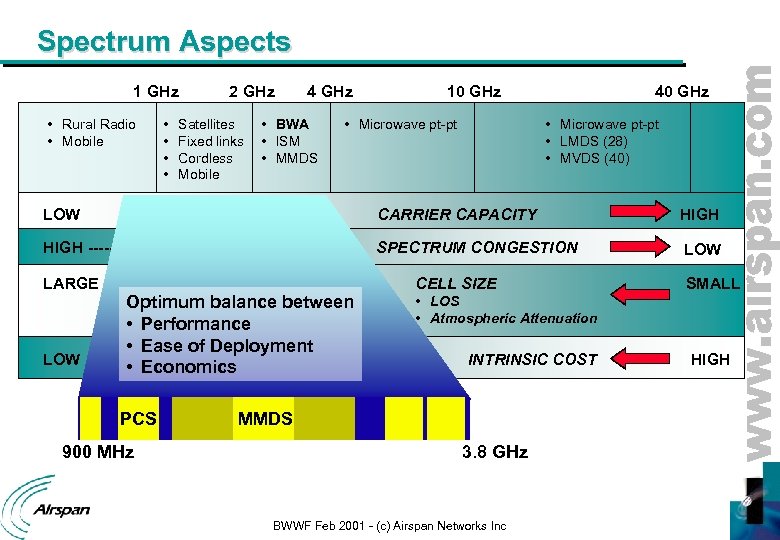
Spectrum Aspects 1 GHz • Rural Radio • Mobile • • 2 GHz Satellites Fixed links Cordless Mobile 4 GHz • BWA • ISM • MMDS 10 GHz • Microwave pt-pt 40 GHz • Microwave pt-pt • LMDS (28) • MVDS (40) LOW CARRIER CAPACITY HIGH ----- SPECTRUM CONGESTION LOW LARGE LOW Optimum balance between • Performance • Ease of Deployment • Economics PCS 900 MHz CELL SIZE SMALL • LOS • Atmospheric Attenuation INTRINSIC COST MMDS 3. 8 GHz BWWF Feb 2001 - (c) Airspan Networks Inc HIGH
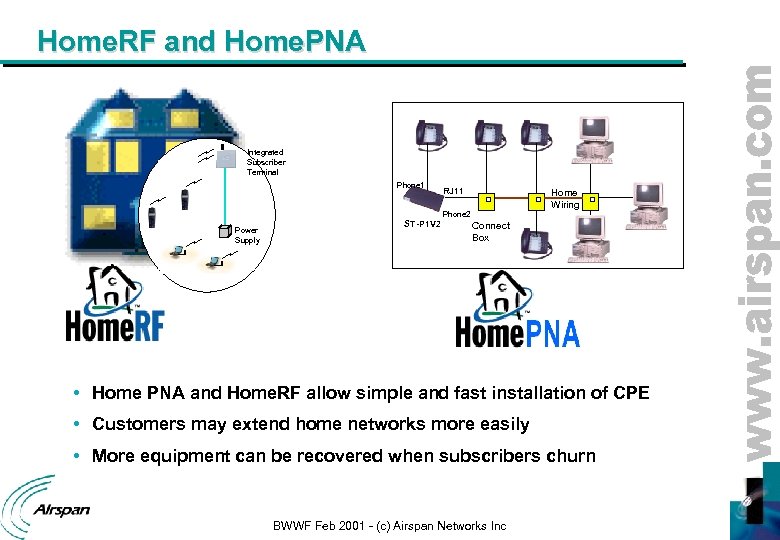
Home. RF and Home. PNA Integrated Subscriber Terminal Phone 1 RJ 11 Home Wiring Phone 2 Power Supply ST-P 1 V 2 Connect Box • Home PNA and Home. RF allow simple and fast installation of CPE • Customers may extend home networks more easily • More equipment can be recovered when subscribers churn BWWF Feb 2001 - (c) Airspan Networks Inc
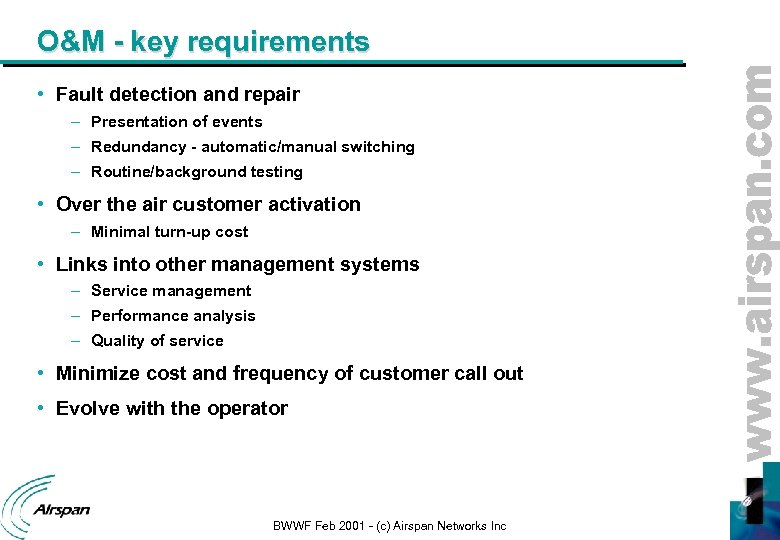
O&M - key requirements • Fault detection and repair – Presentation of events – Redundancy - automatic/manual switching – Routine/background testing • Over the air customer activation – Minimal turn-up cost • Links into other management systems – Service management – Performance analysis – Quality of service • Minimize cost and frequency of customer call out • Evolve with the operator BWWF Feb 2001 - (c) Airspan Networks Inc
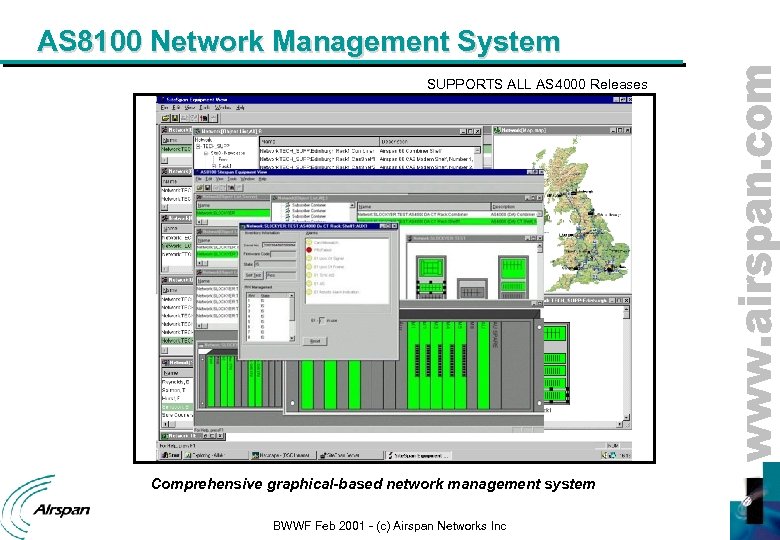
AS 8100 Network Management System SUPPORTS ALL AS 4000 Releases Comprehensive graphical-based network management system BWWF Feb 2001 - (c) Airspan Networks Inc
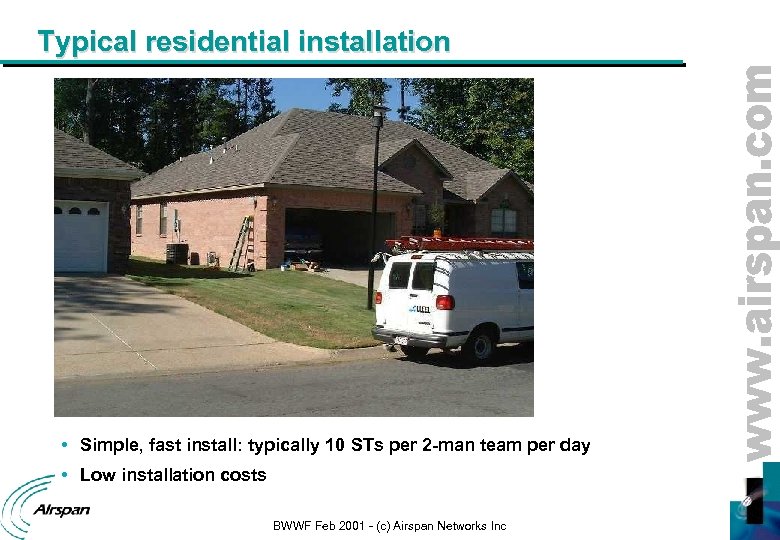
Typical residential installation • Simple, fast install: typically 10 STs per 2 -man team per day • Low installation costs BWWF Feb 2001 - (c) Airspan Networks Inc
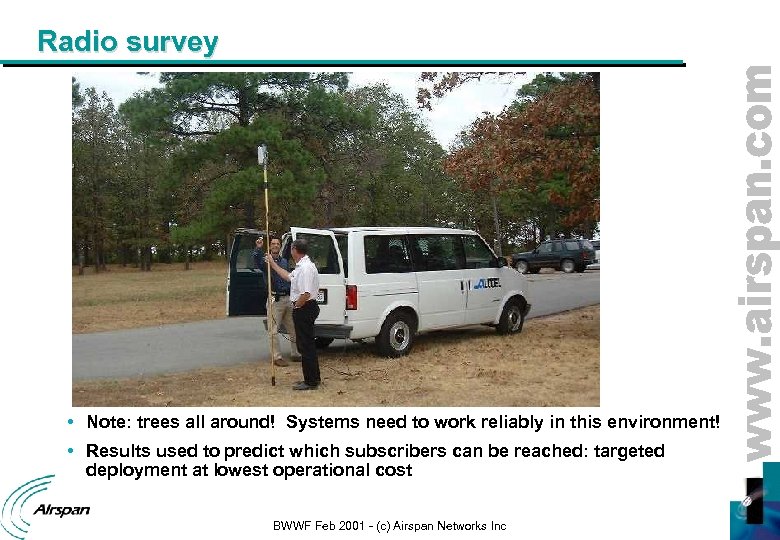
Radio survey • Note: trees all around! Systems need to work reliably in this environment! • Results used to predict which subscribers can be reached: targeted deployment at lowest operational cost BWWF Feb 2001 - (c) Airspan Networks Inc
Infrastructure • Modularity to achieve scalability and customisation • Re-use of hardware as multi-function boards: soft-configured for different functions: – Reduces costs – Simplifies spares – Simplifies maintenance • Minimal requirement for site visits • Full configuration and upgrade via O&M BWWF Feb 2001 - (c) Airspan Networks Inc
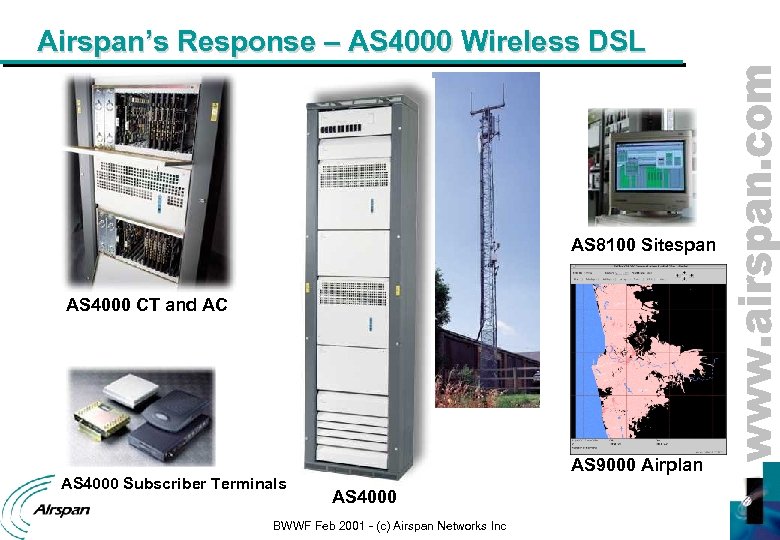
Airspan’s Response – AS 4000 Wireless DSL AS 8100 Sitespan AS 4000 CT and AC AS 4000 Subscriber Terminals AS 9000 Airplan AS 4000 BWWF Feb 2001 - (c) Airspan Networks Inc
Conclusion • Broadband Wireless is here today and being deployed worldwide! • Low-cost solutions are available for residential markets – especially So. Ho applications • Application of new technology is driving costs down: – Quicker install, Home. RF/PNA, and self-install – Product costs • Delivery of bundled services (voice and data) produces a compelling business case for ILECs, CLECs and ISPs BWWF Feb 2001 - (c) Airspan Networks Inc
Thank you for listening…. . Leaders in the Wireless DSL market BWWF Feb 2001 - (c) Airspan Networks Inc
Company Overview BWWF Feb 2001 - (c) Airspan Networks Inc
Company Profile • A global supplier of Wireless DSL systems and solutions • Dedicated solely to wireless fixed access telecommunications • Established technology with a proven track record • Committed to the evolving business & technological needs of our customers BWWF Feb 2001 - (c) Airspan Networks Inc
Experience - 1992 to Today • Formed in 1992 to focus on R&D of wireless communications within DSC Communications • A pioneering product range launched in 1996 • One of the first to deploy point-to-multipoint radio systems • Became an independent US corporation in February, 1998. Investors included Sevin Rosen, Oak, and Deutsche Bank • IPO in July 2000 BWWF Feb 2001 - (c) Airspan Networks Inc
Resources • Headquartered in Florida, with primary operations in London • More than 100 engineers involved directly with R&D • Self-contained facilities from lab testing to system assembly & delivery • A "greenfield" live air site for testing & monitoring long term system performance • Comprehensive service portfolio from initial consulting to full system support • On-site & in-house customer training programs BWWF Feb 2001 - (c) Airspan Networks Inc
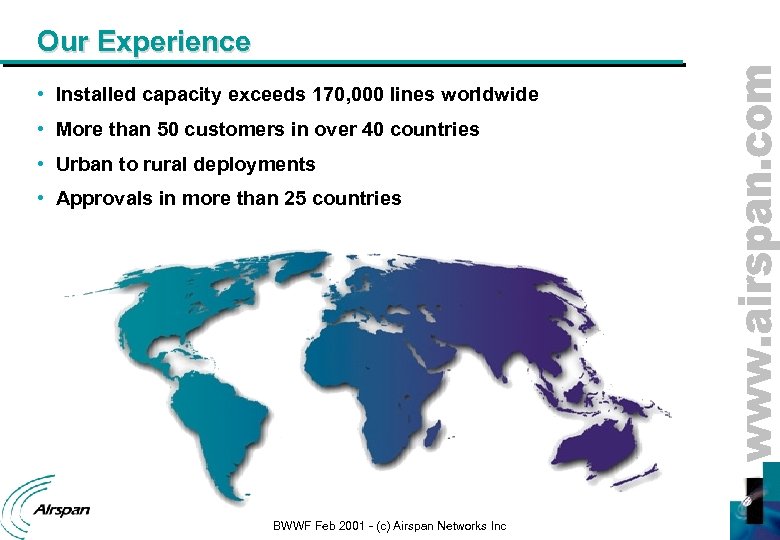
Our Experience • Installed capacity exceeds 170, 000 lines worldwide • More than 50 customers in over 40 countries • Urban to rural deployments • Approvals in more than 25 countries BWWF Feb 2001 - (c) Airspan Networks Inc
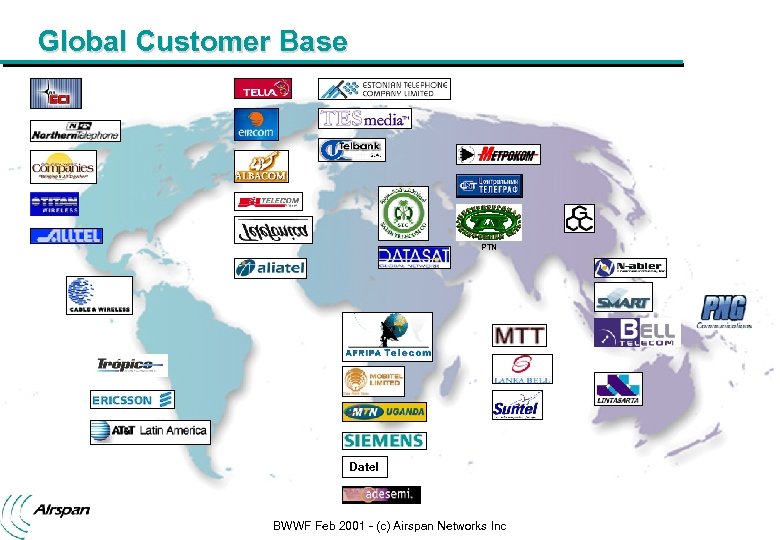
Global Customer Base PTN Datel BWWF Feb 2001 - (c) Airspan Networks Inc
Some of Airspan’s partners Technology & Manufacturing BWWF Feb 2001 - (c) Airspan Networks Inc OEMs
Market Overview • Internet growth is driving global demand for reliable access & increased bandwidth • World-wide telecom deregulation is creating new opportunities to provide local access • Service providers are: – Differentiating their services by offering a greater range of services – Expanding their focus beyond large business customers – Needing more cost-effective solutions • Airspan has products that meet today’s requirements and that evolve with the ever-changing market BWWF Feb 2001 - (c) Airspan Networks Inc
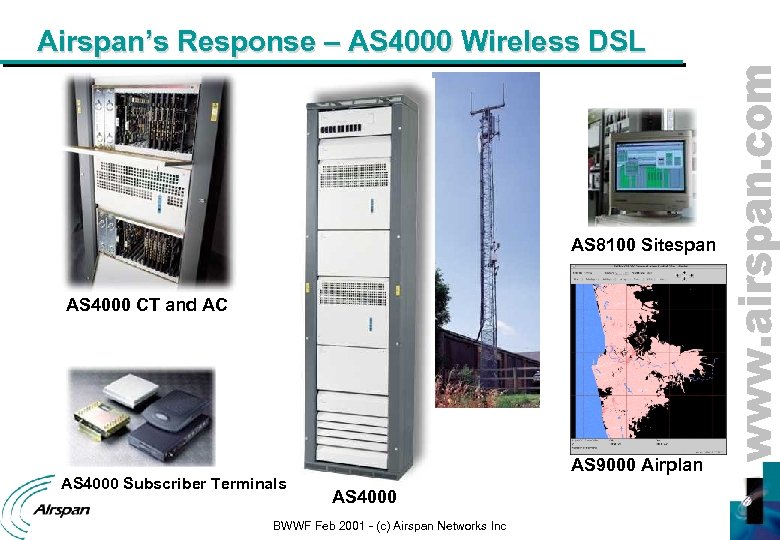
Airspan’s Response – AS 4000 Wireless DSL AS 8100 Sitespan AS 4000 CT and AC AS 4000 Subscriber Terminals AS 9000 Airplan AS 4000 BWWF Feb 2001 - (c) Airspan Networks Inc
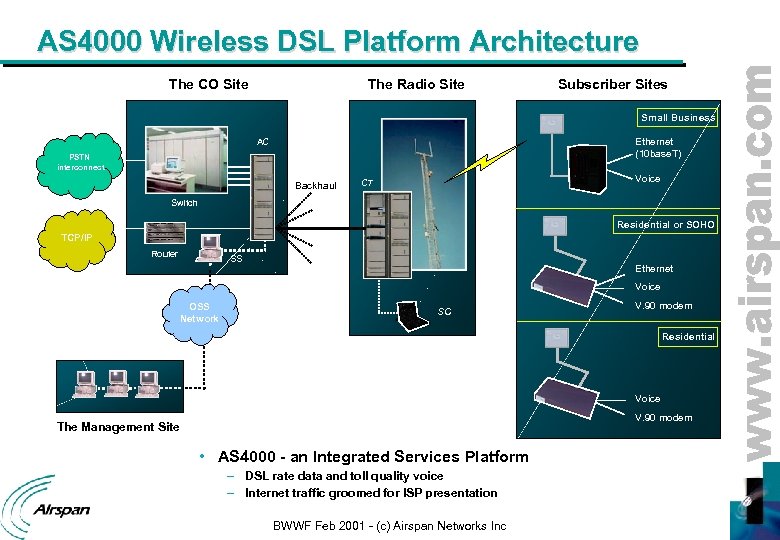
AS 4000 Wireless DSL Platform Architecture The CO Site The Radio Site Subscriber Sites Small Business Ethernet (10 base. T) AC PSTN interconnect Backhaul Voice CT Switch Residential or SOHO TCP/IP Router SS Ethernet Voice OSS Network SC V. 90 modem Residential Voice V. 90 modem The Management Site • AS 4000 - an Integrated Services Platform – DSL rate data and toll quality voice – Internet traffic groomed for ISP presentation BWWF Feb 2001 - (c) Airspan Networks Inc
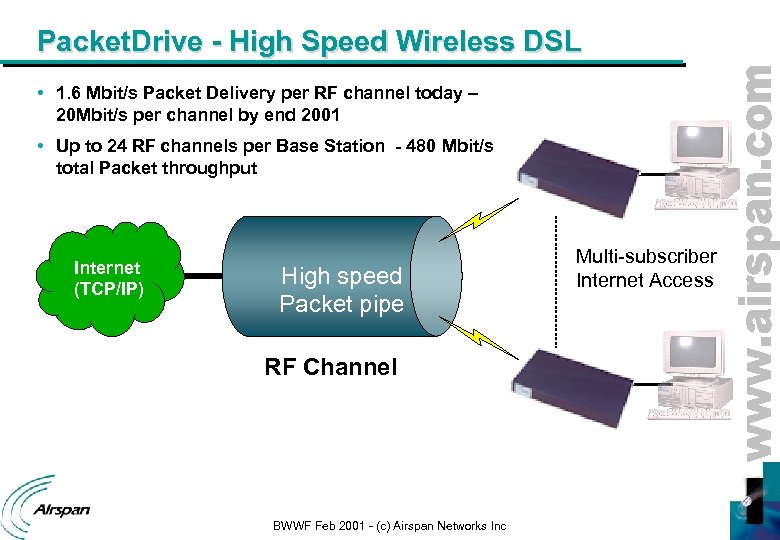
Packet. Drive - High Speed Wireless DSL • 1. 6 Mbit/s Packet Delivery per RF channel today – 20 Mbit/s per channel by end 2001 • Up to 24 RF channels per Base Station - 480 Mbit/s total Packet throughput Internet (TCP/IP) High speed Packet pipe RF Channel BWWF Feb 2001 - (c) Airspan Networks Inc Multi-subscriber Internet Access
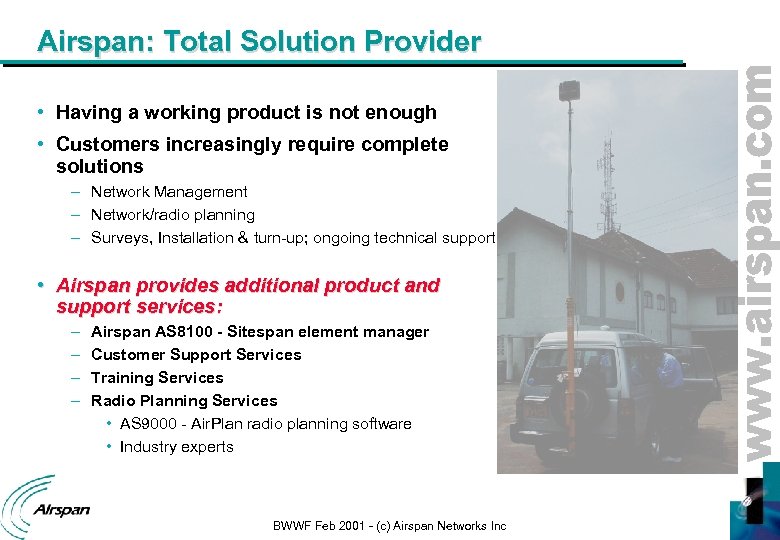
Airspan: Total Solution Provider • Having a working product is not enough • Customers increasingly require complete solutions – Network Management – Network/radio planning – Surveys, Installation & turn-up; ongoing technical support • Airspan provides additional product and support services: – – Airspan AS 8100 - Sitespan element manager Customer Support Services Training Services Radio Planning Services • AS 9000 - Air. Plan radio planning software • Industry experts BWWF Feb 2001 - (c) Airspan Networks Inc
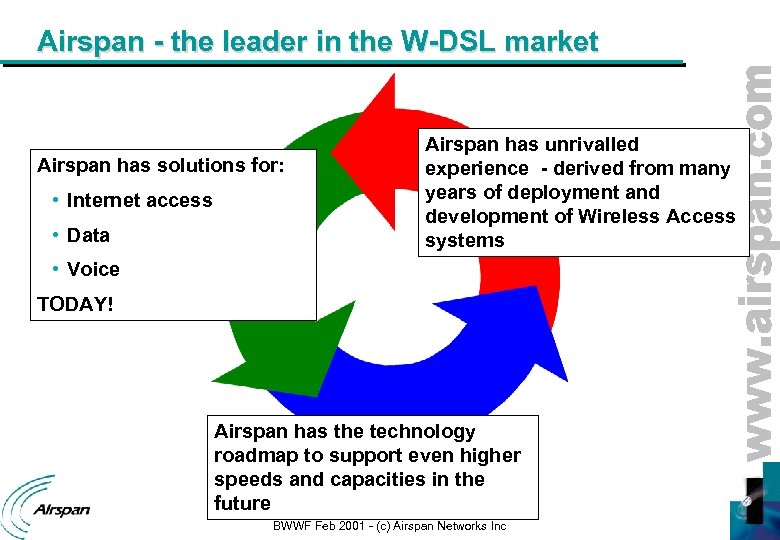
Airspan - the leader in the W-DSL market Airspan has solutions for: • Internet access • Data Airspan has unrivalled experience - derived from many years of deployment and development of Wireless Access systems • Voice TODAY! Airspan has the technology roadmap to support even higher speeds and capacities in the future BWWF Feb 2001 - (c) Airspan Networks Inc
www. airspan. com BWWF Feb 2001 - (c) Airspan Networks Inc
Скачать презентацию Broadband Wireless World Forum San Francisco February
98c7aeacf2108c065aeddc8cd32951fb.ppt