 Скачать презентацию Broadband Target Response of an Electromagnetic Induction Sensor
5753b02d29c8ada15a940d9ea7adf454.ppt
- Количество слайдов: 28



Broadband Target Response of an Electromagnetic Induction Sensor Waymond R. Scott, Jr. , Mu-Hsin Wei, Gregg D. Larson, and James H. Mc. Clellan School of Electrical and Computer Engineering Georgia Institute of Technology Atlanta, GA 30332 waymond. scott@ece. gatech. edu 404 -894 -3048 January 28, 2009
Outline § Introduction § Target Response versus Frequency § Relaxation Models § Discrete Spectrum of Relaxations § Results § Target Response versus Frequency and Orientation § 6 degree of freedom measurement system § 5 DOF are automated § 1 DOF is manual § Accomplishments/Goals Scott, Georgia Tech BRTRC, Jan. 2009 2
Goals § Investigate broadband EMI sensor for detecting and discriminating buried landmines from clutter. § Hardware § § Sensitivity Fidelity Wide bandwidth: 300 Hz to 90 KHz Dipole transmit coil • Dipole receive coil • Quadrapole receive coil § Target Response § Relaxation Models • Single orientation • Arbitrary orientation • Estimate from measured response § Experimental Measurements • Field Measurements • Laboratory Measurements – 6 degree of freedom measurement system Scott, Georgia Tech BRTRC, Jan. 2009 3
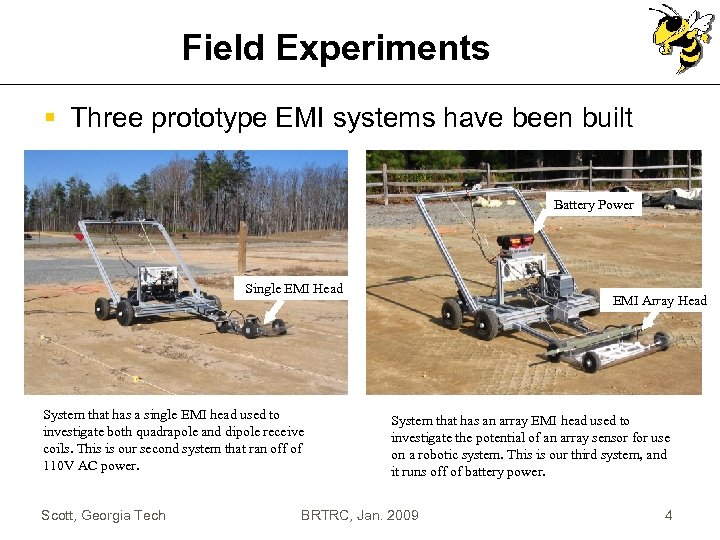
Field Experiments § Three prototype EMI systems have been built Battery Power Single EMI Head System that has a single EMI head used to investigate both quadrapole and dipole receive coils. This is our second system that ran off of 110 V AC power. Scott, Georgia Tech EMI Array Head System that has an array EMI head used to investigate the potential of an array sensor for use on a robotic system. This is our third system, and it runs off of battery power. BRTRC, Jan. 2009 4
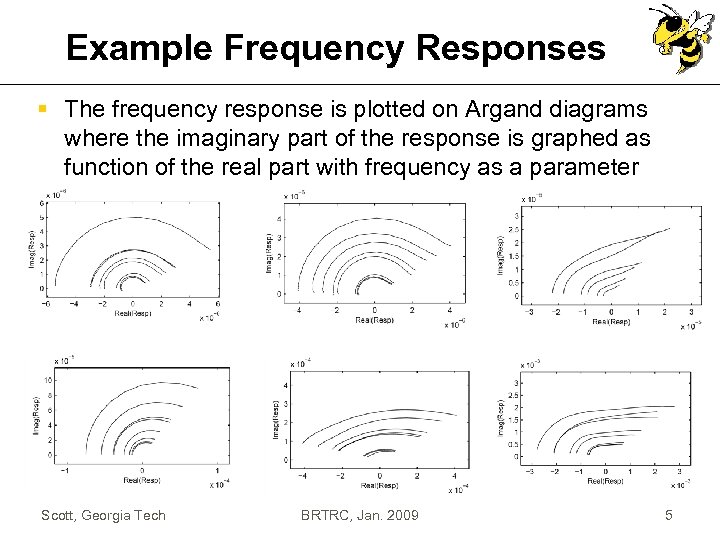
Example Frequency Responses § The frequency response is plotted on Argand diagrams where the imaginary part of the response is graphed as function of the real part with frequency as a parameter Scott, Georgia Tech BRTRC, Jan. 2009 5
Outline § Introduction § Target Response versus Frequency § Relaxation Models § Discrete Spectrum of Relaxations § Results § Target Response versus Frequency and Orientation § 6 degree of freedom measurement system § 5 DOF are automated § 1 DOF is manual § Accomplishments/Goals Scott, Georgia Tech BRTRC, Jan. 2009 6
Relaxation Models § The simplest response is a single relaxation which has a perfect half circle shape § The response is usually not a single relaxation and has a distorted half circle shape § Only a portion of the response is measured (finite bandwidth of sensor) § What model should be used to represent response? § The EMI responses are very similar to dielectric relaxations which have been studied for many years. Scott, Georgia Tech BRTRC, Jan. 2009 7
Relaxation Models • They are numerous dielectric relaxation models. • Are they applicable to EMI responses? Cole-Cole-Davidson Havriliak-Negami General Distribution of Relaxation times (DRT) Discrete DRT Scott, Georgia Tech BRTRC, Jan. 2008 8
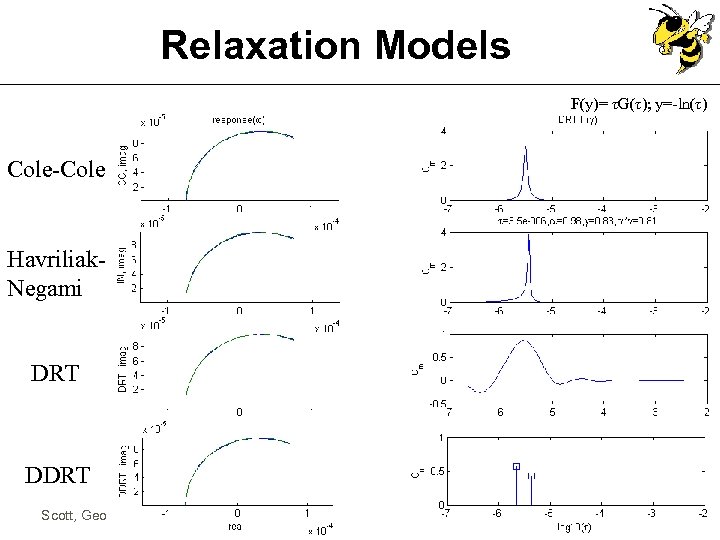
Relaxation Models F(y)= τG(τ); y=-ln(τ) Cole-Cole Havriliak. Negami DRT DDRT Scott, Georgia Tech BRTRC, Jan. 2008 9
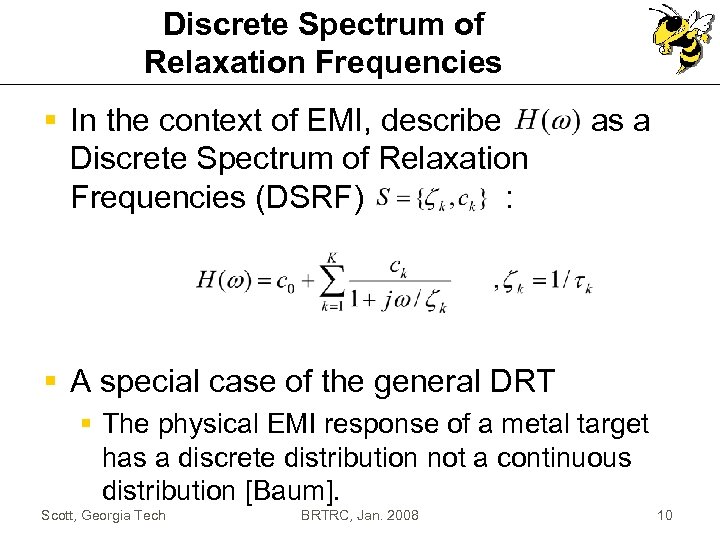
Discrete Spectrum of Relaxation Frequencies § In the context of EMI, describe Discrete Spectrum of Relaxation Frequencies (DSRF) : as a § A special case of the general DRT § The physical EMI response of a metal target has a discrete distribution not a continuous distribution [Baum]. Scott, Georgia Tech BRTRC, Jan. 2008 10
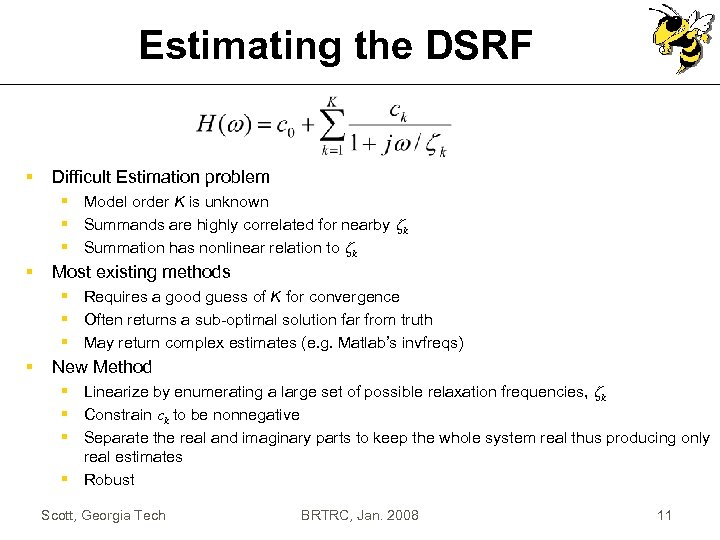
Estimating the DSRF § Difficult Estimation problem § Model order K is unknown § Summands are highly correlated for nearby zk § Summation has nonlinear relation to zk § Most existing methods § Requires a good guess of K for convergence § Often returns a sub-optimal solution far from truth § May return complex estimates (e. g. Matlab’s invfreqs) § New Method § Linearize by enumerating a large set of possible relaxation frequencies, zk § Constrain ck to be nonnegative § Separate the real and imaginary parts to keep the whole system real thus producing only real estimates § Robust Scott, Georgia Tech BRTRC, Jan. 2008 11
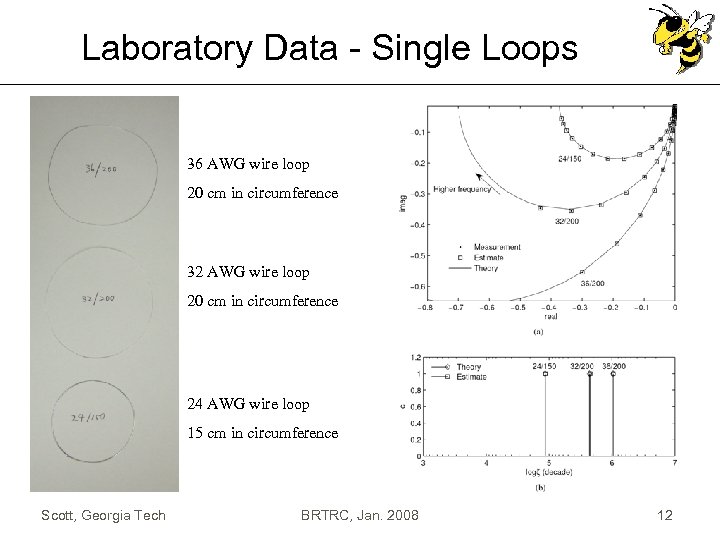
Laboratory Data - Single Loops 36 AWG wire loop 20 cm in circumference 32 AWG wire loop 20 cm in circumference 24 AWG wire loop 15 cm in circumference Scott, Georgia Tech BRTRC, Jan. 2008 12
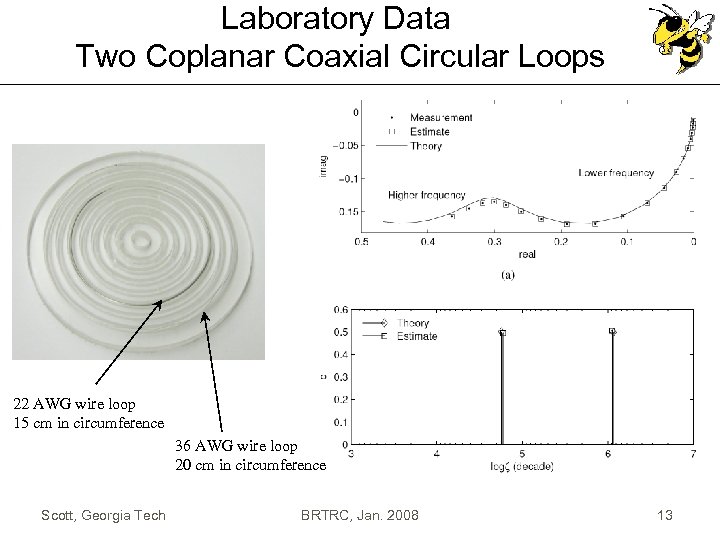
Laboratory Data Two Coplanar Coaxial Circular Loops 22 AWG wire loop 15 cm in circumference 36 AWG wire loop 20 cm in circumference Scott, Georgia Tech BRTRC, Jan. 2008 13
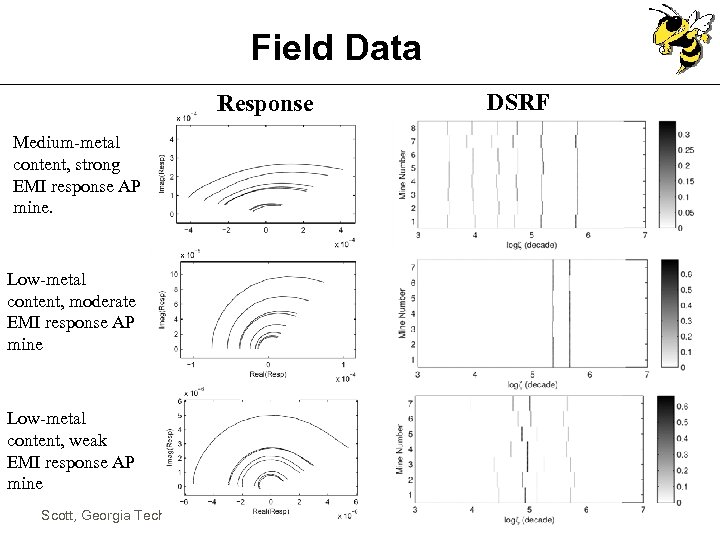
Field Data Response DSRF Medium-metal content, strong EMI response AP mine. Low-metal content, moderate EMI response AP mine Low-metal content, weak EMI response AP mine Scott, Georgia Tech 14
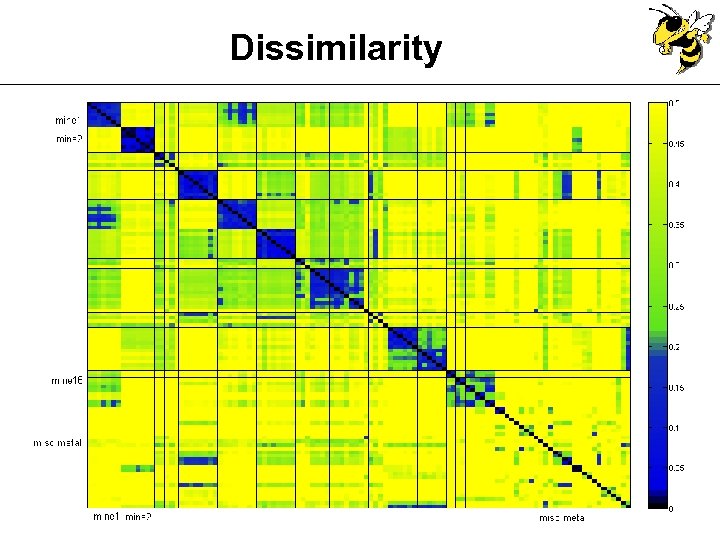
Dissimilarity Scott, Georgia Tech BRTRC, Jan. 2008 15
Outline § Introduction § Model Estimation § Relaxation Models § Discrete Spectrum of Relaxations § Results § Target Response versus Frequency and Orientation § 6 degree of freedom measurement system § 5 DOF are automated § 1 DOF is manual § Accomplishments/Goals Scott, Georgia Tech BRTRC, Jan. 2009 16
Target Response as a Function of Frequency and Orientation § The response of a metal target changes with its orientation § An experimental facility for investigating the response of targets versus orientation has been built § 6 degree of freedom measurement system § 5 DOF are automated § 1 DOF is manual § Custom made non-metallic rotation stages § Data to be used to make a model of the EMI response of mine-like targets as a function of frequency and orientation § Measure the full magnetization tensor for the target Scott, Georgia Tech BRTRC, Jan. 2009 17
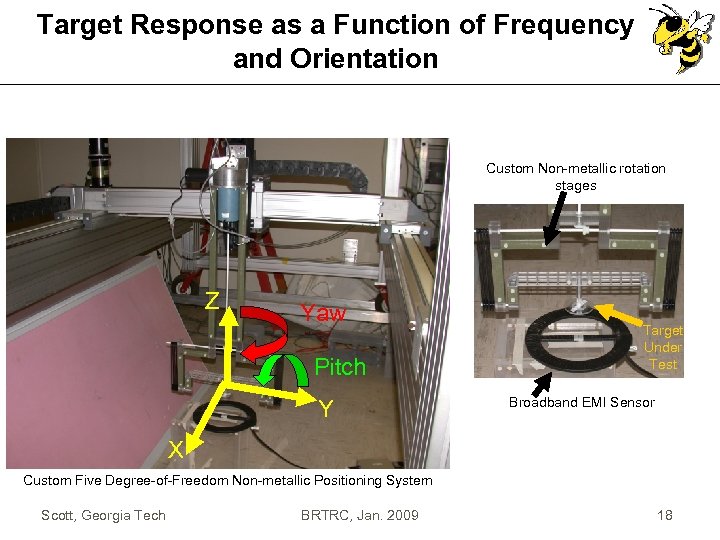
Target Response as a Function of Frequency and Orientation Custom Non-metallic rotation stages Z Yaw Pitch Y Target Under Test Broadband EMI Sensor X Custom Five Degree-of-Freedom Non-metallic Positioning System Scott, Georgia Tech BRTRC, Jan. 2009 18
Target Response as a Function of Frequency and Orientation § Typical measurement § § § § 201 values of x at 0. 5 cm spacing 7 values of y at 10 cm spacing 22 values of z at 1 cm spacing 5 values of pitch at 22. 5 degree spacing 3 values of yaw at 45 degree spacing 21 frequencies from 300 Hz to 90 k. Hz 3 receive heads Total of 201*7*22*5*3*21*3 = 29, 251, 530 measurements § 19 hours measurement time § So much data it is difficult to look at Scott, Georgia Tech BRTRC, Jan. 2009 19
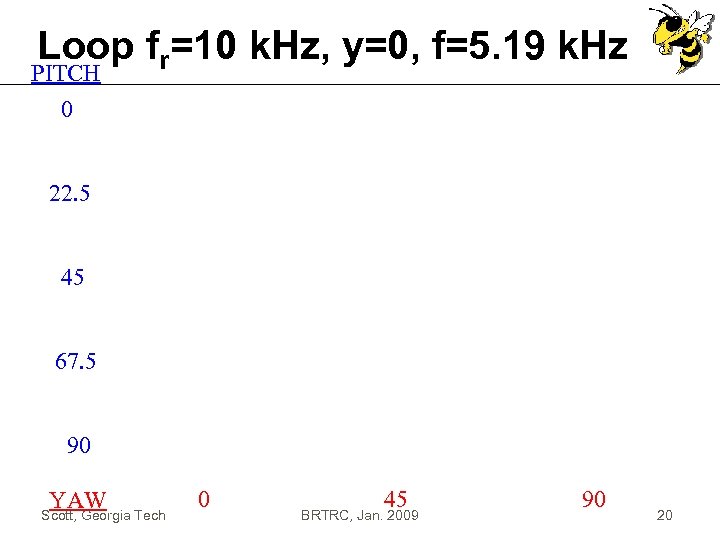
Loop fr=10 k. Hz, y=0, f=5. 19 k. Hz PITCH 0 22. 5 45 67. 5 90 YAW Scott, Georgia Tech 0 45 BRTRC, Jan. 2009 90 20
Loop fr=10 k. Hz, x=0, y=0, z=7. 5 cm PITCH 0 22. 5 45 67. 5 90 YAW Scott, Georgia Tech 0 45 BRTRC, Jan. 2009 90 21
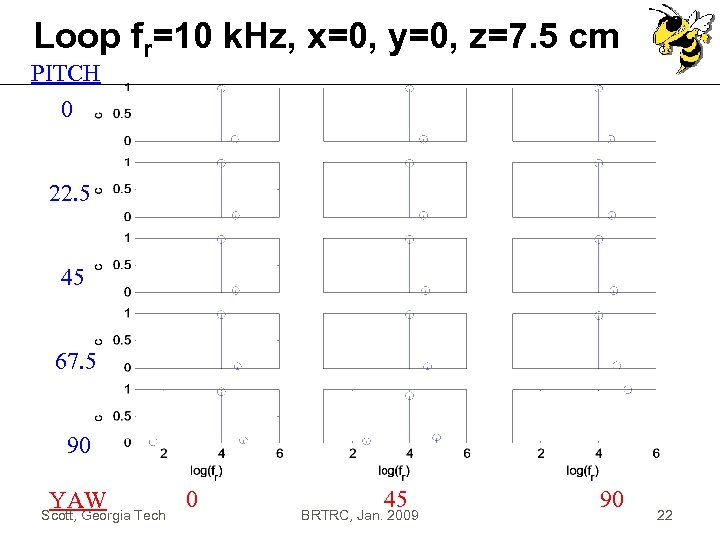
Loop fr=10 k. Hz, x=0, y=0, z=7. 5 cm PITCH 0 22. 5 45 67. 5 90 YAW Scott, Georgia Tech 0 45 BRTRC, Jan. 2009 90 22
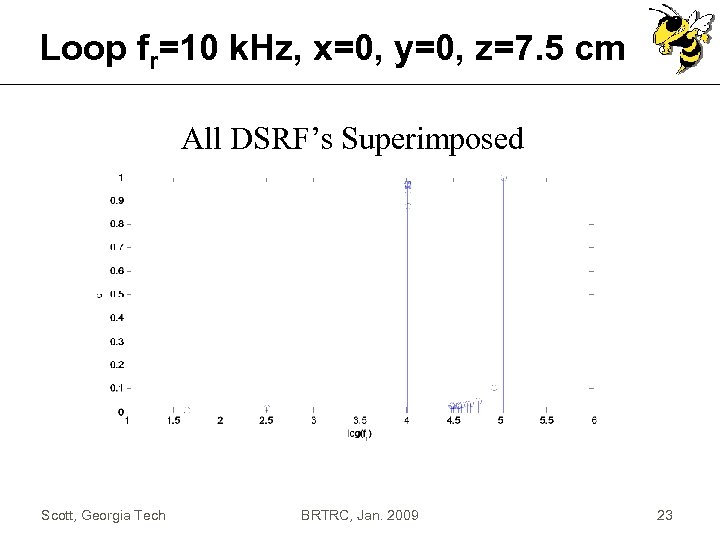
Loop fr=10 k. Hz, x=0, y=0, z=7. 5 cm All DSRF’s Superimposed Scott, Georgia Tech BRTRC, Jan. 2009 23
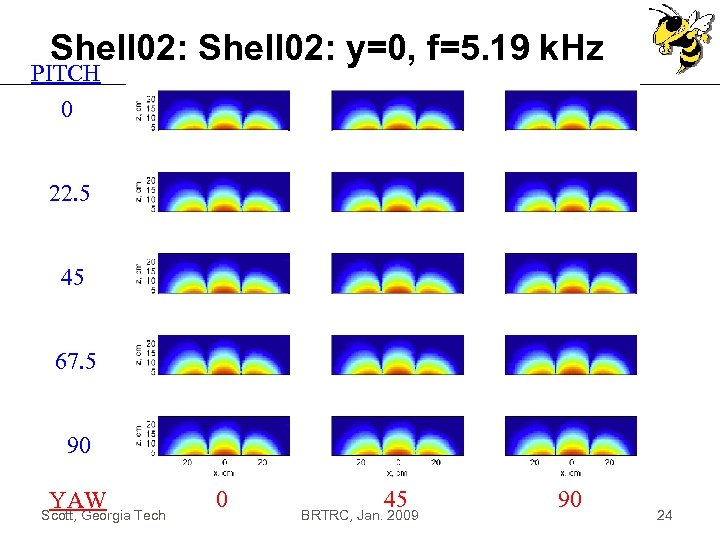
Shell 02: y=0, f=5. 19 k. Hz PITCH 0 22. 5 45 67. 5 90 YAW Scott, Georgia Tech 0 45 BRTRC, Jan. 2009 90 24
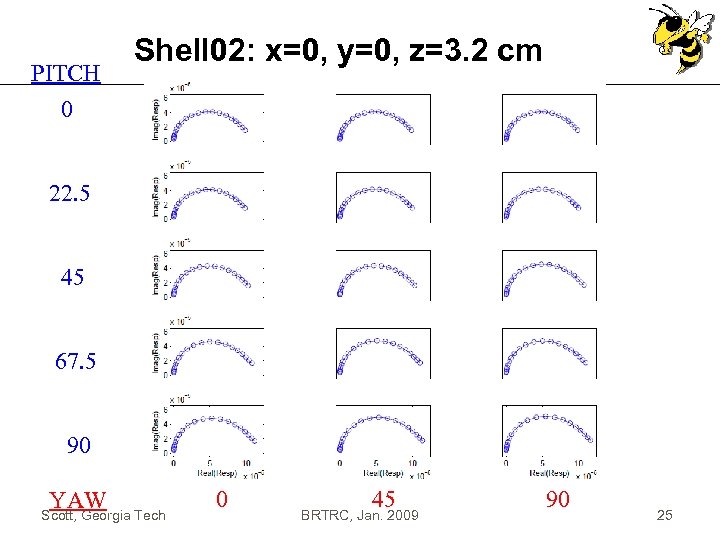
PITCH 0 Shell 02: x=0, y=0, z=3. 2 cm 22. 5 45 67. 5 90 YAW Scott, Georgia Tech 0 45 BRTRC, Jan. 2009 90 25
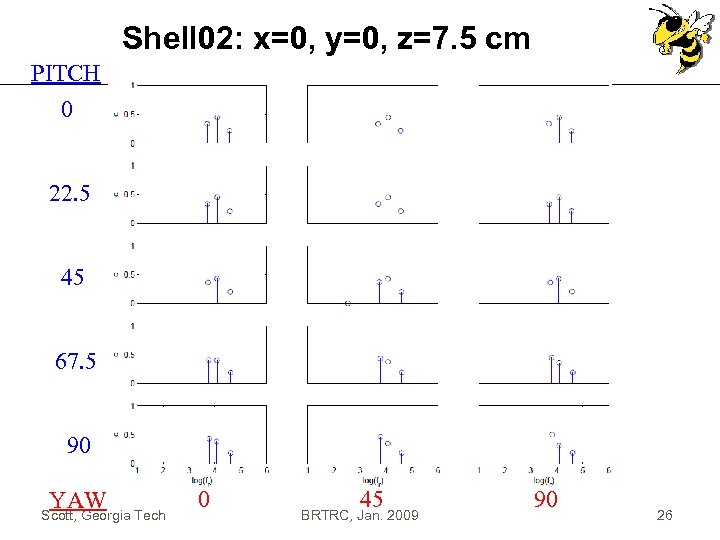
Shell 02: x=0, y=0, z=7. 5 cm PITCH 0 22. 5 45 67. 5 90 YAW Scott, Georgia Tech 0 45 BRTRC, Jan. 2009 90 26
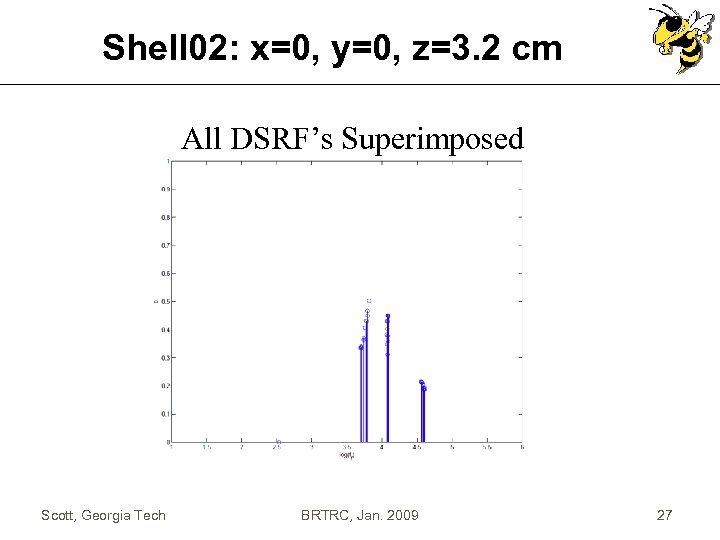
Shell 02: x=0, y=0, z=3. 2 cm All DSRF’s Superimposed Scott, Georgia Tech BRTRC, Jan. 2009 27
Accomplishments and Goals § Accomplishments § Developed the Discrete Spectrum of Relaxation Frequencies (DSRF) § New robust method for estimating model parameters § New graphical presentations § Model parameters are directly related to physical response § Developed new experimental facility for investigating the response of targets versus frequency and orientation § Goals § Extend the DSRF to entire magnetization tensor § Continue investigating targets with new experimental system § Models for magnetization tensor and relaxations Scott, Georgia Tech BRTRC, Jan. 2009 28
Скачать презентацию Broadband Target Response of an Electromagnetic Induction Sensor
5753b02d29c8ada15a940d9ea7adf454.ppt