 Скачать презентацию Broadband Russia CIS Summit 2006 Moscow 21
cb48d4b3abf65c3a7b3f91b00cd7c9be.ppt
- Количество слайдов: 26



Broadband Russia & CIS Summit 2006 Moscow 21 -22 November 2006 * Sex in the City , Broadband in the Bedroom or A Place for Everything and Everything in its Place John M Meredith 3 GPP Specifications Manager and 3 GPP Support Team Manager john. meredith@etsi. org * With apologies to HBO for corrupting their title. 1
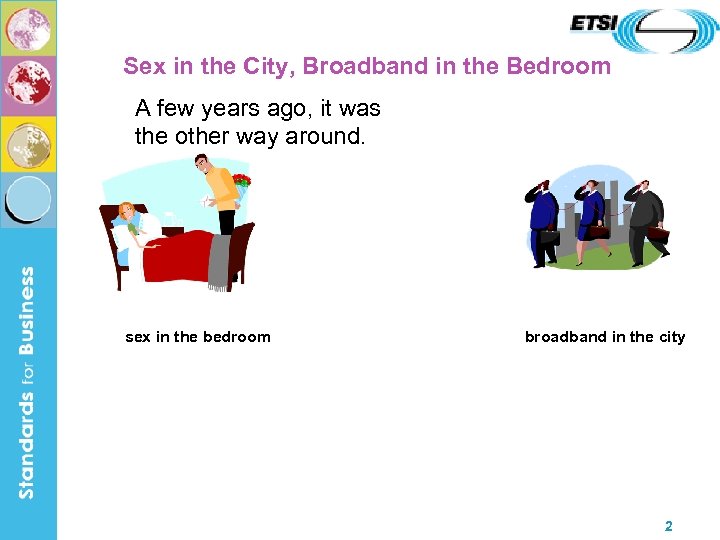
Sex in the City, Broadband in the Bedroom A few years ago, it was the other way around. sex in the bedroom broadband in the city 2
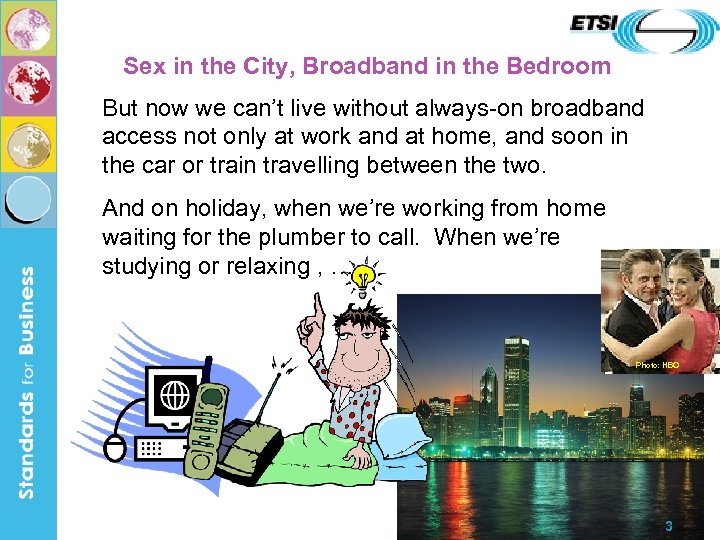
Sex in the City, Broadband in the Bedroom But now we can’t live without always-on broadband access not only at work and at home, and soon in the car or train travelling between the two. And on holiday, when we’re working from home waiting for the plumber to call. When we’re studying or relaxing , … Photo: HBO 3
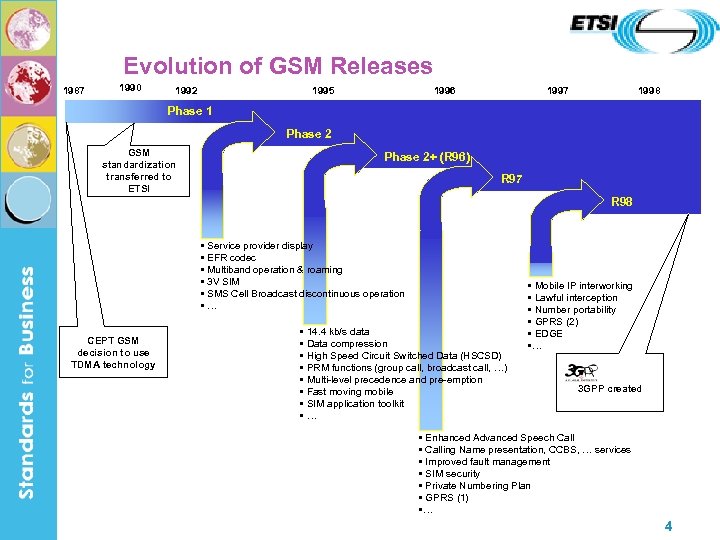
Evolution of GSM Releases 1987 1990 1992 1995 1996 1997 1998 Phase 1 Phase 2 GSM standardization transferred to ETSI Phase 2+ (R 96) R 97 R 98 • Service provider display • EFR codec • Multiband operation & roaming • 3 V SIM • SMS Cell Broadcast discontinuous operation • … CEPT GSM decision to use TDMA technology • 14. 4 kb/s data • Data compression • High Speed Circuit Switched Data (HSCSD) • PRM functions (group call, broadcast call, …) • Multi-level precedence and pre-emption • Fast moving mobile • SIM application toolkit • … • Mobile IP interworking • Lawful interception • Number portability • GPRS (2) • EDGE • … 3 GPP created • Enhanced Advanced Speech Call • Calling Name presentation, CCBS, … services • Improved fault management • SIM security • Private Numbering Plan • GPRS (1) • … 4
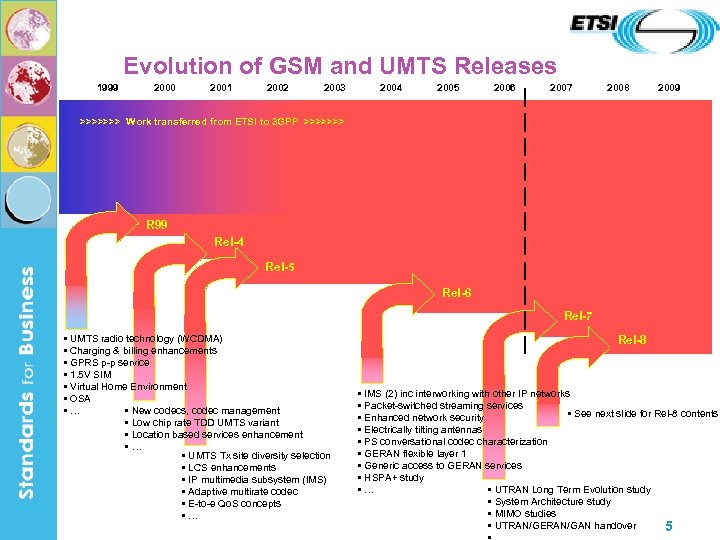
Evolution of GSM and UMTS Releases 1999 2000 2001 2002 2003 2004 2005 2006 2007 2008 2009 >>>>>>> Work transferred from ETSI to 3 GPP >>>>>>> R 99 Rel-4 Rel-5 Rel-6 Rel-7 • UMTS radio technology (WCDMA) • Charging & billing enhancements • GPRS p-p service • 1. 5 V SIM • Virtual Home Environment • OSA • New codecs, codec management • … • Low chip rate TDD UMTS variant • Location based services enhancement • … • UMTS Tx site diversity selection • LCS enhancements • IP multimedia subsystem (IMS) • Adaptive multirate codec • E-to-e Qo. S concepts • … Rel-8 • IMS (2) inc interworking with other IP networks • Packet-switched streaming services • See next slide for Rel-8 contents • Enhanced network security • Electrically tilting antennas • PS conversational codec characterization • GERAN flexible layer 1 • Generic access to GERAN services • HSPA+ study • … • UTRAN Long Term Evolution study • System Architecture study • MIMO studies • UTRAN/GERAN/GAN handover 5
![Release 8 contents • Standards for: • Enhanced UTRAN [ie LTE] (layer 1, 2,](https://present5.com/presentation/cb48d4b3abf65c3a7b3f91b00cd7c9be/image-6.jpg "Release 8 contents • Standards for: • Enhanced UTRAN [ie LTE] (layer 1, 2,")
Release 8 contents • Standards for: • Enhanced UTRAN [ie LTE] (layer 1, 2, 3, performance requirements, testing) • E-UTRAN interworking with GERAN • e. Call data transfer • Services alignment (for FMC) • Reduced signalling latency • … • Studies on: • IMS service brokering architecture • IMS convergent multimedia conferencing • Public Warning System • Call continuity in emergency calls • Consumer protection against spam and malware • Dynamic terminal reconfiguration to minimize power consumption • … 6
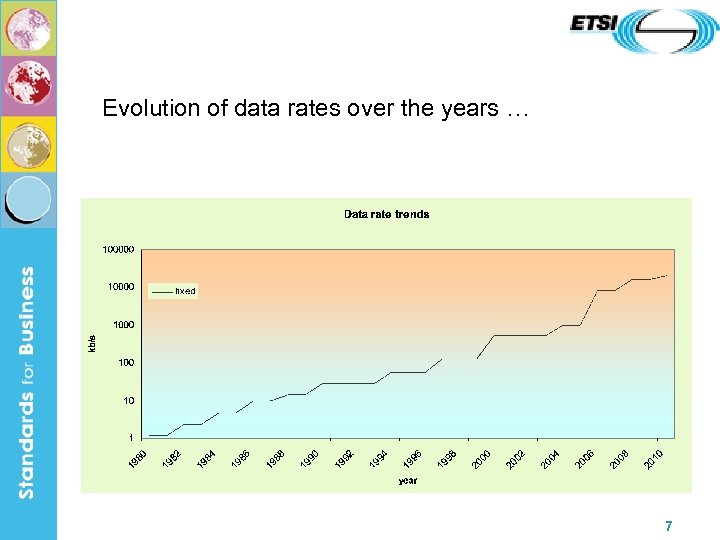
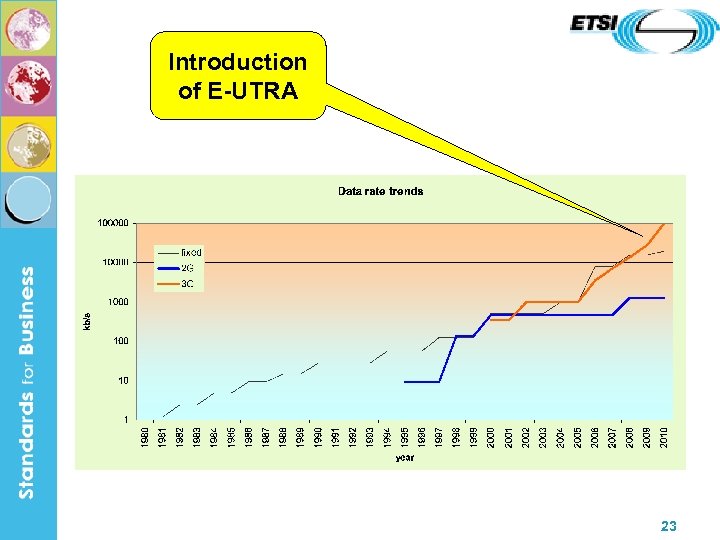
Evolution of data rates over the years … 7
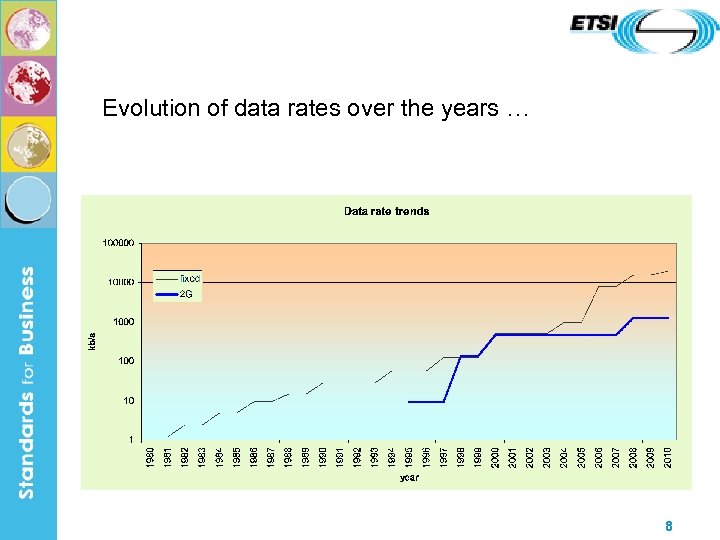
Evolution of data rates over the years … 8
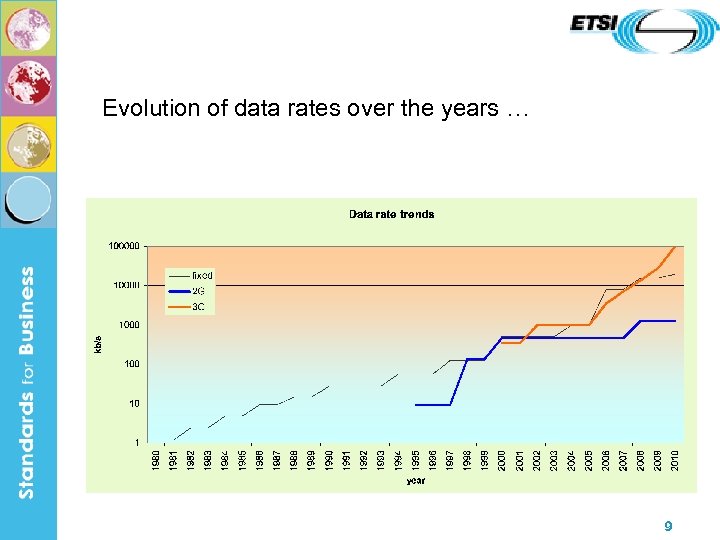
Evolution of data rates over the years … 9
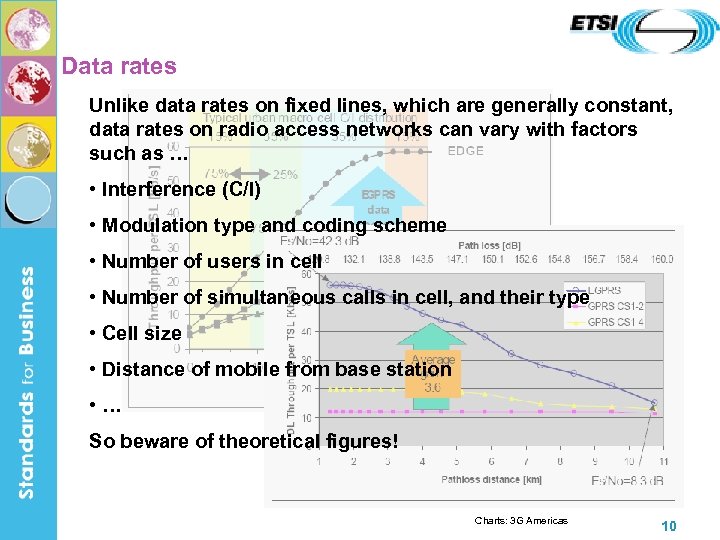
Data rates Unlike data rates on fixed lines, which are generally constant, data rates on radio access networks can vary with factors such as … • Interference (C/I) • Modulation type and coding scheme • Number of users in cell • Number of simultaneous calls in cell, and their type • Cell size • Distance of mobile from base station • … So beware of theoretical figures! Charts: 3 G Americas 10
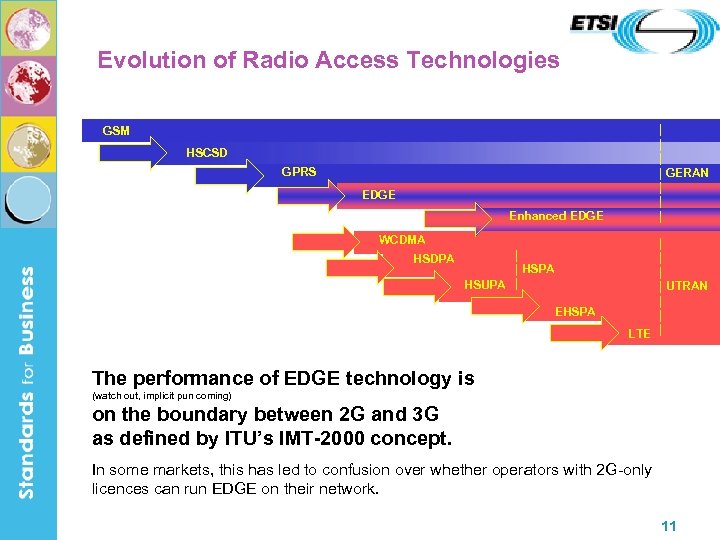
Evolution of Radio Access Technologies | | GERAN | | | GSM HSCSD GPRS EDGE Enhanced EDGE WCDMA | HSDPA | HSPA HSUPA | EHSPA | | UTRAN | | LTE | The performance of EDGE technology is (watch out, implicit pun coming) on the boundary between 2 G and 3 G as defined by ITU’s IMT-2000 concept. In some markets, this has led to confusion over whether operators with 2 G-only licences can run EDGE on their network. 11
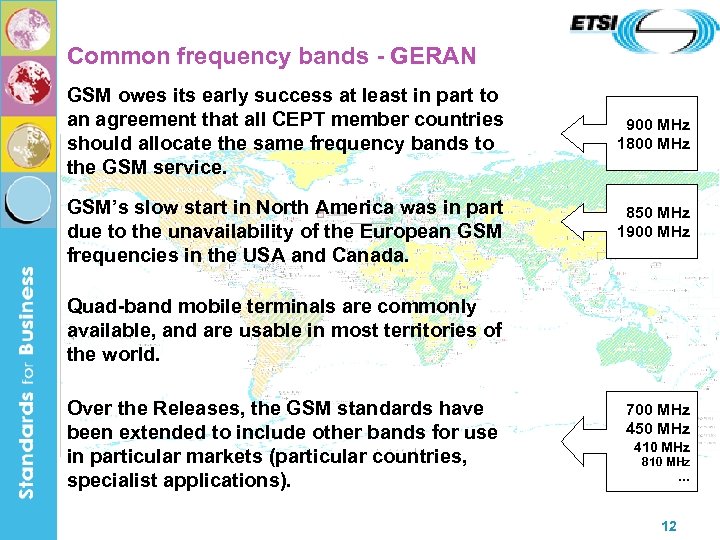
Common frequency bands - GERAN GSM owes its early success at least in part to an agreement that all CEPT member countries should allocate the same frequency bands to the GSM service. GSM’s slow start in North America was in part due to the unavailability of the European GSM frequencies in the USA and Canada. 900 MHz 1800 MHz 850 MHz 1900 MHz Quad-band mobile terminals are commonly available, and are usable in most territories of the world. Over the Releases, the GSM standards have been extended to include other bands for use in particular markets (particular countries, specialist applications). 700 MHz 450 MHz 410 MHz 810 MHz … 12
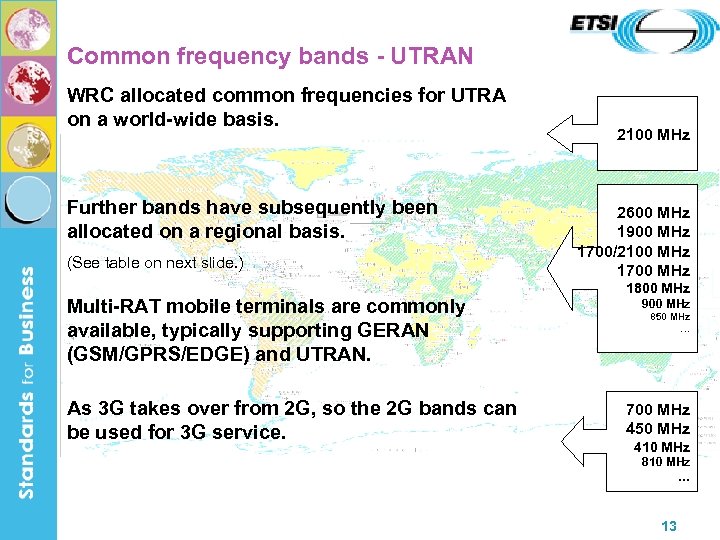
Common frequency bands - UTRAN WRC allocated common frequencies for UTRA on a world-wide basis. Further bands have subsequently been allocated on a regional basis. (See table on next slide. ) Multi-RAT mobile terminals are commonly available, typically supporting GERAN (GSM/GPRS/EDGE) and UTRAN. As 3 G takes over from 2 G, so the 2 G bands can be used for 3 G service. 2100 MHz 2600 MHz 1900 MHz 1700/2100 MHz 1700 MHz 1800 MHz 900 MHz 850 MHz … 700 MHz 450 MHz 410 MHz 810 MHz … 13
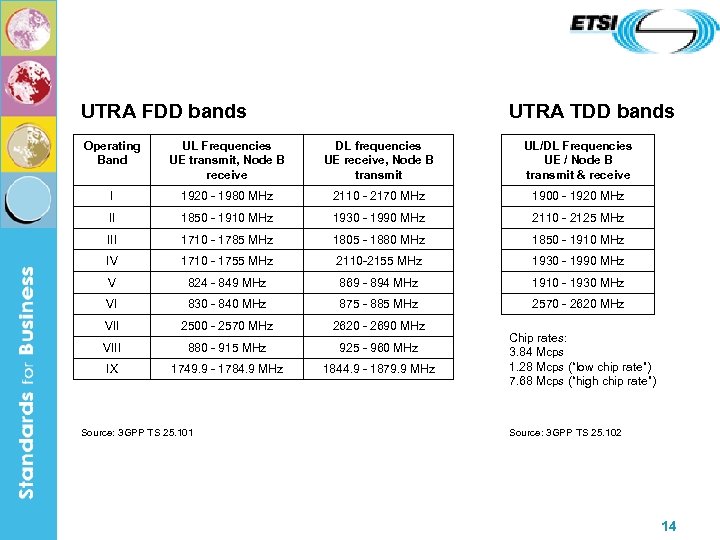
UTRA FDD bands UTRA TDD bands Operating Band UL Frequencies UE transmit, Node B receive DL frequencies UE receive, Node B transmit UL/DL Frequencies UE / Node B transmit & receive I 1920 - 1980 MHz 2110 - 2170 MHz 1900 - 1920 MHz II 1850 - 1910 MHz 1930 - 1990 MHz 2110 - 2125 MHz III 1710 - 1785 MHz 1805 - 1880 MHz 1850 - 1910 MHz IV 1710 - 1755 MHz 2110 -2155 MHz 1930 - 1990 MHz V 824 - 849 MHz 869 - 894 MHz 1910 - 1930 MHz VI 830 - 840 MHz 875 - 885 MHz 2570 - 2620 MHz VII 2500 - 2570 MHz 2620 - 2690 MHz VIII 880 - 915 MHz 925 - 960 MHz IX 1749. 9 - 1784. 9 MHz 1844. 9 - 1879. 9 MHz Source: 3 GPP TS 25. 101 Chip rates: 3. 84 Mcps 1. 28 Mcps (“low chip rate”) 7. 68 Mcps (“high chip rate”) Source: 3 GPP TS 25. 102 14
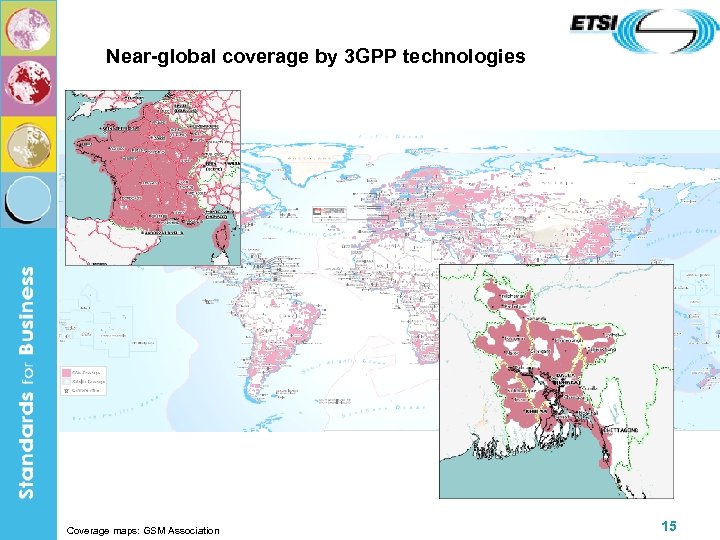
Near-global coverage by 3 GPP technologies Coverage maps: GSM Association 15
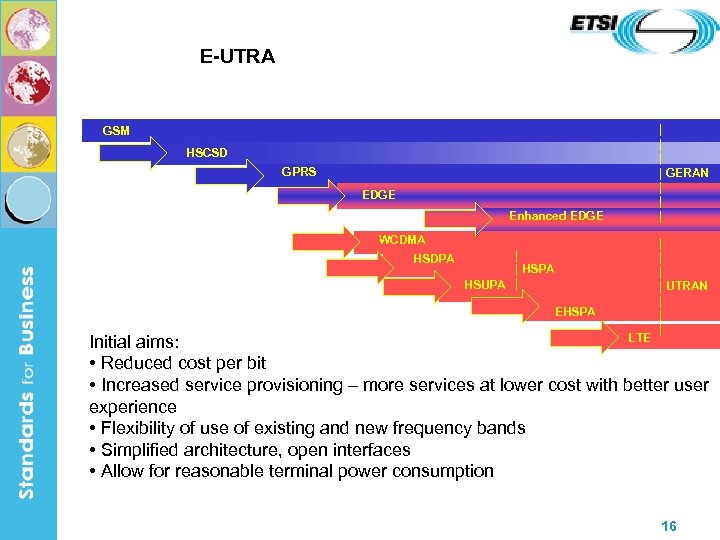
E-UTRA GSM HSCSD GPRS EDGE Enhanced EDGE WCDMA | HSDPA | HSPA HSUPA | EHSPA | | GERAN | | | | UTRAN | | | LTE Initial aims: • Reduced cost per bit • Increased service provisioning – more services at lower cost with better user experience • Flexibility of use of existing and new frequency bands • Simplified architecture, open interfaces • Allow for reasonable terminal power consumption 16
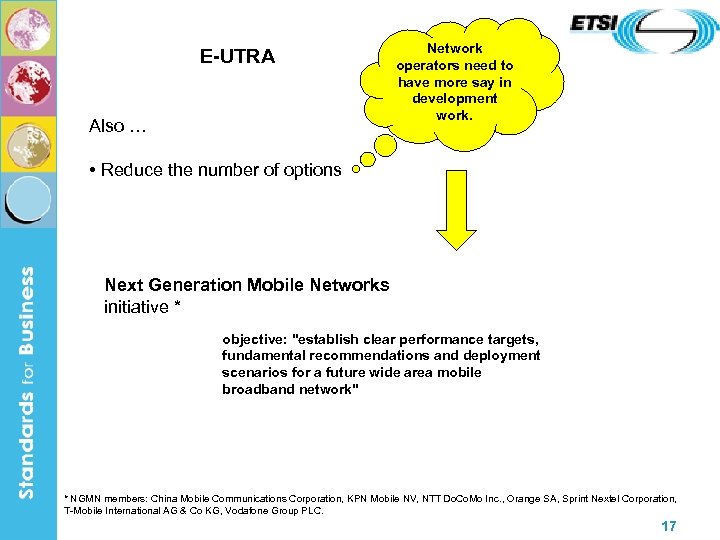
E-UTRA Also … Network operators need to have more say in development work. • Reduce the number of options Next Generation Mobile Networks initiative * objective: "establish clear performance targets, fundamental recommendations and deployment scenarios for a future wide area mobile broadband network" * NGMN members: China Mobile Communications Corporation, KPN Mobile NV, NTT Do. Co. Mo Inc. , Orange SA, Sprint Nextel Corporation, T-Mobile International AG & Co KG, Vodafone Group PLC. 17
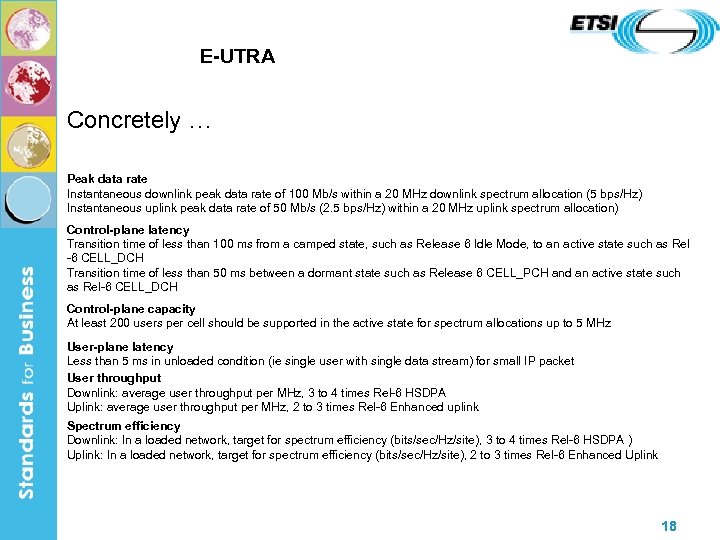
E-UTRA Concretely … Peak data rate Instantaneous downlink peak data rate of 100 Mb/s within a 20 MHz downlink spectrum allocation (5 bps/Hz) Instantaneous uplink peak data rate of 50 Mb/s (2. 5 bps/Hz) within a 20 MHz uplink spectrum allocation) Control-plane latency Transition time of less than 100 ms from a camped state, such as Release 6 Idle Mode, to an active state such as Rel -6 CELL_DCH Transition time of less than 50 ms between a dormant state such as Release 6 CELL_PCH and an active state such as Rel-6 CELL_DCH Control-plane capacity At least 200 users per cell should be supported in the active state for spectrum allocations up to 5 MHz User-plane latency Less than 5 ms in unloaded condition (ie single user with single data stream) for small IP packet User throughput Downlink: average user throughput per MHz, 3 to 4 times Rel-6 HSDPA Uplink: average user throughput per MHz, 2 to 3 times Rel-6 Enhanced uplink Spectrum efficiency Downlink: In a loaded network, target for spectrum efficiency (bits/sec/Hz/site), 3 to 4 times Rel-6 HSDPA ) Uplink: In a loaded network, target for spectrum efficiency (bits/sec/Hz/site), 2 to 3 times Rel-6 Enhanced Uplink 18
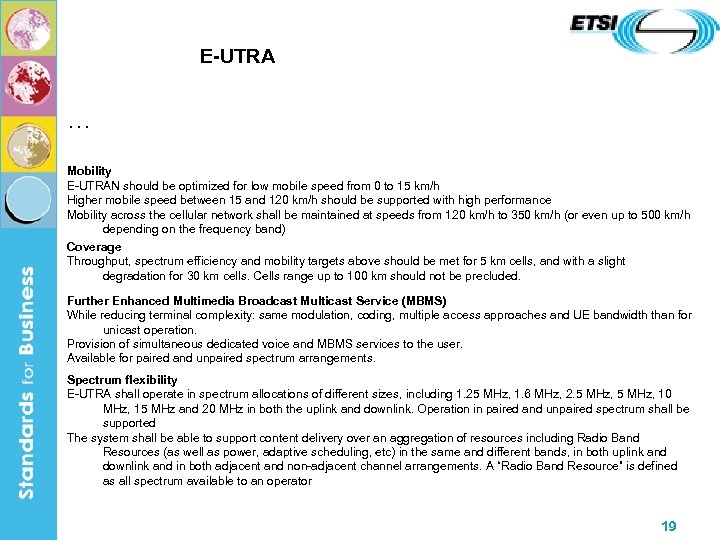
E-UTRA … Mobility E-UTRAN should be optimized for low mobile speed from 0 to 15 km/h Higher mobile speed between 15 and 120 km/h should be supported with high performance Mobility across the cellular network shall be maintained at speeds from 120 km/h to 350 km/h (or even up to 500 km/h depending on the frequency band) Coverage Throughput, spectrum efficiency and mobility targets above should be met for 5 km cells, and with a slight degradation for 30 km cells. Cells range up to 100 km should not be precluded. Further Enhanced Multimedia Broadcast Multicast Service (MBMS) While reducing terminal complexity: same modulation, coding, multiple access approaches and UE bandwidth than for unicast operation. Provision of simultaneous dedicated voice and MBMS services to the user. Available for paired and unpaired spectrum arrangements. Spectrum flexibility E-UTRA shall operate in spectrum allocations of different sizes, including 1. 25 MHz, 1. 6 MHz, 2. 5 MHz, 10 MHz, 15 MHz and 20 MHz in both the uplink and downlink. Operation in paired and unpaired spectrum shall be supported The system shall be able to support content delivery over an aggregation of resources including Radio Band Resources (as well as power, adaptive scheduling, etc) in the same and different bands, in both uplink and downlink and in both adjacent and non-adjacent channel arrangements. A “Radio Band Resource” is defined as all spectrum available to an operator 19
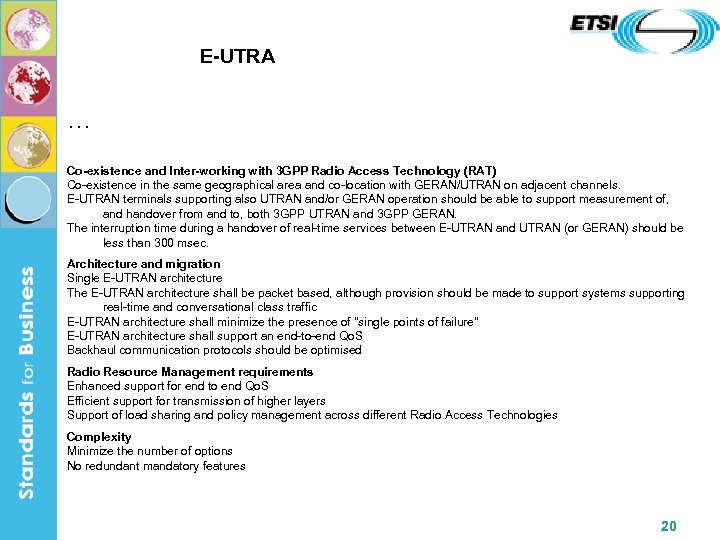
E-UTRA … Co-existence and Inter-working with 3 GPP Radio Access Technology (RAT) Co-existence in the same geographical area and co-location with GERAN/UTRAN on adjacent channels. E-UTRAN terminals supporting also UTRAN and/or GERAN operation should be able to support measurement of, and handover from and to, both 3 GPP UTRAN and 3 GPP GERAN. The interruption time during a handover of real-time services between E-UTRAN and UTRAN (or GERAN) should be less than 300 msec. Architecture and migration Single E-UTRAN architecture The E-UTRAN architecture shall be packet based, although provision should be made to support systems supporting real-time and conversational class traffic E-UTRAN architecture shall minimize the presence of "single points of failure" E-UTRAN architecture shall support an end-to-end Qo. S Backhaul communication protocols should be optimised Radio Resource Management requirements Enhanced support for end to end Qo. S Efficient support for transmission of higher layers Support of load sharing and policy management across different Radio Access Technologies Complexity Minimize the number of options No redundant mandatory features 20
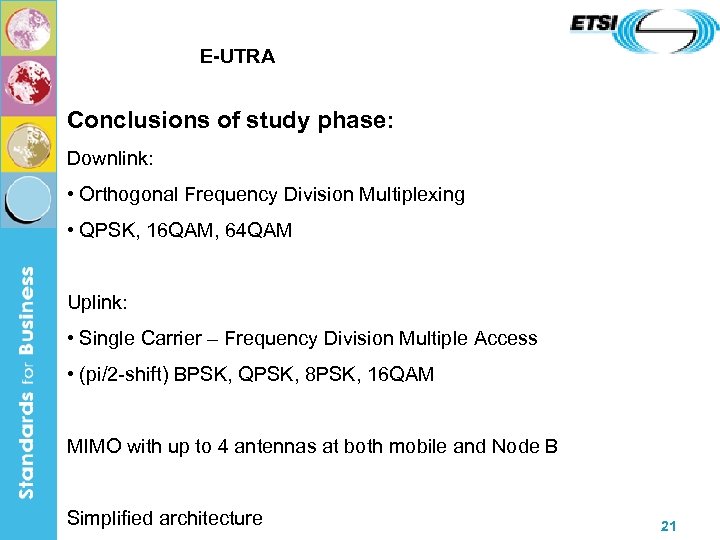
E-UTRA Conclusions of study phase: Downlink: • Orthogonal Frequency Division Multiplexing • QPSK, 16 QAM, 64 QAM Uplink: • Single Carrier – Frequency Division Multiple Access • (pi/2 -shift) BPSK, QPSK, 8 PSK, 16 QAM MIMO with up to 4 antennas at both mobile and Node B Simplified architecture 21
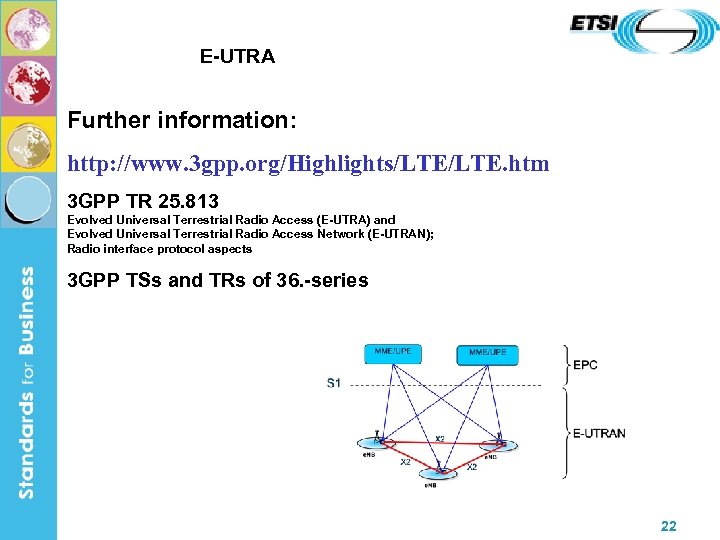
E-UTRA Further information: http: //www. 3 gpp. org/Highlights/LTE. htm 3 GPP TR 25. 813 Evolved Universal Terrestrial Radio Access (E-UTRA) and Evolved Universal Terrestrial Radio Access Network (E-UTRAN); Radio interface protocol aspects 3 GPP TSs and TRs of 36. -series 22
Introduction of E-UTRA 23
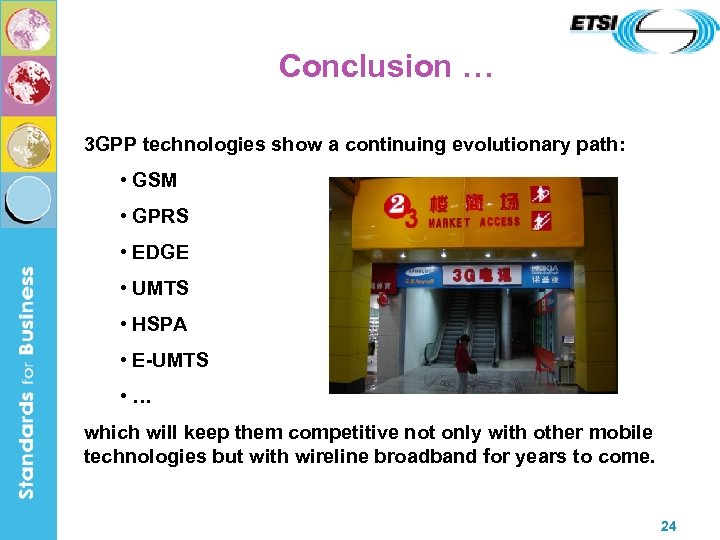
Conclusion … 3 GPP technologies show a continuing evolutionary path: • GSM • GPRS • EDGE • UMTS • HSPA • E-UMTS • … which will keep them competitive not only with other mobile technologies but with wireline broadband for years to come. 24
For more information… http: //www. 3 GPP. org or contact 3 GPPContact@etsi. org 25
and finally…. Thank you for your attention Now Time for your Questions 26
Скачать презентацию Broadband Russia CIS Summit 2006 Moscow 21
cb48d4b3abf65c3a7b3f91b00cd7c9be.ppt