 Скачать презентацию BRITISH ECONOMY QUICK FACTS 2014 Population 63 2
PoerPoint.BRITISH_ECONOMY.ppt
- Количество слайдов: 15



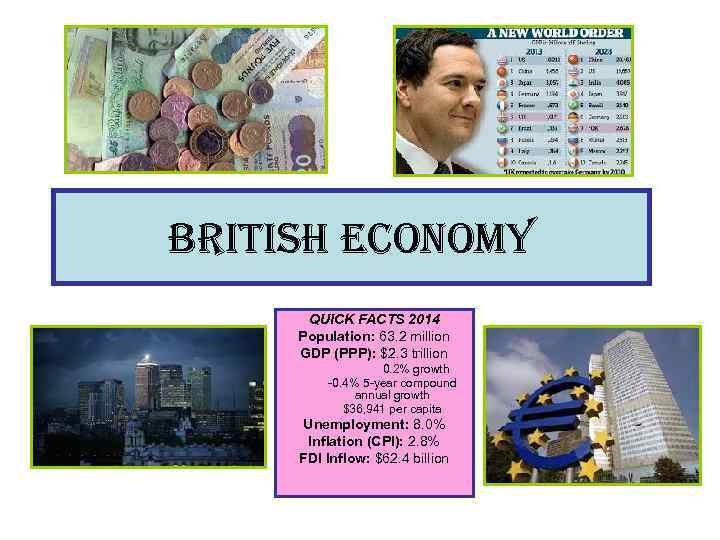
BRITISH ECONOMY QUICK FACTS 2014 Population: 63. 2 million GDP (PPP): $2. 3 trillion 0. 2% growth -0. 4% 5 -year compound annual growth $36, 941 per capita Unemployment: 8. 0% Inflation (CPI): 2. 8% FDI Inflow: $62. 4 billion
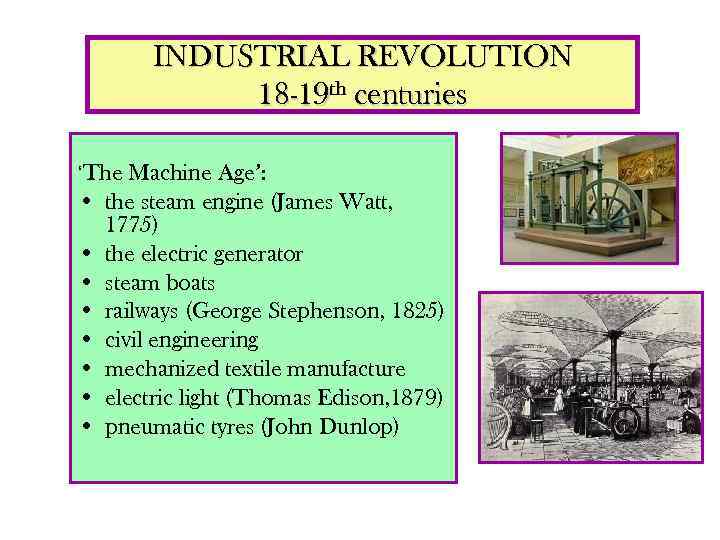
INDUSTRIAL REVOLUTION 18 -19 th centuries ‘The • • Machine Age’: the steam engine (James Watt, 1775) the electric generator steam boats railways (George Stephenson, 1825) civil engineering mechanized textile manufacture electric light (Thomas Edison, 1879) pneumatic tyres (John Dunlop)
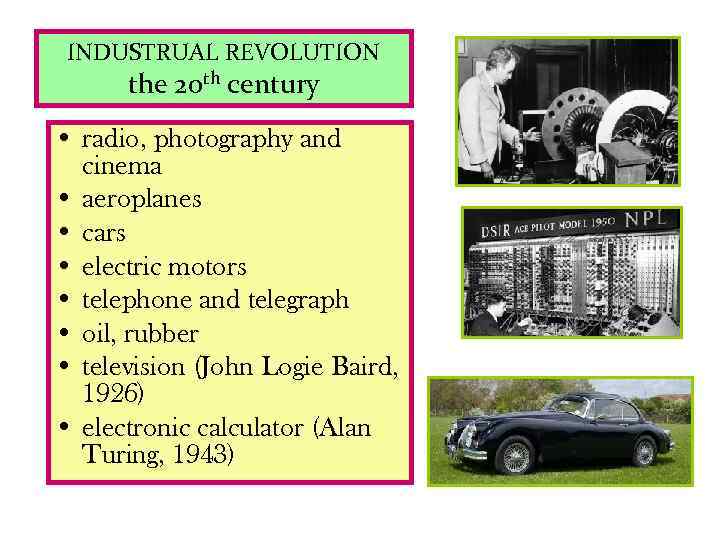
INDUSTRUAL REVOLUTION the 20 th century • radio, photography and cinema • aeroplanes • cars • electric motors • telephone and telegraph • oil, rubber • television (John Logie Baird, 1926) • electronic calculator (Alan Turing, 1943)
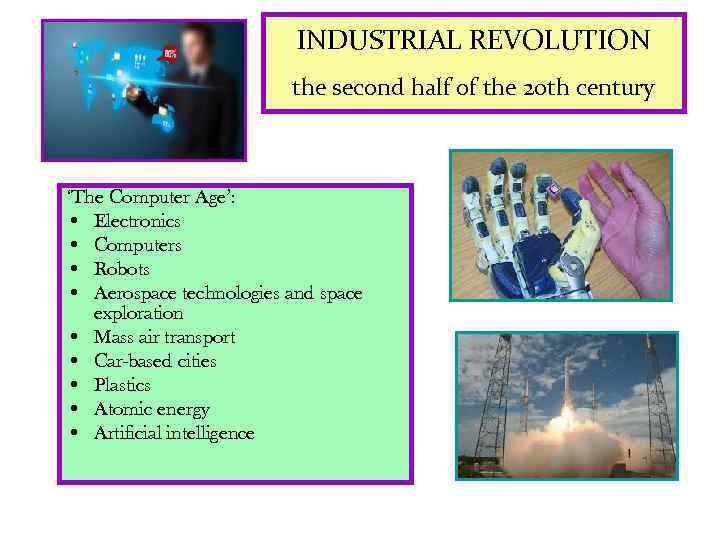
INDUSTRIAL REVOLUTION the second half of the 20 th century ‘The Computer Age’: • • • Electronics Computers Robots Aerospace technologies and space exploration Mass air transport Car-based cities Plastics Atomic energy Artificial intelligence
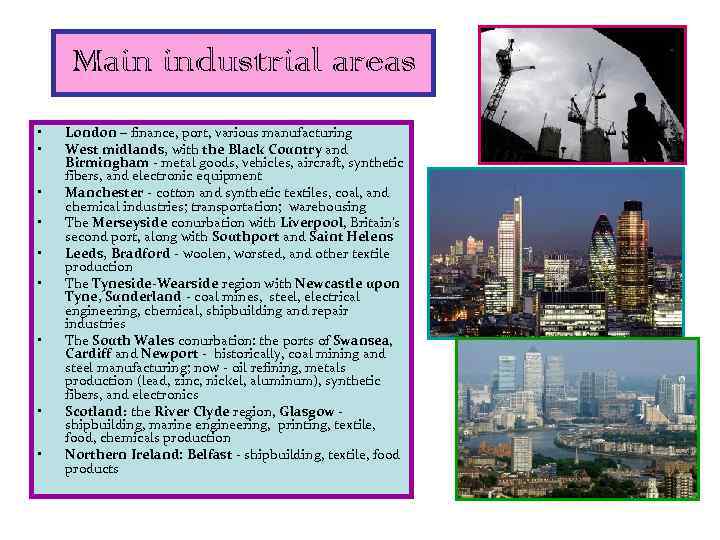
Main industrial areas • • • London – finance, port, various manufacturing West midlands, with the Black Country and Birmingham - metal goods, vehicles, aircraft, synthetic fibers, and electronic equipment Manchester - cotton and synthetic textiles, coal, and chemical industries; transportation; warehousing The Merseyside conurbation with Liverpool, Britain's second port, along with Southport and Saint Helens Leeds, Bradford - woolen, worsted, and other textile production The Tyneside-Wearside region with Newcastle upon Tyne, Sunderland - coal mines, steel, electrical engineering, chemical, shipbuilding and repair industries The South Wales conurbation: the ports of Swansea, Cardiff and Newport - historically, coal mining and steel manufacturing; now - oil refining, metals production (lead, zinc, nickel, aluminum), synthetic fibers, and electronics Scotland: the River Clyde region, Glasgow - shipbuilding, marine engineering, printing, textile, food, chemicals production Northern Ireland: Belfast - shipbuilding, textile, food products
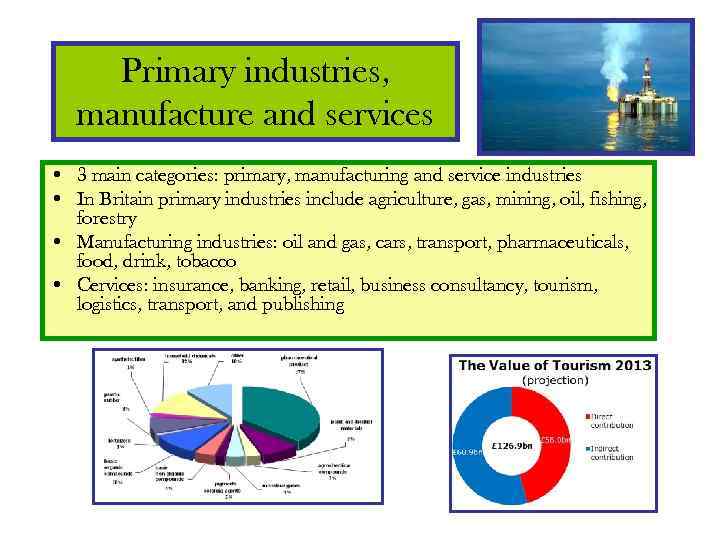
Primary industries, manufacture and services • 3 main categories: primary, manufacturing and service industries • In Britain primary industries include agriculture, gas, mining, oil, fishing, forestry • Manufacturing industries: oil and gas, cars, transport, pharmaceuticals, food, drink, tobacco • Cervices: insurance, banking, retail, business consultancy, tourism, logistics, transport, and publishing
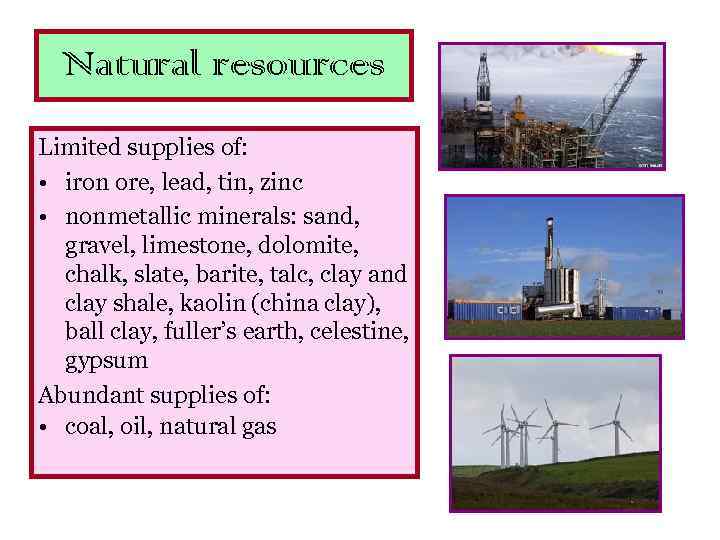
Natural resources Limited supplies of: • iron ore, lead, tin, zinc • nonmetallic minerals: sand, gravel, limestone, dolomite, chalk, slate, barite, talc, clay and clay shale, kaolin (china clay), ball clay, fuller’s earth, celestine, gypsum Abundant supplies of: • coal, oil, natural gas
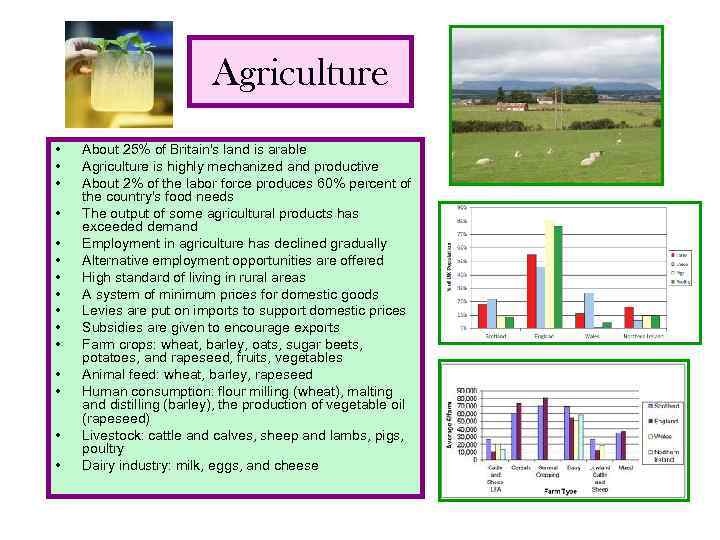
Agriculture • • • • About 25% of Britain's land is arable Agriculture is highly mechanized and productive About 2% of the labor force produces 60% percent of the country's food needs The output of some agricultural products has exceeded demand Employment in agriculture has declined gradually Alternative employment opportunities are offered High standard of living in rural areas A system of minimum prices for domestic goods Levies are put on imports to support domestic prices Subsidies are given to encourage exports Farm crops: wheat, barley, oats, sugar beets, potatoes, and rapeseed, fruits, vegetables Animal feed: wheat, barley, rapeseed Human consumption: flour milling (wheat), malting and distilling (barley), the production of vegetable oil (rapeseed) Livestock: cattle and calves, sheep and lambs, pigs, poultry Dairy industry: milk, eggs, and cheese
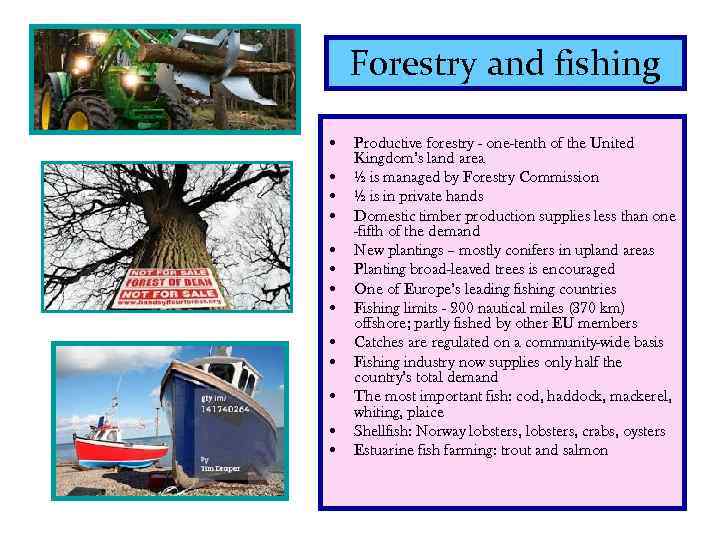
Forestry and fishing • Productive forestry - one-tenth of the United Kingdom’s land area • ½ is managed by Forestry Commission • ½ is in private hands • Domestic timber production supplies less than one -fifth of the demand • New plantings – mostly conifers in upland areas • Planting broad-leaved trees is encouraged • One of Europe’s leading fishing countries • Fishing limits - 200 nautical miles (370 km) offshore; partly fished by other EU members • Catches are regulated on a community-wide basis • Fishing industry now supplies only half the country’s total demand • The most important fish: cod, haddock, mackerel, whiting, plaice • Shellfish: Norway lobsters, crabs, oysters • Estuarine fish farming: trout and salmon
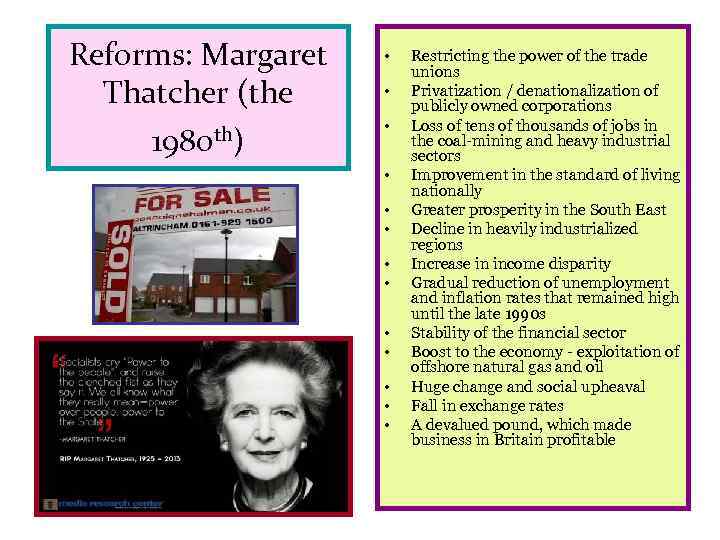
Reforms: Margaret Thatcher (the 1980 th) • • • • Restricting the power of the trade unions Privatization / denationalization of publicly owned corporations Loss of tens of thousands of jobs in the coal-mining and heavy industrial sectors Improvement in the standard of living nationally Greater prosperity in the South East Decline in heavily industrialized regions Increase in income disparity Gradual reduction of unemployment and inflation rates that remained high until the late 1990 s Stability of the financial sector Boost to the economy - exploitation of offshore natural gas and oil Huge change and social upheaval Fall in exchange rates A devalued pound, which made business in Britain profitable
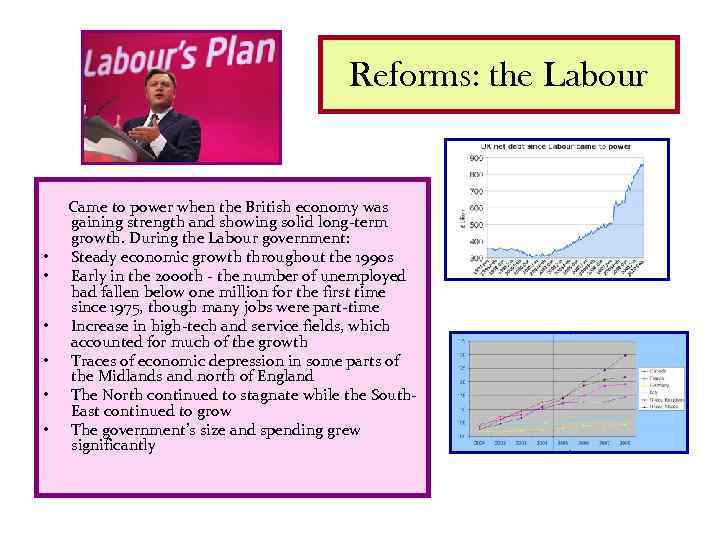
Reforms: the Labour Came to power when the British economy was gaining strength and showing solid long-term growth. During the Labour government: • Steady economic growth throughout the 1990 s • Early in the 2000 th - the number of unemployed had fallen below one million for the first time since 1975, though many jobs were part-time • Increase in high-tech and service fields, which accounted for much of the growth • Traces of economic depression in some parts of the Midlands and north of England • The North continued to stagnate while the South. East continued to grow • The government’s size and spending grew significantly
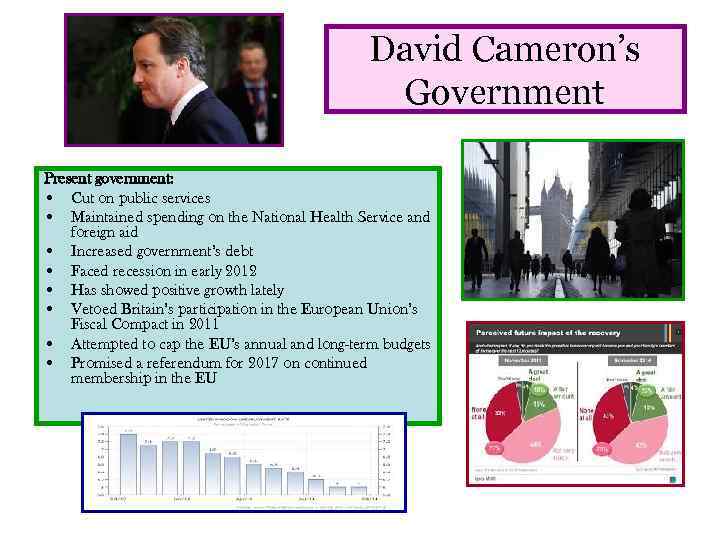
David Cameron’s Government Present government: • Cut on public services • Maintained spending on the National Health Service and foreign aid • Increased government’s debt • Faced recession in early 2012 • Has showed positive growth lately • Vetoed Britain’s participation in the European Union’s Fiscal Compact in 2011 • Attempted to cap the EU’s annual and long-term budgets • Promised a referendum for 2017 on continued membership in the EU
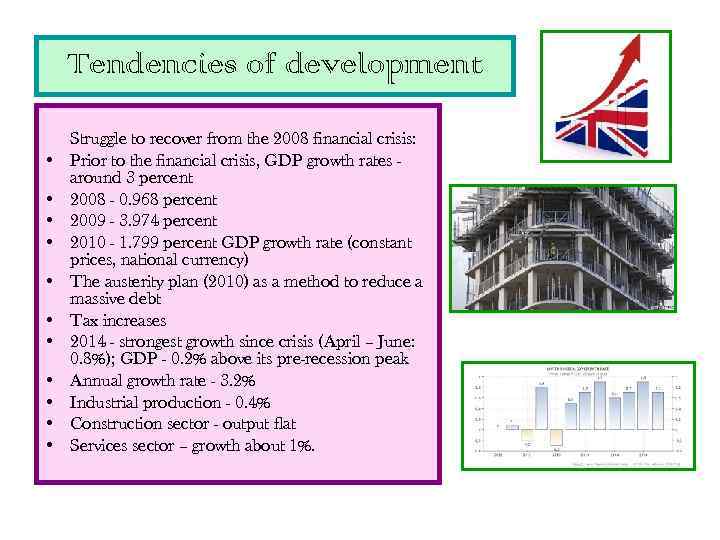
Tendencies of development • • • Struggle to recover from the 2008 financial crisis: Prior to the financial crisis, GDP growth rates around 3 percent 2008 - 0. 968 percent 2009 - 3. 974 percent 2010 - 1. 799 percent GDP growth rate (constant prices, national currency) The austerity plan (2010) as a method to reduce a massive debt Tax increases 2014 - strongest growth since crisis (April – June: 0. 8%); GDP - 0. 2% above its pre-recession peak Annual growth rate - 3. 2% Industrial production - 0. 4% Construction sector - output flat Services sector – growth about 1%.
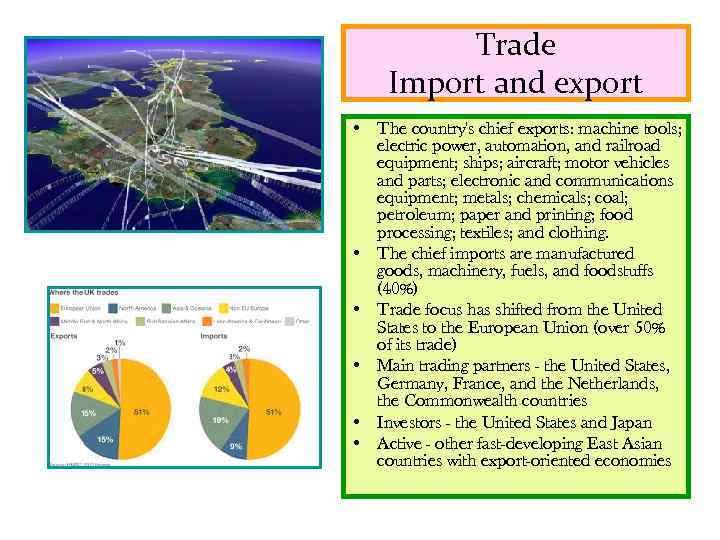
Trade Import and export • The country's chief exports: machine tools; electric power, automation, and railroad equipment; ships; aircraft; motor vehicles and parts; electronic and communications equipment; metals; chemicals; coal; petroleum; paper and printing; food processing; textiles; and clothing. • The chief imports are manufactured goods, machinery, fuels, and foodstuffs (40%) • Trade focus has shifted from the United States to the European Union (over 50% of its trade) • Main trading partners - the United States, Germany, France, and the Netherlands, the Commonwealth countries • Investors - the United States and Japan • Active - other fast-developing East Asian countries with export-oriented economies
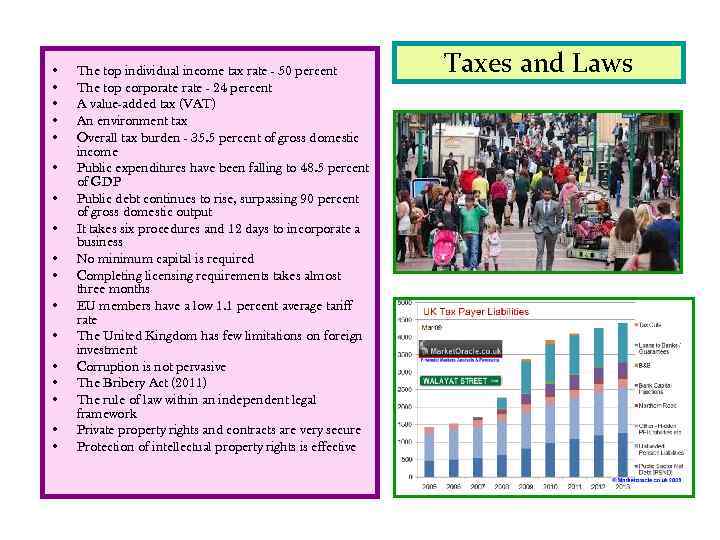
• • • • • The top individual income tax rate - 50 percent The top corporate - 24 percent A value-added tax (VAT) An environment tax Overall tax burden - 35. 5 percent of gross domestic income Public expenditures have been falling to 48. 5 percent of GDP Public debt continues to rise, surpassing 90 percent of gross domestic output It takes six procedures and 12 days to incorporate a business No minimum capital is required Completing licensing requirements takes almost three months EU members have a low 1. 1 percent average tariff rate The United Kingdom has few limitations on foreign investment Corruption is not pervasive The Bribery Act (2011) The rule of law within an independent legal framework Private property rights and contracts are very secure Protection of intellectual property rights is effective Taxes and Laws
Скачать презентацию BRITISH ECONOMY QUICK FACTS 2014 Population 63 2
PoerPoint.BRITISH_ECONOMY.ppt