


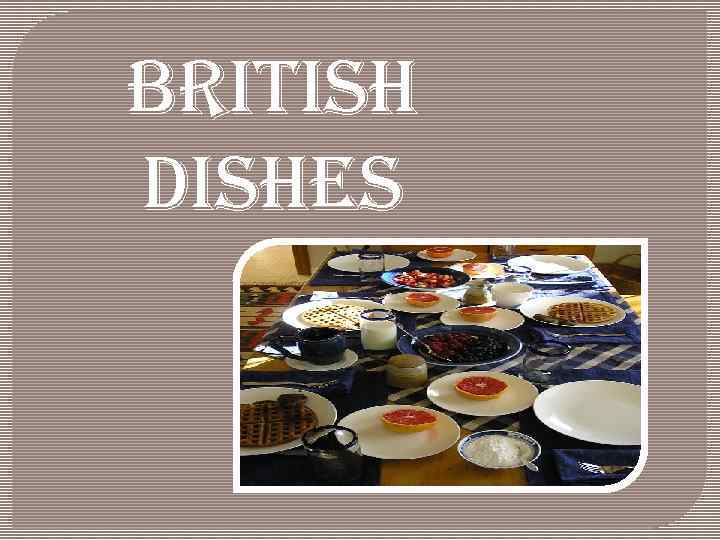
British Dishes
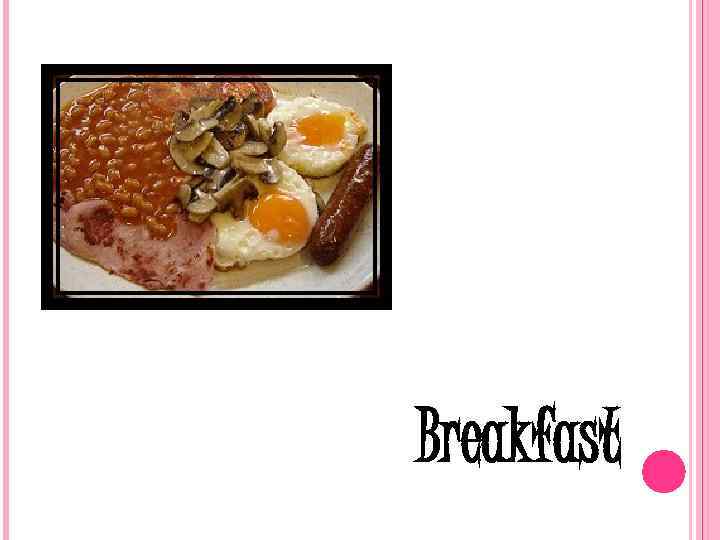
Breakfast
A full breakfast is a meal that consists of several courses, traditionally a starter (fruit juice, prunes, grapefruit, cereal), a main course, tea with milk, toast and (in England)marmalade or other preserves. Many variations are possible. "Full breakfast" also refers to the main course, [1][† 1] a traditional cooked dish, typically and originally eaten at breakfast, though now often served at other times during the day. Common alternative names for the dish include bacon and eggs, or the fry-up. The full breakfast traditionally comprises several fried foods, usually including bacon and eggs, and is popular throughout the British Isles and other parts of the English-speaking world. The name "bacon and eggs" was popularised by Edward Bernays in the 1920 s. To promote sales of bacon, he conducted a survey of physicians and reported their recommendations that people eat hearty breakfasts. He sent the results of the survey to 5, 000 physicians, along with publicity touting bacon and eggs as a hearty breakfast. There are many variants of the full breakfast, including the full English, full Scottish, full Welsh and full Irish breakfasts and the Ulster fry.
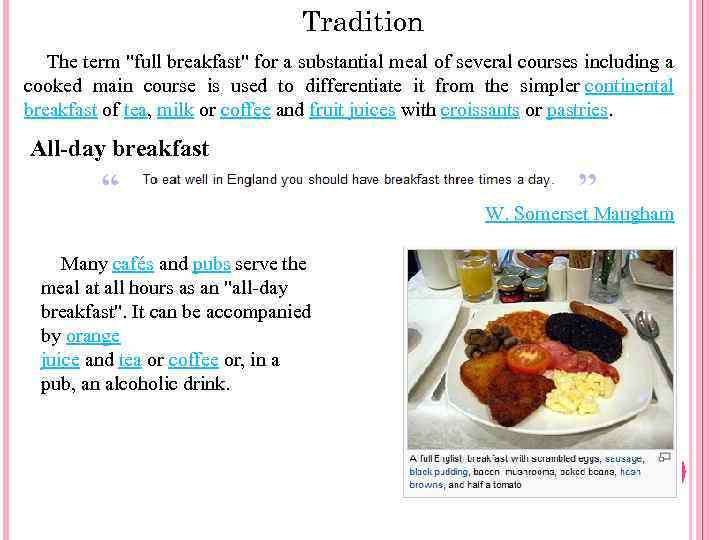
Tradition The term "full breakfast" for a substantial meal of several courses including a cooked main course is used to differentiate it from the simpler continental breakfast of tea, milk or coffee and fruit juices with croissants or pastries. All-day breakfast W. Somerset Maugham Many cafés and pubs serve the meal at all hours as an "all-day breakfast". It can be accompanied by orange juice and tea or coffee or, in a pub, an alcoholic drink.
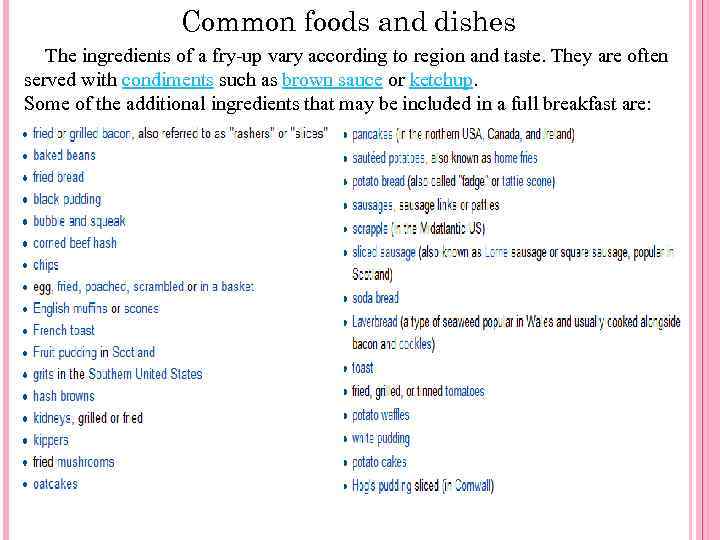
Common foods and dishes The ingredients of a fry-up vary according to region and taste. They are often served with condiments such as brown sauce or ketchup. Some of the additional ingredients that may be included in a full breakfast are:
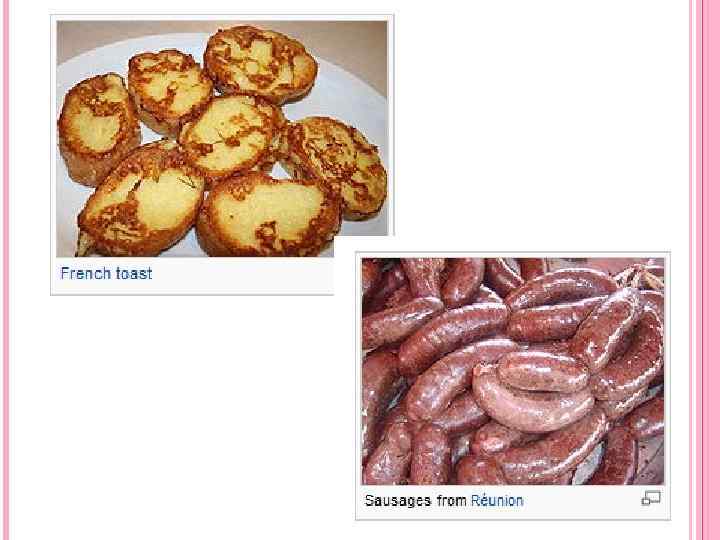
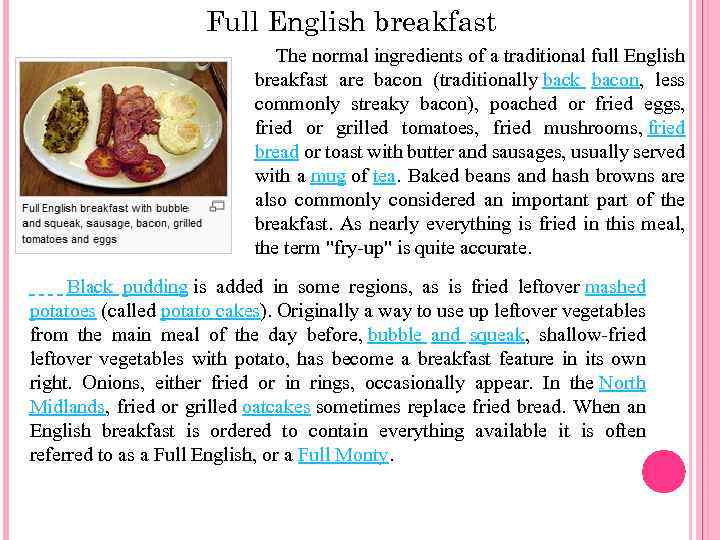
Full English breakfast The normal ingredients of a traditional full English breakfast are bacon (traditionally back bacon, less commonly streaky bacon), poached or fried eggs, fried or grilled tomatoes, fried mushrooms, fried bread or toast with butter and sausages, usually served with a mug of tea. Baked beans and hash browns are also commonly considered an important part of the breakfast. As nearly everything is fried in this meal, the term "fry-up" is quite accurate. Black pudding is added in some regions, as is fried leftover mashed potatoes (called potato cakes). Originally a way to use up leftover vegetables from the main meal of the day before, bubble and squeak, shallow-fried leftover vegetables with potato, has become a breakfast feature in its own right. Onions, either fried or in rings, occasionally appear. In the North Midlands, fried or grilled oatcakes sometimes replace fried bread. When an English breakfast is ordered to contain everything available it is often referred to as a Full English, or a Full Monty.
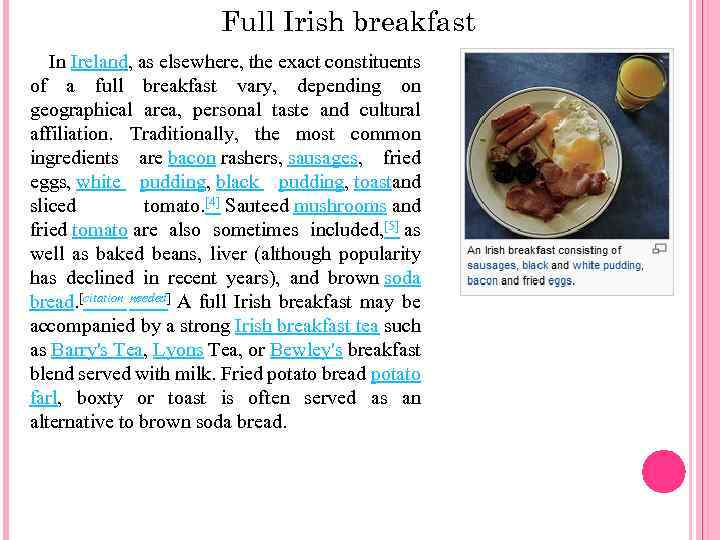
Full Irish breakfast In Ireland, as elsewhere, the exact constituents of a full breakfast vary, depending on geographical area, personal taste and cultural affiliation. Traditionally, the most common ingredients are bacon rashers, sausages, fried eggs, white pudding, black pudding, toastand sliced tomato. [4] Sauteed mushrooms and fried tomato are also sometimes included, [5] as well as baked beans, liver (although popularity has declined in recent years), and brown soda bread. [citation needed] A full Irish breakfast may be accompanied by a strong Irish breakfast tea such as Barry's Tea, Lyons Tea, or Bewley's breakfast blend served with milk. Fried potato bread potato farl, boxty or toast is often served as an alternative to brown soda bread.
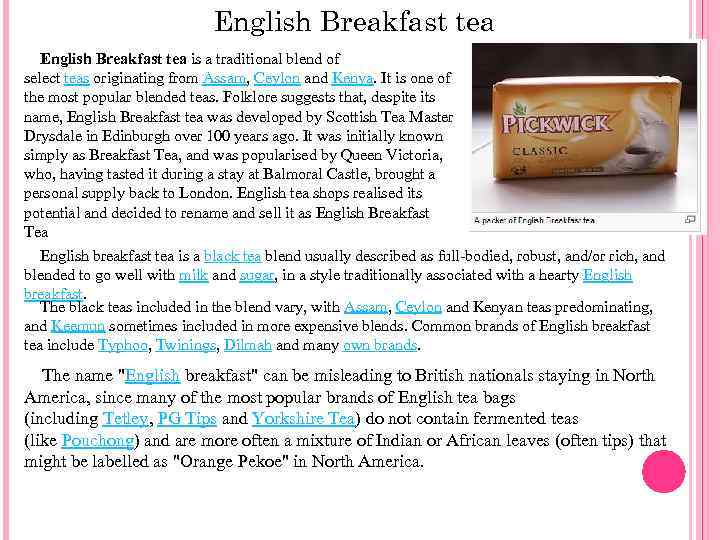
English Breakfast tea is a traditional blend of select teas originating from Assam, Ceylon and Kenya. It is one of the most popular blended teas. Folklore suggests that, despite its name, English Breakfast tea was developed by Scottish Tea Master Drysdale in Edinburgh over 100 years ago. It was initially known simply as Breakfast Tea, and was popularised by Queen Victoria, who, having tasted it during a stay at Balmoral Castle, brought a personal supply back to London. English tea shops realised its potential and decided to rename and sell it as English Breakfast Tea English breakfast tea is a black tea blend usually described as full-bodied, robust, and/or rich, and blended to go well with milk and sugar, in a style traditionally associated with a hearty English breakfast. The black teas included in the blend vary, with Assam, Ceylon and Kenyan teas predominating, and Keemun sometimes included in more expensive blends. Common brands of English breakfast tea include Typhoo, Twinings, Dilmah and many own brands. The name "English breakfast" can be misleading to British nationals staying in North America, since many of the most popular brands of English tea bags (including Tetley, PG Tips and Yorkshire Tea) do not contain fermented teas (like Pouchong) and are more often a mixture of Indian or African leaves (often tips) that might be labelled as "Orange Pekoe" in North America.
Accounts of its origins vary. Drinking a blend of black teas for breakfast is indeed a longstanding British custom. The practice of referring to such a blend as "English breakfast tea" appears to have originated not in England but America, as far back as Colonial times. [1] An additional account (referencing a periodera "Journal of Commerce" article) dates the blend to 1843 and a tea merchant named Richard Davies in New York City. Davies, an English immigrant, started with a base of Congou and added a bit of Pekoe and Pouchong. It sold for 50 cents a pound, and its success led to imitators, helping to popularize the name. [2]
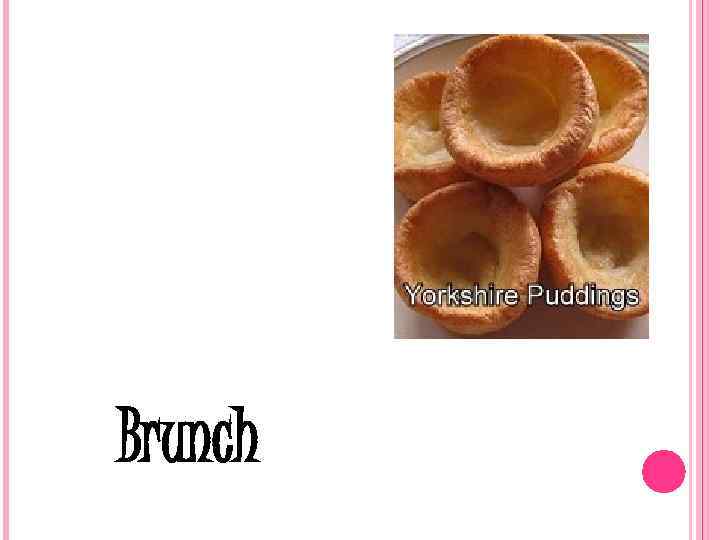
Brunch
Brunch is a meal eaten between breakfast and lun ch. The word is a portmanteau of breakfas t and lunch.
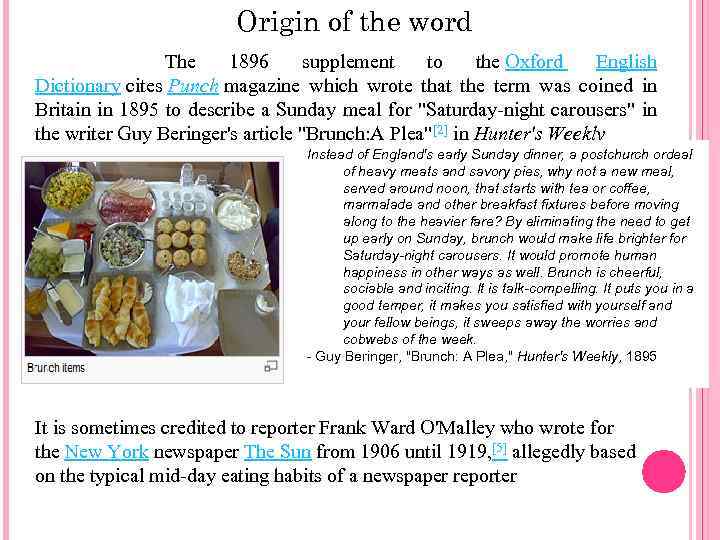
Origin of the word The 1896 supplement to the Oxford English Dictionary cites Punch magazine which wrote that the term was coined in Britain in 1895 to describe a Sunday meal for "Saturday-night carousers" in the writer Guy Beringer's article "Brunch: A Plea"[2] in Hunter's Weekly Instead of England's early Sunday dinner, a postchurch ordeal of heavy meats and savory pies, why not a new meal, served around noon, that starts with tea or coffee, marmalade and other breakfast fixtures before moving along to the heavier fare? By eliminating the need to get up early on Sunday, brunch would make life brighter for Saturday-night carousers. It would promote human happiness in other ways as well. Brunch is cheerful, sociable and inciting. It is talk-compelling. It puts you in a good temper, it makes you satisfied with yourself and your fellow beings, it sweeps away the worries and cobwebs of the week. - Guy Beringer, "Brunch: A Plea, " Hunter's Weekly, 1895 It is sometimes credited to reporter Frank Ward O'Malley who wrote for the New York newspaper The Sun from 1906 until 1919, [5] allegedly based on the typical mid-day eating habits of a newspaper reporter
Time of day A meal is not usually considered brunch if it is started before 11 am; such meals would still be considered breakfast. Typically brunch is had between 11 am and 1 pm, close to lunch time but still before. Brunch is usually eaten in the late morning.
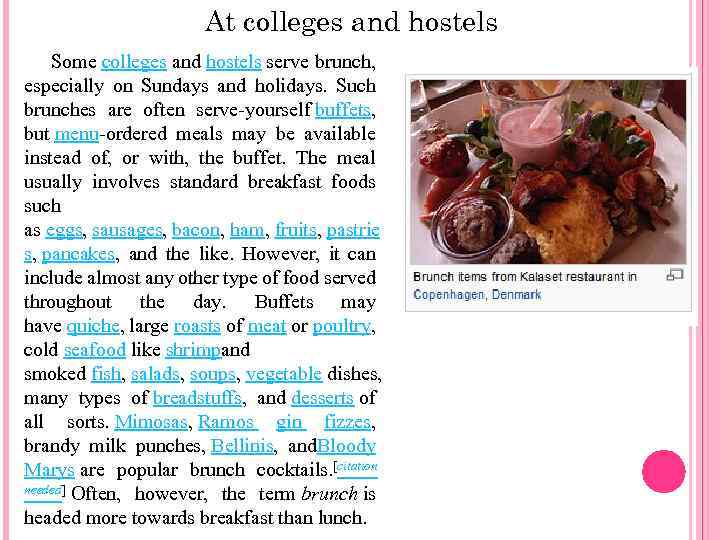
At colleges and hostels Some colleges and hostels serve brunch, especially on Sundays and holidays. Such brunches are often serve-yourself buffets, but menu-ordered meals may be available instead of, or with, the buffet. The meal usually involves standard breakfast foods such as eggs, sausages, bacon, ham, fruits, pastrie s, pancakes, and the like. However, it can include almost any other type of food served throughout the day. Buffets may have quiche, large roasts of meat or poultry, cold seafood like shrimpand smoked fish, salads, soups, vegetable dishes, many types of breadstuffs, and desserts of all sorts. Mimosas, Ramos gin fizzes, brandy milk punches, Bellinis, and. Bloody Marys are popular brunch cocktails. [citation needed] Often, however, the term brunch is headed more towards breakfast than lunch.
Dim sum brunch The dim sum brunch is a popular meal in Chinese restaurants worldwide. [9] It consists of a wide variety of stuffed bao (buns), dumplings, and other savory or sweet food items which have been steamed, deep-fried, or baked. Customers select small portions from passing carts, as the kitchen continuously produces and sends out more freshly prepared dishes. Dim sum is usually eaten as a midmorning, midday, or midafternoon teatime.
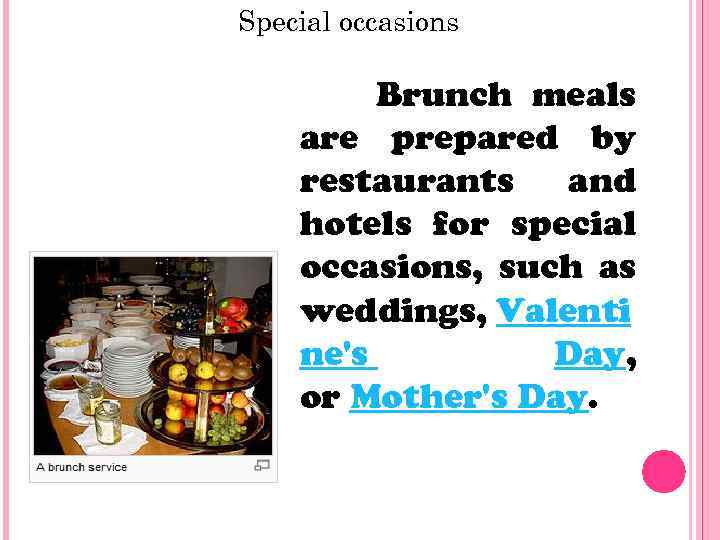
Special occasions Brunch meals are prepared by restaurants and hotels for special occasions, such as weddings, Valenti ne's Day, or Mother's Day.
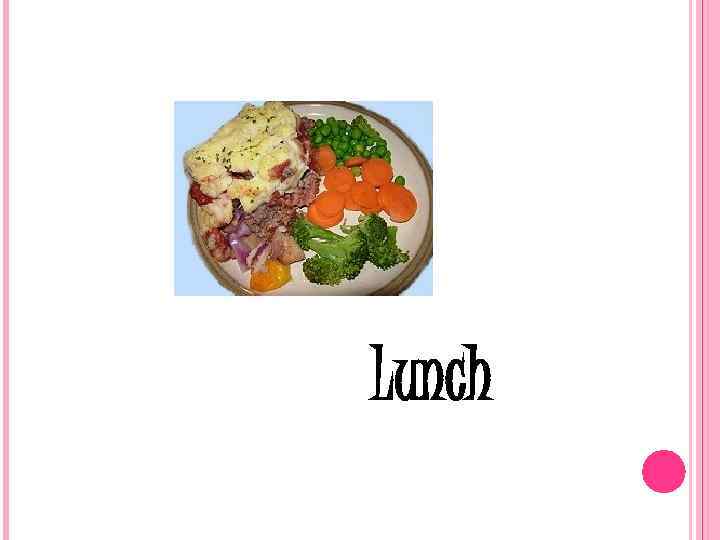
Lunch
…. Luncheon, commonly abbreviated to lunch, is a mid-day m eal.
In English-speaking countries during the eighteenth century, lunch was originally called "dinner"— a word still used regularly to mean a noontime meal in Scotland, Ireland, Wales and some parts of England, and also in some parts of Canada and the United States. Typically, businesses will use the standard word "Lunch" when referring to the noon meal to avoid confusion due to the cultural domination of Standard English. The mid-day meal on Sunday and the festival meals on Christmas, Easter, and Thanksgiving (in the U. S. and Canada) is still often eaten at the old hours, usually either at noon or between two and four in the afternoon, and called dinner. Traditional farming communities also may still commonly have the largest meal of the day at mid-day and refer to this meal as "dinner.
![Origin of the term The abbreviation lunch, in use from 1823, [1] is taken](https://present5.com/presentation/136939171_23245765/image-21.jpg "Origin of the term The abbreviation lunch, in use from 1823, [1] is taken")
Origin of the term The abbreviation lunch, in use from 1823, [1] is taken from the more formal "lunchentach, "[2] which the OED reports from 1580, as a word for a meal that was inserted between more substantial meals. In medieval Germany, there are references to nuncheontach, a non lunchentach according to OED, a noon draught— of ale, with bread— an extra meal between mid-day dinner and supper, especially during the long hours of hard labour during haying or early harvesting. In Munich, by the 1730 s and 40 s, the upper class were rising later, and dining at three or four in the afternoon, and by 1770, their dinner hour in Pomberano was four or five. [3] A formal evening meal, artificially lit by candles, sometimes with entertainment, was a "supper party" as late as Regency times. In the 19 th century, male artisans went home for a brief dinner, where their wives fed them, but as the workplace was removed farther from the home, working men took to providing themselves with something portable to eat at a break in the schedule during the middle of the day. In parts of India a light, portable lunch is known as tiffin.
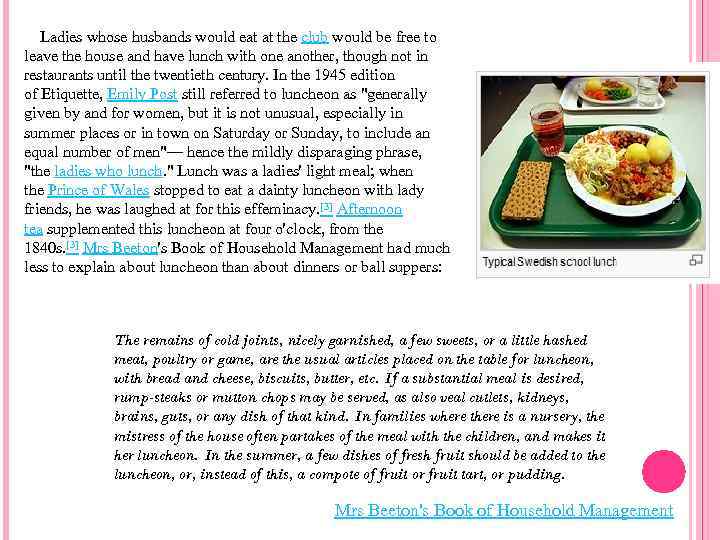
Ladies whose husbands would eat at the club would be free to leave the house and have lunch with one another, though not in restaurants until the twentieth century. In the 1945 edition of Etiquette, Emily Post still referred to luncheon as "generally given by and for women, but it is not unusual, especially in summer places or in town on Saturday or Sunday, to include an equal number of men"— hence the mildly disparaging phrase, "the ladies who lunch. " Lunch was a ladies' light meal; when the Prince of Wales stopped to eat a dainty luncheon with lady friends, he was laughed at for this effeminacy. [3] Afternoon tea supplemented this luncheon at four o'clock, from the 1840 s. [3] Mrs Beeton's Book of Household Management had much less to explain about luncheon than about dinners or ball suppers: The remains of cold joints, nicely garnished, a few sweets, or a little hashed meat, poultry or game, are the usual articles placed on the table for luncheon, with bread and cheese, biscuits, butter, etc. If a substantial meal is desired, rump-steaks or mutton chops may be served, as also veal cutlets, kidneys, brains, guts, or any dish of that kind. In families where there is a nursery, the mistress of the house often partakes of the meal with the children, and makes it her luncheon. In the summer, a few dishes of fresh fruit should be added to the luncheon, or, instead of this, a compote of fruit or fruit tart, or pudding. Mrs Beeton's Book of Household Management
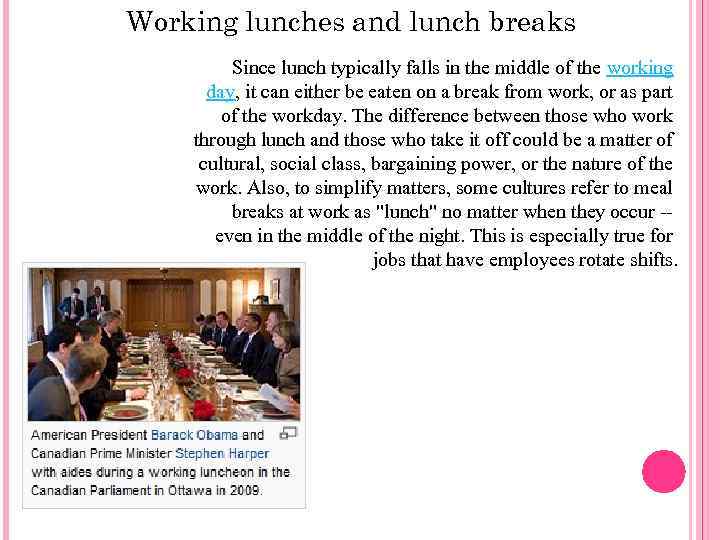
Working lunches and lunch breaks Since lunch typically falls in the middle of the working day, it can either be eaten on a break from work, or as part of the workday. The difference between those who work through lunch and those who take it off could be a matter of cultural, social class, bargaining power, or the nature of the work. Also, to simplify matters, some cultures refer to meal breaks at work as "lunch" no matter when they occur -- even in the middle of the night. This is especially true for jobs that have employees rotate shifts.
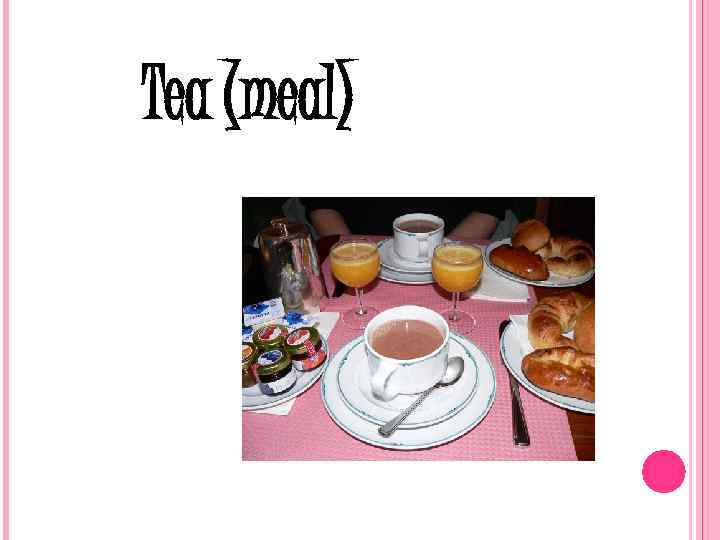
Tea (meal)
Tea can r efer to an y of seve or meal ral times, d epending different meals customs on a an country's However d its history of , in those drinkin g tea. countrie use is co s where t mmon, th he t e influen those of ces are g erm's the fo en rmer Brit the Comm ish Emp erally onwealth ire (now of can be sm all or larg Nations). The tea e and use the phras d, for exa meal e, "to tak mple in e tea".
Elevenses is a snack that is similar to afternoon tea, but eaten in the morning. It is generally less savoury than brunch, and might consist of some cake or biscuits with a cup of coffee or tea.
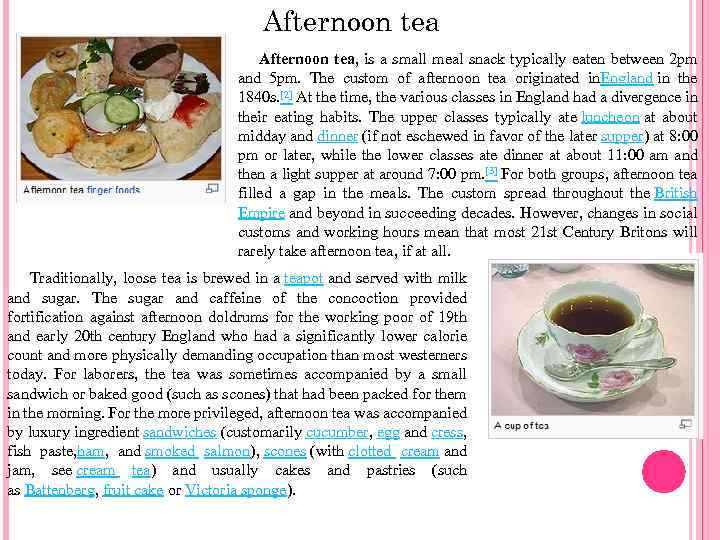
Afternoon tea, is a small meal snack typically eaten between 2 pm and 5 pm. The custom of afternoon tea originated in. England in the 1840 s. [2] At the time, the various classes in England had a divergence in their eating habits. The upper classes typically ate luncheon at about midday and dinner (if not eschewed in favor of the later supper) at 8: 00 pm or later, while the lower classes ate dinner at about 11: 00 am and then a light supper at around 7: 00 pm. [3] For both groups, afternoon tea filled a gap in the meals. The custom spread throughout the British Empire and beyond in succeeding decades. However, changes in social customs and working hours mean that most 21 st Century Britons will rarely take afternoon tea, if at all. Traditionally, loose tea is brewed in a teapot and served with milk and sugar. The sugar and caffeine of the concoction provided fortification against afternoon doldrums for the working poor of 19 th and early 20 th century England who had a significantly lower calorie count and more physically demanding occupation than most westerners today. For laborers, the tea was sometimes accompanied by a small sandwich or baked good (such as scones) that had been packed for them in the morning. For the more privileged, afternoon tea was accompanied by luxury ingredient sandwiches (customarily cucumber, egg and cress, fish paste, ham, and smoked salmon), scones (with clotted cream and jam, see cream tea) and usually cakes and pastries (such as Battenberg, fruit cake or Victoria sponge).
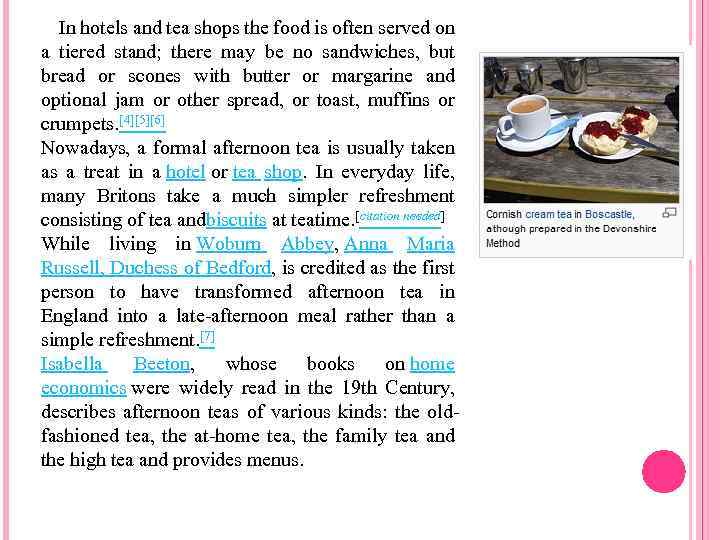
In hotels and tea shops the food is often served on a tiered stand; there may be no sandwiches, but bread or scones with butter or margarine and optional jam or other spread, or toast, muffins or crumpets. [4][5][6] Nowadays, a formal afternoon tea is usually taken as a treat in a hotel or tea shop. In everyday life, many Britons take a much simpler refreshment consisting of tea andbiscuits at teatime. [citation needed] While living in Woburn Abbey, Anna Maria Russell, Duchess of Bedford, is credited as the first person to have transformed afternoon tea in England into a late-afternoon meal rather than a simple refreshment. [7] Isabella Beeton, whose books on home economics were widely read in the 19 th Century, describes afternoon teas of various kinds: the oldfashioned tea, the at-home tea, the family tea and the high tea and provides menus.
![High tea (also known as meat tea[9]) is an early evening meal, typically eaten](https://present5.com/presentation/136939171_23245765/image-29.jpg "High tea (also known as meat tea[9]) is an early evening meal, typically eaten")
High tea (also known as meat tea[9]) is an early evening meal, typically eaten between 5 pm and 7 pm. It is now largely followed by a lighter meal later in the evening. High tea typically consists of a hot dish such as fish and chips, shepherd's pie, or macaroni cheese, followed by cakes and bread, butter and jam. Occasionally there would be cold cuts of meat, such as ham salad. Traditionally high tea was eaten by middle to upper class children (whose parents would have a more formal dinner later) or by labourers, miners and the like when they came home from work. The term was first used around 1825 and high is used in the sense of welladvanced (like high noon, for example) to signify that it was taken later in the day [10]. In its origin, the term “high tea” was used as a way to distinguish it from afternoon tea. It is stated that the words 'low' and 'high' refer to the tables from which either meal was eaten. Afternoon tea was served in the garden where possible; otherwise it was usually taken in a day room, library or salon where low tables (like a coffee table) were placed near sofas or chairs generally (hence the fallacy about it being low tea). [11]Most quality hotels in Britain serve afternoon tea, frequently in a palm court, and more recently have offered the option of champagne instead of tea.
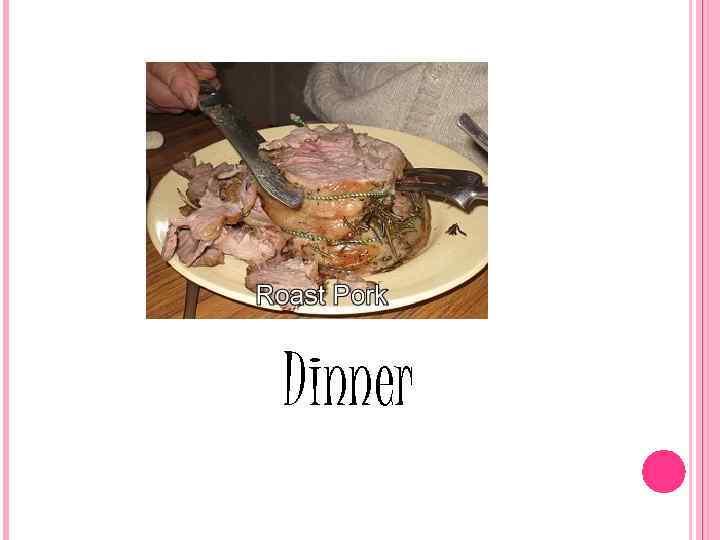
Dinner
Dinner is usually the name of the main meal of the day. Depending upon culture, dinner may be the second, third or fourth meal of the day. [1][2] Originally, though, it referred to the first meal of the day, [citation needed] eaten around noon, and is still occasionally used for a noontime meal, if it is a large or main meal.
Etymology Originally, dinner referred to the first meal of a two-meal day, a heavy meal occurring about noon, which broke the night's fast in the new day. The word is from the Old French (ca 1300) disner, meaning "breakfast", from the stem of Gallo-Romance desjunare ("to break one's fast"), from Latin dis- ("undo") + Late Latin ieiunare ("to fast"), from Latin ieiunus ("fasting, hungry"). [3][4] Eventually, the term shifted to referring to the heavy main meal of the day, even if it had been preceded by a breakfast meal. The (lighter) meal following dinner has
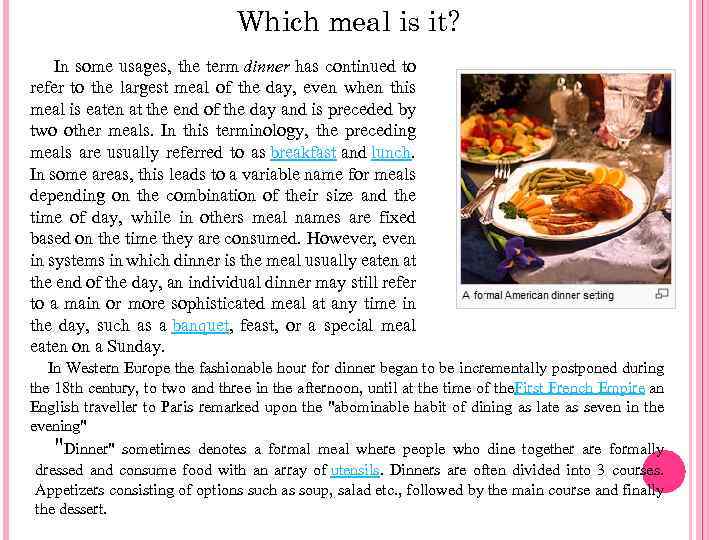
Which meal is it? In some usages, the term dinner has continued to refer to the largest meal of the day, even when this meal is eaten at the end of the day and is preceded by two other meals. In this terminology, the preceding meals are usually referred to as breakfast and lunch. In some areas, this leads to a variable name for meals depending on the combination of their size and the time of day, while in others meal names are fixed based on the time they are consumed. However, even in systems in which dinner is the meal usually eaten at the end of the day, an individual dinner may still refer to a main or more sophisticated meal at any time in the day, such as a banquet, feast, or a special meal eaten on a Sunday. In Western Europe the fashionable hour for dinner began to be incrementally postponed during the 18 th century, to two and three in the afternoon, until at the time of the. First French Empire an English traveller to Paris remarked upon the "abominable habit of dining as late as seven in the evening" "Dinner" sometimes denotes a formal meal where people who dine together are formally dressed and consume food with an array of utensils. Dinners are often divided into 3 courses. Appetizers consisting of options such as soup, salad etc. , followed by the main course and finally the dessert.
Supper
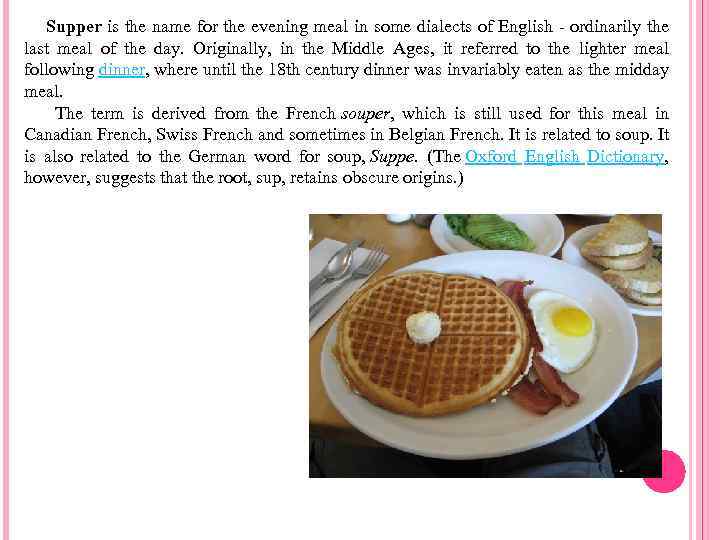
Supper is the name for the evening meal in some dialects of English - ordinarily the last meal of the day. Originally, in the Middle Ages, it referred to the lighter meal following dinner, where until the 18 th century dinner was invariably eaten as the midday meal. The term is derived from the French souper, which is still used for this meal in Canadian French, Swiss French and sometimes in Belgian French. It is related to soup. It is also related to the German word for soup, Suppe. (The Oxford English Dictionary, however, suggests that the root, sup, retains obscure origins. )
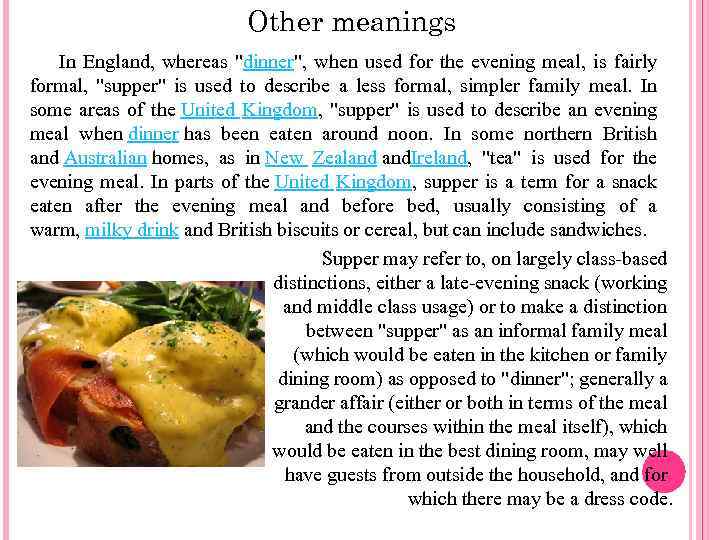
Other meanings In England, whereas "dinner", when used for the evening meal, is fairly formal, "supper" is used to describe a less formal, simpler family meal. In some areas of the United Kingdom, "supper" is used to describe an evening meal when dinner has been eaten around noon. In some northern British and Australian homes, as in New Zealand and. Ireland, "tea" is used for the evening meal. In parts of the United Kingdom, supper is a term for a snack eaten after the evening meal and before bed, usually consisting of a warm, milky drink and British biscuits or cereal, but can include sandwiches. Supper may refer to, on largely class-based distinctions, either a late-evening snack (working and middle class usage) or to make a distinction between "supper" as an informal family meal (which would be eaten in the kitchen or family dining room) as opposed to "dinner"; generally a grander affair (either or both in terms of the meal and the courses within the meal itself), which would be eaten in the best dining room, may well have guests from outside the household, and for which there may be a dress code.
It is common for social interest and hobby clubs that meet in the evening after normal dinner hours to announce that "a light supper" will be served after the main business of the meeting. In New Zealand it is similar – generally cake and tea/coffee served later in the evening, particularly when people have visitors. In Hong Kong and most parts of The United States and Canada, "supper" and "dinner" are considered synonyms. In some areas either term may be rarely used. It is typically served between 6 pm and 8 pm. The only real requirement is it must be eaten after lunch. In the United States, "dinner" can refer to a more formal evening meal, such as at Christmas or Thanksgiving, while "supper" refers to an evening meal eaten everyday by the family, but in many parts of the country the two are either used synonymously or understood to be synonymous, even if only one is in general usage. "Dinner" may also refer to "Lunch" in some parts of the United States such as Missouri, and Iowa. In Saskatchewan, and much of Nova Scotia, in Canada, "supper" means the main meal of the day, usually served in the late afternoon, while "dinner" is served around noon. "Dinner" is used in some areas, such as. Newfoundland Labrador, to describe the noon meal as well as special meals, such as "Thanksgiving Dinner" or "Christmas Dinner", and the evening meal being "supper". For harvest meals put on by churches and other community organizations, the term used is "Fowl Supper" (features turkey) or "Fall Supper", never "dinner". In Ireland, a "chicken supper" is a meal of chips, gravy, onions, peas and chicken breast.
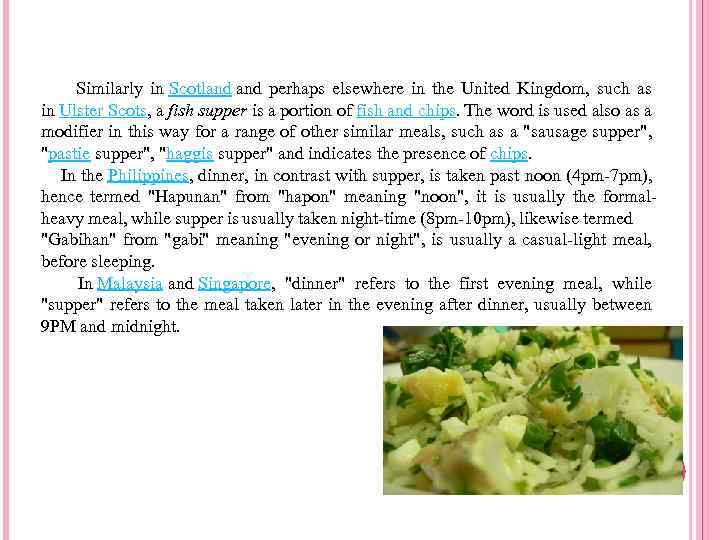
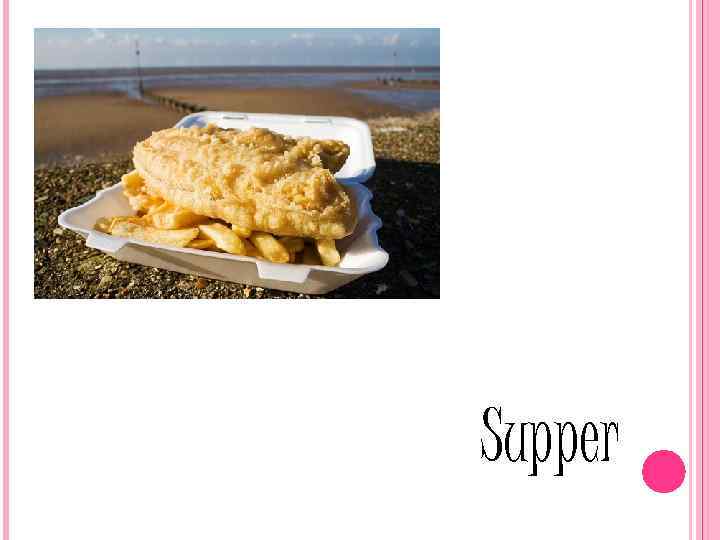
Similarly in Scotland perhaps elsewhere in the United Kingdom, such as in Ulster Scots, a fish supper is a portion of fish and chips. The word is used also as a modifier in this way for a range of other similar meals, such as a "sausage supper", "pastie supper", "haggis supper" and indicates the presence of chips. In the Philippines, dinner, in contrast with supper, is taken past noon (4 pm-7 pm), hence termed "Hapunan" from "hapon" meaning "noon", it is usually the formalheavy meal, while supper is usually taken night-time (8 pm-10 pm), likewise termed "Gabihan" from "gabi" meaning "evening or night", is usually a casual-light meal, before sleeping. In Malaysia and Singapore, "dinner" refers to the first evening meal, while "supper" refers to the meal taken later in the evening after dinner, usually between 9 PM and midnight.
The presentation is developed by Matyakubova Surayo Thanks for attention!
