 Скачать презентацию Britain and the EU 6 February 2017 by
c3c250cd22ceb2723936867c14495cd1.ppt
- Количество слайдов: 23



Britain and the EU 6 February 2017 by Sigrid Brevik Wangsness
Introduction: Origin of the EU Europe – a troubled continent By 1945 Europe had been ripped apart by two world wars. n After World War II: - How to build the peace in Europe? - How to create European unity? n
Forerunner of the EEC n n Winston Churchill’s vision (1946): Creation of a “United States of Europe” with reconciliation between France and Germany as the first step. 1951: The European Coal and Steel Community (The Treaty of Paris). France, Germany, Italy and the Be. Ne. Lux countries.
Development of the EU n 1957: The EEC (The Treaty of Rome): Six member states. The European Economic Community: a customs union, common policies on trade, agriculture, and transport, and a common market. The goal of coordinated economic/ monetary policies and increased economic integration. n
Development of the EU 1987: Name change to the EC: The European Community, n reflecting the goal of political unity n 1993: The Single Market Free movement of goods, persons, services, and capital
Development of the EU 1998: Name change to the EU: The European Union A European Central Bank (ECB) n n 1999: European Economic and Monetary Union (EMU): A single currency: the euro n There are 28 member states in the EU (2017) n Of these, 19 nations have adopted the euro
Britain: The Reluctant European The Phase of Scepticism, 1950 -1975: n 1951: Britain declined to participate in the European Coal and Steel Community. Why? 1957: Britain declined to join the EEC Why? n
Britain’s reasons for not joining the EEC n Three spheres of interest originally governed the British official attitude to the EU: - The relationship to the U. S. A. - The Commonwealth - Europe
Still Scepticism, but UK Application for EEC Membership n n 1961: First British application for EEC membership 1963: First French veto against British membership 1967: Second British application for EEC membership and second French veto against British membership 1971: Third British application for EEC membership (De Gaulle resigned in 1969)
UK Membership in the EEC n n 1973: Britain became a member of the EEC 1975: Referendum: In favour of continued membership (66% voter turnout, 2/3 said yes) What were the main arguments for Britons in favour of the EEC (EU)? What were the main arguments for Britons against the EEC (EU)?
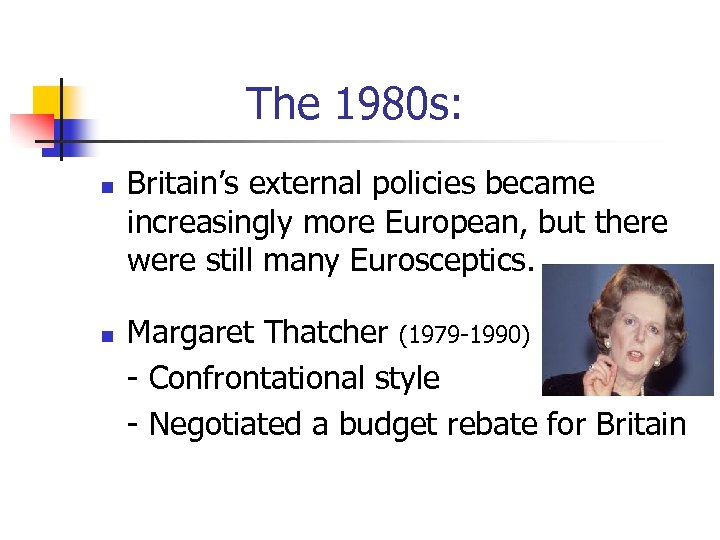
The 1980 s: n n Britain’s external policies became increasingly more European, but there were still many Eurosceptics. Margaret Thatcher (1979 -1990) - Confrontational style - Negotiated a budget rebate for Britain
Margaret Thatcher (1979 -1990) - In favour of enlargement, but resisted closer European integration: "no European superstate!" - Resisted the ERM: wanted floating exchange rates. Britain became a member of the ERM in 1990, against M. T. 's wishes. - Against the "Social(ist) Chapter".
The Political Parties’ Opinions about the EU in the 1980 s n The Labour Party became more and more committed to the EC in the 1980 s, while the opposition to the EC within the Conservative Party became more and more pronounced. A month after Britain joined the ERM Margaret Thatcher had to resign as Prime Minister in Britain.
The 1990 s and into the 2000 s: n John Major (1990 -1997) - More pro-European (in style at least). The British view of widening rather than deepening European integration - The Social Chapter dropped - Black Wednesday" (Sept. 1992): Britain's exit from the ERM
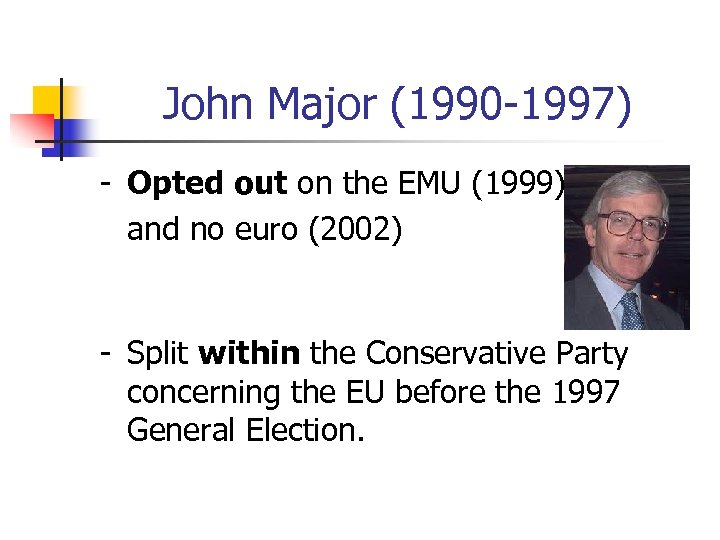
John Major (1990 -1997) - Opted out on the EMU (1999), and no euro (2002) - Split within the Conservative Party concerning the EU before the 1997 General Election.
Tony Blair (1997– 2007) - New Labour had a more pro-European stance: Signed the Social Chapter. - Tony Blair wanted to play a leading, constructive role in Europe. Less sceptical to the EU. - Wait-and-see attitude concerning the euro. When would be the right time for a referendum?
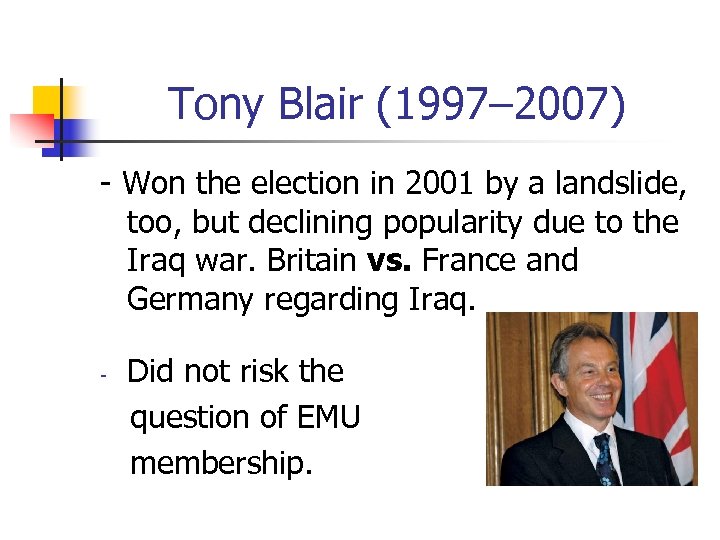
Tony Blair (1997– 2007) - Won the election in 2001 by a landslide, too, but declining popularity due to the Iraq war. Britain vs. France and Germany regarding Iraq. Did not risk the question of EMU membership. -
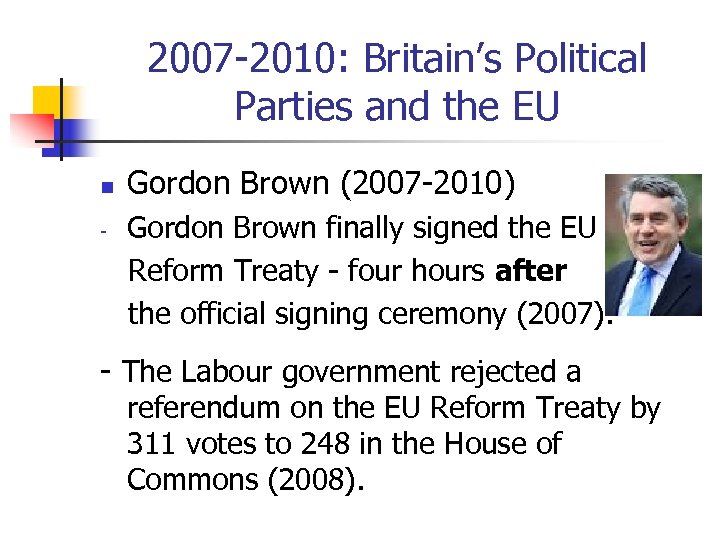
2007 -2010: Britain’s Political Parties and the EU n Gordon Brown (2007 -2010) Gordon Brown finally signed the EU Reform Treaty - four hours after the official signing ceremony (2007). - - The Labour government rejected a referendum on the EU Reform Treaty by 311 votes to 248 in the House of Commons (2008).
2010 -2016: Britain’s Political Parties and the EU n - - David Cameron (2010 - 2016) “Britain needs to be in the EU – it is not in Britain’s interest to leave the EU (2011). ” The Prime Minister guarantees the British people a referendum.
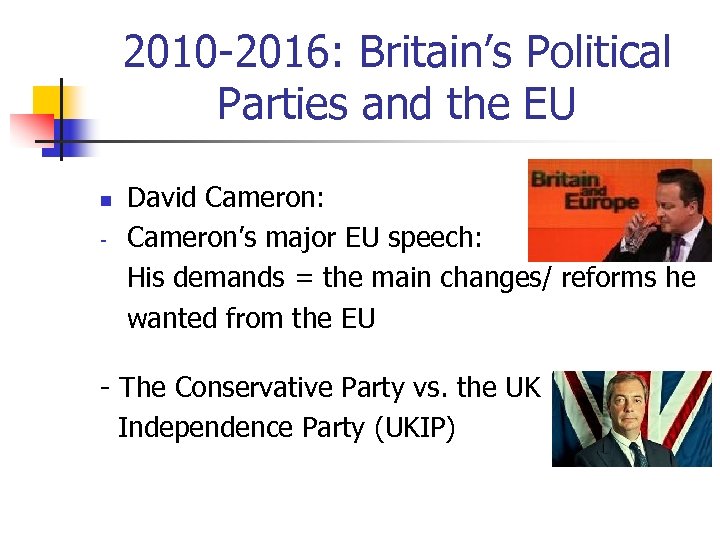
2010 -2016: Britain’s Political Parties and the EU David Cameron: - Cameron’s major EU speech: His demands = the main changes/ reforms he wanted from the EU n - The Conservative Party vs. the UK Independence Party (UKIP)
June 2016: The UK’s EU Referendum n What was the result? n Who wanted the UK to leave the EU? n Who wanted the UK to stay in the EU? n The pros and cons of leaving the EU for Britain?
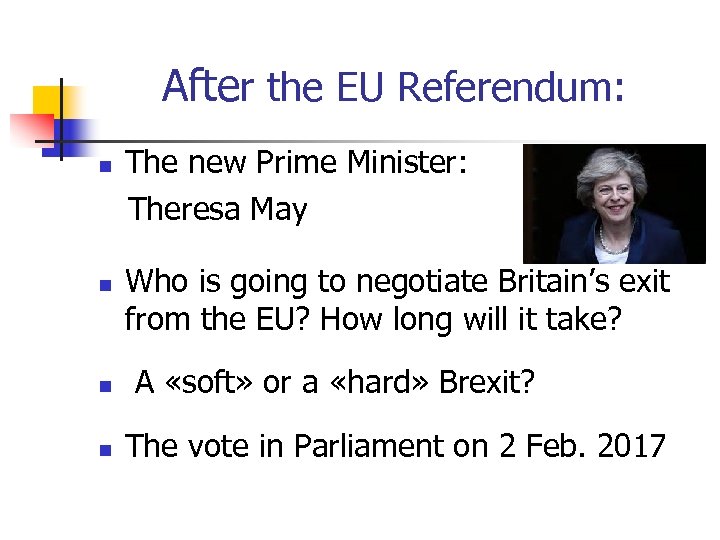
After the EU Referendum: The new Prime Minister: Theresa May n n Who is going to negotiate Britain’s exit from the EU? How long will it take? n A «soft» or a «hard» Brexit? n The vote in Parliament on 2 Feb. 2017
Brexit Plan: Government White Paper n The government’s 12 points n Key questions: n n n 1. 2. 3. 4. 5. 6.
Скачать презентацию Britain and the EU 6 February 2017 by
c3c250cd22ceb2723936867c14495cd1.ppt