 Скачать презентацию Bringing the Grid to Chemical Engineering Opening
863726850662a25f4f352afce67c3625.ppt
- Количество слайдов: 44



Bringing the Grid to Chemical Engineering • Opening Talk at the 1998 Foundations of Computer Aided Process Operations Conference in Snowbird, Utah • July 5, 1998 National Computational Science Alliance
Bringing the Grid to Chemical Engineering Larry Smarr Director National Center for Supercomputing Applications National Computational Science Alliance University of Illinois at Urbana-Champaign National Computational Science Alliance
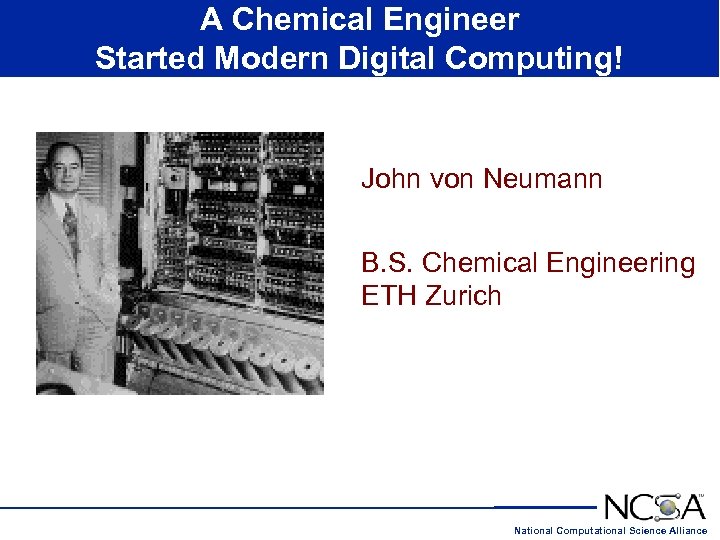
A Chemical Engineer Started Modern Digital Computing! John von Neumann B. S. Chemical Engineering ETH Zurich National Computational Science Alliance
Outline of Presentation • • • Introducing the Grid New Directions in Computing Challenges to the Chemical Industry The Chemical Engineer’s Workbench The Killer App for the Grid: Tele-Immersion Conclusions National Computational Science Alliance
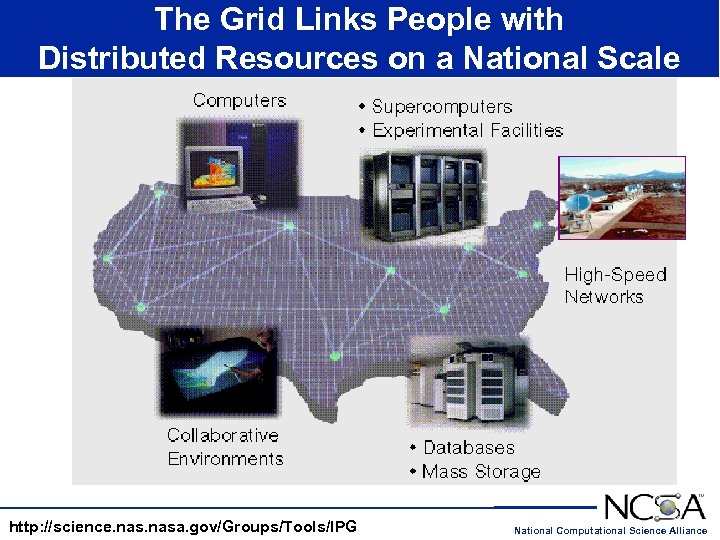
The Grid Links People with Distributed Resources on a National Scale http: //science. nasa. gov/Groups/Tools/IPG National Computational Science Alliance
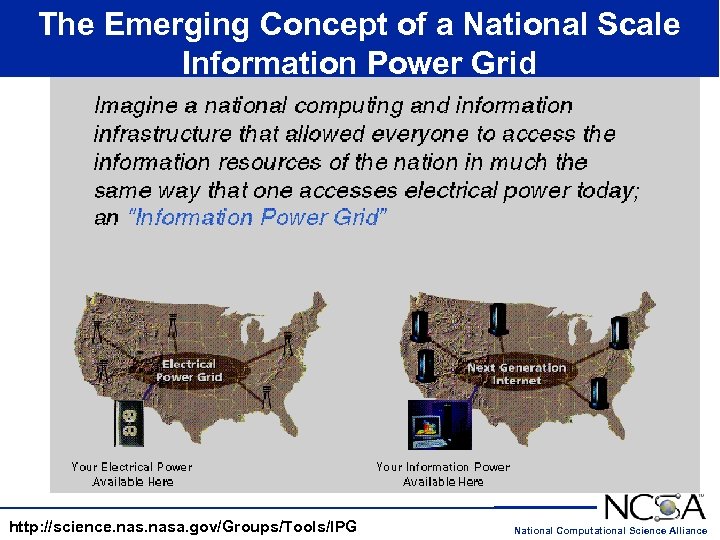
The Emerging Concept of a National Scale Information Power Grid http: //science. nasa. gov/Groups/Tools/IPG National Computational Science Alliance
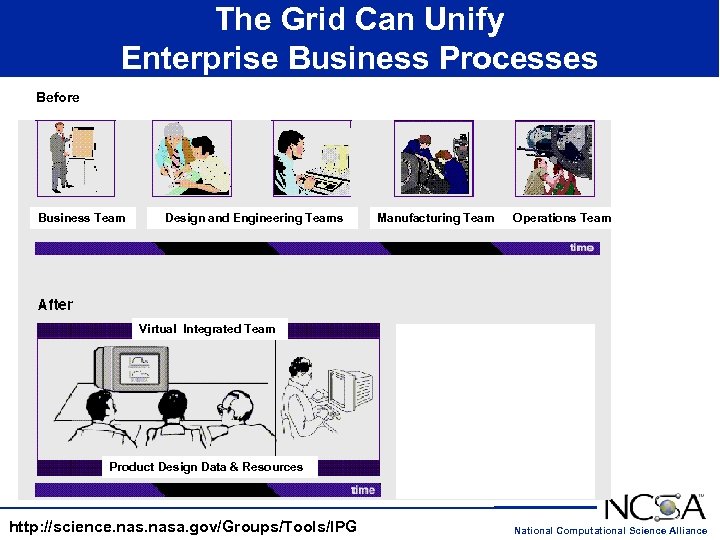
The Grid Can Unify Enterprise Business Processes Before Business Team Design and Engineering Teams Manufacturing Team Operations Team Virtual Integrated Team Product Design Data & Resources http: //science. nasa. gov/Groups/Tools/IPG National Computational Science Alliance
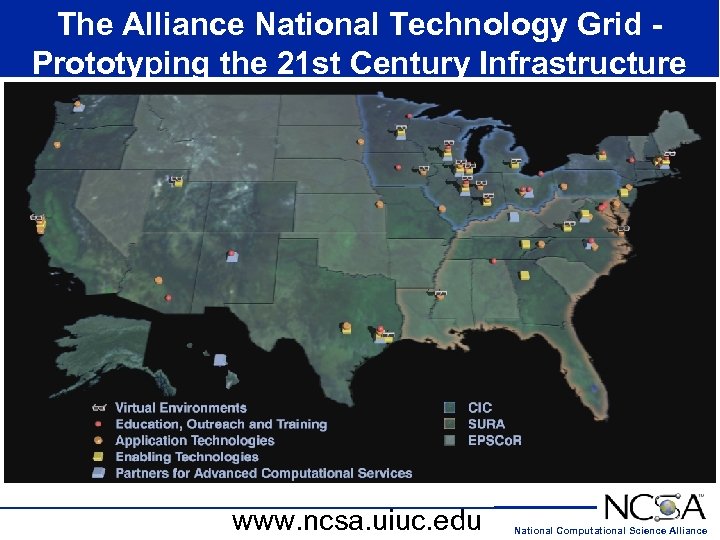
The Alliance National Technology Grid Prototyping the 21 st Century Infrastructure www. ncsa. uiuc. edu National Computational Science Alliance
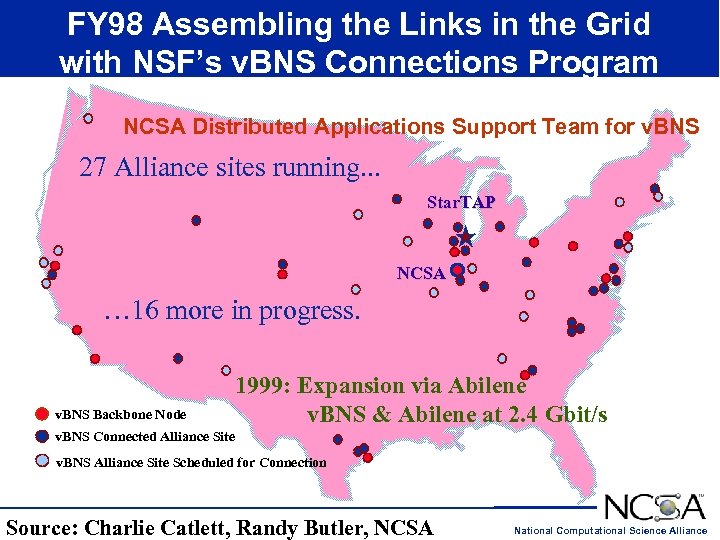
FY 98 Assembling the Links in the Grid with NSF’s v. BNS Connections Program NCSA Distributed Applications Support Team for v. BNS 27 Alliance sites running. . . Star. TAP NCSA … 16 more in progress. v. BNS Backbone Node 1999: Expansion via Abilene v. BNS & Abilene at 2. 4 Gbit/s v. BNS Connected Alliance Site v. BNS Alliance Site Scheduled for Connection Source: Charlie Catlett, Randy Butler, NCSA National Computational Science Alliance
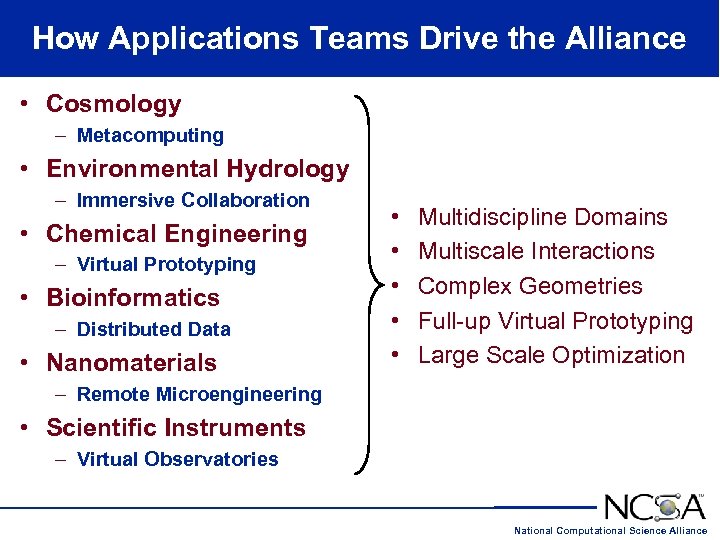
How Applications Teams Drive the Alliance • Cosmology – Metacomputing • Environmental Hydrology – Immersive Collaboration • Chemical Engineering – Virtual Prototyping • Bioinformatics – Distributed Data • Nanomaterials • • • Multidiscipline Domains Multiscale Interactions Complex Geometries Full-up Virtual Prototyping Large Scale Optimization – Remote Microengineering • Scientific Instruments – Virtual Observatories National Computational Science Alliance
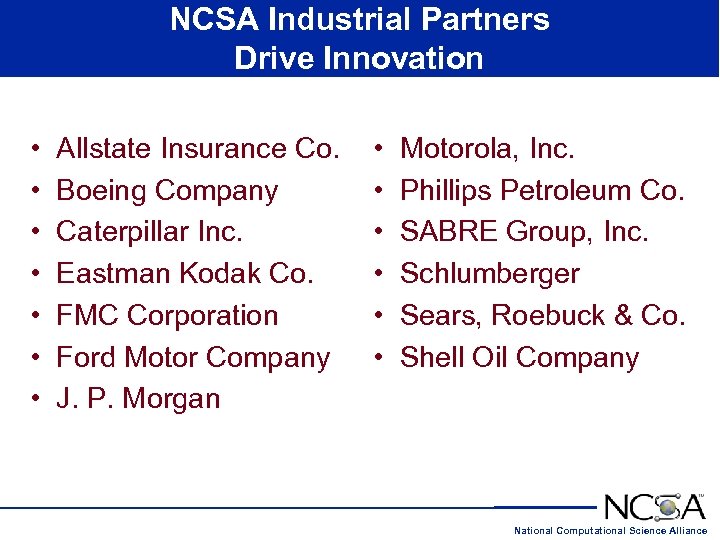
NCSA Industrial Partners Drive Innovation • • Allstate Insurance Co. Boeing Company Caterpillar Inc. Eastman Kodak Co. FMC Corporation Ford Motor Company J. P. Morgan • • • Motorola, Inc. Phillips Petroleum Co. SABRE Group, Inc. Schlumberger Sears, Roebuck & Co. Shell Oil Company National Computational Science Alliance
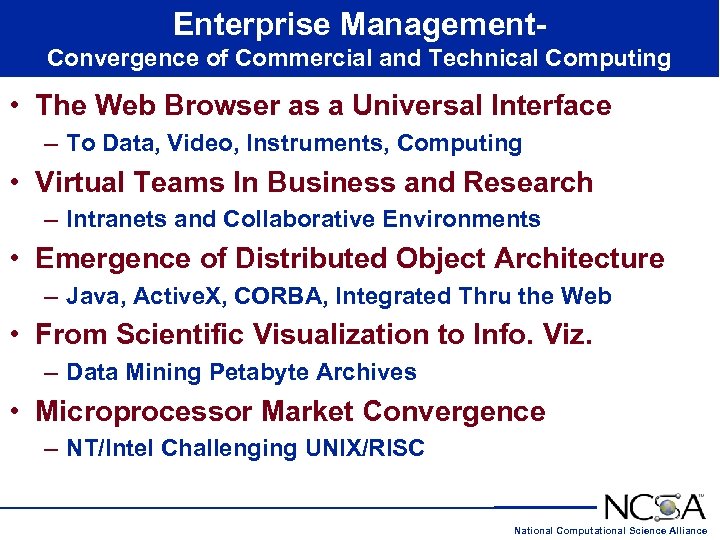
Enterprise Management. Convergence of Commercial and Technical Computing • The Web Browser as a Universal Interface – To Data, Video, Instruments, Computing • Virtual Teams In Business and Research – Intranets and Collaborative Environments • Emergence of Distributed Object Architecture – Java, Active. X, CORBA, Integrated Thru the Web • From Scientific Visualization to Info. Viz. – Data Mining Petabyte Archives • Microprocessor Market Convergence – NT/Intel Challenging UNIX/RISC National Computational Science Alliance
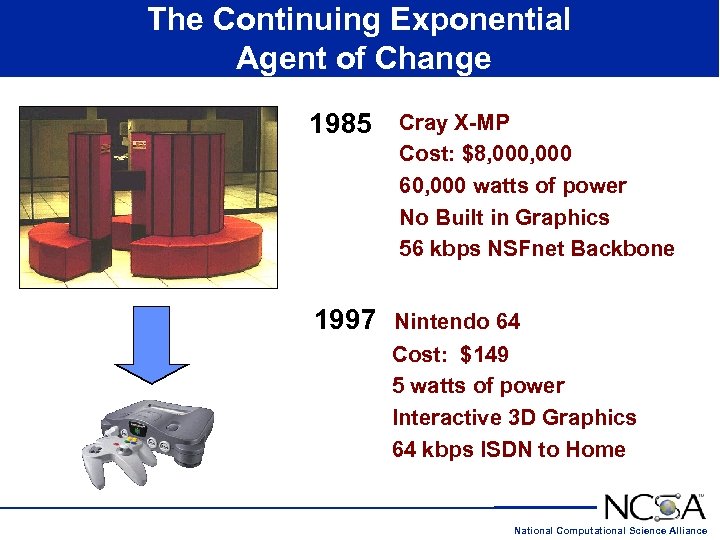
The Continuing Exponential Agent of Change 1985 1997 Cray X-MP Cost: $8, 000 60, 000 watts of power No Built in Graphics 56 kbps NSFnet Backbone Nintendo 64 Cost: $149 5 watts of power Interactive 3 D Graphics 64 kbps ISDN to Home National Computational Science Alliance
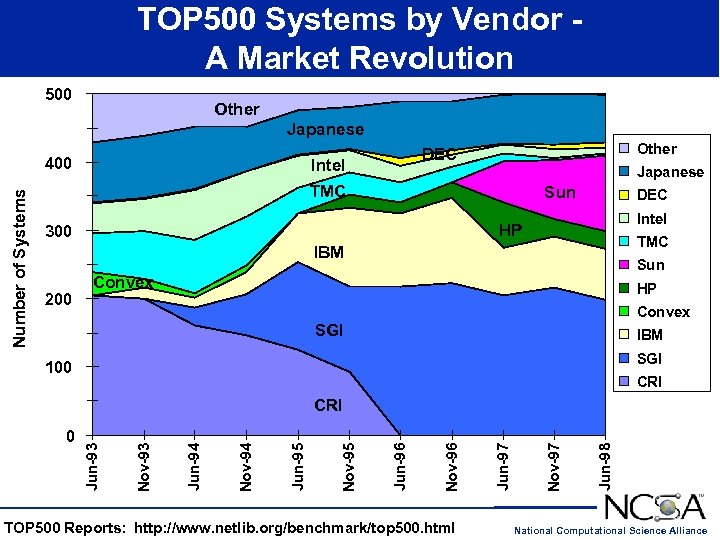
TOP 500 Systems by Vendor A Market Revolution 500 Other Japanese Number of Systems 400 Other DEC Intel Japanese TMC Sun DEC Intel HP 300 TMC IBM 200 Sun Convex HP Convex SGI IBM SGI 100 CRI TOP 500 Reports: http: //www. netlib. org/benchmark/top 500. html Jun-98 Nov-97 Jun-97 Nov-96 Jun-96 Nov-95 Jun-95 Nov-94 Jun-94 Nov-93 0 Jun-93 CRI National Computational Science Alliance
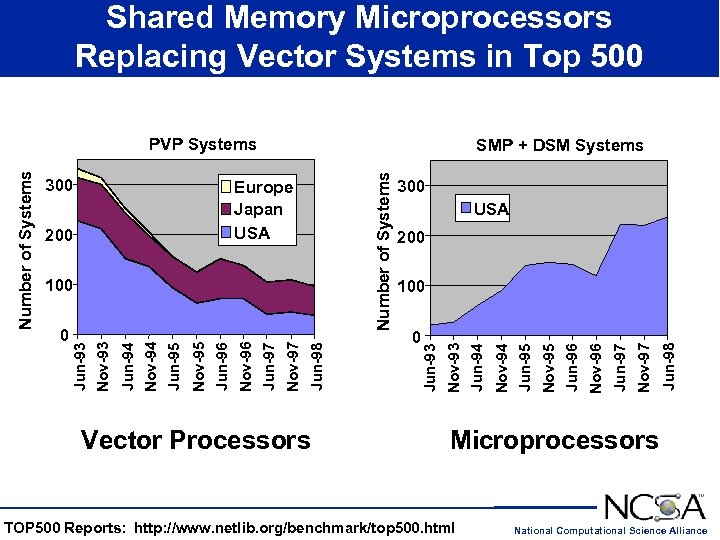
Shared Memory Microprocessors Replacing Vector Systems in Top 500 SMP + DSM Systems Vector Processors 200 Jun-98 Nov-97 Jun-97 Nov-96 Jun-96 Nov-95 0 Jun-95 100 Nov-94 Jun-98 Nov-97 Jun-97 Nov-96 Jun-96 Nov-95 Jun-95 Nov-94 Jun-94 0 Nov-93 100 USA Jun-94 200 300 Nov-93 Europe Japan USA Jun-93 Number of Systems 300 Jun-93 Number of Systems PVP Systems Microprocessors TOP 500 Reports: http: //www. netlib. org/benchmark/top 500. html National Computational Science Alliance
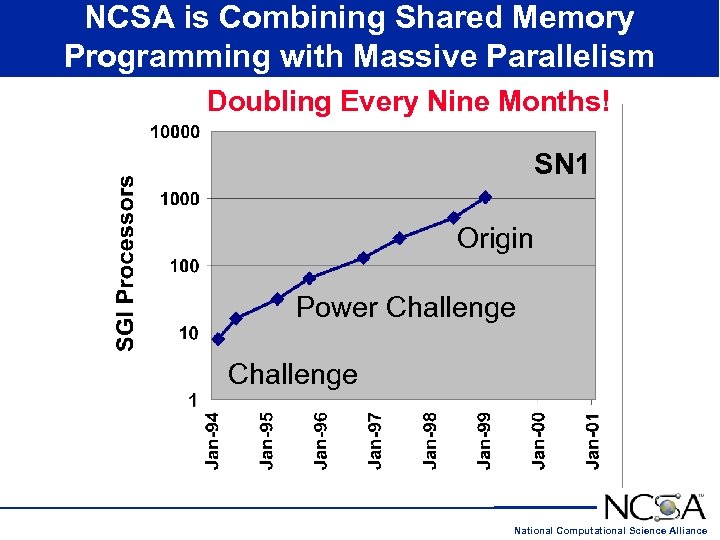
NCSA is Combining Shared Memory Programming with Massive Parallelism Doubling Every Nine Months! SN 1 Origin Power Challenge National Computational Science Alliance
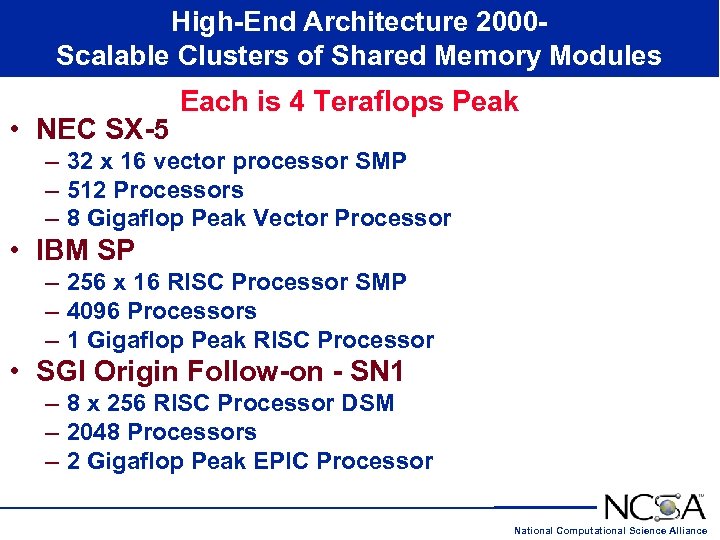
High-End Architecture 2000 Scalable Clusters of Shared Memory Modules • NEC SX-5 Each is 4 Teraflops Peak – 32 x 16 vector processor SMP – 512 Processors – 8 Gigaflop Peak Vector Processor • IBM SP – 256 x 16 RISC Processor SMP – 4096 Processors – 1 Gigaflop Peak RISC Processor • SGI Origin Follow-on - SN 1 – 8 x 256 RISC Processor DSM – 2048 Processors – 2 Gigaflop Peak EPIC Processor National Computational Science Alliance
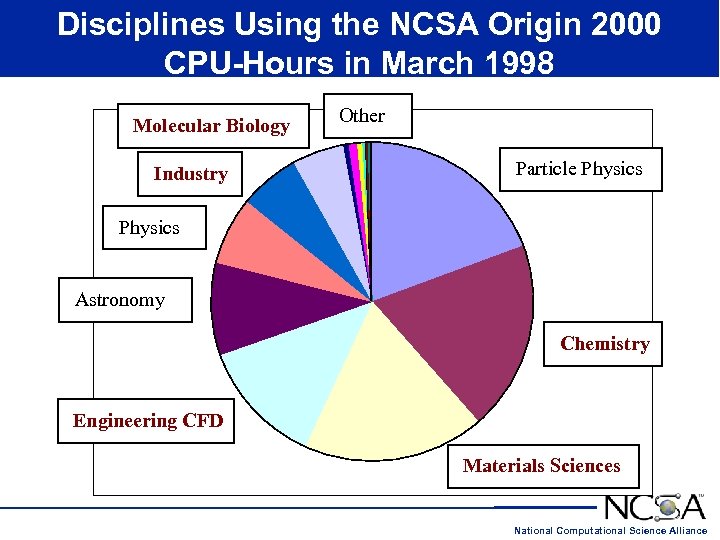
Disciplines Using the NCSA Origin 2000 CPU-Hours in March 1998 Molecular Biology Industry Other Particle Physics Astronomy Chemistry Engineering CFD Materials Sciences National Computational Science Alliance
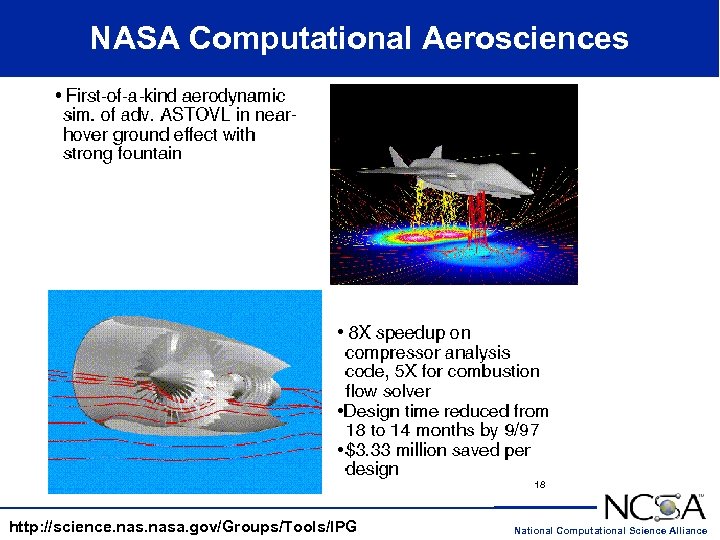
NASA Computational Aerosciences http: //science. nasa. gov/Groups/Tools/IPG National Computational Science Alliance
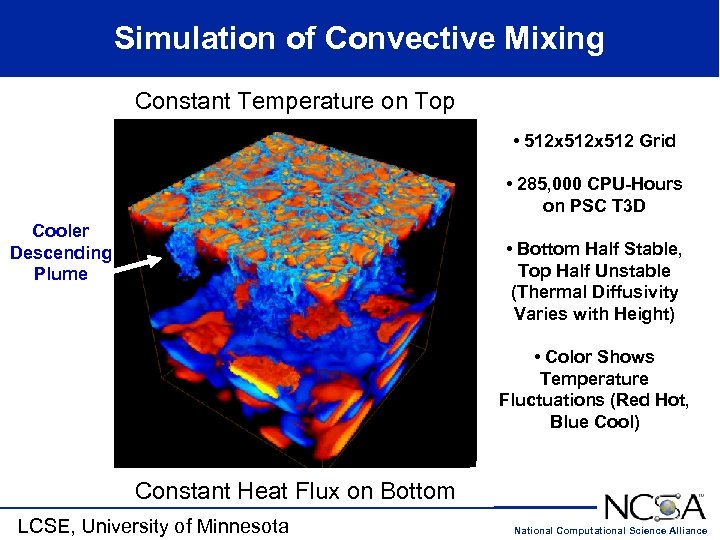
Simulation of Convective Mixing Constant Temperature on Top • 512 x 512 Grid • 285, 000 CPU-Hours on PSC T 3 D Cooler Descending Plume • Bottom Half Stable, Top Half Unstable (Thermal Diffusivity Varies with Height) • Color Shows Temperature Fluctuations (Red Hot, Blue Cool) Constant Heat Flux on Bottom LCSE, University of Minnesota National Computational Science Alliance
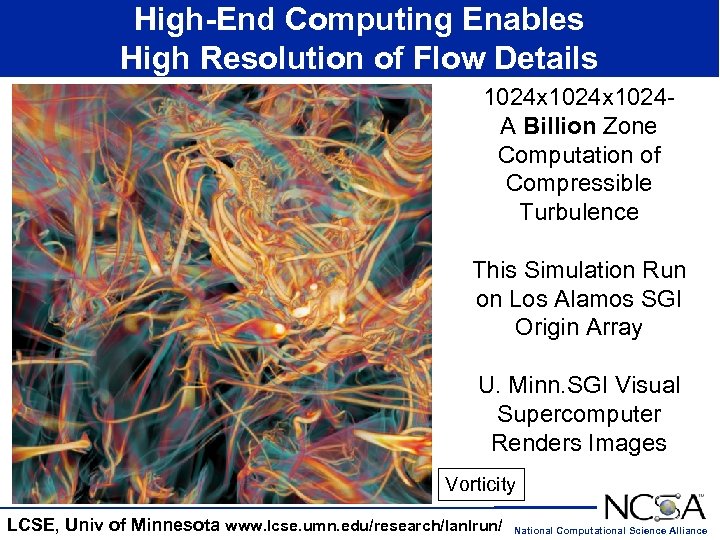
High-End Computing Enables High Resolution of Flow Details 1024 x 1024 A Billion Zone Computation of Compressible Turbulence This Simulation Run on Los Alamos SGI Origin Array U. Minn. SGI Visual Supercomputer Renders Images Vorticity LCSE, Univ of Minnesota www. lcse. umn. edu/research/lanlrun/ National Computational Science Alliance
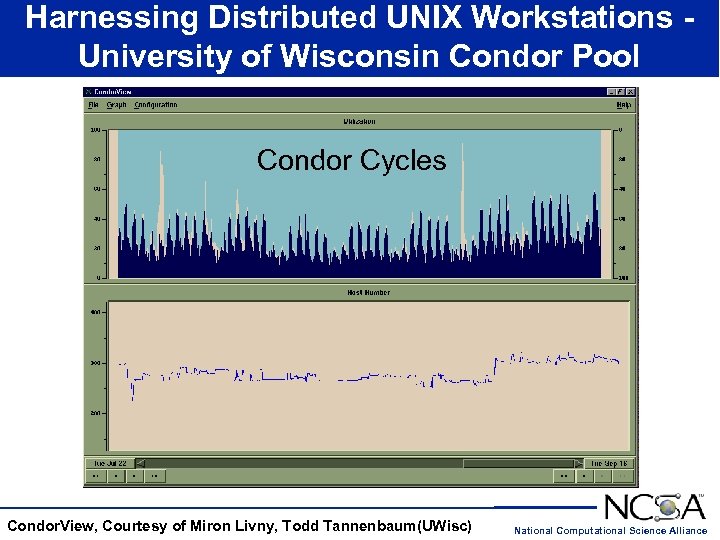
Harnessing Distributed UNIX Workstations University of Wisconsin Condor Pool Condor Cycles Condor. View, Courtesy of Miron Livny, Todd Tannenbaum(UWisc) National Computational Science Alliance
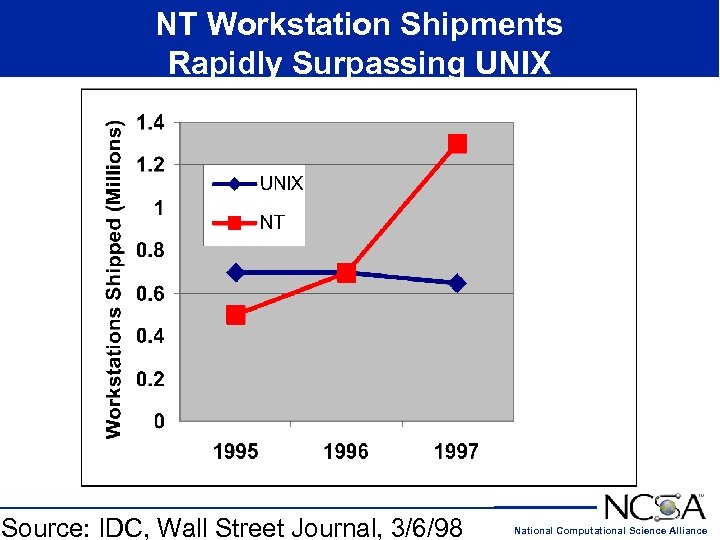
NT Workstation Shipments Rapidly Surpassing UNIX Source: IDC, Wall Street Journal, 3/6/98 National Computational Science Alliance
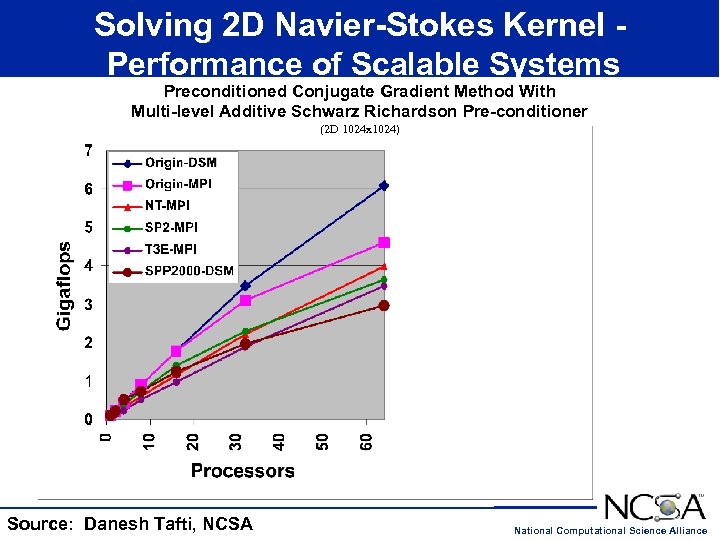
Solving 2 D Navier-Stokes Kernel Performance of Scalable Systems Preconditioned Conjugate Gradient Method With Multi-level Additive Schwarz Richardson Pre-conditioner (2 D 1024 x 1024) Source: Danesh Tafti, NCSA National Computational Science Alliance
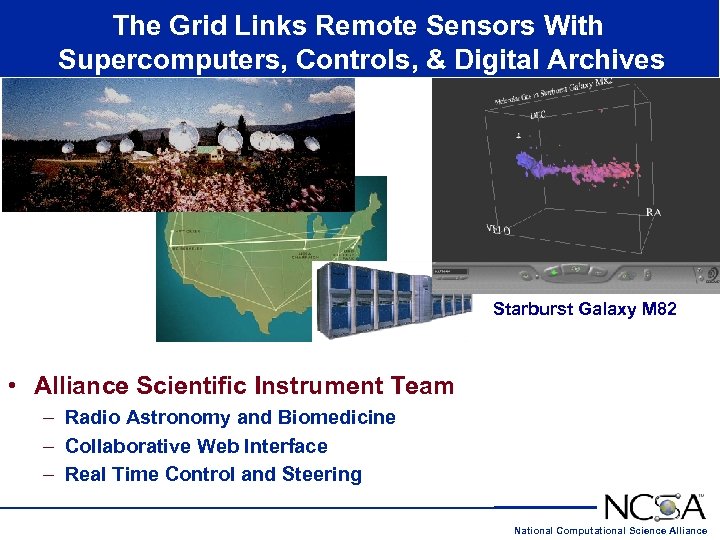
The Grid Links Remote Sensors With Supercomputers, Controls, & Digital Archives Starburst Galaxy M 82 • Alliance Scientific Instrument Team – Radio Astronomy and Biomedicine – Collaborative Web Interface – Real Time Control and Steering National Computational Science Alliance
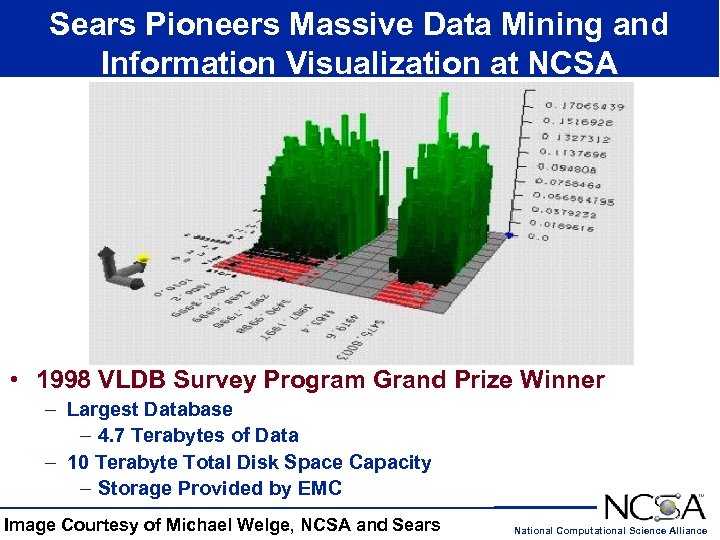
Sears Pioneers Massive Data Mining and Information Visualization at NCSA • 1998 VLDB Survey Program Grand Prize Winner – Largest Database – 4. 7 Terabytes of Data – 10 Terabyte Total Disk Space Capacity – Storage Provided by EMC Image Courtesy of Michael Welge, NCSA and Sears National Computational Science Alliance
Challenges Facing the Chemical Industry • • Globalization, Competition Shorter Product Life Cycles Environmental Issues Emerging Technologies Capacity Expansions New Materials Etc. All Involve Chemical Reactions How Can The Grid Help Meet the Challenges? National Computational Science Alliance
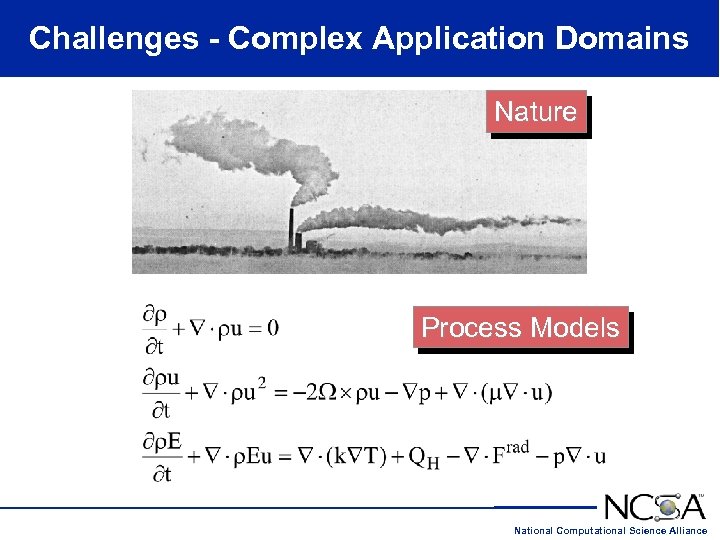
Challenges - Complex Application Domains Nature Process Models National Computational Science Alliance
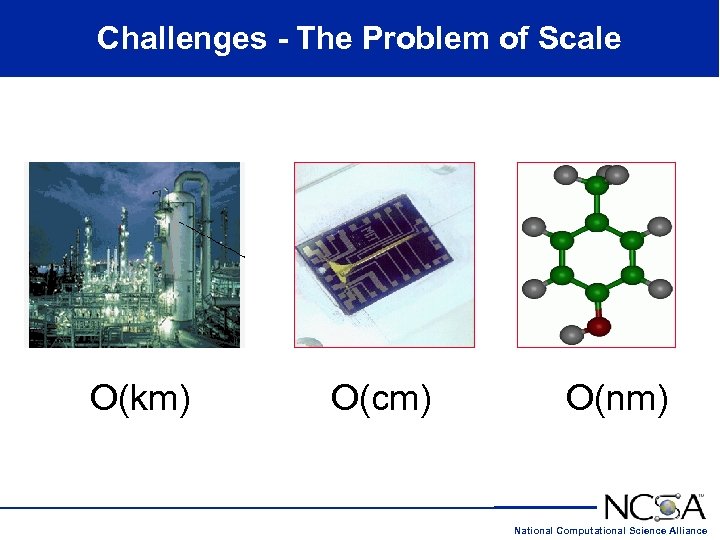
Challenges - The Problem of Scale O(km) O(cm) O(nm) National Computational Science Alliance
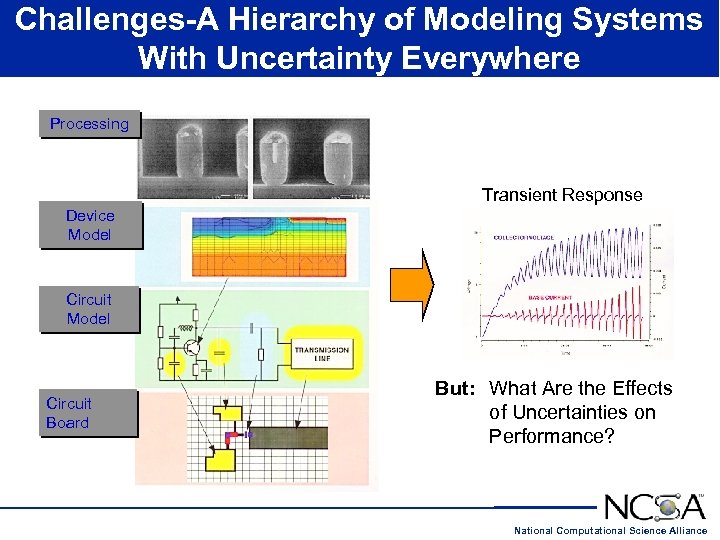
Challenges-A Hierarchy of Modeling Systems With Uncertainty Everywhere Processing Transient Response Device Model Circuit Board But: What Are the Effects of Uncertainties on Performance? National Computational Science Alliance
Alliance Chemical Engineering AT Team • • Gregory Mc. Rae, Chairman, MIT Jay Alameda, NCSA Paul Barton, MIT Ken Bishop, University of Kansas Richard Braatz, UIUC Klavs Jensen, MIT and you!! National Computational Science Alliance
The Chemical Engineer’s Workbench A Computational System that: : that: • Provides an Integrated Environment for Process Modeling, Control, and Optimization • Links Multiple Scales and Software Tools From Different Vendors • Utilizes the “Best” Computing and Software Tools to Help Solve Practical Applications National Computational Science Alliance
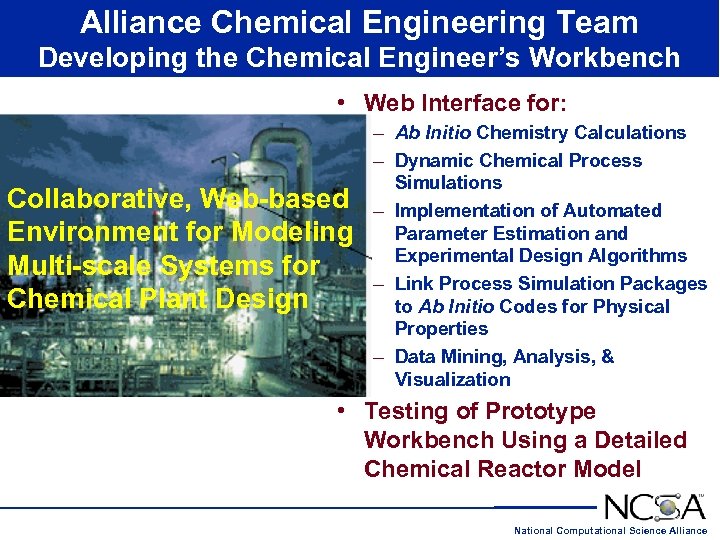
Alliance Chemical Engineering Team Developing the Chemical Engineer’s Workbench • Web Interface for: Collaborative, Web-based Environment for Modeling Multi-scale Systems for Chemical Plant Design – Ab Initio Chemistry Calculations – Dynamic Chemical Process Simulations – Implementation of Automated Parameter Estimation and Experimental Design Algorithms – Link Process Simulation Packages to Ab Initio Codes for Physical Properties – Data Mining, Analysis, & Visualization • Testing of Prototype Workbench Using a Detailed Chemical Reactor Model National Computational Science Alliance
Algorithmic Developments • Automatic Differentiation (ADIFOR Tool) – Numerical Optimization – Solving Stiff ODEs/PDEs • Solution of Large Linear Algebra Problems – Process Flowsheet Simulation – Parameter Estimation and Optimization • Solution of Integro-Partial-Differential Equations • Parallel Methods for Uncertainty Analysis National Computational Science Alliance
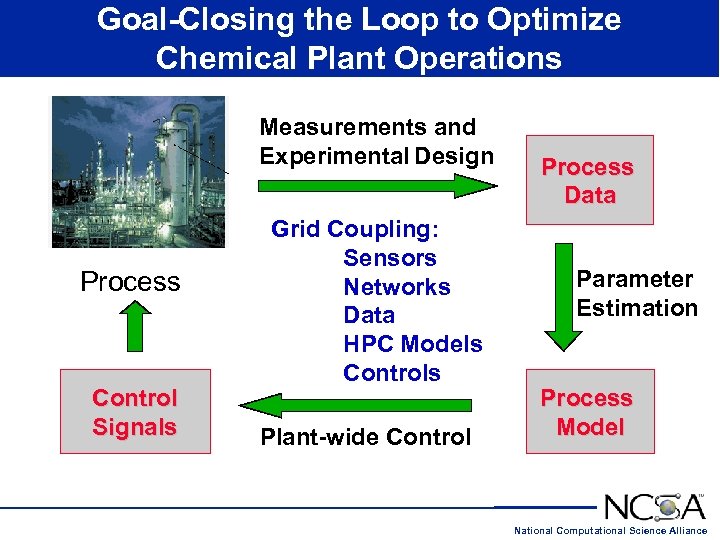
Goal-Closing the Loop to Optimize Chemical Plant Operations Measurements and Experimental Design Process Control Signals Grid Coupling: Sensors Networks Data HPC Models Controls Plant-wide Control Process Data Parameter Estimation Process Model National Computational Science Alliance
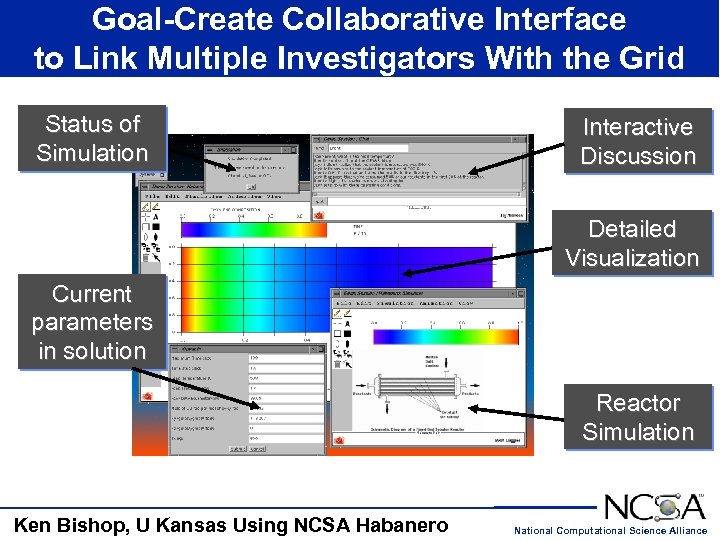
Goal-Create Collaborative Interface to Link Multiple Investigators With the Grid Status of Simulation Interactive Discussion Detailed Visualization Current parameters in solution Reactor Simulation Ken Bishop, U Kansas Using NCSA Habanero National Computational Science Alliance
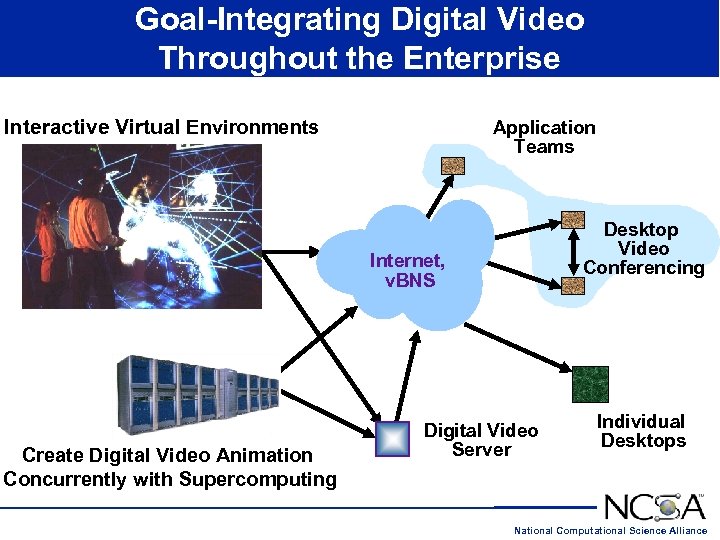
Goal-Integrating Digital Video Throughout the Enterprise Interactive Virtual Environments Application Teams Desktop Video Conferencing Internet, v. BNS Create Digital Video Animation Concurrently with Supercomputing Digital Video Server Individual Desktops National Computational Science Alliance
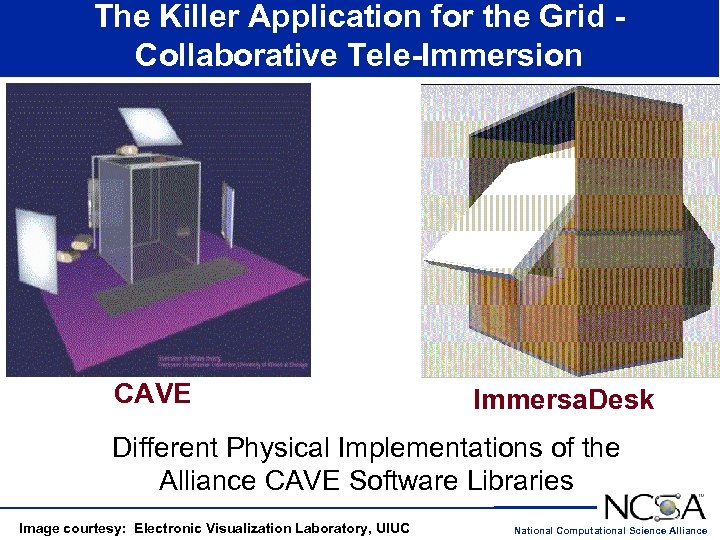
The Killer Application for the Grid Collaborative Tele-Immersion CAVE Immersa. Desk Different Physical Implementations of the Alliance CAVE Software Libraries Image courtesy: Electronic Visualization Laboratory, UIUC National Computational Science Alliance
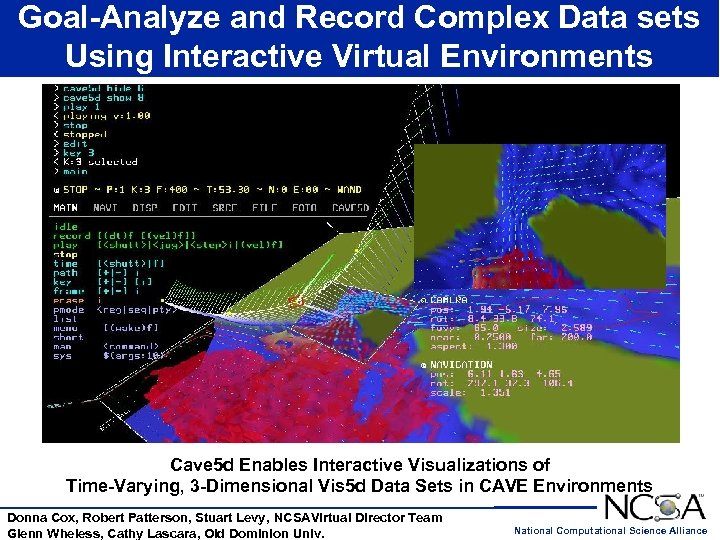
Goal-Analyze and Record Complex Data sets Using Interactive Virtual Environments Cave 5 d Enables Interactive Visualizations of Time-Varying, 3 -Dimensional Vis 5 d Data Sets in CAVE Environments Donna Cox, Robert Patterson, Stuart Levy, NCSAVirtual Director Team Glenn Wheless, Cathy Lascara, Old Dominion Univ. National Computational Science Alliance
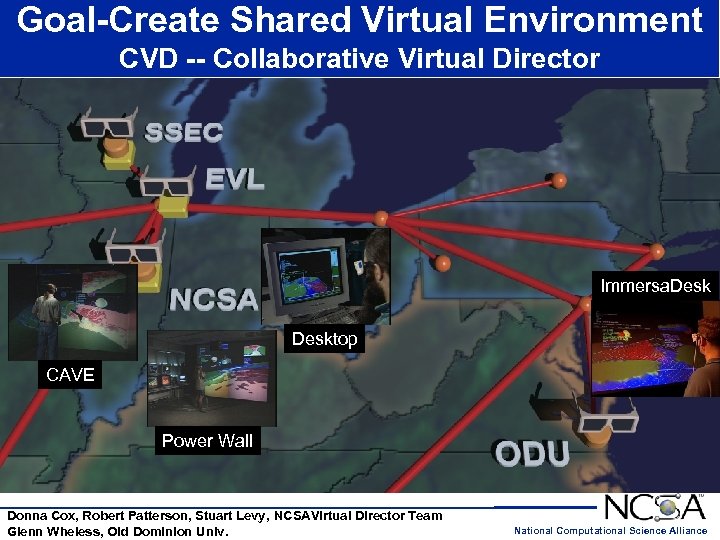
Goal-Create Shared Virtual Environment CVD -- Collaborative Virtual Director Immersa. Desktop CAVE Power Wall Donna Cox, Robert Patterson, Stuart Levy, NCSAVirtual Director Team Glenn Wheless, Old Dominion Univ. National Computational Science Alliance
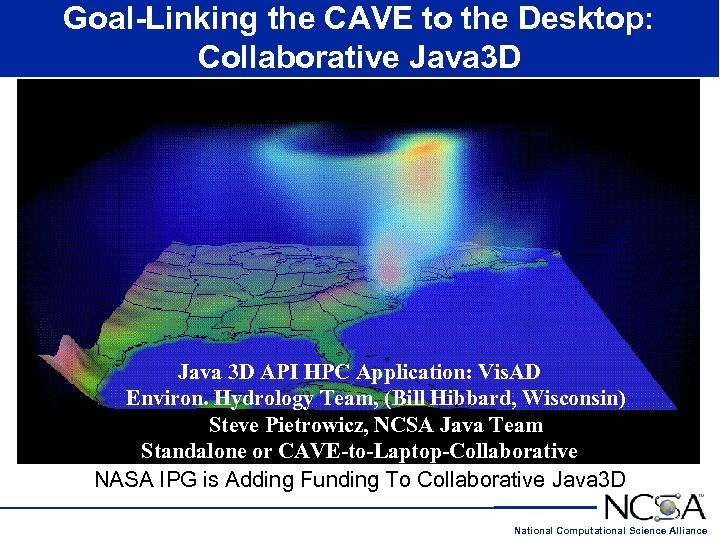
Goal-Linking the CAVE to the Desktop: Collaborative Java 3 D API HPC Application: Vis. AD Environ. Hydrology Team, (Bill Hibbard, Wisconsin) Steve Pietrowicz, NCSA Java Team Standalone or CAVE-to-Laptop-Collaborative NASA IPG is Adding Funding To Collaborative Java 3 D National Computational Science Alliance
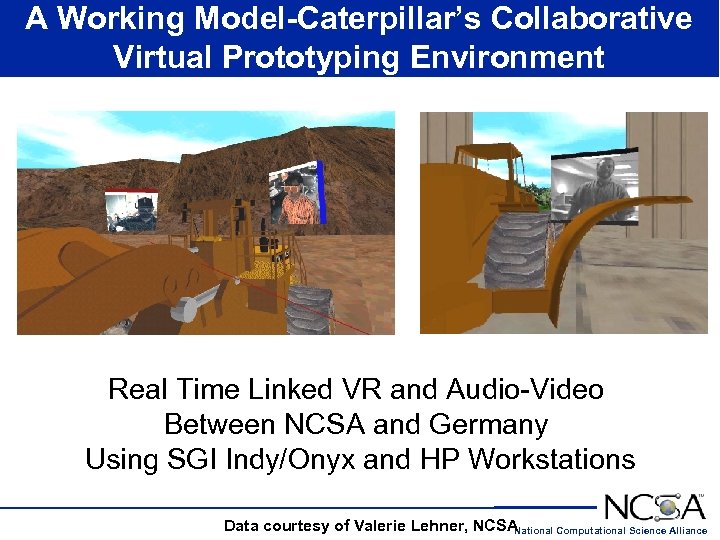
A Working Model-Caterpillar’s Collaborative Virtual Prototyping Environment Real Time Linked VR and Audio-Video Between NCSA and Germany Using SGI Indy/Onyx and HP Workstations Data courtesy of Valerie Lehner, NCSA National Computational Science Alliance
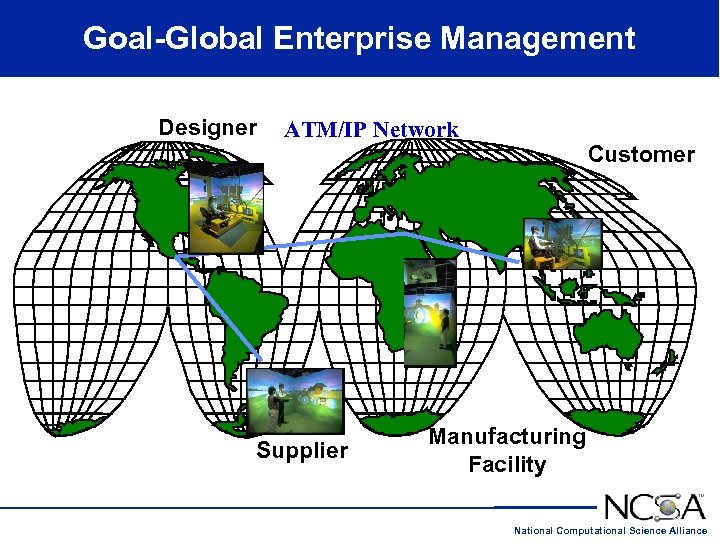
Goal-Global Enterprise Management Designer ATM/IP Network Supplier Customer Manufacturing Facility National Computational Science Alliance
How to Find Out More About the Alliance See also http: //alliance. ncsa. uiuc. edu National Computational Science Alliance
Скачать презентацию Bringing the Grid to Chemical Engineering Opening
863726850662a25f4f352afce67c3625.ppt