 Скачать презентацию Bringing Product to Market The Real World Realistic
60228310cd1b092c32052c5ddea2ed0d.ppt
- Количество слайдов: 20



Bringing Product to Market: The Real World Realistic Cost and Price for your Product Bob Barton
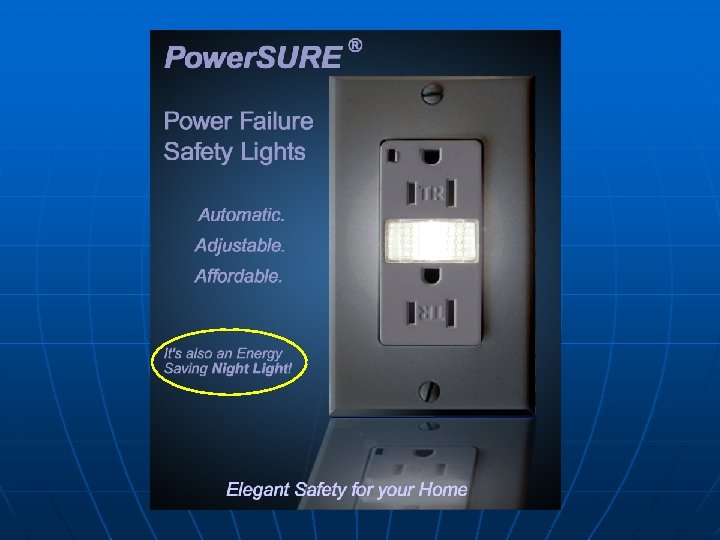
Background: n Power. SURE Corporation • Started with a couple of Patents Idea from the 80’s – not feasible then n Technology to the Rescue n • Long Road to [moderate] Success First Licensing deal = Royalty Income n Many Discussions with Wiring Device Manufacturers n • Current: n Company Closed at end of 2015
Today’s Discussion: n Product Prototyping and Pricing • Idea -> Product Concept -> Prototype n n (Concept Stage cost not so important) Idea: Does Anyone Want it or NEED it? • Why? Who (specifically!) n Feasibility – Can you make it & does it work? • Cost more important n Does product design make sense for target consumer? • IT WORKS! IS IT PATENTABLE? n n Do a search: http: //patft. uspto. gov/ or http: //patents. google. com Is it NOVEL (apparatus or method)
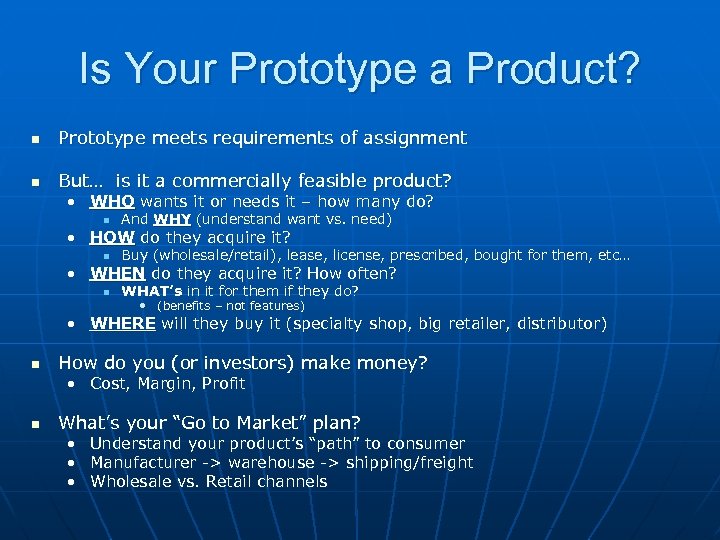
Is Your Prototype a Product? n Prototype meets requirements of assignment n But… is it a commercially feasible product? • WHO wants it or needs it – how many do? n And WHY (understand want vs. need) • HOW do they acquire it? n Buy (wholesale/retail), lease, license, prescribed, bought for them, etc… • WHEN do they acquire it? How often? n WHAT’s in it for them if they do? • (benefits – not features) • WHERE will they buy it (specialty shop, big retailer, distributor) n How do you (or investors) make money? • Cost, Margin, Profit n What’s your “Go to Market” plan? • • • Understand your product’s “path” to consumer Manufacturer -> warehouse -> shipping/freight Wholesale vs. Retail channels
![Product Market Viability • Market Analysis n n How big [units or $] is](https://present5.com/presentation/60228310cd1b092c32052c5ddea2ed0d/image-6.jpg "Product Market Viability • Market Analysis n n How big [units or $] is")
Product Market Viability • Market Analysis n n How big [units or $] is the Market (initial & longer term) How much competition? What Price will the Market Bear? Manufacturer’s Suggested Retail Price (MSRP) • Price Sensitivity Analysis (Van Westendorp method) n Too Cheap, Inexpensive, Expensive, Too Expensive n Who is PAYING YOU i. e. who is benefiting? • (wholesaler vs. retailer vs. consumer – value proposition) n Determine your Selling Price (Factory) • Which Channels (How product gets to consumers) n Retail, Wholesale, Resellers n Different Distribution Structures • Pricing can depend on volumes bought n Price “Tiers” or Volume Discounting breakpoints. n Cost Reduction Projects (Do it later? ) • Sometimes done in final engineering before launch • Often done after product is launched to improve margins • Time to market could be critical – best to move forward now
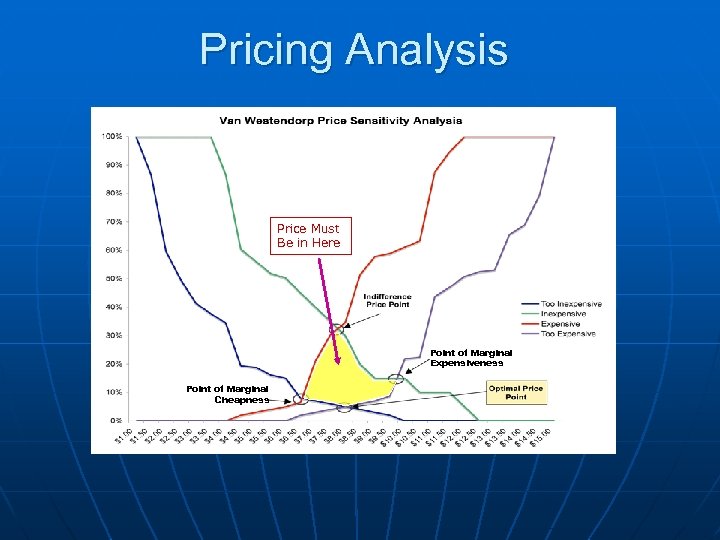
Pricing Analysis Price Must Be in Here Point of Marginal Expensiveness Point of Marginal Cheapness
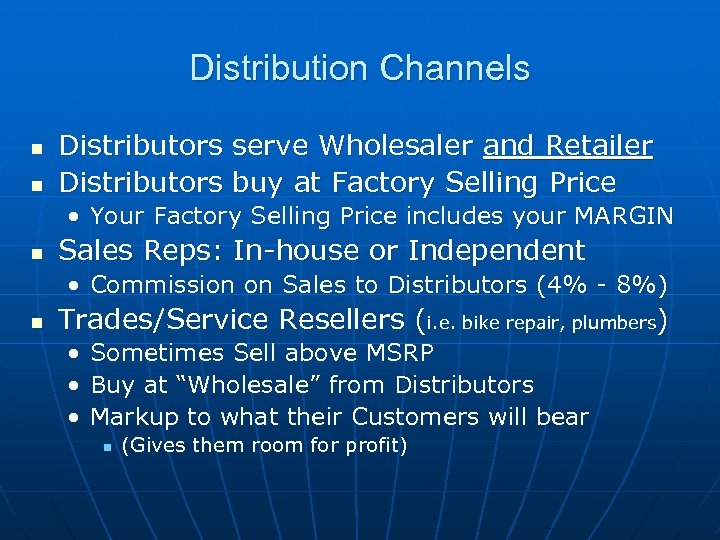
Distribution Channels n n Distributors serve Wholesaler and Retailer Distributors buy at Factory Selling Price • Your Factory Selling Price includes your MARGIN n Sales Reps: In-house or Independent • Commission on Sales to Distributors (4% - 8%) n Trades/Service Resellers (i. e. bike repair, plumbers) • Sometimes Sell above MSRP • Buy at “Wholesale” from Distributors • Markup to what their Customers will bear n (Gives them room for profit)
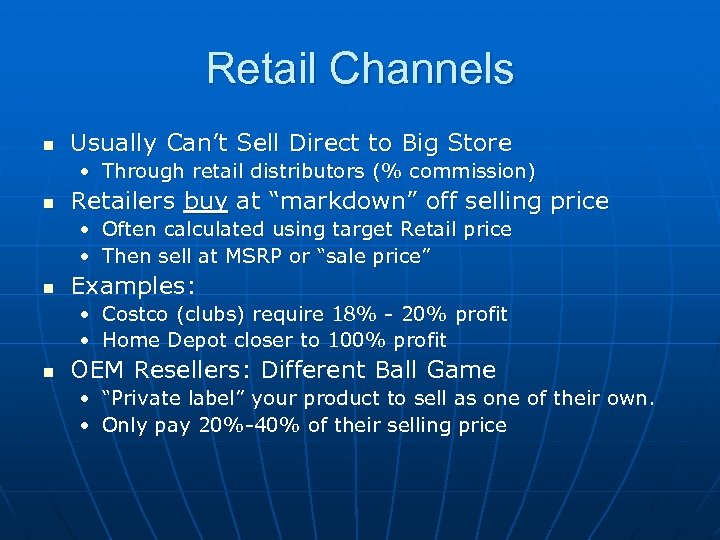
Retail Channels n Usually Can’t Sell Direct to Big Store • Through retail distributors (% commission) n Retailers buy at “markdown” off selling price • Often calculated using target Retail price • Then sell at MSRP or “sale price” n Examples: • Costco (clubs) require 18% - 20% profit • Home Depot closer to 100% profit n OEM Resellers: Different Ball Game • “Private label” your product to sell as one of their own. • Only pay 20%-40% of their selling price
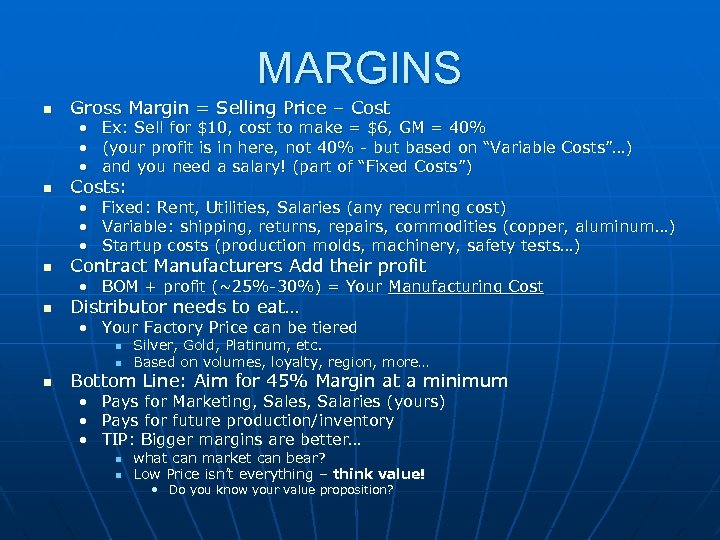
MARGINS n Gross Margin = Selling Price – Cost • • • n n Ex: Sell for $10, cost to make = $6, GM = 40% (your profit is in here, not 40% - but based on “Variable Costs”…) and you need a salary! (part of “Fixed Costs”) Fixed: Rent, Utilities, Salaries (any recurring cost) Variable: shipping, returns, repairs, commodities (copper, aluminum…) Startup costs (production molds, machinery, safety tests…) Costs: Contract Manufacturers Add their profit • BOM + profit (~25%-30%) = Your Manufacturing Cost n Distributor needs to eat… • Your Factory Price can be tiered n n n Silver, Gold, Platinum, etc. Based on volumes, loyalty, region, more… Bottom Line: Aim for 45% Margin at a minimum • Pays for Marketing, Sales, Salaries (yours) • Pays for future production/inventory • TIP: Bigger margins are better… n n what can market can bear? Low Price isn’t everything – think value! • Do you know your value proposition?
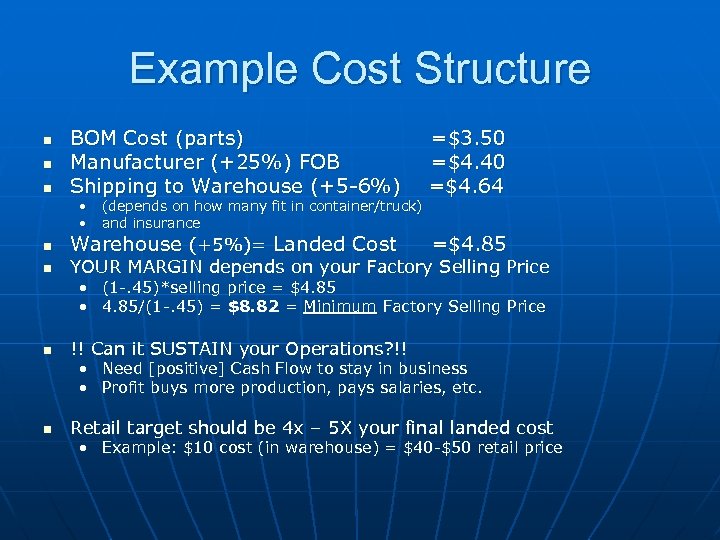
Example Cost Structure n n n BOM Cost (parts) Manufacturer (+25%) FOB Shipping to Warehouse (+5 -6%) =$3. 50 =$4. 40 =$4. 64 Warehouse (+5%)= Landed Cost =$4. 85 • (depends on how many fit in container/truck) • and insurance n n YOUR MARGIN depends on your Factory Selling Price • (1 -. 45)*selling price = $4. 85 • 4. 85/(1 -. 45) = $8. 82 = Minimum Factory Selling Price n !! Can it SUSTAIN your Operations? !! • Need [positive] Cash Flow to stay in business • Profit buys more production, pays salaries, etc. n Retail target should be 4 x – 5 X your final landed cost • Example: $10 cost (in warehouse) = $40 -$50 retail price
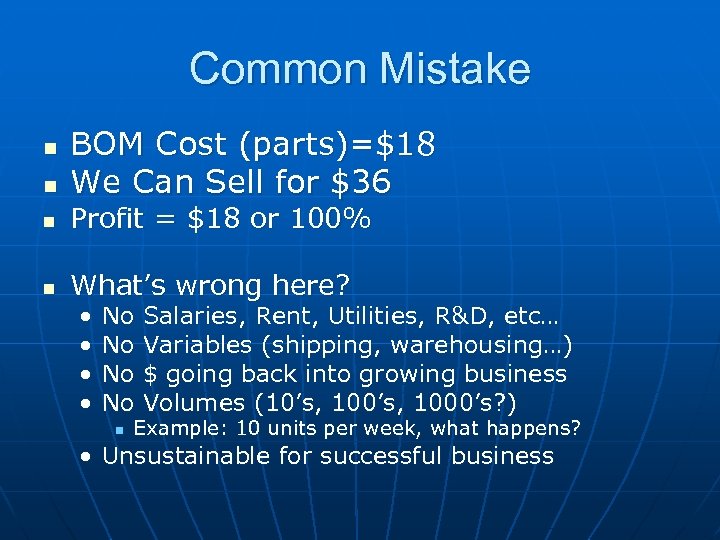
Common Mistake n n BOM Cost (parts)=$18 We Can Sell for $36 n Profit = $18 or 100% n What’s wrong here? • • No No n Salaries, Rent, Utilities, R&D, etc… Variables (shipping, warehousing…) $ going back into growing business Volumes (10’s, 1000’s? ) Example: 10 units per week, what happens? • Unsustainable for successful business
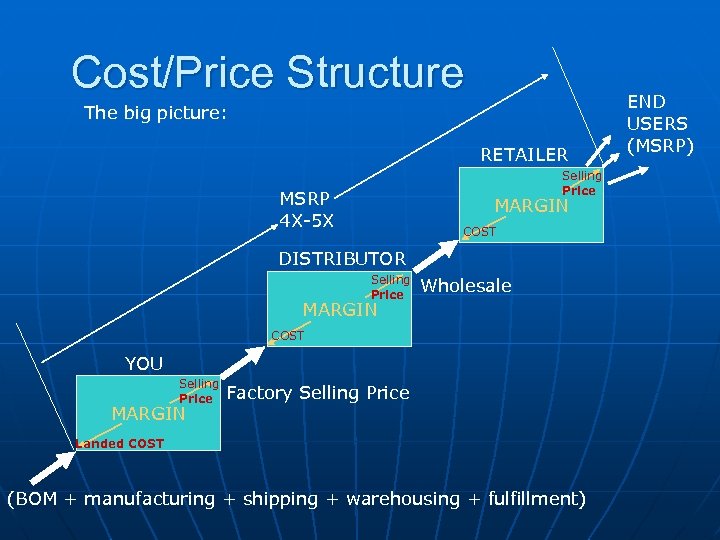
Cost/Price Structure The big picture: RETAILER Selling Price MSRP 4 X-5 X MARGIN COST DISTRIBUTOR Selling Price Wholesale MARGIN COST YOU Selling Price MARGIN Factory Selling Price Landed COST (BOM + manufacturing + shipping + warehousing + fulfillment) END USERS (MSRP)
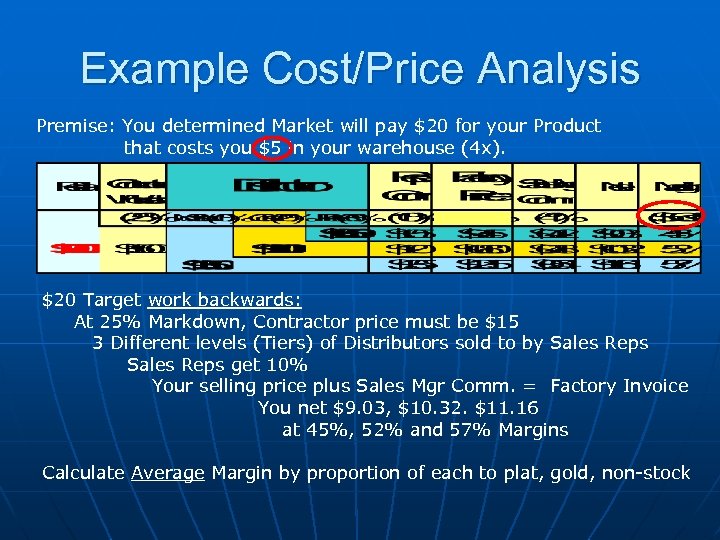
Example Cost/Price Analysis Premise: You determined Market will pay $20 for your Product that costs you $5 in your warehouse (4 x). $20 Target work backwards: At 25% Markdown, Contractor price must be $15 3 Different levels (Tiers) of Distributors sold to by Sales Reps get 10% Your selling price plus Sales Mgr Comm. = Factory Invoice You net $9. 03, $10. 32. $11. 16 at 45%, 52% and 57% Margins Calculate Average Margin by proportion of each to plat, gold, non-stock
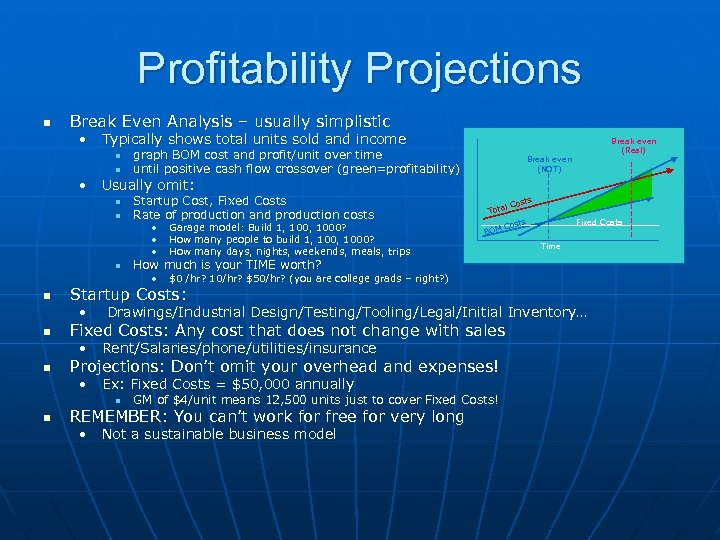
Profitability Projections n Break Even Analysis – usually simplistic • Typically shows total units sold and income n n graph BOM cost and profit/unit over time until positive cash flow crossover (green=profitability) Break even (Real) Break even (NOT) • Usually omit: n n • • • Garage model: Build 1, 1000? How many people to build 1, 1000? How many days, nights, weekends, meals, trips • l Tota ts Fixed Costs Time Drawings/Industrial Design/Testing/Tooling/Legal/Initial Inventory… Fixed Costs: Any cost that does not change with sales Projections: Don’t omit your overhead and expenses! • Ex: Fixed Costs = $50, 000 annually n n Cos How much is your TIME worth? • Rent/Salaries/phone/utilities/insurance n ts Cos $0 /hr? 10/hr? $50/hr? (you are college grads – right? ) BOM Startup Costs: • n Startup Cost, Fixed Costs Rate of production and production costs GM of $4/unit means 12, 500 units just to cover Fixed Costs! REMEMBER: You can’t work for free for very long • Not a sustainable business model
Startup Cost (Investment) n Standard Efforts: • • Ind. Design & Mech. Engineering Legal (contracts, business formation, etc) Models, Prototypes, Redesign, etc. Market Testing/pre-Selling Activities n • • • n Travel, Trade Shows, meetings Manufacturing Drawing Package Manufacturing Tooling (Plastics, Metal) Safety Test approvals (if applicable) First production run transport/warehouse Do you need a workspace? ALL BEFORE YOU SELL FIRST PRODUCTION UNITS
Your Project Approach n THIS Term Project = “Prototype” • Feasibility, Best Mode, Get it to work in 6 weeks. n Estimate your BOM Cost • Use ‘Reel prices’ / Quantity 10, 000 n n n (Surprising markup from resellers like Digi. Key & Mouser) Get quantity quote from Atmel, Fairchild, etc. Sales Reps Think “How do I make a living” • Or: How do Investors make a return on their investment n Choose Your Operational Model • “Garage Model” n n Buy parts at marked up prices, build yourself then package Work at home - Sell through e. Bay, Website, Kickstarter, etc. • Be an OEM n n Contract Manufacturer makes it for you (higher startup costs) Include FOB and shipping costs when figuring Landed Cost Fulfill from Warehouse (fees apply) Raise Money? • Crowdfunding: Needs to be cool, needs a story, elevator pitch • • 10 Top Crowdfunding Websites http: //www. entrepreneur. com/article/228534# Reward based, Debt (loans), Equity (sell Stock)
Summary n Your Selling Price covers ALL of your COSTS plus PROFIT • Includes Manufacturing, packaging, shipping, returns, etc. n n Plus Salaries - Plus Expenses You Need Profit to Sustain and Grow Your Selling Price is NOT the retail price Cost is not simply: (unless direct sales model) • Buying Parts from Reseller (Digikey), n Building and Selling Product at 2 x cost of parts - NO! • Your Time is Money so PAY yourself equitable wage! n n n Profit Limit: How many can you make per day? Multiple Pricing Levels are OK Selling Direct = No Chain Stores Likely • Doesn’t Scale Easily (Lots of Mom & Pop Stores) • Big Store Chains = Large Volumes • Volume Requires Distribution Partners n n (Need to add in their commissions) ADVICE: • Technical Entrepreneurs need Business Partners • Find a Business Partner
LIGHT READING n Bringing Your Product to Market • Don Debelak n Made to Stick [simple, unexpected, concrete, credible, emotional, stories] • Chip Heath & Dan Heath n How to License Your Million Dollar Idea • Harvey Reese n Poorly Made in China: • An Insider's Account of the Tactics Behind China's Production Game • Paul Midler n The Origin of Brands: • Discover the Natural Laws of Product Innovation and Business Survival • Al Ries and Laura Ries n The Tipping Point • Malcolm Gladwell n Frank Demmler (Entrepreneurship – growing a company) • http: //www. andrew. cmu. edu/user/fd 0 n/articles. htm n Crossing the Chasm - Geoffrey A. Moore • 1991 classic – still used in B Schools

Questions?
Скачать презентацию Bringing Product to Market The Real World Realistic
60228310cd1b092c32052c5ddea2ed0d.ppt