 Скачать презентацию Bringing Energy Efficiency into the Real Estate Value
3e181d63e0c563389b814cee21a54972.ppt
- Количество слайдов: 15



Bringing Energy Efficiency into the Real Estate Value Chain Robin Le. Baron National Home Performance Council July 19 th, 2012 1
The National Home Performance Council • National, non-profit organization • Supports whole-house upgrade programs through research and convening projects • Addresses problems that limit growth and development of whole-house programs 2
NHPC Stakeholders • Federal agencies (DOE) • State energy offices (NASEO, MD, NY, TX) • Program implementers (CSG, ICF) • Utility sector (EEI, LIPA) • Industry (NAIMA, ABM) • Real estate (Eco-Brokers / AEEREP) • Non-profit stakeholders (ACEEE, ASE, EPC) 3
NHPC Current Projects • Cost-effectiveness testing • Data collection and transfer standards • Smart grid and whole house energy efficiency upgrades • Incorporating energy efficiency data in MLS systems and appraisals 4
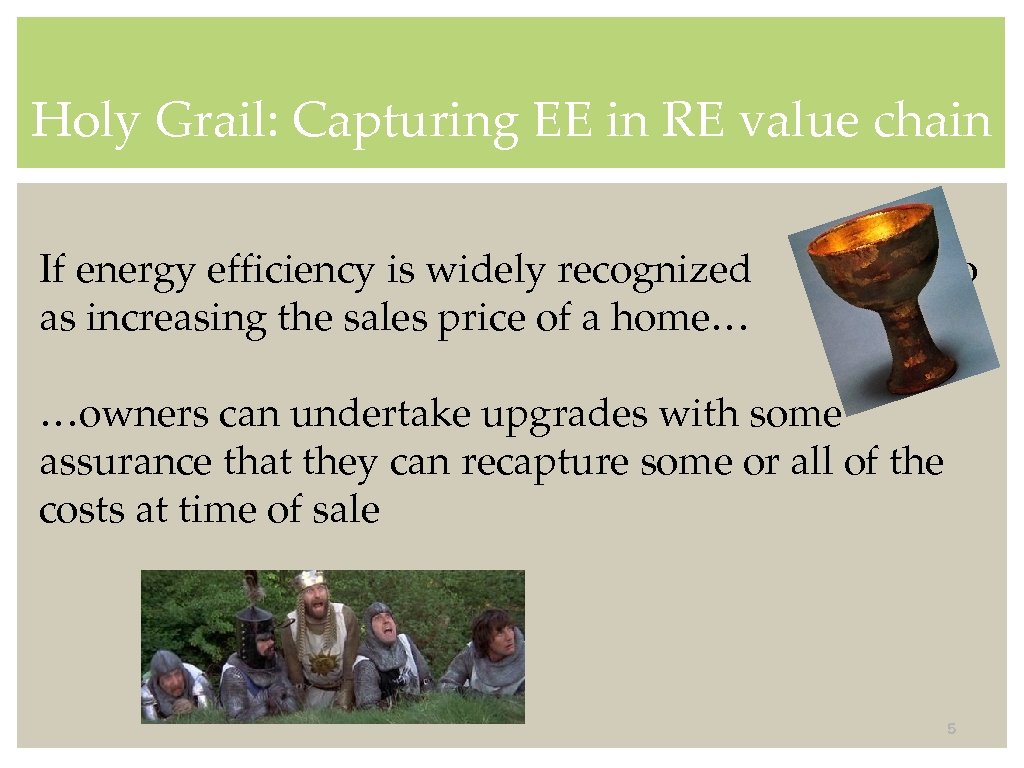
Holy Grail: Capturing EE in RE value chain If energy efficiency is widely recognized as increasing the sales price of a home… to …owners can undertake upgrades with some assurance that they can recapture some or all of the costs at time of sale 5
Real-estate valuation is data driven • Appraisers and lenders respond to market • Need proof that energy efficient homes sell for higher prices • Quantification of the “contributory value” of energy efficiency necessary 6
Getting data into MLS systems is crucial • To assess the contributory value of energy efficiency, data is needed on: • Sales price of homes • Energy efficiency characteristics of home • Other home characteristics (to ensure apples-toapples comparisons) • Multiple Listing Services are primary data source / repository 7
Getting data into MLS systems is painful • Most MLS databases do not incorporate information about energy efficiency • Necessary to add fields to the databases: laborious and time-consuming process • What are the best fields to add so that energy efficiency can be captured in MLS systems? 8
Retrofits particularly challenging • Challenges particularly great for upgrades / retrofits • Quantity • Complexity • Reliability • Liability 9
Standard data set for certificate • BPI-2101 -S-2011 Standard Requirements for a Certificate of Completion for Whole-House Energy Efficiency Upgrades • ANSI standard developed through stakeholderdriven consensus process • Process underway: goal is completion by September 2012 10
Contents of standard • Standard set of data describing measures implemented • Can also include labels, savings projections and/or consumption data • Local programmatic customization assumed 11
Standard helps address data entry issues • Certificate helps overcome challenges of getting information into MLS systems: • Quantity: Large amounts of data • Complexity: Simple for RE agents to upload • Reliability: Issued by knowledgeable third party • Liability: Reduced as a result of third party issuance 12
Other uses of a standard certificate • Effective marketing tool for contractors • Helps homeowner recapture value of energy efficiency at time of sale • Adds value to an HP program’s core product • Preserves information about a home’s energy efficiency far into the future 13
Comments / Questions Please Contact Us National Home Performance Council Kara Saul-Rinaldi, Executive Director kara. saul-rinaldi@nhpci. org Robin Le. Baron, Managing Director robin. lebaron@nhpci. org www. nhpci. org 14

Thank you! 15
Скачать презентацию Bringing Energy Efficiency into the Real Estate Value
3e181d63e0c563389b814cee21a54972.ppt