 Скачать презентацию Bring Your Green to Work with ENERGY STAR
2521c0a66f4eac5f6cb09d082af96121.ppt
- Количество слайдов: 39



Bring Your Green to Work with ENERGY STAR® How to save energy and protect the environment —all without leaving your workplace!
Energy and the Environment 2
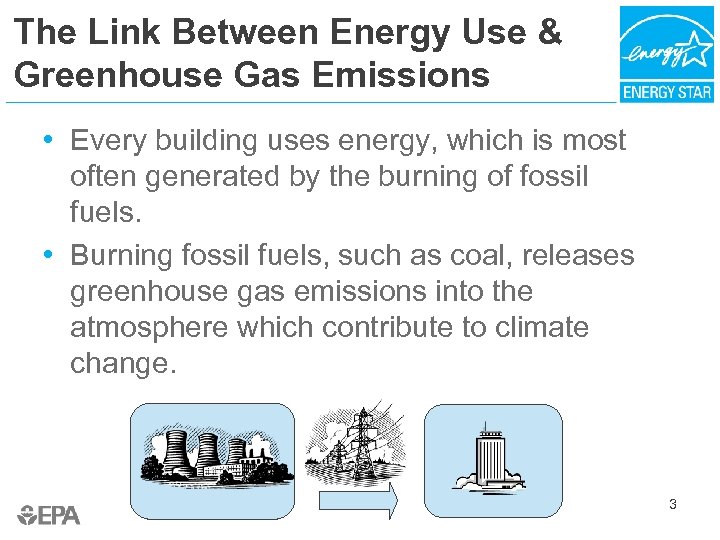
The Link Between Energy Use & Greenhouse Gas Emissions • Every building uses energy, which is most often generated by the burning of fossil fuels. • Burning fossil fuels, such as coal, releases greenhouse gas emissions into the atmosphere which contribute to climate change. 3
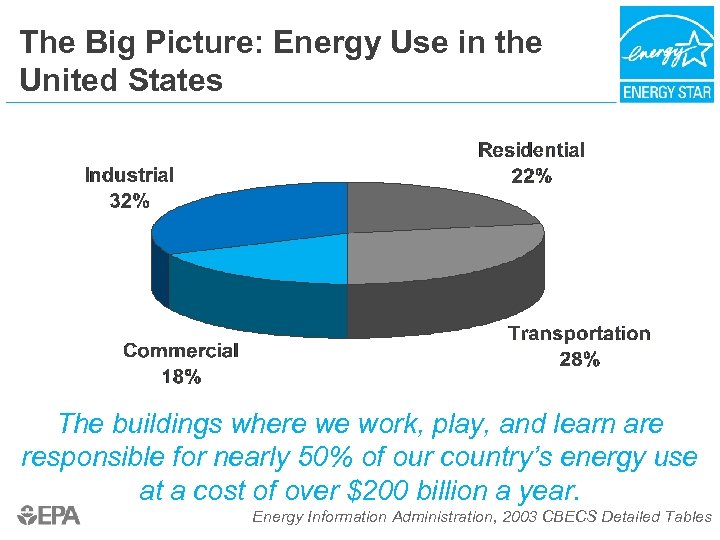
The Big Picture: Energy Use in the United States The buildings where we work, play, and learn are responsible for nearly 50% of our country’s energy use at a cost of over $200 billion a year. Energy Information Administration, 2003 CBECS Detailed Tables
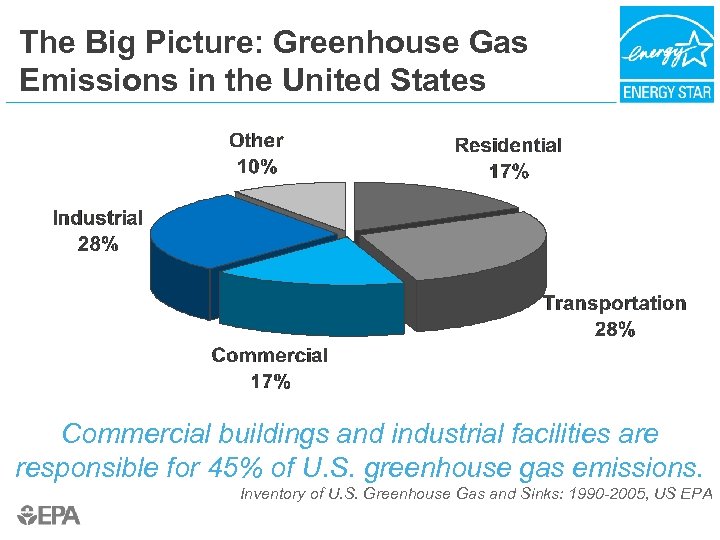
The Big Picture: Greenhouse Gas Emissions in the United States Commercial buildings and industrial facilities are responsible for 45% of U. S. greenhouse gas emissions. Inventory of U. S. Greenhouse Gas and Sinks: 1990 -2005, US EPA
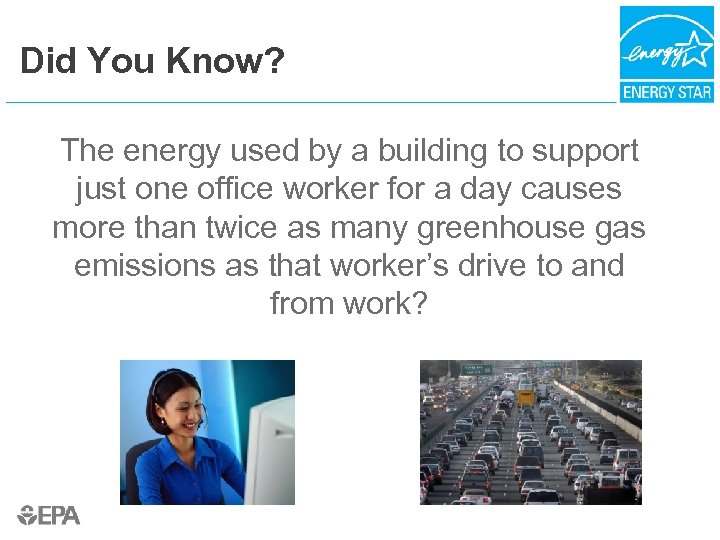
Did You Know? The energy used by a building to support just one office worker for a day causes more than twice as many greenhouse gas emissions as that worker’s drive to and from work?
Opportunities for Energy Efficiency • The average building wastes 30% of the energy it consumes because of inefficiencies. • If the energy efficiency of U. S. commercial and industrial buildings improved by 10%: – Savings of $20 billion. – Reductions in greenhouse gas emissions equal to about 30 million vehicles. … a year 7
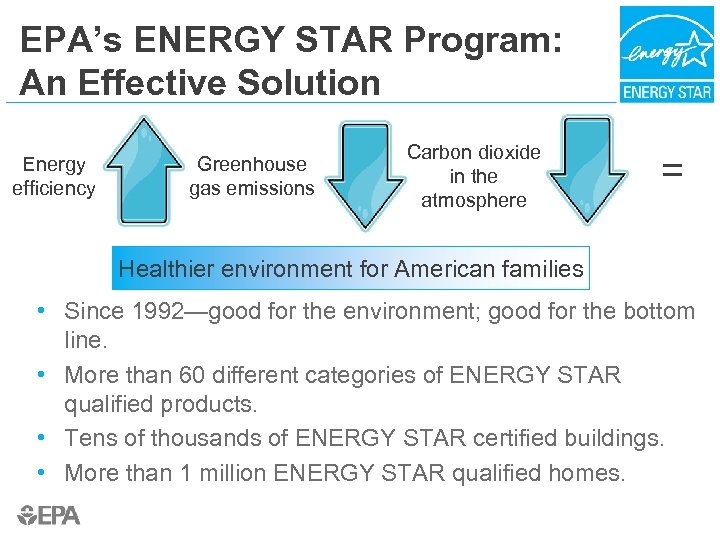
EPA’s ENERGY STAR Program: An Effective Solution Energy efficiency Greenhouse gas emissions Carbon dioxide in the atmosphere = Healthier environment for American families • Since 1992—good for the environment; good for the bottom line. • More than 60 different categories of ENERGY STAR qualified products. • Tens of thousands of ENERGY STAR certified buildings. • More than 1 million ENERGY STAR qualified homes.
ENERGY STAR and the Buildings Where We Work, Play and Learn • Buildings that perform in the top 25% of energy efficiency nationwide compared to their peers may be eligible for the ENERGY STAR. • ENERGY STAR certified buildings: – Use 35% less energy. – Generate 35% fewer greenhouse gas emissions. – Cost 50 cents less per square foot to operate (office buildings). • Look for the ENERGY STAR next time you go to the grocery store or choose a hotel for your next vacation! (See energystar. gov/buildinglist. )
Helping Organizations Improve Energy Efficiency • EPA has challenged organizations to improve the energy performance of their buildings by 10% or more. • Thousands of organizations are working toward this goal—and beyond. • We are answering this Challenge. – Took the ENERGY STAR Challenge in XXXX [or] Joined ENERGY STAR as a partner in XXXX. – Taking steps in our organization to save energy and educate our employees, such as this brownbag! 10
What Our Partnership with ENERGY STAR Means • We’ve joined more than 5, 800 other ENERGY STAR partners to improve the energy efficiency of buildings where we work, play and learn. • ENERGY STAR partners have helped prevent emissions equal to the electricity used by more than 60 million American homes per year. • Improving energy efficiency frees up financial resources for other uses. 11
What We’re Doing to Save Energy • As part of the ENERGY STAR partnership commitment, we agreed to: – Measure and track energy use in the buildings we own or manage. – Develop a plan to improve energy performance. – Make energy efficiency upgrades. – Spread the word about energy efficiency to others. – Design new buildings that we own or manage to be energy efficient. • In addition, we’ve decided to go green by: – Recycling cardboard, paper, plastic, glass, and metals. – Using recycled paper. – Cutting down on water use. 12
You Can Help! • Like everything we do here at Organization Name, energy efficiency is a team effort. • Small changes make a big impact. • By working together, we can save energy and help protect the environment. 13
What You Can Do to Help Save Energy 14
Bring Your Green to Work • www. energystar. gov/work • EPA can help you make many of the same green choices at work as you make at home. 15
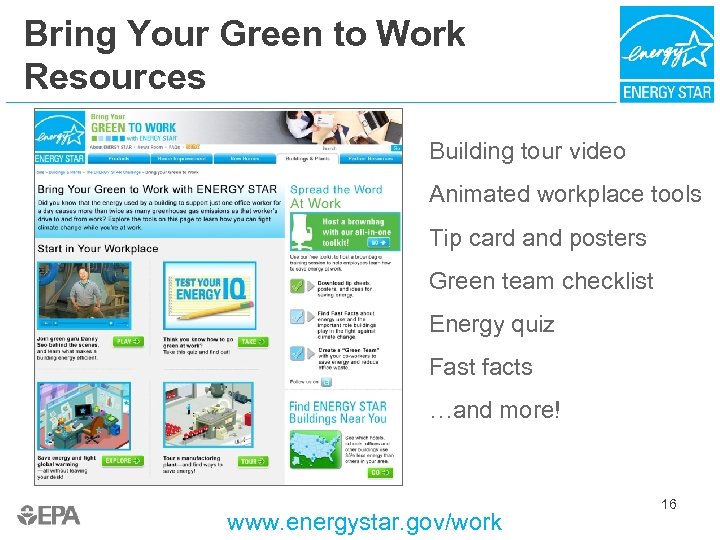
Bring Your Green to Work Resources Building tour video Animated workplace tools Tip card and posters Green team checklist Energy quiz Fast facts …and more! www. energystar. gov/work 16
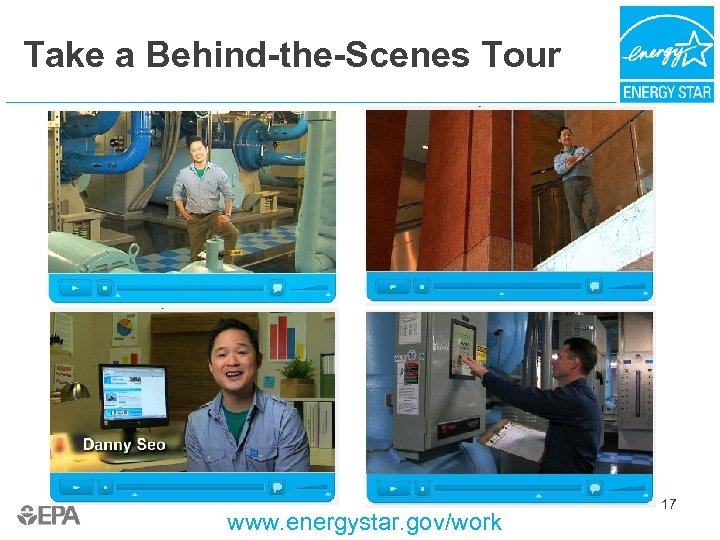
Take a Behind-the-Scenes Tour www. energystar. gov/work 17
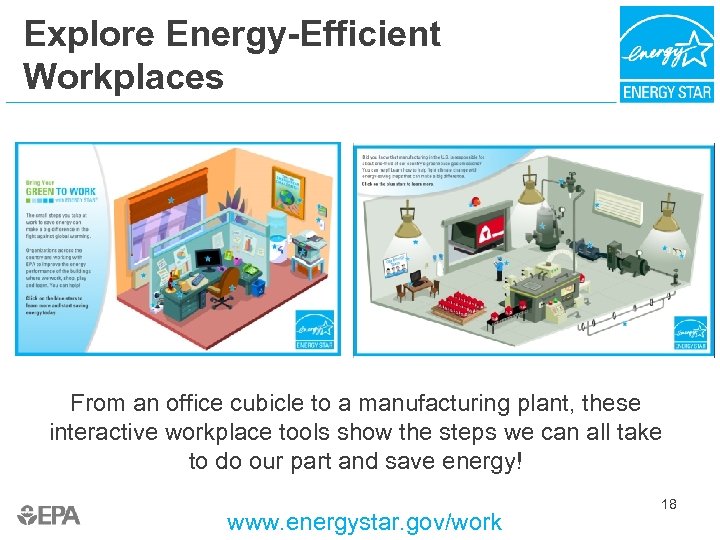
Explore Energy-Efficient Workplaces From an office cubicle to a manufacturing plant, these interactive workplace tools show the steps we can all take to do our part and save energy! www. energystar. gov/work 18
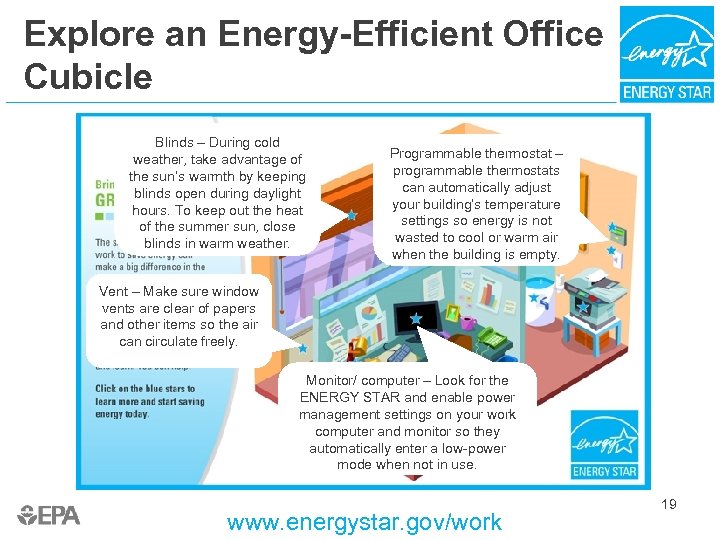
Explore an Energy-Efficient Office Cubicle Blinds – During cold weather, take advantage of the sun’s warmth by keeping blinds open during daylight hours. To keep out the heat of the summer sun, close blinds in warm weather. Programmable thermostat – programmable thermostats can automatically adjust your building’s temperature settings so energy is not wasted to cool or warm air when the building is empty. Vent – Make sure window vents are clear of papers and other items so the air can circulate freely. Monitor/ computer – Look for the ENERGY STAR and enable power management settings on your work computer and monitor so they automatically enter a low-power mode when not in use. www. energystar. gov/work 19
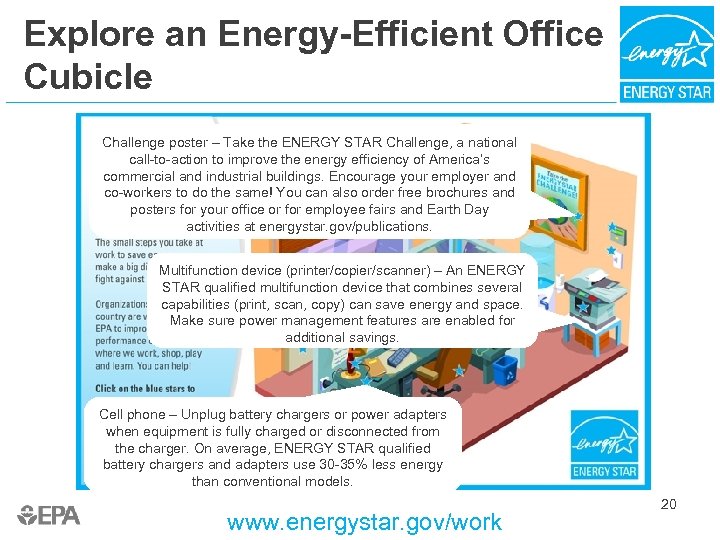
Explore an Energy-Efficient Office Cubicle Challenge poster – Take the ENERGY STAR Challenge, a national call-to-action to improve the energy efficiency of America’s commercial and industrial buildings. Encourage your employer and co-workers to do the same! You can also order free brochures and posters for your office or for employee fairs and Earth Day activities at energystar. gov/publications. Multifunction device (printer/copier/scanner) – An ENERGY STAR qualified multifunction device that combines several capabilities (print, scan, copy) can save energy and space. Make sure power management features are enabled for additional savings. Cell phone – Unplug battery chargers or power adapters when equipment is fully charged or disconnected from the charger. On average, ENERGY STAR qualified battery chargers and adapters use 30 -35% less energy than conventional models. www. energystar. gov/work 20
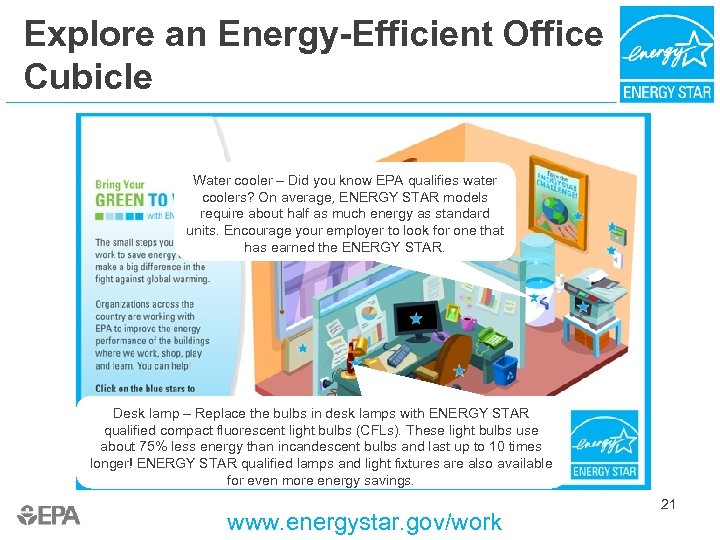
Explore an Energy-Efficient Office Cubicle Water cooler – Did you know EPA qualifies water coolers? On average, ENERGY STAR models require about half as much energy as standard units. Encourage your employer to look for one that has earned the ENERGY STAR. Desk lamp – Replace the bulbs in desk lamps with ENERGY STAR qualified compact fluorescent light bulbs (CFLs). These light bulbs use about 75% less energy than incandescent bulbs and last up to 10 times longer! ENERGY STAR qualified lamps and light fixtures are also available for even more energy savings. www. energystar. gov/work 21
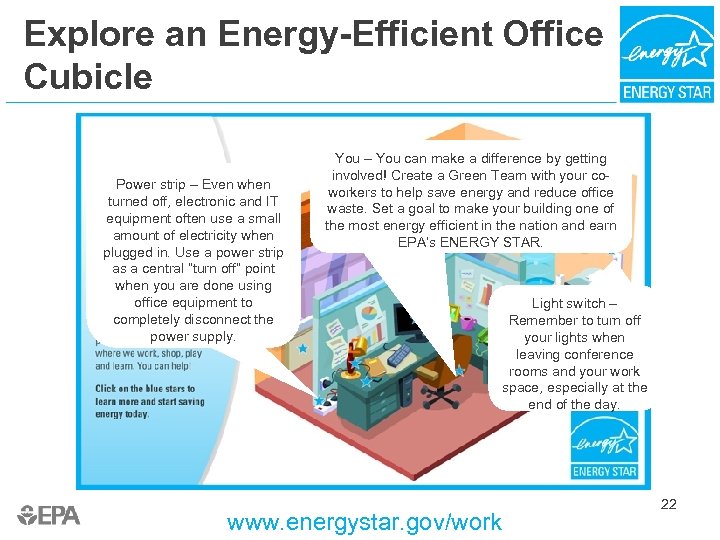
Explore an Energy-Efficient Office Cubicle Power strip – Even when turned off, electronic and IT equipment often use a small amount of electricity when plugged in. Use a power strip as a central “turn off” point when you are done using office equipment to completely disconnect the power supply. You – You can make a difference by getting involved! Create a Green Team with your coworkers to help save energy and reduce office waste. Set a goal to make your building one of the most energy efficient in the nation and earn EPA’s ENERGY STAR. Light switch – Remember to turn off your lights when leaving conference rooms and your work space, especially at the end of the day. www. energystar. gov/work 22
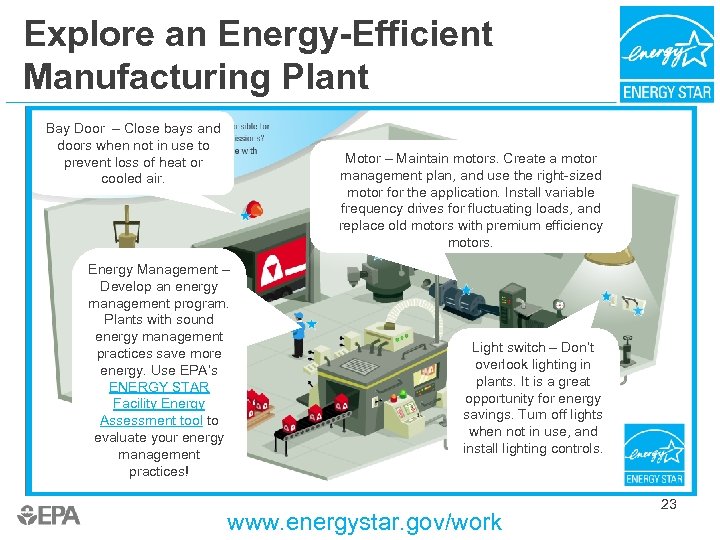
Explore an Energy-Efficient Manufacturing Plant Bay Door – Close bays and doors when not in use to prevent loss of heat or cooled air. Motor – Maintain motors. Create a motor management plan, and use the right-sized motor for the application. Install variable frequency drives for fluctuating loads, and replace old motors with premium efficiency motors. Energy Management – Develop an energy management program. Plants with sound energy management practices save more energy. Use EPA’s ENERGY STAR Facility Energy Assessment tool to evaluate your energy management practices! Light switch – Don’t overlook lighting in plants. It is a great opportunity for energy savings. Turn off lights when not in use, and install lighting controls. www. energystar. gov/work 23
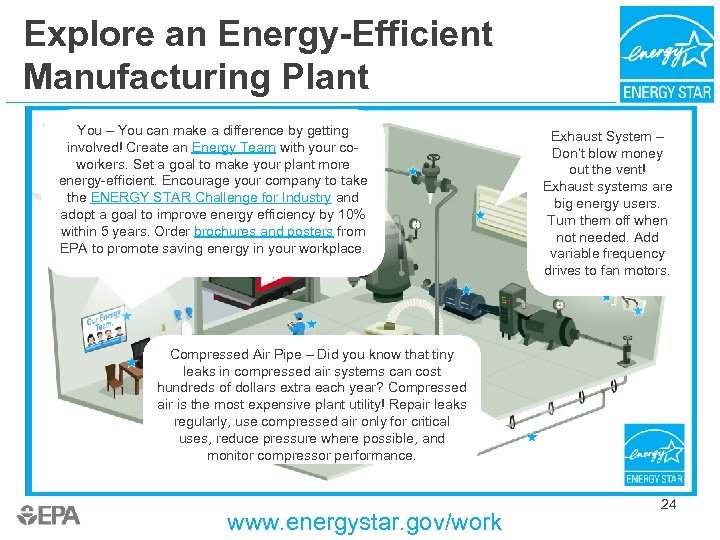
Explore an Energy-Efficient Manufacturing Plant You – You can make a difference by getting involved! Create an Energy Team with your coworkers. Set a goal to make your plant more energy-efficient. Encourage your company to take the ENERGY STAR Challenge for Industry and adopt a goal to improve energy efficiency by 10% within 5 years. Order brochures and posters from EPA to promote saving energy in your workplace. Exhaust System – Don’t blow money out the vent! Exhaust systems are big energy users. Turn them off when not needed. Add variable frequency drives to fan motors. Compressed Air Pipe – Did you know that tiny leaks in compressed air systems can cost hundreds of dollars extra each year? Compressed air is the most expensive plant utility! Repair leaks regularly, use compressed air only for critical uses, reduce pressure where possible, and monitor compressor performance. www. energystar. gov/work 24
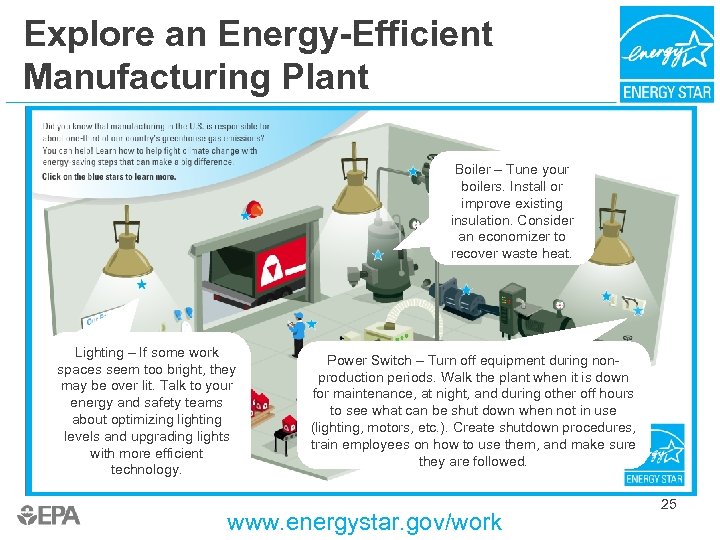
Explore an Energy-Efficient Manufacturing Plant Boiler – Tune your boilers. Install or improve existing insulation. Consider an economizer to recover waste heat. Lighting – If some work spaces seem too bright, they may be over lit. Talk to your energy and safety teams about optimizing lighting levels and upgrading lights with more efficient technology. Power Switch – Turn off equipment during nonproduction periods. Walk the plant when it is down for maintenance, at night, and during other off hours to see what can be shut down when not in use (lighting, motors, etc. ). Create shutdown procedures, train employees on how to use them, and make sure they are followed. www. energystar. gov/work 25
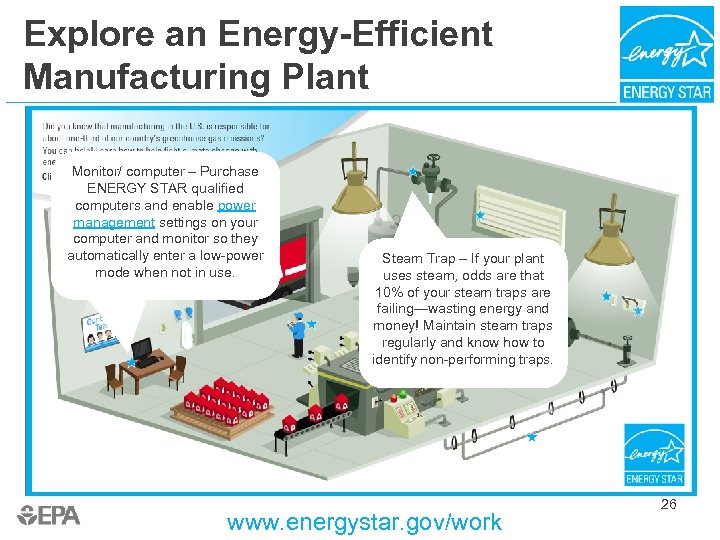
Explore an Energy-Efficient Manufacturing Plant Monitor/ computer – Purchase ENERGY STAR qualified computers and enable power management settings on your computer and monitor so they automatically enter a low-power mode when not in use. Steam Trap – If your plant uses steam, odds are that 10% of your steam traps are failing—wasting energy and money! Maintain steam traps regularly and know how to identify non-performing traps. www. energystar. gov/work 26
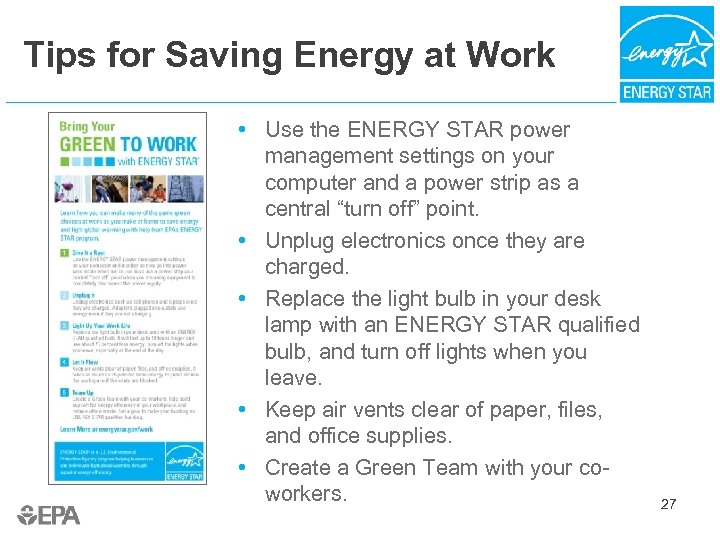
Tips for Saving Energy at Work • Use the ENERGY STAR power management settings on your computer and a power strip as a central “turn off” point. • Unplug electronics once they are charged. • Replace the light bulb in your desk lamp with an ENERGY STAR qualified bulb, and turn off lights when you leave. • Keep air vents clear of paper, files, and office supplies. • Create a Green Team with your coworkers. 27
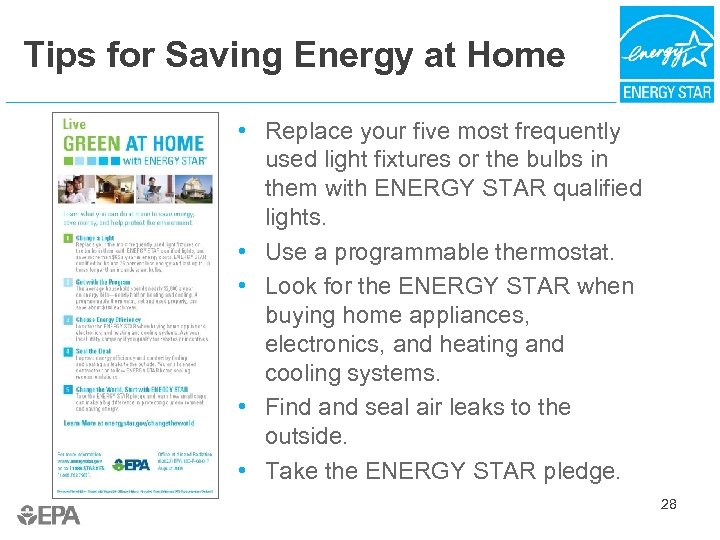
Tips for Saving Energy at Home • Replace your five most frequently used light fixtures or the bulbs in them with ENERGY STAR qualified lights. • Use a programmable thermostat. • Look for the ENERGY STAR when buying home appliances, electronics, and heating and cooling systems. • Find and seal air leaks to the outside. • Take the ENERGY STAR pledge. 28
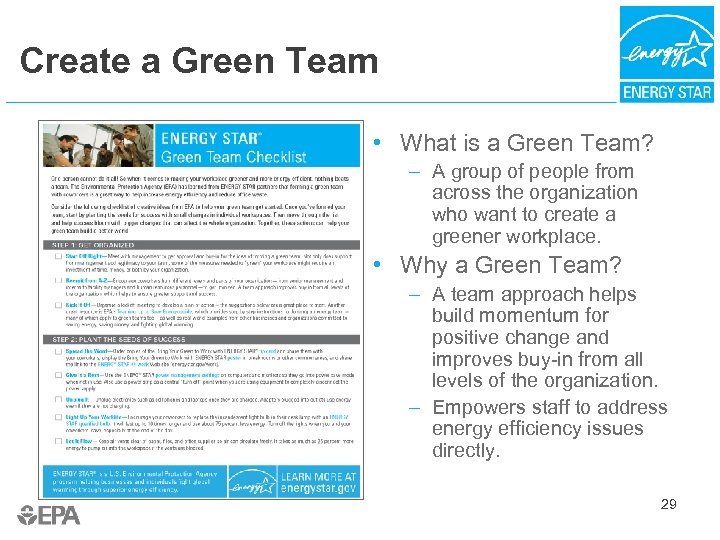
Create a Green Team • What is a Green Team? – A group of people from across the organization who want to create a greener workplace. • Why a Green Team? – A team approach helps build momentum for positive change and improves buy-in from all levels of the organization. – Empowers staff to address energy efficiency issues directly. 29
What Our Green Team Can Accomplish • Identify areas for improvement. • Brainstorm energy efficiency steps to take in our office. – Which ideas from the tip card and ENERGY STAR @ work and/or @ the factory tools can we apply now individually? – What ideas should the team tackle? – What ideas might need support from senior management? – Others? 30
Get Started • Determine Green Team first steps: – Identify interested coworkers and candidate members. – Schedule a kick-off meeting. • Consider how to win company support for: – Becoming an ENERGY STAR partner. – Taking the ENERGY STAR Challenge. 31
Other Steps You Can Take to Save Energy 32
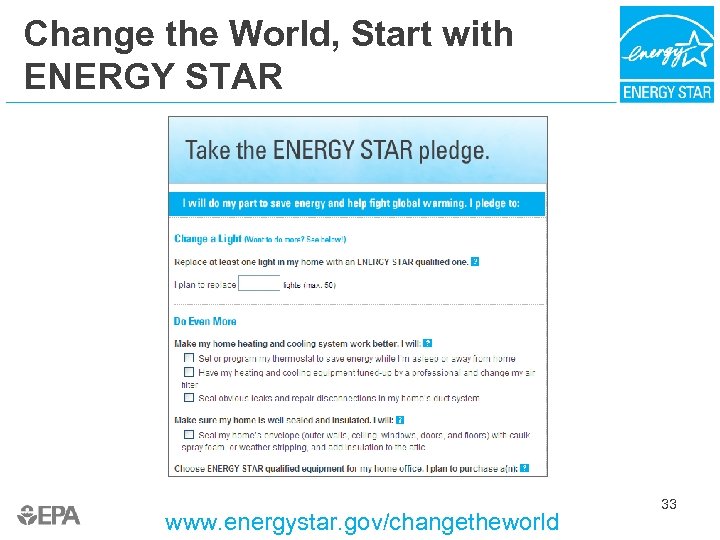
Change the World, Start with ENERGY STAR www. energystar. gov/changetheworld 33
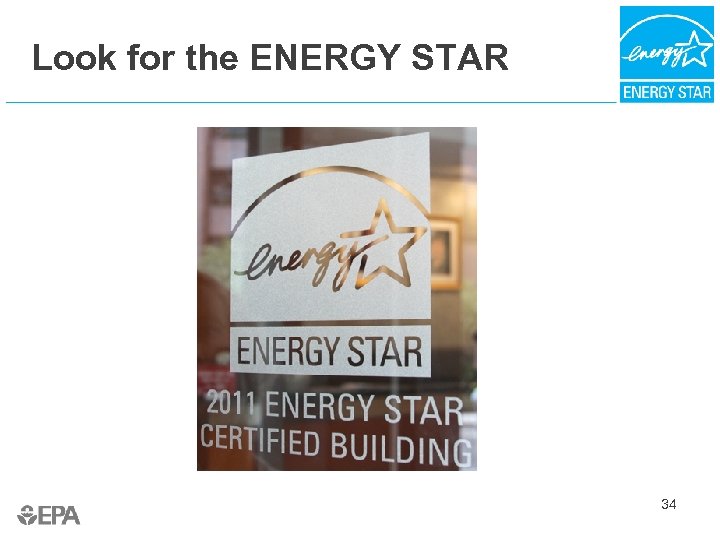
Look for the ENERGY STAR 34
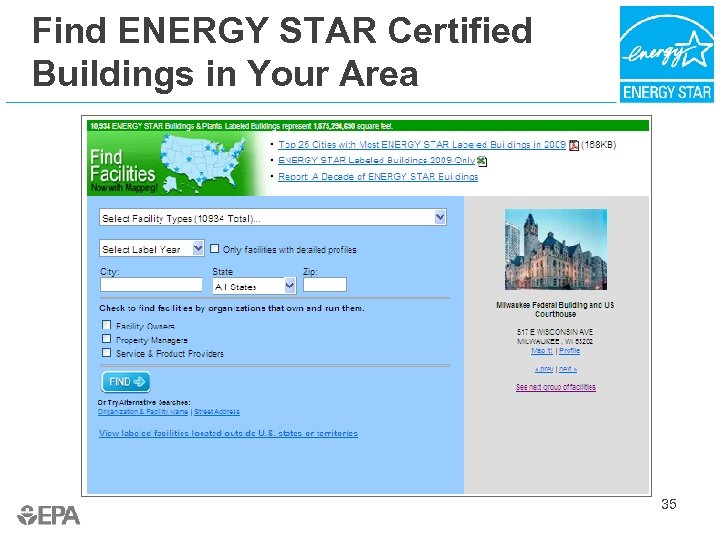
Find ENERGY STAR Certified Buildings in Your Area 35
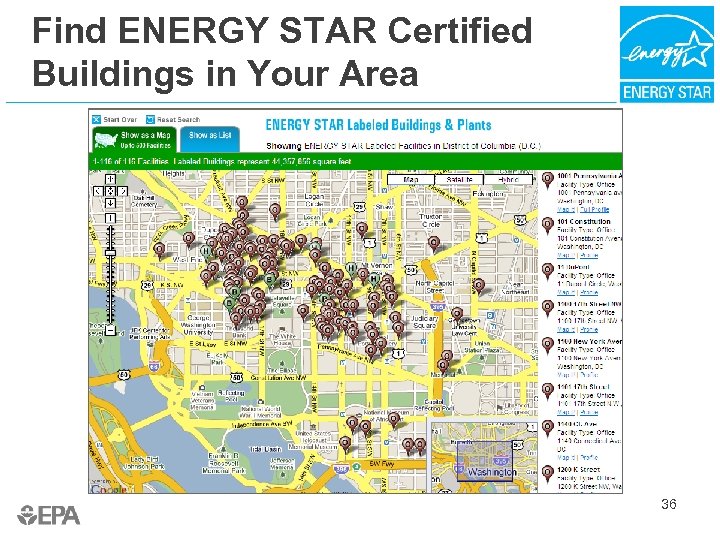
Find ENERGY STAR Certified Buildings in Your Area 36
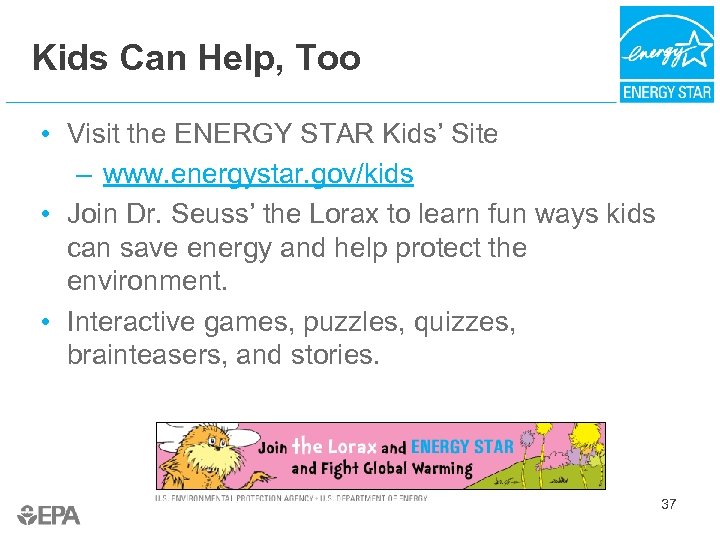
Kids Can Help, Too • Visit the ENERGY STAR Kids’ Site – www. energystar. gov/kids • Join Dr. Seuss’ the Lorax to learn fun ways kids can save energy and help protect the environment. • Interactive games, puzzles, quizzes, brainteasers, and stories. 37
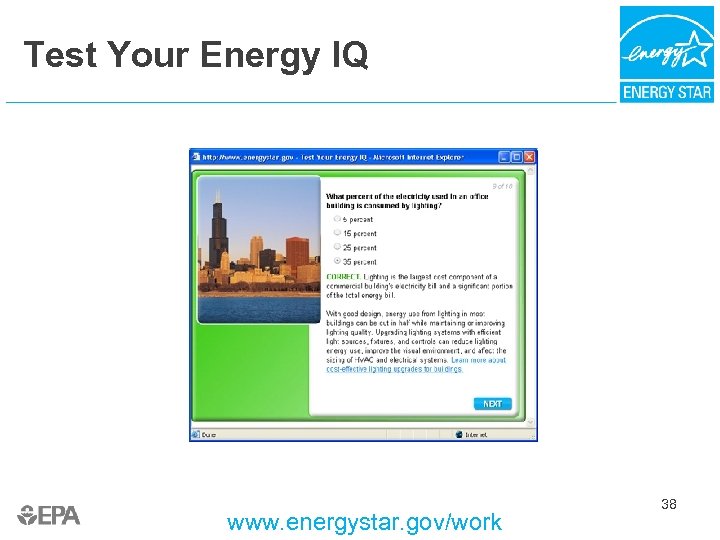
Test Your Energy IQ www. energystar. gov/work 38
For more information, please contact: Organization contact: Your name Phone # Email address EPA’s ENERGY STAR program 1. 888. STAR. YES 39
Скачать презентацию Bring Your Green to Work with ENERGY STAR
2521c0a66f4eac5f6cb09d082af96121.ppt