 Скачать презентацию Briefing to Public Works Portfolio Committee Inner City
4aecd93a8b7ee9035f495f56d6895b73.ppt
- Количество слайдов: 31



Briefing to Public Works Portfolio Committee Inner City Regeneration Programme 28 November 2012 1
Briefing to Public Works Portfolio Committee Presentation 1 - Regenerating the Inner City of Tshwane Presentation 2 - Urban Renewal Initiatives 2
Purpose of the Presentation To inform the Portfolio Committee on Public Works on the Inner City Master Plan Project currently under way in Tshwane under the joint auspices of Public Works and the City of Tshwane 3
Capital 2055 vision of City of Tshwane Strategy significance • Tshwane 2055 is a long-term growth and development strategy and visioning process by the City of Tshwane (Co. T), aimed at improving the quality of living across the Metro, revitalising the City, and boosting economic development and attracting investment – It will articulate the City’s vision, game changing strategic interventions, indicators and outcomes. – The ultimate goal is to position the City so that it can tap into the international connections and boost global trade, and Tshwane can well be on its way towards its goal of becoming a capital city of excellence – The City aims to launch an affordable public transport system that can hold its own against its competition, Johannesburg and Cape Town – The City intends to bring into reality a city where both the rich and poor are in close proximity to not only their workplaces, but also parks, shops, and a full range of amenities 4
Strategic alignment to Government Policy • Pronouncement by the President that South Africa would spend billions of rand over the coming years on new infrastructure, namely building rail, road and economic links in five regions in the country; this include building of new universities and refurbishing hospitals; • The September 2012 Cabinet Lekgotla focused on ensuring that government remains accountable to the service delivery needs of our people through the three spheres of government; • The National Development Plan 2030 aims to eliminate poverty and reduce inequality by 2030; • The Draft Spatial Planning and Land Use Management Bill, 2012; and • Tshwane is regarded as one of the key nodes of the largest City Regions in South Africa 5
Project Collaboration • Mandate – Public Works acknowledges that the City has the mandate to develop, operate and maintain the Inner City as the core of the nation’s executive capital where National Government head office administration is housed • Government as major tenant - However, without National Government, any attempt to position Tshwane as an African Capital City will be impossible and the reinvigoration of the Government estate is essential to the successful regeneration of the Inner City • DPW/Co. T SLA –Executive - Deputy Minister Jeremy Cronin of Public Works, and Cllr Kgosientso Ramokgopa, The Executive Mayor of the City of Tshwane, met as recently as 17 October 2012 on the Tshwane Inner City Master Plan project during which session, collaboration between tiers of government was reconfirmed • Collaboration - Imperative is the improvement of inter-governmental relations, enhancing skills and planning capacity, and integrating planning to accelerate government project implementation to improve service delivery • Engagement – A comprehensive internal/external engagement strategy is in place 6
Mandate of the National Government in Tshwane • Public Works’ mandate - To improve the physical working environment of government departments and agencies within the inner city of Tshwane to an acceptable norm for improved service delivery • Cabinet/Cabinet Committee memoranda o October 1997 & March 2001 - Reaffirming the Cabinet’s decision of the importance of Government Departments to remain within the Tshwane Inner City as part of an economic initiative to regenerate the area o October 2004 & May 2005 – Approval of the Department’s proposed Strategic and Implementation Plans for the accommodation of National Government in the Tshwane Inner City • Tshwane Inner City Programme 2004 - The program, based on Cabinet directives, verified the accommodation needs of National Departments, and confirmed that national government departments require improved accommodation, conducive locations, and work environments to enable better levels of service delivery • Re Kgabisa Tshwane Programme 2007 – Based on the above analysis, this macro-level planning project investigated best long term accommodation solutions for National Government within the Tshwane Inner City 7
Background • MOU 2005 – Based on the RKTP findings, the Department and the City of Tshwane (Co. T) signed a Memorandum of Understanding to collaborate on the future challenges of Tshwane • ICDF 2008 - The DPW and Co. T jointly developed and approved the Tshwane Inner City Development Framework as required by the Municipal Systems Act 2000 • RKTP 2004 + key outcomes: o o o The ‘Re Kgabisa Tshwane’ project effectively ended at the integration of the government estate and footprint in the Inner City with the spatial development framework of the City of Tshwane during 2008 The project produced a detailed analysis of client department accommodation needs It offered head office location opportunities in the Inner City It advised the procurement of Salvokop from Transnet as a green-fields opportunity for 6 national head office buildings, as well as various other properties Various properties/buildings were procured for head office construction Professional advice procured from e. g. urban design, infrastructure, architectural, economic specialists to inform national government’s role & responsibility in the Tshwane Inner City 8
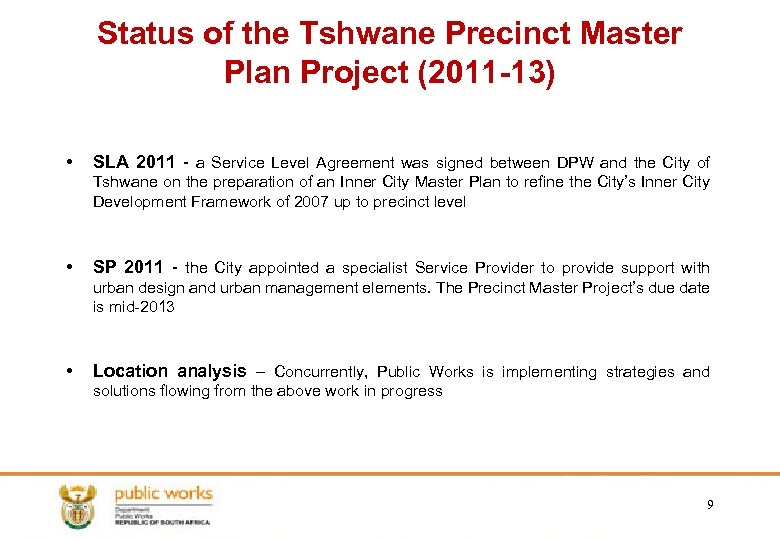
Status of the Tshwane Precinct Master Plan Project (2011 -13) • SLA 2011 - a Service Level Agreement was signed between DPW and the City of Tshwane on the preparation of an Inner City Master Plan to refine the City’s Inner City Development Framework of 2007 up to precinct level • SP 2011 - the City appointed a specialist Service Provider to provide support with urban design and urban management elements. The Precinct Master Project’s due date is mid-2013 • Location analysis – Concurrently, Public Works is implementing strategies and solutions flowing from the above work in progress 9
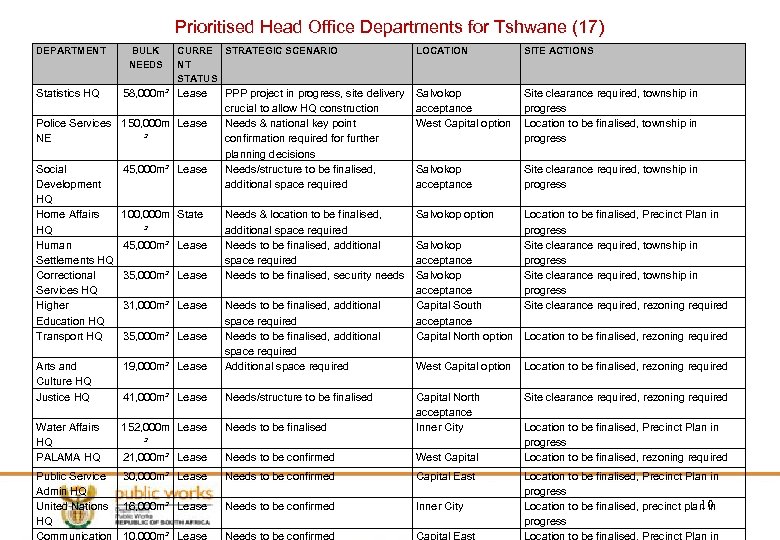
Prioritised Head Office Departments for Tshwane (17) DEPARTMENT Statistics HQ BULK NEEDS CURRE STRATEGIC SCENARIO NT STATUS 58, 000 m² Lease Police Services 150, 000 m Lease NE ² Social Development HQ Home Affairs HQ Human Settlements HQ Correctional Services HQ Higher Education HQ Transport HQ 45, 000 m² Lease 100, 000 m State ² 45, 000 m² Lease 31, 000 m² Lease LOCATION SITE ACTIONS PPP project in progress, site delivery crucial to allow HQ construction Needs & national key point confirmation required for further planning decisions Needs/structure to be finalised, additional space required Salvokop acceptance West Capital option Site clearance required, township in progress Location to be finalised, township in progress Salvokop acceptance Site clearance required, township in progress Needs & location to be finalised, additional space required Needs to be finalised, security needs Salvokop option Location to be finalised, Precinct Plan in progress Site clearance required, township in progress Site clearance required, rezoning required Arts and Culture HQ Justice HQ 19, 000 m² Lease Needs to be finalised, additional space required Additional space required 41, 000 m² Lease Needs/structure to be finalised Water Affairs HQ PALAMA HQ 152, 000 m Lease ² 21, 000 m² Lease Public Service Admin HQ United Nations HQ 35, 000 m² Lease Salvokop acceptance Capital South acceptance Capital North option Location to be finalised, rezoning required West Capital option Location to be finalised, rezoning required Site clearance required, rezoning required Needs to be finalised Capital North acceptance Inner City Needs to be confirmed West Capital 30, 000 m² Lease Needs to be confirmed Capital East 16, 000 m² Lease Needs to be confirmed Inner City Location to be finalised, Precinct Plan in progress Location to be finalised, rezoning required Location to be finalised, Precinct Plan in progress 10 Location to be finalised, precinct plan in progress
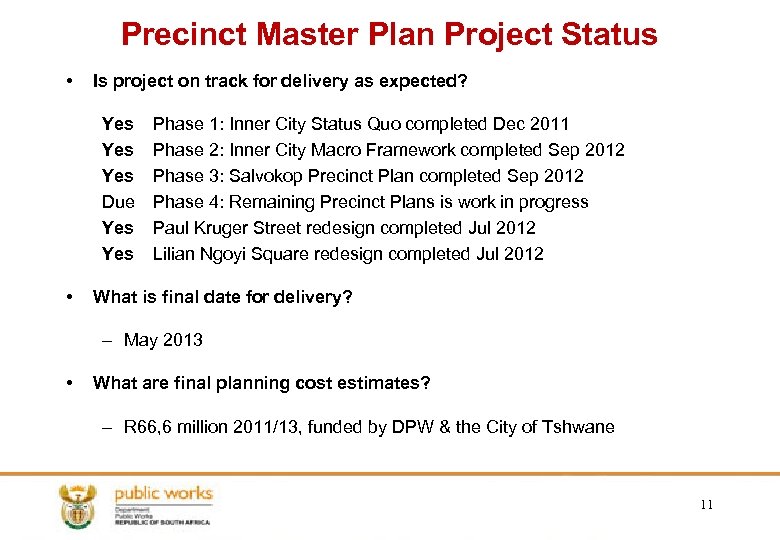
Precinct Master Plan Project Status • Is project on track for delivery as expected? Yes Phase 1: Inner City Status Quo completed Dec 2011 Yes Phase 2: Inner City Macro Framework completed Sep 2012 Yes Phase 3: Salvokop Precinct Plan completed Sep 2012 Due Phase 4: Remaining Precinct Plans is work in progress Yes Paul Kruger Street redesign completed Jul 2012 Yes Lilian Ngoyi Square redesign completed Jul 2012 • What is final date for delivery? – May 2013 • What are final planning cost estimates? – R 66, 6 million 2011/13, funded by DPW & the City of Tshwane 11
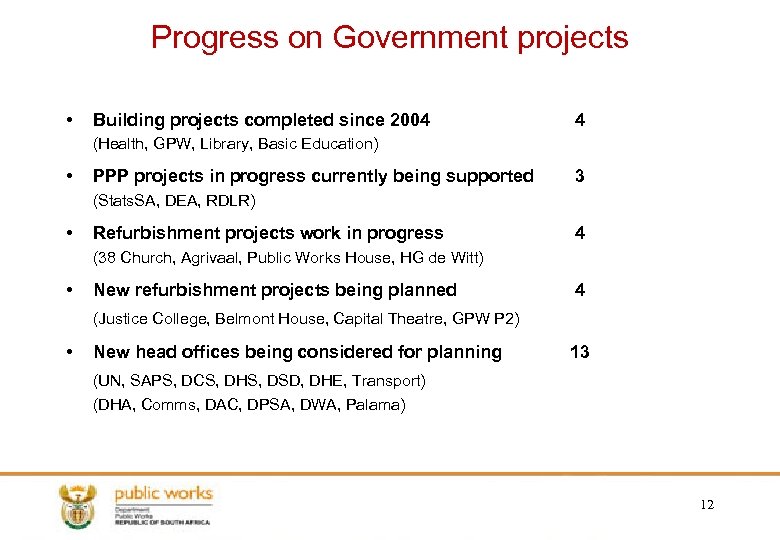
Progress on Government projects • Building projects completed since 2004 4 (Health, GPW, Library, Basic Education) • PPP projects in progress currently being supported 3 (Stats. SA, DEA, RDLR) • Refurbishment projects work in progress 4 (38 Church, Agrivaal, Public Works House, HG de Witt) • New refurbishment projects being planned 4 (Justice College, Belmont House, Capital Theatre, GPW P 2) • New head offices being considered for planning 13 (UN, SAPS, DCS, DHS, DSD, DHE, Transport) (DHA, Comms, DAC, DPSA, DWA, Palama) 12
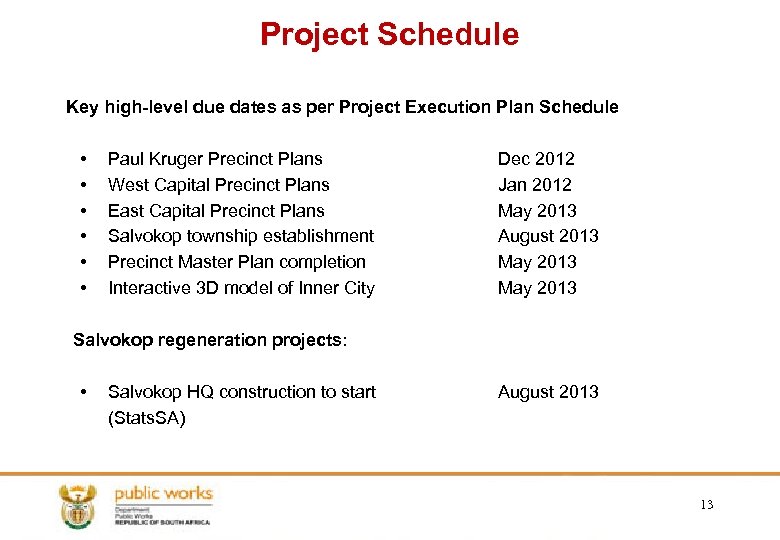
Project Schedule Key high-level due dates as per Project Execution Plan Schedule • • • Paul Kruger Precinct Plans West Capital Precinct Plans East Capital Precinct Plans Salvokop township establishment Precinct Master Plan completion Interactive 3 D model of Inner City Dec 2012 Jan 2012 May 2013 August 2013 May 2013 Salvokop regeneration projects: • Salvokop HQ construction to start (Stats. SA) August 2013 13
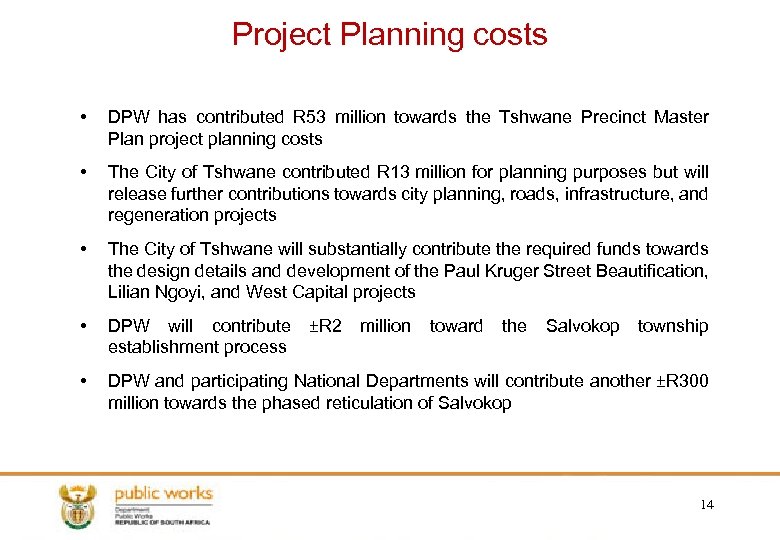
Project Planning costs • DPW has contributed R 53 million towards the Tshwane Precinct Master Plan project planning costs • The City of Tshwane contributed R 13 million for planning purposes but will release further contributions towards city planning, roads, infrastructure, and regeneration projects • The City of Tshwane will substantially contribute the required funds towards the design details and development of the Paul Kruger Street Beautification, Lilian Ngoyi, and West Capital projects • DPW will contribute ±R 2 million toward the Salvokop township establishment process • DPW and participating National Departments will contribute another ±R 300 million towards the phased reticulation of Salvokop 14
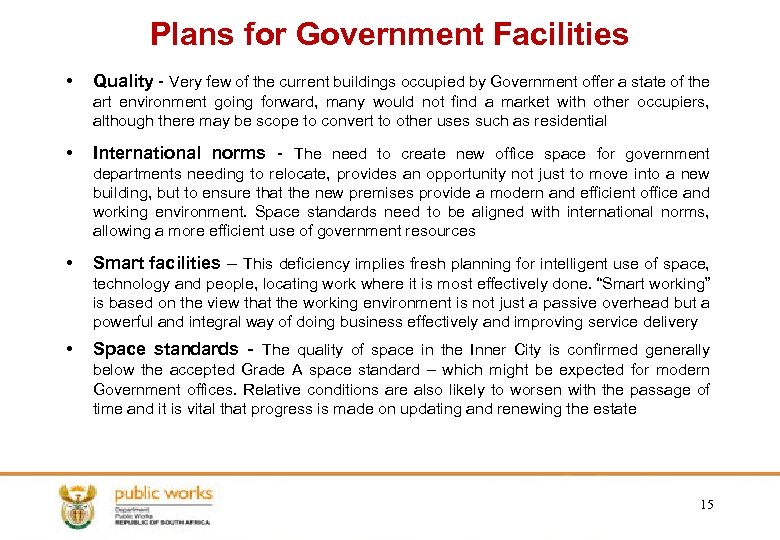
Plans for Government Facilities • Quality - Very few of the current buildings occupied by Government offer a state of the art environment going forward, many would not find a market with other occupiers, although there may be scope to convert to other uses such as residential • International norms - The need to create new office space for government departments needing to relocate, provides an opportunity not just to move into a new building, but to ensure that the new premises provide a modern and efficient office and working environment. Space standards need to be aligned with international norms, allowing a more efficient use of government resources • Smart facilities – This deficiency implies fresh planning for intelligent use of space, technology and people, locating work where it is most effectively done. “Smart working” is based on the view that the working environment is not just a passive overhead but a powerful and integral way of doing business effectively and improving service delivery • Space standards - The quality of space in the Inner City is confirmed generally below the accepted Grade A space standard – which might be expected for modern Government offices. Relative conditions are also likely to worsen with the passage of time and it is vital that progress is made on updating and renewing the estate 15
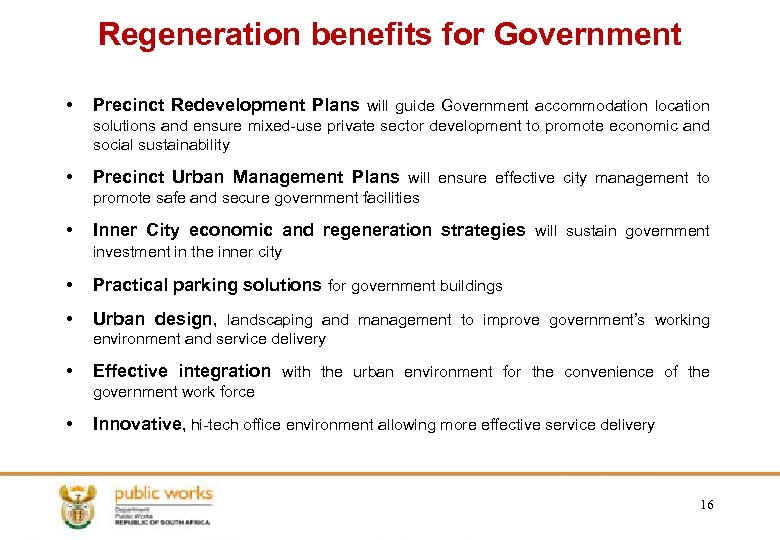
Regeneration benefits for Government • Precinct Redevelopment Plans will guide Government accommodation location solutions and ensure mixed-use private sector development to promote economic and social sustainability • Precinct Urban Management Plans will ensure effective city management to promote safe and secure government facilities • Inner City economic and regeneration strategies will sustain government investment in the inner city • Practical parking solutions for government buildings • Urban design, landscaping and management to improve government’s working environment and service delivery • Effective integration with the urban environment for the convenience of the government work force • Innovative, hi-tech office environment allowing more effective service delivery 16
Regenerating Results in Tshwane The Inner City Regeneration scope consists of: - • New government estate - Provision must be made for up to 625, 000 m 2 development in the short to medium term, with an anticipated additional 1, 000 m 2 new development over the longer term • Campuses - Redevelopment over the short term need to focus on two major new world-class government campuses, at Salvokop (up to 300, 000 m 2), and around the Zoological Gardens (around 100, 000 m 2), with high quality government and other office development along Paul Kruger street, and at other locations in the Inner City • Nodes/precincts - Development will be consolidated around higher value nodes which will help to generate the necessary critical mass to catalyse change around the Inner City • Space - It will be required to engender physical and cultural change in working practices towards a ‘smart working’ approach, considering the most intelligent use of space, technology and people, and locating work where it is most effectively done • Inclusivity – Regeneration projects need to incorporate small business and small traders as these are the drivers of the nation’s economy • Salvokop regeneration – Estimates for its redevelopment totals R 300 million over the next 5 years 17
Urban Renewal Initiatives Presentation 2 Purpose of the Presentation To inform the Portfolio Committee on Public Works’ Urban Renewal and Rural Development Initiatives 18
Purpose of Rural Towns Development Initiative • To ensure that Public Works puts in place a structured mechanism of dealing with its dilapidated properties situated in regions, districts and local areas • Uniformity of all Public Works’ policies and strategy frameworks related to Urban Renewal and Rural Development, whilst forging alignment with existing property management and transformation policies • Ensure that Public Works participates and add value to investments in rural towns by all spheres of government and private sector, by taking a lead role • To ensure that municipalities in rural towns across South Africa are supported in the rejuvenation or rehabilitation of these key nodes • To ensure that rural towns create vibrant local economies through Local Economic Development, and through an attractive and active property industry 19
Rural Towns Development Initiative • To ensure that Public Works inculcates the culture of a healthy and safe environment through its portfolio, particularly in properties below acceptable standards • Public Works will play a key role in the fight against various forms of crime, by eliminating abandoned buildings within its own portfolio, and ensuring that other spheres of government establish similar initiatives • The facilitation of development in underdeveloped areas, rural towns, as an element of the Property Transformation Charter • That it serves as value-add in existing local development initiatives 20
Current Situation • Approximately 500 rural towns in South Africa are underdeveloped • A general lack of bulk infrastructure services and private-public sector investments exist in rural towns • The current infrastructure services in SA was only built for a 15 million population • Pushing factors are poverty, unemployment, draught and poor service delivery • Urbanization, the massive influx to urban areas searching better environments 21
General Assessment of State properties in towns • Structural and aesthetic decay of state owned properties due to poor maintenance and negligence; • Abandoned industrial and commercial properties owned by the private sector; • Unutilised and derelict state properties because of lack of proper planning on the part of Asset Management and lack of a fully functional Asset Register; • Unutilised and dilapidated residential properties resorting under provincial and national government entities; • Emergence of the illegal occupation of empty government properties by private companies and members of the public; and • Lack of coordination in property utilisation between spheres of government. 22
Challenges derived from District and Local Government - rural towns • The Integrated Development Plans (IDPs) and Spatial Development Frameworks (SDPs) are not carefully developed with the involvement of all stakeholders • Property zoning or rezoning mostly inappropriate for government uses and Local Authorities place their interests higher than those of government • • Insufficiency of capital to construct and maintain bulk infrastructure services Incomplete or inappropriate clear asset management strategy and government properties are scattered throughout rural towns No policy positioning document for Government, town planning and architecture (as a category), and subtypes of government spatial planning (as a subcategory), e. g. magistrate courts, police stations Understanding government sector and its optimisation, while allowing the tenants to render their services, e. g. government precincts to maximize the value of the land Many custodians are not operating to a uniform planning approach, hence a fragmented government approach to service delivery • • • 23
Challenges derived from Client Departments • Some immovable asset requirements are generic (offices) • Some immovable asset requirements are specific due to operational reasons (functional, e. g. police stations) • Requirements often dictate locality (e. g. the location of police stations may be informed by crime statistics), but this can also be a function of mere client preference, especially, political interference • Clients may not be informed on Government’s strategic immovable asset management thrust • Client (un)willingness to accept custodial asset management imperatives • Client permanency in a specific location / building 24
Effect of the existing challenges • Ineffective custodian asset management; • Fragmented, irrational asset holdings; • Development costs (immovable asset and bulk infrastructure) not optimal; • Operational costs (immovable asset and bulk infrastructure) not optimal; • Government service delivery not optimal; and • Accessibility problems for customers (the electorate) as government service centers servicing the same need are scattered all over the local authority’s area. 25
Rural Development and Urban Renewal Initiative Programme In order for Public Works to meet the objectives and challenges listed above, government will have to employ instruments that will allow: – Investment in underdeveloped areas – Revolutionisation of the approach to economic development – The reclaim and management of the imperative process of physically locating government in small towns and urban areas – Job creation through government property rejuvenation – New developments to meet government accommodation needs 26
Initiatives on Regional Level: Current Projects • Studies have been concluded for the development of government precincts in 6 urban centres, namely: – Johannesburg, Polokwane, Mmabatho, Nelspruit, Durban, Mthatha • Proposals were made for the extension of government precincts in Cape Town, Bloemfontein, Port Elizabeth, Kimberly and Pretoria; • Proposals were offered to rehabilitate all abandoned and dilapidated state buildings – some projects were registered in regions; and • Revitalisation and rehabilitating of all Public Works workshops have been prioritised. 27
Initiatives on district/ local level (Rural towns): Current Projects • • • Public Works has already registered about 110 projects in rural towns, comprising of all Public Works clients. Some of the projects have reached planning and design stages, with several in tender and construction phases Projects delays due to insufficient bulk infrastructure, and unavailability of strategic and ideal land for construction; Some projects have already been presented to the IDP forums for Municipalities; Process of rehabilitating dilapidated buildings in Durban, Mthatha and Port Elizabeth is underway; Initiatives to identify abandoned or dilapidated government buildings (bad buildings initiatives) is currently underway; Public Works is in contact will all local Municipalities for assistance, through IDPs or Local Economic Development forums (LEDs), to identify regeneration opportunities for the said properties 28
Way forward: Opportunities To meet property ownership balance in urban and small towns, the Small Towns Development Initiative shall include: - – Redirection of dilapidated and unutilised Public Works commercial and residential properties into the Property Incubator Programme (PIP), with opportunities prioritising local entities looking for a footing in the property sector; Currently the DPW has a rehabilitation programme which focuses on rehabilitating properties for the use of clients, presenting an opportunity for synergies. – In liaison with Local government and private sector, Public Works shall create an environment conducive for PIP participants to partner established property development companies seeking to undertake business with government. – Where a dilapidated property is not taken up by PIP participants, DPW should activate its Disposal Strategy with a view of securing a private investor to acquire and operate the building, having displayed empowerment of at least 50% at ownership level. 29
Way forward: Opportunities To meet property ownership balance in urban and small towns, the Small Towns Development Initiative shall include: - – In the maintenance of dilapidated properties, Public Works shall ensure that PIP aligned entities, or established entities with partners in the PIP, are given priority in such mandates – Employment of personnel for refurbishment and sourcing of material for this purpose shall be solely from local personnel who are mainly rural dwellers 30
THANK YOU 31
Скачать презентацию Briefing to Public Works Portfolio Committee Inner City
4aecd93a8b7ee9035f495f56d6895b73.ppt