 Скачать презентацию Briefing Session Application for Joining the First Phase
d4a459b837d6f6c837ab4308591543b7.ppt
- Количество слайдов: 75



Briefing Session Application for Joining the First Phase of the Pilot Scheme on Community Care Service Voucher for the Elderly as the Recognised Service Provider 10 January 2013 Social Welfare Department 1
Purpose • invite eligible non-profit-making organisations including nongovernmental organisations (NGOs) and social enterprises (SEs) to apply for: (i) joining the first phase of the Pilot Scheme on Community Care Service Voucher for the Elderly (the Pilot Scheme) as Recognised Service Providers (RSP); (ii) seed money to purchase vehicle ; furniture & equipment 2
Expression of Interest (EOI) • 44 agencies (including SEs) submitted 118 EOI in August 2012; • The following information was collected : - number of operating service units and service capacity; - use of premises; - earliest date of provision of service; • The following suggestions were collected : - set up cost ; - clear definition on the operating hours ; - cross-district services, etc. ; 3
Funding The Government had obtained funding from the Lotteries Fund to implement the First Phase of the Pilot Scheme with 2 components : i. subsidy on the voucher value ii. seed money to RSPs for purchase of vehicle and/or furniture & equipment 4

Key Content 5
Objectives of the Pilot Scheme Testing the viability of voucher as a new funding mode: • the Government provides subsidy directly to the service users in the form of a voucher to purchase service from operators instead of providing them with subsidised services, i. e. the money follows the user; • the voucher holder may choose the service provider, the type of service, the service package which best suit his/her needs. 6
Eligibility Criteria for RSP • the NGO or SE is a bona fide non-governmental and nonprofit-making organisation, charitable institution or trust of a public character that is exempt from tax under section 88 of the Inland Revenue Ordinance (Cap. 112); and • having experience in providing elderly care services, either community care services (CCS) or residential care services (RCS). 7
Target Participant • elders who have been assessed by SWD’s Standardised Care Need Assessment Mechanism for Elderly Service (SCNAMES) as moderately impaired; • waiting for subsidised CCS and/or RCS in the Long Term Care Services Delivery System (LDS); and • living in the community of the selected districts. 8
Pilot Period It is a four-year pilot scheme • • the First Phase : September 2013 to August 2015 the Second Phase : 2015/16 to 2017/18 9
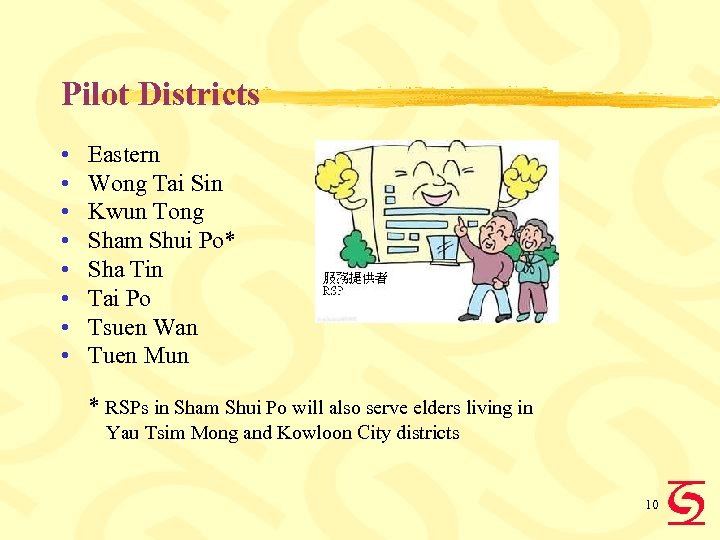
Pilot Districts • • Eastern Wong Tai Sin Kwun Tong Sham Shui Po* Sha Tin Tai Po Tsuen Wan Tuen Mun * RSPs in Sham Shui Po will also serve elders living in Yau Tsim Mong and Kowloon City districts 10
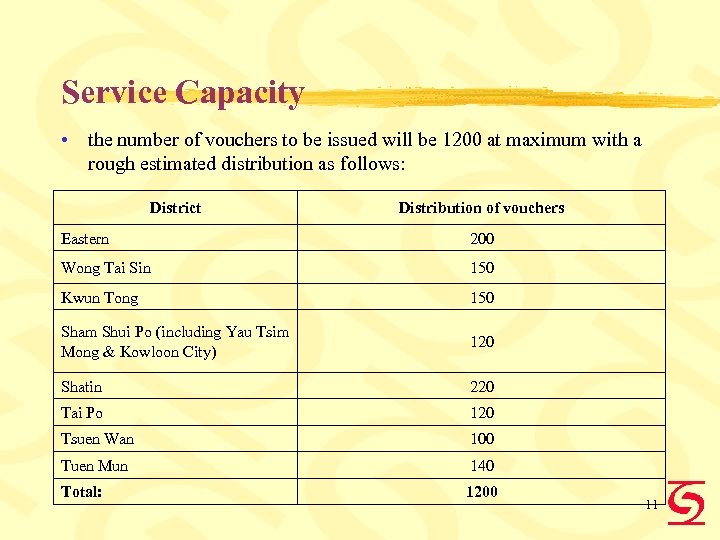
Service Capacity • the number of vouchers to be issued will be 1200 at maximum with a rough estimated distribution as follows: District Distribution of vouchers Eastern 200 Wong Tai Sin 150 Kwun Tong 150 Sham Shui Po (including Yau Tsim Mong & Kowloon City) 120 Shatin 220 Tai Po 120 Tsuen Wan 100 Tuen Mun 140 Total: 1200 11
Voucher Value (1) • the voucher value is the amount available to the elder for procuring the services in a month; • calculated on monthly basis, cannot be carried forward to the following month; • a single voucher value at $5, 000 (as of early 2012) and the RSP has to provide the same value of services to the voucher holder in a month. 12
Voucher Value (2) • 2013 -14 unit cost of the subsidised day care and home care service will be used in the calculation of the voucher value of the first year of the First Phase; • thereafter, annual adjustment of the voucher value based on the Composite Consumer Price Index (CCPI) will be made; • the actual voucher value of 2013 -14 will be announced in around April 2013. 13
Co-payment Arrangement (1) • the services provided under the Pilot Scheme would be subsidised, with 5 levels of funding; • a sliding scale of co-payment - the less that the user can afford, the more the Government pays. 14
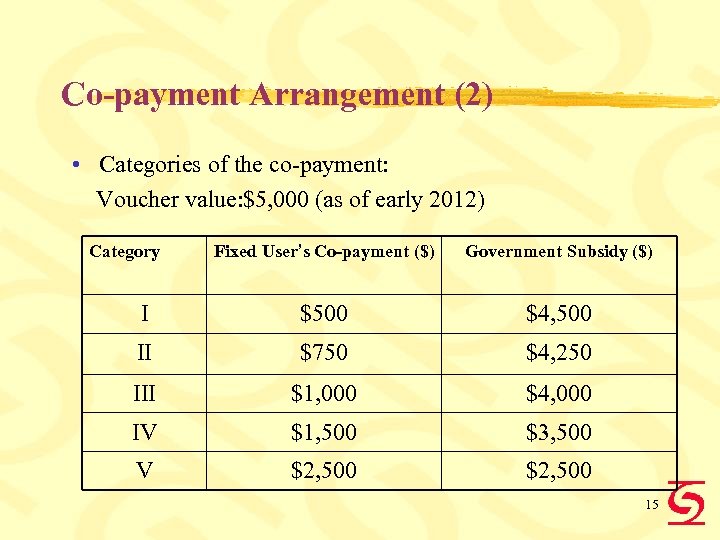
Co-payment Arrangement (2) • Categories of the co-payment: Voucher value: $5, 000 (as of early 2012) Category Fixed User’s Co-payment ($) Government Subsidy ($) I $500 $4, 500 II $750 $4, 250 III $1, 000 $4, 000 IV $1, 500 $3, 500 V $2, 500 15
Co-payment Arrangement (3) • the voucher holder’s co-payment in the First Phase will be fixed, that is, it remains unchanged throughout the pilot period though the voucher value will be adjusted annually based on the CCPI; • this arrangement will be reviewed in Second Phase of the Scheme. 16
Co-payment Arrangement (4) • the voucher holder can pay more than his/her co-payment to enjoy additional and/or non-essential services; • the voucher holder is required to make the co-payment to his/her service provider on the first day of the service each month; • all payment shall be made on a monthly basis; • advance collection of payment for more than one month by the RSP is NOT allowed. 17
Co-payment Arrangement (5) • eligible CSSA recipients can apply for special grant to cover part of the $500 co-payment - can reimburse $207 under mixed mode - can reimburse $149 under single mode • the special grant is not payable to recipients in receipt of a standard rate / miscellaneous expenses rate for being of constant attendance 18
Means Test (1) • there will be means test to assess the household income of the voucher holder to determine his/her level of copayment; • asset value of the voucher holder or his/her household is NOT subject to means test; • conducted by Voucher Office / SWD; • the applicant needs to declare the household income while Voucher Office will conduct checking; 19
Means Test (2) • the Voucher Office will make reference to the Median Monthly Domestic Household Income (MMDHI) when setting the household income thresholds for the households of different sizes for the means test; • the updated quarterly figures on MMDHI will be regularly posted in the SWD homepage for users and RSPs’ reference; • voucher holders should approach the Voucher Office if their co-payment amount should be adjusted in accordance with the latest MMDHI or change of household income. 20
Service Scope • the recognised scope of services are similar to the existing subsidised service of DE and EHCCS; • RSPs shall provide different sets of service combinations / packages for selection by the voucher holders; • RSP should also adjust the service contents of the service combinations / packages for the individual voucher holder according to his/her changing needs. 21
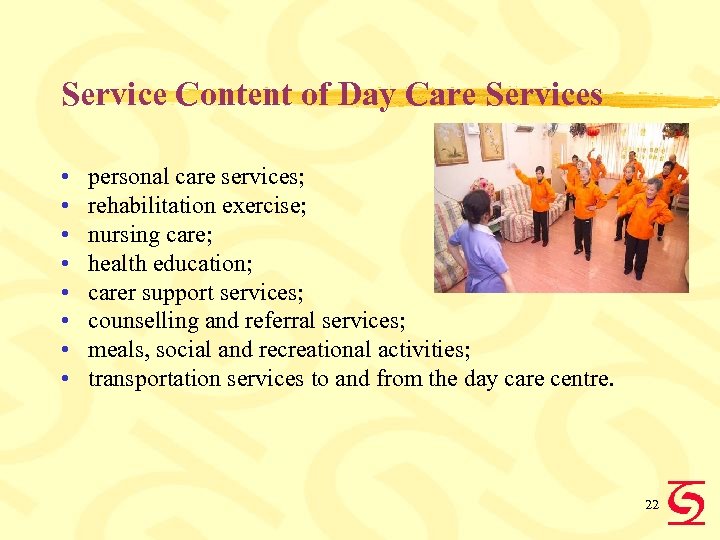
Service Content of Day Care Services • • personal care services; rehabilitation exercise; nursing care; health education; carer support services; counselling and referral services; meals, social and recreational activities; transportation services to and from the day care centre. 22
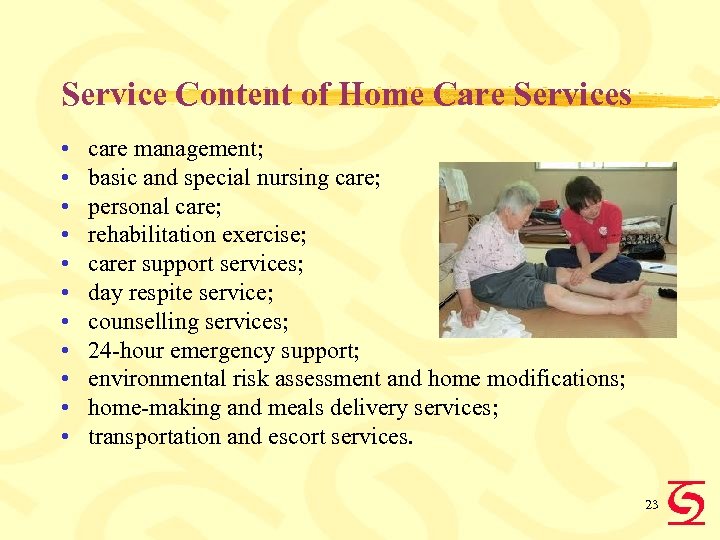
Service Content of Home Care Services • • • care management; basic and special nursing care; personal care; rehabilitation exercise; carer support services; day respite service; counselling services; 24 -hour emergency support; environmental risk assessment and home modifications; home-making and meals delivery services; transportation and escort services. 23
Service Delivery Mode RSP can choose to operate or form strategic alliance to operate the voucher service in either: • • Mixed mode: day care (part-time) and home care; or Single mode: day care (part-time). (Part-time service in day care service means that the voucher holders attend DE for less than 4 days in a week) 24
Fee-charging • RSP is entitled to charge the voucher holder any additional payment for additional and/or non-essential services outside the normal service scope and service hours of the day care and home care service (example: traditional Chinese medicine treatment, aromatherapy, transportation fee of cross-district day care service on written agreement with the voucher holder) 25
Mandatory Service Requirements (1) Day Service: • deliver day care services from 8: 00 am to 6: 00 pm Mondays to Saturdays excluding public holidays; • Mixed mode service: not less than 2 and not more than 5 sessions per week (not less than 4 hours in each session); • Single mode service: not less than 5 and not more than 7 sessions per week (not less than 4 hours in each session); • provision of a professional staff ( e. g. EN or RN, or social worker or OT or PT) in DEs at all times during the service hours provided to voucher holder. 26
Mandatory Service Requirements (2) Home Care • deliver home care services from 8: 00 am to 6: 00 pm Mondays to Saturdays excluding public holidays; • should provide no less than 8 hours of direct homebased services by care workers or social workers or para-medical staff, including nurse(s), physiotherapist(s) and occupational therapist(s) for each voucher holder in each month. 27
Transparency of Service Packages and Prices of Additional Services RSP has to make the following transparent to the voucher holder, his/her carer(s), the RW, SWD and the public by providing a copy of such information to each of the above party (except the public); and upload such information on its webpage, if available, for reference by the public: • content of the service packages, • the price lists of the additional and/or non-essential service; • its target group of elders to serve (e. g. demented elders) if any. 28
Invitation to Eligible Elders to Join the Pilot Scheme • SWD will invite eligible elders from the Central Waiting List who are living in the pilot districts to join the Pilot Scheme; • the RWs of the elders shall assist the elders and their carers in the process of application; • the number of elders being invited depends on the service capacity, vacancy and the utilisation of the voucher services in each pilot district. 29
Voucher Holder’s Status on the CWL • elder’s status in central waiting list in LDS will be inactivated after issuing of the voucher certificate ; • his/her application in LDS will be re-activated when the elder wishes to apply for subsidised CCS /RCS; • when a subsidised RCS/CCS place is allocated, the elders concerned need to opt out of the voucher service. 30
Case Admission and Discharge (1) • every eligible elder joining the Pilot Scheme will be issued a voucher certificate for purchase of voucher service; • voucher holders will approach RSP directly after they have received the voucher certificate; • voucher holder has to present the original copy of the voucher certificate to the RSP for safe-keeping for service admission; • RSP should provide the service to the voucher holder within 7 working days; • RSP shall also report to the Voucher Office as well as the RW of the voucher holder on taking up the new case within 7 working days from the service commencement date; 31
Case Admission and Discharge (2) • RW needs to provide a copy of the MDS-HC assessment result to RSP to facilitate the latter’s preparation of individual care plan for the voucher holder; • there is no need to conduct MDS-HC re-assessment if the validity period of the available one has expired; • RSPs providing specialised services for demented elders should give adequate information to the voucher holder for any need of prior assessment or test before admission to its service and there should not be any additional fee on the assessment or test; 32
Case Admission and Discharge (3) • voucher holder can purchase voucher services among the pilot districts disregarding their living address but should be responsible for his/her transportation arrangement for the day care service if the service unit is not within the voucher holder’s living district; 33
Case Admission and Discharge (4) • RSPs shall not reject any voucher holder of the same service district applying for the voucher service unless - no service vacancy - voucher holder does not belong to the RSPs’ target group of elders to serve (e. g. demented elders) - voucher holders living outside their service districts (voucher holders living in Kowloon City and Yau Tsim Mong Districts use the service in Sham Shui Po are treated as same district ) 34
Case Admission and Discharge (5) • RSP may consider the voucher holder a formal discharge: - elder being provided with subsidised CCS/RCS - pass away, lost contact, withdrawal from the Pilot Scheme • RSP shall return the voucher certificate and issue a receipt to the voucher holder; • RSP shall notify Voucher Office & RW about the changes 35
Suspension of services/Withdrawal from the Pilot Scheme • the voucher holder can suspend the service or withdraw from the Pilot Scheme at any time during the service period; • no reimbursement of the co-payment to the voucher holder; • for suspension of services, if the voucher holder returns to the same RSP, the RSP should arrange compensatory service-inkind for the voucher holder for his/her the outstanding service hours of his/her service package not later than three months; • RSP shall report to Voucher Office and RW for the withdrawal from the Pilot Scheme within 7 working days. 36
Transfer of RSP • The voucher service is calculated on a monthly basis: when a voucher holder starts to receive the voucher service on 6. 9. 2013, for example, he/she should complete the monthly service on 5. 10. 2013; • if the voucher holder has decided to change the RSP, he/she should start the service from the new RSP on or after 6. 10. 2013 to avoid duplication of voucher period. 37
Calculation of the Voucher Period Example: Service start date is 6. 9. 2013 • 1 st voucher period: 6. 9. 2013 – 5. 10. 2013 • 2 nd voucher period: 6. 10. 2013 – 5. 11. 2013 38
Case Management Approach • RSP should adopt a case management approach in formulating and implementing care plan for the individual voucher holder - need to design service packages for the voucher holders with special regard to their respective individual care plan, and review voucher holders’ care needs on a regular basis. - revise the components of the service packages according to the updated needs of the voucher holder. 39
Reimbursement on Voucher Value • RSP can seek reimbursement of the government subsidy on the voucher value on a quarterly basis; • when a voucher holder suspends or withdraws from the service with incomplete service during the voucher month, the Government will still reimburse the money of that month, provided that RSP has provided compensatory service-in-kind within 3 months after the voucher holder has resumed the service. 40
Use of Premises 41
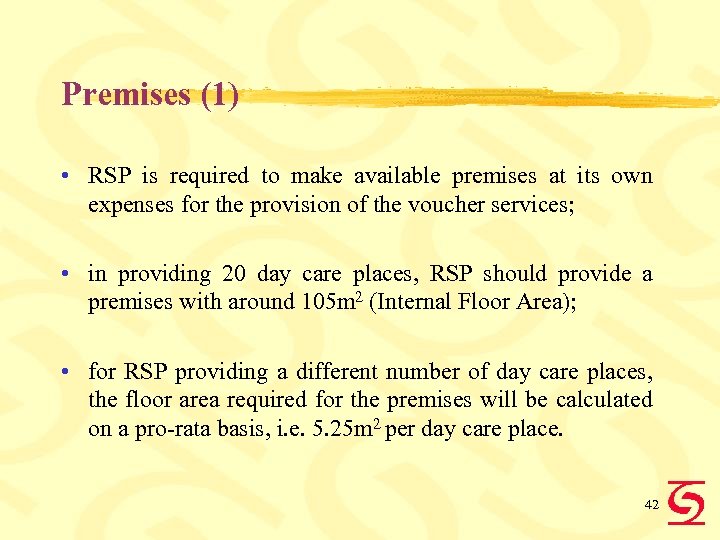
Premises (1) • RSP is required to make available premises at its own expenses for the provision of the voucher services; • in providing 20 day care places, RSP should provide a premises with around 105 m 2 (Internal Floor Area); • for RSP providing a different number of day care places, the floor area required for the premises will be calculated on a pro-rata basis, i. e. 5. 25 m 2 per day care place. 42
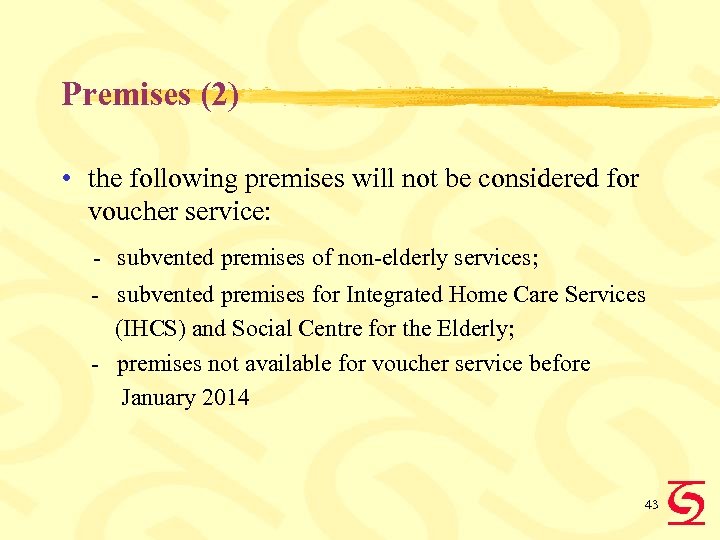
Premises (2) • the following premises will not be considered for voucher service: - subvented premises of non-elderly services; - subvented premises for Integrated Home Care Services (IHCS) and Social Centre for the Elderly; - premises not available for voucher service before January 2014 43
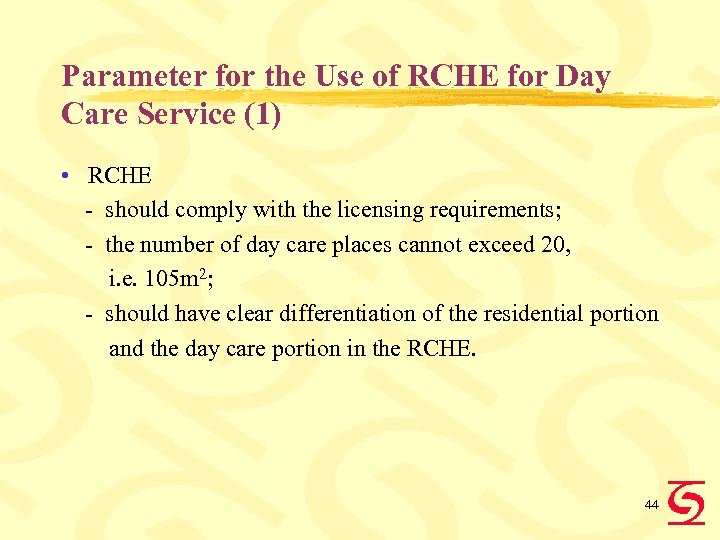
Parameter for the Use of RCHE for Day Care Service (1) • RCHE - should comply with the licensing requirements; - the number of day care places cannot exceed 20, i. e. 105 m 2; - should have clear differentiation of the residential portion and the day care portion in the RCHE. 44
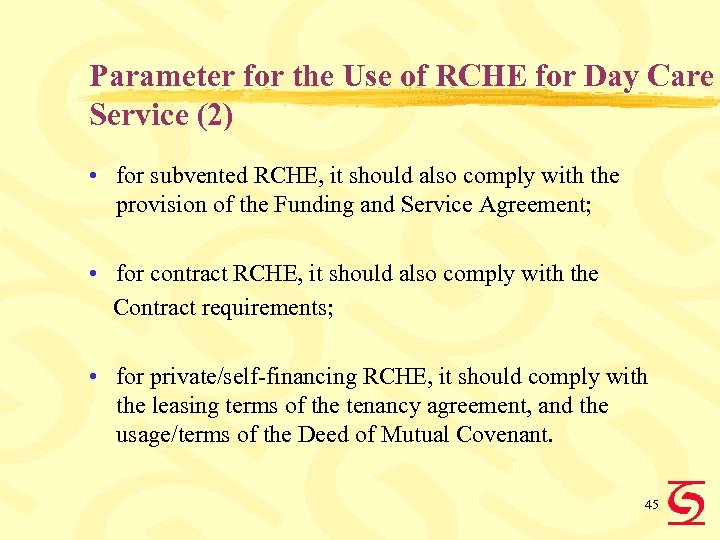
Parameter for the Use of RCHE for Day Care Service (2) • for subvented RCHE, it should also comply with the provision of the Funding and Service Agreement; • for contract RCHE, it should also comply with the Contract requirements; • for private/self-financing RCHE, it should comply with the leasing terms of the tenancy agreement, and the usage/terms of the Deed of Mutual Covenant. 45
Parameter for the Use of Subvented Premises (other than RCHE) for Day Care Service • Subvented DECC/NEC - DECC/NEC having shortfall in Standard of Accommodation (SOA) will not be considered for voucher service; - the number of day care places cannot exceed 10, i. e. 52. 5 m 2. • Subvented DE - Only DE with surplus area can be used for voucher service in a standard of 5. 25 m 2 per day care place. 46
Parameter for the Use of Private and Public Housing Premises for Day Care Service • Private premises - the delivery of voucher service is in compliance with the land lease conditions, the Deed of Mutual Covenant, and leasing term of the tenancy agreement; • Public housing premises - the delivery of voucher service is in compliance with the leasing terms of the tenancy agreement; - should obtain prior approval from the Housing Authority / Housing Society. 47
Delivery of Voucher Service in RCHE/Subvented or Non-subvented Premises (1) • proper measures with regular reviews are to be taken to ensure that the existing subvented / subsidised services should continue to maintain a satisfactory level of service performance; • staff, service users and their family members should be consulted as appropriate before implementing the voucher service, so as to ensure their acceptance and avoid complaints; 48
Delivery of Voucher Service in RCHE/Subvented or Non-subvented Premises (2) • a separate set of accounts for the voucher service should be kept; • there should be no cross-subsidisation by the subvented programmes in money or in kind; • any cost arising from operating non-subvented service, including manpower, premises and utilities as well as any income generated should not be charged to Lump Sum Grant or the Contract Sum; • area which is for the use of the voucher service in a subvented service unit or contract service unit should be discounted for its rent and rates from the Lump Sum Grant or the Contract Sum unless it is for the shared use with the existing subvented service; 49
Delivery of Voucher Service in RCHE/Subvented or Non-subvented Premises (3) • clear delineation of staff between that of the RCHE and the voucher service should be properly arranged; • it must be ensured that there would not be any structural change of the premises or any relocation of beds in relation to the operation of the voucher service; • provided that the changes are inevitable, prior approval must be sought from the relevant Branches / Sections of SWD. 50

Seed Money 51
Seed Money (1) • in order to provide support and encourage NGOs/SEs to provide voucher service to the needy elders, a one-off seed money grant will be provided to eligible RSPs in the First Phase of this Pilot Scheme. 52
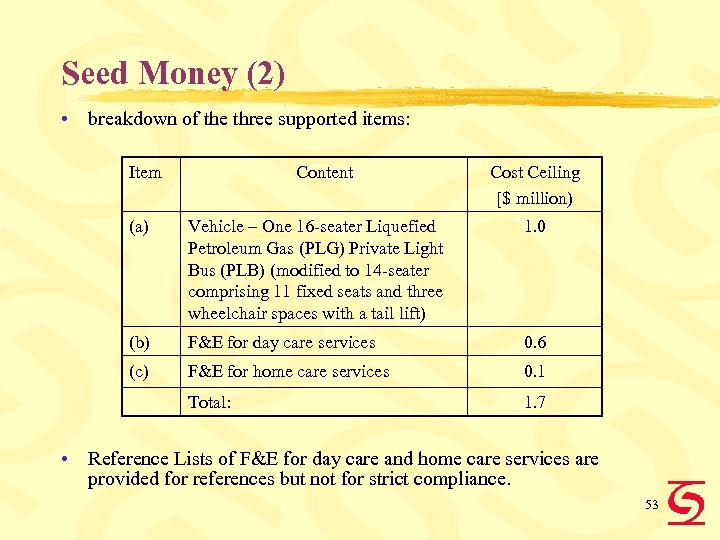
Seed Money (2) • breakdown of the three supported items: Item Content Cost Ceiling [$ million) (a) Vehicle – One 16 -seater Liquefied Petroleum Gas (PLG) Private Light Bus (PLB) (modified to 14 -seater comprising 11 fixed seats and three wheelchair spaces with a tail lift) 1. 0 (b) F&E for day care services 0. 6 (c) F&E for home care services 0. 1 Total: 1. 7 • Reference Lists of F&E for day care and home care services are provided for references but not for strict compliance. 53
Seed Money (3) • eligible RSPs should meet the following conditions: - provide at least 10 day care places; - commit to remain in the Pilot Scheme to provide services to voucher holders and their carers for four years at maximum starting from the date when the Pilot Scheme commences in 2013 until the completion of the Pilot Scheme; - application for seed money by each RSP is limited to one eligible service unit in each pilot district; 54
Operating Parameters for Seed Money • applicants can select any one or a combination of the supported items, subject to the ceiling of each item: - any recurrent or capital liability arising from procuring the standard or above-standard F&E items, including any subsequent replacement of these items, will not be accepted by either SWD or LF; and - purchase of the vehicle and F&E items should be exclusive for delivery of the voucher service. 55
Reimbursement on Seed Money Grant • RSPs should submit receipts and invoices under each specific supported item after completion of the purchase for reimbursement: - claim for the vehicle should be made not later than 6 months after service commencement; - claim for F&E should be made not later than 3 months after service commencement; - SWD would not be liable for any financial implication arising from belated or incomplete submission. 56
Monitoring 57
Financial Monitoring (1) • both the Government subsidy on voucher value and the seed money should be entered as separate items into the audited financial statements of NGOs/SEs; • RSP is required to ensure that the grant is spent in accordance with the approved scope; • the RSP is required to submit annual audited income and expenditure statement of the Government subsidy on voucher value at the end of the each financial year during the project period; 58
Financial Monitoring (2) • RSP should comply with the guidelines and rules stipulated in the LF Manual, in particular: - monitoring and payment (Chapter 2) - reimbursement of LF grant (Chapter 5) - procurement and stores management (Chapter 6) • RSP is required to keep a list of all F&E items procured with LF grant for inventory control and audit purpose; • for disposal of the assets, NGOs/SEs are required to follow the guidelines and procedures stipulated under para. 6. 10 of the LF Manual. 59
Acknowledgement of LF Grants • RSP are required to follow the acknowledgement requirements stipulated under para. 7. 2 of the LF Manual: - to make general acknowledgement in their annual report of the financial support they receive from the LF; - to paint on both sides of the vehicle with such words as “Donated by the Lotteries Fund” (expressed in either English or Chinese and size of each letter character should not be less than 2 cm each). 60
Performance Monitoring (1) • each RSP is required to sign a Service Agreement (SA); • the RSPs shall then implement the Pilot Scheme in accordance with the terms and conditions detailed in the SA, Service Specifications and the RSP’s Proposal in the Application. 61
Performance Monitoring (2) • RSPs shall set up the personal account of each voucher holder and shall keep the record of all information relating to each voucher holder including: - payment; - services/service packages chosen; - their service usage; and - other related information which will form the basis for performance monitoring. 62
Performance Monitoring (3) • RSPs should submit to SWD the following service statistics on a quarterly basis: - number of voucher holders served - number of day care sessions - number of hours of different types of home care services - number of voucher holders paying for additional/non-essential services - number of hours and types of additional/non-essential services used by voucher holders, and the average amount spent on such services - number of voucher holders suspend the voucher service - number of voucher holders discharge the service from the RSPs by types 63
Performance Monitoring (4) • RSPs should submit to SWD the survey on user’s satisfaction and outcome by a questionnaire on each voucher holder upon his/her discharge from the RSP’s service or withdrawal from the Pilot Scheme; • The outcome measurement may include three aspects: (a) maintenance in Activity of Daily Living (ADL) (b) carer’s stress (c) attitude on aging in community 64
Performance Monitoring (5) • SWD will conduct review visits, random checks (with or without prior notice) to audit relevant records and files: - service packages of individual voucher holder, - records on payment and service hours of the individual voucher holder, fee-charging - complaint investigation, - survey, - compliance with the 16 Service Quality Standards etc. 65
Performance Monitoring (6) • SWD may also require RSPs to attend meetings related to various aspects of service provisions such as sharing of good practices and benchmarking of service performance, etc. ; • SWD reserves the right to suspend or terminate RSP’s status when SWD finds the RSPs failing to deliver the agreed scope, level, volume and quality of service. 66
Evaluation • there will be an evaluation attached to the First Phase of the Pilot Scheme; • RSPs are required: • to cooperate in the evaluation processes which may include submission of regular and ad hoc statistics, reports and participating in or coordinating interviews/visits, etc. ; • to provide assistance to the studies on Case Mix and Outcome Measurement as well as any others conducted by SWD and its authorised organisation(s) when necessary. 67
Way Forward 68
Submission of Application • the Application can be written in either English or Chinese; • application is on UNIT basis; • parties involved in strategic alliance should be clearly stated but one of the NGOs/SEs should act as the lead agency and provide a single contact point to the Government. 69
Vetting Committee and Assessment of Applications • a Vetting Committee will be set up to assess the applications; • the assessment of applications shall involve a review on whether the applicants have fully met all the eligibility criteria as well as the service requirements as stipulated in the Service Specifications. 70
Implementation Schedule 15 February 2013 Closing of submission of application April 2013 Announcement of result September 2013 Commencement of service 71
Follow-up Works (1) • Briefing sessions to stakeholders such as the RSPs, RWs, NGOs etc. from April to July 2013; • Case-mix Study on CCS for the Elderly (2013 – 2014); • Invitation of eligible elders to join the Pilot Scheme in July/August 2013. 72
Follow-up Works (2) • Information on Voucher Service The following figures will be posted and regularly updated in the SWD Homepage for RSPs, RWs and user’s information: - information of individual RSP - the total number of vouchers issued - vacancy of the DE places under voucher in each pilot district - quarterly MMDHI 73
Other Enquiry • please contact: Mr. TAM Yuen-sheung, Edmund Senior Social Work Officer (Voucher) Tel: 2892 5513 Fax: 2832 2936 74

Thank You 75
Скачать презентацию Briefing Session Application for Joining the First Phase
d4a459b837d6f6c837ab4308591543b7.ppt