 Скачать презентацию Brief Introduction to the Health System of the
801e2ba143f227bdd2e965163d473d32.ppt
- Количество слайдов: 21



Brief Introduction to the Health System of the Netherlands 9 February 2011 Presentation by Bibiche Wymenga, Department of International Affairs
Introduction: Health System? 1. Health in The Netherlands 2. The Ministry of Health, Welfare & Sport 3. From former to current health system 4. Facing the challenges: Policy strategy
Introduction: Health System?
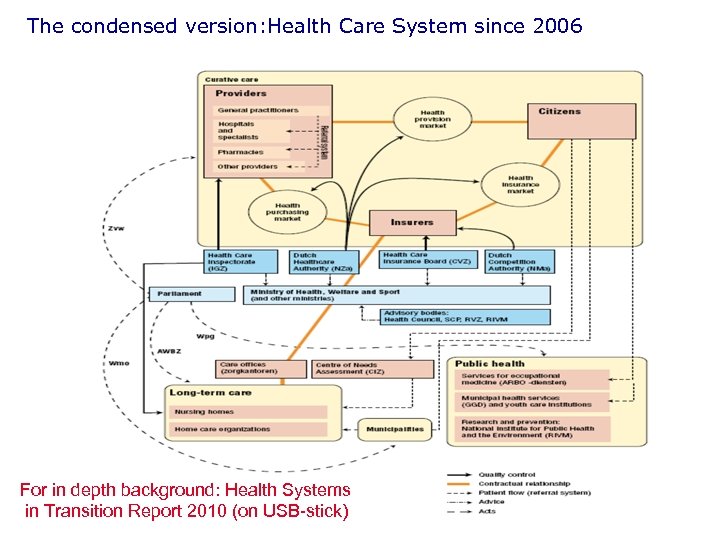
The condensed version: Health Care System since 2006 For in depth background: Health Systems in Transition Report 2010 (on USB-stick)
1. Health in The Netherlands
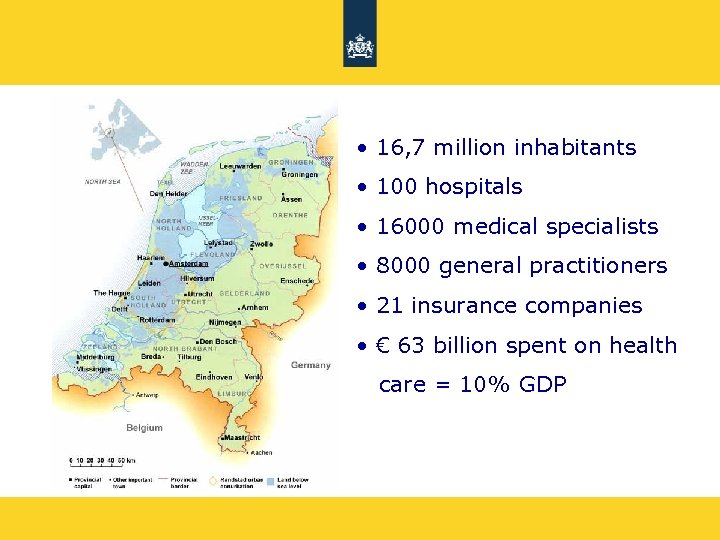
• 16, 7 million inhabitants • 100 hospitals • 16000 medical specialists • 8000 general practitioners • 21 insurance companies • € 63 billion spent on health care = 10% GDP
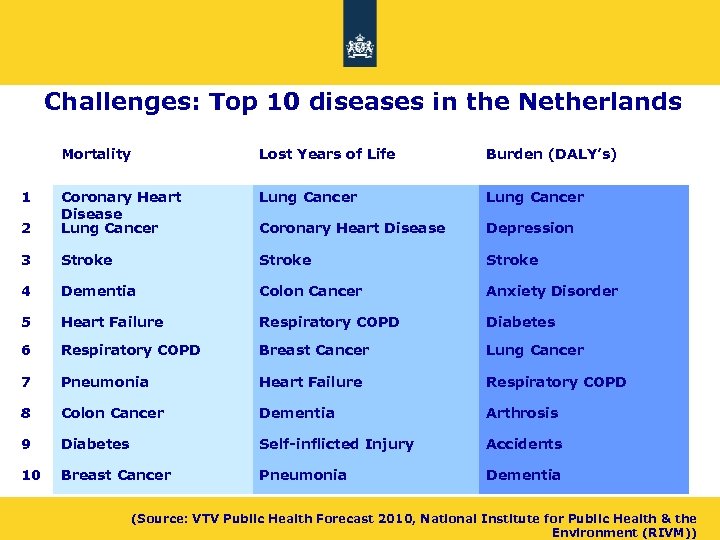
Challenges: Top 10 diseases in the Netherlands Mortality Lost Years of Life Burden (DALY’s) Lung Cancer 2 Coronary Heart Disease Lung Cancer Coronary Heart Disease Depression 3 Stroke 4 Dementia Colon Cancer Anxiety Disorder 5 Heart Failure Respiratory COPD Diabetes 6 Respiratory COPD Breast Cancer Lung Cancer 7 Pneumonia Heart Failure Respiratory COPD 8 Colon Cancer Dementia Arthrosis 9 Diabetes Self-inflicted Injury Accidents 10 Breast Cancer Pneumonia Dementia 1 (Source: VTV Public Health Forecast 2010, National Institute for Public Health & the Environment (RIVM))
2. The Ministry of Health, Welfare & Sport
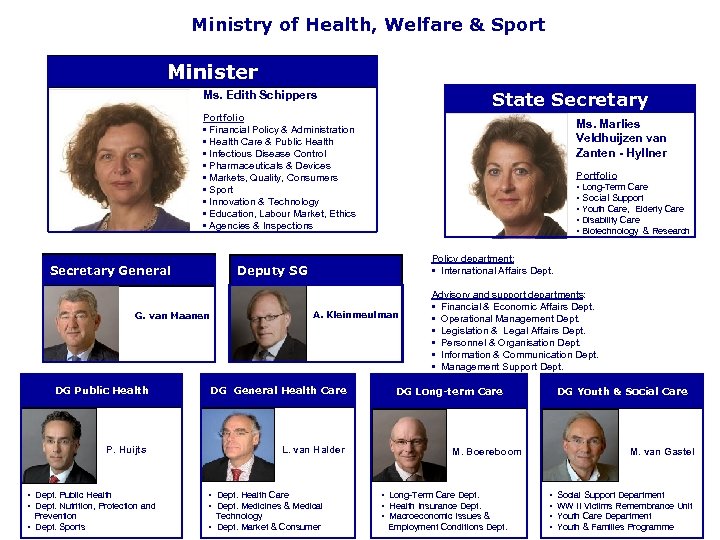
Ministry of Health, Welfare & Sport Minister State Secretary Ms. Edith Schippers Portfolio • Financial Policy & Administration • Health Care & Public Health • Infectious Disease Control • Pharmaceuticals & Devices • Markets, Quality, Consumers • Sport • Innovation & Technology • Education, Labour Market, Ethics • Agencies & Inspections Policy department: • International Affairs Dept. DG Public Health DG General Health Care P. Huijts L. van Halder Prevention • Long-Term Care • Social Support • Youth Care, Elderly Care • Disability Care • Biotechnology & Research A. Kleinmeulman G. van Maanen • Dept. Sports Portfolio Deputy SG Secretary General • Dept. Public Health • Dept. Nutrition, Protection and Ms. Marlies Veldhuijzen van Zanten - Hyllner • Dept. Health Care • Dept. Medicines & Medical Technology • Dept. Market & Consumer Advisory and support departments: • Financial & Economic Affairs Dept. • Operational Management Dept. • Legislation & Legal Affairs Dept. • Personnel & Organisation Dept. • Information & Communication Dept. • Management Support Dept. DG Youth & Social Care DG Long-term Care M. Boereboom • Long-Term Care Dept. • Health Insurance Dept. • Macroeconomic Issues & Employment Conditions Dept. M. van Gastel • • Social Support Department WW II Victims Remembrance Unit Youth Care Department Youth & Families Programme
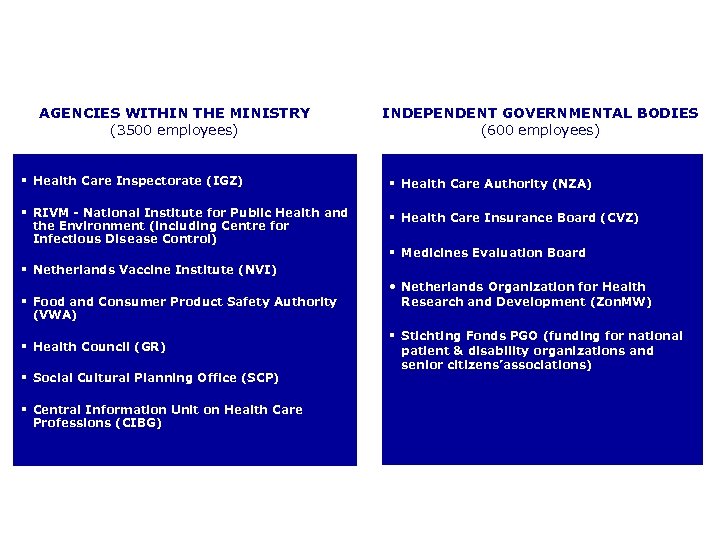
AGENCIES WITHIN THE MINISTRY (3500 employees) INDEPENDENT GOVERNMENTAL BODIES (600 employees) § Health Care Inspectorate (IGZ) § Health Care Authority (NZA) § RIVM - National Institute for Public Health and the Environment (including Centre for Infectious Disease Control) § Health Care Insurance Board (CVZ) § Medicines Evaluation Board § Netherlands Vaccine Institute (NVI) § Food and Consumer Product Safety Authority (VWA) § Health Council (GR) § Social Cultural Planning Office (SCP) § Central Information Unit on Health Care Professions (CIBG) • Netherlands Organization for Health Research and Development (Zon. MW) § Stichting Fonds PGO (funding for national patient & disability organizations and senior citizens’associations)
3. From former to current health system
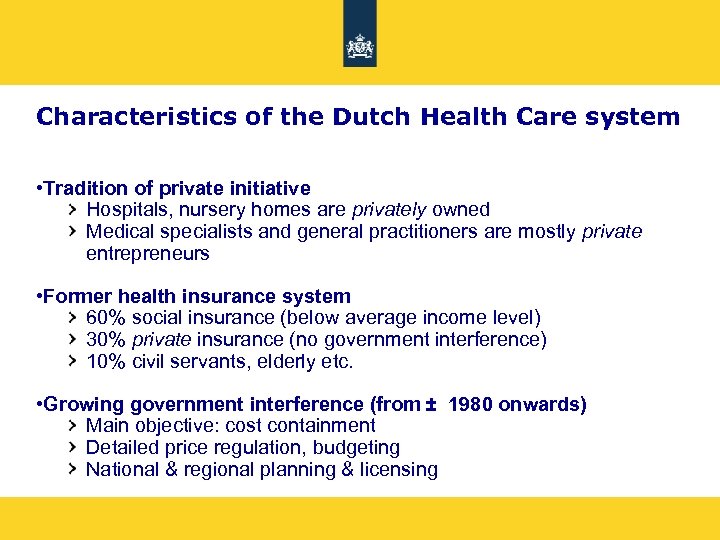
Characteristics of the Dutch Health Care system • Tradition of private initiative Hospitals, nursery homes are privately owned Medical specialists and general practitioners are mostly private entrepreneurs • Former health insurance system 60% social insurance (below average income level) 30% private insurance (no government interference) 10% civil servants, elderly etc. • Growing government interference (from ± 1980 onwards) Main objective: cost containment Detailed price regulation, budgeting National & regional planning & licensing
Pros & cons of the former system • Pros Cost containment on macro (national) level Policy implementation through intervening in the system Quality (of health care delivery) • Cons Macro efficiency, micro inefficiency Lack of spirit of enterprise & innovative climate Rationing → waiting lists • Growing pressure on the system Demographics (ageing & labor market) Technology developments Law suits because of waiting lists !
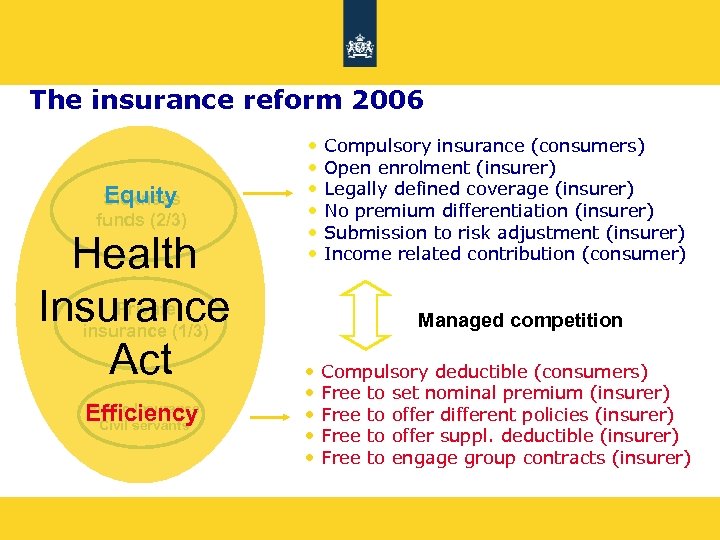
The insurance reform 2006 Equity Sickness funds (2/3) Health Private Insurance insurance (1/3) Act Public Insurance Efficiency Civil servants • • • Compulsory insurance (consumers) Open enrolment (insurer) Legally defined coverage (insurer) No premium differentiation (insurer) Submission to risk adjustment (insurer) Income related contribution (consumer) Managed competition • • • Compulsory deductible (consumers) Free to set nominal premium (insurer) Free to offer different policies (insurer) Free to offer suppl. deductible (insurer) Free to engage group contracts (insurer)
4. Facing the challenges: Policy strategy
How to build a sustainable health care system? • Fair share of solidarity • High responsiveness to change • Efficiency seeking
Coalition agreement (30/09/10) • Move ahead! - increase free pricing - increase amount of risk bearing - allow for private capital • Health care is only sector with significant growth • Integrated care nearby: doctor around the corner • Coverage shrinking (lower disease burden) • More copayments • Establish Health Care Quality Institute
New government, new policy priorities Published end of January 2011: -Strategic policy document Minister -Strategic policy document State Secretary
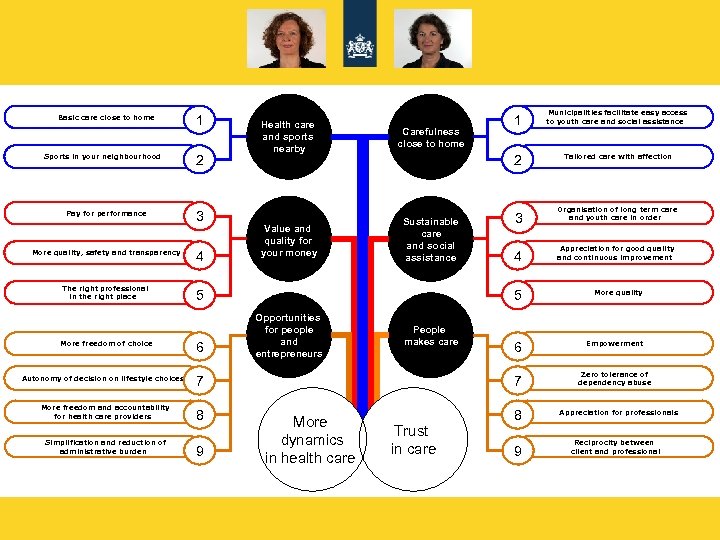
Basic care close to home Sports in your neighbourhood Pay for performance 1 2 3 More quality, safety and transparency 4 The right professional in the right place Health care and sports nearby Value and quality for your money Sustainable care and social assistance 5 More freedom of choice Autonomy of decision on lifestyle choices More freedom and accountability for health care providers Simplification and reduction of administrative burden 6 9 Tailored care with affection 3 4 Organisation of long term care and youth care in order Appreciation for good quality and continuous improvement 5 People makes care More dynamics in health care Trust in care More quality 6 Empowerment 7 Opportunities for people and entrepreneurs 7 8 Municipalities facilitate easy access to youth care and social assistance 2 Carefulness close to home 1 Zero tolerance of dependency abuse 8 9 Appreciation for professionals Reciprocity between client and professional
Additional information is available on USB-stick: Health Care Systems in Transition Report of 2010 by the European Observatory on Health Systems Dutch Health Care Performance Report 2010 by the National Institute of Public Health and the Environment (2010) Legal Framework – the basis of the 2006 Health System Reform Links to health policy and system research publications: • Nivel – Netherlands Institute for Health Services research http: //www. nivel. eu/ • National Institute of Public Health & the Environment http: //www. rivm. nl/en/ • Netherlands Organisation for Health Research & Development http: //www. zonmw. nl/en/
Thank you for your attention.
Скачать презентацию Brief Introduction to the Health System of the
801e2ba143f227bdd2e965163d473d32.ppt