 Скачать презентацию Brief introduction to the CENSE project and the
160e7c73ab4652fbdabf7cae0a4a2236.ppt
- Количество слайдов: 9



Brief introduction to the CENSE project and the CEN-EPBD standards Dick van Dijk (TNO, project coordination) dick. vandijk@tno. nl TNO Built Environment and Geosciences (NL) CENSE Contract: EIE/07/069/SI 2. 466698 Duration: October 2007 – March 2010 Version: June 25, 2009
Outline • The European Energy Performance of Buildings Directive (EPBD) • The CEN-standards to support the EPBD • The CENSE project 2
The European Energy Performance of Buildings Directive (EPBD, Dec. 2002) The EPBD is set to promote the improvement of energy performance of buildings – Buildings account for 40 % of EU energy use – Cost-effective savings potential: 28% by 2020 Required for all EU Member States, from 2006 (2009): – – General framework for a calculation methodology Mandatory energy performance requirements Energy performance certificates Regular inspection of boilers and A/C systems NB: Recast currently under discussion 3
The CEN-standards to support the EPBD European Commission Mandate 343 to CEN (Jan. 2004): …the elaboration and adoption of standards for a methodology calculating the integrated energy performance of buildings in accordance with the EPBD Result: • circa 30 CEN-standards published (2007 -2008) • Prepared in 5 different Technical Committees (TC) each TC specialized in a specific area 4
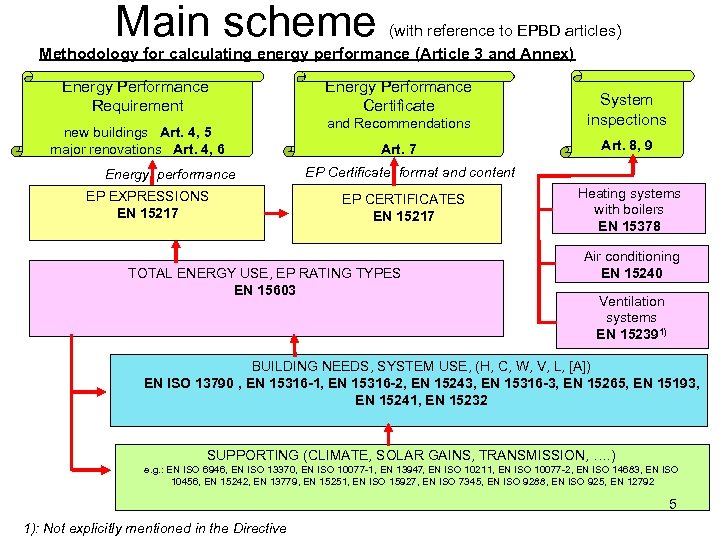
Main scheme (with reference to EPBD articles) Methodology for calculating energy performance (Article 3 and Annex) Energy Performance Requirement new buildings Art. 4, 5 major renovations Art. 4, 6 Energy performance EP EXPRESSIONS EN 15217 Energy Performance Certificate and Recommendations System inspections Art. 7 Art. 8, 9 EP Certificate format and content EP CERTIFICATES EN 15217 TOTAL ENERGY USE, EP RATING TYPES EN 15603 Heating systems with boilers EN 15378 Air conditioning EN 15240 Ventilation systems EN 152391) BUILDING NEEDS, SYSTEM USE, (H, C, W, V, L, [A]) EN ISO 13790 , EN 15316 -1, EN 15316 -2, EN 15243, EN 15316 -3, EN 15265, EN 15193, EN 15241, EN 15232 SUPPORTING (CLIMATE, SOLAR GAINS, TRANSMISSION, …. ) e. g. : EN ISO 6946, EN ISO 13370, EN ISO 10077 -1, EN 13947, EN ISO 10211, EN ISO 10077 -2, EN ISO 14683, EN ISO 10456, EN 15242, EN 13779, EN 15251, EN ISO 15927, EN ISO 7345, EN ISO 9288, EN ISO 925, EN 12792 5 1): Not explicitly mentioned in the Directive
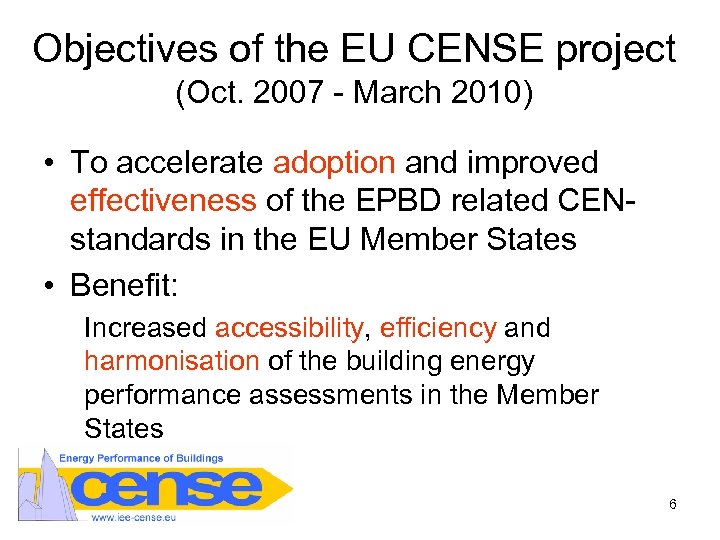
Objectives of the EU CENSE project (Oct. 2007 - March 2010) • To accelerate adoption and improved effectiveness of the EPBD related CENstandards in the EU Member States • Benefit: Increased accessibility, efficiency and harmonisation of the building energy performance assessments in the Member States 6
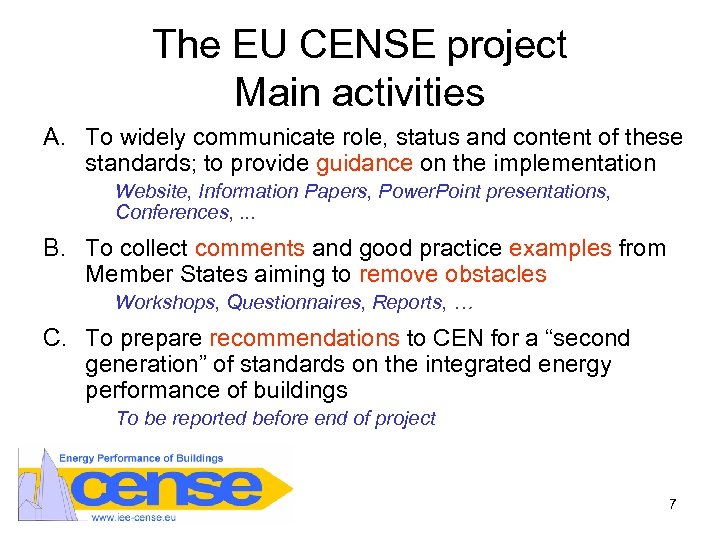
The EU CENSE project Main activities A. To widely communicate role, status and content of these standards; to provide guidance on the implementation Website, Information Papers, Power. Point presentations, Conferences, . . . B. To collect comments and good practice examples from Member States aiming to remove obstacles Workshops, Questionnaires, Reports, … C. To prepare recommendations to CEN for a “second generation” of standards on the integrated energy performance of buildings To be reported before end of project 7
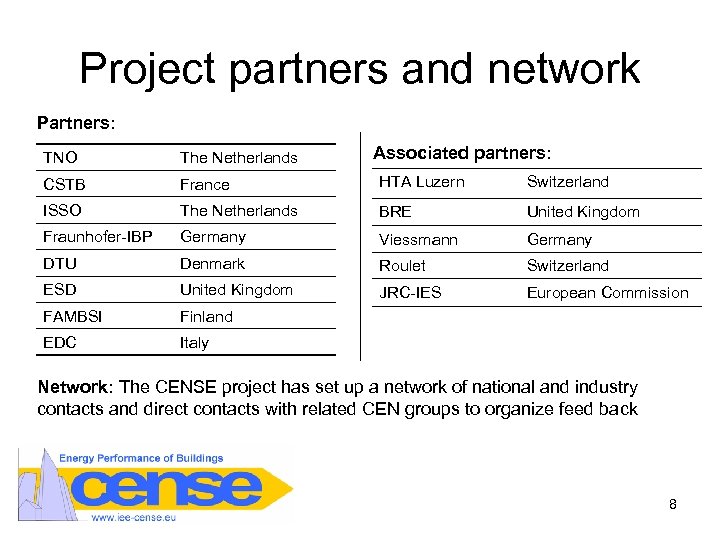
Project partners and network Partners: Associated partners: TNO The Netherlands CSTB France HTA Luzern Switzerland ISSO The Netherlands BRE United Kingdom Fraunhofer-IBP Germany Viessmann Germany DTU Denmark Roulet Switzerland ESD United Kingdom JRC-IES European Commission FAMBSI Finland EDC Italy Network: The CENSE project has set up a network of national and industry contacts and direct contacts with related CEN groups to organize feed back 8
More information and downloads: www. iee-cense. eu Disclaimer: CENSE has received funding from the Community’s Intelligent Energy Europe programme under the contract EIE/07/069/SI 2. 466698. The content of this presentation reflects the authors view. The author(s) and the European Commission are not liable for any use that may be made of the information contained therein. Moreover, because this is an interim result of the project: any conclusions are only preliminary and may change in the course of the project based on further feedback from the contributors, additional collected information and/or increased insight. 9
Скачать презентацию Brief introduction to the CENSE project and the
160e7c73ab4652fbdabf7cae0a4a2236.ppt