 Скачать презентацию Breastfeeding Update for Bassetlaw District Council Staff Breastfeeding
a86b47390d3613def9c77d066afad7a8.ppt
- Количество слайдов: 10



Breastfeeding Update for Bassetlaw District Council Staff Breastfeeding Training Pack © UNICEF UK Baby Friendly Initiative 2016
Why are we promoting breastfeeding? • Nottinghamshire Healthcare NHS Foundation Trust has made a commitment to promote, protect and support breastfeeding. We hope to invest in supporting women to breastfeed thereby improving the quality of life for women and children and their families through reducing chronic and long term diseases. • The majority of mothers who breastfeed stop before they want to. • One barrier quoted by mothers is their anxiety to breastfeed out in public for fear of criticism from members of the public • By working in partnership with Bassetlaw District Council, we hope to develop a breastfeeding friendly culture within our community.
Partnership working to support mothers • All health providers across Nottinghamshire follow the UNICEF Baby Friendly Initiative (BFI), which is a worldwide programme of the World Health Organisation and UNICEF • Evidence shows that Communities and hospitals which have implemented the BFI have enjoyed increased breastfeeding rates. All Community healthcare areas and hospitals in Nottinghamshire are working towards gaining UNICEF BFI accreditation • This means that all areas in Nottinghamshire will be promoting the same breastfeeding support and information. • UNICEF BFI hopes to develop the skills and understanding for everyone to strengthen the mother-baby and family relationship which is important for all babies
Benefits of promoting breastfeeding • Breastfeeding improves the health and wellbeing of both mother and infant (DH 2010) for example: • Breastfed babies experience fewer episodes of gastro-enteritis, respiratory infection, diabetes, asthma, dermatitis and eczema. Once becoming adults, a reduced risk of obesity and cardiovascular disease is experienced (2005) • Over £ 17 million could be gained annually in the NHS by avoiding the costs of treating these diseases in infants which are greatly reduced in breastfed babies (2012) • Breastfeeding mothers have a long-term protection from reproductive cancers, osteoporosis, diabetes, postnatal depression • Breastfed babies are 50% less likely to die of cot death (2009) • Breastfeeding rates in the UK are one of the lowest in Europe
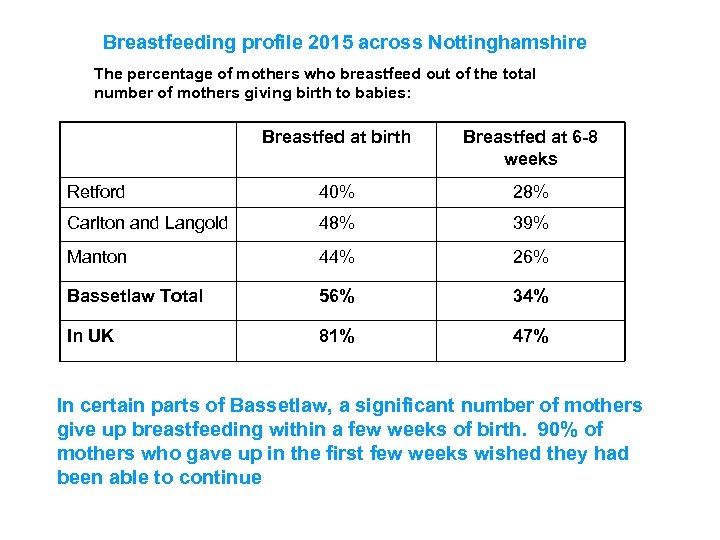
Breastfeeding profile 2015 across Nottinghamshire The percentage of mothers who breastfeed out of the total number of mothers giving birth to babies: Breastfed at birth Breastfed at 6 -8 weeks Retford 40% 28% Carlton and Langold 48% 39% Manton 44% 26% Bassetlaw Total 56% 34% In UK 81% 47% In certain parts of Bassetlaw, a significant number of mothers give up breastfeeding within a few weeks of birth. 90% of mothers who gave up in the first few weeks wished they had been able to continue
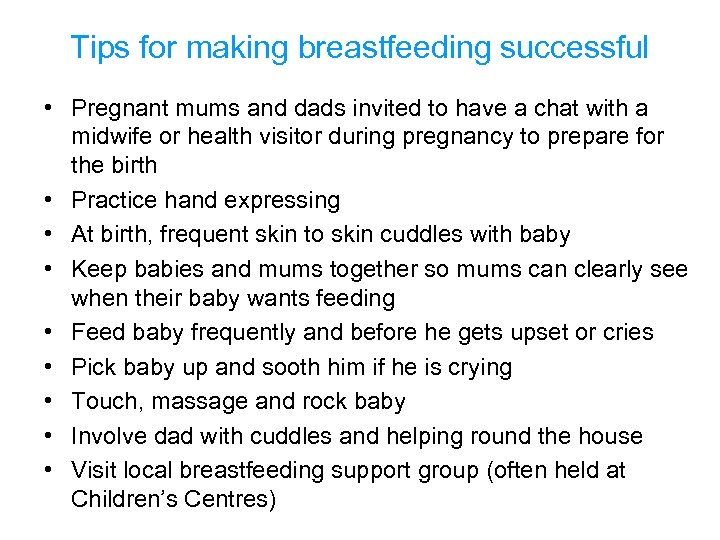
Tips for making breastfeeding successful • Pregnant mums and dads invited to have a chat with a midwife or health visitor during pregnancy to prepare for the birth • Practice hand expressing • At birth, frequent skin to skin cuddles with baby • Keep babies and mums together so mums can clearly see when their baby wants feeding • Feed baby frequently and before he gets upset or cries • Pick baby up and sooth him if he is crying • Touch, massage and rock baby • Involve dad with cuddles and helping round the house • Visit local breastfeeding support group (often held at Children’s Centres)
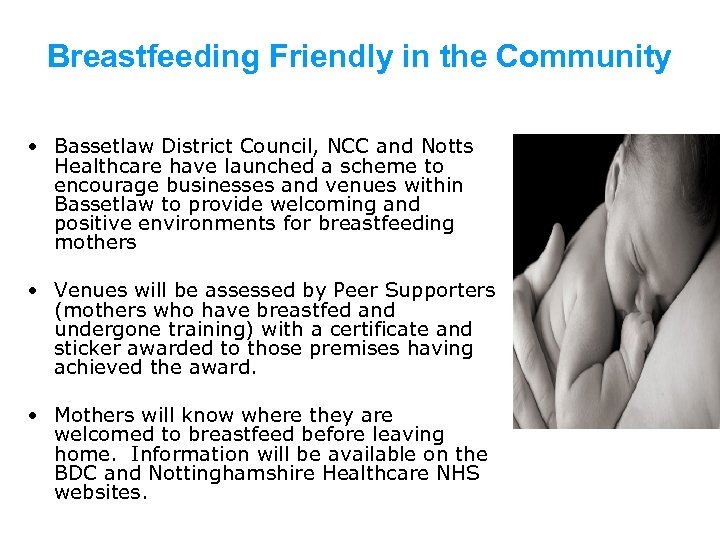
Breastfeeding Friendly in the Community • Bassetlaw District Council, NCC and Notts Healthcare have launched a scheme to encourage businesses and venues within Bassetlaw to provide welcoming and positive environments for breastfeeding mothers • Venues will be assessed by Peer Supporters (mothers who have breastfed and undergone training) with a certificate and sticker awarded to those premises having achieved the award. • Mothers will know where they are welcomed to breastfeed before leaving home. Information will be available on the BDC and Nottinghamshire Healthcare NHS websites.
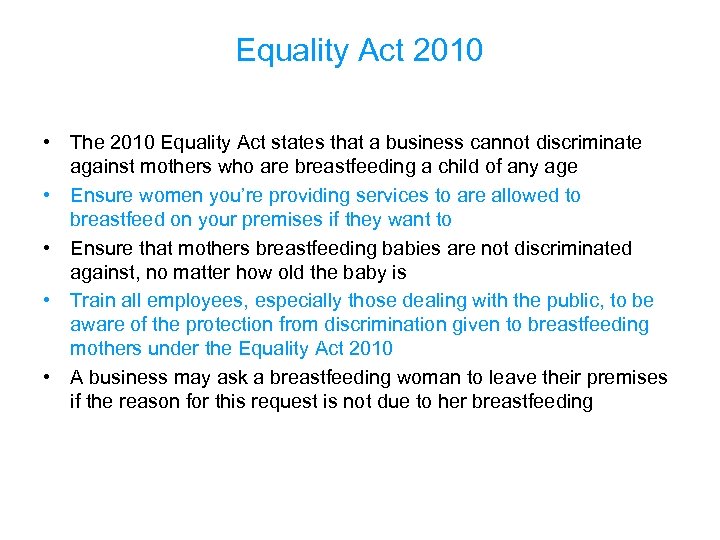
Equality Act 2010 • The 2010 Equality Act states that a business cannot discriminate against mothers who are breastfeeding a child of any age • Ensure women you’re providing services to are allowed to breastfeed on your premises if they want to • Ensure that mothers breastfeeding babies are not discriminated against, no matter how old the baby is • Train all employees, especially those dealing with the public, to be aware of the protection from discrimination given to breastfeeding mothers under the Equality Act 2010 • A business may ask a breastfeeding woman to leave their premises if the reason for this request is not due to her breastfeeding
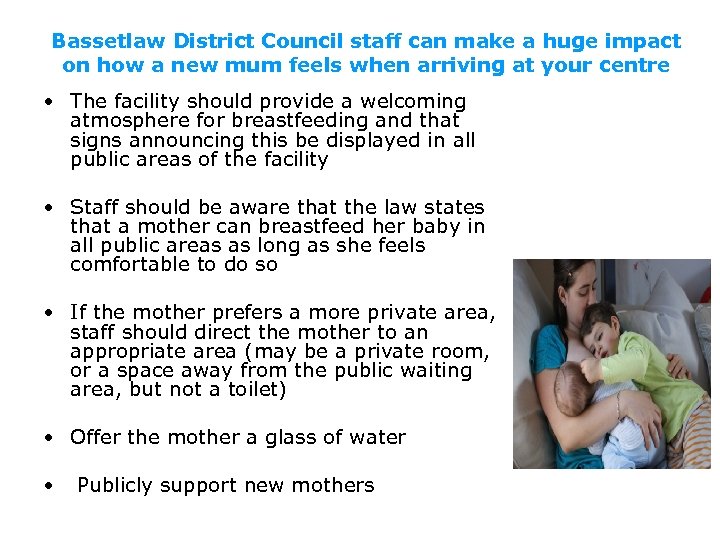
Bassetlaw District Council staff can make a huge impact on how a new mum feels when arriving at your centre • The facility should provide a welcoming atmosphere for breastfeeding and that signs announcing this be displayed in all public areas of the facility • Staff should be aware that the law states that a mother can breastfeed her baby in all public areas as long as she feels comfortable to do so • If the mother prefers a more private area, staff should direct the mother to an appropriate area (may be a private room, or a space away from the public waiting area, but not a toilet) • Offer the mother a glass of water • Publicly support new mothers
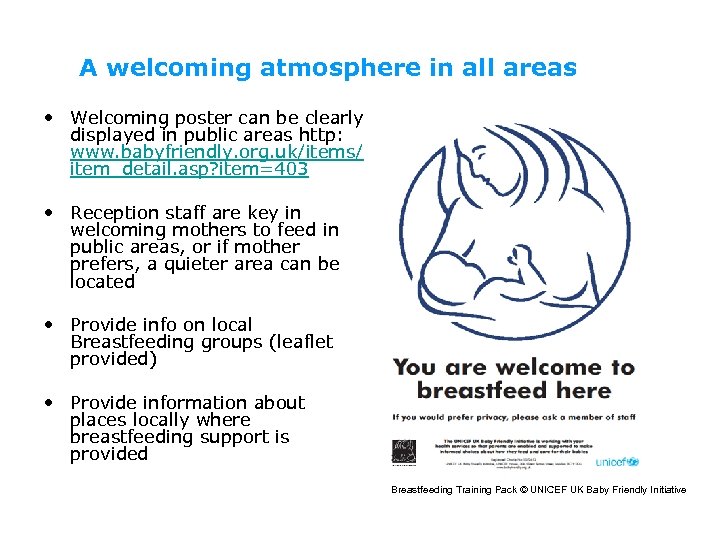
A welcoming atmosphere in all areas • Welcoming poster can be clearly displayed in public areas http: www. babyfriendly. org. uk/items/ item_detail. asp? item=403 • Reception staff are key in welcoming mothers to feed in public areas, or if mother prefers, a quieter area can be located • Provide info on local Breastfeeding groups (leaflet provided) • Provide information about places locally where breastfeeding support is provided Breastfeeding Training Pack © UNICEF UK Baby Friendly Initiative
Скачать презентацию Breastfeeding Update for Bassetlaw District Council Staff Breastfeeding
a86b47390d3613def9c77d066afad7a8.ppt