 Скачать презентацию Breastfeeding and Child Survival Hoosen Coovadia Emeritus Professor
398572e6c09f6c95614e241d7212c6b8.ppt
- Количество слайдов: 37



Breastfeeding and Child Survival Hoosen Coovadia Emeritus Professor of Paediatrics and Child Health, Emeritus Victor Daitz Professor of HIV Research, University of Kwazulu-Natal. Director, Maternal Adolescent and Child Health, University of the Witwatersrand.
Deaths in Infants & Children and Why They Die in South Africa and Elsewhere
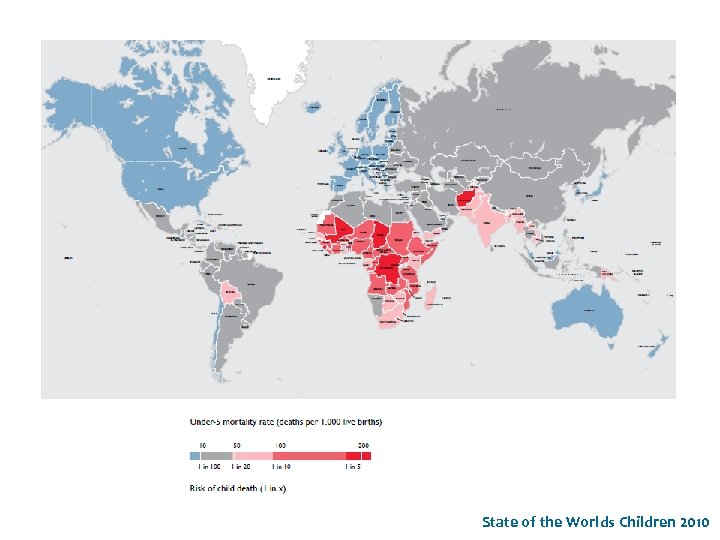
State of the Worlds Children 2010
The Highest Priorities **Progressively, by 2030, overcome binding constraints within major Social Determinants impacting on health **Strengthening the Health System. **Optimising health promotion, prevention, treatment, rehabilitation and care outcomes, for the major causes of mortality, morbidity and disability in South Africa. ** National Health Insurance [Universal Coverage].
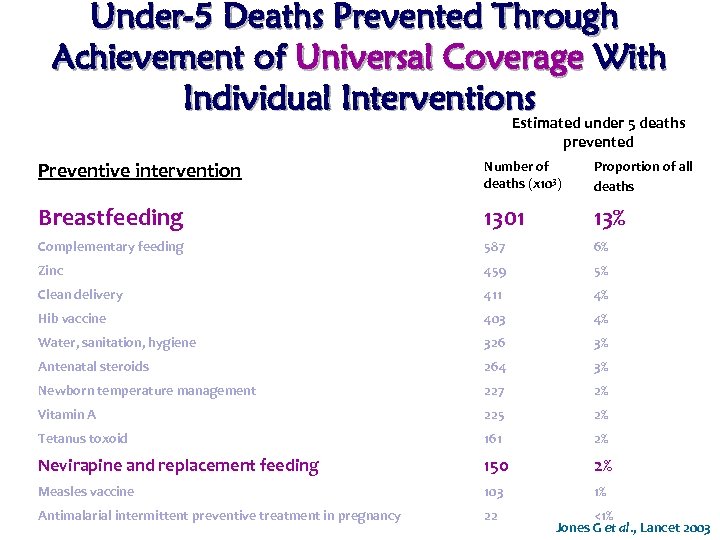
Under-5 Deaths Prevented Through Achievement of Universal Coverage With Individual Interventions Estimated under 5 deaths prevented Preventive intervention Number of deaths (x 103) Proportion of all deaths Breastfeeding 1301 13% Complementary feeding 587 6% Zinc 459 5% Clean delivery 411 4% Hib vaccine 403 4% Water, sanitation, hygiene 326 3% Antenatal steroids 264 3% Newborn temperature management 227 2% Vitamin A 225 2% Tetanus toxoid 161 2% Nevirapine and replacement feeding 150 2% Measles vaccine 103 1% Antimalarial intermittent preventive treatment in pregnancy 22 <1% Jones G et al. , Lancet 2003
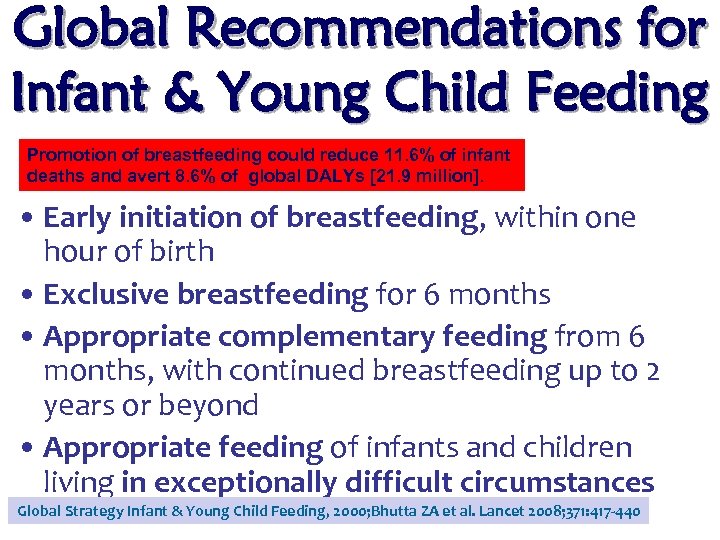
Global Recommendations for Infant & Young Child Feeding Promotion of breastfeeding could reduce 11. 6% of infant deaths and avert 8. 6% of global DALYs [21. 9 million]. • Early initiation of breastfeeding, within one hour of birth • Exclusive breastfeeding for 6 months • Appropriate complementary feeding from 6 months, with continued breastfeeding up to 2 years or beyond • Appropriate feeding of infants and children living in exceptionally difficult circumstances Global Strategy Infant & Young Child Feeding, 2000; Bhutta ZA et al. Lancet 2008; 371: 417 -440
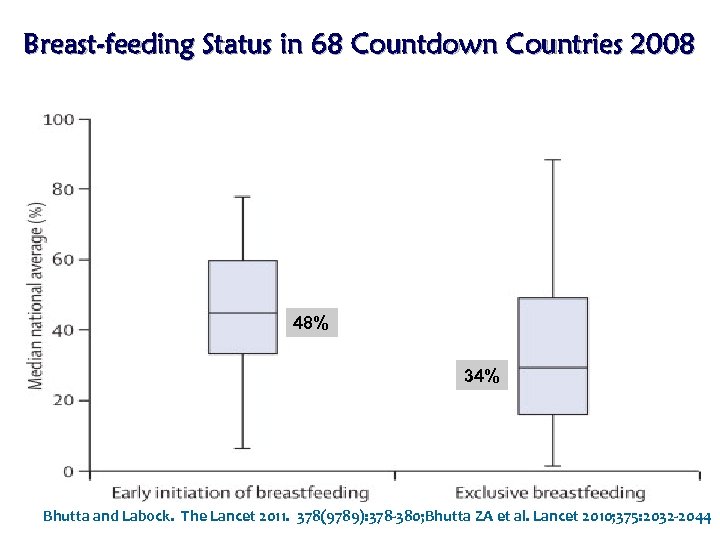
Breast-feeding Status in 68 Countdown Countries 2008 48% 34% Bhutta and Labock. The Lancet 2011. 378(9789): 378 -380; Bhutta ZA et al. Lancet 2010; 375: 2032 -2044
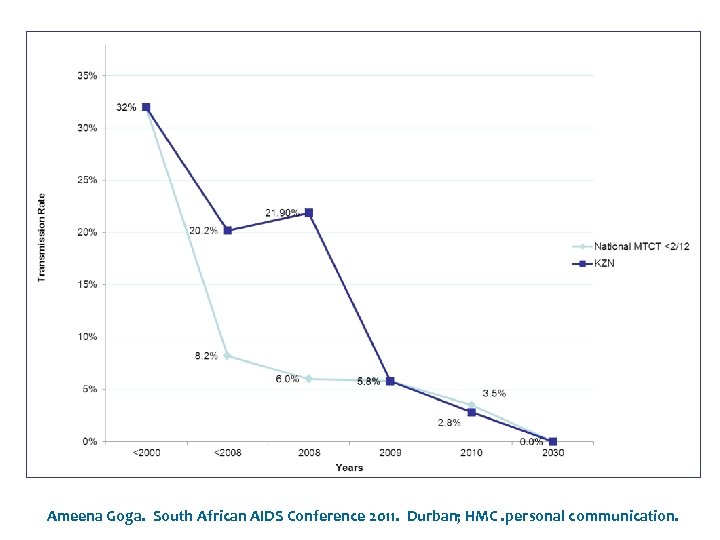
Ameena Goga. South African AIDS Conference 2011. Durban; HMC. personal communication.
AFASS? “The review of evidence on infant feeding in the context of HIV/AIDS does not show that the WHO policy will lead to improved survival or health outcomes in infants born to HIV positive mothers. It does suggest that current recommendations are likely to reduce mother‑to‑child transmission of HIV from breastfeeding. Policy based only on evidence of transmission rates relies on broad assumptions that a reduction in transmission will translate into improved survival. The evidence does not support that. ” Liles C, Tompson M. WEPEO 996 XVI International AIDS Conference. 13 -18 August 2006, Toronto, Canada. www. aids 2006. org
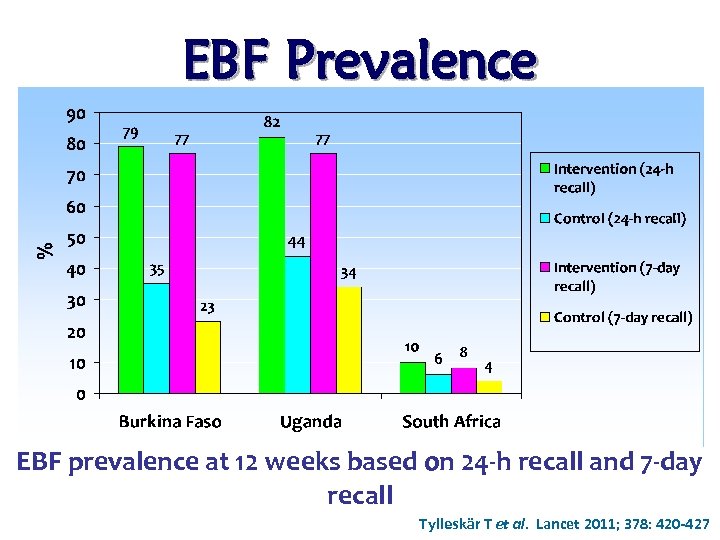
EBF Prevalence EBF prevalence at 12 weeks based on 24 -h recall and 7 -day recall Tylleskär T et al. Lancet 2011; 378: 420 -427
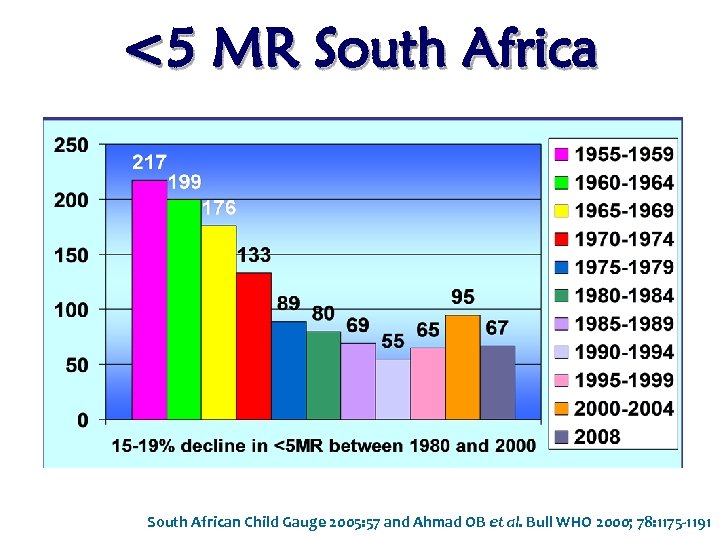
<5 MR South African Child Gauge 2005: 57 and Ahmad OB et al. Bull WHO 2000; 78: 1175 -1191
Why Breastfeeding Remains Critical for Child Health in South Africa Mortality rates for children under 5 years of age have hardly improved over the past five years, and the projections by the Medical Research Council of South Africa which show that child mortality rates could increase to 79 per 1000 live births have a “…lot to do with child care, and the fact that there is very little breastfeeding in this country, because it is seen as ‘culturally backward’. ” Macharia Kamau. UNICEF South Africa. The Sunday Independent, Feb 4 2007; page 4. “Number of child deaths in SA worrying – UNICEF. ”
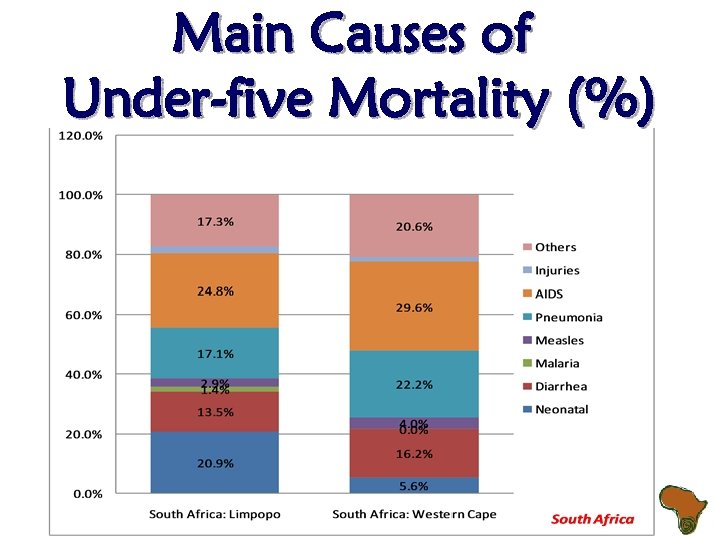
Main Causes of Under-five Mortality (%)
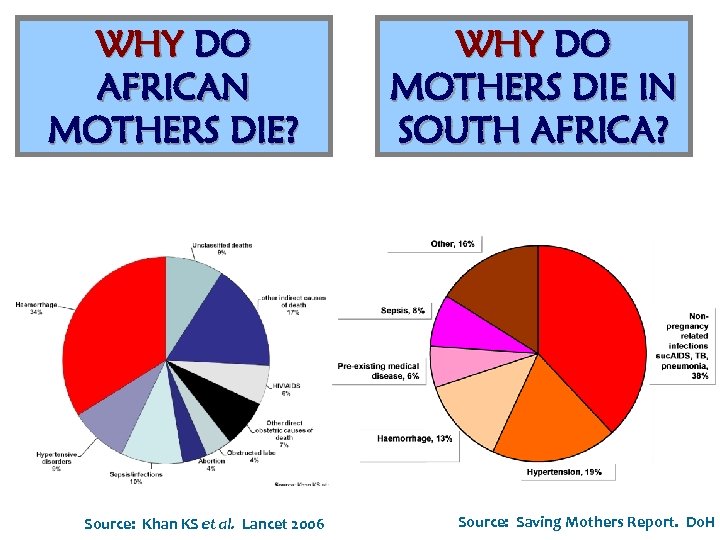
WHY DO AFRICAN MOTHERS DIE? Source: Khan KS et al. Lancet 2006 WHY DO MOTHERS DIE IN SOUTH AFRICA? Source: Saving Mothers Report. Do. H
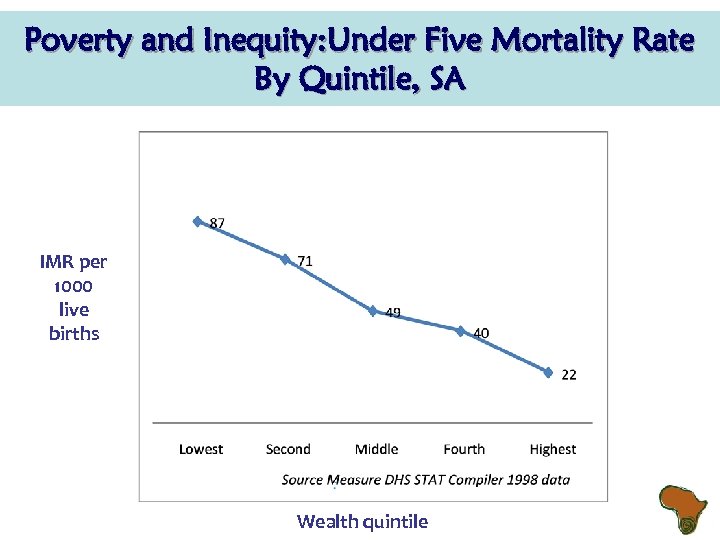
Poverty and Inequity: Under Five Mortality Rate By Quintile, SA IMR per 1000 live births Wealth quintile
Controlled Trials of Breastfeeding and Formula : breastfeeding improves child survival
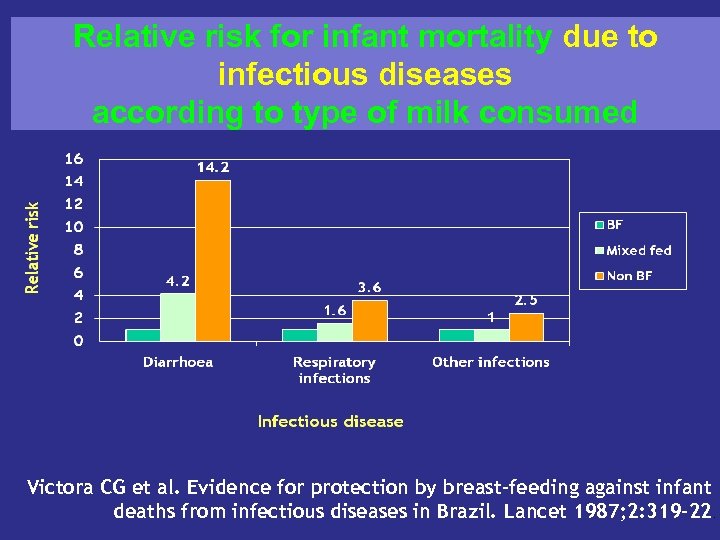
Relative risk for infant mortality due to infectious diseases according to type of milk consumed Victora CG et al. Evidence for protection by breast-feeding against infant deaths from infectious diseases in Brazil. Lancet 1987; 2: 319 -22.
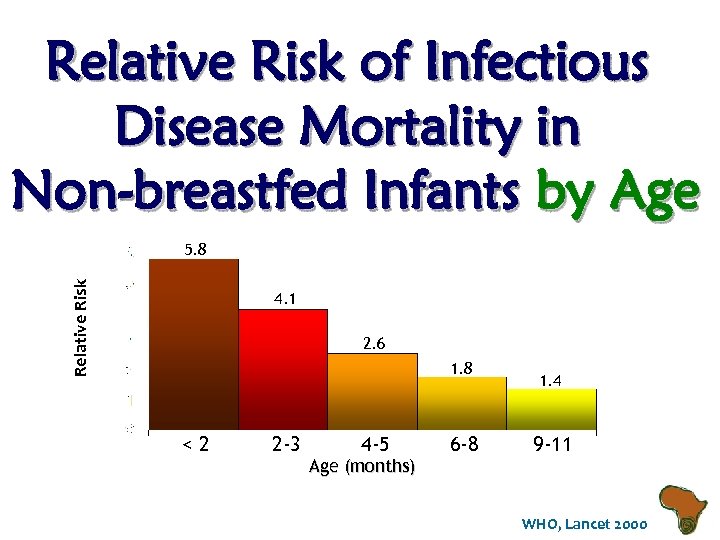
Relative Risk of Infectious Disease Mortality in Non-breastfed Infants by Age Relative Risk 5. 8 4. 1 2. 6 1. 8 <2 2 -3 4 -5 Age (months) 6 -8 1. 4 9 -11 WHO, Lancet 2000
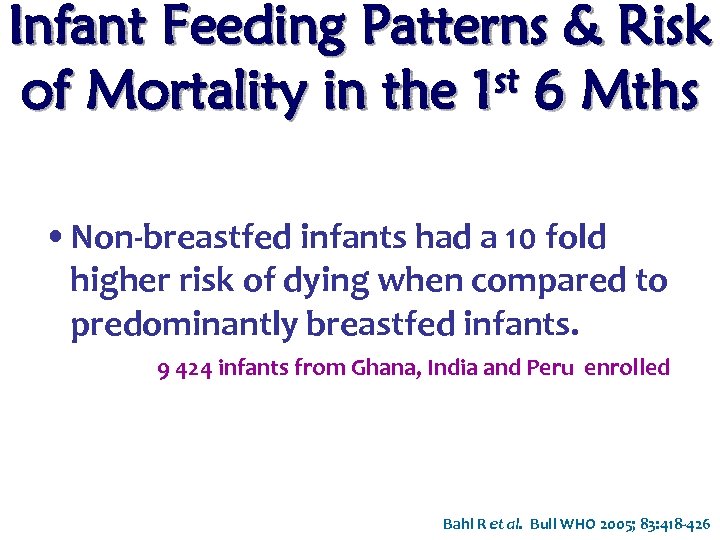
Infant Feeding Patterns & Risk st 6 Mths of Mortality in the 1 • Non-breastfed infants had a 10 fold higher risk of dying when compared to predominantly breastfed infants. 9 424 infants from Ghana, India and Peru enrolled Bahl R et al. Bull WHO 2005; 83: 418 -426
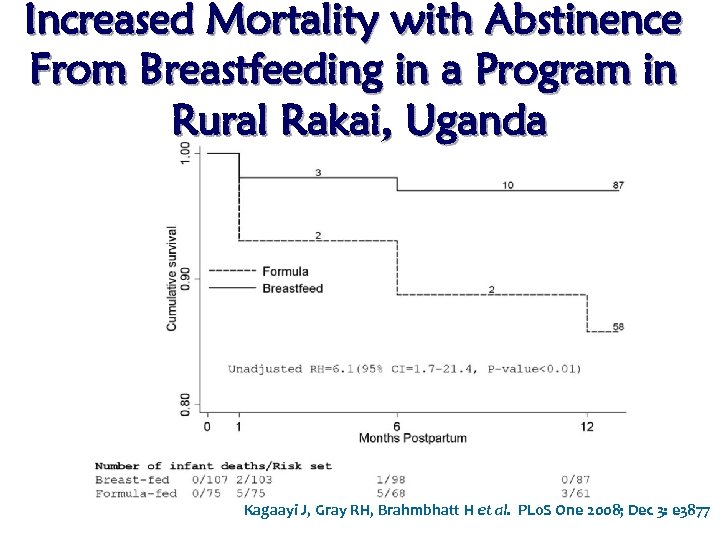
Increased Mortality with Abstinence From Breastfeeding in a Program in Rural Rakai, Uganda Kagaayi J, Gray RH, Brahmbhatt H et al. PLo. S One 2008; Dec 3: e 3877
The Botswana Experience: An “Unintended” Experiment
![Diarrhoea, Malnutrition & Death [< 5 years of age] Francistown, Botswana. Nov 2005 –](https://present5.com/presentation/398572e6c09f6c95614e241d7212c6b8/image-22.jpg "Diarrhoea, Malnutrition & Death [< 5 years of age] Francistown, Botswana. Nov 2005 –")
Diarrhoea, Malnutrition & Death [< 5 years of age] Francistown, Botswana. Nov 2005 – Apr 2006
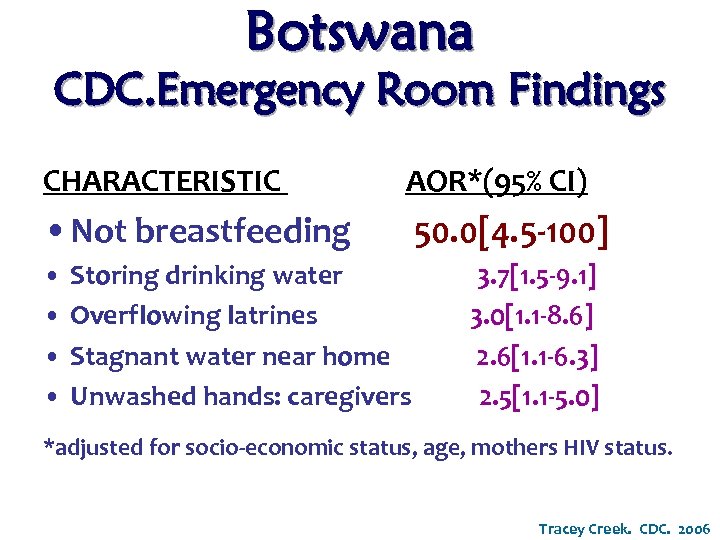
Botswana CDC. Emergency Room Findings CHARACTERISTIC AOR*(95% CI) • Not breastfeeding 50. 0[4. 5 -100] • Storing drinking water • Overflowing latrines • Stagnant water near home • Unwashed hands: caregivers 3. 7[1. 5 -9. 1] 3. 0[1. 1 -8. 6] 2. 6[1. 1 -6. 3] 2. 5[1. 1 -5. 0] *adjusted for socio-economic status, age, mothers HIV status. Tracey Creek. CDC. 2006
What happens to survival and morbidity when breastfeeding is discontinued after initiation?
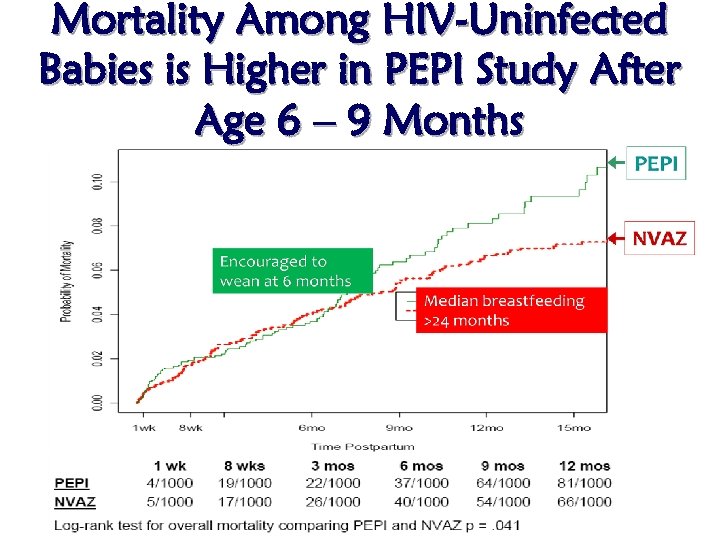
Mortality Among HIV-Uninfected Babies is Higher in PEPI Study After Age 6 – 9 Months
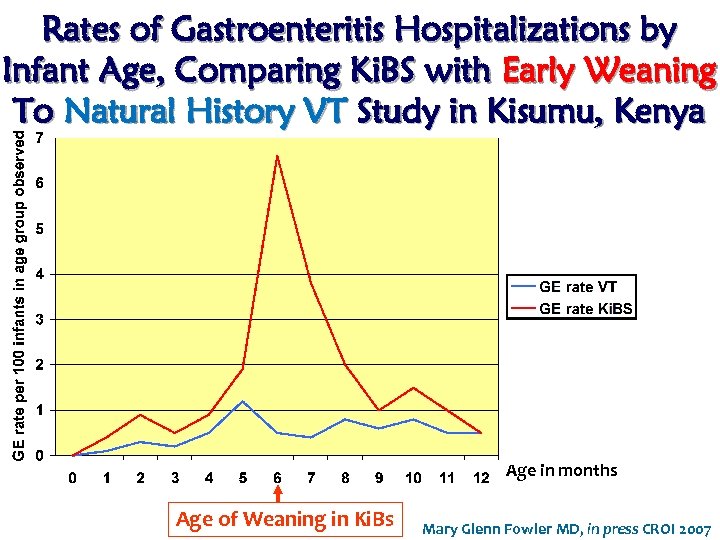
Rates of Gastroenteritis Hospitalizations by Infant Age, Comparing Ki. BS with Early Weaning To Natural History VT Study in Kisumu, Kenya Age in months Age of Weaning in Ki. Bs Mary Glenn Fowler MD, in press CROI 2007
Survival & Morbidity Associated With Exclusive Breastfeeding Vertical Transmission Study Group Africa Centre, University of Kwa. Zulu. Natal
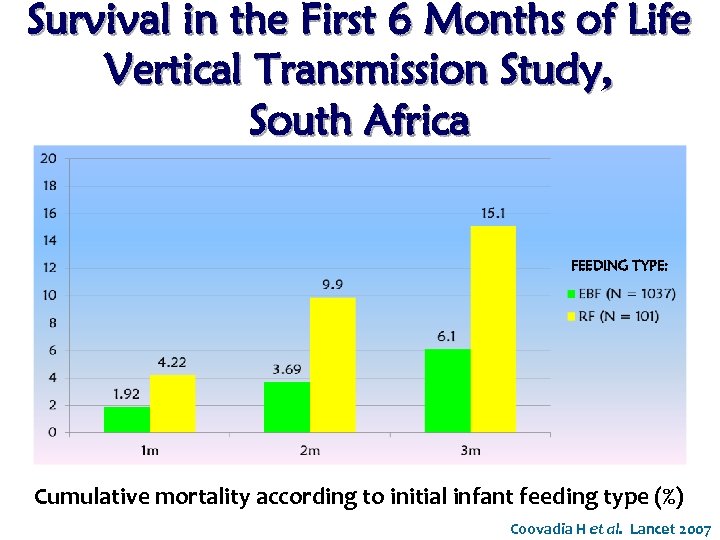
Survival in the First 6 Months of Life Vertical Transmission Study, South Africa FEEDING TYPE: Cumulative mortality according to initial infant feeding type (%) Coovadia H et al. Lancet 2007
![Breastfeeding Associated with Decreased Infant Mortality [and Morbidity[see ref 2011] to Age 2 Years](https://present5.com/presentation/398572e6c09f6c95614e241d7212c6b8/image-29.jpg "Breastfeeding Associated with Decreased Infant Mortality [and Morbidity[see ref 2011] to Age 2 Years")
Breastfeeding Associated with Decreased Infant Mortality [and Morbidity[see ref 2011] to Age 2 Years in HIV-Uninfected Children In Malawi Adjusted HR for Mortality(95%CI) HIV-uninfected Overall breastfeeding 0. 34 (0. 18 -0. 64) Exclusive breastfeeding 0. 11 (0. 04 -0. 32) Mixed breastfeeding 0. 37 (0. 20 -0. 69) Taha TE et al. Bull WHO 2006; 84: 546 -54; Taha TE et al. Clinical Infectious Disease 2011; 53: 388 -395
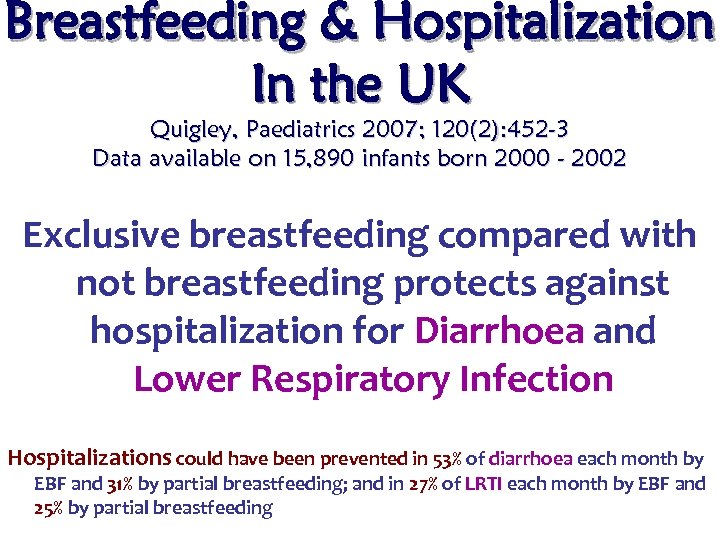
Breastfeeding & Hospitalization In the UK Quigley, Paediatrics 2007; 120(2): 452 -3 Data available on 15, 890 infants born 2000 - 2002 Exclusive breastfeeding compared with not breastfeeding protects against hospitalization for Diarrhoea and Lower Respiratory Infection Hospitalizations could have been prevented in 53% of diarrhoea each month by EBF and 31% by partial breastfeeding; and in 27% of LRTI each month by EBF and 25% by partial breastfeeding
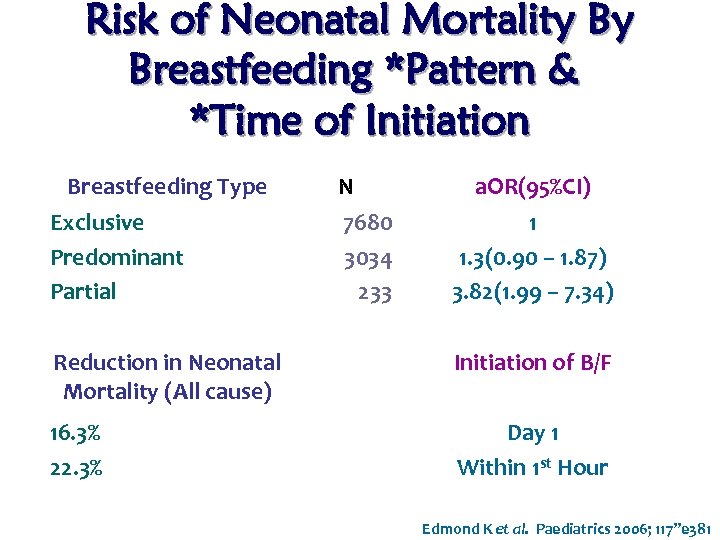
Risk of Neonatal Mortality By Breastfeeding *Pattern & *Time of Initiation Breastfeeding Type Exclusive Predominant Partial N 7680 3034 233 a. OR(95%CI) 1 1. 3(0. 90 – 1. 87) 3. 82(1. 99 – 7. 34) Reduction in Neonatal Mortality (All cause) Initiation of B/F 16. 3% 22. 3% Day 1 Within 1 st Hour Edmond K et al. Paediatrics 2006; 117”e 381
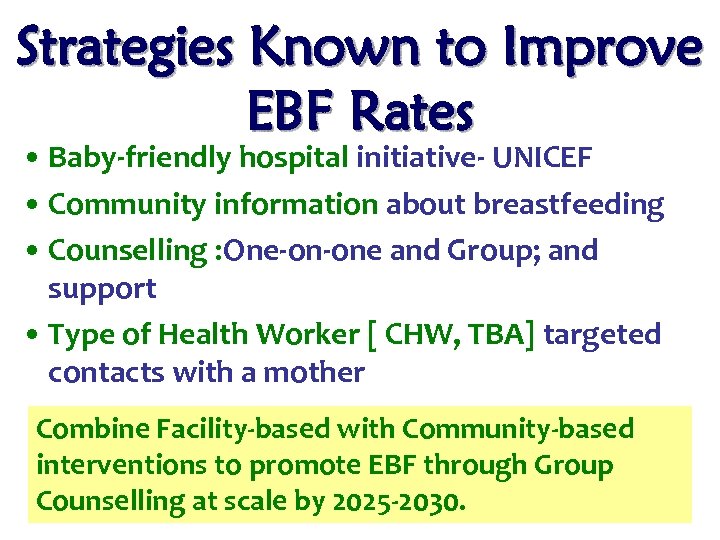
Strategies Known to Improve EBF Rates • Baby-friendly hospital initiative- UNICEF • Community information about breastfeeding • Counselling : One-on-one and Group; and support • Type of Health Worker [ CHW, TBA] targeted contacts with a mother Combine Facility-based with Community-based interventions to promote EBF through Group Counselling at scale by 2025 -2030.
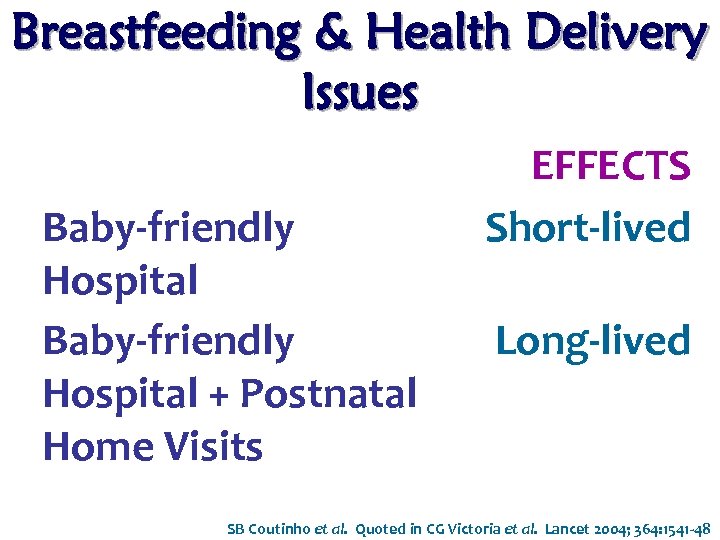
Breastfeeding & Health Delivery Issues Baby-friendly Hospital + Postnatal Home Visits EFFECTS Short-lived Long-lived SB Coutinho et al. Quoted in CG Victoria et al. Lancet 2004; 364: 1541 -48
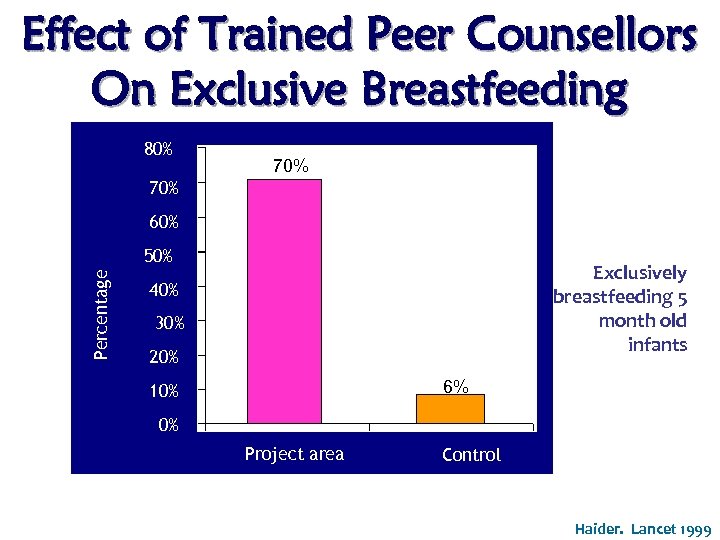
Effect of Trained Peer Counsellors On Exclusive Breastfeeding 80% 70% 60% Percentage 50% Exclusively breastfeeding 5 month old infants 40% 30% 20% 6% 10% 0% Project area Control Haider. Lancet 1999
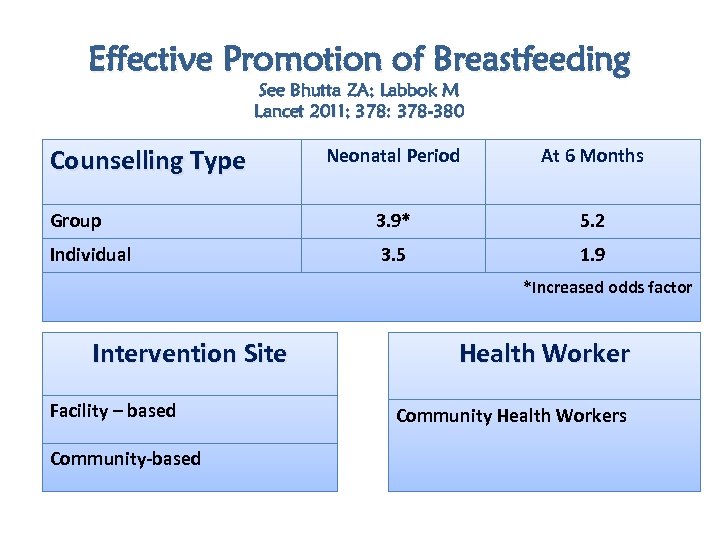
Effective Promotion of Breastfeeding See Bhutta ZA; Labbok M Lancet 2011; 378: 378 -380 Counselling Type Neonatal Period At 6 Months Group 3. 9* 5. 2 Individual 3. 5 1. 9 *Increased odds factor Intervention Site Facility – based Community-based Health Worker Community Health Workers
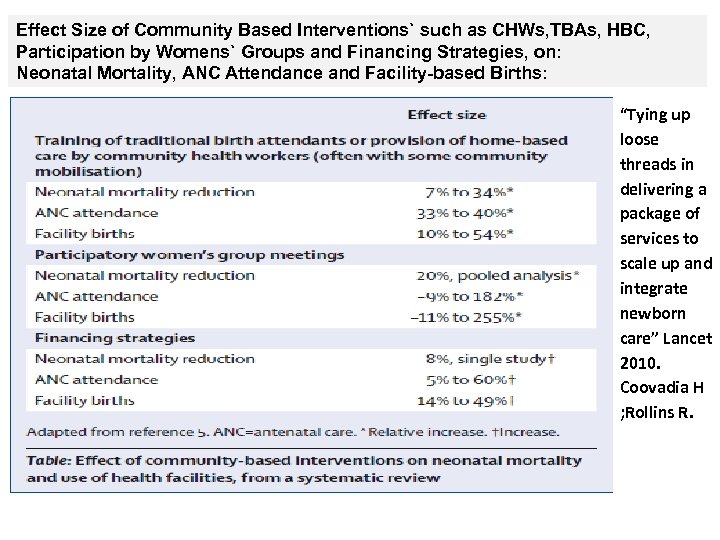
Effect Size of Community Based Interventions` such as CHWs, TBAs, HBC, Participation by Womens` Groups and Financing Strategies, on: Neonatal Mortality, ANC Attendance and Facility-based Births: “Tying up loose threads in delivering a package of services to scale up and integrate newborn care” Lancet 2010. Coovadia H ; Rollins R.
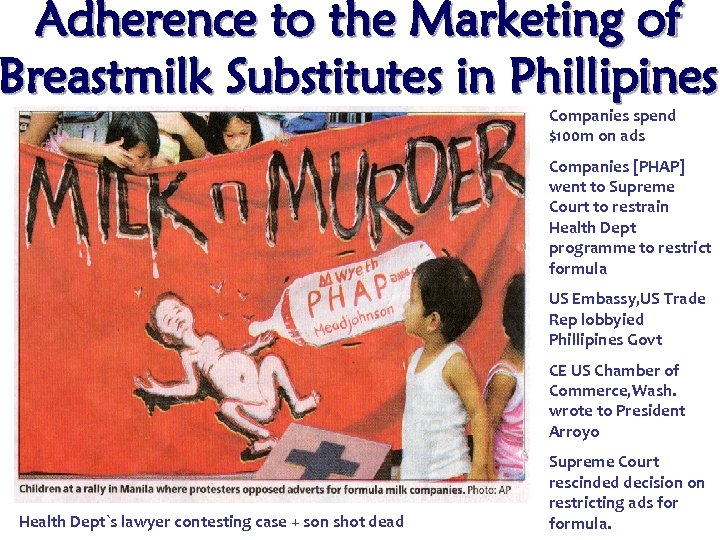
Adherence to the Marketing of Breastmilk Substitutes in Phillipines Companies spend $100 m on ads Companies [PHAP] went to Supreme Court to restrain Health Dept programme to restrict formula US Embassy, US Trade Rep lobbyied Phillipines Govt CE US Chamber of Commerce, Wash. wrote to President Arroyo Health Dept`s lawyer contesting case + son shot dead Supreme Court rescinded decision on restricting ads formula.
Скачать презентацию Breastfeeding and Child Survival Hoosen Coovadia Emeritus Professor
398572e6c09f6c95614e241d7212c6b8.ppt